AR
TICLE
1 Departamento de Fonoaudiologia, Faculdade de Medicina, Universidade Federal de Minas Gerais (UFMG). Av. Alfredo Balena 190/199, Santa Efigênia. 30130-100 Belo Horizonte MG Brasil. ludlabanca@ gmail.com
2 Programa de Residência Multiprofissional em Saúde do Idoso, Hospital das Clínicas, UFMG. Belo Horizonte MG Brasil. 3 Departamento de Gerontologia, Centro de Ciências Biológicas e da Saúde, Universidade Federal de São Carlos. São Carlos SP Brasil.
4 Departamento de Oftalmologia e Otorrinolaringologia, Faculdade de Medicina, UFMG. Belo Horizonte MG Brasil.
Screening of hearing in elderly people: assessment of accuracy
and reproducibility of the whispered voice test
Abstract Given the high prevalence of presbycusis and its detrimental effect on quality of life, screen-ing tests can be useful tools for detectscreen-ing hearscreen-ing loss in primary care settings. This study therefore aimed to determine the accuracy and reproduc-ibility of the whispered voice test as a screening method for detecting hearing impairment in old-er people. This cross-sectional study was carried out with 210 older adults aged between 60 and 97 years who underwent the whispered voice test employing ten different phrases and using audi-ometry as a reference test. Sensitivity, specificity and positive and negative predictive values were calculated and accuracy was measured by calcu-lating the area under the ROC curve. The test was repeated on 20% of the ears by a second examin-er to assess intexamin-er-examinexamin-er reproducibility (IER). The words and phrases that showed the highest area under the curve (AUC) and IER values were: “shoe” (AUC = 0.918; IER = 0.877), “window” (AUC = 0.917; IER = 0.869), “it looks like it’s go-ing to rain” (AUC = 0.911; IER = 0.810), and “the bus is late” (AUC = 0.900; IER = 0.810), demon-strating that the whispered voice test is a useful screening tool for detecting hearing loss among older people. It is proposed that these words and phrases should be incorporated into the whispered voice test protocol.
Key words Older persons, Screening, Hearing loss, Senior health care services, Primary health care
Ludimila Labanca 1
Fernando Sales Guimarães 2
Letícia Pimenta Costa-Guarisco 3
Erica de Araújo Brandão Couto 1
Labanca L Introduction
Population ageing due to rising life expectancy is a global phenomenon. Brazil is no exception to this trend and, according to current projections, the total number of people aged 60 years or over is expected to reach 32 million by 20201. Aging is a natural process of human development where-by individuals undergo gradual physiological changes2,3.
Presbycusis is an age-related change in au-ditory acuity characterized by symmetrical, downward sloping high-frequency, bilateral, sensorineural hearing loss2,4,5. The prevalence of age-related hearing loss ranges between 30% and 90%2,4,6. Presbycusis causes major commu-nication difficulties, particularly in understand-ing speech and conservations in noisy environ-ments7-9. The diagnosis of hearing loss is made through pure-tone audiometry and vocal audi-ometry to determine auditory sensitivity and the quality of peripheral auditory information based on sound frequency hearing and speech recogni-tion index2,5. These tests, together with acoustic immittance testing, are used to determine the type and degree of hearing loss and help doctors to diagnose presbycusis. Pure-tone audiometry is the gold-standard for hearing evaluation and requires an acoustically treated environment and equipment10. Given the operational complexities involved in performing pure-tone audiometry, this test has limited use as a method for the uni-versal hearing screening of older people. As a re-sult, other hearing screening methods that can be easily used and applied by trained practitioners are emerging as an alternative in the public health arena11.
The whispered voice test has been recom-mended as a screening test for detecting hearing impairment among elderly persons suspected of having presbycusis6,12-14. It is considered a low-cost, simple-to-use and fast test for detecting moderate hearing loss among adults who do not need to use hearing aids14
.
The health care guidance note produced by the Ministry of Health, Aging and the Health and Care of Older People (Envelhecimento e saúde da pessoa idosa)15 recommends the whispered voice test as a screening instrument for testing auditory acuity among older people. According to the rec-ommendations, the examiner should stand out-side the patient’s field of vision at a distance of 33 cm from each ear and whisper at each side a sim-ple brief question such as “what is your name?”. If the patient does not respond, the external
audito-ry canal should be inspected for any obstruction that may cause a reduction in auditory acuity. In the absence of obstruction, the patient should be referred to specialized health center for audio-metric testing15.
The whispered voice test has been used in se-nior health care centers and in the Unified Health System by geriatric health practitioners and a range of other health professinoals16,17. However, everyday questions such as “what is your name?” may contain cognitive clues, whereby hearing only the word “what” or “name”, for example, may lead to the correct answer even though the patient has hearing loss and needs intervention. In Brazil, the current lack of research on the sen-sitivity, specificity, inter-examiner reproducibili-ty and positive and negative predictive values of the whispered voice test raises difficulties to the standardization and validation of this technique as a screening tool for detecting hearing loss among the aged population.
In Brazil, until now there is no standardiza-tion and validastandardiza-tion of this technique, due to there are not studies in which sensitivity, specificity, inter-examiner reproducibility and positive and negative predictive values of the whispered voice test are stablish as a screening tool for detecting hearing loss among aged Brazilian population.
The present study therefore aims to deter-mine the reproducibility and accuracy of the whispered voice test as a screening tool for de-tecting hearing loss among older people by em-ploying different phrases and using pure-tone threshold audiometry as the reference test. Based on the findings of this study, we propose a set of different speech stimuli as part of the whispered voice test protocol.
Methodology
A cross-sectional accuracy study was undertak-en whereby hearing evaluations were performed with a group of older people attending a senior health care center at a public university hospital in Brazil.
aúd
e C
ole
tiv
a,
22(11):3589-3598,
2017
(standard deviation: 8, minimum of 60 years and maximum of 97 years) and 420 tested ears.
The data collection process involved the fol-lowing steps: inspection of the external auditory canal; the whispered voice test; and pure-tone and vocal audiometry.
The inspection of the external auditory ca-nal was undertaken using a Omni 3000 otoscope to determine whether there was total or partial obstruction of the external acoustic meatus. Pa-tients with an obstruction that was likely to im-pede the detection of hearing thresholds were informed and referred for assessment and oto-rhinolaryngological procedures and subsequent evaluation18,19.
The whispered voice test was conducted by specialized professionals in a silent room with minimal internal and external noise and with the patient sitting in a chair in the presence only of the examiner. Despite the fact that the room had an acoustic booth, we opted to carry out the test in an untreated environment so that the findings would reflect the reliability of the tool for use in typical medical consulting rooms, including those found in primary health care facilities. The stimuli were presented via the whispered speech of the examiner, who was careful to speak at a uniform level of loudness throughout the tests. The examiner stood behind each ear at arm’s length (measured as the distance between the elbow and clenched fist and equivalent to a dis-tance of approximately 33 centimeters from the tested ear) at an angle of zero and outside the pa-tient’s field of vision14,15.
Verbal stimuli were previously selected con-sidering the following linguistic aspects: word size, commonly used phrases and words in Por-tuguese, and the presence of common speech sounds in Portuguese. To cater for the audio-metric characteristics of presbycusis5, we were careful to ensure that the speech material con-tained a phonemic repertoire that included dif-ferent points of articulation, emphasizing fric-atives, which have lower peak acoustic energy and a wider frequency spectrum20. All words and phrases were selected from speech lists used in audiological evaluation21,22, considering size, ease of reproduction, and suitable content for older people.
A set of different whispered phrases and words was presented to both ears. The nontest ear was occluded by the examiner by rubbing the tragus in a circular motion to minimize the participation of the opposite auditory canal. For the right ear, the patient was requested to answer
the question “what is your name?” and repeat the phrase “it looks like it’s going to rain”, the word “shoe”, the word “Key”, and the word “does”. For the left ear, the patient was requested to answer the question “how old are you?” and repeat the phrase “the bus is late”, the word “window”, the word “rain”, and the word “chalk”. For each whis-pered stimulus, the result was expressed as a fail, where the patient was unable to correctly repeat the phrase or word (tested positive for possible hearing loss), or a pass (tested negative for hear-ing loss).
To test inter-examiner reproducibility, 42 par-ticipants were randomly selected and underwent the test again. This time, the test was conducted by a less experienced examiner who was a mul-tiprofessional resident in the field of geriatric medicine and trained to conduct the test. The test was conducted in a room with similar features to the one used in the first test and appropriate care was taken to control internal and external noise. Reproducibility was tested by comparing the level of agreement between the results obtained by the first and second examiners for each stimulus. The level of agreement was determined using the Kap-pa coefficient (k) using the following categories23: 0 – 0.2: very poor; 0.21–0.4: poor; 0.41 – 0.6: moderate; 0.61 – 0.8: good; 0.81 – 100: very good.
The intrinsic quality of the whispered voice test was assessed by calculating sensitivity, spec-ificity, and positive and negative predictive val-ues, using audiometry as a reference test. Receiv-er opReceiv-erating charactReceiv-eristic (ROC) analysis was performed using the sensitivity and specificity values. The area under the curve (AUC) was cal-culated to assess the accuracy of the whispered voice test for each of the phrases used23.
Pure-tone audiometry was performed after the whispered voice test to determine bone-con-duction and air-conbone-con-duction thresholds. This was done using an appropriately calibrated AVS-500 audiometer and acoustic booth, both manufac-tured by Vibrasom. Initially, air-conducted hear-ing thresholds were determined at 250Hz, 500Hz, 1000Hz, 2000Hz, 3000Hz, 4000Hz, 6000Hz, and 8000Hz. When these thresholds exceeded 20dB HL, bone-conducted thresholds were deter-mined at 500Hz, 1000Hz, 2000Hz, 3000Hz, and 4000Hz19. In accordance with the BIAP classifi-cation, hearing loss was confirmed when hearing thresholds were higher than 20dB HL at the fol-lowing frequencies: 500Hz, 1000Hz, 2000Hz, and 4000Hz18,24.
Labanca L The study was approved by the Ethics
Com-mittee at the Federal University of Minas Gerais and was conducted in accordance with National Health Council guidelines.
Results
General characteristics of the study participants
The general characteristics of the study par-ticipants are presented in Table 1. A total of 420 individual ears were tested. Based on the results of pure-tone audiometry as a reference test, the prevalence of hearing loss was 68.8% (Table 1).
Sensitivity, specificity, and negative and positive predictive values of the whispered voice test
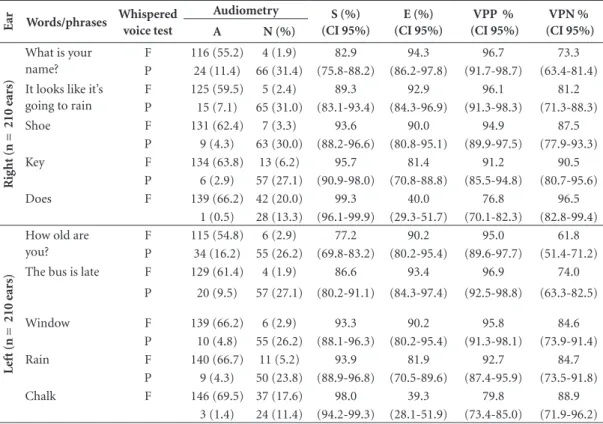
Table 2 shows the comparison between the results of the whispered voice test and tone au-diometry and the sensitivity, specificity and neg-ative and positive predictive values for each stim-ulus presented.
Accuracy of the whispered voice test
Figure 1 shows the ROC curves produced us-ing the sensitivity and specificity values from the whispered voice test for each stimulus. A visual analysis of the curves shows that the AUC of the stimulus “shoe” was 0.918, followed by “window” (AUC = 0.917), “it looks like it’s going to rain” (AUC = 0.911), “the bus is late” (AUC = 0.900), “what is your name?” (AUC = 0.886), “key” (AUC = 0.886), “how old are you?” (AUC = 0,837), “rain” (AUC = 0.880), “does” (AUC = 0.696), and “chalk” (AUC = 0.687) (Figure 1).
Reproducibility of the whispered voice test
The reproducibility of the whispered voice test varied according to the stimulus. Table 3 shows the level of agreement between the an-swers obtained by the first examiner and those obtained by the second examiner.
Proposed application of the whispered voice test
Based on the results of the tests of accura-cy and reproducibility, Figure 2 shows the pro-posed application of the whispered voice test as
a screening tool for detecting hearing loss among older people.
Discussion
The search for an efficient and effective screening test for detecting hearing loss among the geriatric population is important, particularly given the prevalence of hearing impairment among older people and the detrimental effect it can have on quality of life if left undetected and untreated6. In view of the important contribution of hearing to communication among older people and the limited access to audiological services, primary care services are expected to provide auditory acuity screening of the geriatric population and refer patients to secondary care services as and when necessary26. Hearing screening should be simple enough to be conducted in primary care settings and sensitive enough to identify patients with possible risk of hearing loss3.
Hearing screening to detect hearing impair-ment is currently recommended as a fundaimpair-mental component of any general evaluation of an older individual in national health care guidelines not only in Brazil, but also in other countries such as the United Kingdom and Austrelia27-30. The pres-ent study tested the whispered voice test, recom-mended by the Ministry of Health for screening older people in primary health care settings15, standardized the questions using phonetically balanced words and phrases, and suggested a new test protocol (Chart 1).
The technique used for the whispered voice test varies between studies27-29,31. For example, the appropriate distance between the examiner’s mouth and tested ear ranges between 3315-17,28 and 60 centimeters 6,28-30, while other studies use digits, letters and words as stimuli6,28-31. In the present study, the examiner stood 33 cm to the side of the tested ear15,28 and whispered phrases and different sized words in an attempt to identi-fy the most sensitive types of verbal stimuli spe-cifically capable of determining possible hearing loss, using audiometry as a reference test. The phrases and words were chosen bearing in mind that presbycusis is characterized by hearing loss at high frequencies5 and therefore the test should contain words and phrases with sounds in this frequency band, such as fricatives.
aúd
e C
ole
tiv
a,
22(11):3589-3598,
2017
Table 1. General characteristics of the study participants (n = 210).
Characteristics n %
Gender (n = 210) Women 135 64.3
Men 75 35.7
Complaint of hearing loss (n = 210) Yes 167 79.5
No 43 20.5
Complaint of tinnitus (n = 210) Yes 158 75.2
No 52 24.8
Complaint of dizziness (n = 210) Yes 123 58.6
No 87 41.4
Presence of hearing loss (n = 420 ears) Yes 289 68.8
No 131 31.2
Degree of hearing loss (n = 289 ears with presence of de hearing loss)
Mild 92 31.8
Moderate 130 45.0
Moderately severe 49 17.0
Severe 13 4.5
Profound 5 1.7
Type of hearing loss
(n = 289 ears com presence of hearing loss)
Sensorineural 255 88.2
Conductive 2 0.7
Mixed 32 11.1
n: number
Table 2. Sensitivity, specificity and negative and positive predictive values of the whispered voice test by words
and phrases used, using audiometry as a reference test.
E
ar Words/phrases Whispered
voice test
Audiometry S (%)
(CI 95%)
E (%) (CI 95%)
VPP % (CI 95%)
VPN % (CI 95%)
A N (%)
R
ig
ht (n = 210 e
ar
s)
What is your name?
F 116 (55.2) 4 (1.9) 82.9 94.3 96.7 73.3
P 24 (11.4) 66 (31.4) (75.8-88.2) (86.2-97.8) (91.7-98.7) (63.4-81.4)
It looks like it’s going to rain
F 125 (59.5) 5 (2.4) 89.3 92.9 96.1 81.2
P 15 (7.1) 65 (31.0) (83.1-93.4) (84.3-96.9) (91.3-98.3) (71.3-88.3)
Shoe F 131 (62.4) 7 (3.3) 93.6 90.0 94.9 87.5
P 9 (4.3) 63 (30.0) (88.2-96.6) (80.8-95.1) (89.9-97.5) (77.9-93.3)
Key F 134 (63.8) 13 (6.2) 95.7 81.4 91.2 90.5
P 6 (2.9) 57 (27.1) (90.9-98.0) (70.8-88.8) (85.5-94.8) (80.7-95.6)
Does F 139 (66.2) 42 (20.0) 99.3 40.0 76.8 96.5
1 (0.5) 28 (13.3) (96.1-99.9) (29.3-51.7) (70.1-82.3) (82.8-99.4)
Le
ft (n = 210 e
ar
s)
How old are you?
F 115 (54.8) 6 (2.9) 77.2 90.2 95.0 61.8
P 34 (16.2) 55 (26.2) (69.8-83.2) (80.2-95.4) (89.6-97.7) (51.4-71.2)
The bus is late F 129 (61.4) 4 (1.9) 86.6 93.4 96.9 74.0
P 20 (9.5) 57 (27.1) (80.2-91.1) (84.3-97.4) (92.5-98.8) (63.3-82.5)
Window F 139 (66.2) 6 (2.9) 93.3 90.2 95.8 84.6
P 10 (4.8) 55 (26.2) (88.1-96.3) (80.2-95.4) (91.3-98.1) (73.9-91.4)
Rain F 140 (66.7) 11 (5.2) 93.9 81.9 92.7 84.7
P 9 (4.3) 50 (23.8) (88.9-96.8) (70.5-89.6) (87.4-95.9) (73.5-91.8)
Chalk F 146 (69.5) 37 (17.6) 98.0 39.3 79.8 88.9
3 (1.4) 24 (11.4) (94.2-99.3) (28.1-51.9) (73.4-85.0) (71.9-96.2)
Labanca L
the word size the higher the sensitivity. For the phrase “what is your name?” sensitivity and spec-ificity were 82.9% and 94.3%, respectively. This question is predictable and commonly used on a day-to-day basis, thus increasing redundancy and the likelihood of guessing the correct answer. This in turn means that the number of false neg-atives was higher than that found for words such as “shoe” or “window”. The same occurs with the phrase “how old are you?”, suggesting that both phrases should not be used for hearing screening.
Previous studies that determined the sensitivity and specificity of the whispered voice test con-ducted in other countries found that sensitivity and specificity values ranged between 80% and 100% and 80% and 90%, respectively27-31.
To demonstrate the relationship between sensitivity and specificity, ROC analysis was per-formed to reveal phrases for which there was greater optimization of sensitivity as a function of specificity (Figure 1). The results showed that the AUC value was greatest for the words
0 10 20 30 40 50 60 70 80 90 100
0 10 20 30 40 50 60 70 80 90 100
S
e
n
s
ib
il
id
a
d
e
(
%
)
1-especificidade (%)
Qual é o seu nome. AUC = 0,886 (0,84-0,93). Parece que vai chover. AUC = 0,911 (0,86-0,96).
Sapato. AUC = 0,918 (0,87-0,96). Chave. AUC = 0,886 (0,83-0,94).
Faz. AUC = 0,696 (0,61 - 0,78). Referência
A)
B)
p<0,001
0 10 20 30 40 50 60 70 80 90 100
0 10 20 30 40 50 60 70 80 90 100
S
e
n
s
ib
il
id
a
d
e
(%
)
1-especificidade (%)
Qual a sua idade. AUC= 0,837 (0,77-0,89). O ônibus está atrasado. AUC = 0,900 (0,85-0,94).
Janela. AUC = 0,917 (0,87-0,97). Chuva. AUC = 0,880 (0,87-0,97).
Giz. AUC = 0,687 (0,60-0,77). Referência.
B)
p<0,001
Figura 1. ROC curves of the whispered voice test for different stimuli. A) ROC curve for the right ear. B) ROC
curve for the left ear.
ROC: receiver operating characteristics; AUC: area under the ROC curve (95% Confidence Interval – lower and upper). What is your name? AUC = 0.886 (0.84-0.93)
Shoe. AUC = 0.918 (0.87-0.96) Does. AUC = 0.696 (0.61-0.78)
It looks like it’s going to rain. AUC = 0.911(0.86-0.96) Key. AUC = 0.886 (0.83-0.94)
Reference 1 Specificity (%)
S
ensibilit
y (%)
S
ensibilit
y (%)
1 Specificity (%)
p < 0.001
p < 0.001
How old are you? AUC = 0.837 (0.77-0.89) Window. AUC = 0.917 (0.87-0.97) Chalk. AUC = 0.687 (0.60-0.77)
aúd
e C
ole
tiv
a,
22(11):3589-3598,
2017
“shoe” (AUC = 0.918) and “window” (AUC = 0.917), followed by “it looks like it’s going to rain” (AUC = 0.911), “the bus is late” (AUC = 0.900), “what is your name?” (AUC = 0.886), “key” (AUC = 0.886), “how old are you?” (AUC = 0.837), “rain” (AUC = 0.880), “does” (0.696), and “chalk” (0.687) (Figure 1). Thus, the words that showed highest accuracy were “shoe” and “window”. These words begin with fricatives within the frequency band 3000Hz to 8000Hz, showing that speech discrimination is influenced by high frequencies and that the whispered voice test should therefore include words with speech sounds in this frequency band in order to make it more sensitive to sloping hearing loss, which is a major characteristic of presbycusis5.
Some studies report that the whispered voice test may be influenced by variables related to the presentation of stimuli by the examiner, such as
voice intensity and experience14,29. In the pres-ent study, the whispered voice test was initially conducted by an experienced examiner who was careful to speak at a uniform level of loud-ness throughout the tests. To test inter-examiner variability, the same procedure was repeated by a second examiner with 20% of the individual ears. The results show that the level of agreement between the examiners varied according to the stimulus presented. The phrases that showed best inter-examiner reproducibility where the trisyl-labic words “shoe” (k = 0.877) and “window” (k = 0.869), followed by the phrases “the bus is late” (k = 0.810) and “it looks like it’s going to rain” (k = 0.810). For the phrase “what is your name?”
inter-examiner reproducibility was 75%. The reproducibility values of the whispered voice test described in the literature vary. A study carried out in Washington that compared the
Table 3. Agreement degrees of inter-examiners in whisper test performances.
Word/phrase Inter-examiner agreement
(kappa)
Classification of agreement degrees
What is your name 0,754 Good
How old are you 0,769 Good
The bus is late 0,810 Great
It looks like it’s going to rain 0,810 Great
Shoe 0,877 Great
Window 0,869 Great
Rain 0,683 Good
Key 0,683 Good
Does 0,701 Good
Chalk 0,754 Good
Chart 1. Proposed application of the whispered voice test as a screening tool for detecting hearing loss among
older people.
Step 1: The whispered voice test should be conducted in a quiet room with the patient sitting on a chair. The
examiner should instruct the patient as follows: “you should keep your eyes closed and at your side I am going to whisper a word and/or a phrase; if you hear the word and/or phrase please repeat it”.
Step 2: The examiner should stand outside the patient’s field of vision at a distance of approximately 33
centimeters and at the same level as the tested ear and whisper the word “shoe” or the phrase “the bus is late”
and wait for a response. In the other ear, the examiner should whisper the word “window” or the phrase “It
looks like it’s going to rain” and wait for a response.
Step 3: If the patient correctly repeats the words or phrases, he/she is considered to have PASSED the test. If the
patient does not correctly repeat the words or phrases, he/she is considered to have FAILED the test.
Step 4: Patients who fail the test should have their external auditory canal inspected and in the case of ear wax
Labanca L results of the whispered voice test conducted
by an otolaryngologist with those obtained by a speech therapist found that level of agreement was 67%31, while a study that compared the re-sults of the test performed by a geriatrician and otolaryngologist showed a rate of 88%30. Despite the variability among reproducibility values, our findings show that the whispered voice test is reproducible, since, depending on the stimulus presented, the level of agreement remained be-tween good and very good even after changing the examiner. This shows that a properly trained practitioner is capable of conducting the test in a primary health care setting. The most important benefit of this test is that it offers greater efficien-cy without reducing screening quality, meaning that only patients who really need specialized hearing evaluations will be referred to secondary care services.
Despite being a simple test of hearing abili-ty, the whispered voice test does have some lim-itations, since it should be conducted carefully by an experienced examiner in a quite setting. Furthermore, mild degrees of hearing loss (up to 40 dB) may go undetected by the test. How-ever, from a public health perspective, this type of hearing loss has little detrimental impact on the quality of life and independence of older pa-tients18,24. On the other hand, moderate hearing loss may go unnoticed by older people, which can have a detrimental effect on cognition, indepen-dence and quality of life9,18,24.
Presbycusis is progressive and can be treated and rehabilitated using electronic sound ampli-fication devices available through the audito-ry health care services provided under Brazil’s public health care system32,33. It is important to highlight that early diagnosis and intervention is crucial to ensure successful rehabilitation and use of these devices among the geriatric population, since the longer the period of auditory depriva-tion, the more difficult it is for an older individu-al to become readapted to the world of sound9,33.
In light of the above, the whispered voice test is an important screening tool for detecting hear-ing loss among the geriatric population.
The findings of the present study reveal that, for the phrase “what is your name?”, suggested by the guidance note Aging and the Health and Care of Older People15, inter-examiner reproducibility, sensitivity, specificity, and positive and negative predictive values were 75%, 83%, 94%, 97%, and 73%, respectively, while accuracy, expressed by area under the ROC curve, was 89%, using au-diometry as a reference test. The words “shoe” and “window” showed the highest accuracy. For the word “shoe”, AUC, inter-examiner reproduc-ibility, sensitivity, specificity, positive and nega-tive predicnega-tive values were 92%, 88%, 94%, 90%, 95%, and 87%, respectively, whereas for the word “window” AUC, sensitivity, specificity, positive and negative predictive values were 92%, 93%, 90%, 96%, and 85%, respectively. Thus, although the use of the phrase “what is your name?” is suggested for screening, the present study reveals that other words and phrases showed higher sen-sitivity and reproducibility. In light of this, it is suggested that the whispered voice test should be conducted as outlined in Chart 1.
Conclusion
aúd
e C
ole
tiv
a,
22(11):3589-3598,
2017
Collaborations
L Labanca, LPC Guarisco and DU Gonçalves worked on the conception, design, data analysis, data interpretation, approval of the manuscript content, and in the writing of the present study; FS Guimarães e EAB Couto worked on data anal-ysis, data interpretation, approval of the manu-script content, and in the writing of the present study.
Acknowledgments
We would like to thank the staff at the senior health care center in Belo Horizonte. We are also grateful to the students from the speech therapy course at UFMG and multiprofessional resident at the Hospital das Clínicas who took part in data collection.
References
1. Instituto Brasileiro de Geografia e Estatística (IBGE) [Internet]. Projeção da população do Brasil por sexo e idade: 2000-2060 [acessado 22 fev 2015]. Disponível em: http://www.ibge.gov.br/home/estatistica/popula-cao/projecao_da_populacao/2013/default_tab.shtm 2. Veras RP, Mattos LC. Audiologia do
envelhecimen-to: revisão da literatura e perspectivas atuais. Rev Bras Otorrinolaringol 2007; 73(1):128-1234.
3. Veras R. Em busca de uma assistência adequada à saúde do idoso: revisão da literatura e aplicação de um ins-trumento de detecção precoce e de previsibilidade de agravos. Cad Saude Publica 2003; 19(3):705-715. 4. Baraldi GS, Almeida LC, Borges ACC. Evolução da
per-da auditiva no decorrer do envelhecimento. Rev Bras Otorrinolaringol 2007; 73(1):64-70.
5. Anjos WT, Labanca L, Resende LM, Costa GLP. Cor-relação entre as classificações de perdas auditivas e o reconhecimento de fala. Rev CEFAC 2014; 16(4):1109-1116.
6. Ramdoo K, Bowen J, Dale OT, Corbridge R, Chatterjee A, Gosney MA. Opportunistic hearing screening in el-derly inpatients. SAGE Open Medicine 2015; 2:1-5. 7. Tenorio JP, Guimarães JA, Tenório L, Flores NGC, Iorio
MC. Comparação entre critérios de classificação dos achados audiométricos em idosos. J Soc Bras Fonoau-diol 2011; 23(2):114-118.
8. Calais LL, Borges ACLC, Baraldi GS, Almeida LC. Queixas e preocupações otológicas e as dificuldades de comunicação de indivíduos idosos. Rev soc bras fonoau-diol 2008; 13(1):12-19.
9. Ribas A, Kozlowski L, Almeida G, Marques JM, Silves-tre RAA, Mottec CM. Qualidade de vida: comparando resultados em idosos com e sem presbiacusia. Rev bras geriatr gerontol 2014; 17(2):353-362.
10. Marini ALS, Halpern R, Aerts D. Sensibilidade, especi-ficidade e valor preditivo da queixa auditiva. Rev Saude Publica 2005; 39(6):982-984.
11. Caldas CP, Veras RP, Motta LB, Lima CK, Kisse CBS, Trocado CVM, Guerra ACLC. Rastreamento do risco de perda funcional: uma estratégia fundamental para a organização da Rede de Atenção ao Idoso. Ciên Saúde Colet 2013; 18(12):3495-3506.
12. Schneider RH, Marcolin D, Dalacorte RR. Avaliação funcional de idosos. Scientia Medica 2008; 18:4-9. 13. Lachs MS, Feinstein AR, Cooney LM Jr, Drickamer MA,
Marottoli RA, Pannill FC, Tinetti ME. A Simple Proce-dure for General Screening for Functional Disability in Elderly Patients. Ann Intern Med 1990; 112:699-706. 14. McShefferty D, Whitmer WMW, Swan IRC, Akeroyd
MA. The effect of experience on the sensitivity and specificity of the whispered voice test: a diagnostic ac-curacy study. BMJ Open 2013; 3(4):e002394. 15. Brasil. Ministério da Saúde (MS). Secretaria de
Aten-ção a Saúde [Internet]. Envelhecimento e saúde da pessoa idosa [acessado 2015 set 20]. Disponível em: http://189.28.128.100/dab/docs/publicacoes/cader-nos_ab/abcad19.pdf
Labanca L 17. Centro de referência à saúde do idoso de Campinas
[Internet]. Avaliação breve do idoso [acessado 2015 jul. 8]. Disponível em: http://www.campinas.sp.gov.br/sa/ impressos/adm/FO811.pdf
18. Sistema de Conselhos Federal e Regionais de Fonoau-diologia [Internet]. Manual de procedimentos em au-diometria tonal limiar, logoauau-diometria e medidas de imitância acústica [acesso 2015 Ago 15]. Disponível em: http://www.fonoaudiologia.org.br/publicacoes/Manual %20de%20Audiologia%20.pdf
19. Redondo MC, Lopes Filho O. Avaliação auditiva básica: acumetria e audiometria. In: Lopes Filho O. Tratado de fonoaudiologia. 3ª ed. Barueri: Editora Manole; 2013. p.53-69.
20. Russo I, Behlau M. Percepção da fala: análise acústica do português brasileiro. São Paulo: Lovise; 1993.
21. Costa MJ, Iório MCM, Mangabeira-Albernaz PL. Re-conhecimento de fala: desenvolvimento de uma lista de sentenças em português. Acta AWHO 1997; 16(4):164-173.
22. Pereira LD, Schochat E. Manual de Avaliação do proces-samento auditivo central. São Paulo: Lovise; 1997. 23. Siqueira AL, Tibúrcio JD. Estatística na área da Saúde:
conceitos, metodologia, aplicações e prática computacio-nal. Belo Horizonte: COOPMED, UFMG; 2011. 24. Bureau International d’ Audiophonologie (BIAP)
Clas-sification audiométrique des deficiencies auditives [Inter-net].[acessado 2011 Maio 15]. Disponível em: http:// www.biap.org/fr/recommandation/archives/65-ct- 2-classification-des-surdites/5-recommandation-biap-021-bis
25. Dean AG, Sullivan KM, Soe MM. OpenEpi: Open Source Epidemiologic Statistics for Public Health, Version 3.01 [Internet]. 2013 [cited 2015 jun 23]. Disponível em: http://www.OpenEpi.com
26. Aguilera SLVU, Franca BHS, Moyses ST, Moyses SJ. In-termunicipal inequities in access and use of secondary health services in the metropolitan area of Curiti-ba. Rev bras epidemiol 2014; 17(3):654-667.
27. Pirozzo S, Papinczak T, Glasziou P. Whispered voice test for screening for hearing impairment in adults and children: systematic review. BMJ 2003; 327:967. 28. Swan IR, Browning GG. The whispered voice as a
screening test for hearing impairment. J R Coll Gen Pract 1985; 35(273):197.
29. Eekhof JA, de Bock GH, de Laat JA, Dap R, Schaapveld K, Springer MP. The whispered voice: The best test for screening for hearing impairment in general practice?
Br J Gen Pract 1996; 46(409):473-474.
30. Macphee GJ, Crowther JA, McAlpine CH. A simple screening test for hearing impairment in elderly pa-tients. Age Ageing 1988;7(5):347-351.
31. Uhlmann RF, Rees TS, Psaty BM, Duckert LG. Validity and reliability of auditory screening tests in dement-ed and non-dementdement-ed older adults. J Gen Intern Med
1989; 4:90-96.
32. Brasil. Ministério da Saúde (MS). Portaria nº 587, de 07 de outubro de 2004. Determina que as Secretarias de Estado da Saúde dos estados adotem as providências necessárias à organização e implantação das Redes Es-taduais de Atenção à Saúde Auditiva. Diário Oficial da União 2004; 11 out.
33. Buriti AKL, Oliveira SHS. Adaptação à prótese auditiva em usuários assistidos pelo SUS. Rev soc bras fonoaudiol
2012; 17(1):41-46.
Article submitted 18/08/2016 Approved 12/12/2016