AP
PLICATION OF
ENVIRONMENTAL MANAGEMENT
PRINCIPLES IN THE PROGRAM FOR
ERADICATION OF AEDES (STEGOMYIA)
AEGYPTI (LINNEUS, 1762) IN THE
REPUBLIC OF CUBA, 1984l
Jose’ A. Armada Gessd and RafaeZ Figueredo Gonz&Zez3 -
B
ACKGROUND
The Republic of Cuba in- cludes the island of Cuba (the largest is- land in the West Indies Archipelago) and over 1,600 keys and islets. Cuba’s mean average temperature is 77.7 “F and its mean relative humidity is 79%. The rainy season runs from May through Oc- tober with an average relative humidity of 82%, and the dry season runs from November through April with an aver- age relative humidity of 77%.
In 1881 Cuba’s Carlos Finlay formulated the brilliant theory that yel- low fever was transmitted by the bite of the mosquito A&es aegypti. However, % between 1904 and 1954 no effective Ae- 2 des aegypti control programs were con-
.
s ducted in Cuba. As a result, high A. 8 -
.B ’ This article will also be published in Spanish in the Bo- u
Q letin de la Oj%a Sanitarza Panamericana, 1986. 3 z Entomologist, National Aeah aegypti Eradication Campaign, Ministry of Public Health, Havana, Cuba.
’ Chief Medical Officer, National AedesaegyptiEradica- tion Campaign, Ministry of Public Health, Havana,
Cuba.
aegypti infestation rates, generally rang- ing from 11% to 26%) prevailed throughout the country.
Following the 1959 Revolu- tion, a vertically organized A. aegypti control program was begun in four prov- inces where infestation indices ranging from 0.1 O/O to 53.4% in infested locali- ties were being reported. In 1967 this program was integrated into the General Health Services and started being con- ducted through the country’s existing network of polyclinics. Nevertheless, the basic objective of A. aegyptz’ eradication was not achieved.*
In 1977, dengue virus (sero- type 1) was introduced into Eastern Cuba, leading to an epidemic that quickly spread to nearly every part of the country and produced at least 5,000,OOO
dengue cases .5 From 1978 to May 1981, however, only sporadic cases were re- ported.
’ S. Martinez, J. Fetnandez, and C. Martinez; Erradica- cion del Ae. aegypti en Cuba. Congreso de lngenieria Sanitaria, Panama. 1982.
In the first half of 1981, sero- logically distinct cases (caused by den- gue-2 virus) began being diagnosed, and cases of dengue hemorrhagic fever were observed. In all, from May (when the epidemic began) until October (when it ended) a total of 344,203 cases and 158 deaths were reported, 101 (63.9%) of the dead being children less than 15 years of age, The epidemic peaked on 6 July 1981, when 11,721 cases were re- ported, and apparently ended on 10 Oc-
tober, the day the last case was reported.
E
MERGENCE OF
THE NATIONAL
A. AEGYP2-T
ERADICATION CAMPAIGN
When it became clear that this latter epidemic constituted a na- tional emergency, Commander in Chief Fidel Castro, President of the Council of State and Council of Ministers, issued a directive on 9 June 1981 calling for ter- mination of the epidemic and nation- wide eradication of Aedes uegypti. To achieve these aims, a national Aedes aegyp’ eradication campaign was begun and immediate efforts were made to re- duce prevailing aegypti infestations.
This national campaign was promptly provided with an organization, subject to strict discipline and control, that was appropriate for achieving na- tionwide uegypti eradication, and all personnel and material resources re- quired were made available. Eradication activities were then initiated and were pursued concurrently throughout the country.
The campaign was divided into the following phases: (1) prepara-
tory phase (lo-31 July 1981); (2) attack phase (3 August-30 September 1981)$
(3) consolidation phase (beginning 1 Oc-
tober 1981, one year); and (4) mainte- nance and surveillance phase (perma- nent, following A. aegypti eradication in each municipality). Overall supervision has been provided by a “National Di- recting Group” consisting of three medi- cal officers (a chief, an assistant chief, and an epidemiologist), an entomolo- gist, two supervisors, and clerical person- nel. Under this group has been a “Pro- vincial Directing Group” in each province consisting of a chief medical of- ficer (in some provinces this post has been held by a veterinarian or a special- ized health worker), an entomologist, several general supervisors, and clerical personnel. And last, work at the local level has been supervised by a “Munici- pal Directing Group” consisting of a municipal chief and one or more teams of supervisors directing several teams of inspectors (one inspector per 1,500 in- habitants) and controllers, as well as cler- ical personnel. Entomologists have been assigned to some of these municipal groups. In addition, the program has been supported by the provincial medi- cal entomology laboratories, and by some 60. licensed entomologists who have provided technical analysis to sup- port surveillance activities and to help pinpoint the causes of aegypti foci.
Overall, the personnel as- signed to the campaign included 15 pro- vincial directors, 60 entomologists, 27 general supervisors, 729 team leaders, 3,801 inspectors, and 1,947 controllers.
6 The interim period (l-2 August 1981) provided time for personnel to get from the places where training
T
HE CAMPAIGN’S
ACTIVITIES
The ecology of the Aedes aegypti mosquito is closely linked to man; indeed, anthropogenic factors are the main determinants of this domestic species’ habitats. Consequently, the most effective way of fighting aegypti is to adopt rigorous environmental sanita- tion measures. In this regard, timely health education designed to enlist the community’s active participation in the drive to reduce the number of foci is vi- tally important.
In our particular case, the ex- istence of an ongoing hemorrhagic den- gue outbreak dictated that quick and vigorous action should be taken to re- duce the vector population, thereby breaking the epidemiologic chain of transmission. In this vein, the procedure of choice for dealing with an aegypti- transmitted viral disease outbreak fos- tered by a high density of the mosquito is aerial spraying designed to exterminate both imagoes and immature forms. If properly conceived and executed, such action provides the quickest way of re- ducing the general uegypti population. Another consideration weighed in decid- ing on appropriate measures included the fact that control measures with a nonselective impact (application of % G-i broad-spectrum insecticides, for exam- C‘I ple) often cause serious ecologic disrup- s tions and may even provoke abnormal 4 increases in vector or other harmful insect .$ populations. For these reasons, and also
u
a 23 because ultra-low-volume (IJLV) insecti- 2
tide applications are usually less gener- ally toxic than treatments with conven-
3
tional insecticide formulations, it was decided to rely on ULV applications. These included spatial treatments with
188 ground-based ULV equipment (towed
mechanical ULV generators), aerial ULV
applications (from 6 June to 18 July, be- fore the intensive attack phase began), and in-house cold ULV aerosol treatments applied with mechanical back-pack sprayers. The insecticide chosen for all of these applications was 95 % malathion.
In addition, it is well-known that various interventions preventing, re- ducing, or eliminating suitable aegypti breeding-places and larval habitants pro- vide a basis for effective vector control. Therefore, while the initial aggressive
ULV adulticiding was still in progress, a si- multaneous start was made on physical destruction, focal treatment with te- mephos (Abate), and perifocal treatment with fenthion (Baytex) of all actually or potentially positive breeding areas.
PHASE
T
HE ATTACK
During the intensive attack phase, which lasted from 3 August to 30
September 1981, the following actions were taken nationwide:
1) All premises were inspected every two months, and all foci were treated with 1% granular temephos (Abate) used as a larvicide at a dose of
1 ppm. Also, perifocal areas out to a dis- tance of 200 meters from each focus were treated with a 2.5 % suspension of fen- thion (Baytex 40% wettable powder).
2) The interiors of all rest- dences and other premises were treated every seven days with deodorized 95% malathion applied as a ULV aerosol from back-pack mist generators.
(95 % , applied as a ULV aerosol) every seven days by towed ULV generators.
4) Decree-Law 27, which im- poses fines on parties responsible for the existence of conditions propitious for the proliferation of Aedes aegypti (unsani- tary conditions in houses and yards) was strictly enforced.
5) An intensive health educa- tion campaign was launched by means of posters, pamphlets, flyers, etc., and the mass media.
6) An extensive nationwide sanitation campaign was carried out, principally for the purpose of physically destroying actual and potential A. ae- gyp’ breeding-places with active public
participation.
Equipment used during this attack phase included 207 towed ULV
spray generators, 3,883 portable back- pack ULV spray generators, 4,146 hand- held sprayers, and other appropriate sup- port equipment (including a total of 307 vehicles-motorcycles with side-cars, four wheel drive jeeps, tractors, trucks, and buses) depending on the sizes and needs of the particular provinces and municipalities involved.
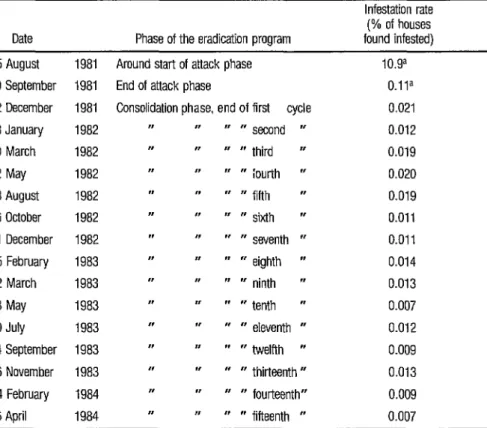
At the end of the attack phase, the A. aegypti house infestation rate had been reduced considerably, by a factor of about 100 (Table 1). In addi-
TABLE 1. A. aegypti house infestation rates observed before and during the eradication program (August 1981 through April 1984).
Date Phase of the eradication program
Infestation rate (% of houses found infested) 5 August 1981
30 September 1981 12 December 1981 23 January 1982 20 March 1982 22 May 1982 13 August 1982 16 October 1982 11 December 1982 5 February 1983 2 March 1983 28 May 1983 30 July 1983 24 September 1983 26 November 1983 4 February 1984 16 April 1984
Around start of attack phase End of attack phase
Consolidation phase, end of first cycle I, ,, ” ” second ” I, II ” ” third ” I, n ” ” fourth ” I, I, “ ” fifth ” I, ,, ” ” sixth ” I, r, ” ” seventh ” ,,
I, I, I,
” ” eighth ” ” ” ninth “ n I, ” ” tenth ” I, I, ” ” eleventh ” ,, I, ” ” twelfth ” ,, I, ” ” thirteenth” I, I, ” ” fourteenth” ,, I, ” ” fifteenth ”
IO.93 0.11a 0.021 0.012 0.019 0.020 0.019 0.011 0.011 0.014 0.013 0.007 0.012 0.009 0.013 0.009 0.007
tion, the number of dengue cases re- ported daily had dropped from 3,3 19 (reported on the day the attack phase be- gan) to an average of only three to six per day (beginning 15 September).
T
HE CONSOLIDATION
AND MAINTENANCE
PHASES’
The consolidation phase was initiated on 1 October 198 1. During this phase, all the elements of the campaign were maintained. The intensity and scale of the attack operations were kept up so as to diminish the chances that physio- logic resistance to the insecticides in use would emerge, and simultaneous nation- wide coverage was continued. At the same time, sufficient flexibility was built into the program to permit adjustment of tactics or adoption of needed changes.
In addition, health education was provided through the mass media. This education, which stressed the im- portance of basic sanitation, has been a fundamental element responsible for the campaign’s progress. It has also sup- ported intensive sanitation efforts, em- ploying some 1,200 trucks and 2,000 men, that have been conducted from time to time throughout the country.
&I
3
’ The consolidation phase pursued systematic eradication .s
of A. #egypti through inspection and treatment cycles.
8
This phase reached its scheduled end on 1 October 1982; but in order to provide better comparison with .g annual statistical data from other sources, the phase can
u be considered to have ended on 31 December 1982. a
3
The maintenance phase that followed the consolidation phase has involved elimination of A. aegrpti breeding
%
places that “survived” the preceding phases and per- manent surveillance of the vector.
2
190
As the foregoing suggests, this overall program has been given strong government support, reinforced by rigorous control and enforcement measures, and has enjoyed community understanding and participation-all of which have helped to ensure its success.
Another point that should be noted is that as the program has ad- vanced, temporarily effective chemical spraying has given way to long-term en- vironmental measures-partly to prevent potential development of mosquito resis- tance to the insecticides employed, and partly in recognition of the fact that fre- quent spraying is best used as a tempo- rary stopgap. Specifically, beginning with the second cycle of the consolida-
tion phase (which started on 23 January 1982), perifocal treatment with fenthion was suspended. Beginning with the third cycle (starting 20 March 1982), ULV spray- ing with 95 % malathion was suspended. And beginning with the sixth cycle, peri- focal application of temephos was sus- pended .
In addition, beginning with the second cycle all campaign inspectors began destroying useless containers with picks or piercing them in such a way that they would no longer hold water, thereby ensuring that they would not serve as breeding-places for aegyptz’. They also began brush-cleaning the insides of wa- ter storage containers.
Other measures designed to reduce aegypti breeding-places were as follows:
l A national ban was placed on
use of water-bearing containers in cemeteries. Containers with sand or soil are permitted, provided that their bottoms are perforated so that no water can accumulate.
l Storage of water in containers
l The planting of bromeliads
(e.g., Bronze&z pinguin) as hedges to fence off properties was banned because of the plants tendency to accumulate water in their leaf axils.
l The campaign concentrated
on reduction of aegypti breeding-places as a means of eradicating foci and also encour- aged adequate sanitary disposal of solid waste (including cans and other containers) in such a way as to avoid creating potential breeding- places.
l Biologic control was instituted
in all major lakes and ponds by stocking them with larvivorous fish. The three indige- nous species known to have the greatest pred- atory capacity were used for this purpose, namely Predia neticzclata, the guppy, which adapts readily to a wide variety of weather conditions and ecologic niches; Gambzlsia punctata; and Ganzbusia puncticdata. The particular larvivorous species used depended upon the ecologic characteristics of the lake or pond involved.
l An effort was made to per-
suade the public that these fish offered a safe and effective means of vector control, and this secured community participation in the biologic control operation.
Another key program action has been the creation of “vector control- lers.” These controllers, who have made a major contribution, are women orga- nized into teams or “brigades.” Their work, which is appropriately supervised and regulated, consists of activities in the areas of health education, entomologic surveillance, and assessment of the tech- nical quality of the visiting health worker teams’ performance. In effect, they act as a corps of inspectors, making weekly vis- its to places considered potentially dan- gerous breeding areas-such as spillways, junkyards, cemeteries, and so forth. These vector controllers are authorized to impose fines under Decree-Law 27 for sanitary violations.
TABLE 2. A. aegypti infestations indicated nationwide by weekly in- spections of larvitraps placed for surveillance of the mosquito.a
Traps positive for
No. of A. aegypti No. of A. aegypfi Cycle larvitraps specimens captured No. installed No. % and examined
2 5,065 2 0.04 8,062 3 6,434 7 0.11 23,867 4 9,946 5 0.05 33,922 5 9,393 14 0.15 10,257 6 11,504 16 0.14 51,975 8' 13,383 12,585 :5" 0.11 0.12 66,347 54,060 9 13,893 12 0.09 89,525 IO 14,585 6 0.04 73,261 :: 14,068 14,536 :i 0.09 0.14 69,590 74,880 13 14,755 11 0.07 91,343 14 14,929 11 0.07 82,062 15 15,401 8 0.05 84,676
It should also be noted that the program employs all the basic ele- ments of entomologic surveillance, as follows:
l Ovitraps and larvitraps that
consist of a 45 cm section of tire containing water are placed at residences and other
premises throughout the country, according
to specific ecologic requirements, and are in-
spected at precise seven-day intervals. The
results of this larvitrap surveillance are shown in Table 2.
l Adult vectors are captured by
controllers inside houses in the course of their regular visits.
l Fixed adult-capture stations
operating at regular intervals and with regu- lar hours have been established.
l Collections are made of all
aquatic larvae detected in breeding-places during inspections of residences and other premises (including empty lots).
l All material collected is sent to
the Provincial Medical Entomology Labora- tory for taxonomic classification.
l Areas of entomologic risk are
determined-these being areas that have a
high potential for harboring and generating
aegypti vectors.
Overall responsibility for maintaining the technical quality of the surveillance system, providing advice about the vector, making taxonomic de- terminations, and performing entomo- logic analyses of detected aegyptz’ foci rests with 60 licensed entomologists based at medical entomology laborato- ries. One of these laboratories is located in each of Cuba’s 14 provinces and in the Special Municipality of the Isle of Youth.
S
UMMARY
The dengue epidemic that struck Cuba in 1981 caused a total of 344,203 reported cases and 158 deaths. The Cuban Government’s response to
this emergency was to launch a major eradication campaign against the vector mosquito Aedes uegypti-by spraying to kill adults in the first months and by adoption of various longer-term mea- sures designed to progressively reduce and eliminate uegypti populations.
These latter measures in- cluded focal and perifocal treatment of breeding areas, physical destruction of actual or potential breeding-places, modification of drinking-water tanks and other containers so as to render them unsuitable for aegypti proliferation, stocking of lakes and ponds with larvivo- rous fish, an intensive health education campaign, pursuit of ongoing aegypti surveillance activities, and enforcement of sanitary regulations prohibiting the maintenance of conditions suitable for uegypti breeding. This major effort re- duced the aegypti house infestation in- dex from 11% or more in early August 1981 to 0.1% in January 1982, and has succeeded in keeping it down to around that level or below since then. The cam- paign thus provides a good current ex- ample of how aegypti can be successfully controlled given sufficient funds, per- sonnel, equipment, government back- ing, and broad public support.
B
IBLIOGRAPHY
Armada, J. A., and J. A. Trigo. Tknicos de lucha anti-aegyptz. Ministerio de Salud Pfiblica, Havana, 1981.
3 Ministerio de Salud Pbblica. Proyecto de C6- digo Sanitario de la RepGblica de Cuba, Ha- vana, 1978.
4 Ministerio de Salud Pdblica. Informes finales: Ciclos Campatia NacionaI de Erradicacibn de1 Aea’es aegypti. Havana, 1982-1984.
5 Odum, E. P. Ecology. 1966.
6 Terry, H., R. Figueredo, andJ. A. Armada. In- forme preliminar de Ia Camptia National de ErradicaciBn de1 Aedes (s) aegypti, Cuba 1982. Paper presented at the Meeting of the Technical Group on Aedes aegypti, Dengue, and Yellow Fever held at Mexico City, Mexico, in 1982.
8 Tonn, R., R. Figueredo, and L. J. Uribe. Ae- des aegypti, yellow fever, and dengue in the Americas. Mospito News, Vol. 42, No. 4, December 1982.
9 World Health Organization. V&or Ecology. WHO Technical Report Series, No. 501. Ge- neva, 1972.
10 World Health Organization. Engineering As- pects of Vktor Control’ Operations. WHO
Technical Report Series, No. 603. Geneva, 1977.
11 World Health Organization. Environmental Management for ?&or Control. WHO Tech- nical Report Series, No. 649. Geneva, 1980. 7 Tonn, R. Asesoria a la campaiia anti-Aedes
aegypti en Cuba. Informe OPS, Cuba 5100, 1981.
12 World Health Organization. Resistance o tors of Dtiease to Pesticides. WHO Tee x nical k- Report Series, No. 655. Geneva, 1980. 13 World Health Organization. Environmental