*e-mail: [email protected]
Corrosion Behavior of Ti and TI6Al4V in
Citrate Buffers Containing Fluoride Ions
Anelise Marlene Schmidta*, Denise Schermann Azambujab
a
Departament of Biology and Chemistry, University of Ijui,
P.O. Box 560, Ijui - RS, Brazil
b
Laboratory of Electrochemistry, Institute of Chemistry,
Federal University of Rio Grande do Sul, P.O. Box 15003, Porto Alegre, RS - Brazil
Received: June 12, 2009; Revised: November 23, 2009
The effect of fluoride ions concentration on the electrochemical behavior of Ti grade 2 and Ti6Al4V in citrate buffers was studied. Open circuit potential (OCP) measurements and voltammetric studies of the samples in the fluoride containing citrate buffers revealed a dissolution process when the pH falls below 5.0 and the NaF content is higher than 0.01 M. However, in citrate pH 7.6 the materials showed a passive behavior even in 0.1 M NaF. Some micrographs of Ti grade 2 obtained after longer immersion times in citrate pH 5.0 with 0.01 M NaF showed a surface attack. EIS (Electrochemical Impedance Sprectroscopy) data obtained at the OCP revealed that the film resistance decreases when the immersion time is increased in pH 5.0 containing 0.1 M NaF. In the citrate pH 7.6 the EIS data indicated a two-layer model of an oxide film consisting of a more compact inner layer and a porous outer layer. On the other hand, the EIS results in citrate pH 4.0 change significantly when the fluoride ions concentration increases from 0.01 to 0.05 M. The electrochemical data revealed that the corrosion behavior of Ti grade 2 and Ti6Al4V in the citrate buffers depends on the pH, the fluoride content and the exposure time.
Keywords: Ti, Ti6Al4V, citrate, fluoride
1. Introduction
Ti and its alloys are extensively used in medicine and dentistry due to their high resistance to corrosion and biocompatibility with living tissues of the human body. It is well known that Ti undergoes an osseo-integration process when it is placed in contact with bones1,2.
However, the corrosion resistance of Ti decreases when fluoride ions are present in the media. Solutions containing more than 20 ppm of fluoride ions may attack Ti surfaces when the pH falls below 6.0[3].
It is well known that the corrosion and pitting processes on Ti-based alloys depend on the fluoride content and the pH of the media4-10. Previous works reported that the dissolution of the oxide
passive film occurs on Ti grade 2 and Ti6Al4V in fluoride containing citric acid4. According to Reclaru5, pitting was detected at some Ti
alloys in saliva containing 0.1 % NaF and pH < 4.0. Schiff6 showed
that the corrosion resistance of Ti6Al4V alloy in artificial saliva decreased at pH 2.5. Further, Frateur7 observed TiO
2 dissolution in
0.2 M fluoride ions concentration with pH 2.0. According to Huang8,
an increase in fluoride ion concentration leads to a decrease of the corrosion resistance of Ti6Al4V alloy in acid artificial saliva at pH 5.0 and 37 °C. Moreover, in acidic solutions the fluoride ions form HF and a concentration over 30 ppm results in destruction of the TiO2 passive film9,10.
NaF and other fluoride compounds are commonly employed in dental treatments. In fact, most toothpastes and gels used to remove stains from enamel contain a concentration of about 1 and 2% of fluoride, respectively, with a pH between 3.5 and neutral. Despite the benefits of fluoride ions, their infiltration into dental implants may cause Ti corrosive attack if the pH is below neutral. Furthermore, citric acid and citrates are commonly employed in juices and some indus-trialized foods, so they can contact Ti alloy dental prosthese, which demonstrates the importance of studying the corrosive processes of
these materials. The aim of this work is to investigate the corrosion behavior of Ti grade 2 and Ti6Al4V in citrate buffers containing dif-ferent fluoride ion concentrations by electrochemical techniques.
2. Experimental
A conventional three-electrode cell was used for the electrochemi-cal experiments, for which the working electrodes were commercialy pure Ti grade 2[11] or Ti6Al4V12 rods (Table 1) inserted into a Teflon
holder with exposed geometric areas of 0.0177 or 0.0314 cm2,
respec-tively. The samples were acquired from Camacan® Industrial Ltda,
Brazil. These electrodes were polished with 600 and 1200 emery papers, degreased with acetone and rinsed in pure water before each measurement. The reference electrode was the saturated calomel electrode (SCE), to which all the potentials were referred, and a Pt wire was used as the counter electrode.
Ti grade 2 sheets (1 cm2) were examined by scanning electronic
microscopy (SEM) in the JSM5800 device from JEOL®. The
sam-ples were polished with 600 and 1000 emery papers, degreased with acetone and rinsed in pure water before the immersion tests.
The citrate buffers were prepared with 0.1 M citric acid aqueous solutions (pH 2.0) and the pH was adjusted to 4.0 or 5.0 with 0.1 M sodium citrate aqueous solution (pH 7.6). NaF was added to the citrate buffer pH 4.0 at concentrations of 0.01, 0.025, 0.05 or 0.1 M to investigate the effect of the fluoride content. All electrolytes were naturally aerated at room temperatures (20 ± 1 °C).
Electrochemical impedance spectra (EIS) were obtained using an Autolab PGSTAT-30 device in a frequency range from 105 to
10–3 Hz and the amplitude of the sinusoidal signal was 10 mV. The
with a sweep rate of 0.05 V/s. The tests were carried out three times to ensure reproducibility.
3. Results and Discussion
Figure 1 presents the OCPof Ti6Al4V variation with the immer-sion time in the citrate buffers containing 0.1 M NaF. The OCPin the citric acid (pH 2.0) was found to decrease to –1.0 V in the first 5 minutes, indicating the primary oxide film dissolution. It is known that the reaction of NaF with H+ produces HF that dissolves the oxide
film on titanium surfaces13. In the citrate buffer pH 5.0 the OCPshifts
to –0.6 V and remains at this potential after an hour immersion. Ac-cording to Kelsall13, at this potential and pH there is the formation of
the lower oxide Ti2O3 in equilibrium with dissolved Ti producing Ti3+
ions even in fluoride presence. The OCPin citrate buffer pH 7.6 shifts to –0.5 V and increases with the immersion time to values related to a passive oxide film formation, probably TiO2[13]. Ti grade 2 presented
the same behavior (data not shown). These results indicate that the onset of the dissolution process starts at pH < 5.0 which is in good agreement with previous data reported in the literature5,9,10.
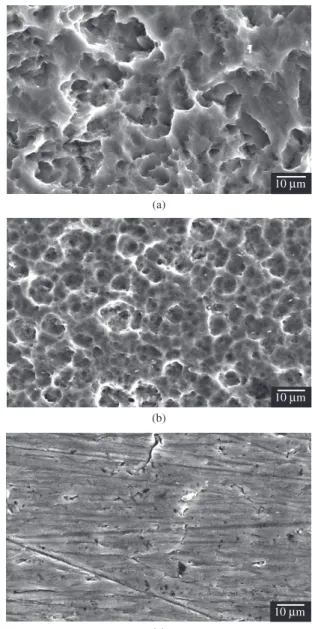
Surface analysis of Ti grade 2 by SEM showed significant surface destruction after 4 days immersion in citric acid containing 0.1 M NaF (Figure 2a). The corrosion was also observed on Ti surface after 4 days immersion in citrate buffer pH 5.0 with 0.1 M NaF (Figure 2b). However, the micrograph of Ti grade 2 in citrate buffer pH 7.6 + 0.1 M NaF did not reveal any attack on the metal surface (Figure 2c). These findings indicate that the corrosion process on Ti in the fluoride containing citrate buffers starts at pH 5.0 after longer immersion times. The EDS analysis found only Ti presence. Accord-ing to Nakagawa9,10, there are limits of fluoride contents and pH values
at which the corrosion behavior of Ti changes drastically.
The OCP of Ti6Al4V after an hour immersion in citrate pH 4.0 decreases from –0.55 to –0.83 V when the NaF concentration in-creases from 0.01 to 0.025 M. However, the micrograph of Ti grade 2 after 2 days immersion in 0.01 M NaF containing citric acid shows the surface attack (Figure 3). This fact indicates the onset of the corrosion process in 0.01 M fluoride ions concentration after longer immersion times.
The voltammetric curve of Ti grade 2 in 0.1 M NaF containing citric acid shows an anodic peak around –0.8 V with current densities of about 6000 µA.cm–2 indicating a dissolution process followed by a
passive region (Figure 4); however, anodic currents are still observed at the reverse scan and the same anodic peak appears again with cur-rent densities of about 2000 µA.cm–2. Further, current oscillations
can be seen at the reverse scan. This kind of oscillations has also been reported in the literature6,14 and was attributed to the
competi-tion between film formacompeti-tion and dissolucompeti-tion. Ti6Al4V presented the same behavior, however the higher anodic currents detected at the reverse scan (5000 µA.cm–2) indicate an enhanced dissolution rate.
These features reveal that the film is unstable and probably contains some pores and/or defects on its surface, as dissolution processes
Figure 1. OCP variation of Ti6Al4V alloy as a function of immersion time in the citrate buffers containing 0.1 M NaF; (▲) pH 7.6, (●) pH 5.0, (■) pH 2.0.
Figure 2. Micrographs of Ti obtained after 4 days immersion in the citrate
Figure 3. Micrograph of Ti after 2 days immersion in 0.01 M containing citric acid solution, magnification × 2000.
Figure 4. Voltammetric curves of Ti and Ti6Al4V in 0.1 M NaF containing
citric acid solution.
can be observed at the reverse scan. Similar results were obtained by other authors6,9,10 for Ti6Al4V in acidified salivas with NaF and
pH ≅ 4.0, but the reverse scans were not presented. According to Shiff6, the passive region observed at anodic potentials showed that
the film became stable. The major difference of our work is that the anodic currents at the reverse scan show that the film is not stable in the media evaluated.
When the pH of the buffer was increased to 5.0, the voltammetric curve of Ti6Al4V (Figure 5) shows an active to passive transition with current densities of about 300 µA.cm–2, in accordance with what was
reported for Ti6Al4V in fluoride containing salivas with pH 5.0[8-10].
The current densities decrease to about 100 µA.cm–2 at pH 7.6 showing
a passive behavior with a current almost constant indicating the film growth, and a small cathodic peak appears around –0.8 V. These facts are in a good agreement with the literature indicating that Ti and its alloys are passive in fluoride containing media with pH > 5.0[5,6,9].
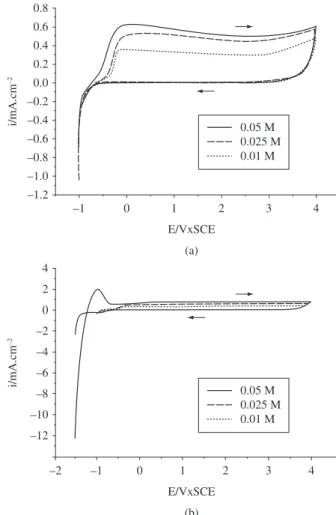
Figure 6a shows the fl uoride concentration effect on the voltam- 6a shows the fluoride concentration effect on the voltam-metric curves of Ti grade 2 in citrate buffer at pH 4.0. The curves re-vealed an active to passive behavior and the current densities increase from 250 to 600 µA.cm–2 on increasing the fluoride concentration
from 0.01 to 0.05 M. For Ti6Al4V the same behavior was observed in 0.01 M NaF, but the dissolution process is noticed at potentials close to –1.0 V in the higher concentration with current densities of about 2000 µA.cm–2 (Figure 6b); however the anodic peak does not appear
at the reverse scan. It is evident that Ti6Al4V is more susceptible to corrosion in this media, which is attributed to the presence of Al
Figure 5. Voltammetric curves of Ti6Al4V in solutions at pH 5.0 and pH 7.6
containing 0.1 M NaF.
Figure 6. Voltammetric curves obtained in citrate buffer pH 4.0 containing
0.01 M, 0.025 M and 0.05 M NaF a) Ti grade 2; b) Ti6Al4V.
and V causing the formation of a more defective film. In fact, Al and V improve the alloy strength3, but, on the other hand, they increase
the anodic dissolution of the alloy15.
3.1. EIS studies
diffusion19. The simulated data are given in Table 2.
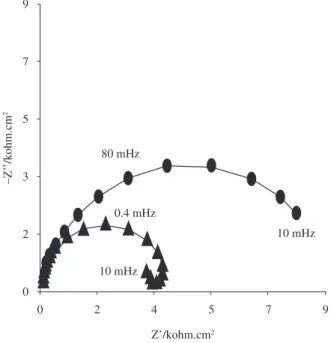
Significant changes are observed at the Nyquist plots of Ti6Al4V in the citrate buffer pH 5.0 containing 0.1 M NaF (Figure 8). The diagram obtained after 1day immersion shows a depressed capacitive response, however the emergence of a low frequency inductive loop-ing is seen after 7 days immersion. Similar impedance spectra have been observed by Scully17 for β-Ti alloy in 5 M HCl solution. The
origin of this looping is not clear but it may indicate changes in the properties of the oxide film. According to the literature this looping may be attributed to a diffusion-controled process within the oxide25
or to a surface charge at the metal-oxide interface26. The equivalent
circuit proposed to describe the EIS data after 1 day immersion is the same of Figure 7b. For longer exposure the EC used is RS(C1[R1L1]), where RS, C1, R1 and L1 represent the resistance of the solution, the total system capacitance, the polarization resistance (RP) and the inductive element, respectively (Figure 9). The results indicate that
Table 2. Fitting parameters used to simulate the EIS of Ti6Al4V in citrate buffer at pH7.6
Time Ecorr (V)
Rs (Ω cm2)
R1 (kΩ cm2)
Q1 (Ω–1cm–2sn)
n R2
(kΩ cm2)
Q2 (Ω–1cm–2sn)
n
1 day –0.42 3.7 236.9 15.3 0.92 753.5 13.8 0.96
7 days –0.30 3.4 88.1 15.1 0.92 315.8 41.7 0.97
Figure 7. a) Nyquist plots of Ti6Al4V in citrate solution pH 7.6 containing
0.1 M NaF after 1 day (●) and 7 days immersion (■). Fitted curves in solid line. b) Equivalent circuit; Rs(Q1 [R1(R2Q2)])
Figure 8. Nyquist plots of Ti6Al4V obtained after 1 day (●) and 7 days (▲)
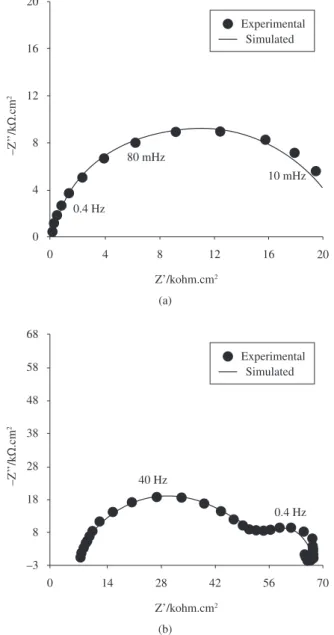
spectra. The EC used to describe the EIS spectrum in 0.01 M NaF (Figure 10a) is the same of that of Figure 7b. On increasing the NaF concentration to 0.1 M (Figure 10b) the diagram shows two capacitive time constants at high and middle frequencies followed by an induc-tive loop at the lower frequency range. This inducinduc-tive time constant has often been attributed to surface or bulk relaxation of species on the oxide layer and related to active dissolution25,26. The experimental data
were described by the EC (Figure 11) RS(Q1[R1(Q2[R2L])]), where RS, represent the resistance of the solution; Q1 and R1 the capacitance and resistance of the high frequencies; Q2 and R2 the capacitance and resistance of the lower frequencies and L the inductive elment. The polarization resistance RP is the sum of R1 and R2.
4. Conclusions
OCP measurements and voltammetric studies revealed that Ti and Ti6Al4V undergo a corrosion process when the pH falls below 5.0 and the fluoride concentration is higher than 0.01 M. Both materials were passive in citrate buffer pH 7.6, even in the presence of 0.1 M NaF; however, in the buffer at pH 5.0 and in 0.01 M NaF containing buffer pH 4.0 a corrosive attack was observed at the micrographs obtained after longer immersion times.
The EIS studies confirm the passive behavior of Ti6Al4V in ci-trate buffer at pH 7.6 such as the corrosive process in cici-trate buffers at pH 4.0 and 5.0. Further, metal dissolution enhances on increasing the fluoride content in citrate buffer at pH 4.0.
The results reported here demonstrate that the corrosion behavior of Ti and Ti6Al4V depends on the fluoride concentration, the pH of the citrate buffers and the immersion time.
Acknowledgements
Financial support of this work by Brazilian agencies: CNPq, CAPES and FAPERGS, are gratefully acknowledged.
References
1. Marc L and Rack HJ. Titanium alloys in total joint replacement – a materials science perspective. Biomaterials. 1998; 19(18):1621-1639.
2. Popa MV, Demetrescu I, Vasilescu E, Drob P, Lopez AS, Mirza-Rosca J et al. Corrosion susceptibility of implant materials Ti5Al4V and Ti6Al4Fe in artificial extra-celular fluids. Electrochimica Acta. 2004; 49(13):2113-2121.
3. Schutz RW and Thomas DE. Corrosion of titanium and its alloys. In: ASM International. Metals Handbook. 19th ed. Ohio, USA: ASM International; 1987. v. 13. p. 669-706.
4. Schmidt AM and Azambuja DS. Electrochemical behavior of Ti and Ti6Al4V in aqueous solutions of citric acid containing halides. Materials Research. 2006; 9 (4):387-392.
5. Reclaru L and Meyer JM. Effects of fluorides on Titanium and other dental alloys in dentistry. Biomaterials. 1998; 19(1-3):85-92.
Figure 9. Equivalent circuit obtained of fitting the EIS data of Figure 8 (7 days); Rs (C1[R1L1]).
Figure 10. Nyquist plots of Ti6Al4V in citrate buffer at pH 4.0; a) 0.01 M
NaF; b) 0.1 M NaF.
a dissolution process of the oxide film occurs after longer exposure in the citrate at pH5.0.
The Nyquist plots of Ti6Al4V (Figure 10) give the effect of fluo-ride ions concentration in citrate buffer at pH 4.0. On increasing the fluoride concentration significant changes are observed on the EIS
RS
R1
Q1
R2 Q2
L
Figure 11. Equivalent circuit obtained of fitting the EIS data of Figure 10b;
10. Nakagawa M, Matono Y, Matsuya S, Udoh K and Ishikawa K. The effect of Pt and Pd alloying additions on the corrosion behavior of titanium in fluoride containing environments. Biomaterials. 2005; 26(15):2239-2246.
11. ASTM. ASTM F67-95. Standard Specification for Unalloyed Titanium for Surgical Implant Applications. USA: American Society for Testing and Materials; 1995.
12. ASTM. ASTM F136-98. Standard Specification for Wrought Titanium-6Aluminum-4Vanadium Extra Low Interstitial Alloy for Surgical Implant Applications. USA: American Society for Testing and Materials; 1998.
13. Kelsall GH and Robbins DJ. Thermodynamics of Ti-H2O-F systems at 298 K. Journal of Electroanalytical Chemistry. 1990; 283(1-2):135-157.
14. Ibris N and Mirza-Rosca J. EIS study of Ti and its alloys in biological media. Journal of Electroanalytical Chemistry. 2002; 526(1-2):53-62.
15. Tomashov ND, Chernova GP, Yu RS and Ayuyan GA. The passivation of alloys on titanium bases. Electrochimica Acta. 1974; 19(4):159-172.
16. Schmidt AM and Azambuja DS. Effect of fluoride ions on Ti6Al4V alloy passivation in lactated Ringer’s serum. Materials Research. 2003; 6(2):227-231.
51(8-9):1815-1819.
21. Pan J, Thierry D and Leygraf C. Electrochemical impedance spectroscopy study of the passive film on titanium for implant application. Electrochimica Acta. 1996; 41(7-8):1143-1153.
22. Gonzalez JEG and Mirza-Rosca JC. Study of the corrosion behavior of titanium and some of its alloys for biomedical and dental implant applications. Journal of Electroanalytical Chemistry. 1999; 471(2):109-115.
23. Ramhelt U and Reinhard G. On the applicability of a constant phase element (CPE) to the estimation of roughness of solid metal electrodes. Electrochimica Acta. 1990; 35(6):1045-1049.
24. Bessone J, Mayer C and Juttner K. AC impedance measurements of aluminum barrier type oxide films. Electrochimica Acta. 1983; 28(2):171-175.
25. Bessone J, Salinas DR, Mayer CE, Ebert M and Lorenz WJ. An EIS study of aluminum barrier type oxide films formed on different media. Electrochimica Acta. 1992; 37(12):2283-2290.