ISSN 0104-6632 Printed in Brazil
www.abeq.org.br/bjche
Vol. 28, No. 02, pp. 221 - 228, April - June, 2011
Brazilian Journal
of Chemical
Engineering
THE INFLUENCE OF CHROMIUM SUPPLIED BY
TANNING AND WET FINISHING PROCESSES ON
THE FORMATION OF Cr(VI) IN LEATHER
W. F. Fuck
*, M. Gutterres, N. R. Marcílio and S. Bordingnon
Federal University of Rio Grande do Sul, Chemical Engineering Department, Laboratory for Leather and Environmental Studies, (LACOURO),
Phone: + (55) (51) 3308-3956; Fax: + (55) (51) 3308-3277, Rua Luiz Englert s/n, Zip Code: 90.040-040, Porto Alegre - RS, Brazil.
E-mail: *[email protected], [email protected]
(Submitted: April 20, 2010 ; Revised: February 7, 2011 ; Accepted: February 7, 2011)
Abstract - Chromium used in leather manufacturing can be oxidized from the trivalent to the hexavalent state, causing environmental concerns. In this study, the influence of Cr(III) from tanning, deacidification pH, fatliquors, chrome retanning and vegetable retanning on the formation of Cr(VI) in leather was analyzed by comparing natural and aged samples. In wet-blue leather, even after aging and in fatliquored leathers that did not suffer the aging process, the presence of Cr(VI) was always below the detection limit of 3 mg/kg. Considering the presence of Cr(VI), the supply of chromium during the retanning step had a more significant effect than during the tanning. In the fatliquoring process with sulfites, fish and synthetic fatliquor leather samples contained Cr(VI) when aged, and the highest concentration detected was 26.7 mg/kg. The evaluation of Cr(VI) formation led to recommendations for regulation in the leather industry.
Keywords: Leather; Hexavalent chromium; Tanning process.
INTRODUCTION
The requirement for hazardous substance control in footwear, leather articles and consumer products is growing strongly (AAFA, 2010; ECHA, 2010; STC Group, 2010; SG, 2009; Adidas Group, 2009; Clarks, 2009). The presence of hexavalent chromium in leather and leather products, which is not used in any step of the manufacturing process, has become a concern in the leather industry. The most common tanning agent used is trivalent chromium in the form of CrOHSO4 (Gutterres, 2008; BASF, 2004). Therefore, efforts are being made to identify the sources of oxidation of Cr(III) to Cr(VI) and to eliminate its presence in finished leather (Hauber, 1999; Babu et al., 2005; Basaran et al., 2007 and Fuck et al., 2008b). This problem can be a strong barrier to the use of the chromium salt as a tanning agent and
even cause restrictions in the trade market of leather articles because Cr(VI) is bioaccumulating, highly toxic, mutagenic and carcinogenic to humans (Kolomaznik et al., 2008) due to its high membrane penetration and strong oxidizing ability (Paustenbach et al., 2003). It is ranked as 18th on the Priority List of Hazardous Substances (ATSDR, 2010). According to Basaran et al. (2006), exposure to heavy metals occurs not only through ingestion of food but also through contact with any object or article of clothing that contains them.
collected from tanneries, but only after aging (the two Cr(VI) concentrations being 3.9 and 4.7 mg/kg). However, for the majority of the leather samples, Cr(VI) was not detected, even under more stringent conditions, indicating that tannery practices are attaining the tanning requirements. According to Palop et al., (2008 a,b), the leather fatliquoring has a strong influence on the formation of chromate in leather from the trivalent chromium used in the tanning. The greatest effect is realized by fatliquoring with sulfated and sulfited fish oils and substances with simple or multiple unsaturated fatty acids (free or esterified).
According to Sammarco (2004), by incrementing 1, 2, 4, 6 and 8% of basic chromium salt (25% Cr2O3 - 33.33 Schorlemmer basicity) supplied in the leather tanning step and fatliquoring with sulfited fish oil, the oxidation of Cr(III) to Cr(VI) increased, resulting, respectively, in Cr(VI) concentrations of 9, 10, 11, 15 and 18 mg/kghide after aging by heat treatment. In general, Hauber (1999) found that the Cr(VI) content of air-dried leathers was below the detection limit; however, after heating at 80°C for 24 h, the ammonia- or sodium bicarbonate-treated samples contained chromate. On the other hand, vegetable tanning or retanning agents, such as mimosa, quebracho, chestnut and tara, appeared to prevent chromate formation, even when the leathers were exposed to extreme conditions, such as heat and UV radiation (Hauber, 2000). To prevent the transformation of Cr(III) to Cr(VI), it is recommended to avoid the use of ammonia to promote dye diffusion (Font et al., 2006). The use of 1 to 3% of vegetable extract tannins in the retanning process is sufficient to ensure that the leather submitted to accelerated aging does not form Cr(VI). When the use of vegetable tannin is not possible due to its color interference, a mixture of phenol and antioxidants can be applied. Gong et al. (2010) studied a new method to avoid the oxidation from trivalent to hexavalent chromium in leather that uses specific compounds, mainly sulfocompounds with valences of 4 or lower and metal chelating agents containing two or more carboxyl groups; with this method Cr(VI) was not found even when the leathers were aged with intense UV light and high temperature for 72 h.
Therefore, the aim of this work was to study the conditions of Cr(VI) formation due to the oxidation of Cr(III) to Cr(VI) in leather in order to provide recommendations to avoid this problem in the leather industry. The factors studied in these experiments were the amount of chromium supplied in the tanning step and the following influences on the steps of wet finishing: the type of oil used in the fatliquoring step, the pH of deacidification, the effects of chrome retanning and vegetable retanning.
Leather samples were tested both in the natural stage and after the aging treatment.
EXPERIMENTAL
After the tanning step, the finishing of the leather is carried out to improve the characteristics of the leather and ensure the specifications of the articles, such as color, resistance (physicomechanical and physicochemical) and softness. The leather finishing system includes the wet-finishing, pre-finishing and finishing steps. The wet-finishing step includes deacidification (in which the leather pH is adjusted to promote the diffusion of the subsequent agents into the leather), retanning, dying and fatliquoring. The usual chemicals used in the retanning step are chromium salts, vegetable tannins and synthetic tannins. Commercial fatliquor preparations are mixtures of oil emulsions known as lickers. The most important group of fatliquor agents includes anionic products, such as sulfated, sulfited and sulfoclorated oils (Gutterres, 2003).
In the experiments, tanned hide samples were submitted to wet-finishing and aging of the obtained leather samples was conducted to simulate the possible chromium oxidation over time by exposure to high temperatures.
Tanning of the Hide Samples
This work began with tanning in the laboratory of two whole bovine hides acquired from a tannery in the pickled stage (acidified to pH 2.5-3.0). The hides were tanned separately using different basic trivalent chromium salt contents: one with a supply of 6% and another with 9% (calculated based on the mass of the hide). The variation of the chromium was tested to examine whether the presence of a higher chromium content would lead to higher hexavalent chromium formation in the leather due to an eventual nonfixation of the excess chromium in the collagen structure. At the end of the tanning process, 1% magnesium oxide was added to promote chromium fixation in the collagen structure. After the chrome tanning, the leather is called wet-blue leather.
Wet-Finishing Tests
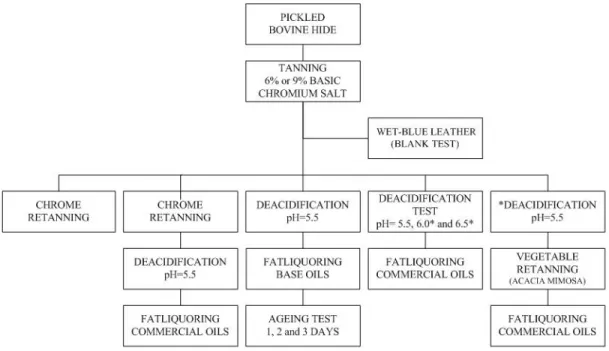
The leather samples tanned with 6% and 9% chromium (III) salt were retanned (with a 4% supply of chromium salt), deacidified to a pH of 5.5, 6.0 or 6.5 (with sodium formate and sodium bicarbonate), fatliquored (with 6% of one type of oil, base oils or commercial oils, as shown in Table 1), naturally dried (without heating) and aged (in 1, 2 or 3 days at 70°C according to NBR 12830:2005). Initially, the wet-blue leather samples were tested in the natural and aged state as blank tests to characterize the increment of the Cr(VI) concentrations under the tested conditions.
The influence of the pH deacidification (pH= 5.5, pH = 6.0 and pH 6.5) and vegetable retanning (with a 5% supply of vegetable tannin - acacia mimosa) on chromium oxidation was tested only for wet-blue leather samples tanned with 9% basic chromium salt followed by fatliquoring with 6% of each available commercial oil. For all the other experiments, the deacidification pH was fixed at 5.5.
The influence of time was tested by accelerated aging of wet-blue leather tanned with 6% and 9% chromium salt and fatliquored with base oils and the samples were analyzed after 1, 2 and 3 days of aging performed in an air-circulating oven at 70°C. For all the other experiments, the aging conditions were fixed at 3 days at 70°C.
Reagents
The chromium salt used in the tanning and chrome retanning was basic chromium sulfate (Chromosal B from LANXESS) with 26% chromium oxide and a basicity of 33% Schorlemmer. During the tanning and wet-finishing process, the base oils and ordinary commercial preparations available in the leather industry were used. Only analytical-grade chemicals were used in analyses. The oils employed were characterized and the results are presented in Table 1.
*applied only to the wet-blue leather samples tanned with 9% Basic Chromium Salt
Figure 1: Flowchart of the experiments
Table 1: Characterization of fatliquoring oils
Type of oil Description of the oil pH Ash
[%]
Volatile matter [%]
Water content [%]
Sulfited fish oil 5.2 4.4 15.5 14.7 Sulfited neatsfoot oil 5.3 1.5 35.8 34.9 Base oils
Synthetic oil 6.8 6.0 57.3 56.2 Fish and synthetic fatliquor 6.0 2.6 37.7 30.4 Synthetic fatliquor 7.9 1.7 21.2 23.3 Commercial oils
Analyses
The analyses performed on the samples were the quantification of total chromium, hexavalent chromium content and volatile matter. The samples were analyzed in both the natural (dried at room temperature) and aged states.
The qualitative and quantitative method of detection of the concentration of Cr(VI) in leather was performed according to the international standard EN ISO 17075:2007. This method consists of Cr(VI)extraction from the leather with a buffer solution (K2HPO4.3H2O) at pH 8.0 under an inert atmosphere. The Cr(VI) in solution reacts with 1,5-diphenylcarbazide forming a red-purple complex, which can be photometrically measured at 540 nm. The highest accepted Cr(VI) concentration for leather is 3 mg of Cr(VI) per kilogram of dry leather (AAFA, 2010; STC Group, 2010; SG, 2009; Adidas Group, 2009; Clarks, 2009). This number is above the detection limit of the method; below this value, it is considered to be undetectable. In this work, the UV - VIS spectrophotometer used was a Varian model Cary 1-E equipped with deuterium and halogen lamps.
RESULTS AND DISCUSSIONS
The study results are described below.
Characterization of Wet-Blue Leathers
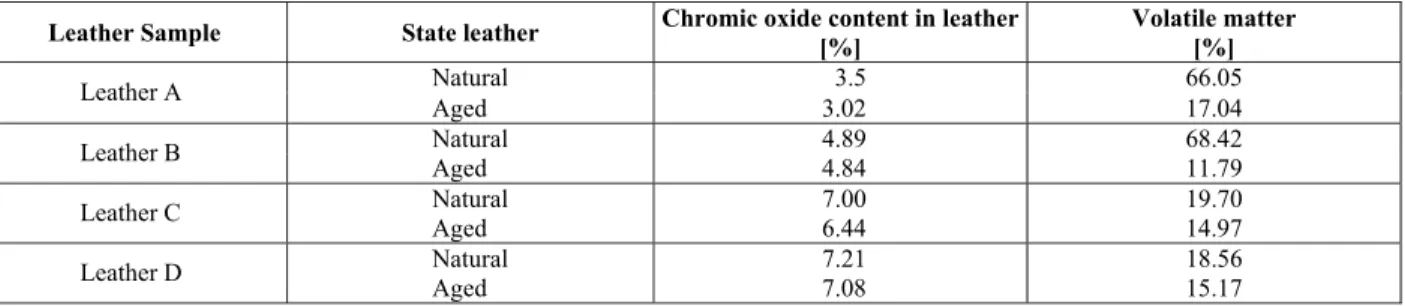
The chemical characteristics of the wet-blue leather are shown in Table 1. According to the specifications of the standard ABNT-NBR 13525:2005, the wet-blue and semifinished/finished leather samples should be within the minimum content (in dry basis) of 2.5% and 3.5% of chromic oxide content, respectively, and the volatile matter should be above the minimum range of 50-60% for the wet-blue samples and 13-18% for the semifinished/finished leather samples. According to ABNT-NBR 11029, volatile matter is the mass lost by the skin or leather when dried (102 ± 2)°C until a constant weight is reached. During the aging of the
wet-blue leather, there was a loss of volatile matter from the tanned collagen structure. As shown in Table 2, the parameters for the chromic oxide and volatile matter contents were in accord with the specifications.
Quantity of Reacted Chromium in Leather
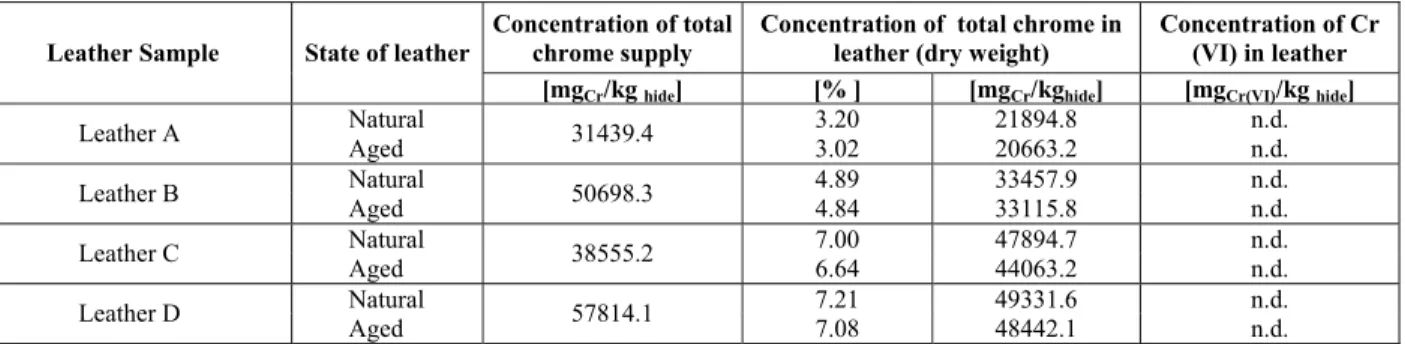
From the total amount of chromium used in the tanning and retanning steps, part of the chromium was reacted into the hide and part remained in the bath (wastewater of the tanning), as shown in Table 3. The residual chromium value in the bath was determined by calculating the difference between the reacted and added amounts.
During the tanning process, the chromium oxide is fixed into the hide, which varies with the supply of chromium salt, the kinetic conditions and the mechanical action. There are considerable amounts of chromium in wet-blue leathers tanned with 6% basic chromium salt and after chrome retanning. Upon basification of the chromium compound at the end of the tanning process with magnesium oxide, there is a reaction between the chromium complex formed and the collagen protein in which the chromium binds directly to the carboxylic group of the collagen. After the retanning with basic chromium salt, the amount of chromium increased in relation to the 6% and 9% tanned leather.
In wet-blue leathers tanned with 9% and then chromium retanned, there was a greater amount of reacted chromium. However, higher amounts of chromium should remain in the tanning bath. The chromium content in the tanned leather increased with the amount supplied because the maximum reaction of chromium with the collagen structure had not yet been reached under the previous condition of 6%. An excess of the tanning agent remained in the residual bath or was present in the collagen structure, but was not chemically linked to the collagen (existing as soluble chromium in leather).
As expected, even after aging, the concentrations of Cr(VI) were always below the limit of detection for wet-blue leather. The same was true for all the leather samples after chrome retanning.
Table 2: Characterization of the wet-blue leathers and chrome retanned leathers
Leather Sample State leather Chromic oxide content in leather [%]
Volatile matter [%]
Natural 3.5 66.05 Leather A
Aged 3.02 17.04
Natural 4.89 68.42 Leather B
Aged 4.84 11.79
Natural 7.00 19.70 Leather C
Aged 6.44 14.97
Natural 7.21 18.56 Leather D
Aged 7.08 15.17
Leather A: tanned with 6% basic chromium salt; Leather B: tanned with 9% basic chromium salt
Table 3: Chromium content in wet-blue leathers and retanned leathers
Concentration of total chrome supply
Concentration of total chrome in leather (dry weight)
Concentration of Cr (VI) in leather Leather Sample State of leather
[mgCr/kg hide] [% ] [mgCr/kghide] [mgCr(VI)/kg hide]
Natural 3.20 21894.8 n.d. Leather A
Aged 31439.4 3.02 20663.2 n.d.
Natural 4.89 33457.9 n.d. Leather B
Aged 50698.3 4.84 33115.8 n.d.
Natural 7.00 47894.7 n.d. Leather C
Aged 38555.2 6.64 44063.2 n.d.
Natural 7.21 49331.6 n.d. Leather D
Aged 57814.1 7.08 48442.1 n.d.
Leather A: tanned with 6% basic chromium salt; Leather B: tanned with 9% basic chromium salt; Leather C: tanned with 6% basic chromium salt and chrome retanned; Leather D: tanned with 9% basic chromium salt and chrome retanned; n. d.: not detectable.
Fatliquoring with Base Oils and Aging Time Influence
The influence of the type of base oil and the aging time on the formation of Cr(VI) in leathers tanned, respectively, with 6% and 9 % basic chromium salt, deacidified at pH 5.5 and fatliquored with base oils is shown in Tables 4 and 5. As shown in the tables, there was no formation of Cr(VI) in the fatliquored and non-aged leather samples, even with an increased supply of chromium.
With 6% chromium salt (Table 4), aging caused the formation of Cr(VI) in fatliquored leather with sulfited fish oil and sulfited neatsfoot oil and, with a low tendency (after only 2 days), synthetic oil. The leather with sulfited fish oil had the highest Cr(VI) concentration on the first day and lower values on the second and third days. For leather treated with sulfited neatsfoot oil, the Cr(VI) concentration detected was lower on the first day and higher on the
second and third.
With 9% chromium salt (Table 5) and fatliquored with sulfited neatsfoot oil, the highest Cr(VI) concentrations were detected on the first day and decreased slowly thereafter. The wet-blue leather fatliquored with sulfited fish oil showed approximately the same Cr(VI) results for all the periods analyzed. The wet-blue leather fatliquored with synthetic oil had Cr(VI) concentration values that could be detected only after the second and third days of aging. In the wet-blue leather with 9% salt, there was a higher formation of Cr(VI) than in the wet-blue leather with 6% salt for the three oils because there was more chromium to be oxidized.
The use of sulfite and fish oils can lead to the oxidation of chromium in leather due to the amount of unsaturated fats in their chemical composition. The synthetic oil has saturated chains that do not form peroxide radicals, thus preventing the oxidation process.
Table 4: Influence of aging time on the formation of Cr(VI) in hide samples tanned with 6% basic chromium salt and fatliquored with base oils
Cr(VI) concentration results [mg/kg] Type of oil
Natural 1 day aged at 70°C 2 days aged at 70°C 3 days aged at 70°C
Synthetic oil n.d. n.d. 3.8 + 0.6 n.d. Sulfited fish oil n.d. 19.5 + 1.5 11.6 + 0.9 10.6 + 0.2 Sulfited neatsfoot oil n.d. 11.6 + 0.2 16.6 + 0.9 17.5 + 0.9
n. d.: not detectable
Table 5: Influence of aging time on the formation of Cr(VI) in hide samples tanned with 9% basic chromium salt and fatliquored with base oil
Cr(VI) concentration results [mg/kg] Type of oil
Natural 1 day aged at 70°C 2 days aged at 70°C 3 days aged at 70°C
Synthetic oil n.d. n.d. 6.9 + 0.8 6.3 + 0.2 Sulfited fish oil n.d. 19.7 + 0.9 19.4 + 1.6 17.7 + 0.6 Sulfited neatsfoot oil n.d. 26.4 + 0.9 24.7 + 1.3 20.4 + 1.7
Fatliquoring with Commercial Oils, Evaluation of pH and Retanning
The Cr(VI) concentration results for the natural and aged hides tanned with 6% (Leather A) and 9% (Leather B) basic chromium salt and fatliquored with commercial oil preparations, are shown in Table 6. There was no detection of Cr(VI) for the naturally dried fatliquored leather. After aging with heat, leathers A and B fatliquored with commercial fish and sulfited oils showed Cr(VI), with the sulfited oil resulting in a slightly higher Cr(VI) content. The leather A fatliquored with synthetic oil resulted in no detection of Cr(VI), whereas for leather B fatliquored with the same oil, Cr(VI) could be detected.
Table 7 shows the Cr(VI) concentration results for chromium retanned and fatliquored leather. Again, it is observed that there was no detectable Cr(VI) concentration for leathers C and D when naturally dried. When aged, there was a higher Cr(VI) formation in fatliquored leather with sulfited oil, followed by fish oil, with a lower amount for synthetic oil. The Cr(VI) concentration results were quite similar for leathers C and D when fatliquored with fish oil or with sulfited oil.
For the hide samples tanned with 9% basic chromium salt, the influence of the deacidification pH before fatliquoring with commercial oils on the formation of Cr(VI) is shown in Table 8. For leathers without aging, there was no formation of Cr(VI) for the three pH values tested for all types of oil, but after aging Cr(VI) was formed. It should be noted that the deacidification pH values employed, which are the most recommended in the leather industry to achieve a good distribution and deep penetration of fatliquors, resulted in high Cr(VI) concentrations with no large variations.
For the hide samples tanned with 9% basic chromium salt and deacidified with pH 5.5, the results for the formation of Cr(VI) in the retanning using 5% vegetable tannin (Acacia mimosa) before fatliquoring with commercial oils are shown in Table 9. The retanning with vegetable tannin showed a beneficial effect, preventing the oxidation of chromium, even under the most favorable conditions considered in this study (fatliquoring with fish and sulfited oils, neutralization pH above 5.5 and aging). Therefore, the formation of Cr(VI) can be offset to some extent by the use of vegetable tannin.
Table 6: Influence of chrome tanning and fatliquoring with commercial oil on formation of Cr(VI) in leather
Cr(VI) concentration results [mg/kg]
Type of oil Leather A Leather A Leather B Leather B
Natural Aged Natural Aged
Synthetic oil n.d. n.d. n.d. 5.9 + 1.0 Fish oil n.d. 9.2 + 0.4 n.d. 10.3 + 0.9 Sulfited oil n.d. 11.3 + 0.4 n.d. 12.7 + 0.6
Leather A: tanned with 6% basic chromium salt; Leather B: tanned with 9% basic chromium salt; n. d.: not detectable.
Table 7: Influence of chrome tanning, retanning and fatliquoring with commercial oil on the formation of Cr(VI) in leather
Cr(VI) concentration results [mg/kg]
Type of oil Leather C Leather C Leather D Leather D
Natural Aged Natural Aged
Synthetic oil n.d. n.d. n.d. 5.4 + 0.3 Fish oil n.d. 15.9 + 0.4 n.d. 12.4 + 0.8 Sulfited oil n.d. 23.5 + 0.8 n.d. 26.7 + 0.5
Leather C: tanned with 6% basic chromium salt and chrome retanned; Leather D: tanned with 9% basic chromium salt and chrome retanned; n. d.: not detectable.
Table 8: Influence of deacidification pH on the formation of Cr(VI) in hide samples tanned with 9% basic chromium salt and fatliquored with commercial oils
Cr(VI) concentration results [mg/kg] Deacidification pH Type of oil
Natural Aged
Synthetic oil n.d. 5.9 + 1.0 Sulfited oil n.d. 12.7 + 0.6 5.5
Fish oil n.d. 10.3 + 0.9 Synthetic oil n.d. 4.0 + 1.0 Sulfited oil n.d. 9.2 + 0.9 6.0
Fish oil n.d. 9.4 + 0.3 Synthetic oil n.d. 4.5 + 0.4 Sulfited oil n.d. 9.1 + 0.3 6.5
Fish oil n.d. 12.7 + 0.4
Table 9: Influence of vegetable retanning on the formation of Cr(VI) in hide samples tanned with 9% basic chromium salt and fatliquored with commercial oils
Cr(VI) concentration results [mg/kg]
Type of oil Without
vegetable tannin
Without vegetable tannin
With vegetable tannin
With vegetable tannin
Natural Aged Natural Aged
Synthetic oil n.d. 5.9 + 1.0 n.d. n.d. Fish oil n.d. 10.3 + 0.9 n.d. n.d. Sulfited oil n.d. 12.7 + 0.6 n.d. n.d.
n. d.: not detectable.
CONCLUSIONS
The preliminary findings of this research were that EN ISO 17075:2007 is effective in detecting concentrations of hexavalent chromium above 3 ppm in leather and that there are some conditions of the wet-finishing process that can lead to chromium oxidation from the trivalent to the hexavalent form in leather, since wet-blue leather did not contain Cr(VI), with or without aging. An increase in the supply of chromium during tanning and retanning showed a tendency toward an increase in the formation of Cr(VI); therefore, the chromium quantities employed in the tanning processes should be controlled and optimized. The use of chromium in the retanning step caused a more pronounced effect than that of tanning itself. The type of oil used is an important factor influencing chromium oxidation.
It is considered that pH 5.5 is sufficiently high for deacidification because it influences the formation of Cr(VI). It would be advisable to work with a pH below 4.5, which is not easily realizable in practice. The retanning with vegetable tannin has a beneficial effect by preventing the oxidation of chromium.
The concern with the presence of hexavalent chromium in leather should not be considered as a definitive barrier to chrome tanning. The oxidation of trivalent chromium can be avoided by carefully controlling the oxidizing factors.
ACKNOWLEDGMENTS
The authors thank the Coordenação de Aperfeiçoamento de Pessoal de Nível Superior (CAPES) of the Brazilian Ministry of Education for providing financial support for this research.
REFERENCES
Adidas Group Policy for the Control and Monitoring of Hazardous Substances, v.7, 2009;
Agency for Toxic Substances and Disease Registry (ATSDR), The Comprehensive Environmental
Response, Compensation, and Liability Priority List of Hazardous Substances. Available at http://www.atsdr.cdc.gov. (Accessed April 2010). American Apparel & Footwear Association (AAFA),
Restricted Substance List, Release 6, (2010). Associação Brasileira de Normas Técnicas. ABNT -
NBR 13525:2005, Requisitos para aceitação do couro quanto à análise química, Rio de Janeiro (2005).
Babu, N. K. C., Asma, K., Raghupathi, A., Venba, R.; Ramesh, R., Sadulla, S., Screening of leather auxiliaries for their role in toxic hexavalent chromium formation in leather posing potential health hazards to the users. Journal of Cleaner Production, v. 13, p. 1189-1195 (2005).
Basaran, B., Iscan, M., Bitlisli, B.O., Aslan, A., Heavy Metal Contents of Various Finished Leathers. Journal of the Society of Leather Technologists and Chemists, v. 90, p.229-234 (2006).
Basaran, B., Isik, N. O., Cr(VI) formation in double-face sheepskins: effect of chromium level and ironing temperature. Journal of the Society of Leather Technologists and Chemists, 91, 4-10 (2007).
Basf S. A., Vade-Mécum do curtidor, n. 4, p. 109-128 (2004).
BLC Leather Technology Centre Ltd. Leather International, available at http://www.leathermag. com. (Accessed, December 2009).
Clarks Restricted Substances, Test House Overview, Full 'Due-Diligence' Test Spec., v. 4 (2009). European Chemicals Agency (ECHA), available at
http://echa.europa.eu/home_en.asp. (Accessed, April 2010).
Font, J., Rius, A., Marsal, A., Sánchez, D., Hauber, C., Tommaselli, M., Como evitar a formação de Cromo VI. Revista do Couro, n. 186, p. 108-110 (2006). Fuck, W. F., Gutterres, M., Marcílio, N. R.,
Fuck, W. F., Gutterres, M., Produtos Químicos Perigosos e de Uso Restrito no Couro, XVII Congresso Latino-Americano dos Químicos e Técnicos do Couro, Rio de Janeiro (2008b).
Gong, Y., Huang, L., Liu, X., Chen, W., Stabilization of chromium: An alternative to make safe leathers. Journal of Hazardous Materials, 179, 540-544 (2010).
Gutterres, M., Absorción de los Agentes de Curtición y Engrase y Modificación de la Matriz de Colágeno. Boletín Técnico de la Associación Química Española de la Indústria del Cuero, v. 54, n. 4, p. 207-215 (2003).
Gutterres, M., Considerações Sobre Curtimento ao Cromo e Meio Ambiente. A Ciência Rumo à tecnologia do Couro, ISBN 978-85-61980-00-9, Editora Tríplice, v. 1, p. 192-195, p. 505 (2008). Hauber, C., Detection and avoidance of hexavalent
chromium in leather and leather products. United Nations Industrial Development Organization (1999).
Hauber, C., Formation, prevention & determination of Cr(VI) in leather. United Nations Industrial Development Organization (2000).
Hong Kong Standards and Testing Centre (STC Group), available at: http://www.stc-group.org/ index.php?hostID=1, (Accessed, July 2010). Kolomaznik, K., Adamek, M., Andel, I., Uhlirova, M.,
Leather waste - potential threat to human health and new technology of its treatment. Journal of Hazardous Materials, 160, 514-520 (2008).
Ollenhauer-Ries, C., Beseitigung von Chrom VI aus Lederartikeln. Leder & Häute Markt, n. 04, p. 8, (2007).
Palop, R., Parareda, J., Ballús, O., Marsal, A., Leather ageing and hexavalent chromium formation as a function of the fatliquoring agent - Part I: Chrome tanned leathers. Journal of the Society of Leather Technologists and Chemists, 92, 200-204 (2008a).
Palop, R., Parareda, J., Ballús, O., Marsal, A., Leather ageing and hexavalent chromium formation as a function of the fatliquoring agent. Part II: Chrome retanned leathers. Journal of the Society of Leather Technologists and Chemists, 92, 233-237 (2008b).
Paustenbach, D., Finley, B., Mowat, F., Kerger, B., Human Health Risk and Exposure Assessment of Chromium (VI) in Tap Water. Journal of Toxicology and Environmental Health Part A, v. 66, n. 14, p. 1295-1339 (2003).
Sammarco, U., Aspectos tecnológicos, ambientais e toxicológicos no moderno trabalho do couro. International Tannery, n. 183, p. 51-68 (2004). SG - The Test Mark for low-pollutant leather products,