\ , I
lnternational Journal of Food Science and Technology (1994) 29, 405-413
Low-level heat-treatment
to extend shelf-life
of fresh fish
r~ Jr' -/..
PAULO V AZ-PIRES*, CHRISTOPHER CAPELL &
ROY KIRBY
Escola Superior de Biotecnologia, UniversidadeCatólicaPortuguesa,Porto, Portugal ;,
~ Summary
\
Jo.
The application of heat to reduce the microbial load and extend the lag phase was studied on whole fish and with bacterial isolates from fresh fish in mixed culture.
o
.. Bacterial isolates obtained from fresh horse-mackerel (Trachurus trachurus) wereheat treated at 60°C for 20 s and stored in nutrient broth on ice. The flora were shown to be heat sensitive and the inft1à1numbers were reduced by over 2.0 10glO cycles. Heating at 60°C extended the lag phase but subsequent growth rates were increased, giving a shelf-life extension of a day and a half. There were no significant effects on visual EC grades of whole fish or on the flavour of cooked filIets. Keywords
Horse mackerel, scad, spoilage, Trachurus trachurus.
j .',
Introduction
Surface microbial contamination is one of the principal causes of the spoilage of meat and fish. AlI animaIs used to supply meat are homeothermic and their natural microflora is not predominantly psychrotrophic. Psychrophilic contamination comes mainly from environmental sources post-slaughter (Tompkin, 1973). A number of methods which result in a reduction of the psychrophilic contamination have been proposed, including a naked flame, hot air-steam (Smith & Graham, 1978), dilute
O
acetic acid (Eustace et ai., 1979) and decontamination by immersion or spraying- . (KelIy et ai., 1982; Everton, 1985; Crouse et ai., 1988). Graham et ai. (1978) used
80°C water spray washes for 10 s and reduced the surface bacterial load of lamb carcasses by 2.5 log units.
The microflora offish is influenced by water temperature (Liston, 1982); fish caught in cold European waters have a large psychrophilic component. Since psychrophilic bacteria are intrinsicalIy associated with the fish this means that refrigeration is less efficient at shelf-life extension. A reduction of the microbial load resulting in an extension of shelf-life of fish and fish products has been achieved with chemical and physical methods including heat treatments: a subject addressed in a recent review by Reddy et ai. (1992).
Since psychrophilic bacteria are generalIy heat sensitive (Olsen & Nottingham, 1980), mild heat treatments may have a beneficial effect upon the keeping qualities
"'
11, I
~
Authors' address: * Escola Superior de Biotecnologia, R. Df. António Bernardino de Almeida, 4200 Porto, Portugal.
* Correspondent. Fax: +351 2 590 351.
406 P. Vaz-Pires et aI.
of fish. Moderate thermal processing is used to extend the refrigerated shelf-life of some prepackaged seafoods by reducing initial numbers and increasing the time before the onset of exponential growth. The relatively mild heating conditions result in colour, texture, and flavour characteristics similar to 'fresh' products (Hackney, 1990). Provided undesirable changes to the sensory quality can be avoided, mild heat treatments to fresh fish would be an acceptable method of shelf-life extension. This study tests the applicability and effectiveness of such a treatment. ~
~. ~'
Materiais and methods
)
Raw materiais and sample preparation
Horse-mackerel (Trachurus trachurus) were caught by bottom trawling, immedi-ately transferred to storage in freshwater ice and stored in the ship's bulk room for 1 or 2 days. After landing, a sample of fish was taken from a single catch and
e
transported to the laboratory in a clean insulated container. The fish were weighed .and kept in a refrigerated room (4°Cj: 1°e) packed in ice in boxes.
The average weight of each fish was 215 g (minimum 191g/maximum 285 g; male to female ratio approximately 1: 1).
~
Microbiological analysis
Media and reagents. Serial dilutions were made in sterile 1/4 strength Ringers solution (Lab M). Nutrient agar and nutrient broth (Lab M) were used as solid and liquid growth media. Media and reagents were prepared according to manufacturers' instructions.
Isolation and testing of bacteria. Pieces of skin (about 2cm2), gill (one whole gill arch) and abdominal cavity (alI organs) asepticalIy taken from freshly caught fish (2 days after catch) were separately homogenized in 20ml of Ringers solution for 2min and bacteria were isolated on nutrient agar spread plates incubated at 1O°C. For 80 initial purified isolates, gram reaction, celI shape and colony morphology were noted. Isolates were noted and 30 were chosen for their diversity of reactions and appearance to represent as large as possible a range of heat resistances. They were
O
separately grown in nutrient broth for 48 h at 30°C. For replicate experiments cocktails were always produced using identical conditions. These cultures were then mixed in equal volume to form a cocktail and 0.5 ml of the mixture was added to 49.5 ml of stirred Ringers solution at 6O°C. After 20 s, 0.5 ml were taken from the Ringers solutions and put into 49.5 ml of nutrient broth pre-stored on ice. A control was simultaneously performed using Ringers at 30°C. Counts were made on nutrient agar plates (incubated at 30°C for 48h) over the folIowing 3 weeks.~ ..
Total counts on fish. A sample of 12, 2-day post-mortem fish was equalIy divided and treated by total immersion in heated tap water for 20 s, six at 30°C (control) and six at 6O°C. Afterwards the fish were immediately replaced into ice which was replenished regularly and from which drip water was removed. Fish boxes were stored at 4 j: 1°C in a refrigerated room. At regular intervals a fish from each sample was selected randomly and circle punch samples of skin were taken asepticalIy from the region behind the operculum above the pectoral fin and homogenized in sterile
Ringers solution. Counts were made on nutrient agar plates (22°C for 48h) as previously described.
Grading and scoring of appearance of raw fish
'.
Untreated.Three trained panellists graded three fish of each group every 2 days,
according to the European Community (E.C.) fish sensory scheme (Howgate et ai., 1992). Each of the panellists was asked to perform an evaluation of the appearance of the skin, slime, eyes, gills and internal organs, the texture and smelI. Fish were classifiedby attributing three points to 'E' or 'Extra', two points to 'A', one point to 'B' and no points to 'C' or 'Unfit' for each of the above characteristics, as described by Huss (1988). The final grade of each fish was calculated from the mean of alI points attributed and the final grade for each day was calculated from the mean of the fish examined.
."
-o
Treated. Twenty raw fish were randomly assigned time/temperature combinationtreatments (in the range of 55-80°C and 10-60 s), then processedby total immersionin heated tap water in a 20-L water bath. The fish were distributed on a white surface in a 4 x 5 matrix, with one identified control as a visual reference. Qne unidentified control was also included. Forty-seven panellists, including professional buyers of fish, were asked to classify the fish with reference to the control, looking only at external aspects, and using the words 'same', 'similar' or 'different'. Comments about the differences were also asked for.
Cooked fish
Twelve fish were divided equally into two groups. Both samples were processed for 20s by total immersion in heated tap water, one at 30°C and the other at 6O°C. From each fish eight filIets were cut and cooked for 10min in a steam cooker over a metallic grid. A triangular test to determine organoleptic distinctiveness was conducted by 18 panellists. The "1.2test was performed according to Box et ai. (1978).
Results
O
"".,.y AlI results are the mean of at least duplicate experiments.~
Heat resistance of bacterial isolates
AlI 80 isolates were found to be gram negative, catalase positive and oxidase posi-tive. When subjected to heat stress using a variety of time temperature combinations, cocktails of bacterial isolates from fresh sea fish consistently demonstrated a sen-sitivity to heat (Fig. 1). A treatment of 60°C for 20s resulted in a reduction of two log cycles. Data colIected (not shown) gave a colIective Doo for the cocktail of 10 s. Heating at 6O°C for 20 s also resulted in an increase in the lag phase of survivors of 4- 5 days when compared with the control.
"
,..
,
Effect of heat treatment on whole fish surfaceflora
Dipping fish in water held at 60°C did not reduce the total viable count (TVC) of samples of skin taken immediately after"treatment, as compared with the controls. These results are in agreement with similar experiments performed on meat carcasses (PowelI & Cain, 1987). Growth curves derived from skin samples on treated and
10 9 ~ 1) 7' 8 E
i2
7 ug
6 § 5 o u .9! 4 ~ .S> 3 S~
2 ../> .. I '" O O 2 6 8 10 12 20o
Time (days) 4 14 16 18Figure 1. Effect of heat stress on mixed cultures of bacteria isolated from horse mackerel (Trachurus
trachurus) and on subsequent growth of the bacteria in nutrient broth on ice. o, 30°C and D, 60°C (::!:20n-I).
untreatedfish (Fig. 2) are similar to those in broth (Fig. 1). Results show that the onset of growth was delayed for approximately 4 days following heat treatment. The subsequent growth rate of bacteria on the treated fish was greater than that observed with the control and the two counts converged after a further 4 days. The qualitative effect of the treatment on the microflora of the fish was not determined.
.fl.l!x~ ,6 r.,)fHhi1j~ (dI:iYs)
Figure 3. Graph showing total 'fiablecó'uóa pétcm2 oÚish skin during 10 days of storage in ice. o, 300C and D, 6O°C (::!:20n-I)'
9 ~ 8 T E i2 7 u cn o '=-c::J 6 o U Q) ~.S>5 S ~ 4 " o ~ 3 O 2 8 10
Sensory analysis of the effects of heat treatment
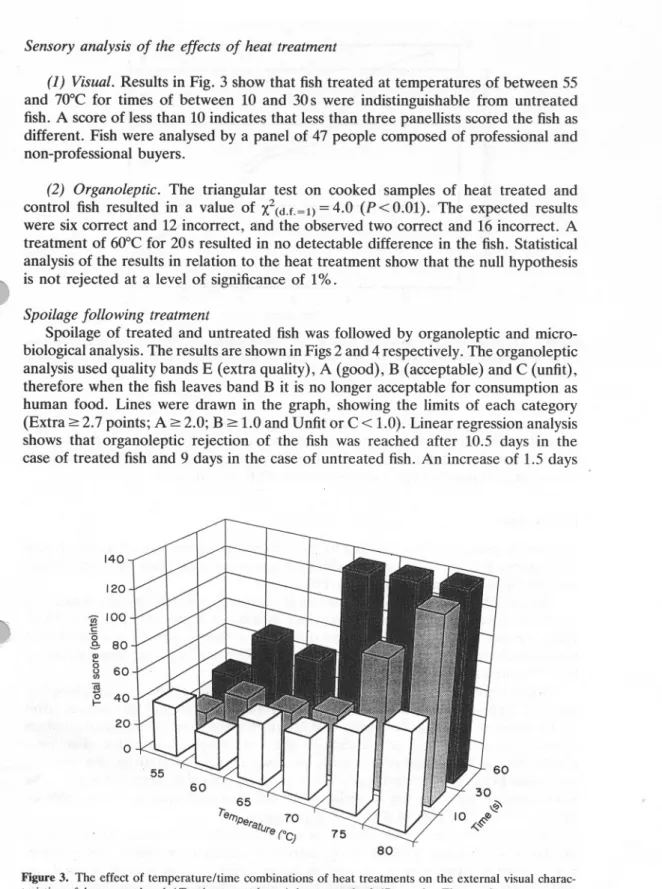
(1) Visual. Results in Fig. 3 show that fish treated at temperatures of between 55 and 70°C for times of between 10 and 30 s were indistinguishable from untreated fish. A score of less than 10 indicates that less than three panellists scored the fish as different. Fish were analysed by a panel of 47 people composed of professional and non-professional buyers.
(2) Organoleptic. The triangular test on cooked samples of heat treated and control fish resulted in a value of X2(dof.=1)= 4.0 (P < 0.01). The expected results were six correct and 12 incorrect, and the observed two correct and 16 incorrecto A treatment of 60°C for 20s resulted in no detectable difference in the fish. Statistical analysis of the results in relation to the heat treatment show that the null hypothesis
O
is not rejected at a level of significance of 1%.
Spoilage following treatmentSpoilage of treated and untreated fish was followed by organoleptic and micro-biological analysis. The results are shown in Figs 2 and 4 respectively. The organoleptic analysis used quality bands E (extra quality), A (good), B (acceptable) and C (unfit), therefore when the fish leaves band B it is no longer acceptable for consumption as human food. Lines were drawn in the graph, showing the limits of each category (Extra 2: 2.7 points; A 2: 2.0; B 2: 1.0 and Unfit or C < 1.0). Linear regression analysis shows that organoleptic rejection of the fish was reached after 10.5 days in the case of treated fish and 9 days in the case of untreated fish. An increase of 1.5 days
120 140
o
~c 100 °õ .e. 80 Q) 5 ~ 60 .. ~ {!. 40 ~ '"oFigure 3. The effect of temperatureltime combinations of heat treatments on the external visual charac-teristics of horse mackerel (Trachurus trachurus) by a panel of 47 people. The scoring system was: O points, same as control; 1 point, similar to control; and 3 points, different from control.
E A B ,J ~..\ ~ " C (A) 4 6
o
Time (days) 8 10 12Figure 4. The progression of organoleptic panel scores of horse mackerel (Trachurus trachurus) over time stored in ice after heat treatment. o, 30"C and o, 6O°C. E (extra) and A, B, C (unfit) are grading standards of the European community.
in the time to rejection was achieved. The organoleptic analysis in the early stages of spoilage show no divergence in bands E and A; in band B however, the organo-leptic assessment of the treated fish consistently received slightly higher quality scores. In all cases spoilage coincides with a TVC of > 107CFU cm-2.
Discussion
The results presented here relating to the heat sensitivity of bacteria isolated from fresh marine fish are in agreement with those previously published for psychrophilic and psychrotrophic bacteria (Liston, 1982).
The growth curves followingtreatment of bacteria in nutrient broth and fish skin are similar. Reproducible microbial analysis of fish is a formidable problem (Huss, ....
1988). Results of the microbial analysisof the fish in these experiments showed large@ variations, however, both growth curves show an increase in the lag phase following heat treatment.
Thirty degrees centigrade was chosen as the control temperature as in principIe it does not represent a lethal stress for psychrotrophic bacteria and therefore controls for the effect of washing. Followingheat treatments the reduction in initial numbers is much greater in liquid culture than on the surface microflora of fish skin. Heat penetration to the surface microflora is not instantaneous or uniform as a result of protection from direct contact with the hot water by body structures and mucus. The actual stress suffered by the bacteria on the fish skin may therefore reasonably be expected to be less than in the broth experiments.
The heat treatment regime chosen for shelf-lifestudies with whole fish was not at the limits which visual analysis of the effects of treatment indicated was possible. Sprays have previously been reported as being difficult to use (Smith & Graham, 1978; Evert~n, 1985) with immersion being more effective in controlling the time and temperature of exposure. In experiments with meat carcasses, Powell & Cain
! ~\ i -, 3 Ê Q) (.) !:!:!.2 e § Q) Q) ilQ) Õ li e' o o o 2
"
(1987) reported that temperature differences between the surface and spray water ranged from 1 to 7°C depending upon the contact time: temperature differences along the surface of the carcass were, however, less than 1°C. As a result of practical difficulties in controlling conditions in industrial situations, a treatment regimen was chosen which would give a reasonable safety margin alIowing for over processing.
The larger than expected number of incorrect results in the triangular test could mean very smalI differences between samples or very large within-sample variation. The panellists were however, unable to detect the differences induced by heat treatment. This could be expected, as the treatment of 20 s at 6O°Cmay be considered almost negligible when compared to the cooking procedure of 10 min at approximately 1O0°C.Poor understanding by the panel of the test as an explanation of the results IS not probable, as clear verbal and written instructions were given to alI panellists.
Spoilage after treatment was folIowed organolepticalIy and microbiologicalIy:
O
. the results for the two types of analysis do not agree. In the early stages folIowing treatment there is no bacterial growth, however no benefit in quality is demonstrated in the organoleptic quality analysis. This would seem to indicate that initiallosses in quality are not related to bacterial activity but to enzymic autolysis. These findings are in agreement with the findings of Huss (1988).It has previously been reported (Hobbs, 1991) that extending the lag phase of bacteria will extend shelf-life. The results presented here demonstrate that even with an extended lag phase there remains the possibility of more rapid subsequent growth, which may reduce or eliminate the advantage gained from the delayed onset of growth. More rapid growth folIowing treatment may occur because some of the competi tive microflora is removed.
Post-process contamination with psychrophilic bacteria may offer an altemative explanation for the limited success of the treatment. Vogel & Silliker (1972) indicated that refrigerated workrooms in the meat and poultry trade may be considered as counter productive with regard to shelf-life extension for this reason. During the course of the experiments alI possible care was taken to avoid this problem; in industrial applications, however, it may be more relevant.
Gutted fish have previously been reported by many authors to have an extended shelf-life in comparison with ungutted fish (Scott et ai., 1986). The reduction of the
O.
:
. gut microflora which can be expected to occur as a result of the removal of intemalorgans may in part account for this. The results presented here are taken only from experiments with ungutted fish. Experiments with gutted fish may be expected to be more successful as the gutting process would make the intemal cavities an extemal surface reachable by the hot water, thereby delaying bacterial growth. The problem of the kinetics of subsequent growth encountered in these experiments would, however, remain. According to Pedrosa-Menabrito & Regenstein (1988) a poor gutting job can sometimes be more harmful than not gutting at alI because of the introduction of contamination. In this particular case, hot water treatments may improve product quality.In general the results demonstrate the difficulties that have previously been encountered with other attempts to extend the shelf-life of food products (Rippen & Hackney, 1992; ElIerbroek et ai., 1993); that is low-Ievel treatments aimed at reducing the initial microflora may not be successful. The result of these treatments may be to alter the organisms spoiling the product and not delay rejection. It has been previously published that hot water improves meat washing processes, as welI as acidification of the water (ElIerbroek et ai., 1993). Shelf-life of meat is improved '1' 1>" Ã .. ( ~ ~
with acids (Everton, 1985). Future work must therefore concentrate on the use of combinations of barriers to growth to effectively delay the spoilage of fresh food products.
Acknowledgments
This work was supported by JNICT (Junta Nacional de Investigação Científica e Tecnológica, Portugal). We wish to thank José Carlos Soares for donations of samples, Vítor Sousa Pereira for technical information and support and Luciano Ferreira for his excellent technical assistance.
References
Box, E.P., Hunter, W.G. & Hunter, J.S. (1978). In: Statistics for Experimenters - an lntroduction
to Design, Data Analysis, and Model Building,
pp. 118-122. New York: John Wiley & Sons. Crouse, J.D., Anderson, M.E. & Naumann, H.D.
(1988). Microbial decontamination and weight of carcass beef as affected by an automated washing pressure and length of time of spray. Journal of
Food Protection, 51, 471-474.
Ellerbroek, L.I., Wegener, J.F. & Amdt, G. (1993). Does spray washing of lamb carcasses alter bacterial surface contamination? Journal of Food Protection, 56, 432-436.
Eustace, I.J., Powell, V.H. & Bill, B.A. (1979). Vacuum packaging oflamb carcasses: use of acetic acid to extend chill storage life. A preliminary investigation, Meat Research Report 3/79.
Australia: Division of Food Research, Meat Research Laboratory.
Everton, A.R. (1985). Attempts to reduce the microbiological contamination of raw meat. The
Meat Hygienist, Sept. 1985, 3-10.
Graham, A., Eustace, I.J. & Powell' V.H. (1978).
Surface deoontamination - a new processing unit
for improved hygiene on carcass meat. Pro-ceedings of the 24th European Meeting of Meat Research Workers. Kulmbach, pp. B8: l-B8:6.
Hackney, C.R. (1990). Processing molluscs. In:
Seafood lndustry (edited by R.E. Martin and G.J.
Flick). pp. 165-17>. New York: Van-Nostrand-Reinhold.
Hobbs, G. (1991). Fish: microbiological spoilage and safety. Food Science and Technology Today, 5, 166-173.
Howgate, P., Johnston, A. & Whittle, K.J. (1992).
Multilingual Guide to EC Freshness Grades for Fishery Products. Aberdeen: Torry Research Station, Food Safety Directorate, Ministry of Agriculture, Fisheries and Food.
Huss, H.H. (1988). In: Le Poisson Frais: Qualité et
Alterations de La Qualité, pp. 29-102. Organ-ization des Nations Unites pour l' Alimentation et I'Agriculture. Collection FAO: Pêches, n° 29.
.~ , i: <:. '"" !!
Kelly, C.C., Lynch, B. & McLoughlin, A.J. (1982).
~
The effect of spray washing on the development~
of bacterial numbers and storage life of lamb carcasses. Journal of Applied Bacteriology, 53, 335-341.Liston, J. (1982). Recent advances in the chemistry of iced fish spoilage. In: Chemistry and
Bio-chemistry of Marine Food Products (edited by R.E. Martin, G.J. Flick, C.E. Hebard & D.R. Ward). pp. 27-36. Westport, CT: AVI Pub-lishing Coo
Olsen, J.C. & Nottingham, P.M. (1980). Tempera-ture. In: Microbial Ecology of Foods, vol. I - Factors affecting life and death of micro-organisms, pp. 1-37. Intemational Commission on Microbiological Specifications for Foods, London: Academic Press.
Pedrosa-Menabrito, A. & Regenstein, J.M. (1988). Shelf.life extension of fresh fish - a review. Part I - Spoilage of fish. Journal of Food Quality, 11, 117-127.
Powell' V.H. & Cain, B.P. (1987). A hot water decontamination system for beef sides, CSIRO
Food Research Quarterly, 47, 79-84. Queens- ... land, Australia: Commonwealth Scientific and~ Industrial Research Organization.
Reddy, N.R., Armstrong, D.J., Rhodehamel, E.J. & Kautter, D.A. (1992). Shelf-life extension and safety concems about fresh fishery products packaged under modified atmospheres: a review.
Journal of Food Safety, 12,87-118.
Rippen, T.E. & Hackney, C.R. (1992). Pasteur-ization of Seafood: Potential for shelf-life exten-sion and pathogen oontrol. Food Technology, 46, 88-94.
Soott, D.N., Fletcher, G.C., Hogg, M.G. & Ryder, J.M. (1986). Comparison of whole with headed and gutted orange roughy stored in ice: sensory, microbiology and chemical assessment. Journal
of Food Science, 51, 79-83.
Smith, M.G. & Graham, A. (1978). Destruction of
Escherichia coli and salmonellae on mutton carcases by treatment with hot water. Meat
!' .. . c.
~)a lo. ;I .
o
o
.
J
...
~, Science, 2, 119-128.Tompkin, R.H. (1973). Refrigeration temperature as an environmental factor influencing the
microbial quality of food - a review. Food
Technology, 27, 54-58.
Vogel, P.W. & Silliker, J.H. (1972). Meat Pro-cessing. U.S. Patent No. 3705813.