This article was published in Microbial Drug Resistance, 21(6), 600-609, 2015
http://dx.doi.org/10.1089/mdr.2014.0252
Combinatorial Activity of Flavonoids with Antibiotics Against
Drug-Resistant Staphylococcus aureus
Ana Cristina Abreu,1 Sofia C. Serra,2,3 Anabela Borges,1,4 Maria Jose´ Saavedra,4 Andrew J. Mcbain,5 Anto´nio J. Salgado,2,3 and Manuel Simo˜es1
The use of resistance-modifying agents is a potential strategy that is used to prolong the effective life of antibiotics in the face of increasing antibiotic resistance. Since certain flavonoids are potent bacterial efflux pump inhibitors, we assessed morin, rutin, quercetin, hesperidin, and ( + )-catechin for their combined activity with the antibiotics ciprofloxacin, tetracycline, erythromycin, oxacillin, and ampicillin against drug-resistant strains of
Staphylococcus aureus, including methicillin-resistant S. aureus. Four established methods
were used to determine the combined efficacy of each combination: microdilution checkerboard assays, time-kill determinations, the Etest, and dual disc-diffusion methods. The cytotoxicity of the flavonoids was additionally evaluated in a mouse fibroblast cell line. Quercetin and its isomer morin decreased by 3- to 16-fold the minimal inhibitory concentration of ciprofloxacin, tetracycline, and erythromycin against some S. aureus strains. Rutin, hesperidin, and ( + )-catechin did not promote any potentiation of antibiotics. Despite the potential cytotoxicity of these phytochemicals at a high concentration (fibroblast IC50 of 41.8 and 67.5 mg/L, respectively), quercetin is commonly used as a supplement for several therapeutic purposes. All the methods, with exception of the time-kill assay, presented a high degree of congruence without any apparent strain specificity.
Introduction
The discovery of most of our current arsenal of anti- microbial products has been based on the well-established ‘‘one-compound-one-drug’’ paradigm.33 However, the pharmaceutical industry’s search for new antimicrobials has markedly slowed in recent years and strategies to mitigate resistance in existing drugs are urgently required, given the substantial increase in antibiotic resistance.
Antimicrobial combinations are frequently used in clinical practice to promote increased pharmacological action or to achieve synergistic activity to treat mixed bacterial infections in which the organisms are not susceptible to a common agent,42,51 to overcome bacterial tolerance,34 to prevent the emergence of drug resistance,5,65 and to minimize toxicity.25 Antibiotics may also be used in combination to increase efficacy. The use of agents that inhibit bacterial resistance mechanisms (resistance-modifying agents [RMAs]) can be highly effective. Several inhibitors of b- lactamases are used in combination with antibiotics: for example, clavulanic acid is used in combination with
amoxicillin (Augmentin®) and ticarcillin (Timentin®), while sulbactam is combined with ampicillin (Unasyn®) and tazobactam, used in combination with piperacillin (as Tazocin®).2 There is considerable scope for expansion of the application of RMAs to increase the effectiveness of current antibiotics and to avoid the emergence of resistant variants during treatment.23,46
There has recently been a resurgence of interest in the use of drugs based on phytochemicals.4 Plants can produce complex mixtures of structural different products that can interact simultaneously with several biological targets and which can lead to enhanced efficiency.29
There are several reports of phytochemical compounds, including flavonoids with limited antimicrobial activity that can enhance the effect of antibiotics.2 Flavonoids are hydroxylated phenolics commonly found in leaves, fruits, and flowers. The existence, number, position, and degree of substitution of hydroxyl or methyl groups on the benzene ring provide much of the structural variation found in flavonoids9 and they, consequently, have a diverse range of pharmacological properties, including anti-inflammatory, oestrogenic, anti-allergic, antifungal, antimicrobial, and antioxidant.15,27,37 Importantly, several flavonoids were found to potentiate some antibiotics due to a possible activity as inhibitors of multidrug-resistant mechanisms, such as efflux pumps.2,39
Quercetin, rutin, hesperidin, and ( + )-catechin were re- ported to have a synergistic activity when combined with oxacillin against vancomycin-intermediate Staphylococcus
aureus (VISA).7 The goal of this work was to evaluate whether these compounds would
be able to potentiate other antibiotics against a range of clinical isolates of antibiotic- resistant S. aureus, including methicillin-resistant S. aureus (MRSA) strains. Morin, the isomer of quercetin, was also included in the tests. Ampicillin and oxacillin (b-lactams), ciprofloxacin (fluoroquinolone), erythromycin (macrolide), and tetracycline were selected as the resistance mechanisms for these antibiotics are already much disseminated. To obtain reliable conclusions about the antibiotic potentiation effects, four distinct methods were used (microdilution broth checkerboard, disc diffusion method, Etest, and time-kill assays). These tests measure distinct effects of antibiotic interactions against bacteria (growth inhibition or killing) and use different growth medium states (broth vs. agar).10,18,64
Materials and Methods
Bacterial strains and growth conditions
Test bacteria included MRSA (MJMC001, MJMC002, MJMC004) and MSSA (MJMC003, MJMC009, MJMC010).
All were low-passage clinical isolates, obtained from the Hospital Centre of Tra´s-os-Montes and Alto Douro, EPE (Vila Real, Portugal).
Additional test strains were S. aureus SA1199B, RN4220, and XU212, which over-express norA, msrA, and tetK, respectively, and were provided by S. Gibbons (University College London, London, United Kingdom)23,24,47,62 and S. aureus XU212 (MRSA). S. aureus CECT 976, used in previous studies with phytochemicals,1,57,60
was included as a comparator. Bacteria were grown overnight at 37ºC and under agitation (150 rpm) in Mueller-Hinton (MH) broth (Merck).
Antibiotics and flavonoids
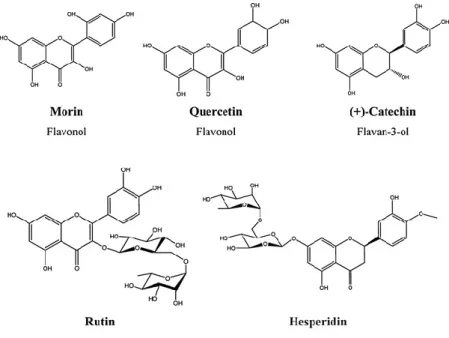
Ampicillin (AMP), ciprofloxacin (CIP), erythromycin (ERY), oxacillin (OXA), and tetracycline (TET) were pre- pared according to the manufacturer’s recommendations. Morin (MOR), quercetin (QUERC), hesperidin (HESP), rutin (RUT), and ( + )-catechin (CAT) (Fig. 1) were prepared in dimethyl sulfoxide (DMSO, 100%). All the compounds and reagents were obtained from Sigma.
Antibacterial susceptibility testing
Minimum inhibitory concentrations (MICs) of each agent were determined by broth microdilution testing according to the Clinical and Laboratory Standards Institute (CLSI) guidelines.41 MICs were defined as the lowest concentration of the antimicrobial compound that inhibited bacterial growth. OD600 was measured to assess the growth of bacteria. Three independent experiments were performed for each compound, and eight replicates per each concentration were performed in each test. The highest concentration of DMSO remaining after dilution (10%, v/v) caused no growth inhibition (data not shown).
Antibiotic-flavonoid antibacterial effects
Antibiotic-flavonoid combinations were tested using the broth microdilution checkerboard, disc diffusion method, Etest, and time-kill assays. Three independent experiments were performed for each combination and test. Based on a new approach developed for interactions between compounds that have no antimicrobial activity but that can potentiate antimicrobials,3 the combinations were classified as potentiation, additive, indifferent, or negative. Combinations were classified as additive if two or more methods presented that same interpretation of the results. Otherwise, results obtained between the limits defined for potentiation and negative interactions did not distinguish between additivity and indifference.
Checkerboard microdilution assay
Checkerboard assay was performed according to Bona- pace et al.10 and Humphreys
et al.31 with some modifications. The concentration of each antibiotic tested ranged from
1/64 to 2· MIC. The flavonoids were tested at several concentrations ranging from 10 to 1,500 mg/L. The anti- microbial solutions did not exceed 10% (v/v) of the volume used in each well (200 ml). Growth controls with DMSO at 10% (v/v) were assessed in wells not containing the chemicals. Negative controls were performed by adding fresh MH broth without bacteria to each combination. Incubation was performed for 24 hours at 37ºC, and readings were determined spectrophotometrically at 600 nm. For the combinations where one of the compounds has no antimicrobial activity, the fractional inhibitory concentration36,53 might not be determinable. In those cases, potentiation was defined as an antibiotic MIC reduction of 4-fold dilutions, an additive interaction as an MIC reduction ≥2-fold and ≤ 4-fold dilutions, and a negative interaction as an MIC
increase of 4-fold dilutions.
Disc diffusion method
This method was a modification from the Kirby–Bauer method and was applied in similar studies.1,57 The concentrations for the flavonoids were chosen according to the checkerboard results. Each flavonoid was added to MH agar (after autoclaved and cooled to ~30ºC), yielding the final concentration desired, and the medium was poured into 90 mm Petri dishes. The bacterial suspensions were adjusted to 0.5 McFarland standards and seeded over hardened MH agar Petri dishes. Sterile blank discs (6 mm diameter; Oxoid) were placed on the agar plate. A volume of 15 l of each antibiotic prepared according to the CLSI guidelines (AMP, 10 g/disc; CIP, 5 g/disc; ERY, 15 g/disc; TET, 30 g/disc; and OXA, 1 g/disc) was added to the blank discs.14 As control, antibiotic discs were applied on simple MH agar plates (without flavonoid). After incubation at 37ºC, for 24 hours, each inhibition zone diameter (IZD) was recorded and analyzed according to CLSI guidelines.14
According to the scheme proposed in a previous study,3 the combination between two bioactive agents was characterized as additive if 4 ≤ (IZD combination - IZD most active agent) < 6 mm, and as potentiation if (IZD combination - IZD most active agent) ≥ 6 mm. The limits for negative interactions were not defined since no negative combinations were ever found.
Etest
This method was performed according to the manufacturer’s instructions (AB Biodisk). The concentrations for the flavonoids were chosen according to the checkerboard results. The bacterial inoculum and the MH agar plates were prepared as described for the disc diffusion method, and antibiotic Etest strips (AB Biodisk) were applied in duplicate on the agar plates. As control, antibiotic strips were applied on simple MH agar plates (without flavonoid). After incubation for 24 hours at 37ºC, the MICs were read. For Etest, if the MIC of antibiotic was reduced by > 3-fold dilutions, the result was considered potentiation; a reduction of ≥ 2 but < 3 was considered an additive; and an increase of threefold dilutions of the MIC was classified as negative.12,35,63
Time-kill assay
This method was performed according to Bonapace et al.10 with some modifications. The antibiotics were tested at MIC, 1/2 · MIC, and 1/4 · MIC. The concentration of each flavonoid was chosen according to the checkerboard results. The combinations were added to sterilized tubes and inoculated with each isolate in a total medium volume of 10 ml. The antimicrobial combinations did not exceed 10% (v/v) of the final volume. Controls were performed with each product separately. Colony forming units (CFU) counts were performed after 0, 4, 8, and 24 hours of the beginning of the incubation at 150 rpm and 37ºC. The limit of detection was 50 CFU/ml. Potentiation was considered as a ≥ 2- log10 decrease in CFU/ml between the combination and its most active constituent at the designated sample time; an additive interaction was defined as a log10 decrease ≥ 1 and < 2 in CFU/ml; and a negative interaction was defined as a ≥ 2- log10
increase in CFU/ml.18,40
Cytotoxicity testing
The cytotoxicity of the flavonoids was evaluated ac- cording to ISO/EN 10993 (part 5)32 guidelines using L929 cells (ATCC CCL 1), from an immortalized mouse lung fibroblast cell line. Cells were grown in 175 cm2 culture flasks using Dulbecco’s modified Eagle’s medium (DMEM; Sigma) supplemented with 1% of penicillin and streptomycin solution (Sigma) and 10% fetal bovine serum (FBS; Biochrome). The flasks were incubated at 37ºC for 72 hours in a 95% air 5% CO2 atmosphere with 100% humidity. Then, cells were trypsinised, plated in 96-well microtiter plates at a concentration of 1 · 104 cells per well, and left to adhere for 24 hours at 37ºC in a 95% air 5% CO2 atmosphere with 100% humidity. The medium in each well was replaced by 200 ml of fresh DMEM with the flavonoids at several concentrations. The flavonoids did not exceed 2% (v/v) of the well final volume. Growth control was performed by adding fresh medium without any flavonoid and the negative control by adding DMSO at 2% (v/v). Each condition was performed in five wells and in triplicate. The plates were incubated for 72 hours (at 37ºC, in a 95% air 5% CO2 atmosphere with 100% humidity). After incubation, the cell viability was assessed using the Cell Titer 96® One solution Cell proliferation Assay Kit (Promega). This assay involves the bioreduction of the substrate, [3-(4,5-dimethylthiazol-2-yl)-5-(3-carboxyl-methoxy-phenyl)-2(4-sulfo-phenyl)-2H tetrazolium] (MTS) into a brown formazan product by NADPH or NADP produced by dehydrogenase enzymes in metabolically active cells.51 For the assay to occur, the medium with flavonoids was removed and replaced by 200 ml of a mixture of DMEM without FBS and MTS (1:5 ratio) and incubated for 3 hours (at 37ºC, in a 95% air 5% CO2 atmosphere with 100% humidity). The optical density of each well was measured at 490 nm using a plate reader (Molecular Devices). From the dose-response curves obtained, the half maximal inhibitory concentration (IC50) values were calculated by probit analysis, according to Sebaugh.59
Statistical analysis
For statistical analysis, the in vitro results were analyzed by Student’s t-test using the statistical program SPSS version
19.0 (Statistical Package for the Social Sciences). Statistical calculations were based on a confidence level ≥ 95% ( p < 0.05) that was considered statistically significant.
Results
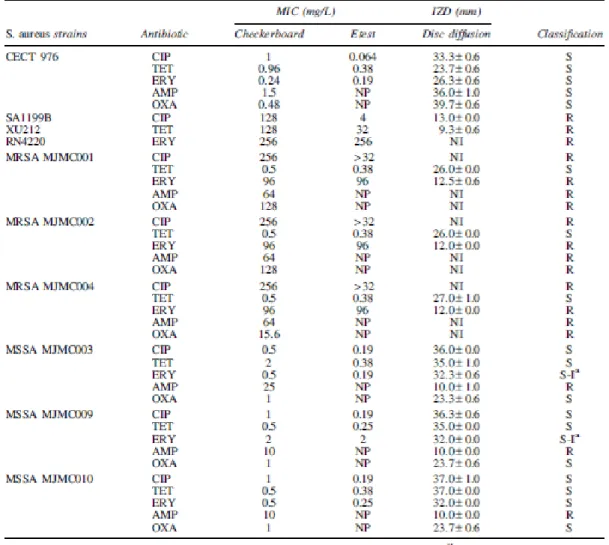
The classification of the S. aureus strains according to their resistance profile was done based on the comparison of the MICs/IZDs results of antibiotics and the susceptibility breakpoints of the CLSI guidelines (Table 1).41 The agreement between the MICs obtained by microdilution technique and Etest (within – 1-log2 dilutions) was 75% for TET, 88% for ERY, and only 38% for CIP. According to the classifications presented by Reynolds et al.56 there was good agreement for ERY and poor agreements for TET and CIP. No MIC was detected for any flavonoid for concentrations lower than 1,500
mg/L (data not shown). Also, no IZD was obtained with the flavonoids for the same amount of com- pound (22.5 g/disc).
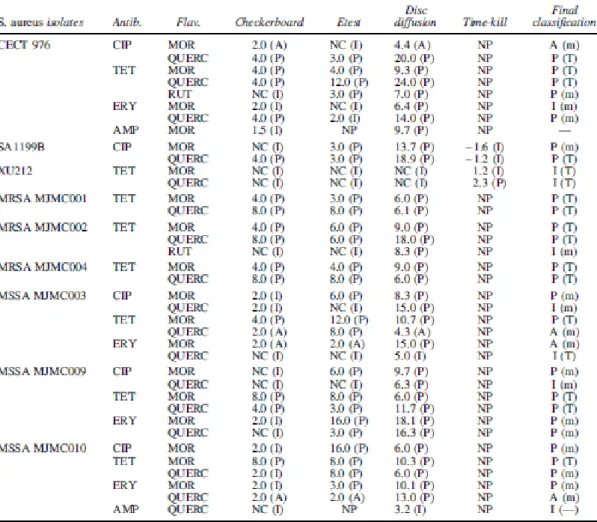
Table 2 presents the results of the combinations of anti- biotics and flavonoids obtained by checkerboard, Etest, disc-diffusion method, and time-kill assay. Only the combinations that resulted in a significant modification in comparison with antibiotics alone for, at least, one method have been presented. The concentrations of the flavonoids for the combination assays were chosen according to the checkerboard results and were considered the minimal concentrations causing the best effects (for active compounds: MOR, QUERC, and RUT). For CAF and THEO that had no activity, the same concentration of the other compounds (500 mg/L) was used. Checkerboard and Etest methods revealed several MIC reductions of the antibiotics, especially in the presence of MOR and QUERC (at 500 mg/L). The same behavior was observed by disc-diffusion method, where the higher IZD increases were obtained, especially with MOR and QUERC. No MIC increase or IZD decrease was obtained for antibiotics with the addition of flavonoids ( p > 0.05).
Figure 2 presents the log10 CFU/ml results versus time for each combination. Time-kill assays were performed only for S. aureus SA1199B, RN4220, and XU212 since this method was performed on combinations selected on the basis of their performance, assessed by the other three tests. No log10 CFU reduction was observed with the flavonoids alone for the concentrations tested when compared with the growth control (
p > 0.05, data not shown). Log10 CFU/ml increases were obtained for S. aureus
SA1199B when CIP (at 1/2 MIC) was combined with MOR and QUERC, compared with CIP alone (1.6 and 1.2 log10 increases of CFU/ml, respectively). The other methods provided potentiating effects for these combinations (Table 2). For S. aureus XU212, TET combined with MOR and QUERC caused a 1.8 and 1.7 log10 CFU/ml reduction, respectively, when compared with TET (at 1/4 MIC) and 1.2 and 2.6 log10 CFU/ml reduction, respectively, compared with TET (at 1/2 MIC). However, indifferent results were obtained for these combinations with the other three methods (Table 2). For S.
aureus RN4220, time-kill assay and the other methods provided indifferent results.
The combinations tested with the four methods were classified as potentiation, additive, or indifferent as previously described (Table 2). No negative effects were observed. Considering the total agreement and minor disagreement cases (for checkerboard, Etest, and disc-diffusion method; Table 2), potentiation was found for 24 of 190 combinatorial cases (12.6%) and additive interactions only for 4 of 190 combinations (2.1%). The majority of the combinations (84.2%) were indifferent.
Potentiation was obtained for the combination of MOR with: CIP against SA1199B and MSSA strains (3/3), TET against CECT 976, MRSA (3/3), and MSSA strains (3/3), and ERY against MSSA (2/3); for the combination of QUERC with: CIP against CECT 976, SA1199B, and MSSA (1/3), TET against CECT 976, MRSA (3/3), and MSSA (2/3) strains, and ERY against CECT 976 and MSSA (1/3); and for the combination of RUT with TET against CECT 976. No additive or potentiating effects were obtained with CAT or HESP. Furthermore, no flavonoid potentiated the activity of either b-lactam (ampicillin and oxacillin).
Agreement between checkerboard, Etest, and disc-diffusion method was 85%. Agreement between time-kill assay and the other three methods for S. aureus SA1199B,
XU212, and RN4220 was 80%. However, time-kill assay usually failed to agree with the other methods for the most promising combinations (with MOR and QUERC) against S.
aureus SA1199B and XU212. Agreement was observed in 108 of 120 cases (90%)
between checkerboard and Etest, in 111 of 120 cases (92.5%) between Etest and disc-diffusion method, and in 174 of 190 cases (91.6%) between disc-disc-diffusion method and checkerboard. Minor disagreements for checkerboard, Etest, and disc-diffusion method were obtained for 18 of 120 cases, respectively (15.0%). No major disagreements were obtained between these three methods.
Cytotoxicity tests of the flavonoids were performed using the MTS viability assay of L929 cells. The DMSO (2%) was not toxic for cells (data not shown). From the dose-response curves obtained, IC50 values were calculated by probit analysis. QUERC, MOR, and HESP presented low values of IC50 (41.8, 67.5, and 50.4 mg/L, respectively) after 72 hours of incubation with L929 cells. CAT had an IC50 of 302.5 mg/L, and RUT showed the highest value (1267.5 mg/L).
Discussion
In this study, various combinations of selected flavonoids and antibiotics were tested for their antibacterial potency using four different methods. This strategy maximized the likelihood of detecting potentiating combinations. Potentiating and additive interactions were found in 24 and 4 of 190 combinatorial cases (12.6% and 2.1%), respectively, and mainly for combinations involving MOR and QUERC. Both MOR and QUERC increased the activity of CIP and TET against S. aureus CECT 976; of CIP against SA1199B; and of TET against all MRSA and MSSA strains. In addition, some potentiation/additive interactions were found with MOR and QUERC combined with ERY. RUT only caused potentiation when combined with TET against S. aureus CECT 976. While some potentiating results were found on some S. aureus strains, this was not observed for others.
Experimentation on drug combinations can lead to opposite conclusions by different methodologies since they use different endpoints (inhibition or killing) and medium state (broth vs. agar).10,18,64 There was a high degree of agreement between checkerboard, Etest, and disc-diffusion methods (85%) but generally lower agreement for time-kill assays, probably because this is a test for bactericidal activity, contrarily to the others. Other researchers have already developed some comparisons on the agreement between these methods, which varies a lot between studies.3,13,38,44,48,64
QUERC is the most abundant flavonol found in the human diet.17 MOR is the isomer of QUERC and it has also been found to possess antibacterial activity. RUT is the glycosidic form of QUERC.6 Reports on the antibacterial activity of these flavonoids are conflicting, especially regarding their MICs, probably owing to inter- and intra-assay variation in susceptibility testing or due to the difference in genetic variation of the strain.7,16,30,54,55 Both MOR and QUERC (500 g/disc) were reported to inhibit the growth of aureus, CAT (500 g/disc) only had a slightly activity, and RUT (500 g/disc) had no antimicrobial activity.55 The concentration of 500 g/disc is, however, much higher than the highest used in this study, 22.5 g/disc. In another study, the MIC of
QUERC against S. aureus was found to be 80 mg/L.54 QUERC (15 mg/L) was found to exert antibacterial activity against S. aureus, including MRSA, and to potentiate the activity of erythromycin, oxacillin, ampicillin, vancomycin, and gentamicin against MRSA.30 Other investigations showed that 87.3% of the combinations be- tween eight flavonoids (including CAT, HESP, QUERC, and RUT) and OXA were synergistic against VISA.7 However, in this study, no synergism was obtained with OXA against the tested S. aureus strains. Eumkeb et al.20 also demonstrated that QUERC, galangin, and baicalein exhibited the potential to reverse bacterial resistance to b- lactam antibiotics against penicillin-resistant S. aureus apparently due to interaction with penicillinase, cytoplasmic membrane damage, inhibition of protein synthesis, and changes in the PBP2a.
Other studies with polyphenolic compounds also reported potentiating activities with some antibiotics against different bacterial strains. These studies were already reviewed elsewhere.2,22 Besides, many of these compounds are re- ported to have common mechanisms of action by inhibition of efflux pumps, or PBP2a, or increasing the membrane permeability, their activity may significantly vary when interacting with other biomolecules. Also, considering that these studies used different bacterial strains, antibiotics, and methods, it can be difficult to compare results on the basis of a structure-activity relationship.
In this study, the only potentiation of an antibiotic against a strain resistant to that antibiotic was observed for SA1199B with the combination of MOR/QUERC and CIP. In the other combinations, potentiation occurred only with strains that were susceptible to the antibiotics. Therefore, with the exception of the first situation, which may be due to efflux pump inhibition, these activities are, in general, probably not related to RMA. In fact, several studies have examined the potential of QUERC to inhibit various bacterial enzymes, explaining why this molecule has such a diverse applicability (including anti-tumor therapy, neuro- protection, cardiovascular disease profylaxis, inflammation, diabetes mellitus, infection, etc).21,26,58 However, it is clear that further research is necessary to understand MOR/ QUERC potentiation of CIP, TET, and ERY. One of the proposed mechanisms of action of QUERC was the inhibition of gyrases through two different mechanisms based either on interaction with DNA or with ATP binding site of gyrase.52 Since CIP also functions by inhibiting DNA gyrase, the presence of a second compound with the same target could inhibit or potentiate its activity. In fact, in this study, potentiation of CIP by QUERC was found. To our knowledge, data on MOR as antimicrobial and RMA are scarce or even inexistent.
It has been suggested that flavonoids are likely to have limited toxicity, because they are widely distributed in edible plants and beverages and have previously been used in traditional medicine.11 Indeed, in the United States, the daily dietary intake of mixed flavonoids is estimated to be in the range of 500–1,000 mg.61 QUERC has also been used as a dietary supplement (250–500 mg thrice per day) for therapeutic purposes. However, in this study, QUERC presented low values of IC50 after 72 hours of incubation with L929 cells (41.8 mg/L). This value is in accordance with some other reports. Ngomuo and Jones43 carried out the cytotoxic effects of QUERC and other compounds, and they
reported inhibition of cell growth by 50% after 48 hours of incubation for QUERC at 24 mg/L for Chinese hamster ovary cells, 36 mg/L for mouse fibroblast cells (3T3), and 21 mg/L for normal rat kidney cells. Pawlikowska-Pawlega and Gawron50 reported that QUERC caused partial growth inhibition of mouse fibroblast cells (NCTC) when used at 10 mg/ L, and almost complete growth inhibition when applied at 50 mg/L. However, based on the information provided by Quercegen Pharmaceutics regarding toxicological safety studies (pers. comm.), human clinical studies corroborating epidemiological studies, human pharmacokinetic studies, as well as other information available to Food and Drug Ad- ministration (FDA), quercetin received generally regarded as safe (GRAS) status for its intended use as an ingredient in beverages, grain products and pastas, processed fruits and fruit juices, and soft candies at levels till 500 mg per serving. FDA has not, however, made its own determination regarding the GRAS status of the subject use of quercetin.
There are tens of reports in the literature regarding the potential benefits of QUERC for various applications, with various purported modes of action, while others refer to toxicity issues.21,26,58 Although QUERC has tested positive for mutagenicity and genotoxicity in vitro in some reports, other in vitro studies suggest that QUERC is protective against genotoxicants and regarded as antimutagenic.45 The implications of these conflicting findings in an assessment of human safety have not been established.28 Therefore, the mechanisms underlying its biological effects remain obscure and understanding how QUERC causes either protection or cell death in the same model is a research priority.49
Considering the considerable number of studies reporting the potentially beneficial effects of QUERC on health, little is known about its bioavailability.19 Currently, a number of studies have been carried out in both animals and humans. However, in vivo data on the disposition, absorption, bio- availability, and metabolism of QUERC are scarce and contradictory. The low bioavailability of flavonoids has been a concern. However, it can be improved by using food matrix components or particular delivery forms.8 Harwood et al.28 reviewed important studies about bioavailability, distribution, excretion of QUERC, and so on.
The clinical benefits and the effective synergism of these combinations have to be determined in vivo through care- fully designed pharmacokinetic studies in animals. De- termination of synergy or potentiation in vitro might not be reflected in vivo because of the potential failure to achieve synergistic levels of drugs in the desired tissue, the differences in plasma protein binding, and the drug metabolism.33 The modification and optimization of the compounds based on the structure-activity relationship, in a way that the intrinsic pharmacological effect of each one is completely suppressed and only the potentiating effect with the antibiotics is present, is also a further step of research.
In conclusion, this study aimed at testing the combination of five selected flavonoids with common antibiotics searching for potentiating activities. MOR and QUERC were high lighted as antibiotic potentiators. However, the toxicity of these compounds may be a barrier. More information about pharmacokinetics of both compounds would be necessary. Their possible use in combination for surface coating can be a potential
immediate application. Despite measuring different end-points, the use of the four methods enabled a solid conclusion to be reached about the results and also permitted to overcome and circumvent the limitations of each method. Disc-diffusion method is raised as an excellent strategy, be- cause it is very easy to perform, has good agreement results with the other methods, and is low-priced.
Acknowledgments
This work was supported by Operational Program for Competitiveness Factors— COMPETE, FCT/MEC (PIDDAC), and FEDER through Projects Bioresist— PTDC/EBB-EBI/ 105085/2008; Phytodisinfectants—PTDC/DTP-SAP/1078/ 2012 (COMPETE: FCOMP-01-0124-FEDER-028765) and the PhD grants awarded to Ana Abreu (SFRH/BD/84393/ 2012) and Anabela Borges (SFRH/BD/63398/2009). The authors are very grateful to Professor Simon Gibbons (Department of Pharmaceutical and Biological Chemistry, The School of Pharmacy, UCL School of Pharmacy, London) for providing the bacterial strains.
Disclosure Statement
No competing financial interests exist.
References
1. Abreu, A.C., A. Borges, M.J. Saavedra, and M. Simo˜es. 2012. Antibacterial
activity of phenyl isothiocyanate on Escherichia coli and Staphylococcus aureus. Med. Chem. 12:756–761.
2. Abreu, A.C., A.J. McBain, and M. Simoes. 2012. Plants as sources of new antimicrobials and resistance-modifying agents. Nat. Prod. Rep. 29:1007–1021.
3. Abreu, A.C., S. Serra, A. Borges, M.J. Saavedra, A. Salgado, and M. Simo˜es. 2014.
Evaluation of the best method to assess antibiotic potentiation by phytochemicals against
Staphylococcus aureus. Diagn. Microbiol. Infect. Dis. 79:125–134.
4. Aburjai, T., R.M. Darwish, S. Al-Khalil, A. Mahafzah, and A. Al-Abbadi. 2001.
Screening of antibiotic resistant inhibitors from local plant materials against two different strains of Pseudomonas aeruginosa. J. Ethnopharmacol. 76:39–44.
5. Allen, G.P., R. Cha, and M.J. Rybak. 2002. In vitro activities of quinupristin-dalfopristin and cefepime, alone and in combination with various antimicrobials, against multidrug- resistant Staphylococci and Enterococci in an in vitro pharmacodynamic model. Antimicrob. Agents Chemother. 46: 2606–2612.
6. Andlauer, W., C. Stumpf, and P. Fu¨ rst. 2001. Intestinal absorption of rutin in free and conjugated forms. Biochem. Pharmacol. 62:369–374.
7. Basri, D., N.M. Zin, N.S. Bakar, F. Rahmat, and M. Mohtar. 2008. Synergistic
effects of phytochemicals and oxacillin on laboratory passage-derived vancomycin- intermediate Staphylococcus aureus strain. J. Med. Sci. 8:131–136.
8. Bischoff, S.C. 2008. Quercetin: potentials in the prevention and therapy of disease. Curr. Opin. Clin. Nutr. Metab. Care 11:733–740.
9. Bohm, B.A. 1998. Introduction to Flavonoids. Harwood Academic Publishers,
Australia.
antibiotic synergy against Acinetobacter baumannii: a comparison with Etest, time-kill, and checkerboard methods. Diagn. Microbiol. Infect. Dis. 38:43–50.
11. Bylka, W., I. Matlawska, and N.A. Pilewski. 2004. Nat- ural flavonoids as antimicrobial agents. JAMA 7:24–31.
12. Canto´n E., J. Pema´n, M. Gobernado, A. Viudes, and A. Espinel-Ingroff. 2005.
Synergistic activities of fluconazole and voriconazole with terbinafine against four Candida species determined by checkerboard, time-Kill, and Etest methods. Antimicrob. Agents Chemother. 49:1593–1596.
13. Chang, P.-C., H.-Y. Li, H.-J. Tang, J.-W. Liu, J.-J. Wang, and Y.-C. Chuang. 2007.
In vitro synergy of baicalein and gentamicin against vancomycin-resistant Enterococcus.
J. Microbiol. Immunol. Infect. 40:56–61.
14. [CLSI] Clinical and Laboratory Standards Institute. 2003. Performance Standards for Antimicrobial Susceptibility Testing. Sixth Edition, CLSI, Wayne, PA.
15. Cowan, M.M. 1999. Plant products as antimicrobial agents. Clin. Microbiol. Rev.
12:564–582.
16. Cushnie, T.P.T., and A.J. Lamb. 2005. Antimicrobial activity of flavonoids. Int. J. Antimicrob. Agents 26:343–356.
17. Duthie, S.J., and V.L. Dobson. 1999. Dietary flavonoids protect human colonocyte
DNA from oxidative attack in vitro. Eur. J. Nutr. 38:28–34.
18. Eliopoulos, G.M., and C.T. Eliopoulos. 1988. Antibiotic combinations: should they be tested? Clin. Microbiol. Rev. 1:149–156.
19. Erlund, I., T. Kosonen, G. Alfthan, J. Ma¨ enpa¨a¨, K. Perttunen, J. Kenraali,
J. Parantainen, and A. Aro. 2000. Pharmacokinetics of quercetin from quercetin aglycone and rutin in healthy volunteers. Eur. J. Clin. Pharmacol. 56:545–553.
20. Eumkeb, G., S. Sakdarat, and S. Siriwong. 2010. Re- versing b-lactam antibiotic resistance of Staphylococcus aureus with galangin from Alpinia officinarum Hance and synergism with ceftazidime. Phytomedicine 18:40–45.
21. Ferry, D.R., A. Smith, J. Malkhandi, D.W. Fyfe, P.G. deTakats, D. Anderson, J.
Baker, and D.J. Kerr. 1996. Phase I clinical trial of the flavonoid quercetin: pharma- cokinetics and evidence for in vivo tyrosine kinase inhibition. Clin. Cancer Res. 2:659– 668.
22. Gibbons, S. 2004. Anti-staphylococcal plant natural products. Nat. Prod. Rep.
21:263–277.
23. Gibbons, S., M. Oluwatuyi, and G.W. Kaatz. 2003. A novel inhibitor of multidrug efflux pumps in Staphylo- coccus aureus. J. Antimicrob. Chemother. 51:13–17.
24. Gibbons, S., and E.E. Udo. 2000. The effect of reserpine, a modulator of multidrug
efflux pumps, on the in vitro activity of tetracycline against clinical isolates of methicillin-resistant Staphylococcus aureus (MRSA) possessing the Tet(K) determinant. Phytother. Res. 14:139–140.
25. Gradelski, E., L. Valera, D. Bonner, and J. Fung-Tomc. 2001. Synergistic activities
of gatifloxacin in combination with other antimicrobial agents against Pseudomonas
aeruginosa and related species. Antimicrob. Agents Chemother. 45:3220–3222.
26. Guardia, T., A.E. Rotelli, A.O. Juarez, and L.E. Pelzer. 2001. Anti-inflammatory properties of plant flavonoids. Effects of rutin, quercetin and hesperidin on adjuvant ar- thritis in rat. Farmaco 56:683–687.
Phytochemistry 55:481–504.
28. Harwood, M., B. Danielewska-Nikiel, J.F. Borzelleca, G.W. Flamm, G.M.
Williams, and T.C. Lines. 2007. A critical review of the data related to the safety of quercetin and lack of evidence of in vivo toxicity, including lack of genotoxic/carcinogenic properties. Food Chem. Toxicol. 45:2179–2205.
29. Hellmann, J.K., S. Mu¨ nter, M. Wink, and F. Frischknecht. 2010. Synergistic
and additive effects of epi- gallocatechin gallate and digitonin on Plasmodium sporozoite survival and motility. PLoS One 5:e8682.
30. Hirai, I., M. Okuno, R. Katsuma, N. Arita, M. Tachibana, and Y. Yamamoto. 2010. Characterisation of anti- Staphylococcus aureus activity of quercetin. Int. J. Food Sci. Technol. 45:1250–1254.
31. Humphreys, G., G.L. Lee, S.L. Percival, and A.J. McBain. 2011. Combinatorial
activities of ionic silver and sodium hexametaphosphate against microorganisms associated with chronic wounds. J. Antimicrob. Chemother. 66:2556–2561.
32. ISO Document 10993. 1992. Biological Compatibility of Medical Devices. 5. Test
for Cytotoxicity: In Vitro Methods. Switzerland.
33. Kalan, L., and G.D. Wright. 2011. Antibiotic adjuvants: multicomponent anti-infective strategies. Expert Rev. Mol. Med. 13:e5.
34. Leekha, S., C.L. Terrell, and R.S. Edson. 2011. General principles of antimicrobial
therapy. Mayo Clin. Proc. 86:156–167.
35. Lewis, R.E., D.J. Diekema, S.A. Messer, M.A. Pfaller, and M.E. Klepser. 2002. Comparison of Etest, chequerboard dilution and time–kill studies for the detection of synergy or antagonism between antifungal agents tested against Candida species. J. Antimicrob. Chemother. 49:345–351.
36. Mackay, M.L., K. Milne, and I.M. Gould. 2000. Comparison of methods for assessing synergic antibiotic inter- actions. Int J. Antimicrob. Agents 15:125–129.
37. Martini, N.D., D.R.P. Katerere, and J.N. Eloff. 2004. Bio- logical activity of five antibacterial flavonoids from Combretum erythrophyllum (Combretaceae). J. Ethnopharmacol. 93:207–212.
38. Mayer, I., and E. Nagy. 1999. Investigation of the synergic effects ofaminoglycoside-fluoroquinolone and third-generation cephalosporin combinations against clinical isolates of
Pseudomonas spp. J. Antimicrob. Chemother. 43:651–657.
39. Musumeci, R., A. Speciale, R. Costanzo, A. Annino, S. Ragusa, A. Rapisarda, M.S.
Pappalardo, and L. Iauk. 2003. Berberis aetnensis C. Presl. extracts: antimicrobial properties and interaction with ciprofloxacin. Int. J. Antimicrob. Agents 22:48–53.
40. [NCCLS/CLSI] National Committee for Clinical Laboratory Standards. 1999. Methods for Determining Bactericidal Activity of Antimicrobial Agents. NCCLS/ CLSI, Wayne, PA.
41. [NCCLS/CLSI] National Committee for Clinical Laboratory Standards. 2003. Methods for Dilution Anti- microbial Susceptibility Test for Bacteria That Grow Aerobically. Sixth Edition, NCCLS/CLSI, Wayne, PA.
42. Neu, H.C., and T.D. Gootz. 1996. Antimicrobial chemotherapy. In S. Baron (ed.),
Medical Microbiology. 4th ed., University of Texas Medical Branch at Galveston, Texas, pp. 1–27.
43. Ngomuo, A.J., and R.S. Jones. 1996. Cytotoxicity studies of quercetin, shikimate,
44. Nicodemo, A.C., M.R.E. Araujo, A.S. Ruiz, and A.C. Gales. 2004. In vitro
susceptibility of Stenotrophomonas maltophilia isolates: comparison of disc diffusion, Etest and agar dilution methods. J. Antimicrob. Chemother. 53:604–608.
45. Okamoto, T. 2005. Safety of quercetin for clinical application (Review). Int. J. Mol. Med. 16:275–278.
46. Olajuyigbe, O.O., and A.J. Afolayan. 2012. Synergistic interactions of methanolic
extract of Acacia mearnsii De Wild. With antibiotics against bacteria of clinical relevance. Int. J. Mol. Sci. 13:8915–8932.
47. Oluwatuyi, M., G.W. Kaatz, and S. Gibbons. 2004. Antibacterial and resistance modifying activity of Rosmarinus officinalis. Phytochemistry 65:3249–3254.
48. Orhan, G., A. Bayram, Y. Zer, and I. Balci. 2005. Synergy tests by E test and
checkerboard methods of anti- microbial combinations against Brucella melitensis. J. Clin. Microbiol. 43:140–143.
49. Ossola, B., T.M. Ka¨ a¨ ria¨inen, A. Raasmaja, and P.T. Ma¨ nnisto¨ . 2008. Time-dependent protective and harmful effects of quercetin on 6-OHDA-induced toxicity in neuronal SH-SY5Y cells. Toxicology 250:1–8.
50. Pawlikowska-Pawlega B., and A. Gawron. 1995. Effect of quercetin on the growth of mouse fibroblast cells in vitro. Pol. J. Pharmacol. 47:513–535.
51. Petersen, P.J., P. Labthavikul, C.H. Jones, and P.A. Bradford. 2006. In vitro
antibacterial activities of tigecycline in combination with other antimicrobial agents de- termined by chequerboard and time-kill kinetic analysis. J. Antimicrob. Chemother. 57:573–576.
52. Plaper, A., M. Golob, I. Hafner, M. Oblak, T. Sˇolmajer, and R. Jerala. 2003.
Characterization of quercetin binding site on DNA gyrase. Biochem. Biophys. Res. Commun. 306:530–536.
53. Rand, K.H., H.J. Houck, P. Brown, and D. Bennet. 1996. Reproducibility of the microdilution checkerboard method for antibiotic synergy. Antimicrob. Agents Chemother. 37:613–615.
54. Rattanachaikunsopon, P., and P. Phumkhachorn. 2010. Contents and antibacterial
activity of flavonoids extracted from leaves of Psidium guajava. J. Med. Plants Res. 4:393–396.
55. Rauha, J.-P., S. Remes, M. Heinonen, A. Hopia, M. Kahkonen, T. Kujala, K. Pihlaja,
H. Vuorela, and P. Vuorela. 2000. Antimicrobial effects of Finnish plant ex- tracts containing flavonoids and other phenolic compounds. Int. J. Food Microbiol. 56:3–12.
56. Reynolds, R., J. Shackcloth, D. Felmingham, and A. MacGowan. 2003. Comparison of BSAC agar dilution and NCCLS broth microdilution MIC methods for in vitro susceptibility testing of Streptococcus pneumoniae, Haemophilus influenzae and Moraxella catarrhalis: the BSAC respiratory resistance surveillance programme. J. Antimicrob. Chemother. 52:925–930.
57. Saavedra, M.J., A. Borges, C. Dias, A. Aires, R.N. Bennett, E.S. Rosa, and M.
Simões. 2010. Antimicrobial activity of phenolics and glucosinolate hydrolysis products and their synergy with streptomycin against pathogenic bacteria. Med. Chem. 6:174–83.
58. Scambia, G., F.O. Ranelletti, P.B. Panici, R. De Vincenzo, G. Bonanno, G. Ferrandina, M. Piantelli, S. Bussa, C. Rumi, M. Cianfriglia, et al. 1994. Quercetin potentiates the effect of adriamycin in a multidrug-resistant MCF-7 human breast-cancer cell line: P-glycoprotein as a possible target. Cancer Chemother. Pharmacol. 34:459–
464.
59. Sebaugh, J.L. 2011. Guidelines for accurate EC50/IC50 estimation. Pharm. Stat.
10:128–134.
60. Simo˜es M., R. Rocha, M.A. Coimbra, and M. Vieira. 2008. Enhancement of Escherichia coli and Staphylococcus aureus antibiotic susceptibility using sesquiterpenoids. Med. Chem. 4:616–623.
61. Skibola, C.F., and M.T. Smith. 2000. Potential health impacts of excessive flavonoid
intake. Free Radic. Biol. Med. 29:375–383.
62. Smith, E., M. Williamson, N. Wareham, G. Kaatz, and Gibbons. 2007. Antibacterials and modulators of bacterial resistance from the immature cones of Chamaecyparis lawsoniana. Phytochemistry 68:210–217.
63. Sopirala, M.M., J.E. Mangino, W.A. Gebreyes, B. Biller, Bannerman, J.-M.
Balada-Llasat, and P. Pancholi. 2010. Synergy testing by Etest, microdilution checker- board, and time-kill methods for pan-drug-resistant Acinetobacter baumannii. Antimicrob. Agents Chemother. 54: 4678–4683.
64. White, R.L., D.S. Burgess, M. Manduru, and J.A. Bosso. 1996. Comparison of three
different in vitro methods of detecting synergy: time-kill, checkerboard, and E test. Antimicrob. Agents Chemother. 40:1914–1918.
65. Zimmermann, G.R., J. Leha´r, and C.T. Keith. 2007. Multi-target therapeutics:
when the whole is greater than the sum of the parts. Drug Discov. Today 12:34–42.
FIG. 2. Log10 CFU/ml obtained for 24 hours time- kill assay for: CIP (1/4 MIC and 1/2 MIC) + flavonoids (500 mg/L) against Staphylococcus aureus SA1199B (A); TET (1/4 MIC and 1/2 MIC) + flavonoids against S. aureus XU212 (B); and ERY (1/4 MIC and 1/2 MIC) + flavonoids against S. aureus RN4220 (C). Growth control (without antibiotic treatment) (A), antibiotic control (-), MOR (:), QUERC (,), RUT ( · ), HESP (C), CAT (:). The means – SD for at least three separate experiments are illustrated. Data are means and SD from at least three independent experiments. No significant CFU reduction was obtained with flavonoids alone ( p > 0.05). CAT, ( + )-catechin; CFU, colony-forming unit; CIP, ciprofloxacin; ERY, erythromycin; HESP, hesperidin; MICs, minimum inhibitory concentrations; MOR, morin; QUERC, quercetin; RUT, rutin; SD, standard deviation; TET, tetracycline.
Table 1. MICs Obtained by Checkerboard and Etest, and IZDs Obtained by Disc-Diffusion Method for the Antibiotics Alone Against the Staphylococcus
Table 2. MIC Fold Reductions (for Checkerboard and Etest) and IZD Increases (for Disc-Diffusion Method) and log10 CFU Reductions (for Time-Kill Method) Obtained with the Combination of Antibiotics with Flavonoids (at 500 mg/L)