1
Abstract – Beyond 3G networks have to deal with the integration of multiple different requirements, besides technological aspects. Most especially business perspectives, and user requirements, are essential from the telecommunications operator point of view. .
This paper describes the formal path of an operator and scenario driven approach used within the Daidalos project in order to develop a Beyond 3G network architecture and to verify these technical developments by proof-of concept demonstrations.
I. INTRODUCTION
The Daidalos project [1] started with a basic assumption: Mobility will become a central aspect of the lives of European citizens - in business, education, and leisure. This assumption is not surprising. Due to rapid technological and societal changes, there has been a bewildering proliferation of technologies and services for mobile users. This has created a complex (and confusing) communications environment for both users and network operators. Further development of existing technologies, and the addition of new ones in Beyond 3G (B3G) systems, do support the expect impact of mobility in our daily life. Nevertheless, these trends also require a rethinking of fundamental technological issues in order to create user-centred, but manageable, communication infrastructures. Therefore, the R&D project Daidalos aims to develop a System B3G network strongly taking into account business and operator requirements. This paper briefly discusses the Daidalos project visions and objectives (in sections II and III), the two key guiding lines of the project, scenarios (section IV) and operator-orientation (section V) and our approach to architecture development (section VI).
II.THE DAIDALOS VISION
The vision of Daidalos is of a world in which: • Mobile users can enjoy a diverse range of
personalised services – seamlessly supported by the underlying technology and
1 Authors in alphabetic order.
transparently provided through a pervasive interface.
• Mobility has been fully established through open, scalable and seamless integration of a complementary range of heterogeneous network technologies.
• Network and service operators are able to develop new business activities and provide profitable services in such an integrated mobile world.
Daidalos continues from a conceptual point of view the “philosophy” developed within the IST-Project “Mobility and Differentiated Services in a Future IP Network – Moby Dick” [2, 3], which can be regarded as an Internet-oriented approach to realize a mobile True-IP network infrastructure for operators.
III.THE DAIDALOS OBJECTIVES
The objective of Daidalos is to develop and demonstrate an open architecture based on a common network protocol (IPv6) that becomes a significant step towards approaching the Daidalos vision. The overall Daidalos objectives are to: • design, prototype and validate the necessary
infrastructure and components for efficient distribution of services over diverse network technologies (in B3G scenarios);
• integrate complementary network technologies to provide pervasive and user-centred access to these services;
• develop an optimised signalling system for communication and management support in these networks;
• demonstrate the results of the work through strong focus on user-centred and scenario-based development of technology.
Within the scope of these objectives, Daidalos will:
• support mobility in a new and integrated manner, both at the level of pervasive, personalised applications, and at the network services level. Daidalos will achieve this by extending mobility concepts [4] to technology areas not yet available in the mobile operators portfolio, e.g. DVB-broadcasting and MPEG-21, and by relating application-level concepts
Daidalos: An Operator and Scenario driven Integrated Project
Rui L. Aguiar
1, Hans-Werner Bitzer
2, Hans Joachim Einsiedler
3, Jürgen Jähnert
4, Riccardo Pascotto
2,
Antonio Sanchez
51
Universidade de Aveiro, DET-IT, [email protected]
2
T-Systems Nova, {hans-werner.bitzer, riccardo.pascotto}@t-systems.com
3Deutsche Telekom Innovation Center, [email protected] 4University of Stuttgart, RUS, [email protected]
such as “personalised user session” to network-related concepts exploited in mobility such as user profiles with Authentication, Authorisation, Accounting, and Auditing (AAAA) information.
• integrate a broad range of network technologies in an efficient and scaleable manner. Network technologies considered by Daidalos include (and merge) fixed and mobile, wired and wireless, symmetric and asymmetric, unicast, multicast, and broadcast, ad-hoc and infrastructure mode networks. This set of technologies is selected because it strives for completeness, and at the same time for openness to future technologies. Specifically, technologies such as Bluetooth, Wireless LAN, TD-CDMA, Ethernet, 802.16 and DVB-T will be addressed.
• provide the necessary mobility and layer 3-paging (IP 3-paging), routing and discovery, Security, Authentication, Authorisation, Accounting, and Auditing (SA4C), Quality of Service (QoS), and network resource management functionalities for Beyond 3G network and provider configurations – specifically including technology, multi-access and multi-homing scenarios.
• enable the user to interact with devices in their environment and to have personalised access to feature rich services and applications, including those based on pervasive computing, intelligent context-awareness and extended personalisation.
• be aligned to relevant standards, regulation bodies and national research initiatives, and further contribute to their development when appropriate.
IV.SCENARIO APPROACH
Specification and realisation of the Daidalos architecture will be driven and controlled by a scenario-based design process. A collection of interactive and distributed scenarios and use-cases, covering different aspects of the Daidalos vision in the widest possible range, is being developed. In order to reach this goal, two core scenarios have been defined: the Mobile University and the Automotive Mobility scenario. The scenarios are based on views aiming to describe scenes with practical relevance, acting as both a technology push device and a methodology to control the technical workpackages of the project. This scenario-based approach will guarantee results of strong human relevance.
Global architecture and scenario based design will use a METHODOLOGY OF CONTINUOUS EVOLUTION OF KEY SCENARIOS. The two adapted scenarios have a different focus and are
based on different styles, time frames, concept ranges, and angle of view that cover the different aspects of the Daidalos vision in a range as wide as possible. They will be used to co-ordinate the development of the Daidalos architecture based on IPv6. The scenario analysis will derive technological innovations and continuous feedback to the overall development process and will further trigger a refinement process of the scenario itself, in several iteration loops, confronting the scenarios with the potentialities open by the designed architecture. The resulting improved scenarios will be continuously evaluated against the technological and societal developments in Daidalos’ surrounding environment
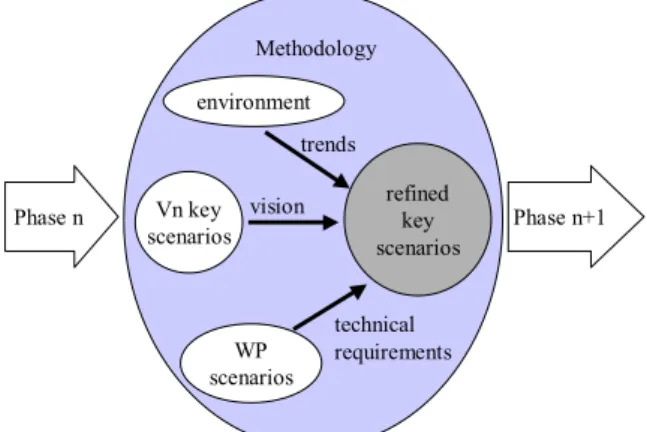
The overall architecture will be optimised in several iteration loops based on feedback received from three directions as shown in Figure 1. The Phase n provides a scenario called version n (Vn) key scenario, which will serve as one, and probably the most important - input for the refined key scenario. The scenarios are currently under the 2nd phase development.
Steady refinements of the scenarios and one annual scenario settlement process will be a platform for requirements generation and architecture definition and serve as a key input to the detailed developments inside the project. Further, there will be input from the external monitoring activities (such as the review of relevant standardisation bodies) where both, the Daidalos technical environment as well as the Daidalos socio-economic environment will be carefully observed and Daidalos relevant input will be provided to the Daidalos architecture.
environment Vn key scenarios WP scenarios refined key scenarios Methodology Phase n Phase n+1 technical requirements trends vision
Figure 1: Iterative Architecture Refinement Process Further input will come from the Daidalos implementation activities which might define more detailed use-cases in order to highlight different technical realisation options, which will be refined based on the iteration process in order to verify the overall focus of the project.
V.OVERALL SCENARIO DESIGN AND
REQUIREMENTS EXTRACTION
The design and analysis of future situations and scenarios shall ensure a development of a user-centric and pervasive architecture throughout the whole project. Existing technical approaches in all workpackages will be refined and new emerging concepts will be exploited, always promoting a user-centric and user-friendly approach of technology. In the following, the two key scenarios will be shortly presented:
Mobile University Scenario
The Daidalos Mobile University targets the need to mobilise cooperation between European academic institutions. The Daidalos platform could enable them to support the movement of students and staff amongst universities within Europe. Note however, that the requirements for this scenario basically match with the requirements coming from a mobile e-Government scenario, or from the one of corporate networks with dynamic components and different hierarchies such as Intranet, Extranet etc.
Technically the focus is on the network infrastructure of a institution (university) which dynamically adapts to the needs of mobile users connecting to the infrastructure from anyplace via the Internet. Within this context, mostly nomadic users are considered. So, the Daidalos Mobile University scenario will cover aspects like dynamic access configuration and rights management for individual users, considering and guaranteeing privacy aspects and anonymity as well as user-specific access to services which are location dependant and user-specifically available.
Automotive Mobility scenario
Broadcast:DVB-T
Wireless LAN
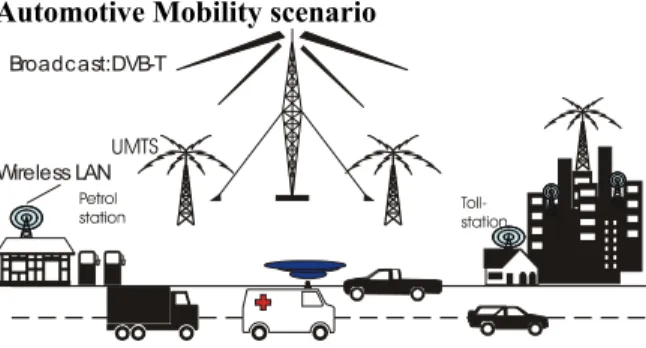
Figure 2: Automotive Mobility Scenario The scenario is based on the following assumptions:
• There is full coverage by a broadcast medium such as DVB-T.
• There is full coverage by “all-IP” UMTS-like technologies, but the cell diameter will be huge. This leads to expensive costs for using the link.
• In towns, there is coverage by Wireless LAN. Toll- and petrol stations have also Wireless LAN connectivity.
• The cars, related to the scenario have at least DVB-T, UMTS, and Wireless LAN interfaces. First Sub-scenario:
The cars on the motorway are building an ad-hoc-network. The car closest to the toll- or petrol station builds the router to enter via the toll-station or the petrol station the Internet.
This ad-hoc network supports unidirectional services such as Voice over IP which can be maintained with a certain degree of quality. The ad-hoc network will also act as a request link in an asymmetric services for cheap broadband services transmitted to the car via DVB-T. Expensive services such as telephony can be requested via “UMTS”.
Second Sub-scenario:
An ambulance car drives along the street. The ambulance car is connected via a “Guardian Angel System” to the hospital and needs bandwidth for the connection. All users will either be pushed to other access technologies or their QoS will be downgraded to a lower QoS. The ambulance car will have the best service for the communication.
VI.TELECOM DRIVEN APPROACH
In order to achieve the key objective of Daidalos, a careful mixture of competences and profiles is required, covering operators, industry, research and users. Daidalos is strongly focused on the development of new networking technologies that are feasible to implement in the mid future, both from a technological point of view and from a business and social point of view also. On a higher level it requires commitment from telecom operators and manufacturers.
As such, there is a strong influence inside Daidalos from telecom operators. To fulfil this requirement, it is natural for the consortia to have a fruitful mixture of telecom and broadcast operators for a critic mass. As shown in Figure 3, the consortium includes ten telecom operators, and three broadcast operators out of the 47 partners including manufacturers and academia.
Norway: Telenor Germany: EURECOM T-Systems/Deutsche Telekom Poland: Polska Telefonia Luxembourg: SES Astra France: France Telecom, TDF, UDCast
Spain: Telefonica Italy: Telecom Italia Portugal: Portugal Telecom Greece: OTE, Temagon Figure 3: Operator Overview
Daidalos end results expect to influence the way telecom networks will evolve, and directly impact future telecom business.
In the Daidalos context, the focus lies on the access of services. Current existing and future access technologies will be considered. A complexity that is arising with the widespread deployment of different access technologies is that many different technologies may be provided by different administrative organisations, with different sizes. This means that network and service management must now address both the integration of multi-vendor technologies within one organisation, and the federation of network capabilities/services between multiple administrative organisations. This latter requirement has historically been ignored by single technology centric studies.
The industry approach to modelling network and service management between organisations is to create a business model to describe the business relationships and establish/design the processes that are executed and run between them; for example, planning, fulfilment, assurance and billing. The revenue sharing model, billing and accounting processes are fundamental to the business models that are used operationally. Federation between access operators, and the service providers using them, is fundamentally dependent on the Business Models and Business Cases that are established between them and enforced in Network and Service Management Operational Systems of each organisation.
The size of the Daidalos market amongst service providers, and the wide range of access network infrastructure technologies (including broadcast media), means that a huge number of organisations are potentially involved, representing a large diversity of sectors, with different sizes, global/regional scope, cultures and commercial models. Furthermore, many of these organisations come from sectors unrelated to telecommunica-tions. This brings new challenges into the traditional telecommunication approaches to this problem.
Business modelling will aim to fill these gaps, by integrating organisational, financial and technological viewpoints. An activity in Daidalos will specifically aim to:
• identify new sources of revenue & business opportunities for involved stakeholders.
• investigate efficient ways of organising business interactions.
• guide architectural decisions for service design & development.
• define & automate dynamic processes to support rapid service investment decisions. Business modelling for Daidalos will focus on appropriately assessing the user and industry
requirements that will drive architectural decisions and service development/deployment plans for integrating access networks.
The overall scope is the identification of new sources of revenue and business opportunities in the upcoming "converged networks and services" landscape. In this context, the outcome of market analysis and modelling would comprise concrete commercial guidelines, crucial for the success of the envisaged market, and regulatory guidelines, for the establishment of a legal environment that can guarantee the reliability of the services and the sustainable growth of both niche and mass markets.
The rationale and scope of this activity has 3 major interactions: Daidalos Daidalos Business / Market Aspects Business / Market Aspects Regulation / Standardisation Regulation /
Standardisation Market /IndustryMarket /Industry
Figure 4: Business Model Activity
• To Daidalos: Definition of methodologies and processes for modelling the market and for capturing evolving business requirements. Definition of business cases/paradigms that can guide the development and validation of the architecture and Service Management Framework.
• To Market/Industry: Commercial guidelines and methodologies (targeting the success of the envisaged Next Generation Systems - NGSs - Framework) for different NGSs market stakeholders.
• To Regulation/Standardisation: Recommen-dations (establishing a legal environment guaranteeing viability of involved entities and sustainable growth of the market).
VII.ARCHITECTURE,IMPLEMENTATIONS, AND
INTEGRATION
Daidalos targets different scenarios with high social impact. The integration and implementation work will mainly focus on the two Daidalos key scenarios. The final details of the scenarios to be validated will be defined during the project execution, and derived from the definition of
Daidalos Scenarios. The technical requirements thus achieved will be fed into the architecture together with requirements from (Figure 5):
• A service definition framework, expressing the service provision relationships to be expected in that multiple administrative domains world. • A security framework, describing the required
security requirements to be fulfilled, and the technologies used for that.
• A technology scouting framework, indicating key leading technologies to be used.
• and the different access technology requirements.
The output of the architecture will then lead to a protocols and software specification and the implementations in the respective workpackages.
Architecture Technology Scouting Services Scenarios Start Business Modelling Security Software Specification, Implementations, and Integration Cellular Technologies. Wireless Technologies. Broadcast Technologies.
Figure 5: Daidalos Architecture Process In order to proof the overall concept and the implementations, an initial demonstrator will de defined which will implement significant parts of the scenarios prototypically.
To this concern, the following description uses these definitions below:
• Functional components: Technology-oriented modules and systems developed in the implementation workpackages.
• Testbed: Implementation of functional components into an operational.
• Site: At least one site in which a testbed is placed.
• Integrated system: One or more testbeds, in one or more sites, working in an integrated manner, to allow for virtual co-location.
After the Daidalos implementation phase an overall system integration process is foreseen. This will be considered as input to the architecture and the software specification as defined, work closely with the technology-oriented implementation workpackages and produce, as the final result, the assessment of the Daidalos concepts. As intermediate results, this implementation will link back to the architectural and scenario activities to give indications to further refine the architecture through the provision of end-user point of view and to the implementation workpackages to give feedback on technological issues. To this aim, the integration will perform the system integration of
the different technologies into a number of consolidated project-wide testbeds.
VIII.CONCLUSION
Starting with the overall Daidalos vision, this paper describes the objectives of Daidalos and the two guiding approaches – namely two scenarios (Mobile University scenario and Automotive scenario) and telecom operator business requirements – with which the project will design a Beyond 3G system.
The output of the architecture (currently in a first iteration [5]) will be used for software specification, followed by implementations in different workpackages, and finally the integration of the different sub-systems to fulfil the requirements of the scenarios.
The results of the integration evaluation will be continually fed back to the scenarios and the architecture. Other aspects of the real world that will impact the architecture are the service framework, technology scouting, changes of access technologies, and security issues.
Currently the project is in a design and analysing phase to define the global architecture. Detailed scenario descriptions (first phase) are finished. Early implementations have already started. The first detailed architecture iteration is planned to mid 2004.
IX.ACKNOWLEDGEMENTS
The work presented in this paper was partially funded by the FP6 EU project IST-2002-506997 "Daidalos" (Designing Advanced network Interfaces for the Delivery and Administration of Location independent, Optimised personal Services), and synthesises the contributions of the consortia.
X.REFERENCES
[1] http://www.ist.daidalos.org/
[2] H. Einsiedler, Rui L. Aguiar et all, “The Moby Dick Project: a Mobile Heterogeneous All-IP Architecture”, Advanced Technologies, Applications and Market Strategies for 3G - ATAMS 2001, ISBN 3-88309-20-X, pp. 164-171, Kraków, 2001.
[3] http://www.ist-mobydick.org/
[4] Mortaza S. Bargh, Dennis Bijwaard, et al, “Mobility Management in beyond 3G-Environments”, WWRF #9, 1 and 2 July 2003, Zurich, Switzerland.
[5] Rui L. Aguiar, Dennis Bijwaard et al, “Designing Networks for the Delivery of Advanced Flexible Personal Services: the Daidalos approach”, IST Mobile Communications Summit, June 2004.