Information Management
Specialization in Geographic Information
Systems
Place and City: merging our affective and
social spatial dimension in the (smart) platial
city
Albert Acedo Sánchez
A thesis submitted in partial fulfillment of the
requirements for the degree of Doctor in Information
Management
August, 2018
NOVA Information Management School
Prof. Marco Painho, Supervisor Prof. Christian Kray, Cosupervisor Prof. Sven Casteleyn, Cosupervisor
Place and City: merging our affective and social spatial dimen-sion in the (smart) platial city
Copyright © Albert Acedo Sánchez, NOVA Information Management School, Universi-dade NOVA de Lisboa.
The NOVA Information Management School and the Universidade NOVA de Lisboa have the right, perpetual and without geographical boundaries, to file and publish this dissertation through printed copies reproduced on paper or on digital form, or by any other means known or that may be invented, and to disseminate through scientific repositories and admit its copying and distribution for non-commercial, educational or research purposes, as long as credit is given to the author and editor.
This document was created using the (pdf)LATEX processor, based in the “novathesis” template[1], developed at the Dep. Informática of FCT-NOVA [2].
"You do not really understand something unless you can explain it to your grandmother"
Albert Einstein
I dedicate this research to my late grandmother, she was the kindest person and clever mind I have ever met.
Ac k n o w l e d g e m e n t s
This research becomes a reality with the kind support and help of many individuals. As I always said, this is a "collaborative" research.
I am grateful to Professor Marco Painho, Professor Sven Casteleyn and Professor Chis-tian Kray for the support, motivation, availability, ideas, corrections and planning, that allowed completing this work in the anticipated time.
A very special gratitude to my life partner Mercè Bou Cintas, without her, probably you would not be reading these pages. My eternal gratitude for your love, encouragement and all the countless hours that you have dedicated to this research.
I am also grateful to ESR colleagues with a special mention to Fernando Santa for his help and shared beers showing me that he is a ’brave’, Marek Smid for all the cigarettes stolen and Mijail for these eternal discussions. Especially, thanks to my favorite Cuban guy German Martin Mendoza the guilty that I had the chance to do a Phd.
Thanks to my friends for carefully listening to my endless speeches about the topic. To Nova staff for the help in all the steps of this process and, obviously, to the European Commission to allow me to have lived three of the best years of my life.
And finally, last but by no means least, to my family, far away this three years but very close in spirit. They continuously gave me the support needed throughout my life.
Thanks for all your encouragement!
This dissertation is funded by the European Commission within the Marie Skłodowska–Curie Actions (ITN–EJD). Grant Agree-ment Number 642332 – GEO–C – H2020–MSCA–ITN–2014.
A b s t r a c t
We are living in (smart) cities that hold social-oriented promises but currently, most of these cities disregard the humans. Although some alternatives are appearing such as smart citizen-centric approaches, there is a lack of how promoting truly appealing perspectives toward a common good or better social synergies. Thereby, smart cities, with their associated Information and Communication Technology tools, are offering new possibilities, but, unfortunately, citizens are not fully exploiting the opportuni-ties to empower themselves because, among other reasons, they are not aware of their common spatialities. Currently, we are not able to operationalize the spatial human-urban interactions regarding citizens’ cognitions, feelings and behaviors towards city places (i.e., sense of place) and meaningful geographic human relationships (i.e., so-cial capital). Both concepts are significant as resources for an alternative landscape based on human perception and organization of social interactions fostered through the geographic place(s). In this research, we highlight the need to understand and operationalize social concepts spatial dimension for a better understanding of a smart citizen-centric approach which is mainly dependent on our capability to understand platial urban dynamics. We conceptualized a (spatial) conceptual framework for sense of place and social capital at the individual level to study their spatial relationship in the urban context. We developed a web map-based survey based on the literature to spatialize, characterize and measure sense of place, social capital and civic engagement. Using the spatial data collected, we validated our framework and demonstrated the importance to encompass the spatial dimension of social concepts (i.e., sense of place and social capital) as pivotal aspect (1) to understand the platial urban dynamics; (2) to provide useful social-spatial data to city processes (e.g. civic engagement); and (3) to reveal the potential to include them in social theory and structural equation models. Furthermore, we highlighted the crucial role of Geographic Information Science (GISc) techniques to gather the spatial dimension of those social concepts. Although in this
research we focus on the spatial relationship between sense of place and social capital on civic engagement, the possibilities to relate our framework and methodology to other city based-notions can bring to light new platial urban dynamics. This research wants to open up the agenda for further research into exploratory place-based geography studies and, simultaneously, sets up a common social ground to build other socially-oriented conceptualizations or applications on top of it.
Keywords: sense of place, social capital, spatial dimension, platial urban dynamic, urban intelligence, civic engagement
C o n t e n t s
List of Figures xvii
List of Tables xxi
Listings xxiii
Glossary xxv
Acronyms xxvii
1 Introduction 1
1.1 A disclaimer before reading this research. . . 1
1.2 Problem statement . . . 2
1.3 Scientific background . . . 4
1.3.1 (Smart) city . . . 4
1.3.2 Place as a resource in the smart city. . . 6
1.3.3 A citizen-centric smart city approach . . . 7
1.3.4 A relational ground: Attitude theory . . . 8
1.3.5 A (spatial) relational ground:Agnew(2002,2011) conceptualiza-tion of place . . . 14
1.3.6 The spatialization of place-related concepts . . . 15
1.3.7 Assumptions of this research . . . 16
1.4 Relevance. . . 17 1.5 Research questions . . . 17 1.6 Objectives . . . 19 1.7 Contributions . . . 20 1.8 Research organization. . . 21 1.8.1 Publications . . . 23
C O N T E N T S
2 Place and city: Operationalizing Sense of Place and Social Capital in the
urban context 27
2.1 Introduction . . . 28
2.2 Background: the non-spatial approach . . . 30
2.3 Reasoning for a spatial approach . . . 36
2.3.1 Building the foundations for the spatial relationship of sense of place and social capital . . . 38
2.3.2 Exploring the foundations . . . 40
2.4 Discussion . . . 41
2.5 Roadmap for future research . . . 44
3 One tool to spatialize all: sense of place, social capital and civic engagement 47 3.1 Introduction . . . 48
3.2 Fishing with a net: spatializing sense of place, social capital and civic engagement . . . 49
3.2.1 Sense of place, social capital and civic engagement: the gathering 50 3.2.2 Engaging the citizen . . . 53
3.3 Discussion . . . 54
4 Place and city: Toward Urban Intelligence 57 4.1 Introduction . . . 58
4.1.1 Place in the smart city context . . . 59
4.1.2 The spatial dimension of place-related concepts: sense of place and social capital . . . 62
4.2 Methodology . . . 64
4.2.1 Data collection: the spatialization of sense of place and social capital . . . 65
4.2.2 Studying the spatial relationship between sense of place and social capital . . . 66
4.2.3 Study area . . . 68
4.3 Results . . . 68
4.3.1 Collective level: fuzzy understanding of place urban dynamics . 69 4.3.2 Individual level: sharp understanding of place urban dynamics 71 4.4 Discussion . . . 75
4.5 Conclusions and future work. . . 80
5 Place and city: Toward a geography of engagement 83
C O N T E N T S
5.1 Introduction . . . 84
5.2 Theoretical background and hypotheses . . . 86
5.2.1 Relating sense of place, social capital, and civic engagement . . 87
5.3 Methodology . . . 91
5.3.1 Experimental design . . . 91
5.4 Research model . . . 93
5.4.1 Introducing the spatial perspective in the research model . . . . 94
5.5 Results . . . 96
5.5.1 Data collection and measurement model . . . 96
5.5.2 Structural Model . . . 98
5.5.3 A geographical evaluation of the structural model . . . 99
5.6 Discussion . . . 101
5.7 Conclusions . . . 104
5.7.1 Notes to advance in the spatial adquisition of social concepts . . 105
6 Conclusions and future work 107 6.1 Conclusions . . . 107
6.1.1 Main results and contributions . . . 108
6.1.2 Limitations and future research . . . 109
6.1.3 Final remarks . . . 110
Bibliography 113
A Appendix. Chapter 2 143
B Appendix. Chapter 4 149
C Appendix. Chapter 5 151
D Appendix. Do people develop activities at places in which citizens have a
sense of place? 157
E Appendix. Finding the bridge between individuals’ perceptions and
spa-tial features in the notion of place 167
L i s t o f F i g u r e s
1.1 Schema of the scientific background outline . . . 5
1.2 Visual schema of the research organization. . . 21
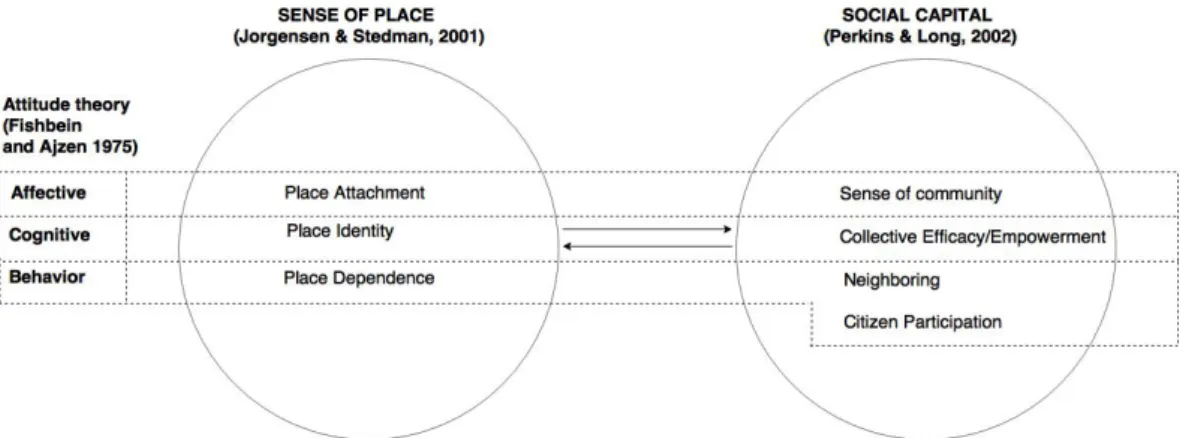
2.1 Theoretical framework that encompasses the background of this article . . 31
2.2 Relational schema of the dimensions for each concept: sense of place and social capital. Each relation (arrow) is supported by the literature, the respec-tive references indicated by numbers are listed in Table A.1 of the Appendix A. . . 35
2.3 Schema showing the relationships between sense of place and social capital dimensions. Each relationship (arrow) is supported by the literature, the respective references indicated by numbers and listed in Table A.1 of the
Appendix A . . . 36
2.4 The eight topological relationships between two regionswith connected
bound-aries, adapted fromEgenhofer et al.(1994). This figure encompasses either a
non-existing relationship (disjoint) or an existing spatial relationship (meet, overlap, equal, contains, inside, covers, and covered by) between the two
concepts (SOP and SC) . . . 38
2.5 Overview of article schema. The example shows possible GSOPijand GSCik
areas in a given city X and the right part represents all the possible spatial
relationships based on Statement 2.4 . . . 40
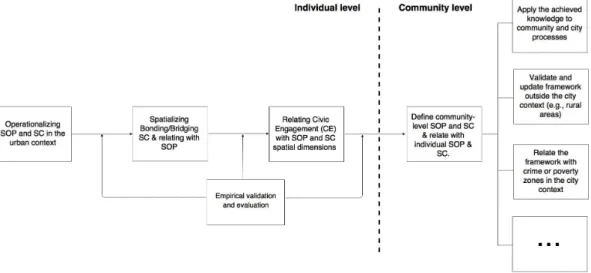
2.6 The schema for future research. Each box symbolizes a step in our research. The first box on the left is the current article, followed by the intended steps
for our future line of research . . . 45
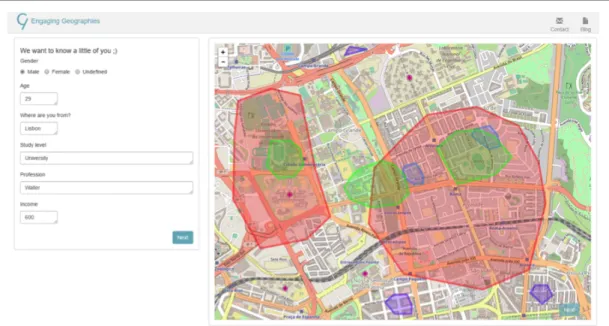
3.1 General tool interface . . . 50
3.2 Our tool’s software organization . . . 51
3.3 SOP representation and characterization with questions based on Cilliers
L i s t o f F i g u r e s
3.4 Presenting the areas that the user has provided. Red color is related to SOP,
green to CE, violet to bridging SC and pale blue to bonding SC . . . 54
4.1 A relational basic schema that shows the main concepts described in the re-search. Continuous circles define different locations of places by each citizen in a given city. At the individual level, the sum of all of these geographical areas creates the individual spatialities for each citizen. At the collective level, the total of these places in a given city forms the platial urban dynamic of a city (discontinuous line). The awareness and operationalization of this platial urban dynamics by the city stakeholders set the urban intelligence of
a given city . . . 61
4.2 Lisbon parishes distribution (study area) . . . 69
4.3 Representation of areas of overlapping (a) sense of place (SoP) and (b) social
capital (SC) using a Kernel density function . . . 71
4.4 Sense of place (a) and social capital (b) hotspots in Lisbon using Kernel
density function with bandwidth = 500m and grid cell = 30m. . . 71
4.5 Ripley’s K function for sense of place (a), social capital (b) and Cross-type
Ripley’s K function (c) . . . 72
4.6 Distribution along the city of Lisbon of participants. Notes: (1) just 132 participants wanted to accurately spatially define their home, (2) it is repre-sented as the centroid of the areas, but the Euclidean distance is related to
the closest point between participants’ homes and the targeted area . . . . 73
4.7 Group A - defined areas embedding the spatial dimensions of SoP and SC of
participants . . . 75
4.8 Frequency distribution of overlapping between sense of place and social
capital areas . . . 76
4.9 Fuzzy representation of participants-based area that embed SoP and SC
based on Kernel density estimation function . . . 80
5.1 Schema showing the relationships between sense of place and social capital
dimensions toward civic engagement. Figure adapted from Acedo et al.
(2017b), numbers in the arrows are references listed in Table C.2 in Appendix C. . . 88
5.2 Schema of the application flow. . . 93
5.3 Research model . . . 94
L i s t o f F i g u r e s
5.4 The spatial relationships between the three constructors: sense of place, so-cial capital and civic engagement. Subset A represents the positive spatial relationship between GSoP and GSC, and B between GSC and GCE. The overlapping between the three constructors is defined by the subset C. Fi-nally, the last subset (D) is composed by those citizens without any positive spatial relationship between GSoP-GSC and GSC-GCE. Note: to make the
document easier to read, we will treat GSoPias GSoP, GSCias GSC and GCEi
as GCE. . . 95
5.5 Structural model results . . . 98
5.6 The spatial relationships between the three constructors according to our model and their respective results in the structural model. Discontinue lines mean statistically not significant. . . 100
A.1 Systematic literature review procedure for identifying the final set of studies in order to create Figures 2.2 and 2.3 . . . 147
D.1 Locations of events . . . 161
D.2 Intensity functions of the two events . . . 162
D.3 Ripley’s K function for the two events . . . 163
D.4 Cross–type Ripley’s K function . . . 163
D.5 Relation between sense of place centroids and geolocated tweets . . . 164
E.1 (a) all areas, (b) data gathered, where blue is from Google Places API and red is from Overpass API . . . 170
E.2 Ratios of the spatial elements extracted from both data sources for an area 171 E.3 Description of qualitative and quantitative dimensions for each group of areas 174 F.1 Representation of the three stages . . . 180
F.2 Layers to relate the three triads and methods helped to find In-between places183 F.3 Transcription in Jefferson system . . . 186
F.4 Path followed in the walking activity with the first group . . . 188
L i s t o f Ta b l e s
1.1 Some definitions of sense of place . . . 9
1.2 Some definitions of social capital . . . 11
1.3 Some definitions of civic engagement . . . 12
1.4 Attitude theory relation with the main concepts and dimensions of the sci-entific background. In bold the main concepts; in bold and italics attitude theory dimensions. Note that the conceptualization of civic engagement (Son and Lin, 2008) is a framework and cover the three dimensions of attitude theory in this research . . . 13
1.5 Research chapters and corresponding publications in international scientific journals and conferences . . . 23
2.1 Definitions of the dimensions for social capital and sense of place . . . 33
3.1 Questions about bonding and bridging social capital. Source: Adapted from Williams(2006) . . . 53
4.1 Demographics of the sample for this study . . . 70
4.2 Distribution of Geographical sense of place (GSoP) and Geographical social capital (GSC) regarding the home parish . . . 74
5.1 Research hypotheses regarding the relationship between sense of place, so-cial capital and civic engagement . . . 89
5.2 Research hypotheses regarding the spatial relationship between sense of place, social capital and civic engagement . . . 91
5.3 Demographics of the sample for this study . . . 97
5.4 Quality assessment (square root of AVE in bold). . . 97
5.5 Higher-order formative constructs. Inner VIF values (N=119) . . . 98
5.6 Structural model evaluation (β values) for the sample and related subsets . 101 5.7 R2square values for the sample and related subsets. . . 101
L i s t o f T a b l e s
5.8 Summary about supported (y) and rejected (n) hypothesis . . . 101
A.1 Relationship between numbers in Figures 2.2 and 2.3 and authors . . . 143
B.1 Questions from the web map-based survey to present sense of place and
social capital for their spatialization. . . 149
C.1 Questions from the web map-based application . . . 151
C.2 Relationship between numbers in Figures 5.1 and authors . . . 153
D.1 Studied zones in Lisbon, Portugal . . . 162
E.1 Relation between tags and spatial elements . . . 171
E.2 Relational table with the dimensions and their spatial features and subjective
meaning based onCilliers and Timmermans(2014). . . 172
G l o s s a r y
citizen-centric smart city approach It bases on the human-environment interactions which are mainly dependent on our capability to understandplatial ur-ban dynamics.
civic engagement It explains associations or ways in which citizens have a com-mon purpose to preserve and promote public goods (Son and Lin,2008).
geographical perspective It is thespatial dimension/imprint/footprint that concepts acquire.
individuals’ spatialities Individuals or collectives practices related to their geograph-ical location that reflects their spatial actions and interactions (Lussault,2007)).
platial It is concerned about the space-based geography that is fo-cused on human discourses, social values and human-space interactions (Roche,2016, p. 4).
sense of place It explains the cognitive, affective and behavioral dimensions of the relation that an individual has towards a certain geo-graphical area (Jorgensen and Stedman,2001).
smart platial city It is the smart city conceptualization from acitizen-centric
smart city approach.
social capital It analyzes the value of social relationships and networks to societies and individuals (Holt,2008) and it is conceptualized based onPerkins and Long(2002);Perkins et al.(2002).
G L O S S A RY
spatial dimension/imprint/footprint It is the geographical definition on a map of the area that covers the feelings, thoughts and acts toward an object repre-sented through geographic primitives.
spatialize/spatialization It is to transfer the non-spatial knowledge on concepts to the geographical domain through GISc techniques.
urban intelligence It is related to our capability to understand urban dynam-ics which are dependent on the spatial organization of place (Roche,2016).
Ac r o n y m s
CEE Collective Efficacy/Empowerment. CP Citizen Participation.
GCE Geographical Civic Engagement. GIS Geographic information Systems. GISc Geographic information Science. GSC Geographical Social Capital. GSoP Geographical Sense of Place.
N Neighboring.
PA Place Attachment. PD Place Dependence. PI Place Identity.
SC Socia Capital.
SEM Structural equation models. SoC Sense of Community. SoP Sense of Place. SQ1 Search Query 1. SQ2 Search Query 2.
C
h
a
p
t
e
r
1
I n t r o d u c t i o n
1.1
A disclaimer before reading this research
Before to start, a disclaimer is necessary against a possible misunderstanding over the simplification and reduction that this research is exposing, but not fall into itself. It is not the purpose to elucidate all the problems related to the smart city approach and all the possible benefits of acitizen-centric smart city approach. Nor is it the purpose to present a categorical place’ understanding against of the space notion in the city realm. The aim is to highlight the benefits of a fruitful transition from ourindividuals’
spatialitiesto place networks for the better accommodation of our social subjectivities
in the citizen-centric smart city approach. This, itself, is a colossal simplicity of a tremendous complex relationship that needs, among others, the rethink of current terms and a blind faith in the methods used. As you might guess, the entire research is revolving around a geographic perspective focused on humans and their feelings, perceptions and experiences as the first step to advance on a collective and inclusive knowledge.
“A human being is a part of the whole called by us universe, a part limited in time and space. He experiences himself, his thoughts and feeling as something separated from the rest, a kind of optical delusion of his consciousness. This delusion is a kind of prison for us, restricting us to our personal desires and to affection for a few persons nearest to us. Our task must be to free ourselves from
C H A P T E R 1 . I N T R O D U C T I O N
this prison by widening our circle of compassion to embrace all living creatures and the whole of nature in its beauty.”
Albert Einstein
It is not the intention to make ontological claims for terms mentioned in this research. Instead, this study hooks other researchers definitions (see glossary) as significant no-tions for building on top of them what is coming in following chapters. These nono-tions represent views across disciplines on relevant topics for this research. If the reader wants to meet the aims of the study, needs to be understood the explicit goal to be as simple as possible, but not simpler. I placed my two cents on the fields revised to write down the fruits of three of the best years of my life in these pages. I hope you enjoy the reading of this study as much as I did carrying out the research.
"If you can’t explain it simply, you don’t understand it well enough." Albert Einstein
1.2
Problem statement
By 2050, the forecasting is that two-thirds of the world’s population will be urban (United-Nation,2014). Fortunately, the surge of information communication technology and smart cities, with their inherent geospatial capabilities in their tools (e.g., Global Positioning System (GPS), Indoor Positioning System (IPS)), allow alternatives in how to manage those new crowded urban environments. Mainly, those alternatives are based on the extraction of quantitative data from sensors, to better understand and manage city issues (Ash et al.,2016). However, current sensors and context-aware services are yet not able to completely analyze human-urban interactions such as cognitions, feelings and behaviors (i.e., attitude theory dimensions (Ajzen and Fishbein,1975;Rosenberg,1960)) toward social, geographic and material resources in the city context. Those associations, besides to shape our relationship with the urban environment (Duff,2011;Latour,2005;
Molotch,2012), build an important resource for a citizen-centric smart city approach. In turn, thegeographical perspectiveof those human-urban interactions can enable to frame the citizen as one of the main resources in the smart city. A smart city that holds social-oriented promises but currently mostly disregards the human perspective. With this in mind, the cities technological turn is providing a sort of individual autonomy to enjoy new services as consumers or testers, but it is not promoting what is expected as a citizen-centric approach, that searches for the common good, social synergies or political benefits based on a common "right to the city" (Harvey,2008;Lefebvre,1991).
1 . 2 . P R O B L E M S TAT E M E N T
In other words, citizens are not fully exploiting the opportunities that the smart city is offering to empower themselves. It seems that the idea of smartness is reduced to the notion of efficiency. Roughly, we are just changing our channels of communication and interaction, but the neoliberal background of a capitalist city is intact (Cardullo and Kitchin,2018). The acceptance of this city development could outline dangerous disconnections between, for instance, the social and governmental realms.
Nowadays, cities use their hierarchical administrative boundaries to deliver their policies and actions as well as to aggregate individual information as representative. Despite some authors pointed out the need to identify new boundaries that respect the city interactions (Foster and Hipp,2011;Gerell,2014;Grannis,2009), we are still using old boundaries to tackle contemporary social problems. In other words, we are using communal spaces framed and regulated in administrative boundaries, instead to understand citizens-interactions toward, for instance, essential places or geographi-cally located communities. This is an example of a disconnection; governments’ under-standing of citizens as beings within a pre-established range (e.g., neighborhoods and parishes) with already known difficulties when dealing with social problems (Foster and Hipp,2011;Lee et al.,2008), instead of understanding citizens as individually-based ranges established on daily interactions, feelings, and social interactions (i.e., individ-uals’ spatialities). Although citizens are spatially sticky (Rutten et al.,2010;Westlund et al.,2010) and they create ties and social networks in which they carry out their daily tasks (Lewicka,2011b), we are missing techniques to spatially define information about human-city interactions (Lalli,1992;Stedman,2003). There is an outstanding opportu-nity for the integration of social science in current geographic information technologies through the formalization of place theory, that will be possibly richer than space theory (Goodchild and Li,2011). Currently, we are not able to process the spatial dimension of human-urban interactions (Roche,2014), to spatially understand, for instance, the existence of meaningful places with emotional connections (Scannell and Gifford,2016) or the individuals’ geographic social networks (Rutten et al.,2010) existing in the urban context. In this context, the need for new bottom-up place-based information to gather citizenship social characteristics (Elwood et al.,2012;Goodchild,2007) becomes more and more important. Therefore, it makes sense to wonder if it is possible to define auxiliary spatial grounds based on theplatialurban dynamics to deal with city issues in another way. For instance, the low rates of participation in participatory processes in developed countries (Aricat and Ling,2016). With this in mind, the question naturally arises: how can this platial city configuration be operationalized?
C H A P T E R 1 . I N T R O D U C T I O N
This research studies the individuals’ spatialities regarding citizens’ cognitions, feel-ings and behaviors toward city places (i.e.,sense of place) and meaningful geographic human relationships (i.e.,social capital). Thespatialize/spatializationof those human concepts can signify an alternative landscape to build on it a new truly citizen-based social view, recognizing the human perception and organization of social interactions fostered through the geographic place(s).
1.3
Scientific background
This section encompasses all the necessary elements to understand better the progress of this research. Figure1.1shows the arrangement and connection of each notion required to build the research background. Each box in Figure1.1corresponds with a subsection, and the arrows show the sequence followed between them. This section starts with a review of the current challenges on the smart city notion (subsection1.3.1). From that point on, this section is split into two lines; one discussing the place notion in the smart city realm (subsection1.3.2) and the other highlighting the importance and challenges of a citizen-centric smart city approach (subsection1.3.3). We write a brief description of the significance of place in the smart city context and in parallel, we present some perspectives in the challenge to achieve a citizen-centric smart city approach. This is followed by the explanation of the key variables of this research (i.e., sense of place, social capital andcivic engagement) and their suitability to be conceptualized under the attitude theory (Ajzen and Fishbein, 1975; Fishbein and Ajzen, 1975; Rosenberg,
1960) (section1.3.4). Likewise, the place notion is deeper studied underAgnew(2002,
2011) conceptualization (see subsection1.3.5) to build a (spatial) relational ground to attempt the join of the two approaches (i.e., subsection1.3.2and subsection1.3.3). We finish this section discussing the idea of spatializing social concepts (subsection1.3.6) and an enumeration of research’ assumptions (subsection1.3.7).
1.3.1 (Smart) city
In the 90s, Lefebvre (1991) introduced the idea of a collective right to the city. He argued for understanding the city as an object of a social praxis in detriment of the tendency to emphasize economy and politics. Later, Harvey (2008) appealed to the same right as a collective empowerment to reshape the process of urbanization. Despite these two visions, the current city is mainly facing a technological model (i.e., the smart city paradigm). A complex coded city (Amin and Thrift,2002) shaped by algorithms
1 . 3 . S C I E N T I F I C BAC KG R O U N D
Figure 1.1: Schema of the scientific background outline
that coalesce with the Big Data era. Some authors refer to the smart city technological-paradigm in terms of information flow, infrastructure and services (Giffinger and Fert-ner, 2007; Nam and Pardo, 2011), whereas other authors emphasize the quality of life, education or community (Bakıcı et al.,2012; Kourtit and Nijkamp,2012;Kourtit et al., 2012). Roche(2014) performed two exhaustive literature reviews on the smart city concept: a classical and a meta-analytical review. From the traditional one, based on multi-disciplinary academic literature, he argues for four central visions from the smart city literature: information technologies, sustainable development, civic engage-ment and citizen empowerengage-ment. The meta-analytical review, based on speeches by
C H A P T E R 1 . I N T R O D U C T I O N
smart city specialists, states three main key expressions: civil engineering (e.g., sensors, location-based and context-aware services), governance through open data/services and innovative citizenship participation. In fact, some researchers recognize that technology is the meta-factor in the smart city framework and could profoundly influence the other factors (Chourabi et al.,2012). The technological and algorithmic approach monitors the city and tries to reduce its complexity, but, what is the price? Most city algorithms are "black boxes" that operate in the background, outside of citizen direct control or participation. Only the state and a few empowered corporations rule in this new tech-nological top-down form of city governance (Greenfield, 2013). In response to these critiques, some companies and cities have switched to a more ‘anthropocentric’ city initiatives, called ‘citizen-centric’ (Cardullo and Kitchin,2018). This research under-stands this approach as the operationalization of human-urban interactions which are mainly dependent on cities’ capabilities to understand place urban dynamics. Every place has its history (Lefebvre,1991) and a perception from each who frequents them (Lewicka,2011b) that make it unique (Gieryn,2000). However, unfortunately, people and community have been neglected in the smart city perspective (Chourabi et al.,2012) and, consequently, the stakeholders of the technological city are far from recognizing theirspatial dimension/imprint/footprintand to enable their spatialities (Roche,2014) that can become crucial to offer better citizen-centric city services. How to relationally understand the different spatial dimensions, nature and imprint of the city’s actors (e.g., citizens, objects, governments) is still a topic of discussion.
1.3.2 Place as a resource in the smart city
Despite the current globalization process and the ubiquitous communication, place con-tinues to be an object of strong attachment (Lewicka,2011b). Places can evoke feelings (Bondi,2005) and/or lived experiences (Stedman,2003;Tuan,1978). Nevertheless, they are rarely settled due to their dynamic nature based on relative coordinates (Murdoch,
1998).Jordan et al.(1998) stated that place cannot simply be described as a linear loca-tion of related objects, it has to be considered by its inherent human meaning (Relph,
1976; Tuan, 1978). Place is the central piece of human experience with implications for the development of identity and belongs (Duff,2011), thus, the key concept of both human geography and environmental psychology (Antonsich,2010, p. 120). The study of the place needs a relational system (Harvey,1969) where activities and objects define the geographical space (Murdoch,1998). Most conceptualizations of place in the liter-ature (Agnew, 2002,2011; Canter, 1977;Cresswell, 2009; Gieryn, 2000; Stokols and
1 . 3 . S C I E N T I F I C BAC KG R O U N D
Shumaker, 1981; Williams, 2014) hold three similar dimensions: location, materiali-ty/locale and sense of place (Cresswell,2009). Williams(2014) explained (1) location as the meaningful places existing in physical realities and shaped by human social bound-aries; (2) object construction (e.g., built and natural) as a locale for social relations, and (3) sense of place as the places’ significance by individuals. Likewise,Stokols and Shu-maker(1981) defined three place components: aspects of meaning, physical properties and relative activity. Agnew (2002, 2011) also described three dimensions of place: sense of place, locale and location after a review from different disciplines on the place notion (seeAgnew(2011)).
Overall, a place can be understood as the unit of integration between natural and social resources in a particular environment (Patterson and Williams, 2005). Simul-taneously, this union is associational with other places, weaving a network of places that depend on recurrent associations (Thrift, 1999). A place cannot be reduced to just any of its properties without losing its nature (Norberg-Schulz,1980). Hence, the place-making process is influenced by humans and their subjective connotation. This re-lationship is a dynamic phenomenon (Hay,1998) that can be either a conscious (Manzo,
2003) or an unconscious process (Seamon,1984) shaped by positive or negative emo-tions (Ahrentzen,1992).
1.3.3 A citizen-centric smart city approach
Few studies mainly focus on citizens in the smart city realm (Calzada and Cobo,2015;
Granell et al., 2018; Meijer and Bolivar, 2015). Moreover, unfortunately, there is a largely fuzzy idea of what citizen-centric means in practice at the urban context ( Car-dullo and Kitchin,2018). Some researchers advocate for making operations and services truly citizen-centric (Bătăgan, 2011) or to seek an open city based on citizen-related challenges (Degbelo et al.,2016). Indeed, the main aim of the smart city approach is to increase the quality of life of their inhabitant (Bakıcı et al.,2012), thus, to improve the citizenship common good. While the citizen-centric approach is still not well-framed in the smart city, alternative ways to perceive and understand the urban context, based on citizens, can emphasize the affective and performative relationships between indi-viduals and the city environment (Duff,2017).
The human world is constructed and lived through emotions (Anderson and Smith,
2001). We perceive our surroundings in line with our mood and the feelings toward the targeted object. Our interaction with the environment is shaped by how emotions
C H A P T E R 1 . I N T R O D U C T I O N
manage and shape the society-space interplay. This relationship between emotions/feel-ings toward the city has a fluid nature; it is mobile, represents transformation across boundaries and is unstable through time (Duff,2011;Pile,2010). Our interactions with the city underpin the humanist concern for lived experiences and emotional lives (Pile,
2010) that draw a central issue in the study of everyday life (Thrift,2004). This routine is actively shaped by our attachment toward places that form our daily ground (i.e., sense of place) and the social relationships that we build on them (i.e., social capital). Human geographers study the concept of sense of place as the particular relationship between an individual toward a place (Relph,1976;Tuan,1978). The characterization of social relationships has also been studied through the notion of "social capital" notion from many different angles (Szreter,1998). Both (i.e., sense of place and social capital) and their spatial imprint can underpin a social arena to better comprehend social synergies in the city realm. However, to achieve this social ground an agreement and commitment from citizenship to be active and involved citizens is needed. Thus, as a transversal con-cept, civic engagement appears crucial to attempt a citizen-centric smart city approach through the participation of citizens in local, community and governmental affairs (Son and Lin,2008).
1.3.4 A relational ground: Attitude theory
1.3.4.1 Sense of place
Feelings and emotions in the urban context are inevitably affected by place ( Conrad-son,2005) that actively shape our experiences (Duff,2011). Sense of place appears in the literature as the feelings, beliefs and behaviors that humans associate with a place (Jorgensen and Stedman, 2001). Its nature is psychologically and socially based, thus it is changing through time and affected by political, economic and environmental in-fluences (Chapin and Knapp, 2015). The definition of sense of place is elusive and controversial (Antonsich,2010). Despite the different uses of sense of place as a
syn-onym of attachment, belonging or identity, it has also been related to rooted, healthy, self and the philosophical tradition called ’phenomenology’ (Relph,1976;Tuan,1974,
1978) in human geography. On the other hand, there are positivistic and quantitative approaches to the concept (Jorgensen and Stedman,2001) and from social anthropology (Williams and Vaske, 2003). Table1.1 shows a brief collection of the sense of place definitions by diverse authors and perspectives.
Sense of place can comprehend territorial based social relations as well as social inter-actions with the physical environment (Jorgensen,2010). Overall, as can be seen in the
1 . 3 . S C I E N T I F I C BAC KG R O U N D
Table 1.1: Some definitions of sense of place
Some definitions of sense of place Author “Sense of Place was defined as a multidimensional
construct comprising: (1) beliefs about the relation-ship between self and place; (2) feelings toward the place; and (3) the behavioural exclusivity of the place in relation to alternatives”
(Jorgensen and Stedman,
2001, p. 233)
"[. . . ] sense of place [. . . ] the collection of mean-ings, beliefs, symbols, values, and feelings that in-dividuals and groups associate with a particular locality"
(Williams and Stewart, 1998, p. 19)
“sense of place involves a personal orientation to-ward place, in which one’s understandings of place and one’s feelings about place become fused in the context of environmental meanings”
(Hummon,1992, p. 262)
“sense of place broadly as the process by which indi-viduals and groups derive meanings, beliefs, sym-bols, values, and feelings from a particular locality based on human experience, thoughts, emotions, and social relationships.”
(Chapin and Knapp, 2015, p. 40)
“Sense of place differs from place attachment by considering the social and geographical context of place bonds and the sensing of places, such as aes-thetics and a feeling of dwelling.”
(Hay,1998, p. 5)
“Sense of Place: the particular experience of a per-son in a particular setting (feeling stimulated, ex-cited, joyous, expansive, and so forth).”
(Steele,1981)
“individually based, but group informed, localized, personal means of relating to the world, transform-ing mere space into personal place”
(Hay,1988, p. 160–161)
‘Sense of place is an experience created by the set-ting combined with what a person brings to it’
(Steele,1981, p. 9)
“sense of place as an emotional bonding between people and places is created after cognition”
(Najafi et al.,2011, p. 189)
Table1.1, a three-component view of the sense of place is predominant in the literature (Stedman, 2002a). Conversely, Hummon(1992) argues two dimensions: community sentiment (i.e., satisfaction, identity and attachment) and community perspective (i.e. people routinely think about the nature and qualities of the community). Relph(1976) comprehend the tripartite based on: physical setting, human activities, and human
C H A P T E R 1 . I N T R O D U C T I O N
social and psychological processes rooted in the setting. Likewise,Jorgensen and Sted-man(2001, 2006) conceived sense of place as a multidimensional construct based on: place attachment, place identity and place dependence. This last conceptualization was validated byPretty et al.(2003) and is one of the most cited in the environmental psychology literature.
1.3.4.2 Social capital
Social resources imply relations of trust and reciprocity that can be associated with social capital (Bourdieu,1984;Bourdieu and Wacquant,1992;Coleman,1988;Putnam,2000). Social capital, that is simultaneously an economic, sociological and political concept (Szreter,1998), has become popular in large part because it is regarded as a solution to social problems (Ryan et al.,2008) and is formed at families, communities, firms level, and national or sub-national administrative units and other institutions (Healy et al.,
2001). In general, social capital is an ambiguous and controversial concept since it has been defined differently to suit different ends (Perkins et al.,2002). The definition of social capital remains contested and mainly based on three different conceptualizations: social theory (e.g.,Bourdieu(1984)), sociological economics (e.g.,Coleman(1988)) and political science (e.g.,Putnam(2000)). Table1.2shows a brief collection of social capital definitions by diverse authors.
We can define social capital as the variable that measures the collaboration among different human collectives and the interactions that arise as fruits of these connections through, for instance, trust, reciprocity and cooperation. People find some of their needs through the people they know (Naughton,2014). Even, Baerenholdt and Aarsaether
(2002) found the network aspect of social capital more determinant than trust or norms. At the collective level, social capital allows network members to perform more com-plex tasks (Burt, 2005;Moran,2005), although a positive attitude toward reciprocity and trust is required to achieve a confident performance (Foster et al.,2015). The first studies of social capital by psychologists (Saegert and Winkel,1998) distinguished four measures of social capital: neighboring, perceived pro-social norms, leadership activ-ity and basic voluntary participation. More recently, communactiv-ity psychologists have been paying attention to two specific constructors: empowerment and sense of com-munity. Perkins and Long(2002) summarized the four dimensions of social capital at the individual level. The informal and affective dimension is defined by trust in one’s neighborhood (sense of community or social bonding) and neighboring (informal behav-ior), while the formal dimensions are designated by collective efficacy or empowerment
1 . 3 . S C I E N T I F I C BAC KG R O U N D
Table 1.2: Some definitions of social capital
Definitions Author
“is a complex account of people’s relationships and their value”[...] “the ways in which social ties can be activated to produce particular types of benefit ... [or] negative outcomes”
(Field,2003, p. 136)
"the norms, networks, and mutual trust of ‘civil society’ facilitating cooperative action among citi-zens and institutions"
(Perkins and Long, 2002, p. 291)
"Social capital is about social relations between individuals and about what happens within these linkages"
(Rutten et al.,2010, p. 3)
"networks together with shared norms, values and understandings that facilitate co-operation within or among groups”
(Healy et al.,2001, p. 41)
“social networks and norms of reciprocity can fa-cilitate cooperation for mutual benefit.”
(Putnam,2000, p. 18)
“social, non-formalized networks that are created, maintained and used by the networks’ nodes/actors in order to distribute norms, values, preferences and other social attributes and characteristics, but which also emerge as a result of actors sharing some of these attributes.”
(Westlund,2006)
“Social capital’s definition includes trust, norms of reciprocity, and social networks.”
(Ikeda and Richey, 2005, p. 239)
"I propose that it would be more useful to con-ceive of social capital in a more traditionally so-ciological fashion: as consisting of actual or poten-tial resources that inhere within social networks or groups for personal benefit"
(Carpiano,2006, p. 166)
(cognitive dimension) and the organized behavior; citizen participation (for other con-ceptualizations of social capital see (Lee and Kim,2014; McMillan and Chavis,1986;
Sampson and Graif,2009)).
1.3.4.3 Civic engagement
Civic engagement can be understood as a process or as an event (UNDP Evaluation Of-fice,2002). Both approaches explain how citizens have a common purpose of promoting public goods (Son and Lin,2008). Table1.3shows a short group of definitions about civic engagement.
C H A P T E R 1 . I N T R O D U C T I O N
Table 1.3: Some definitions of civic engagement
Definitions of citizen/civic engagement Author "Civic engagement is considered as an instrument
for local governance and a foundation for empow-erment of people, which engage citizens in local affairs."
(Mohammadi et al., 2011, p. 215)
“[P]eople participating together for deliberation and collective action within an array of interests, institutions and networks, developing civic iden-tity, and involving people in governance processes.”
(Cooper,2005, p. 534)
“Civic engagement is about participation, empow-erment and partnership.”
(Zlatareva,2008, p. 3)
“a process, not an event that closely involves peo-ple in the economic social, cultural and political processes that affect their lives.”
(UNDP Evaluation Office,
2002, p. 1)
“citizen engagement values the right of citizens to have an informed say in the decisions that affect their lives.”
(Sheedy et al.,2008, p. 4)
“Civic engagement describes how an active citizen participates in the life of a community in order to improve conditions for others or to help shape the com- munity’s future”
(Adler and Goggin, 2005, p. 241)
“citizen engagement refers to the ways in which citizens participate in the life of a community in order to improve conditions for others or to help shape the community’s future.”
(Cegarra-Navarro et al.,2014, p. 660)
Overall, from the definitions in Table1.3, civic engagement is a process of citizens involvement with their society and their government with the aim to address issues of public concern (Son and Lin, 2008), improving conditions of others and helping the community. In other words, the measurement of the right of citizens to have a say in the decisions that affect their lives (Sheedy et al.,2008, p. 4).
1.3.4.4 Attitude theory
Attitudes are held toward some aspect of the individuals’ world (e.g., person, object, behavior or policy) and influence the pattern of our responses to the object (Ajzen and Fishbein,1975). Attitude theory holds two main conceptualizations: unidimensional (i.e., person’s location on a dimension of affect or evaluation) and multidimensional (i.e.,
1 . 3 . S C I E N T I F I C BAC KG R O U N D
commonly based on cognition, affect and behavior) (Dillon and Kumar,1985). Rosen-berg(1960) took this last approach as the basis of his study which was replicated by many other authors (Ajzen and Fishbein,1980;Triandis,1971;Zimbardo and Ebbesen,
1970) as well as validated byBreckler(1984).
Based on the attitude theory,Jorgensen and Stedman(2001) conceptualized sense of place as a multidimensional construct arguing that affect (i.e., place attachment), cogni-tion (i.e., place identity) and behavior (i.e., place dependence) are three distinguishable components of the response to an (spatial) attitude object (i.e., place). Perkins and Long
(2002) theorized social capital through four dimensions: sense of community, collective efficacy/empowerment and neighboring and citizen participation. Interestingly, these four dimensions can also be the target of feelings, beliefs, and acts toward individuals or groups (see chapter2.2). Civic engagement explains associations or ways in which citi-zens have a common purpose to preserve and promote public goods (Son and Lin,2008).
Amnå(2012) argued that civic engagement also deals with beliefs, feelings, behaviors among others, thus can be predicted by behavioral intentions (Ajzen,1991;Chen,2016). Therefore, it seems that there is a common ground on attitude theory (Ajzen and Fish-bein,1975;Fishbein and Ajzen,1975;Rosenberg,1960) to encompass the three concepts (i.e., sense of place, social capital and civic engagement). The next step is how to fit them in the smart city realm to elucidate a better citizen-centric approach. Table1.4
describes the relationship between the three main concepts (i.e., sense of place, social capital and civic engagement), their dimensions and the multidimensional attitude the-ory conceptualization. The explanation of each dimension of the Table1.4is showed in Table2.1of chapter2.
Table 1.4: Attitude theory relation with the main concepts and dimensions of the sci-entific background. In bold the main concepts; in bold and italics attitude theory dimensions. Note that the conceptualization of civic engagement (Son and Lin,2008) is a framework and cover the three dimensions of attitude theory in this research
Attitude theory (Ajzen and Fishbein,1975) Sense of place (Jorgensen and Stedman,2001)
Social Capital(Perkins and
Long,2002) Civic
Engage-ment(Son and Lin,
2008) Affective Place attachment Sense of community
Cognitive Place Identity Collective efficacy (Empowerment)
Behavior Place dependence (formal) Citizen Participation (informal) Neighboring
C H A P T E R 1 . I N T R O D U C T I O N
1.3.5 A (spatial) relational ground:Agnew(2002,2011) conceptualization of place
Agnew(2002,2011) defined three dimensions of place: sense of place, locale and loca-tion. The same author describedlocation in space as an activity or object located that is related to other sites as a system of mobile places within a city. Those locations influ-ence how individuals perceive themselves (Gotham and Brumley,2002), influence our social relations (Simms,2008) and it has an effect on political participation (Mohan and Mohan,2002). The material shape of spaces and objects location in places is part of the persistent mutuality of the material and the social realm (Latour,2005). Drawing on the idea of Bruno Latour, the human body is also a tool-being in the place environment (Thrift, 2008). The study of urban context holds a social and emotional resource, as well as a focus on how artefacts shape and allow urban life (Molotch,2012). However, there have been few studies on the material shape of spaces and objects location in contemporary place-making (Conradson,2005).
Sense of place and place attachment are suitable to be measured as a spatial concept since their affective bonds are toward an area (Altman and Low,1992;Stedman,2003). The relationship with the specific place where one develops one’s activities and has emotions draws important interest to the comprehension of the daily citizenship con-text. Every space was conceived for holding a particular action (Najafi et al.,2011). The experience in place can create meaning (Manzo,2005) at different levels (e.g.,
neighbor-hood, city, country) (Hidalgo and Hernández,2001;Scannell and Gifford,2010). The current trend in social debates comprehends neighborhood as the ideal spatial container for the analysis of attachment and identity (Casakin et al.,2015;Cattell,2001;Forrest and Kearns,2001;Jorgensen,2010). Nonetheless, some authors argue that the role of the neighborhood only relies on a quality factor (Hays and Kogl,2007) and its prefer-ence responds to available and ordered information (Coulton et al.,2001). In the same line,Hidalgo and Hernández(2001) found that attachment to the neighborhood is the weakest affective spatial range in comparison with house and city.
Locale conceptualization by Agnew (2002, 2011) shares elements with the social capital notion. Locale refers to the settings where daily activities occur, i.e., the geo-sociological element of place. In this perspective, the location is not a mere position, but the transformation ruled by the social life and environment that structure the social interaction in places (Agnew,2011). Likewise, as mentioned in subsection1.3.4.2, social capital analyses the value of social relationships and networks to societies and individu-als (Holt,2008). Although some authors have argued that social capital is not explicitly
1 . 3 . S C I E N T I F I C BAC KG R O U N D
spatial (Forrest and Kearns,2001) or even considered that geographical social capital is almost dead (Radcliffe,2004), other authors claimed for the potential of understanding and reconceptualizing social capital geographically (Holt, 2008; Mohan and Mohan,
2002;Putnam,2000;Rutten et al.,2010;Westlund et al.,2010). For instance,Westlund et al.(2010) conceptualize the space into three complex perspectives that allow different
kinds of social capital at the individual level. Social capital comprehends the spatial dimension of social relationships between humans (Foster et al., 2015; Rutten et al.,
2010) and can considerably vary on individual characteristics (e.g., education, culture, age) (McPherson et al.,2001). The lack of spatial context in the measurement can entail difficulty in determining and analyzing social capital (Cattell, 2001), for instance, in transnational surveys (Westlund et al.,2010).
1.3.6 The spatialization of place-related concepts
Nowadays, no one is neglecting that place and place-related concepts (i.e., sense of place, social capital and civic engagement) have a critical spatial connotation, although the problem arises on how this spatial dimension operationalizes itself. Some non-representational theorists (Dewsbury,2003;Thrift,2008) argue on the necessity of not emphasizing representation as the primary step to extract knowledge, but to study what is also possible beyond this representation (Cadman,2009). In other words, they advo-cate the significance of that which cannot be brought into representation (Pile,2010). Arguing the difficulty to relate abstract social phenomena to the features of a particular place in a given time (Thrift,1983). Likewise,Duff(2011) highlighted the problematic issues of recognizing these essential places through the relevant information from an individual. Some authors argue that the current spatial configuration is inscribing a balance of multiple network positions defined on a folded and striated geography ( Mur-doch,1998), rather than purposively territorial or scalar (Amin,2004). Thus, there is a current of thought that advocates for the rejection of the idea of place aligned as a concept with boundaries (Malpas,2012).
If we recognize the representation and spatial definition of place and place-related concepts, other problems related to precision and accuracy on its borders appear. While space is strongly related to science and its aims of replicability, i.e., its Euclidean nature based on coordinates make easier its characterization, delimitation and transfer, place, based on human interactions, conveys vague meaning characterized by context ( Good-child and Li,2011). Place dependency on culture, linguistics, dynamism, time and scale also complicate its boundary definitions (Ballatore,2016). Furthermore, how cultural,
C H A P T E R 1 . I N T R O D U C T I O N
human and social geographies can be represented and how their representation is being theorized is currently under debate (Anderson,2017). As stated by (Latour, 2005, p. 184) to enable a place involves practices of scaling, spacing and contextualizing. Peo-ple interact and live in places, are moving and working in places, thus they cannot be represented as a mere location of an object relative to others (Jordan et al.,1998). More-over, unfortunately, the exchange between GISc and the humanities has been limited to introduce GIS standard capabilities into humanities projects (Bodenhamer et al.,2013).
The role of GISc, under the umbrella of Qualitative GIS, is the extension of GIS’ capabilities with the integration of non-cartographic elements (Elwood and Cope,2009;
Preston and Wilson,2014). GIS serves to simplify an enormously complex real-world (Jacquez et al., 2000). In turn, GIS has often been accused of considering a simplistic view of the complexity of many geographic ideas (Pickles, 1995). The complexity of human dynamics and the vagueness of the notion of place and place-related concepts make its successful formalization very difficult (Goodchild and Li,2011). This spatial inaccuracy is featuring the difficulty of building a stable reference frame, although vagueness is endemic in geographic information (Goodchild,2011). Indeed, the compu-tational representation of place and place-related concepts is one of the critical research areas for the advancement of GISc (Ballatore,2016, p. 1). Although some studies store place-based data without the requirement to reduce it to a defined space (Huck et al.,
2014), technological advances in GISc have provided more meaning about the physical world than for mapping subjective experiences and place-related concepts (Brown and Kyttä,2014).
1.3.7 Assumptions of this research
This research enumerates some assumptions supported by the subsections above. The reason to introduce these assumptions is to better define the city environment, stake-holders and the social concepts treated in this study. These assumptions lay on the background of all the chapters of this research and form the central pillar that underlies this study.
• For a citizen in a given city:
– There is at least one meaningful place with emotional connections (Scannell and Gifford,2016) (i.e., sense of place)
– There is at least one geographically based social network he/she belongs to (e.g., family, friends, social groups) (Bourdieu,1984;Rutten et al.,2010) (i.e.,
1 . 4 . R E L E VA N C E
social capital)
• The spatial dimension of those two concepts (i.e., sense of place and social capital) are aligned with the essence of (Agnew,2002,2011) notion of place.
• Sense of place (Jorgensen and Stedman, 2001), social capital (Perkins and Long,
2002) and civic engagement (Son and Lin,2008) can be understood based on the attitude theory (Ajzen and Fishbein, 1975; Rosenberg, 1960), being important concepts (among others) for the conceptualization of a citizen-centric smart city approach based on the relationship of their spatial dimensions
1.4
Relevance
The citizenship place network of the cities is still hidden. Although many authors fore-saw theoretically the platial structure of the city (Duff, 2011; Latour, 2005; Massey,
1994;Murdoch, 1998;Roche,2016), its operationalization is yet a contemporary con-straint in urban studies. City councils just hold their hierarchical administrative bound-aries to deliver their policies and actions. We foresee the relevance to add alternative landscapes based on the spatial relationship between sense of place and social capital. Our governments are attempting to solve city social issues just knowing where we live or work. That is not that simple. It is relevant to note individuals’ spatialities to better decide what actions over the city can affect to whom, instead of base this decision to a mere postal address. Our individual spatialities need to be recognized as available resources for all the city’s stakeholders to set up useful alternative geographies. The comprehension of these platial dynamics and the human-urban interactions within a city offer, for instance, better performance in urban planning processes (Lewicka,2005,
2011b;Manzo and Perkins,2006;Perkins et al.,1996). We are proposing to contribute toward the understanding of the city in another way, where citizens’ attitudes regard-ing social, places and participation are fostered through their spatial dimension. This spatial perspective to social concepts could be the pivotal aspect for embedding them into the urban context.
1.5
Research questions
According to the previous sections, we state five main research questions that we at-tempt to answer throughout the chapters of this research. Each question tries to help or extend the previous one to concatenate a common thread.
C H A P T E R 1 . I N T R O D U C T I O N
• How can the spatial relationship between sense of place and social capital be conceptualized in the urban context?
There are several types of research about people’s relation to a place and their degree of attachment, but we do not know enough about where exactly these meaningful rela-tionships and places are (Hidalgo and Hernández,2001;Lewicka,2011b).
• How can the spatial dimensions of sense of place, social capital and civic engage-ment be defined in the urban context?
We are witnessing a rise in the importance of human-city interaction, but there is a lack of tools and techniques to geographically define this associations (Brown and Kyttä,
2014;Lalli,1992;Stedman,2003). For a citizen-centric smart city approach, based on individuals’ spatialities, is crucial to gather and understand the spatial configuration of human data that draws on our attitudes toward the city and their resources.
• What is the spatial relationship between sense of place and social capital in the urban context?
Although some studies systematically demonstrate that some forms of social capital are predictors of sense of place (Mesch and Manor,1998;Raymond et al.,2010; Scannell and Gifford,2010), their spatial imprint in the city has not been studied and validated to date.
• How can the spatial relationship between sense of place and social capital in the urban context be related with the platial urban dynamics and the notion ofurban intelligence?
Urban intelligence is related to our capability to understand urban dynamics which are dependent on the spatial organization of place. Hence, both sense of place and social capital spatial dimensions can elucidate the spatial configuration of urban intelligence.
• What is the influence of sense of place and social capital on civic engagement when taking in consideration their spatial relationship?
The relationship between sense of place, social capital and civic engagement have been studied in the literature, but not from a geographical perspective that can embed better performance in participatory processes.
1 . 6 . O B J E C T I V E S
1.6
Objectives
Taking into consideration the research questions previously stated, this research has two main objectives:
• To formalize and study the spatial relationship between sense of place and social capital in the urban context.
To test whether sense of place and social capital have aspatial
dimension/imprint/foot-printand a possible shared spatial dimension in the urban context.
• To investigate the suitability of this new spatial approach (i.e., spatial relationship between sense of place and social capital) for alternative city configurations such as platial urban dynamics and other place-related concepts (e.g., civic engage-ment).
A non-operationalized spatial configuration is leading city processes based on the place notion. This research aims to elucidate more knowledge in the study of the network that embeds the urban dynamic of the city.
The specific objectives of the research are:
1. To perform a literature review about sense of place and social capital and their dimensions.
2. To propose a framework based on the spatial formalization between sense of place and social capital.
3. To build a tool to gather the spatial data of sense of place, social capital and civic engagement.
4. To gather and analyze the spatial data of sense of place, social capital and civic engagement.
5. To investigate their spatial relationships.
6. To study its spatial relationship and behavior toward the notion of urban intelli-gence and place.
7. To assess the importance of understanding their spatial dimension in the context of civic engagement.
C H A P T E R 1 . I N T R O D U C T I O N
1.7
Contributions
The contributions of this research are:
• Theoretical contributions
– An innovative (spatial) conceptual framework for sense of place and social capital at the individual level. Researchers will dispose of a robust concep-tual framework ready to build other socially-oriented concepconcep-tualizations or applications on top of it.
– New insights into the discussion of the city platial configuration, as well as the evaluation of our framework when is related to other concepts’ spatial dimensions (e.g., civic engagement)
• Practical contributions
– The validation of our spatial conceptual framework through spatial data gath-ered from our PPGIS application that merge a web map-based approach with traditional questionnaires based on SoftGIS methodology (Kahila and Kyttä,
2009;Kyttä and Kahila,2011). We built an open source web map-based sur-vey to better understand the spatial behavior of social concepts. This web map-based survey is in line with the fulfillment of the requirement of the GEO-C project1 to contribute to the open city toolkit2. This tool could be understood as a template for new products based on spatializing and measur-ing several kind of notions, and it is open source, therefore, replicable and reusable.
– New findings of the spatial dimension of sense of place and social capital in the urban context, i.e., spatial variability, distribution and relationship. This understanding provides information about individuals’ spatialities regarding sense of place and social capital and, simultaneously, recognize the couple as inhibitors of place-making.
– A methodology (1) to add the spatial dimension of social concepts into statis-tical methods (i.e., SEM); and (2) to acquire the spatial dimension of social concepts through GISc techniques and tools. This procedure can be a valu-able resource for the advance in qualitative or mixed GIS methods.
1http://www.geo-c.eu[accessed on 17th of August]
2http://www.geo-c.eu/opencitytoolkit[accessed on 17th of August]
1 . 8 . R E S E A R C H O R G A N I Z AT I O N
1.8
Research organization
This dissertation is based and organized by research articles, published, under revision or submitted to scientific journals3. Figure 1.2 shows a visual relational schema to understand the hierarchy and weight of each chapter. At a first glance, Figure1.2has a concentric design. It wants to emulate a fruit as a metaphor for our research. In the middle, the seed or core (chapter2) that is covered by two layers to help, protect and extend the "roots" of our research (chapters3and4). Finally, from the fruit starts to appear a new one, smaller, that can evolve in a promising area of future scholarship (chapter5).
Figure 1.2: Visual schema of the research organization
The current chapter1stands as the introductory chapter, including the problem statement, scientific background, relevance, research questions, objectives, expected contribution of this research, as well as the outline of the document.
Chapter2depicts the core of the research; its foundations. It contains the formal conceptualization and initial conceptual framework (based on a systematic literature
3As a consequence of this format, the reader may find some repetition of ideas and concepts in the