Revista UNILUS Ensino e Pesquisa v. 16, n. 43, abr./jun. 2019 ISSN 2318-2083 (eletrônico)
LUCIANA APARECIDA BARBIERI DA ROSA Universidade Federal de Santa Maria, UFSM, Santa Maria, RS, Brasil. PABLINA TRINDADE DE OLIVEIRA Faculdade Palotina de Santa Maria, FAPAS, Santa Maria, RS, Brasil. MARIA CAROLINA MARTINS RODRIGUES Universidade do Algarve, UAlg, Faro, Portugal. LARISSA CRISTINA BARBIERI Faculdade de Educação São Luís, FESL,
Jaboticabal, SP, Brasil. VANDERLÉIA LEAL LOSEKAN Faculdade Palotina de Santa Maria, FAPAS, Santa Maria, RS, Brasil. CAROLINE ROSSETTO CAMARGO Universidade Federal de Santa Maria, UFSM, Santa Maria, RS, Brasil. Recebido em março de 2019. Aprovado em agosto de 2019.
MANAGEMENT OF COMPETENCES AND TALENT RETENTION: SYSTEMATIC REVIEW OF PUBLICATIONS ON THE WEB OF SCIENCE OF THE ISI WEB OF KNOWLEDGE IN THE PERIOD FROM 2000 TO 2017
ABSTRACT
This article analyzes the characteristics of the publications related to the themes of Competence Management and Retention of Talents. Thus, the objective of the article is to analyze the characteristics of the publications related to the topic of competence management and Retention of talents, between 2000 and 2017. The methodology used was a bibliometric, descriptive research carried out in the Web of Science database, totaling 28 articles selected. The main thematic areas, authors, types of documents, title of the sources, year of publications, institutions, languages and countries of these publications were identified. The results of the survey show that 2015 was the year with the highest number of publications. It was also verified that the article "From Managers to Leaders: The Strategic Management of Talent" by the authors Caracol; Palma; Sousa, are in the Ranking of the ten most published on the subject.
Keywords: people management; skills; talents.
GESTÃO DE COMPETÊNCIAS E RETENÇÃO DE TALENTOS: REVISÃO SISTEMÁTICA DE PUBLICAÇÕES NA WEB OF SCIENCE DO ISI WEB OF KNOWLEDGE NO PERÍODO DE 2000 A 2017
RESUMO
Este artigo analisa as características das publicações relacionadas aos temas de Gestão de Competências e Retenção de Talentos. Assim, o objetivo do artigo é analisar as características das publicações relacionadas ao tema de Gestão de Competências e Retenção de Talentos, entre 2000 e 2017. A metodologia utilizada foi uma pesquisa bibliométrica, descritiva, realizada na base de dados Web of Science, totalizando 28 artigos selecionados. Foram identificados as principais áreas temáticas, autores, tipos de documentos, título das fontes, ano das publicações, instituições, idiomas e países dessas publicações. Os resultados da pesquisa mostram que 2015 foi o ano com maior número de publicações. Verificou-se também que o artigo “From Managers to Leaders: The Strategic Management of Talent” dos autores Caracol; Palma; Sousa, estão no Ranking dos dez mais publicados sobre o tema.
Palavras-Chave: gestão de pessoas; competências; talentos.
Revista UNILUS Ensino e Pesquisa Rua Dr. Armando de Salles Oliveira, 150 Boqueirão - Santos - São Paulo
11050-071
http://revista.lusiada.br/index.php/ruep [email protected]
INTRODUCTION
The growth of the human resources area directly influenced the theories of management and organizations in general had significant changes in the corporate environment with changes in people management (Dutra, 2001).
In a scenario of external influences, institutions began to pay more attention to human issues, to knowledge, training, training and experiences, which emphasized skills, as well as giving greater importance to the development of people and the results and organizational goals through human capital (Mertens, 1996).
From the understanding that the right competencies allocated in the right places, together with the need to align human capacity with organizational strategy positively affect the results of the processes. It is understood that the integrated intellectual capital, that is, the knowledge of each individual shared with all of the organization makes the learning process much more assertive.
However, there are barriers that make these changes and integration difficult, because it demands time, organization, frequent changes and resistances of the organization itself and of the collaborators themselves. Development happens when you combine knowledge and apply effectively to processes. For this, it is necessary a good planning and mapping of the competences of the organization, by activities and responsibilities of each sector, to know, thus, the profile of the collaborator for each department.
In addition to improving results, management by competencies is directly linked to the retention of talent, as it seeks to value them and keep them in the organization. Given the competitive landscape, companies are giving greater importance to this fact. However, there is still a great waste of human knowledge due to inefficient management.
According to Cheap (1998, p.16) competence is defined as "knowledge that comprises knowledge capable of producing certain performances, as well as assimilating and producing relevant information". What besides the knowledge, skill and attitude, the author also considers the optimization of functions and resources?
In this sense, considering the importance of people management in organizations, it was decided to review the literature on the subject that will be addressed: Management by Competencies and Retention of Talents. In order to discover the following research question: "How is the scenario of international publications related to the themes of Management by Competencies and Retention of Talents presented? From the foregoing, it prepared the general objective of the study: to analyze the characteristics of publications related to the themes Management Skills and Talent Retention in the period from 2000 to 2017.
However, this work seeks to include the following specific objectives:
a) Map and analyze the characteristics of the publications that relate the themes Management by Competencies and Retention of Talents;
b) To present a characterization of the academic production between the period 2000 - 2017, through the methodological aspects of research. The research will be carried out through a bibliometric study, which can be characterized as two strands, Macrobibliometry and Microbiometry, according to (Nery, 1986; Alvarado, 2007), the first refers to several areas of knowledge, which can compare and to measure the influence of national publications in relation to international publications. The second modality seeks to understand the dynamics of scientific publications and to verify the interests of the area for future
publications. To do so, the Web of Science database will be used in the period 2000-2017.
In order to reach the proposed goal, the research is structured in an introduction, theoretical reference with the themes of Management by Competencies and Retention of Talents, as well as the presentation of the proposed method for the development of the work and, finally, the final results and considerations.
THEORETICAL REFERENCE
Evolution of the Human Resources Function
The industrialization process in Brazil made important contributions and a major economic breakthrough in the mid-50s, the country was undergoing socio-political changes econ-O positive upside, which influenced the process of professionalization of the companies.
However, from the 80's, an economic crisis began, the historical context was the end of the military dictatorship, popular demonstrations and the trade union movement took over the country. For the companies, the crisis represented an opportunity for changes in the way of managing, which until then was familiar and personal, started to seek a more professional management model.
From an ominous external context, the alternative for companies was strategic HR management. According to Gutierrez (1995, p.78):
[...] From 1987 to 1990, it is the strategic HR management model that predominates. This is not only due to the promotion of HRM, but also, and especially, to the expansion of the HR area, in contributing to the achievement of organizational objectives. HR policies are explicitly oriented in this direction and aim at achieving the strategic objectives of the organization through a concept that values the human person as a source of potential and strategic resources. Due to the growth of the Human Resources area, it started to go beyond legal and administrative issues, began to meet other aspects such as recruitment, selection, training, remuneration, performance evaluation, and activities also meet the institution's strategic objectives (Gutierrez, 1995). Therefore, over time it was necessary to improve the domain of Strategic Human Resources Management, external influences also contributed to the changes in work relations.
In this sense, the evolution of the strategic vision of HR began to value the human side and improve internal development training. From this, the management of people emerges that in Fleury & Fleury's conception (2001) the employee is a more complete person and not just a part of the production line.
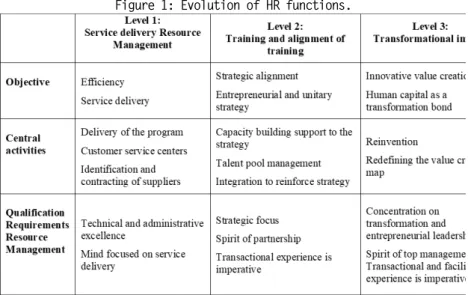
Another important reflection was the professor of organizational behavior at the London Business School, Douglas Ready, he points out the importance of developing the people who are in charge of developing all the others. In figure 1, the author guides three levels of Resources Management functions.
Figure 1: Evolution of HR functions.
Thus, if HR managers served the third level in the companies, they would have sufficient capacity to lead the changes and meet the requests of the directors.
Due to the movements of the market and organizations, the HR function has undergone several modifications over time, including in relation to nomenclatures. What until then was known as a personal department or HR department, went through the phase of associating people management with strategic issues of the company, focused on results, some authors denominated Strategic HR Management or Strategic HR, (Miner, Crane, 1995; Albuquerque, 1999). Already for a more humanized bias the terms "Human Capital Management" or "People Management" or "Talent Management" were considered.
People management is directly related to the values, mission, vision and goals of the company. According to Gil (2010, p.17), "people management is the managerial function that aims at the cooperation of people who work in organizations to achieve both organizational and individual goals." Therefore, the importance of aligning personal goals with those of the company, because it strengthens the relationship that goes beyond rights and duties.
The challenge that organizations face is precisely, at this point, to get everyone engaged in the company, to believe in the purpose and goals. To form a team that adheres to the purposes of the organization, first and foremost, leaders need to be in agreement with the goals and pass on their respective teams.
As a result, we started to study more about the effects on the corporate environment, to value the professionals and to allocate them in a more productive and directed to their own competences. As a result, these professionals sought more and more qualification and increased competitiveness among employees and between organizations.
The Historical Evolution of the Concept of Competence-Based Management
The market between the 1980s and 1990s underwent intense changes related to management, technology, labor relations and this reflected in the increase of competitiveness. From this, there was the process of restructuring and adapting the culture and management model of the organizations to remain attractive in their segments.
The term competence can be seen from several perspectives, as it is applied to several areas of knowledge. For management one of the understandings is that it
refers to the famous CHA (knowledge, skills and attitudes), according to Matos (2013, p.51):
[...] Competence is the knowledge, skills and attitudes that the individual develops and transforms into performance within the corporate environment, and that qualifies him or not for the demanding job market and also for possible promotions within the organization. It is the CHA (knowledge, skills, attitudes) so discussed in academic circles. [...]
There are also other perspectives that understand the competence factor as "(...) know how to act, mobilize resources, interact multiple and complex knowledge, learn how to engage, take responsibility, have strategic vision. The competences must be aggregators of economic value for the organization and of social value for the individual "(Fleury & Oliveira, 2001, p.190).
However, Dutra (2004) mentions that an individual's performance refers to three important factors: development, effort, and behavior. Following the rationale of Dutra (2004), the author discusses that making a scale of complexity is the best way to measure development, by analyzing how the individual is able to deal with difficult situations, making decision in complex scenarios, this can be done both by the individual himself and by the head of the same.
Effort differs from development by the fact of how is the relationship of the company with the developer, win-win, lose-win or lose-lose? An individual who is struggling today does not mean that he or she will always strive, so Dutra (2004) believes that effort is linked to motivation and a variable remuneration can be used for it.
On the other hand, the behavior is something subjective, but that can be analyzed through management tools, such as profile mapping with a 360º evaluation, can be accompanied by two forms, both static and dynamic, in the first can be a specific situation of the company, the second is related to organizational learning and skills development.
According to Zarifian (2003), it is recommended to apply competency management through six phases:
a) Explain the strategy: This is the starting point, explaining the organization's strategy and the competencies that interest it to be developed.
b) Explain the organization's macro - choices: It is the institution's options linked to its objectives that explain the reason for developing such competencies.
c) Define principles that characterize what is meant by competences: At this stage we define a philosophy of competence.
d) Elaborating a first definition of the areas of competency: The major areas of competence should be mapped, according to the author, based on four pillars, the professional competences, organizational competencies and competences related to clients.
e) Make an analysis of the situations with the stakeholders: Identify with the interested public, build the competences that are mobilizable.
f) Validate areas of competence and rank hierarchical levels that will interfere in wages: Finally, the hierarchical levels are arranged to make everyone explicit.
They are steps for mapping organizational competencies and organizing them in ways that add the institution a competitive advantage over its competitors.
Conceptual model of competence-based management
The word competence comes from the Latin word "competentia", meaning in the dictionary of the Portuguese language: "Legal Faculty, which an official or a court has, to judge and judge a lawsuit or question. Quality of those who can appreciate and resolve any matter. Aptitude, suitability: man of great competence" (Figueiredo, 1913, page 490).
In the English-language dictionary (Gove, 1981, p.63), it defines competence as: "quality or state of being functionally adequate or having sufficient knowledge, judgment, skills or strength for a given task."
For the administration, the authors Dolabella; Bitencourt (2006, p.3) explains that "competence management has a very dynamic concept and is still under construction, having basically two theoretical perspectives: one based on the individual (qualification and development) and the other focused on the organization (strategy)".
The author Durand (1998) makes a comparison "in medieval times, the alchemists sought to turn metals into gold; managers and companies today seek to turn assets and resources into profits. A new form of alchemy is needed by organizations. Let's call it 'competence.' "
Although the individual may have natural competences, on the other hand the learning process for the development of others is needed. In this sense, Zarifian (1999), addresses as main changes in the corporate universe that justify the management competency model:
Figure 2: Changes that justify the Competence Management model.
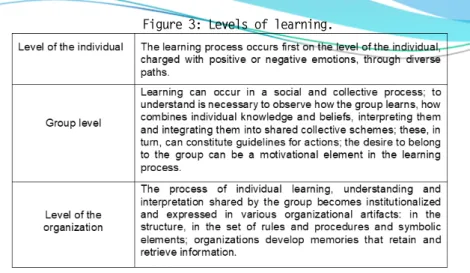
In this context, Fleury & Fleury (2001) posits that competence is directly related to learning, so one must go the path of individual learning, group learning and, finally, learning in the organization. The authors also explain that "learning is a complex neural process, which leads to the construction of memories. What you learn and then forget is as if it never happened; the set of things we remember is our identity. "
However, in what way do we move from individual learning to organizational development? In order to answer this question, the figure 3 to explain.
Figure 3: Levels of learning.
TALENT MANAGEMENT
A major differential for companies is to use intellectual capital as a competitive advantage in the market, considering that the greatest resource of the institutions are in their employees, from the shop floor to the CEO.
However, there are many barriers to training, developing and supporting talents in Brazil, this has a much broader scope than just the impact on companies, since training starts at school.
In an interview with the magazine HSM MANAGEMENT, Robinson (2012, p. 2) states that "(...) talents are systematically destroyed (...)". He points out a problem in the educational system, in Brazil and in many other countries, because they are standardized, "(...) the result is that future adults lose contact with their creativity, ironically the most necessary skill of today's companies.)". Due to constant changes, the corporate environment also continues to adapt to new realities and ways of producing, even without the need to register the point.
The author brings another important reflection about the traditional model of professional training:
"For years and years companies have assumed that by being formally educated people will have the skills, skills and competencies that businesses need. Parents, on the other hand, also assumed that, once educated, their children would have jobs and income. But this relationship between business and education is broken; we destroyed talents. " (p.2)
This reality affects in many sectors both educational, professional and economic, there is a tendency to follow standards. However, a process of revolution is continuing and many organizations have become aware of the change in the business scenario, which requires constant learning and adaptation to innovations.
According to Chowdhury (2003, p.31), "a person with talent is a creator, someone who breaks rules, initiates changes, and generates knowledge. Talents are the spirits of a company. They open the door of knowledge to all. "
According to Fleury & Fleury (2001), the company's strategy must be aligned with the competencies that need to be contracted-Phase of Personnel Capture-; the Process of Competence Development, are opportunities that the company offers to train and train the employee; finally, the Talent Retention is sought, so that the remuneration can be improved through promotions.
Therefore, it will be analyzed in the following sections the origin and importance of talent management and its advantages, in addition, will be discussed on the attraction, development and retention of talent.
Origin and Importance of Talent Management
In a scenario of changes, Guedes (2002) lists three movements that contributed to the changes in the scenario: globalization until the end of the 20th century, spread production, technology, organization and consumption; productive restructuring with the model of rigidity, with wage employment, state regulation, intense union participation is replaced by a more flexible model, with new segments and innovation in several areas and finally, there was the financialization movement, as it defines the accumulation of wealth.
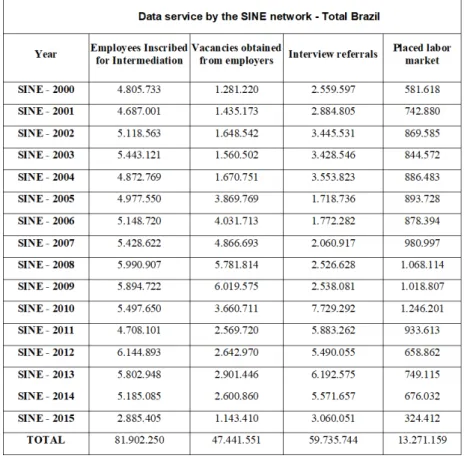
The changes in market trends led to changes in the paradigms of business management, especially with regard to the profile of the employee, because what was once ideal and desirable, for example the ideal employment relationship was to stay thirty years in a company, this was seen as stable, secure and reliable, today there may be another interpretation, comfort. We can analyze these changes through Figure 4.
Figure 4: Data on labor intermediation from 2000 to 2015 - Data up to 08/15/2015.
The SINE (National System of Employment) instituted by Decree 76.403 on 08.10.75, is an agency of the federal government coordinated by the Ministry of Labor and Employment, with the purpose of intermediation of labor through its agencies spread throughout the country, in addition to controlling the payment of unemployment insurance and support the Employment, Work and Income Generation Program (PROGER).
It can be noticed an evolution in the years 2000 to 2008, on workers placed in the labor market. From 2009 to 2015, a significant drop in this indicator, which explains the great economic recession that Brazil has faced in recent years.
At that rate, there was a growth in people management, because economics and technology required this from companies, and good professionals needed to be kept
in the company to make it competitive. From here, started speaking themselves in talent, attracting, developing and retaining them, the new challenge of organizations.
According to Chiavenatto (2004, p. 54), "the concept of human talent necessarily leads to the concept of human capital - the invaluable asset that an organization can muster to achieve competitiveness and success." And Mayo (2003, p.5) states that "without people, all structural elements - as much relating to clients as organizational ones - could disintegrate and would surely stop growing."
A fact that was increasingly confirmed in the eyes of managers, betting on people became the investment with the greatest return in organizations.
Advantage of Talent Management
Talent management stands out as a competitive advantage in the market because it focuses on high performance, according to Ulrich (1999, 29) "successful companies will be those more experienced in attracting, developing and retaining individuals with skills, perspective and experience to run a global business. "
For Tachizawa et al. (2001) the importance of concise, results-focused management is defined by
One of the requirements for organizations to achieve better results is to optimize the resources they have... As a result, the optimization of people's work may increase as specific programs maintain their motivation and develop their skills. Therefore, the optimization of people's work is directly linked to the better financial performance of the organization (pp. 123-124). The differential of companies is in their own talents, without them nothing happens, creativity, knowledge, skills, ability to make decisions and lead changes within the organization, attracting customers, making business profitable, innovation among many other advantages. This happens when the team is united, valued and satisfied, challenging but not impossible.
To remain competitive in the marketplace, companies have adapted their culture and goals to the required changes, just as people have had to be more and more qualified to face competition. In this sense, there has been an evolution also in the new generations, as the world is becoming more dynamic and to remain in the market is necessary beyond all the qualifications, much flexibility to adapt to different environments.
However, new generations are not only concerned about pay, because what makes sense in building a career is much bigger than that, they need to be part of a purpose and feel valued.
It can be said that the business environment interferes a lot with the motivation and quality of life of the employee, a fact that proves this is the home office, this work strategy became much more common, because the entrepreneurs noticed that certain segments need bigger incentives creativity and stimulate brilliant collaborators. In addition to that, both the company and the employee can benefit, avoiding chaotic traffic, better balancing personal and professional life and reducing costs for the company.
Although many companies are already aware of this new trend of humanization, there are others that remain resistant, but only those with ease of adaptation will survive in the market.
METODOGY
The present study is exploratory in nature, it is characterized as a quantitative approach and for the purposes of its operationalization it was developed from a bibliometric research, aiming to broaden the knowledge related to the
in the database WOS in the period 2000-2017 and to identify which topics are related to the topic being studied and which are more relevant.
Definition of the study scope
The investigation of the publications for the accomplishment of bibliometrics was carried out from the search engines of the database of Web of Science (WOS).
The WOS is a multidisciplinary base consisting of approximately one third indexed.000 newspapers. It is an index of citations, informing, for each article, the documents cited by him and the type of documents that quoted him (Graph 1).
Graph 1. Type of documents.
Source: Own elaboration.
Bibliometrics has the characteristic of disseminating and exposing scientific knowledge through the quantification and measurement of publications of articles and researches carried out.
For Oliveira et al (2013), the use of bibliometric research is a fundamental resource for the search of scientific knowledge and its purpose is the application of a technique that measures the influence of some variables such as: researchers or journals, allowing to draw the outline and their trends.
The terms Skills Management and Talent Retention were searched in the Web of Science in the period between 2000 and 2017 resulting in a total of 28 papers.
The following variables were identified for the bibliometric analysis of the study: main authors, title of the sources, main institutions, year of publications, main countries and languages, relationship between authors with more publications and more cited publications.
Steps for collecting data
The research was divided into two stages. Initially, the terms Skills Management* and Talent Retention* in the WOS base search field. The asterisk was used to cover terms with different endings related to the words Skills Management* and Talent Retention* if delimiting the period 2000 - 2017. The following are general characteristics of publications have been raised.
We compared the most cited publications and the authors who published the most during the same period, in the second stage. It is evident from Figure 5 the steps of the research.
Figure 5 - Stages of the research.
Therefore, a bibliometric analysis of the aforementioned study was performed according to the steps described in Figure above.
ANALYSIS AND DISCUSSION OF RESULTS
Next, the results of the research are presented, identifying the main characteristics of scientific production in the WOS related to the keywords Competency Management and Talent Retention in the period 2000 - 2017. After improving the research for the categories of Competency Management and Retention of Talents and choosing to present results referring only to articles, total of 28 articles. First, the general characteristics of the publications will be presented: main authors, title of sources, main institutions, year of publications, main countries and languages. Finally, the number of publications per author and the number of citations will be presented.
General characteristics of the publications on Management by Skills and Retention of Talents in WOS
The following are the general characteristics found in scientific publications around the world related to the themes of Competence Management and Retention of Talents, the following sections will be presented: main authors, title of sources, institutions, year of publications, countries and languages.
Main authors
You can see in Graph 2 the main authors who have published articles on the
topics Management Skills and Talent Retention from 2000 - 2017. Graph 2 - Number of articles by author.
Management by Skills and Retention of Talents simultaneously. The authors who had the highest number of publications were: Caracol; Coetzee; Da Palma, and Sousa with two each.
Title of the sources
In Graph 3, it presents the main sources of publications. Graph 3 - Number of articles by source.
It can be verified that the sources with the greatest number of articles published on the subject of Competence Management and Retention of Talents were in the African Journal of Business Management (2), Proceedings of the Conference on European Management Leadership and Governance (2) and the Sa Journal of Human Resource Management (2) publications.
In Graph 4, are the main areas of publishing articles.
Thus, it should be noted that the main areas of publications include Business Economics.
Institutions
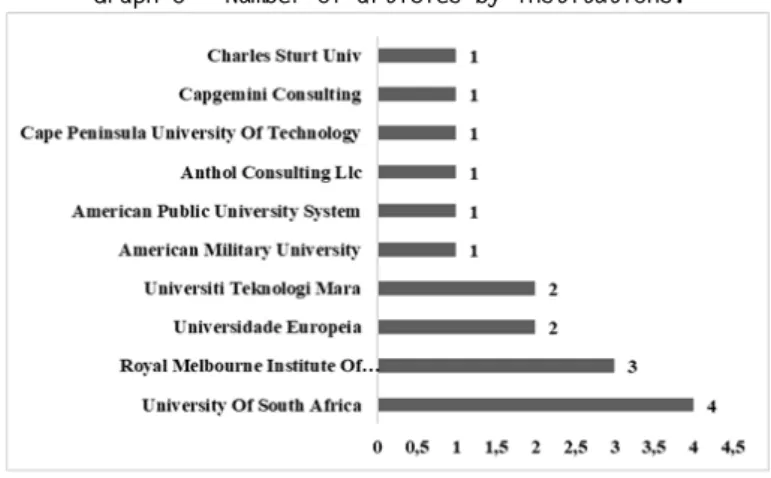
With Graph 5, one can analyze the institutions that had the greatest publication of articles on the subject in question.
Graph 5 - Number of articles by institutions.
There are also a few institutions that have had publications on the subject, such as the University of South Africa (4), Royal Melbourne Institute of Technology Rmit (3) and 2 publications on the topics analyzed at the European University and Universiti Teknologi Mara.
Articles per year
In Graph 6, it represents the number of articles per year in the period 2000 - 2017, on the subject.
Articles by country
With Graph 6, it can be analyzed that the publications on the subject begin, worldwide, in the year 2006, which is a very current subject. But the graph 7, showcase the number of articles by country.
Graph 7 - Number of articles per country.
It is verified that the largest amount of publications was in South Africa that led the ranking with 7 articles, followed by the United States with 4 publications.
Therefore, it can be inferred that in these countries there are most publications related to the topic Skills Management * and Talent Retention *. It is noteworthy that, although in Portugal there are 2 publications in the Web of Science on the researched subject, which indicates that this theme is still little worked, so it may be useful for future Portuguese researchers who seek originality in their works.
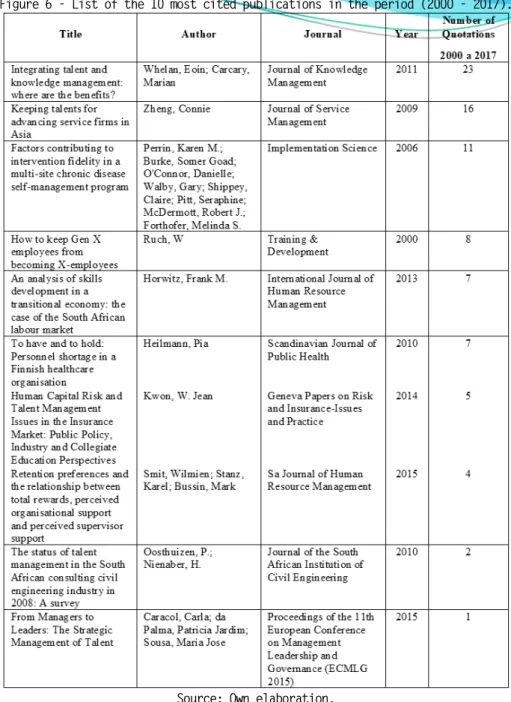
Given the research on issues Skills * Management and Talent Retention*, held in WOS, the ten were selected most cited publications and related to the authors with more publications not shown in Figure 6.
Figure 6 - List of the 10 most cited publications in the period (2000 - 2017).
Source: Own elaboration.
The preparation d to figure 5 aimed to analyze the relationship of the cited publications to the authors that published that same period related in Figure 2. In the image we found that the article " From Leaders to Managers: The Strategic Management of talent " belongs to the authors Caracol, C; Palma P. J.; Sousa, M J. who are among the top 10 on the subject.
CONCLUSION
This study aimed to understand the characteristics of the international scientific production that relates the themes Management by Competencies and Retention of Talents. In order to fulfill the objective of this study, bibliometric research was carried out using WOS, which resulted in the analysis of 3 types of documents.
In relation to the research perspectives, it is verified that the interests and foci of research on the subject of Competence Management and Retention of Talents, express an increase in the importance of the area for scientific knowledge. Thus, it was possible to map and analyze the scenario of scientific production related to the
With regard to the dissemination vehicle, it was found a representativeness in the publication of articles. The year with the highest number of publications was 2015. The sources of publication stand If African Journal of Business Management (2), Proceedings of the Conference on Management Leadership and European governance (2) and Sa Journal of Human Resource Management (2).
As for the authors who published more on the subject under study, a multiplicity and diversity was observed regarding the authorship of the works. It was found, therefore, that the most cited researchers were : Whelan, E; Carcary, M. with 23 quotes, not having a great exponent when analyzing the subjects Skills Management * and Talent Retention *, simultaneously.
The institutions that stood out in terms of publications related to Skills Management * and Talent Retention *, were: University of South Africa (4), Royal Melbourne Institute of Technology RMIT (3) and two publications on the topics analyzed European University and University Teknology Mara
Also, the ten publications most cited and related to the authors with the highest number of publications were selected. Against this background it was found that three of the authors that more public plow in the period 2000 -2017, are co-authors of a d the more articles cited in Web of Science.
The contribution of this article to the studies in Management is due to the resulting indicators regarding the research institutions and the periodicals that stand out most in the production of the knowledge on the subject at the international level.
LIMITATIONS AND FUTURE RESEARCH LINES
The fact of the information presented are limited to items found in the Web of Science because of the incompatibility of other databases with the software used in this study have the main limitation of this study.
For future studies it is suggested the expansion of research by articles on the subjects Skills Management and Talent Retention in the Scopus database as well as national and international scientific events in order to obtain other results on the bibliometric profile of the publications in relation to these themes.
BIBLIOGRAPHY
BARATO, J. N. Competências essenciais e avaliação do ensino universitário. Brasília: Universidade de Brasília. 1998.
CALLADO, A. André Cunha; AMORIM, Tânia Nobre Gonçalves Ferreira. Relações entre competências estratégicas e o uso de indicadores de desempenho de cadeias de
suprimento entre empresas agroindustriais. Revista ADM.MADE, Rio de Janeiro, ano 18, v.22, n.1, p.01-14, janeiro/abril, 2018.
CHIAVENATO, I. Gestão de pessoas: o novo papel dos recursos humanos nas organizações. 2. ed, rev. e atual. Rio de Janeiro: Campus, Elsevier Publishing Company, 2004. CHOWDHURY, Subir. A era do Talento: Obtendo Alto Retorno Sobre o Talento. São Paulo: Editora Pearson Education do Brasil, 2003.
DOLABELLA, R.; BITTENCOURT, C. C. A consolidação das competências organizacionais na vinicultura brasileira: um estudo de caso na Vinícola Miolo. In: ENANPAD, 2006. Salvador, BA, Brasil.
DRUCKER, P. F. Desafios Gerenciais para o Século XXI. São Paulo: Pioneira Thonson Learning, 2000.
DURAND, T. Forms of Incompetence. Proceedings Fourth International Conference on Competence-Based Management. Oslo: Norwegian Scholl of Management, 1998.
DUTRA, J. S. Competências: Conceitos e instrumentos para a gestão de pessoas na empresa moderna. São Paulo: Atlas, 2004.
DUTRA, J. S. Gestão de pessoas com base em competências: In: DUTRA, J. S. (org). Gestão por Competências.São Paulo: Gente, 2001.
FIGUEIREDO, C. Novo dicionário da língua portuguesa. Disponível em: http://dicionario-aberto.net/dict.pdf Acesso em novembro de 2018.
FLEURY, L. T. M.; FLEURY, A. Construindo o conceito de competência. RAC, Edição Especial 2001.
FLEURY, Maria Tereza Leme; OLIVEIRA JR, M. M. Gestão estratégica do conhecimento: integrando aprendizagem, conhecimento e competências. São Paulo: Atlas, 2001.
GIL, Antônio Carlos. Gestão de Pessoas – Enfoque nos Papéis Profissionais. São Paulo. Atlas. 2010.
GOVE, P.B. Webster’s third new international dictionary of the english language, unabridged. Springfield: G.& C. Merriam. 1981.
GUEDES, S.M.G. Perfil profissional e mercado de trabalho: relação com a formação
acadêmica pela perspectiva de estudantes universitários. Estudos de Psicologia, Natal, p. 299-309, jul-dez. 2002.
GUTIERREZ, L. H. S. Recursos Humanos: uma releitura contextualista. Revista de Administração de Empresas, v. 35, n. 4, p. 72-82, 1995.
LEAL, Rafael. Revista Melhor Gestão de Pessoas. Quatro pontos fundamentais para reter e motivar talentos atualmente. Disponível em: https://revistamelhor.com.br/reter-e-motivar-talentos-atualmente/ versão online. 2018.
MATOS, N. Conceito chave. Disponível em: http://www.revistamelhor.com.br/textos/0/ conceito-chave-264339-1.asp Acesso em setembro de 2013.
MAYO, A. O valor humano da empresa: valorização das pessoas como ativos. São Paulo: Pearson Prentice Hall, 2003.
MERTENS, L. Sistemas de competência laboral: sistemas, surgimento y modelos. Turin: OIT, 1996.
MINISTÉRIO DO TRABALHO E EMPREGO. Postos do Sistema Nacional de Emprego – SINE.
Disponível em: http://dados.gov.br/dataset/postos-do-sistema-nacional-de-emprego-sine. Acesso em novembro 2018.
MINISTÉRIO DO TRABALHO E EMPREGO. Tabela – Dado sobre intermediação de mão-de-obra de 2000 até 2015. Publicado em 01 de setembro de 2015. Disponível em:
http://trabalho.gov.br/dados-abertos/sistema-nacional-de-emprego. Acesso em novembro de 2018.
READY, Douglas. Evolução das funções de RH. Publicado na revista HSMManagement; 2010. ROBINSON, Ken. Destruímos Talentos. Revista HSMManagement, setembro-outubro, 2012. SANT’ANNA, S. A.; DINIZ, M. D.; PAIVA, G. M. S.; Revista de Ciências da Administração • v. 20, n. 51, p. 138-151, novembro. 2018
TACHIZAWA, T.; FERREIRA, V. C. P.; FORTUNA, A. A. M. Gestão com pessoas: uma abordagem aplicada às estratégias de negócios. 2. ed. Rio de Janeiro: Fundação Getúlio Vargas, 2001.
ULRICH, D. Os campeões de recursos humanos: inovando para obter os melhores resultados. São Paulo: Futura, 1999.
WEBSTER. Webster’s third new international dictionary of the english language, unabridged. Springfield: G.& C. Merriam, 1981.
ZARIFIAN, P. Objectif compétence. Paris: Liaisons, 1999.
ZARIFIAN, Philippe. O modelo da competência: trajetória histórica, desafios atuais e propostas. São Paulo: SENAC, 2003.