A Work Project, presented as part of the requirements for the Award of a Masters Degree in Management from the NOVA – School of Business and Economics
How to optimize the traditional retail market for
FMCG sector?
A Regional approach for Unilever’s Business
Model
Booklet 1 of 2
Tânia Cristina Ferreira Sequeira
Student Number 879
A Project carried out on the Field Lab in Entrepreneurial and
Innovative Ventures, under the supervision of:
Prof. Filipe Castro Soeiro
2
ABSTRACT
The aim of this work project is to discuss, assess and optimize the business model of a relevant manufacturer in the Fast-Moving Consumer Goods industry, Unilever-Jerónimo Martins, to be applied, afterwards, to the traditional retail stores placed in the coastal zone between Lisbon and Oporto.
The trends of the traditional retail market were discussed in interviews to traditional retail managers of Lisbon, sales/merchandising teams and distribution experts. Focusing on a sample of 14 traditional supermarkets placed in the coastal zone and 30 traditional store customers, it was proven that a distributor that supplies many products categories is higher appreciated by these retailers. As a result and assessed the capabilities and resources of Unilever-Jerónimo Martins, the customized distribution service based on direct store distribution and “personalized selling service” should be provided.
KEY WORDS
Retail Management, Fast-Moving Consumer Goods, Unilever-Jerónimo Martints, Business Model, Traditional Retail Market, Coastal Zone between Lisbon and Oporto
INTRODUCTION
Proximity and trust as main differentiation factors, the traditional retailers, meaning the independent or regional supermarkets chains1 have been emerged in the last years. Consumers have been more demanding in their choices, valuing the quality-price ratio and shopping in the nearest stores to their homes. However, the capillarity of this market, characterized by retailers with dissimilar management styles, hides a not exploited value by manufacturers of the Fast-Moving Consumer Goods sector like Unilever-Jerónimo Martins.
3
In recent years, due to the economic crisis, traditional retailers have been embodied private labels in their portfolios. As a result, consumers have been shift from manufacturers’ to private brands which narrowed the revenues from the producers’ products. How should Unilever-J.M. mitigate the threat of the private labels? What are the other trends that influence the Unilever’s Business Model? What is the desired strategy to be applied to the traditional retail market? Hence, the purpose of this work project is “How to optimize the traditional retail market for FMCG sector? A Regional approach for Unilever’s Business Model” by, firstly, presenting a literature review where the main studies about consumers, retailers and manufacturers are stated. Secondly, it is referred the main objectives that Unilever-J.M. aims to achieve and its current business model is analyzed. Afterwards and focusing on the framework built based on the literature review conclusions it is proven hypothesis that are used, with interviews and articles, to characterize the traditional retail market. Taken into account market analysis findings, it was assessed the Unilever’s business model and stated the desired strategy to be applied to this market.
LITERATURE REVIEW
The relevance of the market segmentation based on location has been disregarded by most of the business studies (Clarke et al,1997) but Clarke et al,1997 defends that retailers should implement different strategies, firstly, according the maturity level of the zones where the store is placed2 and, secondly, concerning the consumers’ behavior and trends.
Studies are also incomplete in what concerns the scope of analysis, by not including an overview of the retail industry structure and the behavior of all players: retailers, manufacturers and consumers.
2 To identify the level of maturity of a region it should be analyzed the following factors: market rivalry;
4
Hence, the main studies regarding consumers-retailers, consumers-manufacturers, retailers-manufacturers are referred in the next sub-chapters and the main conclusions are used to build a framework, presented afterwards, that will be employed in the definition of several hypotheses regarding the traditional retail market trends.
Consumers and retailers | Consumers display different motivations when they have to decide the store to shop (Morscheet et al. 2005)and it includes attributes like store prices3 (Ofir et al, 2008), experience of the retailer, trust about products and retailer, assortment of the products, return policy, product research, delivery cost and loyalty (Helbling et al, 2011). However, the motivations are not common to all the consumers, because they perceive differently the same stimuli which require strong efforts by the retailers to identify changes in consumer demographics and behavior (Konus et al,
2008). As a result, motivations to visit the traditional retail stores diverge among
customers and over time.
Consumers and the manufactures | The tangible contact between consumers and products take place in the point-of-sales but the positive attitude and behavioral intentions towards those products (Keller, 2003) are created by brand-building activities (Sridhar, 2012) such as advertising, pricing strategies and promotional activities. In addition this kind of activities improves not only the consumers’ knowledge about the brands (Aaker, 1991) but also enhances the brand recall and recognition (Solomon et al,
2006).
Retailers and the manufactures | According to Ganesan et al, 2009 part of the retailer payoffs come from the manufacturers’ activities like brand image, sales and products
3
If there is a demanding range of products with lower prices, consumers will regard that store as lower prices.
5
innovation, meaning that to maximize profits, retailers and manufacturer must cooperate in order to find out the best strategies that fit the marketing and the supply requirements of both players. Note the point-of-sales decisions (i.e. merchandising, secondary places and shelf allocation)influence the consumer perceptions and products perceptions (Berthon et al, 2011), thus retailers should be able to manage product categories as specifics profit centers in order to determine which brand-build activities should be implemented in the store as well as to determine the shelf space allocation to each brand/product (Waller et al, 2010). In addiction stock-outs should be carefully managed by retailers with manufacturer’s collaboration to consumers not switch stores or products (Waller et al, 2010).
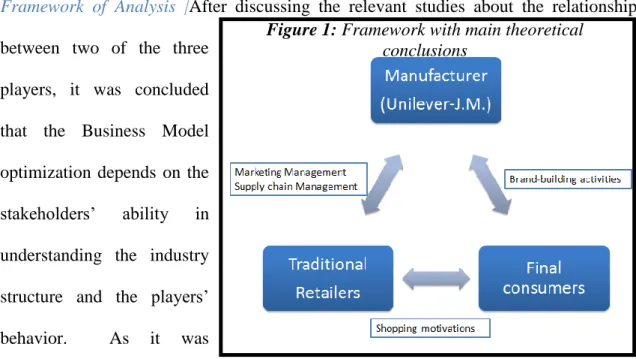
Framework of Analysis |After discussing the relevant studies about the relationship between two of the three
players, it was concluded that the Business Model optimization depends on the stakeholders’ ability in understanding the industry structure and the players’ behavior. As it was
represented in Figure 1, Unilever-J.M. should assess its business model according to the requirements of its customers, the traditional retailers, focusing on marketing and supply issues. On the other hand, consumer trends should also be taken into account because he is the agent that decides what and where to shop.
Figure 1: Framework with main theoretical conclusions
6
THE OPPORTUNITY IN THE TRADITIONAL RETAIL MARKET: RESEARCH QUESTION EXPLANATION
A wider research stands that to survive in a foreign country, companies should implement a strategy adjusted to the particularities of the region (Becker and Huselid,
2006) but even inside the country marked differences in regions could be found. As title
of example, the eastern zone of China has higher concentration of the retailers but, in the other hand, the consumers’ purchasing power is lower compared to the western (Simões, 2012). Consequently, many companies have failed their internationalization in China due to its lack of knowledge regarding the market characteristics. In Portugal, there is a zone (between Lisbon and Oporto) 4 where are placed in 2010, 70%5 of the modern stores6, 64%7 of the traditional retailer and 62%8 of the total population. With such agglomeration of individuals and retailers, there is strong evidence that players behave differently from the interior region.
On the other hand, the supermarkets category have been registered, in the coastal zone of Portugal, an annual growth of 6,5%9, from 2002 to 2007, and an increase of 4%10 on the stores number, from 2000 to 2009. Despite most of the supermarkets belong to one of the eight biggest national and international retailers that operate in the market (i.e. Sonae, Jerónimo Martins, Intermaché, Auchan, Lidl, Minipreço, Carrefour and Plus), the verified growth on sales and number of stores may also be explained by the strategies applied by the remaining supermarkets like embodying private labels in their
4
To this project purpose, the coastal zone follows the Nielsen characterization and includes the following districts: Lisboa, Porto, Setúbal, Aveiro, Braga, Coimbra, Viana do Castelo e Leiria
5 Source: Nielsen, “Anuário Food 2010”, Unpublished 6 Modern retailers are stores that belongs to national and international retail chains
7
Source: Nielsen, “Anuário Food 2010”, Unpublished
8 Source: INE Portugal, 2010, http://www.ine.pt/scripts/flex_provisorios/Main.html
9 Source: Nielsen, “Anuário Food 2010”, Unpublished 10 Source: Nielsen, “Anuário Food 2010”, Unpublished
7
offerings11. As a result, sales from Unilever products could decrease as well as it could narrow the products references acceptance by the traditional retailers.
Hence, the research question of this project is “How to optimize the traditional retail market for FMCG sector? A Regional approach for Unilever’s Business Model” meaning that, how can Unilever’s enhance its position in the traditional retail market by analyzing, discussing and assessing its Business Model.
Some years ago, Unilever provided its products to the traditional supermarkets by direct store distribution, but due to the higher level of complexity of the operations, costs associated and the number of workers required, this strategy was discarded. Concerning the current market trends, one of the hypotheses for Unilever-J.M. is implementing the strategy that did not work in the past, but should this strategy be applied? Are the current environmental and placement conditions strong enough to provide a customized service? What resources and logistics should be used? How should be set the marketing and sales strategy of the service? How should be set the quality of service? These are the sub-research questions discussed in this work project.
UNILEVER JERÓNIMO – MARTINS
Unilever was created in 1929 by a merger between Lever Brothers (British company that provided soups solutions) and Margarine Unie (Dutch firm that offered margarine solutions). Currently, it is a global manufacturer of Fast Moving Consumer Goods known as “knowledge-based organization” (Geoffrey, 2005) due to its operations in more than 190 countries12 worldwide and its large portfolio of brands from food and beverage to home and personal care, where only twelve of the thirty-four brands
11 Source: APED and Roland Berger Strategic Consultants, 2009 12 Source: Unilever Corporate, 2012,
8
generate 1 billion Euros of sales per year13. Unilever is also a decentralized company with headquarters placed in Rotterdam, Netherlands (Unilever NV) and London, United Kingdom (Unilever PLC)14 with 190 independently affiliates which employee more than 171.000 workers15.
With a growth strategy focusing on mergers, acquisitions and joint-ventures, in Portugal the presence of Unilever was intensified, in 1949 with the creation of a joint-venture between Unilever and Jerónimo Martins Group. In 2007, it was chosen the name of “Unilever-Jerónimo Martins” which came from a merger of three manufacturers: FimaVG (margarine producers), Lever (offers cleaner products), IgloOlá (provides frozen producer) and Bestfoods (food solutions). Nowadays, this is the only case of joint-venture inside the Unilever’s group represented by 55% of Unilever equity and 45% of Jerónimo Martins equity16.
The products offered by Unilever-J.M are manufactured in one of the four factories located in Sacavém and Santa Iria de Azoia or imported from other Unilever companies to be afterwards distributed to Cash and Carries, Modern retailers17 and, since July 2012, to the traditional retail stores.
PRODUCTS AND SERVICES OFFERED
In Portugal are offered twenty-three Unilever brands divided by three main categories: Food & Drink, Personal and Home Care.
In the “Food and drink” category are included: preparations for desserts (Alsa brand); drinks (Lipton); Ice creams (Olá, Ben&Jerry); vegetable oil spread, butteries, milks and
13 Source: Unilever Corporate, 2012,
http://www.unilever.com/aboutus/introductiontounilever/unileverataglance/
14 Both headquarters have the same authority and operate based on the similar standards but in terms of
law they are independent.
15
Source: Unilever Bangladesh, 2012, http://www.unilever.com.bd/aboutus/
16 Source: Jerónimo Martins, 2012, http://www.jeronimomartins.pt/o-grupo/faqs.aspx
17 The distribution of the products is made by outsourcing companies such as Frisul LDA and Luís
9
yogurts (Becel, Flora, Vaqueiro, Planta, Tulicreme); soups, stocks and sauces (Calvé, Knorr) and Maizena. The “Food solutions” is a brand exclusively designed to out of home market18 and includes services such as culinary ideas and expertise provided by professional cuisine chefs as well as packaging solutions. Regarding the Personal Care category, it is offered sprays, deodorants, antiperspirants, shower gels, hair products, lotions, soaps and shampoos through brands like Axe, Rexona, Dove, Lux, Vasenol and Linic. Lastly, concerning the Home Care it is composed by cleaning, laundry and dish products represented by Cif, Confort, Skip, Surf and Sun brands.
All products could be found in the two channels: in home19 and out of the home, but 90% and 95%20 of the Olá, Ben&Jerry, Lipton and Food Solutions products are sold in the “out of home” market and also 90% to 95%21 of the remaining brands are sold “in home” market.
VALUE PROPOSITION
Concerning the “in home” market, Unilever brands are sold to retailers and wholesalers which will sell them afterwards to the final consumer, meaning that Unilever creates value for both: final consumers, retailers and wholesalers. In one hand, Unilever offers products with “superior design, characteristics and branding”22
that the consumer is looking for to satisfy their needs of food, personal or home care. On the other hand, retailers and wholesalers captures value from the price margins applied to the products. Note also that Unilever brands have a strong image which attracts consumers to the stores (Jeff 2011) and increases the retailer profits. As a result, it was developed a
18
Out of home market corresponds to the outlets for immediate consumption (i.e. cafeterias, restaurants)
19 In home market corresponds to the “mass market” retailers (i.e. supermarkets, groceries, wholesales) 20 Source: Interview with Mr. Pereira, João (Head of Sales Field - In Home Channel at Unilever JM);
2012, at Unilever-J.M. headquarters, September 18th
21
Source: Interview with Mr. Pereira, João (Head of Sales Field - In Home Channel at Unilever JM); 2012, at Unilever-J.M. headquarters, September 18th
22 Source: Unilever, 2012,
10
pull relationship where retailers win value by having and selling the brands and also consumer gain by using higher quality products.
MISSION AND VISION
Corporate Mission| The core business of Unilever is to provide innovative and higher quality products that can change the consumers’ life. Therefore, Unilever’s mission is to give vitality to people’s life helping them to feel good, happy and to adopt a healthy state of body and mind.
Vision of the Project |Taken into consideration the trends of the traditional retail market, Unilever should optimize its Business Model focusing on the service provided to those retailers. In other words, the vision of this work project23 is:
“Our vision is to be market leaders while focusing on the customer relationship in the traditional retail stores placed in the coastal zone between Lisbon and Oporto by
2018.”
STRATEGIC OBJECTIVES
To Unilever be the market leader in the traditional retail segment, strategic objectives must be set in terms of marketing and sales strategy, logistics, resources and quality of the service provided. Therefore, the increase on the market share, on sales volume and on the number of products references defines if the marketing and sales strategy chosen is the best one. On the other hand, retain and acquire new customers measures the quality of service. To define the logistics and resources it will be chosen the most cost-efficiency strategy that did not compromise the levels of quality and the results of the marketing and sales strategy.
The following strategic objectives are for a year (end of 2013) to the traditional retail stores24:
11
• Increase the market share of the products between 300 basis points and 500 basis points;
• Reach the sales volume of 1% of the Cash and Carries;
• Increase the number of products references 5% in each store; • Increase the number of new customers around 30%;
• Retain between 95% and 100% of the existing customers;
BUSINESS MODEL
To mitigate the threats like the growth of the private labels and to take advantage of the traditional retailer market opportunities, since July 2012, Unilever-J.M, has been trying to understand the impacts of a customized service in the distribution channels to this market.
Before July 2012 the traditional retail market was served by the Cash & Carries, meaning that Unilever provided the products to these wholesalers by using the Luís Simões and Frisul distributors and the traditional retailers contacted the wholesalers to get the products. As a result, there was no direct contact between Unilever and the retailers but since July, it has been testing a different strategy. It was contracted 6 vendors of SociPrime25, divided by areas among Portugal, to visit the traditional retailers and make the orders. These orders are given to Unilever-J.M. which will distribute the products directly to those stores by using their own distributors26 1 week after. The sellers also have the objective to contact prospective traditional supermarkets in order to understand their willingness to use this distribution method and, if so, the application process is evaluated by a computer system. The final approval is made only
24
The strategic objectives were proposed by me and accepted by the company.
25
SociPrime is a Portuguese company that provides merchandising services. Its core business is divided by four independent areas: Reposition, Promotion, Fixed Teams Management and Logistics Implementation.
12
if the traditional store does not have outstanding debts and if the store generates a considerable amount of revenues. Even though, due to administrative procedures the first delivery takes 15 days to the order be completed. The last main task of SociPrime has been trying to realize, in the first phase, if the retailer is willing to accept merchandising in his stores in order to increase the visibility of Unilever brands and, in the second phase, to provide the visibility materials to retailers.
Characterizing the customer relationship management depends on the distribution channel used to serve the traditional retail market, meaning that if Unilever-J.M. contract sellers to contact directly the retailers, the communication intermediaries are cut and the retailers’ requirements are precisely defined. As title of example, the manufacturer is able to negotiate point-of-sales variables such as implementing merchandising or creating secondary spaces in the stores. Otherwise, without this direct contact, the customer relationship management is inexistent or more difficult to optimize.
The bargaining power of Unilever and the traditional retailers influences the prices charged for the products. By using the Cash &Carry channel, traditional retailers not have the possibility to negotiate any subject regarding the products but, on the other hand, they can achieve better deals27. Nonetheless, to Unilever is better to reach agreements directly to the traditional stores because, besides the price, it is able to negotiate a packaging that includes merchandising or secondary prices in order to increase their sales volume and the brand awareness while it is offered a convenient distribution method. Note also that retailers create value if they have recognized
27 In general, traditional retailers may achieve better deals in the Oporto zone where wholesalers are very
competitive in prices. In the Lisbon area, the prices charged could be higher or lower than the direct distribution method offered by Unilever-J.M.
13
manufacturers brands because they increase the stores revenues, attract and retain customers.
To provide a customized distribution service to the traditional retail market monetary resources are required to face the incurred costs with SociPrime to manage the point-of-sales activity, but these outsourcing costs are 25% to 30% less expensive28 than a Unilever internal sales team. Even without precise information, the logistics costs by using their own distributors are important to take into consideration in this strategy. Therefore, to apply a customized service to the retail market, the distribution, marketing & sales and the after-service are the primary activities that may change. Concerning the distribution activities is required physical resources and human resources which, currently are provided through outsourcing contracts. Regarding the marketing & sales activity and the after-service it is required intellectual resources such as capabilities to convince, inform and solve alleged problems. Therefore communication materials and skills of the sales team play an important role. The technology is the support activity that represents a key role, because it is required to assess application processes. In addition, the Human Resources Management activity is also affected only if the marketing & sales and after-service activity are developed by Unilever-J.M. internal teams.
In conclusion, to optimize the traditional retail market, the customer relationship management and the distribution channel are key in the Unilever’ Business Model.
INDUSTRY MAPPING
The Unilever-J.M. business in the traditional retail market is influenced by several key stakeholders, namely: final consumers, traditional retailers, modern retailers, wholesalers and competitors.
28 Source: Interview with Mr. Pereira, João (Head of Sales Field - In Home Channel at Unilever JM);
14
The final consumer is the agent who decides what to buy, where to buy and how many times. As it was referred in the literature review, it is crucial to understand the key motivations to visit and purchase in the traditional retail stores. These trends are discovered in the market research study29 conducted to clients of the traditional supermarket placed coastal zone between Lisbon and Oporto and exploited, afterwards, in the market analysis chapter.
The traditional retailers are Unilever-J.M. that aims a better solution to the Cash &Carry that takes into account their needs and requirements. Therefore, the valued characteristics in a distributor are investigated and presented in the Gap Analysis chapter30. By being an alternative to the Unilever distribution services, the strategies applied by Cash & Carry influences the business model of the manufacturers.
To optimize the traditional retail market, the resources allocation may affect two main agents: the Unilever–J.M. internal employees and the outsourcing companies. If it was implemented the strategy that has been testing, because the distributors (Frisul LDA and Luis Simões) and SociPrime are outsourcing companies, changes on the business model does not affect the internal structure of Unilever-J.M. On the other hand, if it was more effective to provide the customized service by using internal resources, sales people reallocation should be required.
Lastly, Unilever has been facing many powerful global and national competitors in the FMCG industry where some of them have been exploited the traditional retail channels to increase its sales. Nonetheless, any competitor offers products from the three main
29 More information available in Booklet 2: Appendix 1 – Market Research Study: Results 30 More information available in Booklet 2: Appendix 1 – Market Research Study: Results
15
categories (food, home and personal care), which means that Unilever must take advantage in the business model optimization of its sustained competitive advantage. 31
MARKET ANALYSIS
The framework of analysis and the hypothesis| Bearing in mind the Figure 132 it was conducted a marketing research study based on a sample of 14 traditional supermarkets placed on the coastal zone and 30 customers of those stores in order to verify the main trends of this market33. Therefore, regarding the traditional retailers-final consumers relationship it was proven that the main key success factor of this the customized service (H1). In addiction traditional retail stores have been indentified that females between 45 to 65 years old age are the main customer but they do not have precise information about its education and background (H2). Lastly, traditional retailers offer the features, like products information, required by the digital consumer (H3).
Concerning the manufacturers-final consumers it was proven that final consumers have been shift from manufacturer brands to Private Labels (H4). Moreover, private labels are cheaper products with a level degree of quality associated (H5) but by reductions on price consumers may shift from private labels to manufacturer brands (H6).
The hypothesis proven by manufacturer-traditional retailers are presented only in the Recommendations and Conclusions chapter because they show the retailers preferences regarding the distribution method.
PEST Analysis| Consumers, Traditional retail stores, Unilever, Cash & Carries and competitors are traditional retail industry stakeholders that are influenced by
31 To determine the main competitive advantage of Unilever-JM it was used the VRIO analysis provided
in Booklet 2: Appendix 2 – VRIO Framework
32 Literature Review chapter
33 The surveys used as well the hypothesis proven are provided in Booklet 2: Appendix 1 - Market
16
environmental factors. Hence, in this topic it is developed a PEST market analysis focusing on the behavior and trends of the relevant stakeholders.
1. Political and Legal Factors |To avoid inefficiencies in the retail industry driven by the dominance of specific companies the Portuguese Government has been creating Law Regulations regarding the schedules of the stores and the concentration of the retailers to drive the industry as near as possible to perfect competition. Concerning the schedule regulation it was stated that supermarkets have freedom to choose the opening and closing hours/ days, but on the other hand, hypermarkets are avoided to operate on Sunday afternoon. As a result, if traditional retailers do not close doors on Sunday, they may reach customers.
It is also stated in the Portuguese Law that it is forbidden a dominant position in the market by a single or a very restrict group of retailers. Despites 70% of the market share34 belonging the Five Top players (Auchan, Sonae, Jerónimo Martins, Intermarché and Lidl), in the food retail market, the Portuguese Competitive Authority has been defending that the structure of the industry is not the oligopoly. Nevertheless all mergers, acquisitions and organic expansions must be carefully analyzed.
2. Economic Factors | The economic crisis, that Portugal is facing, is one of the reasons appointed to changes on consumers’ attitudes towards products and stores. The household income has been decreasing drastically which has been affecting the private consumption that reduced35 in 2011 around 4% and, in 2012, it is expected a decline around 3%. Other factors have been used to justify the drop on the private consumption such as the unemployment growth, the reduction of GDP and the escalation of the consumer prices around 3% in 2012 and a forecast of 1% in 201336. As result,
34 Source: APED and Roland Berger Strategic Consultants, 2009 35 Source: Euromonitor International, 2012
17
consumers have been more selective, and more concerned about price-quality ratios of the products they shop. A multi-shopper consumer has been emerged by exploiting opportunities in different channels to find the best deals which include promotions. Furthermore, they are looking for affordable luxury products, particularly in the hair care category as well as natural and products that make consumers feel young.
To convince consumers to purchase in the traditional retail stores, 83%37 of the retailers have been investing in private brands and retailer promotions but several supermarkets have financial instability which limits their business operations and their capabilities to face the new customer trends. Note that 66%38 of the retailers have been observed a significant shift from the manufacturers’ brands to private labels but this behavior is more expressive in some categories such as dairy products, cleanness detergents and shower gel. Moreover, because the Portuguese population has been more pessimistic about the economy recovery in the next years, 67% of the retailers and 54% of the consumers defended that the likelihood of shop private labels is higher39.
3. Social and Demographical Factors | The consumers’ decision regarding the stores to shop is, mainly, based on the distance to their homes, meaning that consumers are willing to walk to the store only 15 minutes.
Moreover, as in Norway where people visit the store 3.7 times a week and spend 7 minutes to purchase (Soares, 2012), in Portugal consumers visit the stores almost daily and expend little time to shop. Note also that traditional retail customers placed in the coastal zone also shop more than four times per month in supermarkets and hypermarkets.
37 More information available in Booklet 2: Appendix 1 – Market Research Study: Results 38 More information available in Booklet 2: Appendix 1 – Market Research Study: Results 39 More information available in Booklet 2: Appendix 1 – Market Research Study: Results
18
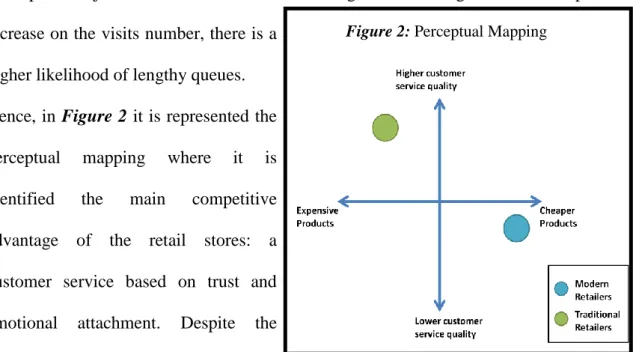
Bearing in mind that consumers are not loyal to stores, what are the main valued characteristics by the consumers to visit and shop in a supermarket? The small distance between their homes and the stores is the most evident point-of-parity valued by both, traditional and modern retailers’ customers40. On the other hand, point-of-differences regarding the modern and traditional stores are the prices of the products, the quality of the customer service provided and the time wasted in the queues41.
Consumers felt that, when they shop in the traditional retail stores, they spend less time in the queues, but experts have been defended42 that the lower amount of customers’ visits per time justifies that faster service, meaning that if it is registered an unexpected increase on the visits number, there is a
higher likelihood of lengthy queues. Hence, in Figure 2 it is represented the perceptual mapping where it is identified the main competitive advantage of the retail stores: a customer service based on trust and emotional attachment. Despite the
modern stores are perceived as lower prices, consumers with lower incomes and more price-sensitivity are also traditional supermarket customers (Angell, 2012), meaning that the weak mobility and the emotional bonding with the retailer are stronger shopping motivation factors.
4. Technological Factors | Portuguese consumers, in general, are not product loyal but they love brands, new and innovative products. In addiction they have been more
40
More information available in Booklet 2: Appendix 1 – Market Research Study: Results
41
More information available in Booklet 2: Appendix 1 – Market Research Study: Results
42 Interview with Dr. Rousseau, José, 2012, Distribution consultant, IADE – Creative University;
December 5th
19
selective and digital platforms have been used to find products and supermarket’s information43. Some traditional retailers placed in the coastal zone between Lisbon and Oporto have been identified these trends and they have been provided online platforms where consumers can find products and supermarket information.44 The e-commerce has been appointed as the future of the retailing (Planner, 2012) but consumers have shown a negative attitude towards this service meaning that consumers do not aim to shop by using the digital channels in the next two years.45
Some experts also believe that the technological innovations will appear, in the next years, in the point-of-sales in order to improve the store experience and the quality of the service provided (Gil,2012).
Market Dimension and Growth| The last updated information about the number of the traditional retail stores brings us back to 2009 where it was counted 142 supermarkets placed in the coastal zone but the growth forecasts were unidentified. Bearing in mind the trends discussed in the PEST Analysis, the market could be segmented in two locations: center of the towns and the areas with higher development growth.
In the center of the towns, supermarkets and groceries are very similar distinguishing only in the sales space46. Therefore, traditional stores have been followed the life cycle of the owners47. Its main customer is the consumer with more than 65 years old which has any capabilities to wander higher distances. With an emotional attachment to the store owner and workers, older consumers are loyal clients by shopping almost daily.
43 More information available in Booklet 2: Appendix 1 – Market Research Study: Results 44 More information available in Booklet 2: Appendix 1 – Market Research Study: Results 45 More information available in Booklet 2: Appendix 1 – Market Research Study: Results 46
Note that to be considered supermarket, according the Portuguese law, it must have a sales space between 400m² and 2000m² (Diário da República, 2009).
47
When owners are young, then the stores are fresh and moderns but when owners get older the supermarket looses vitality.
20
Notwithstanding, the older of tomorrow will be demanding concerning the quality of service provided.
On the other hand, the typical owner is risk averse and less receptive to radical changes by believing that consumers should adapt their behaviors to the stores and it is not the stores goal to meet the consumers’ requirements, or defending that by having years of experience, “feelings” are the most accurate managerial decisions. Hence, the resilience to change, the existence of different management styles, the lack of education on management and the overconfidence of their experience skills are weaknesses that could lead to the stores’ bankruptcy.
The future of these traditional supermarkets also depends if the succession is ensured by the descendents or other independents or if they are acquired by the modern retailers. In the developing zones it has been verified a traditional retailers growth48 such as in Parque das Nações, Cascais/Estoril, both classified as touristic and residence zones. Because the consumers’ target is people between 35 to 65 years old, the stores’ atmosphere is more carefully designed by conveying a contemporary layout. In addiction retailers have been implementing in the stores new technologies, some of them inexistent yet in the national retailers such as QR codes as well it was been improved the store experience by providing a range of customized services such as coffee’ shops. In general, it is adopted a flexible management style based on trust, convenience and innovation which create a business model difficult to copy by the modern retailers.
Hence, the supermarkets placed in the higher development zones, due to its flexible management style and customer target, have strong conditions to be a sustainable business while in the remaining stores the value can exploited on the short-term.
21
Market Specifics: The distribution | If products are not available on the stores shelves, consumers can switch products or stores (Wallet et al, 2010) meaning that managing stock outs is crucial in retailers’ business model. Nowadays, most of the traditional retailers get the products from Cash & Carries49, because it is cheaper, it is offered discounts and they can have access to a wider portfolio variety. However, traditional retailers have also been chosen the modern retailers as suppliers because they have been found in that stores better deals.
To face these trends, Recheio Cash & Carry, the wholesaler leader in Portugal, has been invested on the products differentiation by offering fresh products and investing in their own brands (Masterchef, Gourmês and Amanhecer). In addition according António Pinheiro50 the “Cash & Carry future will be focused on the integration of the “delivery”
service to serve the B2B market” which will enhance the competition between
manufacturers that have been followed the direct store distribution strategy and C&C.
COMPETITION
Market Rivalry | Unilever competitors have been conducted controversial analysis regarding the value of the traditional retail market, thus, different strategies are followed.
Regarding the packaged food category51 the main Unilever-JM competitors that have been invested in the direct store distribution to the traditional retailer stores are Nestlé Portugal SA and Danone Portugal in order to insure the quality of the products delivered. Moreover, Danone Portugal has been providing merchandising and convinced the retailers, through their customized service, to accept novelties. Lactogal S.A. and Fromageries Bel Portugal SA have not invested in this market.
49 More information available in Booklet 2: Appendix 1 – Market Research Study: Results 50 Source: Distribuição Hoje, 2012,
http://www.distribuicaohoje.com/news.aspx?menuid=13&eid=8485&bl=1#.ULy86n5l6xM.email
22
Unilever-JM is the market leader in the Home Care products but it has facing competition from global companies such as Reckitt Benckiser, Procter & Gamble and Henkel Ibérica. However, any of those companies have customized its service in this market.52 On the other hand, the most powerful competitor in this category is the Unilever affiliate in Spain because retailers can reach best deals by purchasing Spanish rather than Portuguese Unilever products.
Concerning the personal care, only L’Oreal and Johnson & Johnson have been providing merchandising to the traditional retail stores.
Hence, the rivalry among existing competitors is higher because there are many manufacturers that aim to differentiate its products in quality and brand image and some of them have been found in this market an opportunity to increase their sales.
Porter’s Model | After conducting a depth market analysis, a reasonable understanding of the industry is provided by the Porter’s analysis (Besanko, 2010) where it was discussed the main conclusions regarding the Buyer Power, the Substitutes and Complements, the Threat of New Entry and The Supplier Power.
1. Buyer Power | The traditional retail stores are small which decreases its negotiation power. Nevertheless, it is expected that these supermarkets will be organized by cooperatives to leverage its position in the negotiations. Therefore the buyer power is considered medium to low.
2. Substituted and Complements| Unilever-J.M. offers a wider portfolio with innovative products, but strong substitutes are represented in every category. Unilever competitors have been investing in R&D to increase the quality of the substitutes’ goods and convince the consumers to shift to their products. In the next years, it is expected a
52 Moreover, Procter & Gamble, because does not believe in its market profitability, are not interested in
23
growth on the substitute products that will compete on quality and price to face the perfect elasticity of the demand. Hence, it represents a higher threat to Unilever-JM. 3. Threat of New Entry | Traditional retailers and wholesalers have been launching their own brands and it is estimated more private labels during the next years because the shift for the consumers to this type of products. However, in some products such as shampoos Unilever could take advantage from the brand image that is valued by the consumers. These factors are very difficult to copy by the entrants because to build brand awareness requires time, financial capabilities and expertise. Therefore, the threat of new entry is medium-low.
4. Supplier Power | It is not expected any changes at the supplier level, thus the supplier
power and its ability to price discrimination will remain the same.
GAP ANALYSIS
To assess the Unilever’s Business Model and discover the desired business strategy to be applied to the traditional retail market, capabilities that represent strengths of the company such as “knowledge-based company”, large portfolio provided and recognized brand awareness must be exploited. Therefore, to implement the customized customer service strategy, Unilever-J.M. may decided if it should be provided the direct store distribution by using the existent outsourcing contracts or establishing a contract with a distributor that already supplies the products to this market. Regarding the customer relationship management, decisions related to the main tasks of the merchandising / sales teams are required. Besides the strategic requirements, it is crucial that the managerial conclusion should be according to retailer and consumer trends.
RISK ANALYSIS
To define the desired strategy, Unilever should also take into account several external and internal risks as it was presented in the following Table 1:
24 Table 1: Risk Analysis
CONCLUSIONS AND RECOMENDATIONS
After discussing the gaps on the market and identified feasible business strategies to provide a customized distribution strategy to the traditional retail market, it was used, in this chapter, the TOWS analysis53 to align the internal and external factors.
In conclusion, Unilever – J.M. should offer the direct store distribution service because as it was proven by the marketing research study (H9) 54 traditional retailers, placed in the coastal zone between Lisbon and Oporto, value the distributor that provides store deliveries of many product categories. In addition by cutting intermediaries, Unilever-J.M. has more control in the supply chain and is aware of changes on the retailer and consumer requirements. The distributor choice must be done according cost-efficiency
53 The TOWS Framework is available in Booklet2: Appendix 3 – TOWS Analysis 54
25
standards, meaning that it must be contracted the most cheaper outsourcing company that supplies the products always only on time.
To meet the retailer requirements in terms of convenience, and bearing in mind the cost-efficiency standards, it should be contracted an outsourcing team to manage the point-of-sales activity by providing merchandising55 (H8) and developing a trust relationship with the retailer. Partner with retailers by advertising in the brands pages, some promotions or activities regarding the Unilever products could be a feasible strategy. To mitigate the aggressive competition of the wholesales in the Porto Region, 2/3 packaging per category where it was included the best seller and novelties must be created. Note that coastal traditional supermarkets have only the 3 best sellers of each category in their shelves but a vast majority is willing to accept novelties (H9)56.
The schedule per sales/merchandiser employee must be elaborated according the sales seasonality, meaning that the traditional retail stores must be contacted in the week 3 or week 4 to make the orders to have the products available in the peak selling weeks (week 1 and 2)57 and avoid stock outs. The remaining weeks must be used to market prospection focusing on the regions with higher development growth.
To meet the requirements of the traditional retail customers Unilever should offer in the traditional retail market small and standard versions of the products as it was applied by Unilever in Brazil in 1997 when it was faced some of the current consumers’ trends such as the lower purchasing power and the price-sensitivity.
To monitor the previous implementation plan it was set the following KPIs: - The Lead time may not exceed 1 week;
- It must be filled in every 2 months clients satisfaction surveys;
55 More information available in Booklet 2: Appendix 1 – Market Research Study: Results 56
More information available in Booklet 2: Appendix 1 – Market Research Study: Results
57
26
- Sellers must report every month the main difficulties, weaknesses and opportunities that they have been facing;
- Sellers must report every 15 days its sales result or the number of new clients depending if it was or not a projection week.
In conclusion, by providing a customized service to the traditional retail market placed between the coastal zone between Lisbon and Oporto, which satisfies consumers and retailer trends, Unilever-J.M. is able to optimize its business model to the traditional retail market placed in the coastal zone between Lisbon and Oporto.
BIBLIOGRAPHIC REFERENCES
Aaker, David, 1991, “Managing Brand Equity”, The Free Press, New York.
Angell, Robert et al, 2012, “Understanding the older shopper: A behavioural typology”; Journal of Retailing and Consumer Services,19: 259-269
APED and Roland Berger Strategic Consultants, 2009, A evolução da concentração da indústria
e da distribuição em Portugal, Lisbon March 16
APED and Roland Berger, 2007, “Impacto da liberalização dos horários do comércio nas grandes
superfícies aos domingos e feriados”,2007, Relatório Final, Lisbon, November 27
Becker, Brian and Huselid Mark, 2006, “Strategic Human Resources Management: Where Do We
Go From Here?”, 32 (6): 898-925
Berthon, Pierre J. et al., 2001, “Organizational and customer perspectives on brand equity: issues
for managers and researchers”, Paper presented at the ANZMAC, Department of Commerce,
College of Business, Massey University, Auckland.
Besanko, Dranove et al., 2010, “The Economics of Strategy”, Fifth Edition, Wiley, 328-339
Clarke, Ian, David Bennison and John Pal, 1997,"Towards a contemporary perspective of retail
location", International Journal of Retail & Distribution Management, 25 (2): 59 - 69
Dant Rajiv and James Brown, 1984, “Bridging the B2C and B2B Research Divide: The Domain of
Retailing Literature”, Journal of Retailing (4, 2008): 371–397
Diário da República, 2009, 1.ª série, N.º 12, January 19 Distribuição Hoje,2012,
http://www.distribuicaohoje.com/news.aspx?menuid=13&eid=8485&bl=1#.ULy86n5l6xM.email (assessed on December 3)
Euromonitor International, 2012, Beauty and Personal Care in Portugal, Industry Overview,
October 10
27
Euromonitor International, 2012, Packaged Food in Portugal, Industry Overview, March 12 INE Portugal, 2012, http://www.ine.pt/scripts/flex_provisorios/Main.html, (accessed on October
10)
Ganesan, Shankar et al, 1985, “Supply Chain Management and Retailer Performance: Emerging
Trends, Issues, and Implications for Research and Practice”; Journal of Retailing (1, 2009) 84–94
Helbling, Jeffrey, Josh Leibowitz and Aaron Rettaliata, 2011, “The value proposition in
multichannel retailing”; McKinsey Quarterly; May 2011
Jerónimo Martins,2012, Jerónimo Martins, http://www.jeronimomartins.pt/o-grupo/faqs.aspx (assessed on September 28)
Jones Geoffrey, 2005, “Renewing Unilever Transformation and Tradition”, Oxford University Press, New York
Keller, Kevin, 2003, “Brand Synthesis: The Multidimensionality of Brand Knowledge”, Journal of Consumer Research, 29, (4): 595-600
Konus, Umut, Peter Verhoef and Scott Neslin,1984, “Multichannel Shopper Segments and Their
Covariates;” Journal of Retailing (4, 2008) 398–413
Morschett Dirk; Bernhard Swoboda and Thomas Foscht, 2005: “Perception of store attributes
and overall attitude towards grocery retailers: The role of shopping motives”, The International
Review of Retail, Distribution and Consumer Research, 15, (4), 423-447 Nielsen, 2010, “Anuário Food 2010”, Unpublished
Ofir, Chezi et al, 1984, “Memory-Based Store Price Judgments: The Role of Knowledge and
Shopping Experience”, Journal of Retailing (4, 2008), 414–423
Planer Boris, 2012, ”Global Retail 2013 – Economic, Demographic & Sector Trends”, in Retail Congress: Thinking the Present, Acting for the Future, Lisbon, Centro Cultural de Belém, November 8th , Unpublished
Soares António, 2012, ”O Mercado Norueguês visto por mim”, in Retail Congress: Thinking the
Present, Acting for the Future, Lisbon, November 8th , Unpublished
Solomon, Michael et al., 2006, “Consumer Behaviour: A European Perspective”, 3rd
edition, Pearson: 61-84
Sridhar, Samu et al., 2012,"Impact of Brand-Building Activities and Retailer-based Brand Equity
on Retailer Brand Communities", European Journal of Marketing, 46 (11)
Swearing, Jeff, 2011; “Brand consistency: Get ahead, get in-store”, Admap, May
The Nielsen Company, 2010, “Nielsen Consumer Confidence Index – Global Survey 3Q 2010”, Dados de Portugal
Unilever, 2012, http://www.unilever.com/images/ir_Introduction_to_Unilever_tcm13-234373.pdf (assessed on September 27)
Waller, Matthew et al, 2010,”Marketing at the retail shelf: an examination of moderating effects of