ISOLearn
Full project name: Innovation and Social Learning in HEI
Project number: 2014-1-PT01-KA203-001087
Gaps and Needs Analysis:
European Report and Roadmap
Final report
Prepared by:
University of Ljubljana, Slovenia and Universidade Aberta, Portugal, with the support of:
ACAPO – Associação dos Cegos e Amblíopes de Portugal, Portugal APS – Associação Portuguesa de Surdos, Portugal
Effebi Association, Italy
Università Telematica Internazionale Uninettuno, Italy Folkenstaten Universitetet, Sweden
1 Coordinated by: Bárbara Brëcko and Vesna Dolničar, University of Ljubljana, Slovenia and José António Porfírio, Universidade Aberta, Portugal
Authors:
Alessandro Caforio, Università Telematica Internazionale Uninettuno Ali Rashidi, Folkenstaten Universitetet
Ana Maria Cotovanu, Effebi Association Barbara Brëcko, University of Lubjliana
Francisco Palmares, Fundação Calouste Gulbenkian Graça Gerardo, ACAPO
Helena Vaz da Silva, Fundação Calouste Gulbenkian
Joaquim Gronita, Universidade Aberta; Escola Superior de Saúde, IPS José António Porfírio, Universidade Aberta
Luisa Valle, Fundação Calouste Gulbenkian
Mariana Martins, Associação Portuguesa de Surdos Mario Spatafora, Effebi Association
Paula Estanqueiro, Associação Portuguesa de Surdos Rosário Cunha, ACAPO
Tiago Carrilho, Universidade Aberta
Yevgenyia Averhed, Folkenstaten Universitetet Vesna Dolnicar, University of Lubjliana
2
Table of contents
EXECUTIVE SUMMARY 4 INTRODUCTION 9 1 DESKRESEARCH 12 1.1 ITALY 13 1.2 PORTUGAL 21 1.3 SLOVENIA 25 1.4 SWEDEN 31 1.5 CONCLUSION 342 ON-LINESURVEYAMONGHEARINGANDVISUALLYIMPAIRED
STUDENTS 35
2.1 INTRODUCTION 35
2.2 PARTICIPATION – GENERAL INFORMATION 37
2.3 SCHOOLING 39
2.3.1 Pre-school education 39
2.4 ADAPTATIONS OF STUDY MATERIALS AND LECTURES 44
2.5 SATISFACTION 51
2.6 BARRIERS 54
2.6.1 Open ended questions 62
3 SEMI-STRUCTUREDINTERVIEWS 68
3.1 INTRODUCTION 68
3.2 RESULTS OF THE INTERVIEWS 69
3.2.1 Description of the HE system in four countries: 69 3.2.2 Services and adaptations provided for visual and hearing impaired students 71
3.2.3 Obstacles and changes 82
3.3 CONCLUSION 85
3
5 CONCLUDINGREMARKSANDROADMAP 90
6 REFERENCES 93
7 APPENDIXI– ONLINE QUESTIONNAIRE 95
4
EXECUTIVE SUMMARY
Desk research
• All participating countries – Italy, Portugal, Slovenia and Sweden – conducted desk research.
• The primary aim of the desk research has been to identify the main needs and gaps in the field of education of visually or hearing impaired persons and to compile existing knowledge and strategies in the field.
• Number of students with hearing or visual impairment is difficult to obtain in all participating countries. There is some data, but it is not aggregated in any of the countries. Usually universities have the information on the number of students with specific disabilities (including visually or hearing impaired) but there is no such data on the system aggregated level.
• The integration of students with special needs is not questionable in any of the countries and it is regulated by law, at least until some levels of study. In the law and regulations there are listed adaptations of the lectures,
assessments, technical and personal aids that can be used for better integration of disabled students.
• In many cases these adaptations are general and often allowing certain adjustments or help – for instance interpreters, but financing of this is not always defined. For instance, sign language interpreters are expected for deaf students but in Slovenia and Portugal the financing on the HE level is not systemic. In Italy in law 104 there is an article (13) saying: The Minister of Education will appoint professionals for the roles of translators in order to facilitate attendance for hearing impaired students.
• Financing for disabled students is not well regulated in Slovenia – the
universities do not have special funds for disabled students, while this seems much better in Sweden since even private educational institutions, who are authorized to issue the qualifications announced by the Agency in specific regulations, can receive funds from Stockholm University disposal as special
5 funds for disabled students. Funding is also better in Italy – there are special organizations offering funds for aids for disabled students.
• Types of study adjustments are similar across countries, and include issues such as:
o The use of specific tools (recorders, speech recognition software, computers…).
o The adaptations of exams (e.g., exams outside the enrollment
deadlines, exams only in oral or written form, an extension of the time of writing examinations, adjustments of exams, etc.).
o Adaptations of materials.
o Psychological support was explicitly mentioned but only in Italy and Portugal. Go back to index
On-line survey among students
• Four countries participated in the survey. Target population were visually or hearing impaired students.
• The purposive sampling technique was used as the target population was very specific and hard to reach. The total sample was 98 students, 41% with visual impairment and 59% with hearing impairment.
• The majority of respondents (76,8%) is studying in the field of social
sciences.
• Among deaf and hard of hearing there are more students studying natural science compared to visually impaired students, where the majority is enrolled into social science programs.
• It is very positive, that students mostly selected their study according to their
interest (82,9%), while 41,4% selected the study because they are good at
it, and 24,3% because it enables employability. Still, 10% of respondents selected the study because they couldn’t select anything else because
of the impairment and 13% feel it is the only one they feel capable to do.
6 • Around 15% of respondents said they do not need any adaptations of the
learning materials, but all others need at least some adaptations.
• All students with visual impairment need at least some adaptations of
learning materials, among hard of hearing there are 77% and 76% among
deaf, who need at least some adaptations of learning materials
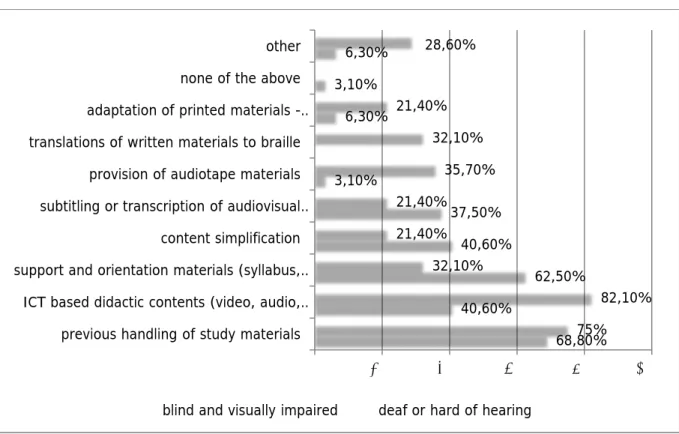
• Depending on the impairments, there are differences between two groups of students. 82,1% of visually impaired students need ICT based didactic
content, while among hearing impaired 40,6% of respondents selected that
answer. In both groups the majority of students said they need previous
handling of study material (75% among visually impaired and 68,8%
among hearing impaired).
• Around one quarter of respondents do not need any adaptations of the lectures.
• Adaptations of the lectures are according to two groups: Visually impaired: 78% - previous handling of study material; 72% - more ICT based
learning material, 39% - note taking by another student. Among hearing impaired more ICT based learning material is relevant to 43% of
respondents in that group. For hearing impaired the most important adaptation is sign language interpretation (63%), followed by previous handling of study material (57%) and note taking by professional (51%) • In general students are not very satisfied with the factors related to the
study, i.e. help from student association, teaching methods/tools, programs and exams appropriate to their needs, special resources for deaf/blind
students, help of counselor/disabled student services, adjustment/adaptation of study materials, inclusion of students with impairment into the study process...
• Students are not very satisfied with the adaptations received. All adaptations were rated between 2,11 and 3,5. In general, partly sighted students rated their satisfaction lower when compared to blind students. Hearing impaired respondents, rated their satisfaction levels with adaptations lower than hearing impaired. Their average rates were between 2,5 and 3.
7 • Students with hearing disabilities are not very satisfied with adaptations: all
services were rated below 3. In both groups lowest rating was obtained for the availability of sign language interpreter (2,5).
• Students feel they are not receiving enough support from classmates, academic staff neither support staff, as their average ratings were between 3,2 and 3,5.
Students proposed different recommendations about improvement of learning experience, but the most obvious was the need to support from qualified experts (like interpreters, tutors, university staff) and services for disabled students, carried out by competent persons, with specific knowledge and competences. Go back to index
In-depth interviews
• All countries reported the results of in-depth interviews.
• In all countries the services and adaptations for visual and hearing impaired students are quite similar. Nevertheless, we can see that in Portugal, Italy and Slovenia, there is no centralized system of action, whereas each faculty functions a little bit differently, while in Sweden every institution interviewed listed exactly the same measures and adaptations implemented to support students with special needs.
• Major obstacles on the institutional level:
o Italy: the challenge of employment after the studies; if the number of disabled student increases additional financial resources will be needed. o Slovenia: there is no systemic financing for students with special needs. o Sweden: no major obstacles, institutions feel they have good
knowledge and they are constantly in contact with the coordinator in Stockholm.
o Portugal: no special financial resources dedicated to HEI to support these students; no law existing to regulate the support these students require on their Higher Education; diversity of answers and
8 organizational structures to answer students’ special needs. Go back to index
9
INTRODUCTION
“Disability has become a central issue in educational policy and practice around the world. There are moral and practical grounds for this attention. Moral grounds that everyone, irrespective of their circumstances should be able to develop their
capabilities to the fullest extent possible, and practical grounds, that all citizens should be encouraged to lead productive and fulfilling lives.” (Cumming, 2012: 1) As data shows, the number of students with different impairments deciding to take up studies is increasing. Although the data about students with specific impairments is not always transparent – as our study showed, there is a lack of transparent data in all participating countries – students with disabilities are a growing minority who needs our attention.
In ISOLEARN project we are focusing on students with visual or hearing impairment – two target groups with different needs. The consequences of lack of sight or hearing are experienced by blind and deaf people both in everyday life – in getting about, interacting with others, etc. – and in the case of typically academic activities – such as participation in lectures and classes, access to textbooks and teaching
materials, etc.
Use of ICT in education is a priority on European policy agenda and there are numerous strategies adopted by European Commission promoting and encouraging the use of ICT to improve learning and teaching experience (EC 2009, 2010, 2012, 2013). In order to enable equal possibilities for visually and hearing impaired students, ICT is a tool from which disabled students can benefit greatly.
Technology plays a vital role in enabling personalized learning by enabling flexible curriculum development and assisting students with disabilities to participate in the learning experiences as equals through the use of accessible ICTs. It is important that the use of technology for learning does not in any way contributes to replicating any form of stigmatization and labeling that may be found elsewhere in society. Accessible ICTs for education include:
10 • Mainstream technologies, such as computers, web browsers, word processors,
whiteboards and mobile phones that contain in-built accessibility features; • Assistive Technologies, such as hearing aids, screen readers, adaptive
keyboards, augmentative communication devices etc.; and
• Accessible media and formats, such as accessible HTML (Hypertext Markup Language), videos with captioning, DAISY (Digital Accessible Information System) books, etc. (UNESCO, 2011)
The use of ICT on its own does not solve all the problems disabled students might face during the study process. For that reasons several adaptations of lectures, assessment and other processes should be done and used by the students. Although adaptations are usually formally stated in official rules and regulations (of the state, university, faculty…), students may still face difficulties, as higher education
institutions (HEI) are not aware enough of their specific needs. In order to gain better understanding of needs in the process of study at HEI, a needs and gaps analyses was conducted in four participating countries: Italy, Portugal, Slovenia and Sweden.
The needs analysis is the process of identifying and evaluating needs in a community or other defined population of people. The identification of needs is a process of describing “problems” of a target population and possible solutions to these problems. A need has been described as:
• A gap between “what is” and “what should be”. (Witkin et al., 1995: 5)
• “A gap between real and ideal that is both acknowledged by community values and potentially amenable to change”. (Reviere et al., 1996: 5)
• May be different from such related concepts as wants (“something people are willing to pay for”) or demands (“something people are willing to march for”). (McKillip, 1987: 16)
Considering the objective of the ISOLEARN project (i.e., to promote the inclusion of visual or hearing impaired students in Higher Education) and the characteristics of
11 researched target population (students), we have decided to follow in this report the discrepancy model of needs assessment, which is the most widely used approach to needs analysis (McKillip 1987). For that purpose, several steps were taken. First a desk research was conducted in order to get better understanding of the situation in participating countries. One of the main goals of this desk research was to capture the general situation in HEI regarding the enrollment of hearing or visually impaired students, the possibilities they have for success, and the existing regulations for this specific type of students in the four participating countries. Secondly an online survey was conducted. With the survey we tried to collect information from primary sources, about the needs, the obstacles, the adaptations offered and needed, and the experiences lived by the ultimate beneficiaries of our project: the visual or hearing impaired students. So, the target population were students enrolled in HE. Third step was conducting in–depth interviews with HEI to obtain the information on how education providers see needs and obstacles felt through their experiences and practices. The report follows the structure of the study. In the first part the situation in four countries is presented, and we can find certain similarities in this domain– the most significant one is, the limited information on number of disabled students, or even the inexistence of systematic registers on the number of students with a specific disability. Secondly we present the results from the on-line surveys
conducted in the four countries involved: Portugal, Italy, Sweden and Slovenia. Due to the existence of some small samples, we opted to present the aggregated results for all participating students. This may be considered one of the limitations of the present study: the population is small and due to the existent data protection,
difficult to reach. Nevertheless, the purpose of the on-line survey is not a comparison between countries but finding different needs, obstacles and experiences from the students that we consider to be similar in the different countries analyzed, and much near to the overall European situation. The third part of the study are in-depth interviews conducted in the four countries, where we investigated how institutions are solving the problems, fulfilling the needs and challenge the obstacles they face when educating students with special needs.
12 All templates and questionnaires as well as some of the information not included in the report can be found in the appendixes to this report. Go back to index
1
DESK RESEARCH
The desk research consisted on a preliminary work of the partners to evaluate the state-of-the-art regarding the education of visually or hearing impaired persons, mainly based on the existing legislation. It was also our main purpose to identify existing knowledge from previous works conducted on these fields – based on published documents, strategies, and existing questionnaires - that would support the partners in developing our proper questionnaire. Sources used were basically the internet, on-line databases, government statistics, articles, and books published on these matters.
Below we present the main results of the desk research conducted on each country. Go back to index
13
1.1 Italy
General situation of HE enrolment of visually or hearing impaired in Italy (short description)
The characterization of visually or hearing impaired HE students in Italy is not an easy task, due to the difficulty to obtain statistics on their figures which is explained by two main reasons: 1. Many of them – being disabled when adult – still have personal problems in declaring their physical deficit; 2. The statistic department of the Italian Ministry of Education does not reveal data on disabled students.
Nevertheless, through the information on the exemption from taxes granted to students with disabilities - general disability, not specifically visual or hearing impairment - we could approximately infer the number of these type of students enrolled in HE.
According to the latest statistical data, referred to the academic year 2012/13, there are 15.691 students with this type of disabilities, being: 13.068 with disability level over 66% and 2.623 with disability level under 66%1
From the academic year 2008-09 to the academic year 2012-13, this number of disabled students in Italy has constantly grown, from 14.595 to 15.691.
Considering the type of disability, students with motor disabilities represented the largest percentage (27,5%) of the enrolled disabled students – for the academic year 2012-13 – followed by minor cases of students with mental difficulties (3,5%) and dyslexia (0,9%) (MIUR-CINECA, 2013)2. Is not possible to detect the percentage for
the specific disabilities of visual / hearing impairment.
1A certification of disability is issued by a medical/legal board at the local health authority to establish
that a student has an eligible disability under Italian law and regulations based on the assessment of a team of professionals from various disciplines. This makes the student eligible and entitled to receive an individually determined program and services in school. The definition of “disabled person” includes, among others, deaf or hearing impaired and blind or visually impaired
14 The most attended courses by this type of students are Liberal-Arts (19,11%) and Law (17,15%), followed by Economics (9,10%), Education (8,57%), Mathematics, Physical and Natural Sciences (8,35%), and finally Political Science (7,98%). The right to education of disabled people3 is guaranteed by the Law n.104/1992 -
later integrated with law n.17/1999 - ensuring their social integration and
highlighting their right to be informed and educated. The same law guarantees the provision of didactical and technical material, programs and specialized languages of adequately qualified staff (teaching or not).
The art. 16 of the above mentioned Law foresees a support for HE students in passing exams, including through agreements with the teacher of the subject and, if necessary, with the Faculty Council. In particular:
• Specific methods and specific technical tools will allow the student to take exams according to the personalized study plan. (art. 16)
•
Universities must appoint a teacher, designated by the dean, with functions of coordination, monitoring and support of all the activities related to the inclusion of disabled students within the university. (art 16)The guarantee of integration for these students is granted by art. 13 paragraph 1 of Law 104:
• Schools and Universities must be provided with the necessary technical
equipment, teaching aid and technical aid of any kind; universities must carry out appropriate interventions that adapt both to the needs of the disabled student and to the individual study plan. The Minister of Education will appoint professionals for the roles of translators in order to facilitate attendance for hearing impaired students. (art.13)
• Specific technical and teaching aid are granted to students enrolled in universities, as well as support from services such as specialized tutors. (art.13)
15 • Social inclusion and integration shall be pursued with actions that will
render effective the right to information and the right to education for the disabled person; with adaptation of equipment and personnel; measures aimed at enhancing full integration in the labor market. (art. 8)
• The exercise of the right to education cannot be prevented by learning difficulties or other difficulties connected with the handicap; parents of the student, together with social and health operators and school staff must define a personalized study plan; the study plan is monitored and updated throughout the permanence of the student in the education system. (art. 12) To monitor the application of these regulations within the Ministry of Education an Observatory – the Observatory H – has been established: it must indicate the strategies and the most effective paths for a real integration of students with disabilities. Its main purposes are focused on achieving the indications contained in the framework Law 104/92, but also on developing recommendations aimed at the strengthening of curricular and extracurricular activities, the provision of suitable technological and didactical materials diversified according to the type of disability, the activation of specific transport services and, finally, the increasing of funds for each Institute to adequately address the needs of disabled students.
The Decree of the President of the Council of Ministers 30 April 1997 - Uniform treatment regarding the right to higher education according to the art. 4 of Law December 2nd, 1991, n. 390 - sets the minimum useful standards to access to
services addressed to university students.
It requires each university must to create a special department - Servizi Disabilità Di Ateneo, SDDA – in charge of all services for disabled students. Among several issues, it must include:
• A specialized tutor whose job involves accompany the student to the activities connected with their study course; specific personal support for taking exams or writing the final dissertation thesis; support for communication. This requires a highly specialized member of the tutoring staff.
16 • Assistance for mobility if the student needs help move in spaces of the
university and to access to classes and other activities
• Teaching material and technological support that the SDDA must make
available for the student. This aspect requires awareness and training for the teaching staff as well.
• Special tools and procedures for taking exams, which requires an individual plan for the disabled student.
• Support for international mobility, which will need a broader development in the future, through better communication and more widespread information, specific aid tools and strategies, awareness of fellow students and teachers, proper organization within universities.
•
All public universities must exempt from the enrollment fee students with disability up to or exceeding 66%, unless they risk financial losses. In this case they could establish partial exemptions only for the best or neediest students. Furthermore, the amount of scholarship for this target of students is higher in order to allow them the use of prostheses and tools as well as of all interventions to facilitate the attending of courses.The tools that disabled students are allowed to use are, for example: 1. Digital recorder;
2. PC with spell checker; 3. E-books;
4. Speech recognition software; 5. Tutor as reader;
6. Calculator;
7. Other technological tools that facilitate the learning process. Other facilitating measures that can be taken are, for example: 1. Dividing exams into several partial tests;
17 2. Preferring oral examinations rather than written ones (considering the individual profile of the student);
3. Reduction (quantitative, not qualitative) of the written test or extension of time available;
4. Considering contents instead of form and orthography when marking tests.
In concrete, the services/initiatives offered by Italian universities are very similar, but there are differences related to the territorial situation and the economic possibility of each institute.
For example, in the case of University Roma Tre a "listening psychological" service is provided, offering psychological support on issues related to the educational path. In addition, on the university website it is available the list of all the existing architectural barriers in the several faculties.
The University La Sapienza in Rome offers an open competitive exam (Master and Phd) for thesis on handicap: the aim is to raise awareness within university community on the topic and to acquire research material. The University also offers its students funding to be used to attend studies abroad.
The University of Milano, in addition to the 'traditional' services, allows students with disabilities to do sports’ activities within the university improving their
physic-psychological wellbeing. It also provides a Healthcare Unit with appropriate staff responsible for diagnostic - therapeutic interventions. Since 1993 a voluntary service offers accompaniment/assistance in educational activities and carrying out of some bureaucratic tasks.
The university organizes courses for blind students helping them in recognizing the environments of the faculties and become self-sufficient in the movements; and ICT courses on how to use hardware and software they could need.
The University of Padova offers its students in deficit situation mostly innovative didactical materials: the texts can be read by computer and/or listened via audio
18 cassettes; for deaf students it is possible to attend lessons simultaneously
transcribed by an operator and displayed on a monitor. Moreover, exams are
customized for each student and internships for graduate are organized to facilitate their work placement.
Existing strategies in Italy dealing with accessibility of higher education for hearing or visually impaired persons
Name of the strategy Source (link) Short summary –
important message, points
Law 104/1992 ‘Law for the assistance, the social inclusion and the rights
of disabled people‘ http://www.normattiva.it/uri- res/N2Ls?urn:nir:stato:legge:2010; 107
Framework for aid, social inclusion and rights of handicapped people. Sets out ‘principles of human rights, social integration and care’. It deals with diagnosis and
prevention, treatment and rehabilitation, services and support, and social exclusion. Law 162/98
‘Modifications of the law 5 February 1992, n.104, concerning support measures towards people with grave handicap’ (published in G:U: 29 of May 1998, n.123)
http://www.parlamento.it/parlam/le ggi/98162l.htm
Seeks to ‘guarantee the right to independent living for people with learning disability and severe restriction of personal autonomy in the conduct of one or more
essential functions of life, not overcome with technical aids’. This includes provision to assist people with high severity of through home care and personal assistance Law n.17/199 "Integrazione e modifica della legge-quadro 5 febbraio 1992, n. 104, per l'assistenza, l'integrazione sociale e i diritti delle persone handicappate" ("Integration and modification of the Framework Law of 5 February 1992 n. 104, for the assistance, social integration and rights of disabled people")
http://www.parlamento.it/parlam/le ggi/99017l.htm
1. Handicapped students enrolled at the university are guaranteed technical aids and specific teaching as well as support of special
services specialized tutoring, set up by the universities within the limits of its budget
2. The university, with its provisions, establish a professor delegated by the
rector for coordinating, monitoring and support of all the initiatives for inclusion of disabled people within the university
19 Italian law on Hearing
impairment 381/1970 http://www.normattiva.it/uri- res/N2Ls?urn:nir:stato:legge:1970-05-26;381
Law regarding the increasing of ordinary public grant for the National authority for the protection and the assistance of deaf people
Italian law /2006 http://www.camera.it/parlam/leggi/06095l.htm On new provisions in favor of the hearing impaired
D.P.R. June 6, 2001, n.
380, art. 82 http://www.parlamento.it/parlam/le ggi/deleghe/01378dla.htm
Elimination or overcoming of architectural barriers in public and private buildings open to the public (universities included)
Law n.4/2004 (also known as "Stanca Law" from the name of the Minister for Innovation and Technologies),
http://www.camera.it/parlam/leggi/ 04004l.htm
Provisions for facilitating the access to ICT tools.
The law defines the terms "Accessibility" and "Assistive technologies", and establishes the obligation for Public Administration to provide ICT services accessible for disabled people. Also Public Universities must be compliant to the Stanca Law.
Ministerial Decree 8 July 2005; Ministerial Decree 20 march 2013
("Technical requirements and different levels of accessibility of ICT tools")
http://www.lavoro.gov.it/
Strumenti/normativa/Documents/20 13/20130320_DI.pdf
It's the technical annex to Stanca Law, and provides Guidelines for Public Administration ICT tools and services. A specific section is about Websites. Guidelines for websites are partially based on WCAG 1.0 Guidelines (the International W3C standard for Accessibility of Websites). Law n. 107/2010 http://www.normattiva.it/uri- res/N2Ls?urn:nir:stato:legge:2010; 107
Provisions for the recognition of visually and hearing impaired people
University Roma Tre:
Initiatives for disabled students
http://host.uniroma3.it/uffici/accogli enzadisabili/
Provision of “listening psychological" service.
20 University La Sapienza,
Rome: University Of Milano: Initiatives for
disabled students. http://www.disp.uniroma1.it/node/ 7088
• Publication of an open competitive exam (Master and Phd) for thesis on handicap.
• Funding for students’ mobility
University Of Milano: Initiatives for disabled students
http://www.unimib.it/upload/pag/4 7038/i./i.f.s.9b.pdf
• Sport activities for the physic physical wellbeing; • Healthcare Unit for diagnostic therapeutic interventions; • Voluntary service of accompaniment/assistance L’empowerment personale e professionale attraverso la lingua inglese nelle persone “diversamente abili”
http://www.labeleuropeolingue.it/it _dbprogetti_scheda.asp?cod=19/08
Personal and professional
empowerment through the English language in disabled people
EAL TOI – Deaf People in Europe Acquiring
Languages Through e- Learning - Transfer Of Innovation (Country, IT)
http://ec.europa.eu/education/lang uage/label/label_public/
index.cfm?fuseaction=
project_award&award_id=9070
The EU project created a digital learning environment specifically conceived for deaf learners and 6 different foreign language courses (3 target languages with the supports in 3 different sign languages) to promote this key competence in deaf people.
La Scuola dei Segni http://www.labeleuropeolingue.it/sc hede_progetti/
Pages%20from%202010_12_proge tti-7.pdf
Project aimed at teaching LIS (Italian Sign Language)
VET4VIP
http://www.vet4vip.org/index.php? cat=The%20Project
Vocational English Teaching for Visually Impaired People
21
1.2 Portugal
General situation of the enrolment of visually or hearing impaired Higher Education students in Portugal (short description)
In Portugal there are difficulties to obtain statistics that clearly identify visually or hearing impaired students due to the use of Functionalities’ International
Classification, which do not distinguish the essential types of impairments. In spite of these difficulties, estimations point to the existence in 2013/2014 of around 30.000 Portuguese Sign Language users, but just around 150 hearing impaired HE students. In terms of visual-impaired persons, estimations point the existence of about 160.000 visual-impaired persons in Portugal, of which 20.000 are blind. Of these, according to GTAEDES, just about 235 are Higher Education students (in 2014).
Both visually and hearing impaired HEI’s students refer the positive aspects of physical accessibility but, on the other hand, they emphasize the negative elements of ‘soft accessibility’ namely regarding individual support and ‘mind openness’ of Universities’ Top Boards, teachers and administrative staff toward their specific needs.
Visually impaired HEI’ students report difficulties regarding teachers’ authorization to class recording and the complete or almost absence of audio classes. In this context, the importance of mutual support among HEI’ impaired students is also reinforced. Since Deaf Bilingual education means having Portuguese as a second language, the Portuguese exam is adapted accordingly. The greatest difficulties for the deaf begins after entering the desired course. Although bilingual education implies that for these students, classes are to be taught using Portuguese Sign Language, namely with interpreters as a resource, this is not continued as a practice in higher education. Thus, deaf students take on themselves the payment of interpreters, as well as the job of raising awareness about their needs to professors.
22 Candidates with physical and sensorial impairments have an annual special quota to access higher education (Regulations of the National Competition for Access and Entry into higher Public Education Article 15o annex II 1st series, no 133 in 14/07/2014, by the Minister of Science and Higher Education).
In the absence of a specific national legislation for higher education regarding the rights of individuals with special needs, the references are the Basic Law of the Education System and the Basic Law of Prevention, Rehabilitation and Integration of Impaired People which are reflected in the articles covered by specific regulations approved by higher education institutions.
According the Basic Law Bases of the Education System impaired people have the following rights:
• Didactical materials necessary for study, namely braille transcriptions and audio recordings
• Individual adaptions of support equipment • Psychologist and pedagogical counseling • Curricula adapted to specific impairment
• Special Regime of Education to adapt learning conditions to the specific needs of impaired people, compensation special equipment, special conditions to attend curricular units, special conditions for assessment (according to the type of exam, type of assessment instrument, oral or written, exam duration and exam location), reinforced pedagogical support (complementary individual support and number of hours well defined)
• Individual classes
• Special classes (for example, with less students or by type of impairment) The Basic Law of Prevention, Rehabilitation and Integration of Impaired People state the following rights:
• Attend the specific needs of impaired people regardless of type and degree of impairment, geographic origin and social and economic situation
• Inform the impaired people of her/his rights through an adequate local administrative support
23 • Special Education through alternative curricula, technical support and
specialized teachers
Existing strategies in Portugal dealing with accessibility of hearing or visually impaired persons to Higher Education
Name of the
strategy Source (link) Short summary – important message, points
National Strategy for Impairment (2011-2013) http://www.inr.pt/content/ /14 02/estrategia-nacional para-deficiencia-endef
This National Strategy was preceded by the First Action Plan for the Integration of Impaired People (2006-2009) and by the ratification of the Convention on the Rights of Impaired People in 2009. This strategy supported the policy of rights promotion of impaired people. The measures cover several government ministries, in order to develop actions in five areas:
1 - Impairment and multidiscrimination 2 - Justice and exercise of rights 3 - Autonomy and quality of life 4 - Accessibility and design for all 5 - Administrative modernization and information systems.
These five areas corresponded to 133 measures of which only 4 relate to HEI: • Measure 16 (area 1) – to develop and promote thematic sessions regarding
impairment directed to HEI students
• Measure 36 (area 2) – to publish a law regarding specific supports for HEI impaired students
• Measure 61 (area 3) – to elaborate a recommendation guide to include the question ‘universal design’ in HEI curricula
24 • Measure 62 (area 3) – to develop and promote thematic sessions regarding
impaired people rights directed to teachers and administrative staff of HEI In spite of its coverage, this strategy lacks a clear focus both on Education and especially on Higher Education since just 3% of these measures relate to these subjects. Moreover, monitoring reports available do not report nothing regarding the accomplishment of these 4 measures.
Both the Ministers’ Council Resolution that defines this strategy, and the related Monitoring Reports rarely mention the words ‘education’ or even ‘higher education’ which constitutes a serious limitation since it is recognized that education is an essential basis for employment and social integration of impaired people. Besides, strategy implementation has had limitations namely derived from an apparent lack of articulation between the various institutions involved to implement it. Go back to index
25
1.3 Slovenia
General situation enrolment of visually or hearing impaired persons in Higher Education in Slovenia (short description)
Status of disabled students in Slovenia is not regulated by law; moreover, there is no exact data on the number of all students with disabilities or students with special needs. The fact is that the number of students with disabilities is increasing, and studying for them is becoming more and more accessible.
Table 1.1: Children and youth with special needs in institution care according to the disability
2012 2013 Yearly change number %
total 1.308 1.332 1,8
With moderate, severe or severe intellectual disabilities 445 427 -4,0 With mild or moderate intellectual disabilities 201 216 7,5
Visually impaired 17 18 5,9
Deaf and hard of hearing 49 45 -8,2
Physically disabled 199 216 8,5
The emotional and behavioral disorders 397 410 3,3 Source: SURS
At Universities the status of disabled students is not regulated uniformly. There are some formal obstacles:
• no uniform terminology, which causes ambiguity in the area of defining of students with special needs
• Procedures for obtaining the status (of student with special needs) are not uniformly regulated
System obstacles:
• inadequate architectural adjustments
• inadequate adaptation of the organization of study and evaluation • inadequate qualifications of trainers
26 • ignoring the needs of students with special needs when preparing study
programs
• inadequate funding.
The area of disabled students each university in Slovenia is regulated with statute, faculties has data only for their students with disabilities. As a result, there are some differences between universities.
Studying is becoming more accessible for the disabled by the year. A wide variety of obstacles, whether architectural, communication, or any other, are already fully or at least largely removed. So we can discuss some really good practices where studying actually becomes friendly for students with disabilities. Of course, there are many cases where faculty remains only partially adjusted or even unadjusted. Accessibility and a decision to study per se are very much affected by the attitude of the staff, especially coordinators and other employees of the faculty. It is very often, that a faculty whit great number of students with disabilities, provide good support for the disabled, while other faculties have fewer experiences with the disabled and
consequently there is no one who would deal with the issue.
Despite the many changes, the biggest problems still remain in the area of physical accessibility of faculties, public transportation, e-teaching materials and technical or communication devices. The state directly does not help a lot, so the faculty and other public institutions are often dependent on their own ingenuity and attention. Furthermore, one of the largest, if not the biggest problem of people with disabilities in general, not just students with disabilities, is personal assistance. This includes assistance with the most basic and daily needs of individuals with severe disabilities. Many students with disabilities are dependent on foreign assistance. Currently few disability organizations provide this sort of assistance; however, the area of personal assistance is still not regulated by law.
Universities and faculties with special policies regulate the status as well as the rights and adaptations for students with disabilities. These rights are slightly different from university to university, but there are some common points. Adjustments are
27 Basic rights are governed by the university statutes. Thus, for example, by the
Statute of the University of Ljubljana, students with disabilities have the right to additional exam periods, they can progress to the higher study year exceptionally, even if not all progression requirements are fulfilled. Similarly, these rights are governed by the statutes of other universities. The status of a disabled student, the process for acquiring the status of a special needs student, the students' rights, and adjustments which can be made to the study process are governed by regulations of students with disabilities, adopted by either the university or individual faculty. As an example we can cite a few types of adjustments:
• exams outside the enrollment deadlines, • exams only in oral or written form,
• an extension of the time of writing examinations, • adjustments of exams,
• the use of special tools,
• preparation of electronic materials
• and the presence of a sign language interpreter.
Each category of people with disabilities has certain problems and it is difficult to compare these barriers among them. Indeed, in a very difficult position are certainly deaf and hard of hearing students, which due to their disability have difficulties following the lecture. Unfortunately, system of financing sign language interpreters for deaf students is not yet fully established. The faculty is legally required to provide an interpreter, but in practice this often does not happen. Also, many problems encounter students with harder physical disability, since their personal assistance is only taken care of in the context of different societies' programs. This kind of assistance is provided in a limited extent and with a limited number of personal assistants.
The Use of Slovenian Sign Language (hereinafter: ZUSZJ), adopted in 2002, provides the right of deaf people to use Slovene sign language for deaf people, to have access to information using techniques adapted to their needs and the scope and manner of exercising the right to a sign language interpreter or other forms of communication
28 in public services and in all other life situations in where deafness is an obstacle in meeting the needs (see letter from the Ministry of Higher Education, Science and Technology). Public and higher education institutions with concession should provide a sign language interpreter for deaf students or enable them to communicate in a different manner, which are acceptable for a deaf person, based on an individualized plan. (http://www.fs.uni-mb.si/podrocje.aspx?id=54)
The University of Ljubljana has in 2014 adopted special guidelines regarding
university procedures and the study process itself to ensure special needs students have equal rights and access to public information. The Statute of the University of Ljubljana specifies criteria for acquiring the status of a special needs student, the students' rights, and adjustments which can be made to the study process. The adjustments are based on the individual's needs and the nature of the study program.
It is important to quote a message from the project StuDis:
“In the future, in the Republic of Slovenia it is essential that in all areas the reaction in response to the needs of disabled people is redirected to long-term systemic creation of opportunities for their equal participation in society. This is particularly important in the field of higher education, which is completely unregulated in this regard. It is absolutely necessary to develop curricula and teaching methods system in such a way that they are accessible for students with disabilities, the need for the necessary adjustments to the individual needs of these students should be as small as possible.”
29
Existing strategies in country dealing with accessibility of higher education to hearing and visually impaired persons
Name of the
strategy Source (link) Short summary – important message, points
Action program for disabled (Akcijski program za invalide http://www.mddsz.gov.si/filead min/mddsz.gov.si/pageuploads/ dokumenti__pdf/api_07_13.pdf
The program has several objectives and one of the objectives relates to education: 4. OBJECTIVE: on the basis of equal opportunities without discrimination and ensuring an inclusive education system at all levels and lifelong learning
In the document actions to reach the goal are described
Law on the Placement of Children with Special Needs (Zakon o usmerjanju otrok s posebnimi potrebami) http://www.uradni-list.si/1/objava.jsp?urlid=20115 8&stevilka=2714
The law addresses children with special needs in all level of education – from pre-school to higher
education. The law determines the methods, forms and adaptations of education. Regulation of the learning process for students with disabilities at the University of Maribor (Pravilnik o študijskem procesu študentov invalidov Univerze v Mariboru) http://www.fg.um.si/studenti/na vodila-in-pravilniki/studenti-s- posebnimi-potrebami/Documents/Pravilnik o študijskem procesu študentov
invalidov UM.doc
The Regulation governs the adaptation of the study process of students with disabilities at the University of Maribor.
Adjusting refers to the accessibility of the built environment,
communication accessibility adaptations of lectures and exercises, and other forms of the study process, adjustments to academic requirements and the availability of and adaptation to study literature.
With the document the study process is regulated and adapted at the study programs of 1st, 2nd and 3rd level of study and the current study programs and advanced study programs
30 Regulations on the adaptation of study for students with special needs –school centre Kranj (Pravilnik o prilagajanju študija študentom s posebnimi potrebami – Šolski center Kranj) http://www.sckr.si/tsc/vss/docu ments/2014/35/Pravilnik_o_PSS _s_posebnimi_potrebami.pdf
The document regulates the following procedures for students with special needs:
• obtaining status
• specific adaptations study • monitoring and support, • rights and duties of students, • record-keeping and documentation Regulations for students with special needs (Pravilnik o študentih s posebnimi potrebami) http://www.uni-lj.si/o_univerzi_v_ljubljani/organ izacija__pravilniki_in_porocila/pr edpisi_statut_ul_in_pravilniki/20 14101712292151/
New document – from 2014. Before 2014 there was no written
regulations for students with special needs at UL (Only the law on placement of children with special needs). The document defines special needs and defines special adjustments of the environment and pedagogical work for students with special needs. Recommendati ons for adaptation of study process, Association for disabled students (Priporočila za prilagoditev študijskega procesa) http://www.dsis-drustvo.si/studis/dsis.pdf
Developed in the StuDis project The handbook describes different forms of disability, it also provides guidance to prepare accessible courses and information for disabled students. It is practical handbook with recommendations for
pedagogical staff. It also includes recommendations for developing curricula, accessible for students with disabilities
31
1.4 Sweden
General situation of visually or hearing impaired persons enrolment in HE in Sweden (short description)
According to Equal Treatment of Students in Universities Act, no student at university or other institution of higher education in Sweden should be discriminated or
differently treated on grounds of origins, sex, sexual orientation, or disability. This covers all levels of the studies: admission, study environment, teaching, and examination. The above-mentioned act enjoins all universities annually to draw up plans of action covering measures necessary to encourage and strengthen the students‘ equal rights regardless of ethnicity, sex, sexual orientation, and disability. Disabled people in Sweden are able to get different types of support for higher education. Swedish National Agency for Higher Education reports that most colleges take great responsibility for their students with disabilities. Full participation and equality for students with disabilities are highlighted as a goal. Swedish National Agency for Higher Education believes that the responsibility that universities have regarding students with disabilities concludes in achieving full participation and equality in accordance with UN Standard Rules. In fact, the Agency introduced a special provision that clarifies universities' responsibility for students with disabilities. Furthermore, Swedish National Agency for Higher Education made possible that even private educational institutions, who are authorized to issue the qualifications the Agency announced in regulations, can receive funds from Stockholm University disposal as special funds for disabled students. This of course assumes that the private higher education institutions, like universities of the public domain, must set aside 0,15 per cent of their funds from the state to provide assistance where needed for students with disabilities. The Stockholm University must also report the total number of students with disabilities at universities with breakdown by college and disability.
32 In order to be admitted to HEI, the applicant must submit all certificates, proving the medical reasons for being admitted on basis of disability.
Needs and gaps in the field
Nevertheless, many students don’t consider information about the support to be easily accessible. They indicate that HEI should do more in this respect. Additional measures desired by students are improved forms of support, more information about the support and better awareness level of the teaching staff regarding disabilities.
It is to mention, that there is a number of psychological issues that describe the necessities of disabled at Swedish universities and colleges, such as:
• Many students say that their study choices are affected by the disability. • Many disabled students feel that the disability affects adversely their
studies. The most common description of this is that disability means that the studies will be much more time consuming and effort demanding.
• There seems to be a widespread dissatisfaction with their own learning outcomes among students with disabilities.
The research shows that there is a lot of work that needs to be undertaken in order to reach this goal, including the following:
• Higher education institutions should review their definitions of disabilities, so that they conform to the definitions in the UN Standard Rules.
• A lot of work to get the universities premises physically accessible remains although many Universities are currently working on this and progress. • HEIs information on opportunities for students with disabilities to study at the
university exists, but must be reaching the target audience better than it does today. Another issue is that higher education institutions sometimes have trouble deciding which department of the college shall be responsible for working with disabled, and what exactly falls under the other organizer's responsibility. Educating disabled is a complex work. The staff dealing with
33 disability issues at universities often work in a special counselor department. It is important that colleges ensure that work with disability issues is given
enough attention.
• Higher education institutions must work to raise teachers' awareness and understanding of issues of disabilities. They should also actively promote cooperation with international partners in this area.
Existing strategies in country dealing with accessibility of higher education to hearing and visually impaired persons
Name of the
strategy Source (link)
Existing in English (yes/no) – link to English source Short summary – important message, points The non-discrimination laws (“Regeringsformen ”, The Discrimination Act and The Law of the European
Convention on Human Rights and Fundamental Freedoms) http://www.riksdagen.se/sv/D okument-Lagar/Lagar/Svenskforfattning ssamling/Kungorelse-1974152-om-beslu_sfs-1974-152/ http://www.riksdagen.se/sv/D okument-Lagar/Lagar/Svenskforfattning ssamling/Diskrimineringslag-2008567_sfs-2008-567/ http://www.echr.coe.int/Docu ments/Convention_ENG.pdf No. Yes. http://www.r egeringen.se/cont ent/1/c6/11/59/0 3/0e63b92f.pdf Yes. http://www.e chr.coe.int/Docum ents/Convention_ ENG.pdf Regulate prohibition against discrimination at institutions of higher education, including an obligation to take reasonable measures of accommodation
The Education Act (Skollagen SFS2010:800) http://www.riksdagen.se/sv/D okument-Lagar/Lagar/Svenskforfattning ssamling/Skollag-2010800_sfs-2010-800/ No.
The principle guideline is that the state provides education for all young people at all levels
Equal Treatment of Students at
Universities Act http://ec.europa.eu/ewsi/UDRW/images/items/docl_19543_3 62758320.pdf Yes. http://www.equal rightstrust.org/ert documentbank/Mi crosoft%20Word No student at university or other institution of higher education in Sweden should be discriminated
34 %20-%20Equal_Treat ment_of_Students _at_Universities_A ct.pdf Mapping the implementation of policy for inclusive education (MIPIE)
/ EU-project http://www.european- agency.org/agency- projects/mapping-the- implementation-of-policy-for-inclusive-education Yes. http://www.europ ean-agency.org/agenc y- projects/mapping- the- implementation- of-policy-for- inclusive-education Recommendations in the form of an outline agenda for future national and European level data collection to be used for mapping the implementation of policy for inclusive education.
Raising
Achievement for all Learners / EU-project http://www.butiken.spsm.se/p rodukt/katalog_filer/Nr%20006 11.pdf http://www.butike n.spsm.se/produk t/katalog_filer/Nr %2000611.pdf
European project in the sphere of quality in inclusive education.
Go back to index
1.5 Conclusion
Summing up the findings of the desk research, it is hard to establish the exact number of students with visual and hearing disabilities in partner countries, since data is not aggregated. All countries have, at least to some extent, regulations which determine the rights of disabled students. Nevertheless, Italy is the only country with specific national legislation regarding rights of students with special needs in HE. In all countries, disabled students have right to use aids and lectures’ adaptations for better integration in the study course. However, funding is not always well
35
2
ON-LINE SURVEY AMONG HEARING AND VISUALLY
IMPAIRED STUDENTS
2.1 Introduction
Four countries participated in the survey, where target population were visually and hearing impaired students. The data collection took place between April and August 2015. Data was collected with on-line questionnaire in 1KA software, on the basis of a questionnaire, properly developed by the partners of the project. This
questionnaire was developed in English and each of the participating countries then translated it into its national language. The questionnaire is part of this report in Annex I.
In order to prepare for the survey of this special population and questionnaire
development, an extensive desk research was conducted in all participating countries (see previous chapter) and experts were consulted to validate all these outputs. Inputs and comments from the associations for blind and deaf persons were particularly valuable and welcome.
As the population of hearing and visually impaired students is small and there are no, or there are very limited, statistics on number of these students, we couldn’t use a probability sampling. Based on the desk research of each country a minimum number of students included in the survey was set for each country, as follows:
• Italy: 20-30 students • Portugal: 15-20 students • Sweden: 15 – 20 students • Slovenia: 5 -10 students
Fieldwork developed by each partner in its country was done with the nonprobability sampling method in order to reach the pre-defined minimum number of
observations. The purposive sampling technique was used as the target population was very specific - students with visual or hearing impairment.
36 Due to personal data protection students could not be contacted directly by the partners of the project. This was one of the obstacles and difficulties in reaching the target population. To overcome this obstacle, and to reach the target group, higher education institutions were contacted directly by partners, and were requested to invite students to participate in the survey. Also student associations and
associations for hearing and visually impaired were contacted and asked for help to reach the target number of the respondents. Simultaneously, we’ve used the
snowball sampling, where students who participated in the survey were asked to invite other students to participate in the survey.
Survey was built to take about 10 minutes on average to be filled in. In spite of this, we’ve noticed that many of the respondents entered the first page of the
questionnaire, but didn’t continue to fill-it in. It is also worth mentioning that the drop out in the middle of the questionnaire and item non-response was relatively high, which could be due to the length of the questionnaire.
Considering the relative low number of responses obtained (98), results are mainly presented for all countries together. However, we’ve decided to present them separately in the case of observations for hearing and visual impaired students. Go back to index
37
2.2 Participation – general information
In total 98 respondents participated in the survey. Table 2.1, below, presents the results by country.
Table 2.1: Participation – by country
country no. of respondents
Italy 30
Portugal 49 Slovenia 6 Sweden 13
Total 98
All countries managed to have more than the lower defined limit of participation and in the case of Italy and Portugal, it was even possible to obtain more observations than the maximum required.
Considering drop out and non-responses’ level for some questions, the number of respondents compared to total responses obtained differ from question to question in each country.
Table 2.2: Participation – gender by country
Gender male female Country n % n % Italy 11 39,3% 17 60,7% Portugal 15 42,9% 20 57,1% Slovenia 2 33,3% 4 66,7% Sweden 6 46,2% 7 53,8%
Results show that in the survey there were 34 male respondents and 48 females. 16 respondents didn’t answer this question. As seen from the Table 2.2 in all
participating countries there are more female than male respondents – in Italy there is 17 (60,7%), in Portugal 20 (57,1%), in Slovenia 4 (66,7%) and in Sweden 7 (53,8%) female respondents.
38
Figure 2.1: Respondents by impairment
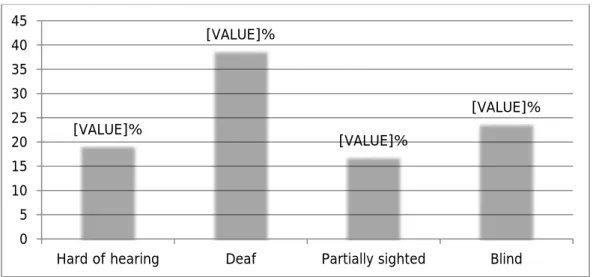
On general there are a more students with hearing impairment (58,6%). As seen from the figure 2.1 there are 39,1% respondents who are deaf, 19,5% who are hard of hearing, 17,2% partially sighted and 24,1% who are blind.
Distribution by impairment per country is presented in the Table 2.3 – as the numbers are low and the sampling was not random, the percentages have only informative nature and we cannot conclude from the data about the general situation in each of the countries.
Table 2.3: Respondents by impairment by country
What kind/degree of impairment do you have?
Hard of hearing Deaf Partially sighted Blind
Country n % n % n % n %
Italy 4 14,3% 8 28,6% 7 25,0% 9 32,1% Portugal 5 11,9% 22 52,4% 6 14,3% 9 21,4% Slovenia 1 16,7% 2 33,3% 1 16,7% 2 33,3% Sweden 7 63,6% 2 18,2% 1 9,1% 1 9,1%
For the majority of respondents their impairment is present since birth (57,1%). Go back to index [VALUE]% [VALUE]% [VALUE]% [VALUE]% 0 5 10 15 20 25 30 35 40 45
39
2.3 Schooling
Part of the questionnaire covered questions about the schooling, as we were interested in what kind of schools the respondents were enrolled before entering higher education.
2.3.1 Pre-school education
Table 2.4: Pre-school education
n %
Mainstream 55 67,1%
School for deaf/blind 23 28,0%
Other 4 4,9%
82 100,0%
Majority of respondents were enrolled in mainstream pre-school (67,1%) and only 28% into special pre-school for deaf or blind.
Regarding data for enrollment into lower primary school – grade 1 to 4, there are 64,2% respondents who were enrolled into mainstream school, and 30,9% who were enrolled into a special school for deaf or blind. 4 respondents were enrolled into other forms of education between school years 1 and 4.
Table 2.5: 1st to 4th grade
n %
Mainstream 52 64,2%
School for deaf/blind 25 30,9%
Other 4 4,9%
81 100,0%
In lower secondary education (from grade 5th until 9th), as per table 2.6 below, the situation is very similar: 64,3% of respondents were enrolled into a so-called mainstream school and 29,8% were enrolled into special schools for deaf or blind students.
40
Table 2.6: 5th to 9th grade
n %
Mainstream 54 64,3%
School for deaf/blind 25 29,8%
Other 5 6,0%
84 100,0%
In the next level of education, the percentages slightly change in favor of
mainstream school (table 2.7). There are 71,1% of respondents who were enrolled into mainstream school from grade 10 to 13 (upper secondary school and 24,1% who were enrolled into school for deaf or blind.
Table 2.7: 10th to 13th grade
n %
Mainstream 59 71,1%
School for deaf/blind 20 24,1%
Other 4 4,8%
83 100,0%
For all participating countries, higher education is only available as mainstream education. In HE we were mainly interested to know about these students’ field of study. Results showed that, as expected, the majority of students (76,8%) is studying in the field of Social Sciences.
Table 2.8: HE – field of study
n %
Natural sciences (STEM - Technology,
Engineering, Mathematics, Physics...) 16 23,2% Social Sciences (Sociology, Languages,
Arts, Education...) 53 76,8%
Total 69 100,0%
It can be seen (Table 2.9) that among deaf and hard of hearing there are more students studying Natural Sciences compared to visually impaired students, where the majority is enrolled into social science programs.
41
Table 2.9: HE field of study by impairment
Hard of
hearing Deaf Partially sighted Blind
n % n % n % n %
Natural Science (STEM - Technology, Engineering,
Mathematics, Physics…) 5 38,5% 7 25,9% 1 7,1% 3 20,0% Social Science (Sociology,
Languages, Arts, Education…) 8 61,5% 20 74,1% 13 92,9% 12 80,0%
They were also asked about their study course and their answers are listed below:
Table 2.10: Study course
n % Sociology and other social sciences 10 15,4% (Sign) language and/or literature 9 13,8%
Education 8 12,3%
Management, administration and/or economics 8 12,3%
Literature 6 9,2% Psychology 5 7,7% Law 3 4,6% Medicine 2 3,1% Mathematics 2 3,1% Architecture 2 3,1% Other 10 15,4%
Majority of respondents is in graduate level (71,6%) and there were no respondents at PhD level.
42
Figure 2.2: Level of study
Respondents were asked for the reason why they’ve selected the current domain of study2. It is interesting to mention that the largest number of respondents have
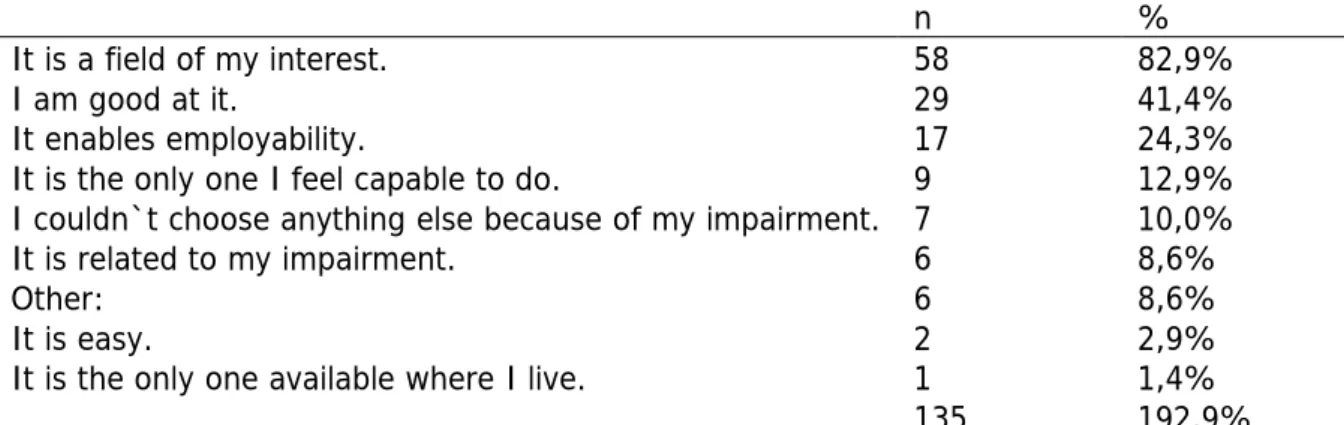
selected their domain of study because it is a field of their interest (82,9%), 41,4% because they feel they are, or can be, good at it, and 24,3% because they believe it enables employability. Apparently, limitations derived from the need to displacement, or even the proper disability, is not taken into consideration when deciding to choose a domain of study. Only one respondent selected his course because it was the only course available in his/her place of living. 10% of respondents said they couldn’t choose anything else because of the impairment, while 8,6% choose the study because it is related to their impairment.
2Since there was the chance to select more than one answer, the sum of all obtained answers is
greater than 100%.
[VALUE]% [VALUE]%
Graduate Masters
43
Table 2.11: Why did you choose this study?
n %
It is a field of my interest. 58 82,9%
I am good at it. 29 41,4%
It enables employability. 17 24,3%
It is the only one I feel capable to do. 9 12,9% I couldn`t choose anything else because of my impairment. 7 10,0%
It is related to my impairment. 6 8,6%
Other: 6 8,6%
It is easy. 2 2,9%
It is the only one available where I live. 1 1,4%
135 192,9%
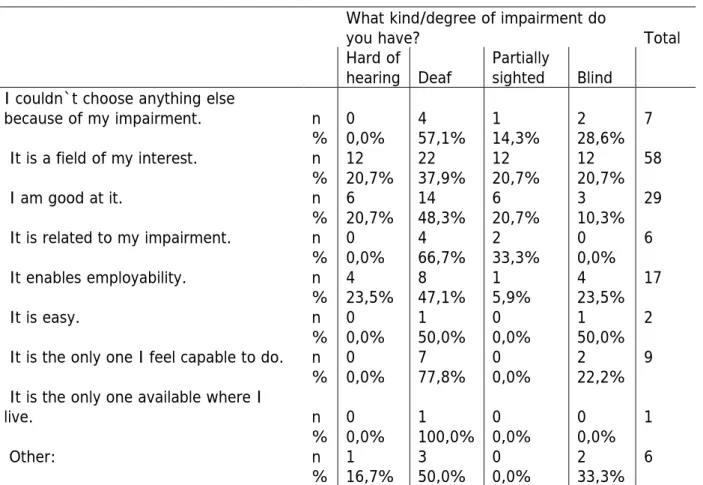
According to the respective impairment, the reasons for selecting a domain of study are presented below (see table 2.12)3.
3Because of the low cell values the table is only informative in nature and we do not draw