Original Article Artigo Original
ISSN 2317-1782 (Online version)
This is an Open Access article distributed under the terms of the Creative Commons Attribution License, which permits unrestricted use, distribution, and reproduction in any medium, provided the original work is properly cited.
Complementarity between PREAUT grid
and IRDI in the analysis of psychic risk at
nine months of age and its relationship with
gestational age
A complementaridade entre sinais PREAUT
e IRDI na análise de risco psíquico aos nove
meses e sua relação com idade gestacional
Antônia Motta Roth Jobim vanHoogstraten1 Ana Paula Ramos de Souza1 Anaelena Bragança de Moraes1
Keywords
Psychoanalysis Child Development Prematurity Autism Mother-child Relations
Descritores
Psicanálise Desenvolvimento Infantil Prematuridade Autismo
Relações Mãe-filho
Correspondence address:
Antônia Motta Roth Jobim van Hoogstraten
Programa de Pós-graduação em Distúrbios da Comunicação Humana, Departamento de Fonoaudiologia, Universidade Federal de Santa Maria – UFSM
Avenida Nossa Senhora Medianeira, 1040, ap. 902, Santa Maria (RS), Brasil, CEP: 97060-002. E-mail: [email protected]
Received: May 26, 2017
Study conducted at Programa de Pós-graduação de Distúrbios da Comunicação Humana, Departamento de Fonoaudiologia, Universidade Federal de Santa Maria – UFSM - Santa Maria (RS), Brasil.
1 Programa de Pós-graduação em Distúrbios da Comunicação Humana, Departamento de Fonoaudiologia,
Universidade Federal de Santa Maria – UFSM - Santa Maria (RS), Brasil.
Financial support: nothing to declare.
Conflict of interests: nothing to declare.
ABSTRACT
Purpose: Compare the level of statistical agreement between the PREAUT grid and the clinical indicators of
risk/reference to child development (IRDI) in the identification of risk, and analyze the frequency of psychic risk
considering the variable gestational age. Methods: The sample consisted of 80 infants, 55 full term and 25 preterm, considering the corrected age. All infants who presented any genetic syndrome, neurological lesions, or sensory
deficits were excluded from the study. The IRDI and the PREAUT grid, in addition to a semi-structured interview,
were used as data collection instruments. The statistical analysis evaluated the degree of agreement between the
PREAUT grid and IRDI levels considering the Kappa coefficient agreement. Results: Perfect agreement was
observed in the identification of individuals with psychic risk in both protocols at nine months of age, although this identification is due to different phenomena. The frequency of psychic risk in preterm infants was higher (24%) than that in full term infants (20%). Considerable psychic risk was observed in the sample studied (21.25%) at
nine months of age. Conclusion: Complete agreement was observed between both protocols in the identification
of psychic risk at nine months of age, whose frequency was important in the studied sample.
RESUMO
Objetivo: Comparar o nível de concordância estatística entre os Sinais PREAUT e os Indicadores Clínicos de
Risco/Referência ao Desenvolvimento Infantil (IRDI) na identificação de risco e analisar a frequência de risco psíquico considerando a variável idade gestacional. Método: A amostra total contou com 80 bebês, sendo 55 bebês
nascidos a termo e 25 bebês nascidos pré-termo, considerando a idade corrigida. Foram excluídos todos os bebês que apresentaram qualquer espécie de síndrome genética, lesões neurológicas ou déficits sensoriais. O IRDI e os Sinais PREAUT, além de uma entrevista semiestruturada foram utilizados como instrumento de coleta
de dados. A análise estatística avaliou o grau de concordância entre os Sinais PREAUT e o IRDI a partir do
coeficiente de concordância kappa. Resultados: Foi observada uma concordância perfeita na identificação de sujeitos em ambos protocolos aos nove meses, embora essa identificação se dê por sinais fenomênicos distintos. A frequência de risco psíquico em bebês prematuros foi superior (24%) à frequência em bebês nascidos a termo (20%). O risco psíquico foi considerável na amostra estudada aos nove meses (21,25%). Conclusão: Houve uma
concordância total entre ambos os protocolos na identificação de risco psíquico aos nove meses, cuja frequência
INTRODUCTION
The identification of developmental and psychic risk from the first months of life has been widely investigated by
researchers who consider mother-infant interactions, especially in relation to initial protoconversations such as the use of
motherese(1-6). They consider these interactions as “catalysts”
for communication development, affecting and regulating the
arousal and attention of infants, facilitating the perception of speech and understanding of language, especially the
communication of affection(5).
In the case of infants who will later develop autism, this preference for the maternal voice is not evidenced, hindering the baby’s engagement in the intersubjective relation, possibly
for deficits in the subcortical processing of emotion in voice(7).
Even so, parents of these children use motherese even more
significantly than parents of typical babies(1) in an attempt
to actively adapt to their children’s lack of responsiveness. These results are obtained(6) when analyzing the relationship
between infant and adult caregiver behaviors through the Infant Caregiver Behavior Scale (ICSB) and the comparative analysis of family videos of babies who became autistic or developed intellectual disability. Parents of babies who later became autistic over-stimulated their babies.
The observation of this type of limitation in family videos of babies interacting with parents and who were diagnosed as autistic after three years of age guided the formulation of the PREAUT grid(8). The researchers observed that the third
moment of the drive circuit did not take place in either one of
the three different drive registers (scopic, oral or invocative)(9).
These signs allowed psychic risk to be identified by the lack
of response to motherese. In the most severe cases, there was
no gaze contact between the dyad, while in milder cases,
the baby did not summon the adult, even though there was a response to the motherese and gaze exchange. The sensitivity
of these signs for the identification of autism was confirmed by
a study(4) that accompanied 25 children with West syndrome up
to 24 months, when they were compared to the results obtained through M-CHAT. The study has shown that PREAUT grid was
productive in the identification of babies with risk for autism.
A recent study(10) suggests that autism originates in prenatal
failure in the development of systems that program timing, serial motor coordination, prospective control of movements,
and control of affective regulation of experiences.
In the present study, for those cases with an intermediate
score between five and 15 in the PREAUT grid, the hypothesis
is that the analysis of the IRDI script can help in understanding risk of a non-autistic nature. The IRDI protocol has been used
in Brazilian research(11) to demonstrate a correlation between
risk and presence of altered maternal mood(12); difficulties
with the constitution of the maternal role(13); prolongation
of breastfeeding and difficulties in food transition(14); low
speech production between 13 and 16 months(15); outcome of
language problems(16-18) and difficulties in the construction of
body image(19). Psychic risk, identified by the IRDI, has also
been shown to be associated with socioeconomic, obstetric, demographic and psychosocial factors(20). These studies confirm
the importance of IRDI in the early detection of psychic suffering
and in the prevention of changes in child development and the development of severe psychopathologies.
Among the obstetric variables, prematurity is a biological
factor that directly affects psychic risk and as such it was
chosen as the object of investigation in the present study.
Prematurity can affect the conditions of CNS maturation and
physical development as a biological risk factor related to
psychic and cognitive factors, thus having consequences for
child development(21,22). In addition, research has sought to
highlight the consequences of prematurity on the maturation and
development of the baby as opposed to those with gestational age greater than 37 weeks(23).
The present article reports partial results of a study that focuses on the complementarity between the PREAUT grid
and IRDI in the identification of the presence of risk in the
process of child development and psychic constitution, besides the analysis of prematurity as a risk factor in child development and the process of psychic constitution. The objectives of the present study are to compare the level of statistical agreement
between PREAUT grid and IRDI in the identification of risk and to analyze the frequency of psychic risk considering the
variable gestational age.
METHODS
This study adopts statistical instruments(24) to present
a prospective cohort, since it followed preterm and full
term infants between the first three and nine months of life,
considering the presence or absence of psychic risk, from the application of the two protocols and the observation of the mother-infant interactive process. The analysis concentrated on the agreement between both protocols at nine months, when
psychic risk can be identified consistently. This is because with the three phases analyzed in the IRDI, it is possible to confirm
the presence of risk, which depends on the absence of two or more indicators and the persistence of this absence in two or more phases. This script, unlike the PREAUT Signals, does
not have a score already indicated in the first phase.
This study is linked to a research project carried out in a Basic Health Unit (BHU) and a University Hospital (UH), located in the Camobi neighborhood of Santa Maria, Rio Grande do Sul. In these two outpatient clinics, infants born preterm and full term were accompanied from one to 24 months.
The research project which encompasses this study
was authorized in May 2014 by the Ethics and Health
The total sample consisted of 80 babies, 55 of whom were born full term and 25 preterm (with gestational age less than 37 weeks)(25), which were evaluated in the protocols
considering the corrected age. Among the full term babies, there were 29 males and 26 females. Among the infants born preterm, 14 were female and 11 were male.
The size of the initial sample included infants who had
completed nine months by the end of the data collection period for the PhD dissertation on which this article is based. All data collection with preterm babies considered the corrected age(22), calculated with the subtraction of the difference between
40 weeks and gestational age at birth.
The study included all mothers whose full term or preterm infants were less than one month old between August 2014 and May 2015 and were seen at least one of two infant care units: the Newborn Screening sector at the BHU, which receives about 150 newborn babies annually for pediatric follow-up,
and the extreme premature follow-up sector of the UH.
All infants with genetic syndromes (Down syndrome, X-fragile, etc.), chronic non-progressive encephalopathy,
or sensory deficits such as deafness or visual impairment, were considered not eligible. This exclusion criterion was
guaranteed in preterm infants based on the assessment that the follow-up of UH preterm infants performed when they were screened. When suspected to have any sensory or other organic limitations based on the physical assessment by the pediatricians at the BHU, full term infants were referred for
medical examination and their data excluded from the sample.
The research did not pose physical or moral risks to the participants, since the tests performed by the team are simple and non-invasive procedures, and can contribute to the early
identification of risk for communication and interaction
disorders. The only inconvenience was returning to the place
of evaluation to participate in filming and answer evaluations and questionnaires. The family members were motivated to
participate as the project would observe the development of the children and provide treatment when necessary.
Collection instruments and procedures
The first contact with the babies and their relatives,
especially the mother, occurred at the Newborn Screening
sector of the BHU and the extreme premature follow-up
sector of the UH. At that moment, the mothers received information regarding the objectives and procedures of the
study. Next, the Free and Informed Consent Term (FICT)
was read to them, including the research objectives, the risks
involved, voluntary nature of participation, confidentiality
regarding their identity and their right to withdraw from the process at any time during the study. On the same day, the semi-structured interview was conducted with the mother.
Three additional meetings were scheduled in which the
dyads were filmed. Their interaction was evaluated using
IRDI and the PREAUT grid and a baby data retrieval was
performed regarding possible changes in the routine of the baby or family.
The four meetings for data collection took place at: One
month of age (first contact, signing of the FICT and
semi-structured interview); Four months age range or PREAUT and IRDI phase I (between three months and one day and
four months and 29 days); Six months age range or IRDI phase II (between five months and one day and six months
and 29 days); and Nine months age range or PREAUT and IRDI phase III (between eight months and one day and nine months and 29 days).
During these meetings, the dyad interaction was observed
using the IRDI and PREAUT grid. Next, the baby and mother were invited to stay in a quiet room to interact on an EVA rug and the interaction was filmed by two digital cameras,
one placed one meter away with a lateral view of the dyad and the other two meters away. The baby was placed sitting in their own chair and the mother facing a mirror behind the baby, allowing the cameras to have a frontal view of the baby
and of the maternal reflection in the mirror. Three moments were considered in the first two evaluations (three and six
months): three minutes of singing, three minutes of free interaction and three minutes with a toy. At the nine-month evaluation, the baby was sitting on the rug and free to move around. The videodata alowed for the PREAUT and IRDI scores assigned by the researcher to be revised by the main supervisor of the study.
The IRDI results revised in the videodata were recorded
as presence or absence of indicators in an Excel bank. In
relation to both PREAUT phases, the obtained sum was
identified and registered in the same bank. The analysis
presented here considered results obtained in IRDI phases I, II and III and those obtained with the PREAUT grid in the nine-month range (eight months and one day to nine months and 29 days).
For the statistical analysis, all infants in the nine-month age group who had absence of at least two indicators of the IRDI script and less than 15 points in the PREAUT grid were
classified as at risk. Comparative analysis between the IRDI
and the PREAUT grid issues were performed individually for those infants with scores below 15 in the PREAUT grid.
The data-collection instruments were used as described in the following section.
Semi-structured interview
The semi-structured interview script used by the research group in a previous study(20) was adapted for this study in order
to capture psychosocial, sociodemographic and obstetric factors.
Through questions presented to the mother, the interview
in two meetings with the dyads: when the babies were within the age range of four months and when the babies were in the age range of nine months. The interviews were performed on the same occasions in which the PREAUT and IRDI were used
with the purpose of verifying changes during the first nine
months of the baby’s life.
IRDI-clinical indicators of child development risk
The IRDI protocol is composed of 31 indicators during the
first 18 months of the child’s life to observe the presence of
psychic risk or child development problems. It is divided into four phases: Phase I (until four months), Phase II (four to eight months incomplete), Phase III (eight to 12 months incomplete)
and Phase IV (12 to 18 months).
For the present study, IRDI was used in its reduced version, which consists of 18 indicators, 14 of which refer to Phases I, II and III. Its reduced version was used, considering the multifactorial analysis of the multicentric research of the Ministério da Saúde presented at the Escola de Saúde Pública do Rio Grande do Sul(26). This study evidenced statistically
significant relationships between the psychic constitution and
the emergence of instrumental aspects of the development of
the baby identified in this reduced version.
The 14 indicators allow an evaluation of infants up to the
first nine months of life, regarding the presence or absence of risks and, in turn, could verify the presence of difficulties in
the development of children concerning subjective constitution. Chart 1 shows the four phases evaluated in IRDI.
The indicators shown in Chart 1 and observed from the mother-baby interaction in the researcher’s meetings with the dyad were evaluated and indicated when present or absent.
PREAUT grid
The purpose of the PREAUT grid is to evaluate the closure of the drive circuit, based on the baby’s ability to spontaneously
engage in synchronized and joyful interactions with the mother.
Two signs are evaluated in the intersubjective relation of the mother-baby dyad: Communicative sign 1 (S1) as the baby seeks to be looked at by the mother (or substitute) in the absence
of any request from her; and Communicative sign 2 (S2) as
the baby tries to provoke a joyful interaction with the mother
(or substitute) in the absence of any request from her(27).
Communicative signs were observed firstly in the mother-baby
interaction and later in the interaction between the researcher and the dyad. It should be noted that in cases where the mother did not interact with her baby during the evaluation period, the researcher asked her to talk to the baby as she would if they
were at home. From the observation of the dyad and subsequent
analysis of the videodata, a value was assigned to each answer
given to the questions in the PREAUT grid. When the sum was equal to 15, the risk for autism was considered absent, while
a score below 15 indicated the presence of risk to be either
Chart 1. Indicators in IRDI - reduced version
PHASES INDICATORS AXIS
PHASE I 0-4 months incomplete
1. When the child cries or screams, the mother knows what she wants. SA/ED
2. The mother speaks in a style particularly directed to the child (motherese). SA
3. The child reacts to the motherese. ED
4. The mother proposes something to the child and waits for the use of the reaction. PA
5. There are exchanges of looks between the child and the mother. SA/PA
PHASE II 4-8 months incomplete
6. The child uses different signs to express different needs. ED
7. The child reacts (smiles, vocalizes) when the mother or another person addresses them. ED
8. The child actively seeks the mother’s gaze. ED/PA
PHASE III 8-12 months incomplete
9. The mother realizes that some requests from the child may be a way to get her attention. ED/SA
10. During the body care, the child actively seeks games and love plays with the mother. ED
11. Mother and child share a particular language. SA/PA
12. The child shows estrangement from unknown people. PF
13. The child makes cute faces. ED
14. The child accepts semi-solid, solid and varied feeding. ED
PHASE IV
12-18 months incomplete 15. The mother alternates moments of dedication to the child with other interests. ED/PF
16. The child supports the mother’s brief absences and responds to prolonged absences. ED/PF
17. The mother no longer feels obliged to satisfy everything the child asks for. PF
18. Parents place small rules of behavior for the child. PF
moderate (between five and 14) or serious (less than five).
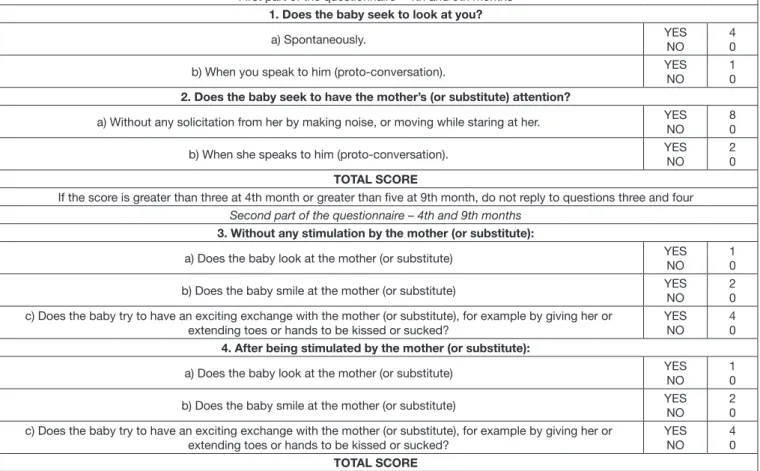
Chart 2 shows the PREAUT grid(28).
Statistical analysis of the data
The data collected for the 80 babies were transferred to an
Excel spreadsheet and recurrently updated according to each
of the three evaluated stages of the babies. Then, descriptive statistics were obtained to verify the degree of correspondence between the IRDI and the PREAUT grid in the sample studied,
using the kappa concordance coefficient and considering 10% as a level of significance. Each of the PREAUT signs was verified
in relation to the 14 indicators considered in the research. These results were interpreted from the following relation of the values
of the kappa coefficient(29):
• Degree of almost perfect agreement = 0.81-1.00;
• Degree of substantial agreement = 0.61-0.80;
• Degree of moderate agreement = 0.41-0.60;
• Degree of regular agreement = 0.21-0.40;
• Degree of small agreement = between 0 and 0.20; and
• Poor agreement degree = 0.
RESULTS
The PREAUT results at four and nine months, used as reference values for comparison with the IRDI are shown in Table 1.
PREAUT scores equal to or lower than 15 indicate the need
for a more detailed evaluation of the baby, since they may indicate a serious risk to development(8). In this regard, the evaluation of
the four month age group demanded attention since 42 infants
(52.5%) in the first phase of application presented altered signs. Although full term and preterm infants equally presented signs
of immature development before reaching four months of age
at the time of the first evaluation, the presence of psychic risk in preterm infants was 11% higher than in those born full term.
The evaluation of the PREAUT grid at nine months, showing a considerable decrease in the number of babies with alterations
(21.25%), was more precise due to greater maturity of the babies. In the first phase, there were eight cases (10%) of scores of five or less, and none in the second phase, while the IRDI
evaluation detected a higher percentage of babies presenting
risk to psychic constitution, but not specific for autism risk, in
this second phase.
Table 2 shows scores for the IRDI protocol, indicating the absent indicators in babies up to nine months considering gestational age. Longitudinal results along three phases corroborate the
Chart 2. PREAUT grid
First part of the questionnaire – 4th and 9th months
1. Does the baby seek to look at you?
a) Spontaneously. YES
NO
4 0
b) When you speak to him (proto-conversation). YES NO
1 0
2. Does the baby seek to have the mother’s (or substitute) attention?
a) Without any solicitation from her by making noise, or moving while staring at her. YES NO
8 0
b) When she speaks to him (proto-conversation). YES NO
2 0
TOTAL SCORE
If the score is greater than three at 4th month or greater than five at 9th month, do not reply to questions three and four Second part of the questionnaire – 4th and 9th months
3. Without any stimulation by the mother (or substitute):
a) Does the baby look at the mother (or substitute) YES NO
1 0
b) Does the baby smile at the mother (or substitute) YES NO
2 0 c) Does the baby try to have an exciting exchange with the mother (or substitute), for example by giving her or
extending toes or hands to be kissed or sucked?
YES NO
4 0
4. After being stimulated by the mother (or substitute):
a) Does the baby look at the mother (or substitute) YES NO
1 0
b) Does the baby smile at the mother (or substitute) YES NO
2 0 c) Does the baby try to have an exciting exchange with the mother (or substitute), for example by giving her or
extending toes or hands to be kissed or sucked?
YES NO
4 0
TOTAL SCORE
Table 1. PREAUT Grid in the 4th and 9th month considering gestational age
Number of babies at risk
Total score of infants at risk
13 12 11 10 9 8 7 6 5 3 2
PHASE I (4th month)
Premature (n=25) 15 (60%) 1 2 9 1 1 1
Full term (n=55) 27 (49%) 2 1 2 15 1 2 2 2
Total (n=80) 42 (52.5%) 2 1 1 4 24 2 3 2 3
PHASE III (9th month)
Premature (n=25) 6 (24%) 1 4 1
Full term (n=55) 11 (20%) 1 9 1
Total (n=80) 17 (21.25%) 1 1 13 1 1
Source: Authors
Table 2. Frequency of absent indicators in the IRDI up to nine months considering gestational age Babys
at risk 2 IRDI absent 3 IRDI absent 4 IRDI absent 5 IRDI absent 7 IRDI absent 8 IRDI absent
Premature (n=25) 6 (24%) 1 3 2
Full term (n=55) 11 (20%) 1 1 4 3 2
Total (n=80) 17 (21.25%) 2 0 4 6 3 2
14 indicators evaluated. Source: Authors
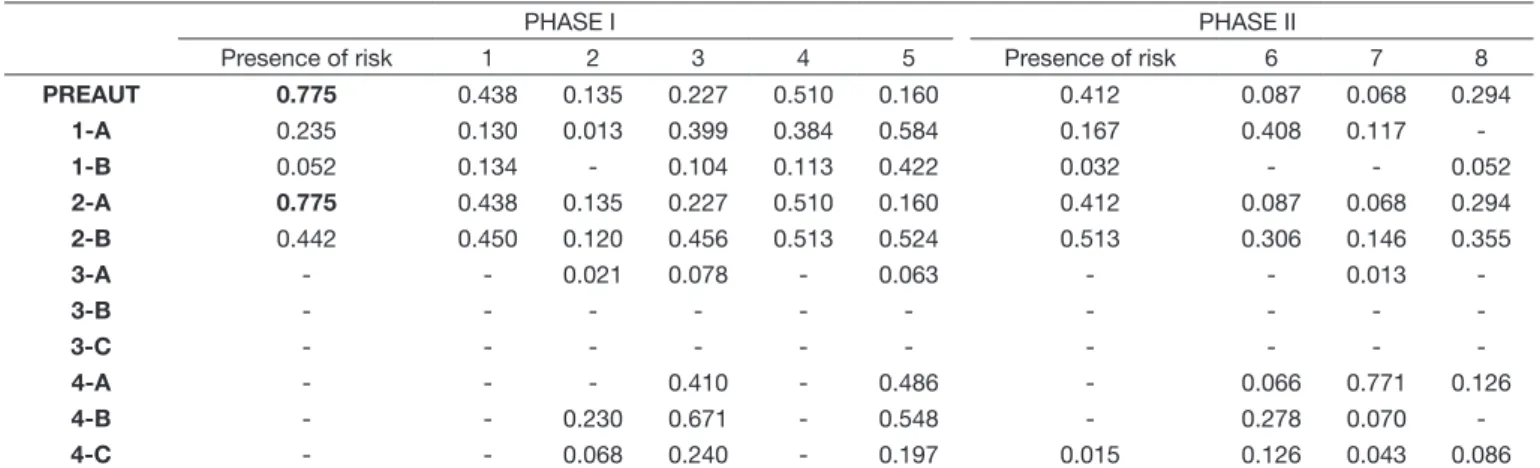
Table 3. Kappa concordance coefficient for presence of risk in the PREAUT Grid at 4th month and IRDI Phases I and II
PHASE I PHASE II
Presence of risk 1 2 3 4 5 Presence of risk 6 7 8
PREAUT 0.775 0.438 0.135 0.227 0.510 0.160 0.412 0.087 0.068 0.294
1-A 0.235 0.130 0.013 0.399 0.384 0.584 0.167 0.408 0.117
-1-B 0.052 0.134 - 0.104 0.113 0.422 0.032 - - 0.052
2-A 0.775 0.438 0.135 0.227 0.510 0.160 0.412 0.087 0.068 0.294
2-B 0.442 0.450 0.120 0.456 0.513 0.524 0.513 0.306 0.146 0.355
3-A - - 0.021 0.078 - 0.063 - - 0.013
-3-B - - -
-3-C - - -
-4-A - - - 0.410 - 0.486 - 0.066 0.771 0.126
4-B - - 0.230 0.671 - 0.548 - 0.278 0.070
-4-C - - 0.068 0.240 - 0.197 0.015 0.126 0.043 0.086
Source: Authors
hypothesis that the evaluation at nine months allows for a more accurate analysis of infant psychic structuring, considering the results of both protocols.
Agreement between IRDI and the PREAUT grid was also found for the scores at four months of age, as shown in Table 3.
The IRDI of phase I presented a kappa coefficient of agreement equal to .775, which is a substantial value in relation to the
PREAUT grid evaluated in the same period. The PREAUT 4A sign (“The child looks at the mother (or substitute)” presented
a kappa coefficient of agreement equal to .771 in relation to IRDI-7 (“The child reacts (smiles, vocalizes) when the mother or another person is addressing them”), at six-month age range.
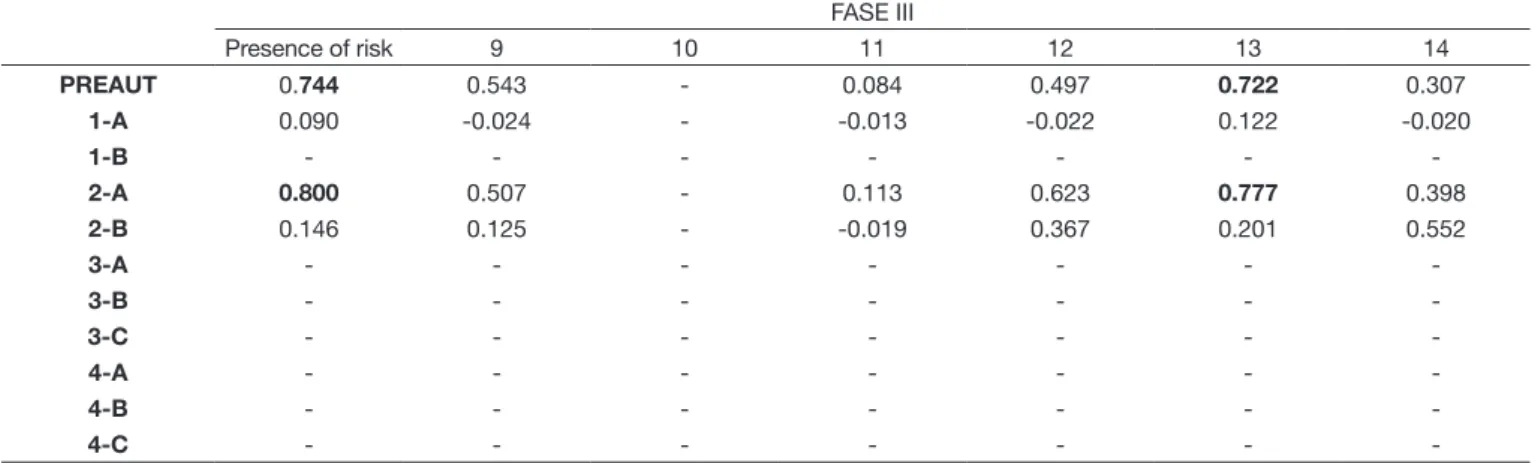
A high kappa coefficient of agreement of .744 was also
obtained with the IRDI of phase III and the PREAUT grid
verified at nine months of age, as shown in Table 4.
An even higher kappa agreement coefficient (.800) was
found between IRDI phase III and PREAUT 2A sign (“The baby seeks to have the mother’s (or substitute) attention without any solicitation from her by making noise, or moving while staring at her”) and (.777) between PREAUT 2A sign and IRDI-13 (“The child makes cute faces”), both indicators of a third moment of the drive circuit.
Both Tables 3 and 4 show a grid combining PREAUT and
IRDI factors. Except for signal 2A, the IRDI (considering the
18-indicator version) and the PREAUT factors demonstrate an
insufficient or moderate kappa agreement coefficient.
than 15. Among the 80 babies involved in the study, only one
presented a score equal to five, an indication of autistic psychic
risk. In general, intermediate PREAUT scores demonstrate signs of non-autistic psychic risk when compared to absent IRDI.
DISCUSSION
The present research springs from the interest in analyzing any existing complementarity between the PREAUT(28) grid
and the IRDI in order to study the capacity of each instrument to evaluate psychic risk and infant development, taking into
account the prematurity that may affect these results.
The question that drives this research refers to the extent to which both instruments present similarities and differences
and the productivity in using them simultaneously, since the
PREAUT grid puts greater emphasis on the risk of progression to autism(8,30) than the IRDI, which, in turn, concentrates on
psychic risk of a broader spectrum(11-20). The results presented in
this analysis indicate high agreement between the two, especially for the nine-month age group, demonstrating that they indicate
psychic risk in a similar way. This confirms the efficacy of both
instruments which has been shown in previous studies(4,8,11-20).
In the nine-month age group, all the infants who presented
a final sum in the PREAUT grid of less than 15 presented at
least two absent indicators in the IRDI script. The results of
the kappa concordance coefficient show a high correlation index between the two protocols, suggesting that they are both
sensitive to signs of risk in the psychic constitution of babies. However, the most important thing to note is that when each PREAUT sign was compared to each indicator of the
Table 4. Kappa concordance coefficient for presence of risk in the PREAUT grid at 9th month and IRDI Phase III
FASE III
Presence of risk 9 10 11 12 13 14
PREAUT 0.744 0.543 - 0.084 0.497 0.722 0.307
1-A 0.090 -0.024 - -0.013 -0.022 0.122 -0.020
1-B - - -
-2-A 0.800 0.507 - 0.113 0.623 0.777 0.398
2-B 0.146 0.125 - -0.019 0.367 0.201 0.552
3-A - - -
-3-B - - -
-3-C - - -
-4-A - - -
-4-B - - -
-4-C - - -
-Source: Authors
Table 5. Description of the number of Indicators absent and sum of PREAUT Grid in seventeen subjects with risk at nine months
Subjects IRDI Phase I n absent
IRDI Phase II n absent
IRDI Phase III n
absent TOTAL
PREAUT Grid 4h month
PREAUT Grid 9th month
T06 2 2 3 7 9 9
T23 3 1 4 8 12 7
T27 3 3 1 7 2 7
T29 2 2 1 5 5 7
T 38 2 1 2 5 6 7
T47 1 1 2 4 7 7
T63 2 3 2 7 7 7
T 65 3 1 4 8 3 5
T74 3 1 1 5 8 7
T76 0 1 1 2 15 7
T112 2 1 2 5 7 7
P18 1 0 1 2 7 11
P19 0 2 3 5 15 6
P24 2 1 1 4 8 7
P33 2 0 2 4 7 7
P35 2 0 2 4 15 7
P40 1 1 3 5 7 7
IRDI script in the same phase, the kappa coefficient was low in all cases except for indicator 13 in relation to PREAUT sign 2A. Although each instrument considers different criteria
based on psychoanalytical theory, they have both led to similar
results in terms of the existence of risk in the process of psychic
constitution of the baby.
For detection of psychic risk, the age of nine months seems to be the best period due to the high levels of coincidence between both protocols. This age could also be seen as a
threshold for a more effective follow-up of the baby in case the baby has not been previously examined. However, in cases of autistic risk, earlier intervention would be more effective,5-6 as
demonstrated by Laznik’s clinical reports of infants younger than six months(9,30). In the Brazilian Unified Health System,
the use of both instruments may be an important support in first
year infant healthcare practices.
In line with the literature(21-23), the present results indicate that
prematurity is a biological factor that directly affects the psyche and mother-child relationship, and thus may have consequences
for child development.
Two other key points emerge from the study. The first is
that although both instruments capture signs of problems in psychic structuring and child development, they rely on distinct
phenomenal signs due to specificities in each instrument.
The second point is that both IRDI-13 (“The child makes cute faces”) and PREAUT 2A (“The baby seeks the mother’s (or substitute) attention without any solicitation by making noise or moving while staring at the mother”) demonstrate the third moment of the drive circuit.
The psychoanalytic orientation common to both instruments does not give them diagnostic value, therefore there is a need for an evaluation in transference so that more accurate
information about the suffering of child and family can guide
the choice of the direction of intervention(19,20). Due to their
distinct phenomenological nature, complementarity of IRDI and PREAUT grid may be productive in psychic risk detection as intervention scripts in infant healthcare depending on the
severity of the psychological suffering existent(8,19,26).
The process of psychic constitution is evidenced by the bond established between the caregiver and the baby. For this reason, the PREAUT grid and the IRDI rely on the initial dyad interaction, providing signs that demonstrate the need for a clinical analytical interpretation. Thus, there is a need for careful training of health care professionals to observe psychic
constitution so that they understand the difference between risk
and diagnosis, as reported by the PREAUT study in France(8).
Nevertheless, insertion of instruments into the health system is
not enough, it is necessary to organize teams for early detection
and intervention that support the primary care teams(9).
CONCLUSION
Considering the frequency of psychic risk in a sample of
25 preterm and 55 full term babies, both groups presented
significant risk at nine months, demonstrating that the nine-month
age range is fundamental for the analysis of psychic risk. Among the 80 babies involved in the study, 17 did not overcome the risk
until this age group, as evidenced by both the PREAUT grid and IRDI. In this age group, the agreement between IRDI and
PREAUT grid was important, even though different phenomenal
factors are considered.
In view of these conclusions, the present study presents certain
limitations related to parents’ difficulties in participating, since
some of them did not understand that such evaluation would
be beneficial for early intervention when necessary. The team sought to monitor each baby every six months up to the age of
two, both full term and preterm infants, and in cases where they presented signs of risk from the age of nine months, parents
were offered one of two intervention possibilities: individual
or in a group based on music intervention.
REFERENCES
1. Cohen D, Cassel RS, Saint-Georges C, Mahdhaoui A, Laznik M-C, Apicella F, et al. Do parenthese prosody and father’s involvement in interacting facilitate social interaction in infants who later develop autism? PLoS One. 2013;8(5):1-10. http://dx.doi.org/10.1371/journal.pone.0061402.
2. Laznik MC. Diversos olhares sobre o autismo. In: Jerusalinsky A, editor. Dossiê autismo. São Paulo: Instituto Langage; 2015. p. 56-61.
3. Lowe JR, Erickson SJ, Maclean P, Schrader R, Fuller J. Association of maternal scaffolding to maternal education and cognition in toddlers born preterm and full term. Acta Paediatr. 2013;102(1):72-7. http://dx.doi. org/10.1111/apa.12037. PMid:23009657.
4. Ouss L, Saint-Georges C, Robel L, Bodeau N, Laznik MC, Crespin GC, et al. Infant’s engagement and emotion as predictors of autism or intellectual disability in West syndrome. Eur Child Adolesc Psychiatry. 2014;23(3):143-9. http://dx.doi.org/10.1007/s00787-013-0430-x. PMid:23728914. 5. Saint-Georges C, Chetouani M, Cassel R, Apicella F, Mahdhaoui A,
Muratori F, et al. Motherese in interaction: at th cross-road of emotion and cognition? A systematic review. PLoS One. 2013;8(10):e78103. http://
dx.doi.org/10.1371/journal.pone.0078103. PMid:24205112.
6. Saint-Georges C, Mahdhaoui A, Chetouani M, Cassel RS, Laznik MC, Apicella F, et al. Do parents recognize autistic deviant behavior long before diagnosis? Taking into account interaction using computational methods. PLoS One. 2011;6(7):e22393. http://dx.doi.org/10.1371/journal. pone.0022393. PMid:21818320.
7. Pannese A, Grandjean D, Frühholz S. Subcortical processing in auditory communication. Hear Res. 2015;328:67-77. http://dx.doi.org/10.1016/j. heares.2015.07.003. PMid:26163900.
8. Crespin G, Parlato-Oliveira E. Projeto PREAUT. In: Jerusalinsky A, editor. Dossiê autismo. São Paulo: Instituto Langage; 2015. p. 436-55.
9. Laznik MC. A hora e a vez do bebê. São Paulo: Instituto Langage; 2013. 10. Trevarthen C, Delafield-Butt J. Autism as a development disorder in
intentional movement and affective engagement. Front Integr Nuerosci. 2013;7:49. http://dx.doi.org/10.3389/fnint.2013.00049. PMid:23882192. 11. Kupfer MCM, Jerusalinsky AN, Bernardino LMF, Wanderley D, Rocha
PSB, Molina SE, et al. Valor preditivo de indicadores clínicos de risco ao desenvolvimento infantil: um estudo a partir da teoria psicanalítica. Lat Am Journal of Fund Psychopath. 2009;6(1):48-68 [citado em 2017 Maio 26]. Disponível em: http://www.fundamentalpsychopathology.org/uploads/ files/latin_american/v6_n1/valor_preditivo_de_indicadores_clinicos_de_ risco_para_o_desenvolvimento_infantil.pdf
12. Flores MR, Souza APR, Moraes AB, Beltrami L. Associação entre indicadores de risco ao desenvolvimento infantil e estado emocional materno. Rev CEFAC. 2013;15(2):348-60. http://dx.doi.org/10.1590/ S1516-18462012005000046.
13. Beltrami L, Moraes A, Souza APR. Constituição da experiência da maternidade e risco ao desenvolvimento infantil. Rev CEFAC. 2014;16(6):1828-36.
14. Vendruscolo JF, Bolzan GM, Crestani AH, Souza APR, Moraes AB. A relação entre o aleitamento, a transição alimentar e os indicadores de risco para o desenvolvimento infantil. Distúrb Comun. 2012;24(1):41-52 [citado
em 2017 Maio 26]. Disponível em: http://revistas.pucsp.br/index.php/dic/
article/view/9704/7208
15. Crestani AH, Moraes AB, Souza APR. Análise da associação entre índices de risco ao desenvolvimento infantil e produção inicial de fala entre 13 e 16 meses. Rev CEFAC. 2015;17(1):169-76. http://dx.doi.org/10.1590/1982-021620153514.
16. Oliveira LD, Souza APR. A percepção materna do sintoma de linguagem em três casos de risco ao desenvolvimento e a busca por intervenção precoce. Distúrb Comun. 2014;26(4):656-67 [citado em 2017 Maio 26]. Disponível
em: http://revistas.pucsp.br/index.php/dic/article/view/9704/7208
17. Flores MR, Souza APR. Diálogo de pais e bebês em situação de risco ao desenvolvimento. Rev CEFAC. 2014;16(3):840-52. http://dx.doi. org/10.1590/1982-0216201411412.
18. Vendrúscolo J, Souza APR. Intersubjetividade no olhar interdisciplinary
sobre o brincar e a linguagem de sujeitos em risco psíquico. Rev CEFAC.
2015;17(3):707-19. http://dx.doi.org/10.1590/1982-0216201514814. 19. Kupfer MC, Bernardino LMF. As relações entre construção da imagem
corporal, função paterna e hiperatividade: reflexões a partir da pesquisa
IRDI. Rev Latinoam Psicopatol Fundam. 2009;12(1):45-58. http://dx.doi. org/10.1590/S1415-47142009000100004.
20. Crestani AH, Mattana F, Moraes AB, Souza APR. Fatores socioeconômicos, obstétricos, demográficos e psicossociais como risco ao desenvolvimento infantil. Rev CEFAC. 2013;15(4):847-56. http://dx.doi.org/10.1590/S1516-18462013000400013.
21. Mancini M, Megale L, Brandão M, Melo A, Sampaio R. Efeito moderador do risco social na relação entre risco biológico e desempenho funcional infantil. Rev Bras Saude Mater Infant. 2004;4(1):25-34. http://dx.doi. org/10.1590/S1519-38292004000100003.
22. Zornig S, Morsch D, Braga N. Os tempos da prematuridade. Rev Latinoam Psicopatol Fundam. 2004;7(4):135-43. http://dx.doi.org/10.1590/1415-47142004004009.
23. Formiga CK, Linhares MBM. Avaliação do desenvolvimento inicial de crianças nascidas pré-termo. Rev Esc Enferm USP. 2009;43(2):472-80.
http://dx.doi.org/10.1590/S0080-62342009000200030. PMid:19655692.
24. Gressler L. Introdução à pesquisa: projetos e relatórios. 2. ed. São Paulo: Loyola; 2004.
25. Dall’Oglio AM, Rossiello B, Coletti MF, Bultrini M, De Marchis C, Ravà L, et al. Do healthy preterm children need neurophsychological follow up? Preschool outcomes compared with term peers. Dev Med Child Neurol. 2010;52(10):955-61. http://dx.doi.org/10.1111/j.1469-8749.2010.03730.x. PMid:20722666.
26. Kupfer MCM, Bernardino LMF, Jerusalinsky AN, Rocha PS, Lerner R, Pesaro ME. A pesquisa IRDI: resultados finais. In: Lenner R, Kupfer MC,
editors. Psicanálise com crianças: clínica e pesquisa. São Paulo: Escuta;
2008. p. 221-30.
27. Olliac B, Crespin G, Laznik MC, Ganouni OCIE, Sarradet JL, Bauby C, et al. Résultats de l’étude “Evaluation d’un ensemble cohérent d’outils de repérage des troubles précoces de la communication pouvant
présager un trouble grave du développement de type autistique”. Paris:
La Recherche Preaut; 2017 [citado em 2017 Maio 26]. Disponível em:
https://www.preaut.fr/dispositifs-experimentaux/la-recherche-preaut/
recherche-preaut-princeps/
28. Olliac B, Crespin G, Laznik M-C, Cherif Idrissi El Ganouni O, Sarradet J-L, Bauby C, et al. Infant and dyadic assessment in early community-based screening for autism spectrum disorder with the PREAUT grid. PLoS One. 2017;12(12):e0188831. http://dx.doi.org/10.1371/journal.pone.0188831. PMid:29216234.
29. Landis JR, Koch G. The measurement of observer agreement for categorical data. Biometrics. 1977;33(1):159-74. http://dx.doi.org/10.2307/2529310. PMid:843571.
30. Kupfer MC. Notas sobre o diagnóstico diferencial da psicose e do autismo na infância. Psicol USP. 2000;11(1):85-105. http://dx.doi.org/10.1590/ S0103-65642000000100006.
Author contributions