Clinical evaluation of a substitute of HLA-B*58:01 in different Chinese ethnic
groups
Xinju Zhang
1*, Lei Jin
2*, Zhiyuan Wu
3, Weizhe Ma
1, Yuming Chen
4, Gang Chen
5, Lixin Wang
6,7,8and Ming Guan
1,3,41
Department of Central Laboratory, Huashan Hospital, Fudan University, Shanghai, China.
2
College of Allied Health Professions, Shanghai University of Medicine and Health Sciences, Shanghai,
China.
3
Department of Laboratory Medicine, North Huashan Hospital, Fudan University, Shanghai, China.
4
Department of Laboratory Medicine, Huashan Hospital, Fudan University, Shanghai, China.
5
Department of Geriatrics, Huashan Hospital, Fudan University, Shanghai, China.
6
The Medical Laboratory Center of General Hospital of Ningxia Medical University, Yinchuan, China.
7The Medical Laboratory of Cardio-Cerebral Vascular Disease Hospital of General Hospital of Ningxia
Medical University, Yinchuan, China.
8
Ningxia Key Laboratory of Clinical Pathogens, Yinchuan, China.
Abstract
The goal of this research was to investigate the linkage disequilibrium between rs9263726 and HLA-B*58:01 in dif-ferent Chinese ethnic groups (Han, Tibet, and Hui) and to study the feasibility of rs9263726 replacing HLA-B*58:01 as an efficient indicator of potential allopurinol hypersensitivity syndrome. In this study, rs9263726 and HLA-B*58:01 were detected in all samples. For samples of individuals whose rs9263726 genotypes were not consistent with HLA-B*58:01, we did high-resolution typing of HLA-B gene to further confirm the correlation of rs9263726 genotype and special HLA-B alleles. We confirmed that the linkage disequilibrium between rs9263726 and HLA-B*58:01 was
more significant in the Han ethnic group (r2
=0.886, D’=1.0) than in the Tibet and Hui ethnic groups (for Tibetan,
r2
=0.606, D’=0.866; for Hui, r2
=0.622, D’=0.924). For Han Chinese, samples with the GG genotype of rs9263726 did not carry HLA-B*58:01, while AA genotype samples were homozygous carriers of HLA-B*58:01. However, GA geno-type samples of rs9263726 required a more sophisticated HLA-B genotyping assay before it was possible to identify whether they were HLA-B*58:01 carriers or not. For Tibetan and Hui, the linkage disequilibrium between rs9263726 and HLA-B*58:01 was not significant. Therefore, rs9263726 cannot replace HLA-B*58:01 in these two groups.
Keywords: rs9263726, HLA-B*58:01, allopurinol hypersensitivity reaction, tag SNP.
Received: August 15, 2017; Accepted: January 23, 2018.
Introduction
Allopurinol is recommended as the first-line pharma-cologic urate-lowering therapy in gout. However, severe hypersensitivity of some patients to allopurinol limits its use in clinical medicine. HLA-B*58:01 has been recom-mended as marker of the severe allopurinol hypersensitiv-ity syndrome in some subpopulations with high prevalence of the HLA-B*58:01 allele, including Chinese, European, Italian, Korean, and Thai (Pavloset al., 2012). However, because of the complexity of the HLA-B polymorphic loci,
the current detection methods, such as SSP and PCR-SSO, are too complex to operate, and several interference factors make the detection of HLA-B*58:01 allele unfeasi-ble for wide application in the clinic.
Tohkinet al.(2013) reported that rs9263726 was in absolute linkage disequilibrium (LD) with HLA-B*58:01 in a Japanese population and could be used as a surrogate marker of HLA-B*58:01 to predict patients with high-risk of severe allopurinol hypersensitivity syndrome. However, unlike the results for this Japanese population, a recent study showed a lack of LD between the rs9263726 A allele and HLA-B*58:01 in Australians (Vidalet al., 2016). This observation suggests that rs9263726 frequencies may differ across different ethnic groups.
In this study, we investigated the linkage relationship between rs9263726 and HLA-B*58:01 in three Chinese
Send correspondence to Ming Guan. Department of Central Labo-ratory, Huashan Hospital, Fudan University, 12 Central Urumqi Road, 200040 Shanghai, P.R. China. E- mail: [email protected].
*These authors contributed equally to this study.
populations. In light of the vast territory, large number of ethnic minorities, and genetic differences in China, this study analyzed the feasibility of substituting HLA-B*58:01 for rs9263726 in Tibetan, Han, and Hui Chinese people based on the morbidity of hyperuricemia. Our data demon-strate that rs9263726 can substitute for HLA-B*58:01 as marker of the severe allopurinol hypersensitivity syndrome in Han Chinese, but not in Tibetan and Hui people.
Subjects and Methods
Subjects
For this study, samples were randomly collected from three groups of participants from different regions of China. The first group consisted of 454 healthy South Han Chinese who were volunteers for clinical physical exami-nation and 205 gout Han patients seen in Huashan Hospital between January 2013 and December 2015. The second group consisted of 500 healthy Tibetans residing in Xining Region of Qinghai Province, recruited from the Tibetan Medical Hospital of Qinghai Province. The third group was composed of 200 healthy Hui people residing in Ningxia Hui Autonomous Region, who were recruited from the General Hospital of Ningxia Medical University. Qinghai Province and the Ningxia Hui Autonomous Region have retained comparatively intact genetically isolated popula-tions. Due to differences in diet structure, climate, and genetic variation, the incidence of hyperuricemia in Han people is higher than that in Hui people (Conget al., 2009), but lower than in Tibetans (Conget al., 2009). Therefore, we chose these three ethnicities for the gene analysis. The healthy individuals did not have a personal or familial his-tory of hyperuricemia or gout. This study was approved by the Ethics Committee of Huashan Hospital and conducted in accordance with the Declaration of Helsinki guidelines for ethics in research. Written informed consent was ob-tained from each patient prior to collection of the speci-mens.
Sample preparation
During transportation, whole blood samples were stored in dry ice to prevent DNA degradation. Genomic DNA was extracted from EDTA-anticoagulated whole-blood samples using the QIAamp DNA Blood Mini Kit (Qiagen, Hilden, Germany) and kept at -20 °C.
rs9263726 genotyping by HRM with an unlabeled probe method
We detected rs9263726(G > A) alleles in all samples by high-resolution melting (HRM) analysis with an unlabeled probe method using the positive and negative control samples identified by Sanger sequencing. The for-ward and reverse primers were 5’-ACCCCAGCTTTACA AGGACCC-3’ and 5’-GCTCCATGTGGCAAAGTCGG TCA-3’, respectively, and the unlabeled probe was
5’-CTCCGAGGAAACTCATCCCCCC-PHO-3’. The re-agent mix was made up as follows: 10mL PremixTaqHS (Takara, Japan), 0.5mL of forward primer (2mM), 0.5mL of reverse primer (10mM), 0.5mL of unlabeled probe (10
mM) and 25 ng DNA that was added to the solution before completing with water to 20mL. The PCR conditions were: initial denaturation at 95 °C for 2 min, 50 cycles at 95 °C for 30 s, 55 °C for 30 s, and 72 °C for 30 s. After amplification, 0.6mL of 1´SYTO 9 dye (Invitrogen, Carlsbad, Califor-nia) was added. The reaction tubes were then transferred to a Rotor Gene Q system (Qiagen) and processed for HRM analysis. The PCR products were heated to 95 °C for 1 min followed by rapid cooling to 40 °C for 1 min to facilitate heteroduplex formation. Melting curve analysis was per-formed by raising the temperature from 55 °C to 89 °C at 0.5 °C /s. Genotypes were identified by the melting temper-atures indicated by peaks on the derivate plots. To confirm the results, all samples with the AA genotype, and 40 ran-domly selected ones with the GA and 30 with the GG geno-type were examined by Sanger sequencing.
To raise the accuracy of the developed method and to avoid interference by other SNPs, we screened the interfer-ence sites surrounding rs9263726. Fifty samples from healthy Han people’s DNA were randomly selected for se-quencing from 200 bp upstream to 200 bp downstream of the rs9263726 allele and construction of a database of dis-tribution of polymorphic loci and common mutations in the area surrounding the rs9263726 allele. The sequencing ser-vice was provided by Shanghai Jie Li Biological Technol-ogy Co., Ltd (Shanghai, China).
HLA-B*58:01 typing by TaqMan assay
HLA-B*58:01 typing of all samples was done by a method previously developed in our laboratory (Zhanget al., 2015). We compared the HLA-B*58:01 with the rs9263726 genotype to analyze the correlation of HLA-B*58:01 carrier status and rs9263726 genotypes (GG, GA, and AA).
High-resolution genotyping of the HLA-B allele
Statistical analysis
Statistical analysis was done using STATA 10.0 (StataCorp LLC, USA). Chi-squared tests were used to de-tect frequency differences of HLA-B*58:01 in Han, Ti-betan, and Hui people. The distribution of the rs9263726 genotype in these three ethnicities was analyzed using SHEsis online software (http://analy-sis.bio-x.cn/SHEsisMain.htm). D’ and r2> 0.8 were con-sidered as indicating the existence of a strong LD. A
p-value < 0.05 was considered as statistically significant.
Results
rs9263726 genotyping with the unlabeled probe HRM method
The sequencing results indicated that a large number of SNPs and deletions were dispersed around the rs9263726 allele (Figure 1). The closest SNP was just 2 bases from rs9263726, after which there were 7 continuous cytosine bases from the second base.
Because of the interference from these SNPs and de-letions, the results of the common Taqman probe method were disturbed by misidentification and/or a nonspecific interference signal while genotyping rs9263726. There-fore, in this study, we decided to detect rs9263726 with an unlabeled probe-HRM method, which could identify the GG, GA, and AA genotypes in a single amplification reac-tion.
By this method, the rs9263726 genotypes were con-firmed according to the melting temperature of the ampli-cons. Each sample had two melting peaks. Melting peaks lower than 72 °C were used to examine base changes in the area covered by the probe; melting peaks higher than 80 °C were used to examine base changes in the whole amplifica-tion area. For probe/product duplexes, the melting peaks on the left with a lower melting temperature (about 60.7 °C) represent the GG genotype and melting peaks on the right with a higher melting temperature (about 67 °C) represent the AA genotype; both melting peaks appeared in the GA genotype (Figure 2).
In this study that included 454 Han, 500 Tibetan, and 200 Hui people, the distribution of rs9263726 genotypes showed significant differences among the three Chinese populations (p=0.0004). Genotype and allele frequences are shown in Table 1. The SNP tested was at Hardy-Weinberg equilibrium in all three groups.
Frequency of HLA-B*58:01 allele carriers in Han, Tibetan, and Hui people
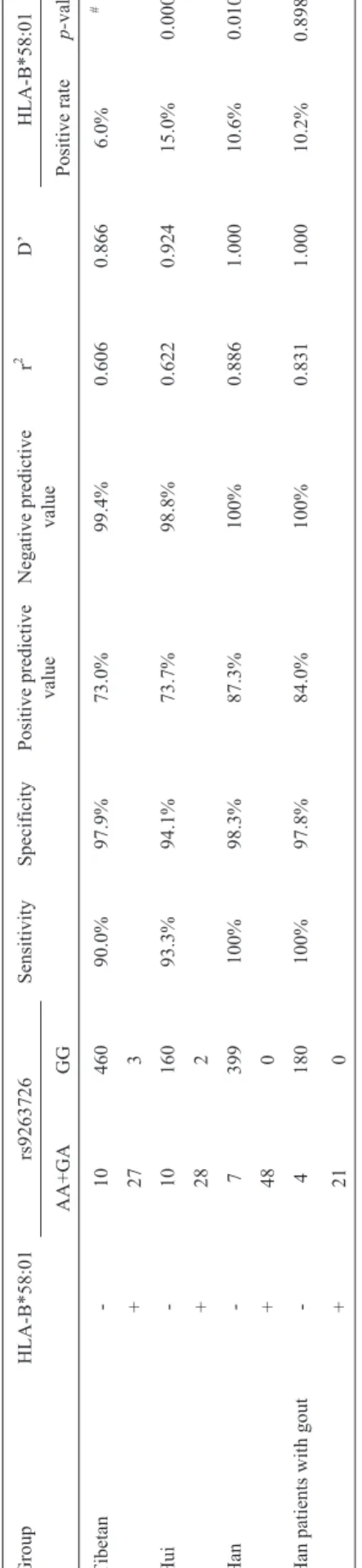
We also investigated the frequency of HLA-B*58:01 allele carriers in the Han, Tibetan, and Hui groups by the method we had previously developed (Zhanget al., 2015). We found that the positive rate of HLA-B*58:01 in Han, Tibetan, and Hui people was 10.6%, 6.0%, and 15.0%, re-spectively (Table 2). The frequency of HLA-B*58:01 allele carriers was significantly different for the three ethnic groups (Tibetan vs Hui, p=0.0001;Tibetan vs Han,
p=0.0100;Han vs Hui,p=0.1075).
Performance of rs9263726 to tag HLA-B*58:01
Performance of rs9263726 to tag HLA-B*58:01 was assessed by its positive predictive value (PPV), negative predictive value (NPV), sensitivity, and specificity. PPV is given as true positive/(true positive + false positive), NPV is true negative/(true negative+false negative), sensitivity is true positive/(true positive+false negative), and specific-ity is true negative/(true negative+false positive). We hy-pothesized that the GG genotype of rs9263726 represents a non-HLA-B*58:01 carrier, and that the GA or AA geno-types both represent an HLA-B*58:01 carrier. The NPV of rs9263726 in Han people was 100% because all samples with the GG genotype of rs9263726 were non-HLA-B*58:01 carriers. Sensitivity was also 100% because all HLA-B*58:01 carriers were GA or AA genotypes of rs9263726. However, PPV was only 87.3% because there were 7 out of 55 samples with the GA or AA genotypes of rs9263726 that were non-HLA-B*58:01 carriers. Specific-ity was 98.3% because 7 out of 406 were non-HLA-B*58:01 carriers with GA or AA genotype of rs9263726. The NPV and PPV in Tibetan people were 99.4% and
73.0%, respectively; in Hui people, they were 98.8% and 73.7%, respectively. The performance of rs9263726 to tag HLA-B*58:01 is shown in Table 2.
Validation of the performance of rs9263726 to tag HLA-B*58:01 in Han patients with gout
The genotypes of rs9263726 and HLA-B*58:01 in 205 Han patients with gout were investigated to detect their relationship in gout patients. The distribution of rs9263726 and the correlation with HLA-B*58:01 in gout patients were similar to that seen in the healthy Han population (Ta-bles 1 and 2).
Genotyping of HLA-B and rs9263726 in samples with inconsistent results
For samples whose rs9263726 genotypes were not linked with the HLA-B*58:01 carrying status, we used the
LABType® HD B Locus Typing Test for high-resolution typing of the HLA-B allele and to further analyze the link-age relationship between HLA-B*58:01 and rs9263726 in the three Chinese populations. In our study, HLA-B*58:01 carriers with the rs9263726 GG genotype did not have ex-actly the same HLA-B alleles in Tibetan and Hui people. In the 500 Tibetan subjects there were three HLA-B*58:01 carriers with the rs9263726 GG genotype: B*51:01/B*58:01, B*51:01/B*58:01, and B*44:03/B*58:01. In Hui samples, two of the 200 subjects were HLA-B*58:01 carriers with the GG genotype of rs9263726: B*51:01/B*58:01 and B*40:01/B*58:01 (Ta-ble 3). No HLA-B*58:01 carriers with the GG genotype of rs9263726 were found in the Han population in this study, and all HLA-B*51:01/B*58:01 and HLA-B*40:01/B*58:01 carriers were of the GA genotype.
Figure 2- Detection of rs9263726 using an unlabeled probe-HRM. Melting peaks lower than 72 °C represent a probe/product duplex. Other melting peaks higher than 80 °C represent a product/product duplex.
Table 1- Allele and genotype frequencies of rs9263726 in Han, Tibetan, and Hui people.
Population rs9263726 p-value Allele p-value
GG GA AA G A
Tibetan people (n=500) 463(0.926) 36(0.072) 1(0.002) 0.0004 962(0.96) 38(0.04) < 0.0001
Hui people (n=200) 162(0.810) 36(0.180) 2(0.010) 360(0.90) 40(0.10)
Han people (n=454) 399(0.879) 51(0.112) 4(0.009) 849(0.93) 59(0.07)
Han patients with gout (n=205) 180(0.878) 25(0.122) 0(0.000) 0.3831# 385(0.94) 25(0.06) 0.7830#
Correlation analysis between the AA genotype and HLA-B*58:01 homozygotes
The frequency of AA homozygotes for rs9263726 in the Tibetan, Han, and Hui populations was 0.2%, 0.9% and 1.0%, respectively (Table 1). The samples for AA homo-zygote were analyzed using high-resolution typing of HLA-B by the LABType® HD B Locus Typing Test Kit. All of the four AA genotype samples were HLA-B*58:01/HLA-B*58:01 in the Han population; the two AA genotype samples in the Hui population were B*44:03/B*58:01; and the only AA homozygote in the Ti-betan population was 58:01/58:01 (Table 4). There was a significant difference in the linkage between the AA geno-type and HLA-B*58:01 homozygotes in these three ethnic groups.
Discussion
The American College of Rheumatology (ACR) rec-ommends that HLA-B*58:01 screening should be consid-ered a risk management component in Chinese patients before taking allopurinol (Khannaet al., 2012; Chenget al., 2015; Koet al., 2015). However, because of the high poly-morphism and complexity of HLA-B alleles, there are nu-merous technical bottlenecks to overcome when extending HLA-B*58:01 detection from scientific research to clinical applications (Guo et al., 1999). Even though Sanger se-quencing could identify the base sequence in most cases, it still leads to ambiguous results in HLA-B genotyping. Therefore, there is a need to find a tag SNP in HLA-B*58:01 for speeding up its application in the clinic.
Table 2 -Performance of rs9263726 to tag HLA-B*58:01. Group HLA-B*58:01 rs9263726 Sensitivity Specificity Positive predictive value Negative predictive value r 2 D’ HLA-B*58:01 AA+GA GG Positive rate p-value Tibetan -10 460 90.0% 97.9% 73.0% 99.4% 0.606 0.866 6.0% # +2 7 3 Hui -10 160 93.3% 94.1% 73.7% 98.8% 0.622 0.924 15.0% 0.0001 # +2 8 2 Han -7 399 100% 98.3% 87.3% 100% 0.886 1.000 10.6% 0.0100 # +4 8 0 Han patients with gout -4 180 100% 97.8% 84.0% 100% 0.831 1.000 10.2% 0.8985* +2 1 0 # Compared with the positive rate of HLA-B*58:01 in Tibetan People. *Compared with the positive rate of HLA-B*58:01 in Han People.
Table 3- HLA-B genotyping for HLA-B*58:01 carriers with the GG ge-notype of rs9263726.
Population Sample No. HLA-B genotyping rs9263726
Tibetan ZM56 51:01/58:01 G G
ZM170 51:01/58:01 G G
ZM267 44:03/58:01 G G
Hui HM103 51:01/58:01 G G
HM196 40:01/58:01 G G
Table 4- HLA-B genotyping of AA homozygote samples in the three pop-ulations.
Population Sample No. HLA-B genotyping rs9263726
Tibetan ZM480 58:01/58:01 A A
Han HS64 58:01/58:01 A A
HS66 58:01/58:01 A A
HS180 58:01/58:01 A A
HS188 58:01/58:01 A A
Hui HM49 44:03/58:01 A A
Compared with the HLA typing method, single SNP detec-tion is more convenient and cost-effective.
As some alleles within nearby genes may be in LD with each other, a tag SNP could be found through this way. The PSORS1C1 (Psoriasis susceptibility 1 candidate 1) gene is only 215 kb away from the HLA-B gene, and rs9263726 (110G > A, Arg37His), which is located in the PSORS1C1 gene, was found in complete LD with HLA-B*58:01 (r2=1, D’=1) in a Japanese population (Maekawa
et al., 2012; Tohkinet al., 2013). However, the LD might differ significantly between different populations. In fact, a lack of LD between rs9263726 and HLA-B*58:01 was found in an Australian population (Vidalet al., 2016).
In this study, we investigated the LD between rs9263726 and HLA-B*58:01 in Han, Tibet, and Hui popu-lations in China. The degree of LD in the Han population (r2=0.886, D’=1.0) was higher than in the Tibetan (r2=0.606, D’=0.866) and Hui populations (r2=0.622, D’=0.924), which means that rs9263726 could be used as a tag SNP of HLA-B*58:01 in Han Chinese but not in the other two populations. Also, in Han patients with gout, the LD between rs9263726 and HLA-B*58:01 was similar to that seen in the healthy Han population. Moreover, all Han subjects with the rs9263726 GG genotype were non-HLA-B*58:01 carriers, which means that the NPV was 100%. The clinical significance of HLA-B*58:01 is that non-HLA-B*58:01 carriers will not suffer from allopurinol-induced severe cutaneous adverse drug reactions. There-fore, rs9263726, which has an NPV of 100%, can be used as a surrogate marker of HLA-B*58:01 in clinical diagno-sis for allopurinol hypersensitivity syndrome.
In contrast, four of the 454 samples of healthy Han (0.9%) were AA genotype of rs9263726, and all were ho-mozygous carriers of HLA-B*58:01. Although it is still un-clear whether there is any difference in the severity and rapidity of cutaneous adverse drug reactions between HLA-B*58:01 homozygous and heterozygous carriers af-ter they take allopurinol, there are three hypotheses about how T-cell receptors and HLA interact with drugs and pep-tides (Hershfieldet al., 2013; Yunet al., 2014), one sug-gesting that an increase of peptide-binding clefts may accelerate or intensify the hypersensitivity. However, this hypothesis requires further investigation. In comparison, such linkage between the AA genotype of rs9263726 and homozygous carriers of HLA-B*58:01 was not found in the Hui population. Two out of the 200 Hui group samples (1.0%) were AA genotype of rs9263726, and both of them were from carriers of HLA-B*44:03/B*58:01. There was only one sample with AA genotype in the Tibetan popula-tion (0.2%). Although the sample was from a HLA-B*58:01/B*58:01 carrier, the result is not sufficient to pro-vide support for such a relationship. Moreover, five sam-ples from the Tibet and Hui populations that were categorized as “false negative” displayed different results in HLA-B typing (Table 3), also indicating that the degrees
of LD are weak between rs9263726 and HLA-B*58:01 in both Hui and Tibet populations.
Liuet al.(2015) detected SNPs around the HLA-B gene in 880 Han Chinese by using Illumina OmniExpress BeadChip assays and discovered seven SNPs with a sensi-tivity of 100% and a specificity³95% that were able to tag HLA-B*58:01, but exclusive of rs9263726. This might be explained by sample differences. In their study, rs9263726 may be rejected due to lack of sufficient specificity. How-ever, in the seven reported SNPs, the highest values of PPV, sensitivity, and specificity were 76.4%, 100%, and 97.41%, respectively, all of which are lower than or equal to 87.3%, 100%, and 98.3% for rs9263726 in this study. Therefore, rs9263726 may be a more suitable surrogate marker of HLA-B*58:01. Kanget al.(2016) also investigated the cor-relation of rs9263726 and HLA-B*58:01, but their distribu-tion and frequency of rs9263726 in the Han populadistribu-tion was different from ours. They did not find the GA genotype of rs9263726, for which the incidence was as high as 11.2% in our study, and the linkage between rs9263726 and HLA-B*58:01 was not as obvious as in our study. These differ-ences might be explained by hereditary differdiffer-ences present in South and West China (Xuet al., 2009).
Before establishing a method to genotype rs9263726, we determined the distribution of interference sites sur-rounding rs9263726 through Sanger sequencing in the range from 200 bp upstream to 200 bp downstream. We found many SNPs and/or mutations (variants) around the allele. There were only two bases from the rs9263726 allele to the closest mutation site, and from the second base after the allele there were seven continuous cytosine bases. With these interference sites, the common Taqman probe method would fail to genotype rs9263726 because of misidentifica-tion or a nonspecific interference signal. Therefore, we de-veloped an unlabeled probe-HRM method to distinguish the GG, GA, and AA genotypes in a single amplification re-action. The accuracy of the developed method can be con-sidered as high, even though there may be unknown new mutations in the detection area that could reflect in a change in the melting curve.
populations, so rs9263726 cannot replace HLA-B*58:01 in these two populations.
Acknowledgments
This work was supported by the Funding “Shanghai Leading Talent in 2015”, Shanghai Science and Technol-ogy Commission Young Investigator “Yangfan” Start-Up Fund (15YF1401700), the Municipal hospital clinical aux-iliary department capacity building project of Shanghai Shen Kang Hospital Development Center (SHDC22014001), and the 2015 Basic Research Project of the Innovation Action Plan from Science and Technology Commission of Shanghai Municipality (15JC1401100).
References
Cheng L, Xiong Y, Qin CZ, Zhang W, Chen XP, Li J and Zhou HH (2015) HLA-B*58:01 is strongly associated with allo-purinol-induced severe cutaneous adverse reactions in Han Chinese patients: a multicentre retrospective case-control clinical study. Br J Dermatol 173:555-558.
Cong Y, Guozhi L, Yunxiang L and Guojun F (2009) Hype-ruricemia in Tibetans undergoing health examination in Linzhi District in Tiebet. Mil Med J South China 23:10-11, 33.
Guo Z, Hood L and Petersdorf EW (1999) Oligonucleotide arrays for high resolution HLA typing. Rev Immunogenet 1:220-230.
Hershfield MS, Callaghan JT, Tassaneeyakul W, Mushiroda T, Thorn CF, Klein TE and Lee MT (2013) Clinical Phar-macogenetics Implementation Consortium guidelines for human leukocyte antigen-B genotype and allopurinol dos-ing. Clin Pharmacol Ther 93:153-158.
Kang X, Chen R, Han M, Liu Z, Liu J, Dai P, Chen C and Wang H (2016) Rapid and reliable genotyping of HLA-B*58:01 in four Chinese populations using a single-tube duplex real-time PCR assay. Pharmacogenomics 17:47-57.
Khanna D, Fitzgerald JD, Khanna PP, Bae S, Singh MK, Neogi T, Pillinger MH, Merill J, Lee S, Prakash S,et al.(2012) 2012 American College of Rheumatology guidelines for manage-ment of gout. Part 1: Systematic nonpharmacologic and pharmacologic therapeutic approaches to hyperuricemia. Arthritis Care Res 64:1431-1446.
Ko TM, Tsai CY, Chen SY, Chen KS, Yu KH, Chu CS, Huang CM, Wang CR, Weng CT, Yu CL, et al. (2015) Use of HLA-B*58:01 genotyping to prevent allopurinol induced severe cutaneous adverse reactions in Taiwan: national pro-spective cohort study. BMJ 351:h4848.
Liu X, Sun J, Yu H, Chen H, Wang J, Zou H, Lu D, Xu J and Zheng SL (2015) Tag SNPs for HLA-B alleles that are asso-ciated with drug response and disease risk in the Chinese Han population. Pharmacogenomics J 15:467-472. Maekawa K, Nishikawa J, Kaniwa N, Sugiyama E, Koizumi T,
Kurose K, Tohkin M and Saito Y (2012) Development of a rapid and inexpensive assay for detecting a surrogate genetic polymorphism of HLA-B*58:01: A partially predictive but useful biomarker for allopurinol-related Stevens-Johnson syndrome/toxic epidermal necrolysis in Japanese. Drug Metab Pharmacokinet 27:447-450.
Pavlos R, Mallal S and Phillips E (2012) HLA and pharma-cogenetics of drug hypersensitivity. Pharmacogenomics 13:1285-1306.
Tohkin M, Kaniwa N, Saito Y, Sugiyama E, Kurose K, Nishikawa J, Hasegawa R, Aihara M, Matsunaga K, Abe M, et al.
(2013) A whole-genome association study of major determi-nants for allopurinol-related Stevens-Johnson syndrome and toxic epidermal necrolysis in Japanese patients. Pharmacogenomics J 13:60-69.
Vidal C, Li J, Fulton R and Fernando SL (2016) A polymorphism within the psoriasis susceptibility 1 candidate 1 (PSORS1C1) gene is not linked to HLA-B*58:01 in an Aus-tralian cohort. Drug Metab Pharmacokinet 31:252-255. Xu S, Yin X, Li S, Jin W, Lou H, Yang L, Gong X, Wang H, Shen
Y and Pan X (2009) Genomic dissection of population sub-structure of Han Chinese and its implication in association studies. Am J Hum Genet 85:762-774.
Yun J, Marcaida MJ, Eriksson KK, Jamin H, Fontana S, Pichler WJ and Yerly D (2014) Oxypurinol directly and immedi-ately activates the drug-specific T cells via the preferential use of HLA-B*58:01. J Immunol 192:2984-2993.
Zhang XJ, Ma HL, Hu CY, Yu B, Ma WZ, Wu ZY, Luo XQ, Zou HJ and Guan M (2015) Detection of HLA-B*58:01 with TaqMan assay and its association with allopurinol-induced sCADR. Clin Chem Lab Med 53:383-390.
Associate Editor: Jorge Lopez-Camelo