Genetic analyses of days to calving and their relationships
with other traits in a Canchim cattle herd
Talita Buttarello Mucari
1,2, Maurício Mello de Alencar
3, Pedro Franklin Barbosa
3and Rogério Taveira Barbosa
31
Universidade Federal de São Carlos, São Carlos, SP, Brazil.
2Universidade do Estado de Mato Grosso, Nova Xavantina, MT, Brazil.
3Embrapa Pecuária Sudeste, São Carlos, SP, Brazil.
Abstract
Heritabilities and genetic correlations in a Canchim beef cattle herd were estimated using data on the following traits: male scrotal circumference at twelve months (SC12); days to first calving (DFC) for heifers; days to calving (DC) for cows; male and female weight (W) at twelve months (W12); heifer weight at the start of the first breeding season (WFBS) and at first calving (WFC); and cow weight at the start of the breeding season (WBS) and at calving (WC). Analyses of the DFC and DC traits were carried out excluding and including penalized (DFCPand DCP) non-calving
females. The restricted maximum likelihood method was used, applying one-trait models for the DFC and DC analy-ses and two-trait models for analyanaly-ses of DFC and DC combined with the other traits studied. Statistical models in-cluded fixed and additive direct random effects for all traits, maternal permanent environmental random effect for SC12 and W12, and the animal permanent environmental random effect for DCP, WBS and WC. We found that DFC
and DC values can be improved by selecting for an increase in the SC12. Genetic correlations between DFC and W12 and between DC and W12 indicated that selection for increased W12 may increase DFC but does not produce significantly correlated responses in DC. Associations of the other body weight traits with DC and DFC suggest that heavier females experience lower reproductive performance.
Key words:beef cattle, body weight, days to calving, days to first calving, genetic correlation, heritability, scrotal circumference. Received: September 18, 2006; Accepted: May 17, 2007.
Introduction
In Brazil beef cattle genetic evaluation programs are now taking into account reproductive traits instead of growth traits only (Euclides Filho, 1999). The inclusion of reproductive traits allows breeders to save time by expos-ing heifers earlier to reproduction and thus reducexpos-ing the generation interval.
Scrotal circumference (SC) of males and weight at different ages are traits usually used in expected progeny difference indices, and their application has lead to satisfac-tory gains in growth and reproductive rates (Garneroet al., 2001; Gunskiet al., 2001; Pereiraet al., 2001).
Bourdon and Brinks (1983) and Bergmann et al.
(1998) reported that the calving interval (CI) is subject to more measurement and estimation bias and errors than days to calving (DC). The DC trait has been recommended for
assessing the reproductive performance of females because the DC value predicts the ability of individual dams to con-ceive early in the breeding season and to calf early in the calving season (Gressleret al., 2000). Furthermore, DC identifies females with the highest fertility and the bulls whose daughters have lower DC values and calve sooner (Pereira et al., 2000). Phenotypic expression of DC is a composite trait, which combines sire effects associated with libido and semen quality, dam effects associated with beginning of the estrus cycle and fertility and calf effects that control the start of parturition (Macneil and Newman, 1994).
Female body weight (W) at the beginning of the breeding season (WBS) and at calving (WC) are other fac-tors affecting herd reproductive performance. According to Randel (1990), the body weight and condition score of the cow at calving are indicators of subsequent reproductive performance because inadequate pre- or post-parturition nutrition in terms of protein and/or energy reduces the first service conception and gestation rates.
The Canchim (5/8 Bos taurusCharolais + 3/8 Bos indicusZebu) beef cattle breed has been studied both as a pure breed and in crossbreeding programs, and researchers are studying appropriate selection criteria for this breed to increase herd productivity (Alencaret al., 1981; Alencar and Bugner, 1986; Alencaret al., 1993; Melloet al., 2002). However, despite the previous research, data associating the scrotal circumference of males and female body weight at different points in the reproductive cycle with female re-productive traits are still scarce in this breed. Genetic analy-ses of the days to first calving (DFC) and DC trait for Canchim females and the relationship of these traits with the scrotal circumference of 12-month males (SC12), male and female 12-month body weight (W12) and the weight of the cow at the start of the breeding season (WBS) and at calving (WC), all of which have not previously been de-fined for this breed, would help breeders to choose selec-tion criteria and obtain genetic progress in herd productivity. The objective of this study was to estimate heritabilities for the DFC and DC traits and assess their ge-netic correlation with the SC12, W12, WBS and WC traits in a Brazilian Canchim herd.
Material and Methods
The data used in this study came from the Canchim herd of Southeast - Embrapa Cattle, an unit of the Brazilian Agricultural Research Corporation (Empresa Brasileira de Pesquisa Agropecuária- Embrapa), located near the town of São Carlos in the Brazilian state of São Paulo. The cattle in the herd were raised on pasture and received a mineral mixture and health care appropriate for the region. The cli-mate of the region is tropical CAw on the Köppen clicli-mate classification. The herd was maintained closed since its for-mation in 1953 until 1999 when new Canchim lines started to be introduced, inbreeding however, was always avoided.
Reproductive management of the females in the herd included different criteria regarding when they were ser-viced by bulls. Initially, heifers were first serser-viced when they were about 34 months old but this was reduced over the years and is now about 22 months. Body weight of the heifers at the time of service and breed traits were also taken into account. Furthermore, after calving the cows were initially serviced after weaning but from 1976 on-wards all cows were serviced during the breeding season except for those which would calve after the end of the cur-rent breeding season. Breeding groups were composed of one bull and about 30 cows but since 1979 artificial insemi-nation was also used. Culling of cows was mainly due to diseases and/or accidents, but in 1977 culling due to low fertility (two consecutive failures) was started.
The DFC and DC data were from 2,105 females born from 1953 to 2001, which participated in breeding seasons from 1957 to 2003. The breeding seasons had no fixed start-ing or finishstart-ing month and were of variable length. In some
years there were two breeding seasons, one in the first and another in the second semester.
The DFC and DC records were calculated from the difference between calving date and the date of the begin-ning of the breeding season. Another set of data was formed, in which females which did not conceive during the breeding season received a penalty and had their DFC and DC values calculated as 21 (one estrus cycle) plus the highest DFC and DC of its contemporary group (Johnston and Bunter, 1996). The penalized values were generally de-nominated DFCPand DCP. Two data sets were formed for
DC and DCP, one for cows only (DCCand DCPC) and
an-other for heifers plus cows (DCHCand DCPHC).
To analyze DFC we produced a data set containing 1,197 DFC values for first breeding season heifers only. However, to analyze DC we used two data sets, one con-taining 4,166 DC values for cows only (DCC) and another
containing 5,403 DC values for cows and heifers combined (DCHC). When females which did not conceive were added,
the number of DFC values increased to 1,840, while the number of DC values for cows only increased to 6,823 and that for cows plus heifers rose to 8,736.
Male and female body weights were standardized to 365 days based on gain from weaning to yearling (W12), data being available from 1953 to 2004. Scrotal circumfer-ence (SC12) data was available from 1982 to 2004, except between 1990 and 1991. Data on WC and WFC were able from 1977 to 2004, while WBS and WFBS were avail-able for the 1980 to 2003 breeding seasons.
The number of animals and observations for each trait are shown in Table 1. Before the analyses, data referring to twins, abortion, embryo transfer, exhibition animals, sup-plemented animals, experimental animals and outliers were deleted from the database.
Variance and covariance components and genetic pa-rameters were estimated by the restricted maximum
likeli-hood method using the MTDFREML program (Boldmanet
al., 1993).
A one-trait animal model was used to estimate the DFC, DFCP, DCC, DCHC, DCPC and DCPHC heritabilities.
For the DC and DCPdata the one-trait model included not
only additive direct random effects but also fixed effects of contemporary group (breeding season, mating type (natural service or artificial insemination) and service bull), physio-logical state of the female (first breeding season heifer, cow with or without a calf, and cow which calved during the breeding season) and age of the female at the beginning of the breeding season as a covariate (linear and quadratic ef-fects). This model was applied without animal permanent environmental effects (model 1) and with animal perma-nent environmental effects (model 2) and the two models compared using the likelihood ratio test (Mood et al., 1974). For analyses of DFC and DFCPdata the model
the data showed no age of heifer effect on these traits so the models did not consider this covariate.
Two-trait analyses were used to obtain genetic corre-lations for the DC, DCP, DFC and DFCP traits with the
SC12, W12, WC, WFC, WBS and WFBS traits. Analyses of the DCP and DC data were carried out using a data set
which included both cows and heifers (DCPHCand DCHC).
The models used for the DCHC, DCPHC, DFC and DFCPdata
were the same as were used for the one-trait analyses, ex-cept that permanent environmental effects were considered only for the DCPHCdata due to results of the likelihood ratio
tests of the one-trait analyses. Models for the analyses of the SC12, W12, WC and WBS data included fixed effects, a covariate and additive direct and permanent environmental random effects, maternal (for the SC12 and W12 data) or animal (for the WC and WBS data). For the SC12 data, re-sidual covariance was set to zero because the data records were taken from different animals. Fixed effects and covariates included in the models of each trait were as fol-lows: SC12, contemporary group (year and month of birth), age of the animal (linear effect); W12, contemporary group (sex, year and month of birth), age of cow at calving (linear and quadratic effects); WC, contemporary group (year and month of birth) and physiological state of the female, age of cow at calving (linear and quadratic effects); and WBS, breeding season and physiological state of the female, age of cow at the beginning of the breeding season (linear and quadratic effects).
Classification of the physiological state of the female for the WC and WBS data was the same as for DC and DCP
data. For the WFC data models included not only additive
direct effects but also contemporary group (year and month of birth) and age of cow at calving (linear effect) fixed ef-fects, while for the WFBS data they included additive direct random effects and breeding season and age of cow at the beginning of the breeding season (linear effect) fixed ef-fects.
Results and Discussion
A descriptive summary of the traits studied is pre-sented in Table 1. The Canchim SC12 and W12 means in our study agreed with those previously reported for the same Canchim herd (Gianlorençoet al., 2003; Talhariet al., 2003) and the DCHC, DCPHC, DFC and DFCP means
were similar to values reported for Nelore beef cattle (Pe-reiraet al., 2001; Mercadanteet al., 2002; Forni and Albu-querque, 2005). Furthermore, the WC mean in our study was similar to that reported for ½ Canchim + ½ Nelore fe-males (Alencaret al., 1999) and the WBS mean was only a little higher than that reported for Nelore cattle (Merca-danteet al., 2004).
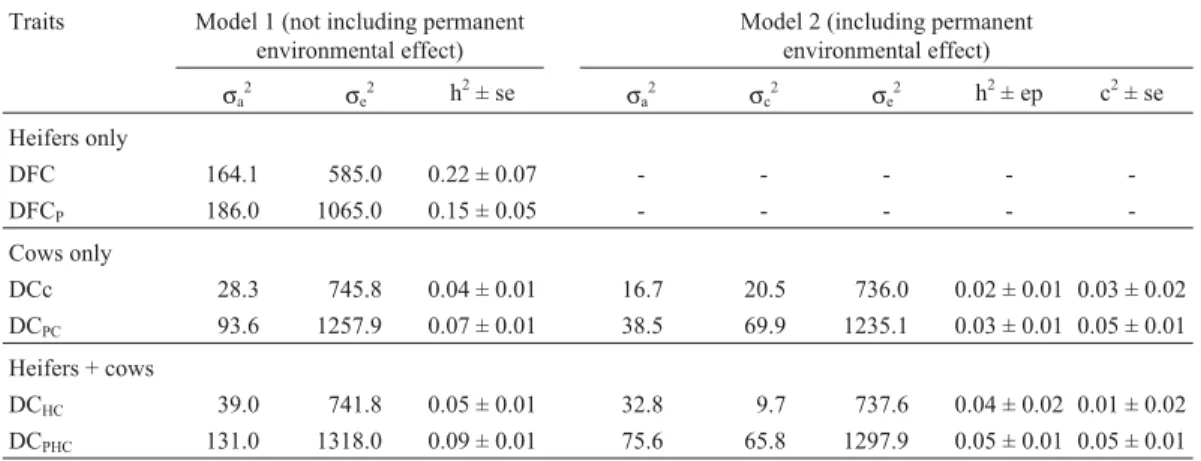
Variance components, heritabilities and the portion of the total phenotypic variation due to permanent environ-ment, estimated by the one-trait analyses, for DC, DCP,
DFC and DFCP, are presented in Table 2. Our Canchim
DFC (h2 = 0.22 ± 0.07) and DFCP (h2 = 0.15 ± 0.05)
heritability estimates were higher than the Nelore date of first calving heritability (h2= 0.11) obtained by Gressleret
al. (2000) and the Nelore DFC and DFCP heritability
(h2 = 0.07 in both cases) reported by Mercadante et al.
(2002). It can be seen that in our study the inclusion of fe-males which did not calve decreased DFC heritability
Traits Ni Nobs CG Mean ± SD
Males
SC12 1,450 1,450 107 20.96 ± 3.67 cm
Males + females
W12 6,326 6,326 500 219.66 ± 43.97 kg
Heifers only
DFC 1,197 1,197 166 328.30 ± 38.00 days
DFCP 1,840 1,840 188 348.54 ± 48.55 days
WFBS 968 968 - 344.64 ± 39.21 kg
WFC 795 795 107 426.99 ± 48.37 kg
Heifers + cows
DCHC 1,602 5,403 438 337.37 ± 42.76 days
DCPHC 2,073 8,736 448 363.94 ± 53.86 days
WBS 1,521 4,996 - 436.79 ± 76.48 kg
(Table 2), contrasting with the results reported by Mercadanteet al.(2002) who found that heritability was the same for both DFC and DFCP. Our DFC heritability
es-timates suggest that this trait presents sufficient genetic variation to respond to selection.
In our analyses of Canchim DC and DCPdata the
in-clusion of permanent environmental effects in the model (model 2) reduced the additive direct component of vari-ance. However, comparison of models 1 and 2 indicated that this effect was significant only for the DCPdata with
cows and heifers (DCPHC) or with cows only (DCPC). This
suggests that a large part of the additive genetic variance in model 1 (without permanent environmental effects) was due to non-additive animal effects, with the inclusion of permanent environmental effects in the model (model 2) re-ducing heritability estimates from h2= 0.07 for DCPCand
h2= 0.09 for DCPHCin model 1 to h2= 0.03 for DCPCand
h2= 0.05 for DCPHCin model 2 (Table 2). There were no
differences between models for the non-penalized data (DCCand DCHC), indicating that the permanent
environ-mental effect for the animal was not an important factor. Our observations are supported by the fact that Pereiraet al.
(2000) reported that in a two-trait analysis of Nelore cattle there was a decrease in DCPheritability from 0.17 to 0.07.
We also found that the model 1 DC estimated herita-bility calculated without penalized data, was low at h2= 0.04 for cows only and h2= 0.05 for heifers plus cows (Table 2) and similar to the lower limit (h2 = 0.02 to h2= 0.09) of the heritability estimates reported by Merca-dante et al.(2002) and Forni et al.(2003) using models which included permanent environmental effects. Further-more, our model 2 DCPheritability estimates using
penal-ized data were also low at h2 = 0.03 for cows only and h2= 0.05 for heifers plus cows (Table 2) and were lower than the h2= 0.07 to h2= 0.16 reported by other workers (Meyeret al., 1991; Johnston and Bunter, 1996; Pereiraet
al.; 2000; Mercadanteet al.; 2002). In our herd, the low val-ues of the fraction of variance attributed to permanent environmental effects and of heritabilities indicate the greater influence of the temporary environment on DC and DCPvalues.
We found a small increase in DC heritability esti-mates when cows which did not calve were included in the cow (DCPC) and cow and heifer (DCPHC) data sets, despite
the fact that the magnitude of the standard error suggests that the differences were not significant. However, this in-crease may have been due to the fact that the data sets which included non-calving females were less selected than the data sets which did not include non-calving females, that is, using only fertile females could mask some trait variability and genetic differences between animals. We also found that with the penalization DFC heritability decreased from h2= 0.22 to h2= 0.15 (Table 2), but due to high standard er-rors this difference may not be significant. Mercadanteet al. (2002) reported that DC heritability increased from h2= 0.02 to h2= 0.12 with the inclusion of non-calving heif-ers and cows, although for DFC heritability these workheif-ers did not find the effect of inclusion or exclusion of non-calving heifers.
The DFC and DFCP heritability coefficients were
higher than the corresponding DC and DCPvalues,
indicat-ing higher genetic variability for heifers than for cows. This could be the result of the culling of open cows, changes in genetic or residual variances (or both) or it could be related to differences in the age at which puberty occurred in the heifers, which would obviously be a less important factor for cows. These comments reflect those made by Meacham and Notter (1987). Inclusion of heifers in cows data sets caused non-significant increases in DC heritability, with or without penalized data, probably due to the higher additive genetic variability of the trait DFC.
Table 2- Variance components and genetic parameter estimates obtained in one-trait analyses of a Canchim herd. Table shows the following traits: days to first calving without (DFC) and with (DFCP) penalization of non-calving heifers; days to calving without (DC) and with (DCP) penalization of
non-calving cows. Additive genetic variance (σa2); permanent environmental variance (σc2); residual variance (σe2); heritability (h2); fraction of the vari-ance due to permanent environment (c2); and standard error (se). The subscript C (DCCand DCPC) stands for cows only and HC (DCHCand DCPHC) for
heifers and cows combined.
Traits Model 1 (not including permanent
environmental effect)
Model 2 (including permanent environmental effect)
σa2 σe2 h2± se σa2 σc2 σe2 h2± ep c2± se
Heifers only
DFC 164.1 585.0 0.22 ± 0.07 - - - -
-DFCP 186.0 1065.0 0.15 ± 0.05 - - - -
-Cows only
DCc 28.3 745.8 0.04 ± 0.01 16.7 20.5 736.0 0.02 ± 0.01 0.03 ± 0.02
DCPC 93.6 1257.9 0.07 ± 0.01 38.5 69.9 1235.1 0.03 ± 0.01 0.05 ± 0.01
Heifers + cows
DCHC 39.0 741.8 0.05 ± 0.01 32.8 9.7 737.6 0.04 ± 0.02 0.01 ± 0.02
that permanent environmental random effects were only in-cluded in the DCPHCmodel. Heritability estimates of DFC,
DFCP, DCHCand DCPHCobtained in the two-trait analyses
were in agreement with those estimated in the one-trait analyses. Studies in beef cattle have reported lower heri-tability estimates for DFC and DFCP(Johnston and Bunter,
1996; Forni and Albuquerque, 2005) and similar heritabi-lity estimates for DC and DCP(Meyeret al., 1991; Johnston
and Bunter, 1996; Pereiraet al., 2000; Pereiraet al., 2001; Forni and Albuquerque, 2005).
Heritabilities estimates of SC12 and W12 (Table 3) were also within the range previously obtained for beef cat-tle (Meyeret al., 1991; Gressleret al., 2000; Melloet al., 2002; Forni and Albuquerque, 2005). Published studies in-volving WFC and WFBS are scarce but in our study the heritability estimates obtained for these traits were of me-dium magnitude, indicating that it is possible to obtain ge-netic progress for theses traits by selection. We found that the heritability for WBS was h2= 0.35 and 0.34, equal to that reported by Mercadanteet al.(2004) (h2= 0.34) but higher than the h2= 0.21 obtained by Meyeret al.(1991) for weight at breeding. Our WC estimated heritability was high (0.52 and 0.51).
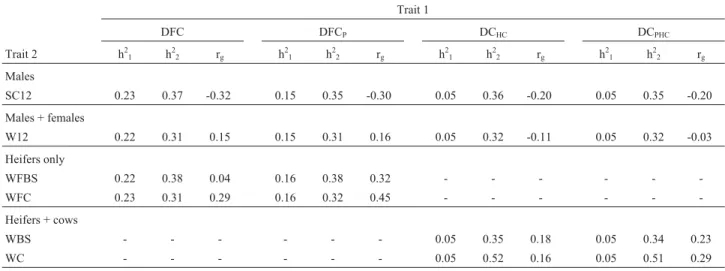
We found that the genetic correlations (rg) of SC12
with DFC (rg= -0.32) and DFCP(rg= -0.30) were favorable,
indicating that selection for SC12 would have a positive ef-fect on female reproductive efficiency. These estimates are higher than the rg= -0.14 for Nelore DFC and scrotal
cir-cumference at 18 months (SC18) reported by Forni and Al-buquerque (2005). In our study the genetic correlations of
Nelore cattle (Pereiraet al., 2000). In fact, the genetic cor-relation between SC12 and DCPreported for Angus cattle
by Meyeret al.(1991) was rg= -0.28, which is similar to the
rg= -0.20 estimated in this study for the same two traits. The
favorable genetic correlations of SC12 with DFC, DFCP,
DCHCand DCPHCshow that male SC12 is a good selection
criterion when improvement in female reproductive traits is desired, and may result in genetic gain of both precocity and fertility.
Genetic correlations of DFC and DFCP with W12
were positive, although of low magnitude (Table 3), indi-cating that heavier heifers may have lower reproductive performance at first calving. These results agree with those reported by Johnston and Bunter (1996), who observed positive genetic correlation values of rg= 0.08 and rg= 0.10
between DFC and body weight. Forni and Albuquerque (2005) found a genetic correlation close to zero (rg= -0.02)
between DFC and 18-month weight.
We found that the genetic correlations of DCHCand
DCPHCwith W12 were negative but close to zero, indicating
that the traits may be controlled by different sets of genes with additive action. These estimates agree with the value of -0.05 reported by Meyeret al.(1991) for the correlation between DCPand W12 in Angus cattle but differed from the
values of 0.74 and -0.36 inB. taurusHereford and cross-bred zebu cattle, also cited by Meyeret al.(1991). Forni and Albuquerque (2005), with Nelore cattle, and Johnston and Bunter (1996), with Angus cattle, estimated genetic correlations of 0.07 for weight at 18 months of age with DC and DCP.
Table 3- Genetic parameter estimates of days to first calving with (DFCP) and without (DFC) penalization of non-calving heifers and days to calving with (DCPHC) and without (DCHC) penalization of non-calving females with scrotal circumference at 12 months of age (SC12), weight of males and females at
12 months of age (W12), weight of heifers at the beginning of the first breeding season (WFBS) and at first calving (WFC), weight of cows at the begin-ning of the breeding season (WBS) and at calving (WC), obtained in two-trait analyses, in a Canchim herd. Heritability of trait 1 (h2
1); Heritability of trait
2 (h22); Genetic correlation between traits 1 and 2 (rg).
Trait 1
DFC DFCP DCHC DCPHC
Trait 2 h2
1 h22 rg h21 h22 rg h21 h22 rg h21 h22 rg
Males
SC12 0.23 0.37 -0.32 0.15 0.35 -0.30 0.05 0.36 -0.20 0.05 0.35 -0.20
Males + females
W12 0.22 0.31 0.15 0.15 0.31 0.16 0.05 0.32 -0.11 0.05 0.32 -0.03
Heifers only
WFBS 0.22 0.38 0.04 0.16 0.38 0.32 - - -
-WFC 0.23 0.31 0.29 0.16 0.32 0.45 - - -
-Heifers + cows
WBS - - - 0.05 0.35 0.18 0.05 0.34 0.23
Genetic correlations of DFC and DFCP with WFC
and WFBS, and of DC and DCPwith WC and WBS were
not found in literature. Correlations obtained in this study were from low to medium and positive, suggesting that fe-males with genetic potential for greater body weights should need more days to calve and to first calving. There was a tendency to increase these correlations with the inclu-sion of females which did not calve in the data sets, indicat-ing that these females (penalized in the analyses and con-sidered of lower fertility) were probably the heaviest.
From the estimates of genetic correlations of DFC
and DFCPwith WFC and WFBS, and of DCHCand DCPHC
with WC and WBS, it is possible to infer that heavier fe-males show lower reproductive performance, both at first calving and as adults. According to Dickerson (1978), when nutritional limitations occur, such as those predomi-nating in extensive production systems in tropical regions, smaller individuals should be more precocious, starting re-production and reaching mature weight faster. These ani-mals would require less nutrients for maintenance than larger animals, and would be more fertile and better adap-ted to nutritionally stressful conditions (Fitzhugh, 1978).
In summary, our data suggests that it is possible to im-prove female days to calving and days to first calving by se-lecting for increase in male scrotal circumference at 12 months of age. Furthermore, selection to increase body weight at 12 months of age does not seem to produce signif-icant correlated responses in days to calving, but may in-crease days to first calving.
Acknowledgments
We thank Southeast - Embrapa Cattle for providing the data, the Brazilian agencies CNPq, for financing the study and providing a fellowship to the second author and CAPES for a scholarship to the first author.
References
Alencar MM, Barbosa PF, Barbosa RT and Vieira RC (1993) Parâmetros genéticos para peso e circunferência escrotal em touros da raça Canchim. Rev Bras Zootec 22:572-583. (Ab-stract in English).
Alencar MM, Barbosa RT and Novaes AP (1999) Característica produtivas e reprodutivas de fêmeas da raça Nelore e cruza-das 1/2 Canchim + 1/2 Nelore. Rev Bras Zootec 28:960-967. (Abstract in English).
Alencar MM and Bugner M (1986) Estudo de idade ao primeiro parto de vacas da raça Canchim. Rev Bras Zootec 15:151-156. (Abstract in English).
Alencar MM, Silva AHG and Barbosa PF (1981) Efeitos da consangüinidade sobre os pesos ao nascimento e à desmama de bezerros da raça Canchim. Rev Bras Zootec 10:151-156. (Abstract in English)
Bergmann JAG, Gressler SL, Pereira CS, Penna VM and Pereira JCC (1998) Avaliação de fatores genéticos e de ambiente sobre algumas características reprodutivas de fêmeas da raça
Nelore em regime de estação de monta restrita. Arq Bras Med Vet Zoot 50:633-645. (Abstract in English).
Boldman KG, Kriese LA, Van Vleck LD and Kachman SD (1993) A Manual for Use of MTDFREML. USDA-ARS, Clay Cen-ter, 120 pp.
Bourdon RM and Brinks JS (1983) Calving date versus calving in-terval as a reproductive measure in beef cattle. J Anim Sci 57:1412-1417.
Dickerson GE (1978) Animal size and efficiency: Basic concepts. Anim Prod 27:367-379.
Euclides Filho K (1999) Melhoramento Genético Animal no Bra-sil: Fundamentos, História e Importância. Embrapa Gado de Corte, Campo Grande, doc. 75, 63 pp.
Fitzhugh HA (1978) Animal size and efficiency, with special ref-erence to the breeding female. Anim Prod 27:393-401. Forni S and Albuquerque LG (2005) Estimates of genetic
correla-tions between days to calving and reproductive and weight traits in Nelore cattle. J Anim Sci 83:1511-1515.
Forni S, Dias LT and Albuquerque LG (2003) Análise genética da característica dias para o parto em bovinos da raça Nelore. Arch Latinoam Prod Anim 11:143-148. (Abstract in Eng-lish).
Garnero AV, Lôbo RB, Bezerra LAF and Oliveira HN (2001) Comparação entre alguns critérios de seleção para cresci-mento na raça Nelore. Rev Bras Zootec 30:714-718. (Ab-stract in English).
Gressler SL, Bergmann JAG, Pereira CS, Penna VM, Pereira JCC and Gressler MGM (2000) Estudo das associações genéticas entre perímetro escrotal e características reprodutivas de fêmeas Nelore. Rev Bras Zootec 29:427-437. (Abstract in English).
Gianlorenço VK, Alencar MM, Toral FLB, Mello SP, Freitas AR and Barbosa PF (2003) Herdabilidades e correlações gené-ticas de caracterísgené-ticas de machos e fêmeas, em um rebanho bovino da raça Canchim. Rev Bras Zootec 32:1587-1593. (Abstract in English).
Gunski RJ, Garnero AV, Borjas AR, Bezerra LAF and Lôbo RB (2001) Estimativas de parâmetros genéticos para caracterís-ticas incluídas em critérios de seleção em gado Nelore. Cienc Rural 31:603-607. (Abstract in English).
Johnston DJ and Bunter KL (1996) Days to calving in Angus cat-tle: Genetic and environmental effects, and covariances with other traits. Liv Prod Sci 45:13-22.
Macneil MD and Newman S (1994) Genetic analysis of calving date in Miles City Line 1 Hereford cattle. J Anim Sci 72:3073-3079.
Meacham NS and Notter DR (1987). Heritability estimates for calving date in simental cattle. J Anim Sci 64:701-705. Meyer K, Hammond K, Mackinnon MJ and Parnell PF (1991)
Es-timates of covariances between reproduction and growth in Australian beef cattle. J Anim Sci 69:3533-3543.
Mello SP, Alencar MM, Silva LOC, Barbosa RT and Barbosa PF (2002) Estimativas de co(variâncias) e tendências genéticas para pesos em um rebanho Canchim. Rev Bras Zootec 31:1707-1714. (Abstract in English).
(Abstract in English).
Mood AM, Graybill FA and Boes DC (1974) Tests of hypotheses. In: Mood AM, Graybill FA and Boes DC (eds) Introduction to the Theory of Statistics. McGraw-Hill, Tokyo, pp 401-470.
Pereira E, Eler JP and Ferraz JBS (2000) Correlação genética en-tre perímetro escrotal e algumas características reprodutivas
Zootec 53:720-727. (Abstract in English).
Randel RD (1990) Nutrition and postpartum rebreeding in cattle. J Anim Sci 68:853-862.
Talhari FM, Alencar MM and Mascioli AS (2003) Correlações genéticas entre características produtivas de fêmeas em um rebanho da raça Canchim. Rev Bras Zootec 32:880-886. (Abstract in English).