The Lives of Others: an interactive
installation
Rui António
UAlg/Uab, CIAC, University of Algarve, Faro, Portugal
Bruno Mendes da Silva
ESEC, CIAC, University of Algarve, Faro, Portugal
João M. F. Rodrigues
ISE, LARSyS (ISR – Lisbon), CIAC, University of Algarve, Faro, Portugal
Mirian Nogueira Tavares
CIAC, University of Algarve, Faro, Portugal
ABSTRACT
"The Lives of Others" is an interactive audiovisual installation that is based on a voyeuristic approach of the binomial inside / outside and private / public, between the finished product presentable to the public and the mechanism that generates it. This mechanism consisting of physical devices and logical-mathematical instructions usually remains in the private sphere, is the interior of the work that is not seen, which belongs only to the creator / author. "The Lives of Others" quest for demystify the separation of the visual apparatus and the mechanism that generates this external system, making both visible and bringing to the public sphere the elements usually hidden.
Keywords: Interactivity, Sensors, Arduino, Video installation, Media digital art.
INTRODUCTION
This paper describes an audiovisual participatory installation, combining audiovisual content with interaction design and user experience, named “The Lives of Others”, that allows spectator tracking, using an ultrasonic sonar sensor and a custom application for video and audio
manipulation. Spectator can interact and freely explore around the artifact, seeing in this way the inside and outside of the artifact, seeing the finished product presentable to the public and the mechanism that generates it. Physical devices and computer instructions are both visible. Once exposed, these elements become part of the work in the visible field and become part of the strategy of artifact exposition. Spectator becomes a voyeur by listening to the conversation of
others and also assumes that role when exploring the artifact space and thus scrutinizes the procedural mechanism.
We find here a parallel between Virilio’s (2000) pessimistic and anti-technological theories, particularly in the construction of the contemporary man and society today. The control societies (Deleuze, 2003) are replacing the model of disciplinary societies1 and their main characteristics are the invisibility and the nomadism (Maffesoli, 2001), exacerbated by widespread
telecommunications, creating the virtual surveillance. As stated Gilles Deleuze (2003): “These are the societies of control, which are in the process of replacing disciplinary societies.
"Control" is the name Burroughs proposes as a term for the new monster, one that Foucault recognizes as our immediate future. Paul Virilio also is continually analyzing the ultrarapid forms of free-floating control that replaced the old disciplines operating in the time frame of a closed system. (…) There is no need to ask which is the toughest regime, for it's within each of them that liberating and enslaving forces confront one another”.
Immersed by the space-time split of teletechnologies (direct television, social networks....), the contemporary man seems to have some difficulty in distinguishing here and now, precipitating certain confusion between private and public (Virilio, 2000; Silva, 2010).
In the following Section is presented the state of art and the concept of the interactive
audiovisual installation “The Lives of Others”, addressing the binomial interior / exterior and public / private, the installation mechanism as well as the voyeuristic aspect inherent in the work. Section Technical Description presents technical components and space requirements for the installation. In Section Conclusions will be discussed some notes on the public presentation of the artifact and relationship / public feedback regarding interactivity and artifact. Finally in last Section future work will be presented.
Since the project “The Lives of Others” is an experimental artistic work, it is legitimate to
consider that it fosters the epistemological reception of metaphors and artistic languages. Taking into account the artistic aspect and the strong digital technological component as a basis for the creation of artefacts and subsequent generation of new knowledge in this project, the
methodology practice-based research is proposed.
RELATED WORK
The use of sensors has been used in many artistic interactive installations to augment the interaction between the public and a specific environment. Audience participation and sensor technology can create visualizations and sound.
Previous work (Antonio et al., 2017) has explore interactive movie installation with the project "Characters looking for a spect-actor" that seeks to explore new forms of non-intrusive
interaction in interactive movies, while at the same time aims to give the spectator on-the-fly control over the film editing. "Characters looking for a spect-actor" explore the possibility of using 3D sensors and mobile devices as interfaces to generate effective interaction mechanisms in interactive films.
THE LIVES OF OTHERS
1 Michele Foucault identified and stood these societies in the seventeenth and twentieth centuries. The disciplinary societies have organized the major spaces of enclosure (family, school, quarters and factory). Currently, we are witnessing a generalized crisis of these means of closing of the disciplinary societies caused by the emergence of control societies in the distance.
"The Lives of Others" is an experimental interactive audiovisual installation that intends to show both sides of the artifact, the finished product and the mechanism that generate it. This
mechanism is hidden, which seeks to make transparent to the spectator / user. Since the invention of Engelbart2 who demand this invisibility as a way to involve more and more human senses, releasing the spectator / user of the apparatus responsible for sensory experiencing. "The Lives of Others" is looking to demystify the separation of the visual apparatus and the mechanism that generates this external system, making both visible and bringing to the public sphere the elements usually hidden.
The resulting device, which can be experienced by audience, has two elements, an audible and visual those cohabit in dissonance.
The sound and the visual element
The sound element transports the spectator to a coffee talk about other people's lives, in this case, about the experiences of different people in a television reality show. By analogy to the
dissection presented in the artifact, which inside and outside is presented, also in this
conversation there is a dissection of the experiences of the participants in that television program by spectator that manifest themselves in the form of reports in some coffee shop, redefining interpersonal relations related to systems rooted in society and causing the distance between the public domain and private domain disappears.
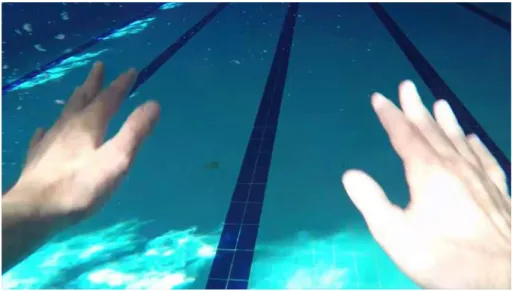
The visual element has a swimming pool scene. The viewer is confronted with a swimming footage captured from a subjective point of view, see Fig. 1.
This element contrasts with the sound element because it is a scene that refers to the individual level, an individual that is swimming in the silence of water and through this act carries an inner journey.
Figure 1 - Video frame.
Inside/Outside and Public/Private
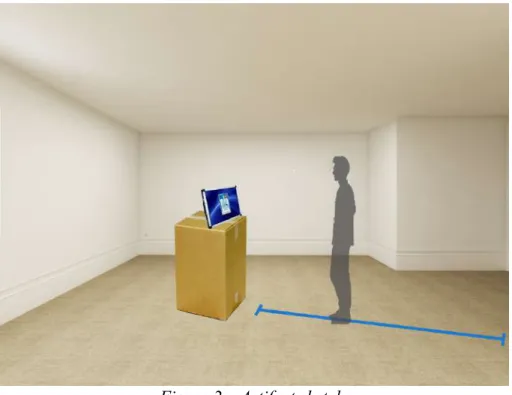
The two elements, sound and visual, are dissonant because they are mismatched, such as interior and exterior or public and private. The interaction of the spectator will give more emphasis to one or the other, through the approach or move away from the artifact. A blue line on the ground suggests this route, see Fig. 2, and propone the spectator / user to a swimming pool track.
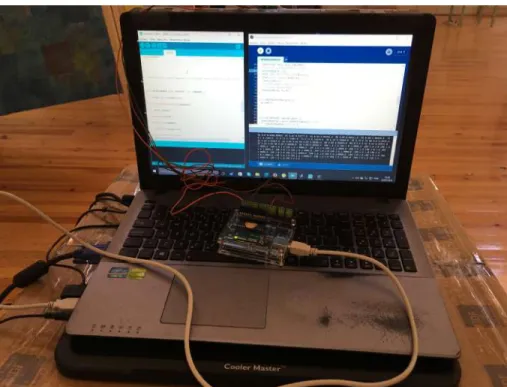
The inside or the private side of "The Lives of Others" is given in two distinct layers, the physical devices which are exposed, and the computer program that manages the system. Both are visible and available to spectator dissecting look as it were an open body, see Fig. 3.
Once exposed, these internal elements become part of the work in the visible field, and thus acquire a new status. Physical devices that allow operationalize the artifact in conjunction with the computational instructions, once exposed, become themselves part of the strategy of wonder and artifact exposition.
Like Engelbart and Kay3 sought transparency of computer systems, also in the art, especially in interactive installations and immersion in augmented reality and virtual reality environments, there was this trend of invisibility of the machine responsible for the implementation and fulfillment of tasks, ie the representational. "The Lives of Others" seeks to subvert the logic based on the distinction between representational and physical, between the outside and the inside, between the public and private. "The Lives of Others" builds his poetics from these various elements, which although layered form a whole. Figuration and enunciation are presented as a single element.
Figure 2 – Artifact sketch.
Figure 1 – Physical devices and computer instructions exposed.
Voyeurism
The voyeuristic component is present both in the representation element and conceptual side. Spectator assumes the role of voyeur when listening to the conversation of others who in turn speak about the lives of others, as a voyeur of a voyeur4. Also assumes that role when exploring the artifact space and thus scrutinizes the procedural mechanism, seeing until computer code, to the interior of the artifact, which usually remains hidden.
New technology and computer networks potentiate through visual exploration a voyeuristic state and a scopic culture. Freud's scopophilia find in a global society dominated by a visual culture and mediated by technological devices, fertile ground for scopic satisfaction from another's privacy (Da Silva, 2014).
Cinema came to occupy an important role in the visual culture of the last century having since the beginning explored the issue of voyeurism and the desire of the spectator to observe, offering the spectator the possibility of observing without being observed. According to Metz (1982), it is the fact that observed object not aware of being watched that gives the spectator a sense of pleasure in the movie theater. The cinematic voyeurism gives spectator one hypnotic state of immersion in a dark room, lying easily an analogy to the Platonic allegory, whose projection mechanism resembles the cinematic apparatus. Baudry & Williams (1974) had already
4 This is also the case in the film "The Lives of Others" by director Florian Henckel von Donnersmarck in which the name of this artifact was based. Spectators and Wiesler captain placed in a listening position, hear to lives of other's.
mentioned this analogy by describing spectator situation sitting in a dark cave viewing the shadows projected on the screen.
"The Lives of Others" invites spectator to explore freely the three-dimensional artifact and for interacting spectator just have to follow the blue line.
TECHNICAL DESCRIPTION
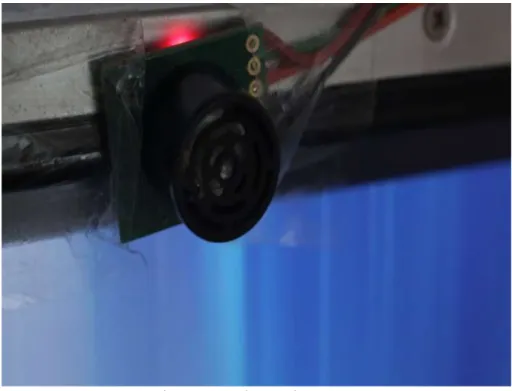
The exposed elements integrate an ultrasonic sensor (Robotics, 2007), see Fig. 4, which detects the presence and measures the distance of the spectator / user to the artifact. An advantage of this type of sensor is that it does not depend on lighting conditions. The electronic circuit Arduino (2016) appropriately programmed for this purpose interprets and communicates the values read from the sensor to the computer.
A computer program developed with Processing language (Frey & Reas, 2012) handles these values in order to generate the interaction mechanism. The program and the output values are shown to spectators on the back monitor while the video is displayed on the front.
Figure 4 – Ultrasonic sensor.
A small monitor is placed on a box, inviting interaction from the spectator. A computational tracking system creates the interaction through an ultrasonic sensor that detects the position of the spectator when he is walking over a suggesting blue line on the ground.
Behind the monitor is a laptop that processes data from the sensor and also displays these data and the programming algorithm. All physical devices and computer algorithms are exposed to the spectator.
The computerized tracking system is composed by: (a) An ultrasonic sensor,
(b) a monitor, (c) a laptop,
(d) an Arduino board and (e) speakers
Finally, the space requirement for the installation is an indoor space with a minimum 5x3 m.
CONCLUSION
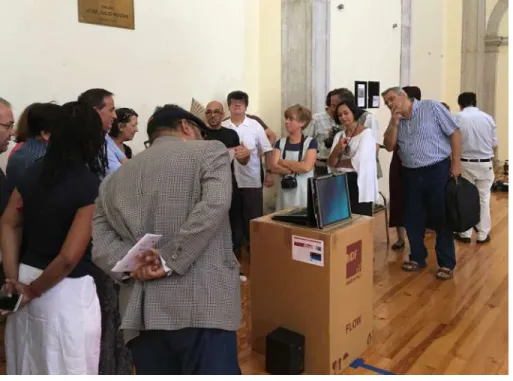
"The Lives of Others" was presented in July 2016 in Media-Digital Art PhD retreat in Lisbon and generated curiosity in the audience who visited the exhibition, see Fig. 5.
The conscious choice to leave it uncovered led some people to offer a cloth in order to give artifact a more finished look. Indeed, the “unfinished” provides insight into the artists’ creative process and allow spectator to recreate the way in which the work of art was made (Baum, Bayer & Wagstaff, 2016). The blue line on the floor suggesting the route to the interaction of the spectator, although facilitate a first contact with the work, had sometimes an absorption effect, causing some spectators stuck to the line, limited so to the public / outside of the work. To enter the private / inside spectators had to leave the line and explore the surrounding space of the work, see Fig. 6. Through this exploration spectator assumes the role of voyeur to scrutinize the procedural mechanism, hardware and software, which controls the artifact and which is normally hidden.
The work is, in itself, a multiple device that allows interaction, like a reality show, the lives of others, and that allows for interaction with the apparatus, the life of the device, when the machine and software give himself to see.
Figure 5 – Artifact presentation.
The installation confronts the public, or instigates to participate actively in the operating logic of the system itself, that is, on the one hand having access to the "secret" of the device that is laid
bare, on the other, being able to control whether view better or hear better, that is, if our voyeurism is more visual or audible, since the installation causes disruption of the two senses.
Figure 6 – Visiting the inside/private side of the artifact.
Future work includes making more experimental media-digital art artifacts involving audiovisual and interaction through sensors. In addition there is also the wish to introduce more elements that can enrich the interactive experience of the narrative point of view through the introduction of different sensors that capture for example the ambient sound, the atmospheric conditions, the quantity and the type of light and the smells. With these elements the possibilities of integration and appropriation of the environment of the spectator by the film are extended, making it a living organism that shares the same physical space.
REFERENCES
Andria, G., Attivissimo, F., & Giaquinto, N. (2001). Digital signal processing techniques for accurate ultrasonic sensor measurement. Measurement, 30(2), 105-114.
António, Rui; Silva, Bruno; Rodrigues, João; Tavares, Mirian. (2017). Experimenting on film: technology meets arts, International Journal of Creative Interfaces and Computer Graphics, 8(1) 04.
Arduino, S. A. (2016). Arduino. Retrieved April 17, 2016, from http://arduino.cc/en/Main/arduinoBoardUno
Baudry, J. L., & Williams, A. (1974). Ideological effects of the basic cinematographic apparatus. Film Quarterly, 28(2), 39-47.
Baum, K., Bayer, A., & Wagstaff, S. (2016). Unfinished: Thoughts Left Visible. Metropolitan Museum of Art.
Da Silva, A. L. P. (2014). Voyeurismo em arte e tecnologia. Retrieved May 12, 2016, from https://art.medialab.ufg.br/up/779/o/art13_AldoPedrosa.pdf
Deleuze, G. (2003). Conversações. Lisboa: Fim de Século, p. 240.
Fry, B., & Reas C. (2012). Processing Software. http://processing.org [10 de abril de 2016]. Maffesoli, M. (2001). Sobre o Nomadismo, Vagabundagens pós- modernas. Rio de Janeiro: Record.
Metz, C. (1982). The imaginary signifier: Psychoanalysis and the cinema. Indiana University Press.
Robotics, A. (2007). Devantech SRF02 sensor. Acroname Robotics.
Silva, B. M. (2010). A máquina encravada: a questão do tempo nas relações entre cinema, banda desenhada e contemporaneidade, Porto: Editorial Novembro, ISBN: 9789898136497.