J. res.: fundam. care. online 2014. jul./set. 6(3):863-875
863
RESEARCH
Perfil da mortalidade por quedas em idosos
Mortality profile from falls in the elderly
Perfil de la mortalidad por caídas en los ancianos
Aíla Marôpo Araújo 1 , Rejane Maria Paiva de Menezes 2 , Ana Elza Oliveira de Mendonça 3 , Monique
da Silva Lopes 4 , Alessandre de Medeiros Tavares 5 , Heloísa Cristina Ferreira de Lima 6
Objective: to characterize the mortality profile due to falls in the elderly, in the period of 2000 and 2010. Method: it is a descriptive, retrospective, epidemiological study, with quantitative approach, elaborated
according to information system data about the elderly mortality. For data collection secondary information was used available by the health ministry, regarding to 70 records of deaths due to falls in the elderly. The tabulation of the data was performed by the tabwin system 3.2, and presented in tables. Results: 30.02% of deaths were motivated by falls of the same level - by slip, stumple or missteps and 24.30% by other falls on the same level. The most important was the group aged of 80 years old or more, homogeneity to male and female, brown skin, illiterate and married individuals. Conclusion: it is essential to strengthen measures to prevent falls in the elderly, as well as disseminate in public policy discussions in the elderly. Descriptors: mortality, elderly, external causes.
Objetivo: caracterizar o perfil de mortalidade por quedas em idosos no período de 2000 e 2010. Método:
trata-se de estudo epidemiológico descritivo, retrospectivo, com abordagem quantitativa, elaborado de acordo com dados do sistema de informação sobre mortalidade de idosos. Para coleta de dados utilizou-se de informações secundárias disponibilizadas pelo ministério da saúde, referentes a 70 registros de óbitos motivados por quedas em idosos. A tabulação dos dados foi efetuada pelo sistema tabwin 3.2 e apresentados em tabelas. Resultados: 30,02% dos óbitos foram motivados por queda de mesmo nível – por escorregão, tropeção ou passos em falso e 24,30% por outras quedas no mesmo nível. Prevaleceram a faixa etária de 80 anos ou mais, homogeneidade aos sexos masculino e feminino, cor parda, indivíduos não alfabetizados e casados. Conclusão: é fundamental que sejam fortalecidas medidas de prevenção de quedas em idosos, assim como difundidas nas discussões de políticas públicas em relação à pessoa idosa. Descritores: mortalidade, idosos, causas externas.
Objetivo: caracterizar el perfil de la mortalidad causados por caídas en los ancianos entre 2000 y 2010. Método: se trata de un estudio epidemiológico descriptivo, retrospectivo con enfoque cuantitativo,
elaborado según datos del sistema de información sobre la mortalidad en los ancianos. Para la recolección de datos se utilizaron informaciones secundarias, disponibles por el ministerio de salud, sobre 70 registros de muertes debido a caídas en los ancianos. La tabulación de los datos se realizó a través del sistema tabwin 3.2 y presentados en tablas. Resultados: 30,02% de las muertes fueron motivadas por caídas del mismo nivel - por resbalones, tropezones o pasos en falso y 24,30% por otras caídas en el mismo nivel. Prevalecieron los de la edad de 80 años o más, homogeneidad de los sexos masculino y femenino, pardos, analfabetos y casados. Conclusión: es esencial que se refuercen medidas para prevenir las caídas en los ancianos, así como difundidas en los debates de política pública en relación el anciano. Descriptores: mortalidad, anciano, causas externas.
1 Corresponding author. Post – Graduate in Nursing at work. Nurse. Manager of Epidemiological Surveillance of Natal - RN. Substitute Professor of Nursing School of Natal/UFRN. Member of the Research Group OF Social and Epidemiological Practices in Health and Nursing of DENF-UFRN. Address: Rua Alziro Zaruh, 22 A, Planalto, CEP: 59073-072. Natal (RN), Brazil. Email: [email protected] 2 Doctorate in Nursing, Graduate and Postgraduate Professor in Nursing/UFRN. Coordinator of the Research of Assistance and Epidemiological Practices in Health and Nursing/UFRN. Email: [email protected] 3 Nurse. Doctorate of the Postgraduate Program of the Health Sciences Center/UFRN. Master in Nursing by the Postgraduate Program in Nursing/UFRN. Nephrology Nurse Specialist in UNIFESP/SP. Member of Incubator Research Groups of Procedures of Nursing and Clinical Nursing of UFRN. Graduation professor in Nursing of the Science and Culture University and Extension of RN/UNIFACEX. Intensive care Nurse at the University Hospital Onofre Lopes (HUOL/UFRN). Email: [email protected] 4 Nurse. Postgraduate student in Nursing at work. Email: [email protected] 5 Graduated in Letters from the Federal University of Rio Grande do Norte. Technical of the Department of Health Surveillance of Municipal Health Secretariat of Natal, acting on Direction from the Zoonoses Center. Email: [email protected] 6 Nurse. Master of the postgraduate program in nursing of the nursing department/UFRN. Email: [email protected].
ABSTRACT
RESUMEN RESUMO
J. res.: fundam. care. online 2014. jul./set. 6(3):863-875
864
I
n recent years, the external causes of morbidity and mortality had become a significant portion of the health problems, and occupy a prominent position in the health statistics in most countries. In the 20th century and at the beginning of the 21st century, the Brazilian epidemiological profile has changed, with the reduction of the communicable diseases and increase of the chronic degenerative diseases and other causes. Under this approach, information about the level of mortality from external causes of a population are quite significant when the purpose is to make inferences about the health conditions of the population and of the groups forming it. Such information makes it possible to identify community groups most affected by certain harms to health, to set priorities, to plan actions and to allocate resources for their solution.1In the current scenario, the external causes are responsible for more than five million deaths and represent approximately 9% of global mortality. In Brazil, they are the third most frequent cause of death. In the Northeast, they occupy the second position, and, in the State of Rio Grande do Norte, the third position, being unquestioned facing this problem next to public managers to be considered as a priority in health.2-3
The external causes include injuries resulting from accidents (related to traffic, drowning, poisoning, falls or burns) and violence (assault/homicide, suicides, suicide attempts, physical, sexual and psychological abuse), which are at the present a major challenge to the public health.2
In the age group, in Brazil, the elderly occupy the sixth position in deaths by external causes, and on the component "accident by fall" they are in the first position. For the World Health Organization (WHO), the elderly are individuals from 60 years old, for developing countries, and 65 and more years old for developed countries.4-5
Data from the Brazilian Institute of Geography and Statistics (IBGE) point out that people aged 60 years old or more have a tendency to duplicate in the period from 2000 to 2020, rising from 13.9 to 28.3 million. Projections indicate that, in 2030, the number of elderly can overcome the children and adolescents (under 15 years old) in about 4million.6
With this understanding, the falls have become a growing problem with the aging process, because the more fragile is the elderly greater propensity to the event, characterized as a factor of extreme importance in situations of morbidity, mortality and institutionalization.7-8
The falls are considered unintended events and they are configured on the change of position of the individual to a lower level in relation to its initial position. For this purpose, intentional position changes are excluded which allow the support on furniture, walls or other objects.7-8
J. res.: fundam. care. online 2014. jul./set. 6(3):863-875
865
METHOD
In Brazil about 30% of the elderly fall at least once a year. In the elderly over 80 years, this proportion rises to approximately 50%. After the first fall, the risk of falling again increases and, for fear of falling, the elderly reduce their mobility and sociability.9
With respect to mortality, in 1990, the rate found by 100 thousand elderly was 3,874.5 in Brazil and 3,080.8 in the Northeast. In 2000, it was observed a sharpest reduction in the country's rates as a whole (3,591.0), trend not observed in the Northeast (3,031.6).10
Discussions about the mortality from falls in the elderly are of the utmost importance, because they constitute a social and public health problem that must be faced by managers, health professionals, individual, and community.
With this, it is required preventive measures against this problematic, because the falls involve a conjuncture of intrinsic and extrinsic components that also affect as a financial impact in the Unified Health System (SUS), in the family and in the community. Studies with this importance may contribute to planning and delimitation of public health policies on the health of the elderly person.
Therefore, this study has the following guiding question: Which are the determine variables for the causes of mortality for falls in the elderly in the city of Natal/RN?
To answer that question, the aim of this study is to characterize the profile of mortality from falls in the elderly.
This is a descriptive and retrospective epidemiological study, of quantitative approach in which the data of Mortality Information System (MIS) were analyzed to the municipality of Natal/RN, in the period from 2000 to 2010.
The Mortality Information System (MIS) was developed and implemented in Brazil by the Health Ministry in 1975. It is a national epidemiological surveillance system and aims to capture data about deaths in the country, in order to provide information on mortality for all instances of the health system. It has as basic document the Declaration of Death (DD), standardized throughout the national territory.11
The data collected through the MIS, in the epidemiological surveillance, are used to calculate the rate or coefficient of mortality and proportional mortality by big groups of causes, by specific causes, age group, sex, education, occupation and other features of deaths.12
The study population was composed of 70 elderly aged 60 years old or more, victims of falls, residents in the capital of Natal/RN. For this, we used the International Classification of Diseases, tenth revision (ICD-10), through the XX chapter (external causes of morbidity and mortality), according to the encoding of falls contemplated of W00 to W19, with coverage between kinds of falls that occur at the same level, highest level and other unspecified falls.3
J. res.: fundam. care. online 2014. jul./set. 6(3):863-875
866
RESULTS AND DISCUSSION
The data were collected in September 2012, through the Department of Information and Computer Science of the UHS (DATAUHS). It was used as variables: capital of residence, year (2000 to 2010), age group, education, ethnicity and marital status. Then, the data were divided into spreadsheets and organized in tabular format with the Tabwin 3.2 program. For analysis it was opted the descriptive statistics.
Averaging was performed in relation to overall mortality for all causes, by external causes, by accidents/falls for all ages, accidents/falls in the age group of 60 years old and by type of accident/fall in the historical series.
For the calculation of the proportional mortality by age, which indicates the percentage distribution of deaths by age group, in the population resident in a given geographical space, in the year under consideration, the calculation is performed by the number of resident deaths, by age group, over the number of deaths of residents, excluding the ignored age (x 100). The denominator used in coefficient was based on population estimates from IBGE provided by the Health Ministry (HM) on the site www.datasus.gov.br, of DATAUHS. It was used as a reference the age distribution of Brazilian population of Census 2010.13
In compliance with the ethical precepts, this study used secondary data provided by HM, provided online (www.datasus.gov.br), with the use of variables that do not allow the identification of the subjects of the research.
The results are presented in the relationship between variables of mortality by type of falling for all ages, mortality by type of falling in the elderly and characterization of mortality by falls in the elderly.
The data showed that general mortality in the City of Natal, in the year 2000, presented the general mortality rate by cause group of 496.27 by 100,000 inhabitants. In 2010, it has introduced a fee of 534.5/100,000 inhabitants. With this, there is a proportional variation between the rates of the referred years of 7.15%. As for the general mortality by external causes, in 2000, the rate was 60.22/100,000 inhabitants, and in 2010 of 76.89/100,000 inhabitants, with a proportional variation between the rates of 21.68%, which denotes to the relevance of these aggravations in the municipal scenario.
As for the proportional mortality rate by external causes, it was evidenced in the study that for the period 2000 to 2010 was 13.10%. Within this component, accidents and falls were 2.11%, and the accidents like falls, at the age of 60 years old or more occupied the percentage of 29.17%.
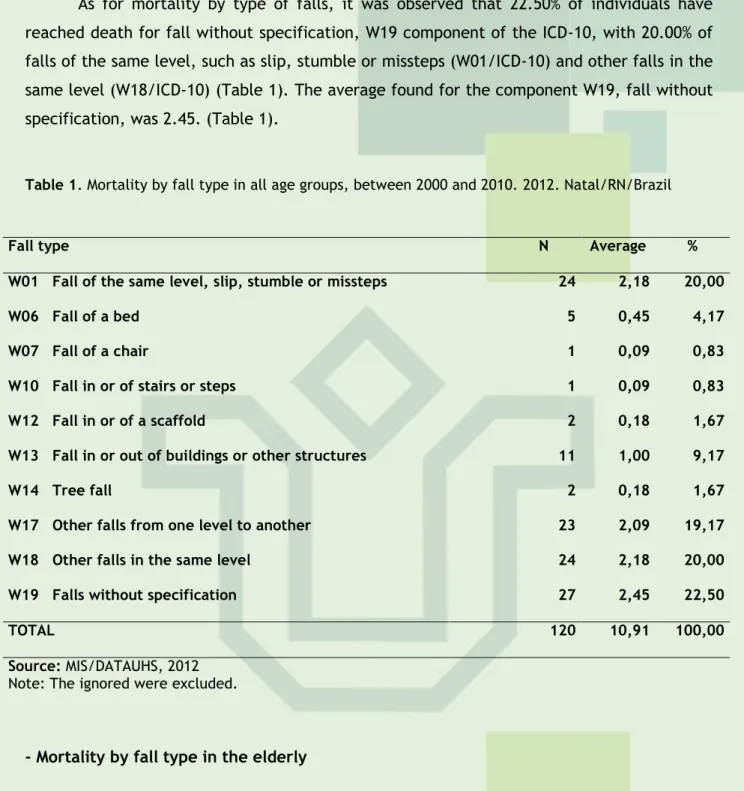
120 deaths were found by falls type in all age groups. And in the types of falls at the age of 60 years old or more the index was 70 deaths, representing the percentage of 58.33% compared to falls in all age groups.
J. res.: fundam. care. online 2014. jul./set. 6(3):863-875
867
- Mortality by type of falls for all ages
As for mortality by type of falls, it was observed that 22.50% of individuals have reached death for fall without specification, W19 component of the ICD-10, with 20.00% of falls of the same level, such as slip, stumble or missteps (W01/ICD-10) and other falls in the same level (W18/ICD-10) (Table 1). The average found for the component W19, fall without specification, was 2.45. (Table 1).
Table 1. Mortality by fall type in all age groups, between 2000 and 2010. 2012. Natal/RN/Brazil
- Mortality by fall type in the elderly
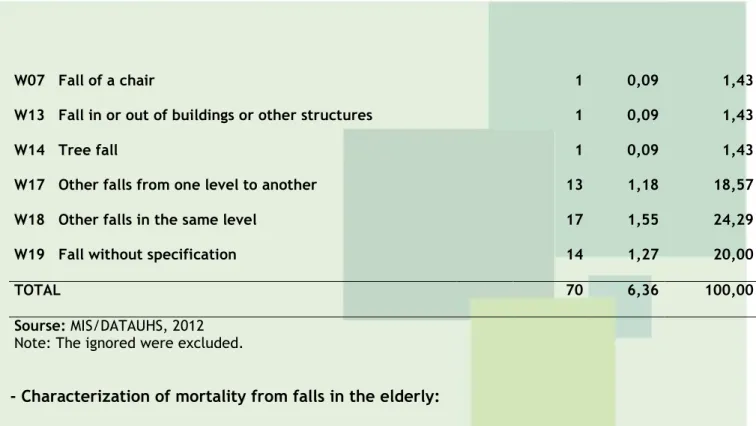
Table 2 showed that, mortality by fall type in the elderly of 60 years old or more, not all components found in mortality from falls of all ages were found in the search age highlighted. Among the types of falls founded, it was obtained that the component W01 (fall of the same level by slip, stumble or missteps) presented the proportional mortality rate by age of 30.00%, followed by other falls on the same level (W18) (24.29%), and 20.00% of the elderly who came to death were for falls without specification.
Table 2. Mortality by fall type in the age group of 60 years old or more, between 2000 and 2010.
2012. Natal/RN/Brazil
Fall type N Average %
W01 Fall of the same level, slip, stumble or missteps 21 1,91 30,0
W06 Fall of a bed 2 0,18 2,86
Fall type N Average %
W01 Fall of the same level, slip, stumble or missteps 24 2,18 20,00
W06 Fall of a bed 5 0,45 4,17
W07 Fall of a chair 1 0,09 0,83
W10 Fall in or of stairs or steps 1 0,09 0,83
W12 Fall in or of a scaffold 2 0,18 1,67
W13 Fall in or out of buildings or other structures 11 1,00 9,17
W14 Tree fall 2 0,18 1,67
W17 Other falls from one level to another 23 2,09 19,17
W18 Other falls in the same level 24 2,18 20,00
W19 Falls without specification 27 2,45 22,50
TOTAL 120 10,91 100,00
Source: MIS/DATAUHS, 2012
Note: The ignored were excluded.
J. res.: fundam. care. online 2014. jul./set. 6(3):863-875
868
W07 Fall of a chair 1 0,09 1,43
W13 Fall in or out of buildings or other structures 1 0,09 1,43
W14 Tree fall 1 0,09 1,43
W17 Other falls from one level to another 13 1,18 18,57
W18 Other falls in the same level 17 1,55 24,29
W19 Fall without specification 14 1,27 20,00
TOTAL 70 6,36 100,00
Sourse: MIS/DATAUHS, 2012
Note: The ignored were excluded.
- Characterization of mortality from falls in the elderly:
For the characterization of mortality from falls in the elderly, the following variables were adopted: sex, age (years), race/color, years of education and marital status, which are presented below:
Table 03. Characterization of mortality by fall in the age group of 60 years old or more, between
2000 and 2010. Natal/RN/Brazil Sex N Média / Average % Male 35 3,18 50,00 Female 35 3,18 50,00 TOTAL 70 6,36 100,00 Age (years) 60-69 9 0,82 12,86 70-79 17 1,55 24,29 80 or more 44 4,00 62,86 TOTAL 70 6,36 100,00 Race/color White 21 1,91 36,21 Black 3 0,27 5,17 Brown 34 3,09 58,62 TOTAL 58 5,27 100,00
Anos de estudo / Study years
None 12 1,09 36,36
1 to 3 years 10 0,91 30,30
4 to 7 years 4 0,36 12,12
8 to 11 years 4 0,36 12,12
J. res.: fundam. care. online 2014. jul./set. 6(3):863-875
869
TOTAL 33 3,00 100,00 Marital Status Single 19 1,73 29,23 Married 27 2,45 41,54 Widower 19 1,73 29,23 TOTAL 65 5,91 100,00 Source: MIS/DATAUHS, 2012Note: The ignored were excluded
Table 3 showed that the proportional mortality rate for falls was similar (50.00%) for both the female and the male. The age group with the highest mortality was 80 years old or more (62.86%), accompanied by 24.29% for the elderly between 70 and 79 years old.
As for the race/color component, it was observed that the majority was brown color (58.62%), followed by whites, with 36.21%. With regard to education, the featured percentage was for those who had none education (36.36%), and 30.30% were had from one to three years of education. About marital status, it was evidenced that 41.54% were married, and 29.23%, single or widowed (Table 3).
With regard to proportional mortality by type of fall in all age groups, it was observed that the majority of deaths are because of falls without specification, falls of the same level and other falls of the same level.
The falls are multifactorial and morbid events and that can cause injuries, emotional disorders, functional decline and death. The main risk factors can be early identified, to prevent and reduce of morbidity, mortality and financial costs rates.14
The inquiry for surveillance of accidents and violence (VIVA), held in Natal/RN, pointed out that the falls generally occupied the percentage of 26.7% of occurrences; secondly appeared other accidents (28.7%) and then, transport accidents (31.0%). As for types of falls, the ones in the same level occupied the percentage of 50.3%. As for the falls of other levels, the percentage of 13.2% is highlighted.2
A study by HM pointed out that the unspecified fall are the second cause of death more evident, which corroborates with the developed research, in which occupied the first position (22.50%).2 As for the falls of the same level, these are also considered a public health problem, both in relation to the high frequency they possess and the direct and indirect effects that cause to the population.15
A research carried out in São Paulo has assessed that in addition to the individual being submissive to falls situation of the same level, serious injury can be linked. In this study it was evidenced that 15% of people have their own height falls, below percentage to the one found (20.00%).15
Within the external causes by type of accident, falls among elderly had a high percentage of mortality, which denotes to the importance of strengthening of preventive measures, health education and the identification of risk factors.
The falls are a complication of paramount importance to the elderly person, because they may cause from small injuries to several fractures, head injuries and hip fractures, being these last, often, outcomes to death.16
J. res.: fundam. care. online 2014. jul./set. 6(3):863-875
870
In Brazil, it was estimated that 29% of elderly suffered falls in a period of one year. As factors for this incidence are the female, over the age of 75 years old, recurring falls, impairment of daily life activities (DlAs), inactivity, as well as changes in balance and mobility.17 In this way, a study points out that the average rate of mortality of elderly people in the first post-fall year comes to 21.8%.18The DlAs are related to self-care and, in the case of limitation of performance, usually require the presence of a caregiver to assist the elderly person to perform them. They can predict difficulties to execute them, exposing further dependencies, because the disabilities in the elderly may signify increased the risk of mortality and hospitalization and, therefore, increased dependence, increased costs for the health sector and the need for health care.19-20-21
In a study22, which had the purpose to evaluate the characteristics of falls among elderly people in São Paulo, it was observed that mortality for fall with level of slip, stumble or misstep showed the percentage of 24.8%, a percentage lower than the research (30.00%); to other falls of the same level, it was found 23.1%, lower index (24.29%). For falls from one level to another, the percentage was of 18.57%, against the 20.00%.2
The falls in the elderly needs assistance in a multidisciplinary perspective, because they require new strategies for its prevention. With that, the different actors and sectors of society must be involved. Indeed, it is imperative for health professionals and health services the provision of care to the elderly person, regarding the assessment of the risk of a fall and subsequent implementation of effective prevention measures.23
It is valid to point out that the main causes of falls in the elderly comprise, in addition to the use of medicines, environmental problems, such as floor and lighting, sensory changes, neurological and musculoskeletal dysfunctions. In this perspective, the use of data about mortality and the identification of the main types of falls that occur among the elderly for health care, for both the knowledge of the situation of community health as to subsidize public policies.16
Therefore, it is essential the adequacy and adaptation of residences for the elderly person reception, especially with regard to accessibility, namely: inclusion of discussion of the environment; rearrangement of the domicile; use of auxiliary equipment to walk; foot and shoe care and, even, "to learn how to fall".24
Researches indicate the Family Health Strategy (FHS) as an important tool in the prevention of falls and the mortality of the elderly population rates, because it is believed that the greater proximity of family and community with the health service must be a facilitator in the development of health promotion activities for the general population, particularly for the elderly person.16
In the scenario of the FHS, it is of paramount importance that the team knows the socio-sanitary reality of the area of expertise, to planning of actions directed to the "problem" found, because the ideal is not the planning of actions from the mortality data, but the activities of health professionals face the determinants and conditions of the health/disease process for the illness prevention and diseases, that is the fall.16
The falls without specification point to the poor quality of DD fill, however, when it comes to the elderly, it is known that between those who live alone and who, perhaps,
J. res.: fundam. care. online 2014. jul./set. 6(3):863-875
871
come to death without assistance or witnesses, can be more difficult to clarify the circumstances of the death.14Camarano and Pasinato25 estimate that the number of elderly would double over the next 20 years, passing from the current 49 million to approximately 100 million in 2025. The study evaluated the intensity of the aging process and the participation of people aged 60 years old or more in the total population in the following countries: Argentina, Brazil, Bolivia, Costa Rica, Mexico and Peru. Brazil was in the moderate advanced aging line, whose proportions of elderly population vary between 8% and 10%.
In 2008, for each group of 100 children from 0 to 14 years old, there were 24.7 elderly of 65 years old or older. It points out that between 2035 and 2040 would already have more elderly population, in a proportion of 18% higher than of children and, in 2050, the relationship may be 100 to 172, 7.26
With this, the analysis of the mortality information, inserted in the enlisted context, allows to assess the current epidemiological profile of the population through its structure and causes. The mortality data provide important elements for the knowledge of population health levels, as well as providing grants for the planning of the actions of the health care policies of different population segments.26
The study of Jorge and collaborators,27 which sought to observe the quality of the information in the databases of MIS and the Hospital Information System of UHS (HIS/UHS) on basic cause of death due to external causes, in the elderly of 60 years old or more in the State of Rio de Janeiro, showed that, among the elderly, the unspecified external causes (62.3%) were the most frequent type of cause registered on the MIS, while in HIS/UHS, the most frequent causes of hospitalization registry were falls (47.0%). According to the study, falls among elderly aged 60 years old or more were 14.6% among the records.
The recording of information in the information systems is of paramount importance in the epidemiological profile configuration of the population under study, because the obtaining of data is subsidy for the construction of more skilled health indicators and sensitive to local reality.27
Mortality statistics alert public authorities about problems of greatest magnitude, constituting important guide for the determination of research priorities in the area of public health.1
As regard the characterization of deaths from falls, the total found in Brazilian population with 65 years old or older, in 1980, 11.4% occurred among men and 18.5% among women with 85 years old or older. In 1995, these percentages rose to 16.1 and 24.8% for males and females, respectively. These data go beyond statistical indicators, because they result in profound political and social implications and in the health system.16
Contrary to what this study reveals, it was observed that from 60 years old it is realized the greatest impact of the fall event, and it was among the elderly in this age group that it was observed the occurrence in 61.8% of all deaths.2
Studies reveal that the highest mortality coefficients from external causes were found, in descending order, in 20 to 59 years old, 60 years old or more, and 10 to 19 years old: a growing trend in adolescents and adults, but descending in individuals of 60 years old or more, although these have presented high values in recent years.1
J. res.: fundam. care. online 2014. jul./set. 6(3):863-875
872
CONCLUSION
In another analysis, it was observed the fall of mortality rate in the elderly of 60 years old in the period, which went from 400 (elderly deaths/10 000 elderly) in 2000 to 364 in 2010. This fall was even more pronounced in the three age groups of elderly presented (60 to 69, 70 to 79 and older than 80 years old). In 2000 and 2010, the mortality rates have increased as the age of the elderly has increased.28
When it comes to sex, the research shows inverse tendency for sexes, i.e. higher values for older elderly women and smaller values for the older elderly men. Although, in the last triennium, the mortality coefficient falls has been the same for both sexes, 58.3 deaths for every 100,000 inhabitants, it was possible to observe that, for males, the coefficients had similar values until 79 years old, with fall after this age. For females, the trend was the opposite, observing major mortality factors for falls in the elderly above 85 years old.16
In Brazil, men with 60 or more years old, residing in the regions Center-West, Southeast and South, are the most vulnerable to death by falls. The falls on the same level correspond to 2.5%, falls from one level to another to 1.7% and unspecified falls the 2.4%. Studies show that the risk of dying as a result of a fall among men was 1.8 times the risk observed among women.2
From the point of view of public health, scholars point out that is a significant problem with prevalence rate of 34.8% for both sexes and to 40.1% for women.18
In addition to the possible traumas and the risk of death, the falls lead to restriction of activities, the decline in the quality of health, disability and the risk of hospitalization in long-stay institutions. In addition, they generate increased costs due to the use of specialized services and the increase in hospitalizations.14
As for the color/race type, heterogeneous sample study with an average age of 69.9 ± 6.906 years old, showed that 139 (70.9%) were female and 57 (29.1%) male, 48.5% were white, 28% browns and 23.5% black, with an average of education of 4.4 years of complete studies, contradicting the profile found in this research.17
Silva and collaborators highlight that the average of educational level found in the studied population was 4.4 years of study, in which, when correlate years of education with the result obtained through the mini exam mental status (MEMS), significance was obtained for the group that introduced average of 5 to 8 years of study, average score of 26.5, due to the level of education.17
The marital status found in the study was 41.54% married, and in research conducted at a specific location in Rio de Janeiro was observed that certain proportion of elderly (20.8%) who have suffered falls lived alone. In the analyzed study, the percentages for death of elderly single and widowers were similar (29.23%).18 Another study revealed prevalence of conjugal life in 44.4% of the elderly.17
J. res.: fundam. care. online 2014. jul./set. 6(3):863-875
873
REFERENCES
From the results, it can be inferred that the mortality from falls in the city of Natal/RN presented the following profile: it occurred in a homogeneous way to the female and male, being more frequent in elderly with 80 years old or more, brown color, without any education and married. As for the types of falls, the most prevalent were of the same level by slip, stumble or missteps, followed by other types at the same level and other fall from one level to another.
Given this profile, the demographic and epidemiological changes involving the elderly person must be perceived through innovative approaches, because it is necessary to promote full care, with emphasis on disease prevention and health promotion and aggravations.
Considering that the falls have considerable impact on the individuals´ lives, in the high economic and social costs and overhead of health services, it becomes essential to the recognition of the most vulnerable groups, like the elderly, in the understanding of the fall event and in the performance of their occurrence by a preventive multidisciplinary team.
Therefore, falls prevention should be increasingly widespread in discussions of public policy for the health of the elderly person. It is expected that these results encourage health professionals in delivering service to the elderly, with the incorporation of practices aimed at identification of risk factors, and health managers, so they can pay attention to this problem that is preventable.
1. Tristão KM, Leite FMC, Schmildt ER, Leite EC, Castro DS, Vilela APM. Mortalidade por causas externas na microrregião de São Mateus, estado do Espírito Santo, Brasil: tendências de 1999 a 2008. Epidemiol Serv Saúde. 2012; 21(2): 305-13.
2. Brasil. Ministério da Saúde. Viva: vigilância de violências e acidentes, 2008 e 2009. Brasília: Ministério da Saúde; 2010.
3. Brasil. Conselho Nacional de Secretários de Saúde. Rio Grande do Norte - Caderno de informações para a gestão estadual do SUS. Brasília: CONASS; 2011.
4. Melo SCB, Leal SMC, Vargas MAO. Internação de idosos por causas externas em um hospital público de trauma. Enferm em Foco. 2011; 2(4): 226-30.
5. Mascarenhas MDM, Monteiro RA, Sá NNB, Gonzaga LAA, Neves ACM, Roza DL, et al. Epidemiologia das causas externas no Brasil: mortalidade por acidentes e violências no período de 2000 a 2009. In: Saúde Brasil 2010: uma análise da situação de saúde e de evidências selecionadas de impacto de ações de vigilância em saúde. Brasília: Ministério da Saúde; 2007. Cap. 11. p. 225-48.
6. Instituto Brasileiro de Geografia e Estatística. Síntese de indicadores sociais: uma análise das condições de vida da população brasileira. Rio de janeiro: IBGE; 2010.
J. res.: fundam. care. online 2014. jul./set. 6(3):863-875
874
7. Nicolussi AC, Fhon JRS, Santos CAV, Kusumota L, Marques S, Rodrigues RAP. Qualidade de vida em idosos que sofreram quedas: revisão integrativa da literatura. Ciência Saúde Coletiva. 2012; 17(3): 723-30.8. World Health Organization. Relatório global da OMS sobre prevenção de quedas na velhice. Secretaria do Estado de São Paulo: São Paulo, WHO; 2010.
9. São Paulo (Estado). Secretaria da Saúde. Vigilância e prevenção de quedas em idosos. São Paulo: SES/SP; 2010.
10. Magalhães APR, Campelo e Paiva S, Ferreira LOC, Aquino TA. A mortalidade de idosos no Recife: quando o morrer revela desigualdades. Epidemiol Serv Saúde. 2011 abr/jun; 20(2): 183-92.
11. Brasil. Ministério da Saúde. Fundação Nacional de Saúde. Manual de procedimento do sistema de informações sobre mortalidade. Brasília: Ministério da Saúde: Fundação Nacional de Saúde; 2001.
12. Fundação Oswaldo Cruz. Escola Nacional de Saúde Pública Sergio Arouca. Envelhecimento e Saúde da Pessoa Idosa. Rio de Janeiro: EAD/ENSP; 2008.
13. REDE Interagencial de Informação para a Saúde. Indicadores básicos para a saúde no Brasil: conceitos e aplicações. 2. ed. Brasília: Organização Pan-Americana da Saúde; 2008. 14. Maciel A. Quedas em idosos: um problema de saúde pública desconhecido pela comunidade e negligenciado por muitos profissionais da saúde e por autoridades sanitárias brasileiras. Rev Méd Minas Gerais. 2010; 20(4): 554-57.
15. Parreira JG, Vianna AMF, Cardoso GS, Karakhanian WZ, Calil D, Perlingeiro JAG, et al. Lesões graves em vítimas de queda da própria altura. Rev Assoc Med Bras. 2010; 56(6): 660-4.
16. Mathias TAF, Jorge MHPM, Andrade OG. Morbimortalidade por causas externas na população idosa residente em município da região sul do Brasil. Rev Latinoam Enferm. 2006 jan/fev; 14(1): 17-24.
17. Silva A, Faleiros HH, Shimizu WAL, Nogueira LM, Nhãn LL, Silva BMF, et al. Prevalência de quedas e de fatores associados em idosos segundo etnia. Ciência Saúde Coletiva. 2012; 17(8): 2181-190.
18. Minayo MCS, Souza ER, Paula DR. Revisão sistemática da produção acadêmica brasileira sobre causas externas e violências contra a pessoa idosa. Ciência Saúde Coletiva. 2010; 15(6): 2719-728.
19. Brasil. Ministério da Saúde. Envelhecimento e saúde da pessoa idosa. Brasília: Ministério da Saúde; 2007.
20. Fabrício SCC, Rodrigues RAP. Revisão da literatura sobre fragilidade e sua relação com o envelhecimento. Rev RENE. 2008 abr/jun; 9(2): 113-19.
21. Oliveira LPBA, Menezes RMP. Representações de fragilidade para idosos no contexto da estratégia saúde da família. Texto Contexto Enferm. 2011 Apr/June ; 20(2): 301-9.
22. Gawryszewski VP. A importância das quedas no mesmo nível entre idosos no Estado de São Paulo. Rev Assoc Med Bras. 2010; 56(2): 162-7.
23. Espada CVOA, Pereira MMN. Falls in elderly people living in the community: the health policies and strategies of prevention. Rev enferm UFPE on line [periódico na internet]. 2012
mai [acesso em 2012 out 14]; 6 (5):1226-33. Disponível em:
J. res.: fundam. care. online 2014. jul./set. 6(3):863-875
875
24. Alves Junior ED, Paula FL. A prevenção de quedas sob o aspecto da promoção da saúde. Fit Perform J [periódico na internet]. 2008 [acesso em 2012 out 16]; 7 (2): 123-29. Disponível em: http://dialnet.unirioja.es/servlet/articulo?codigo=2934958.25. Camarano AA, Pasinato MT. Envelhecimento, Pobreza e Proteção Social na América Latina. Texto para Discussão. 2007; 1:1-32.
26. Brasil. Ministério da Saúde. Viva: vigilância de violências e acidentes, 2008 e 2009. Brasília: Ministério da Saúde; 2010.
27. Jorge MHPM, Cascão AM, Reis AC, Laurenti R. Em busca de melhores informações sobre a causa básica do óbito por meio de linkage: um recorte sobre as causas externas em idosos Estado do Rio de Janeiro, Brasil, 2006. Epidemiol Serv Saúde. 2012 jul/set; 21(3): 407-18. 28. Mendes JDV. Perfil da Mortalidade de Idosos no Estado de São Paulo em 2010. BEPA. 2012; 9(99): 33-49.
Received on: 31/12/2012 Required for review: 22/06/2013 Approved on: 03/10/2013 Published on: 01/07/2014
Contact of the corresponding author: Aíla Marôpo Araújo Rua Alziro Zaru, 22ª,CEP: 59073072.