Revista Gaúcha
de Enfermagem
Surgical safety checklist: benefits, facilitators,
and barriers in the nurses’ perspective
Lista de verificação de segurança cirúrgica: benefícios, facilitadores e barreiras na perspectiva da enfermagem Lista de verificación de seguridad quirúrgica: beneficios, facilitadores
y obstáculos en la perspectiva de la enfermería
Maria Fernanda do Prado Tostesa Cristina Maria Galvãob
ABSTRACT
Objective: To identify the benefits, facilitators and barriers in the implementation of the surgical safety checklist, according to the reports of nurses working in the hospital surgical center.
Method: Cross-sectional study with 91 nurses in 25 hospitals in two municipalities of Paraná. Between the years 2015 and 2016, two structured instruments were used to collect data. For the analysis, Fisher’s exact or Chi-Square test was used.
Results: The implementation of the checklist brought benefits to the patient, surgical team and hospitals. Regarding the facilitators, the results presented a statistically significant difference between the groups in the items offering education (p=0.006) and accep-tance by surgeons (p=0.029). In the barriers, the lack of administrative (p=0.006) and management (p=0.041) support, absence of the patient safety nucleus (p=0.005), abruptly introduced list (p=0.001) and absence of education (p<0.001).
Conclusion: The evidence generated allowed to identify the benefits, facilitators and barriers in the implementation of the checklist in the national context.
Keywords: Perioperative nursing. Checklist. Patient safety.
RESUMO
Objetivo: Identificar os benefícios, facilitadores e barreiras na implementação da lista de verificação de segurança cirúrgica, segundo o relato de enfermeiros que atuavam no centro cirúrgico de hospitais.
Método: Estudo transversal, com 91 enfermeiros em 25 hospitais de dois municípios do Paraná. Na coleta dos dados, entre 2015 e 2016, utilizou-se dois instrumentos estruturados. Para a análise, utilizou-se o teste exato de Fisher ou Qui-Quadrado.
Resultados: A implementação do checklist acarretou benefícios para o paciente, equipe cirúrgica e hospitais. Sobre os facilitadores, os resultados apresentaram diferença estatisticamente significante entre os grupos nos itens oferta de educação (p=0,006) e acei-tação pelos cirurgiões (p=0,029). E, nas barreiras, para a falta de apoio administrativo (p=0,006) e chefias (p=0,041), ausência do núcleo de segurança do paciente (p=0,005), lista introduzida abruptamente (p=0,001) e ausência de educação (p<0,001). Conclusão: As evidências geradas possibilitaram identificar os benefícios, facilitadores e barreiras na implementação do checklist no contexto nacional.
Palavras-chave: Enfermagem perioperatória. Lista de checagem. Segurança do paciente.
RESUMEN
Objetivo: Identificar los beneficios, los facilitadores y las barreras en la implementación de la lista de verificación de seguridad quirúrgica, según el relato de enfermeros que actuaban en el centro quirúrgico de hospitales.
Método: Estudio transversal, con 91 enfermeros en 25 hospitales de dos municipios de Paraná, Brasil. En la recolección de los datos, entre 2015 y 2016, se utilizaron dos instrumentos estructurados. Para el análisis, se utilizó la prueba exacta de Fisher o Qui-Cuadrado. Resultados: La implementación del checklist acarreó beneficios para el paciente, el equipo quirúrgico y los hospitales. En los fa-cilitadores, los resultados mostraron una diferencia estadísticamente significativa entre los grupos en los ítems oferta de educación (p=0,006) y la aceptación por los cirujanos (p=0,029); y, en los obstáculos, para la falta de apoyo administrativo (p=0,006) y jefaturas (p=0,041), ausencia del núcleo de seguridad del paciente (p=0,005), lista introducida abruptamente (p=0,001) y ausencia de educación (p<0,001).
Conclusión: Las evidencias generadas permiten identificar los beneficios, facilitadores y obstáculos en la implementación del che-cklist en el contexto nacional.
Palabras clave: Enfermería perioperatoria. Lista de verificación. Seguridad del paciente.
How to cite this article:
Tostes MFP, Galvão CM. Surgical safety che-cklist: benefits, facilitators, and barriers in the nurses’ perspective. Rev Gaúcha Enferm. 2019;40(esp):e20180180. doi: https://doi. org/10.1590/1983-1447.2019.20180180.
a Universidade Estadual do Paraná (UNESPAR),
Campus de Paranavaí, Colegiado de Enfermagem. Paranavaí, Paraná, Brasil.
b Universidade de São Paulo (USP), Escola de
INTRODUCTION
The Surgical Safety Checklist (SSC) was developed by the World Health Organization (WHO) and originated in the “Safe Surgeries Saves Lives” program, which advocates four pillars for safe surgical care, namely: prevention of sur-gical site infection, safety in anesthesia, improvement of teamwork and communication, and measurement of care through process indicators and results of surgical care. These safety standards were converted into items to be operated through the use of the checklist in the operating room(1).
In order to endorse the WHO global initiative, Brazil, in 2013, through Ordinance No. 1,377 of the Ministry of
Health launched the Safe Surgery Protocolto be
imple-mented by health services as part of the National Patient
Safety Program(2).
Since the publication of the SSC, there are initiatives for its implementation in health services around the world, and there is evidence on the beneficial effects for the pa-tient, such as: the significant decrease in surgical
compli-cations and mortality(3); improving communication and
teamwork(4), optimization of the work process, quality
im-provement and cost reduction(5-6). However, the barriers
imposed to the implementation of the list may compro-mise its effectiveness in clinical practice(6-7).
Thus, there is a necessity to know the critical factors in-volved in the implementation process and the interfering factors for the effective use of the list(6-7), because their
rec-ognition may support the use of more adequate strategies, both for the implementation process and for the daily use of the checklist in the health care services(1).
In the national scenario, among the researches that
investigated the implementation of the SSC, we highlight a study on the impact of SSC on patients’ morbidity and mortality. In this, the results showed that the frequency of mortality and surgical complications, such as for surgi-cal site infection, unplanned return to the surgisurgi-cal center, wound dehiscence, cardiac arrest, unplanned intubation, use of mechanical ventilation for 48 hours or more, pneu-monia, sepsis, urinary retention were considered low in both phases (before and after implementation of the list(8).
Regarding the opinion of the multidisciplinary team on the benefits of the list, its use provided more safety in the sur-gical anesthetic procedure. However, health professionals did not noticed changes in interpersonal communication(9).
Therefore, considering the WHO recommendation for the use of SSC to improve surgical safety, the lack of studies related to the Brazilian experience in the implementation of this tool, the present study was conducted through the following guiding question: What are the benefits,
facili-tators, and barriers to the implementation of the surgical safety checklist in hospitals? In order to answer this ques-tion, the objective was to identify the benefits, facilitators and barriers in the implementation of the surgical safety checklist, according to the report of nurses working in the hospital surgical center.
METHOD
A cross-sectional study conducted in 25 hospitals lo-cated in the National Registry of Health Establishments (CNES) of the Ministry of Health, located in two main cities that make up the mesoregion of Central-North of Parana, namely Londrina (n = 16) and Maringá (n=9). Regarding the characteristics of the participating hospitals in the city of Londrina, 16 hospitals were classified as general, three specialized and one day-hospital. In the city of Maringá, nine hospitals of which six were general, two specialized and one day-hospital. In those who implemented SSC (n=16), 11 in Londrina and five in Maringá, the number of beds varied between ten and 397. In those who had not implemented (n=9), five in Londrina and four in Maringá, the number varied between three and 130 beds. In the Surgical Center (SC), the number of operating rooms var-ied between two and 12 rooms in the hospitals that used the list. In the others, the number ranged from one to five rooms. Regarding the number of surgeries performed an-nually, in the hospitals that implemented SSC, the number ranged from 1,200 to a maximum of 18,000 surgeries. In other hospitals, it ranged from 190 to 4,000 surgeries.
It should be noted that this study is the result of the thesis entitled “Surgical safety checklist: evidence for im-plementation in health services” presented to the Funda-mental Nursing Postgraduate Program of the College of Nursing in the University of São Paulo at Ribeirão Preto(10).
The target population was nurses of both sexes, work-ing in the surgical center of the selected hospital institu-tions, namely: nurse coordinator/head of the unit or nurse assistant/in charge of the sector. The coordinating/director nurses of the hospital or other units that did not work ex-clusively in the surgical center were excluded, as well as professionals who were on leave, covering time off or va-cations in the unit.
the professional category most commonly involved in the implementation of protocols aimed at improving clinical practice in health services in the Brazilian reality. In addition, nurses, as managers of the SC and, considering their profes-sional responsibilities, supervise the practices that involve the multiprofessional team and, therefore, could be the par-ticipating professionals that could contribute expressively with the investigation of the object of this study.
For the data collection, two instruments were devel-oped by the researchers (one aimed at the nurses who worked in hospitals where SSC was implemented, and the other for nurses who worked in institutions where the checklist was not implemented). The instruments were sub-mitted to face and content validity by three invited judges with teaching and/or research activities in perioperative nursing. The instruments are subdivided into two sections, the first consisting of nurses, hospital and surgical center characterization data, and the second contains data on the benefits, facilitators and barriers in the SSC implementation.
The data was collected by the researcher himself, by signing the Informed Consent Form and by the partic-ipants. There were three options for completing the data collection instrument, namely: a) delivery of the printed instrument and filing at the time of the meeting/visit; b) delivery of the printed instrument and date scheduling for return (seven days with the return of the researcher to the hospital); c) sending the instrument of data collection to the e-mail of the participant with physical return (return pe-riod of seven days from the date that the e-mailwas sent).
The data collection period was from December 2015 to May 2016. The data were stored in a spreadsheet of the Microsoft Excel, with the use of double typing technique. For the analysis of the data the Statistical Package Social
Sciences software(SPSS) version 19.0 was used. The
qual-itative variables (benefits, facilitators and barriers) investi-gated were described using the absolute (no) and relative
(%) frequencies. The exact Fisher or Qui-Square test was adopted with significance level α = 0.05.
The research was approved by the Research Ethics Committee of the College of Nursing in the University of São Paulo at Ribeirão Preto with Certificate of Ethical
Ap-preciation Presentation (CAAE) no 48347115.9.0000.5393
and approval report nº 164/2015.
RESULTS
Of the 91 nurses, the majority were female (85; 93.4%), with a predominance of marital status (40; 43.9%). The mean age and duration of the SC were 35.3 years and 5.7 years, respectively.
The majority of the nurses (77; 84.6%) worked in hospi-tal institutions, where SSC (group 1) was implemented and used in practice, and 14 (15.4%) professionals worked in hos-pitals where the checklist was not implemented (group 2).
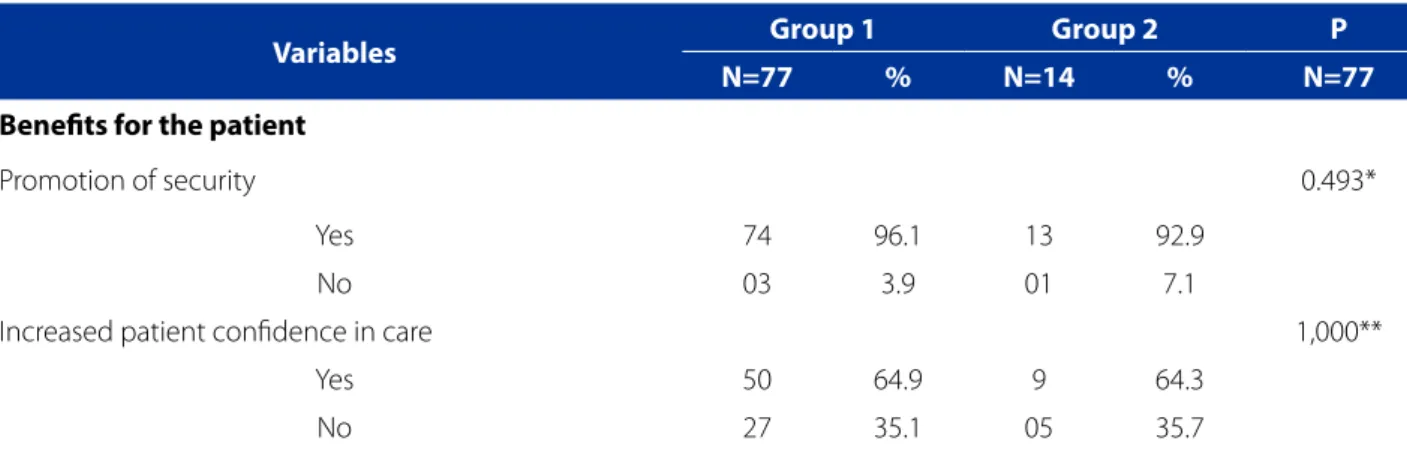
In the group 1, promotion of safety, use of the list as an opportunity for dialogue, socialization of relevant in-formation and improvement of quality of care were the items with the highest percentage of benefits of SSC for the patient, surgical team and health service, respectively. In group 2, regarding the benefits for the patient, two items presented the same percentage, namely: safety promotion and prevention of adverse events. Regarding the benefits to the surgical team, two items also presented the same percentage (improvement of communication and the use of the list as an opportunity for dialogue, with socialization of relevant information). The improvement in the quality of care was the item with the highest percentage of the bene-fits of the SSC for the health service, as presented in Table 1.
Table 1 – Characterization of the benefits of the security checklist according to nurses’ reports. Londrina, Maringá, PR, Brazil, 2015-2016
Variables Group 1 Group 2 P N=77 % N=14 % N=77
Benefits for the patient
Promotion of security 0.493*
Yes 74 96.1 13 92.9
No 03 3.9 01 7.1
Increased patient confidence in care 1,000**
Yes 50 64.9 9 64.3
Reduction of anxiety and fear in relation to surgery 0.567**
Yes 29 37.7 07 50.0
No 48 62.3 07 50.0
Prevention of adverse events 0.683*
Yes 66 85.7 13 92.9
No 11 14.3 01 7.1
Benefits for the surgical team
Communication improvement 0.726*
Yes 59 76.6 12 85.7
No 18 23.4 02 14.3
Opportunity for dialogue with socialization of relevant
information 1,000*
Yes 64 83.1 12 85.7
No 13 16.9 02 14.3
Improving Teamwork 1,000*
Yes 59 76.6 11 78.6
No 18 23.4 03 21.4
Benefits for the surgical center and/or hospital
Improving quality of care 0.292*
Yes 72 93.5 12 85.7
No 05 6.5 02 14.3
Increased efficiency in the operating room 0.543*
Yes 53 68.8 11 78.6
No 24 31.2 03 21.4
Improved safety culture in the surgical center 0.334**
Yes 57 74.0 08 57.1
No 20 26.0 06 42.9
Reduction of hospital costs for the prevention of
adverse events 1,000**
Yes 49 63.6 09 64.3
No 28 36.4 05 35.7
Reduction of hospital costs due to optimization of
efficiency in the operating room 1,000**
Yes 35 45.5 06 42.9
No 42 54.5 08 57.1
The benefits gained outweighed the difficulties to
implement the SSC*** 0.909**
Yes 45 58.4 09 64.3
No 32 41.6 05 35.7
Source: Research data, 2015-2016.
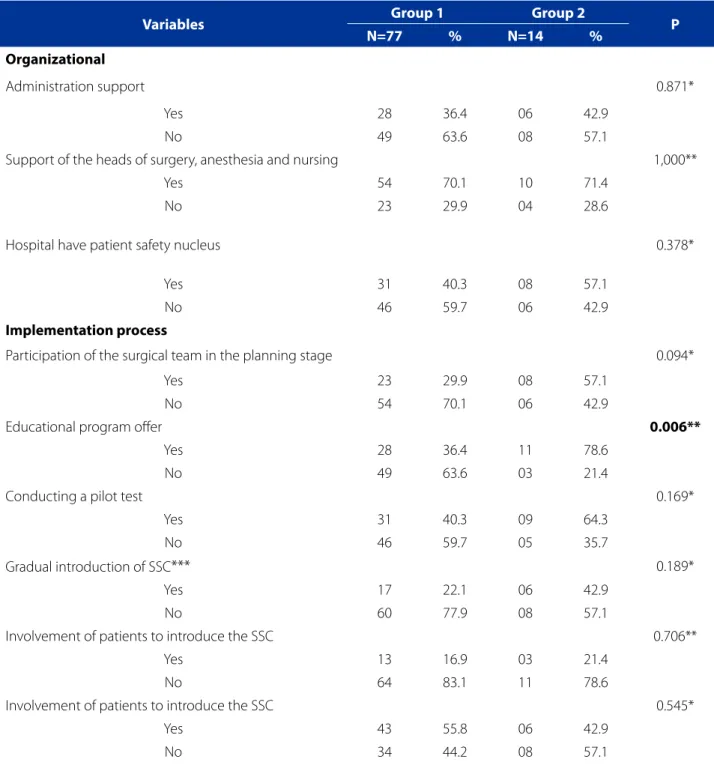
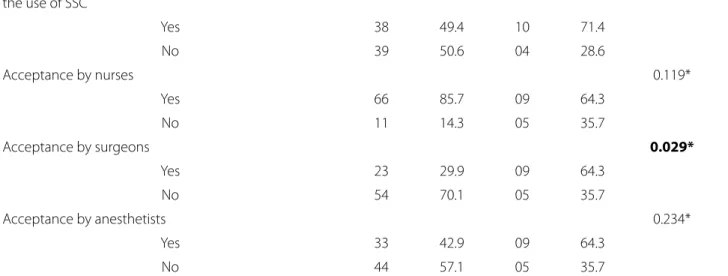
In the group 1, in relation to the facilitators for the im-plementation of SSC, the support of the heads of surgery, anesthesia and nursing (organizational), monitoring of the use practice (implementation process) and acceptance by the nursing team (surgical team) were the items with larger percentages. In the group 2, the items with higher percent-ages were the support of the heads of surgery, anesthesia
and nursing (organizational), the offer of educational pro-gram for the surgical team (implementation process) and the leadership present in the SC to stimulate the use of SSC (surgical team), as presented in Table 2. The results showed statistically significant difference between the groups in the items offered by the educational program (p = 0.006) and acceptance by the surgeons (p = 0.029) (table 2).
Table 2 – Characterization of facilitators for the implementation of the surgical safety checklist in hospitals according to nurses’ reports. Londrina, Maringá, PR, Brazil, 2015-2016
Variables Group 1 Group 2 P N=77 % N=14 %
Organizational
Administration support 0.871*
Yes 28 36.4 06 42.9
No 49 63.6 08 57.1
Support of the heads of surgery, anesthesia and nursing 1,000**
Yes 54 70.1 10 71.4
No 23 29.9 04 28.6
Hospital have patient safety nucleus 0.378*
Yes 31 40.3 08 57.1
No 46 59.7 06 42.9
Implementation process
Participation of the surgical team in the planning stage 0.094*
Yes 23 29.9 08 57.1
No 54 70.1 06 42.9
Educational program offer 0.006**
Yes 28 36.4 11 78.6
No 49 63.6 03 21.4
Conducting a pilot test 0.169*
Yes 31 40.3 09 64.3
No 46 59.7 05 35.7
Gradual introduction of SSC*** 0.189*
Yes 17 22.1 06 42.9
No 60 77.9 08 57.1
Involvement of patients to introduce the SSC 0.706**
Yes 13 16.9 03 21.4
No 64 83.1 11 78.6
Involvement of patients to introduce the SSC 0.545*
Yes 43 55.8 06 42.9
In the group 1, regarding the barriers to SSC imple-mentation, the items with the highest percentages were the lack of support from the heads of surgery, anesthe-sia and nursing (organizational), lack of monitoring of the practice of use (implementation process) and disbelief on SSC benefits by team members (surgical team). In the group 2, the lack of support from the chiefs of surgery, an-esthesia and nursing (organizational), absence of educa-tional program (implementation process) and resistance
of surgeons were the items with larger percentages, as presented in Table 3.
The results showed statistically significant difference between the groups in the lack of support from the ad-ministration (p=0.006), lack of support from the head of surgery, anesthesia and nursing (p=0.041), absence of the patient safety nucleus (p=0.005), abrupt introduction of SSC in the operating room, without planning (p=0.001) and absence of an educational program (p<0.001) (table 3).
Surgical Team
Leadership present at the surgical center to stimulate
the use of SSC 0.154**
Yes 38 49.4 10 71.4
No 39 50.6 04 28.6
Acceptance by nurses 0.119*
Yes 66 85.7 09 64.3
No 11 14.3 05 35.7
Acceptance by surgeons 0.029*
Yes 23 29.9 09 64.3
No 54 70.1 05 35.7
Acceptance by anesthetists 0.234*
Yes 33 42.9 09 64.3
No 44 57.1 05 35.7
Source: Research data, 2015-2016.
*Chi-square test; **Fisher’s exact test; ***SSC = Surgical Safety Checklist
Table 3 – Characterization of the barriers to the implementation of the Surgical safety checklist in hospitals according to nurses’ reports. Londrina, Maringá, PR, Brazil, 2015-2016
Variables Group 1 Group 2 P N=77 % N=14 %
Organizational
Lack of management support 0.006*
Yes 11 14.3 07 50.0
No 66 85.7 07 50.0
Lack of support from the heads of surgery, anesthesia
and nursing 0.041**
Yes 31 40.3 10 71.4
No 46 59.7 04 28.6
Absence of patient safety nucleus 0.005*
Yes 14 18.2 08 57.1
Implementation process
Imposition of use of SSC*** by the manager 0.288**
Yes 13 16.9 04 28.6
No 64 83.1 10 71.4
Abrupt introduction of SSV in the operating room
without planning 0.001*
Yes 08 10.4 07 50.0
No 69 89.6 07 50.0
Absence of educational program <0.001**
Yes 11 14.3 11 78.6
No 66 85.7 03 21.4
Absence of pilot test 0.160*
Yes 12 15.6 05 35.7
No 65 84.4 09 64.3
Lack of monitoring of the use practice 0.243*
Yes 28 36.4 08 57.1
No 49 63.6 06 42.9
Surgical Team
Absence of leadership in the surgical center 0.387**
Yes 09 11.7 03 21.4
No 66 88.3 11 78.6
Difficulty of communication and teamwork 0.064*
Yes 17 22.1 07 50.0
No 60 77.9 07 50.0
Hierarchy among professionals 0.135*
Yes 20 26.0 07 50.0
No 57 74.0 07 50.0
Resistance of surgeons 0.148**
Yes 37 48.1 10 71.4
No 50 51.9 04 28.6
Resistance of anesthetists 0.594*
Yes 19 24.7 05 35.7
No 56 75.3 09 64.3
Resistance of nurses 0.648**
Yes 08 10.4 02 14.3
No 69 89.6 12 85.7
Resistance of nursing technicians 1.00*
Yes 26 33.8 05 35.7
No 51 66.2 09 64.3
Disbelief about SSC benefits by team members 1.00*
Yes 40 51.9 07 50.0
No 37 48.1 07 50.0
Source: Research data, 2015-2016.
DISCUSSION
In the present study, in the comparative analysis be-tween the groups, the nurses’ report on the benefits of SSC was similar, that is, the implementation of the checklist has the potential to produce beneficial effects for the patient, surgical team and health service. In a systematic review of the effects produced by the checklists the results indicated that these tools were effective in improving patient safety in different clinical settings, strengthening clinical practice in accordance with evidence-based guidelines, and reducing the incidence of adverse events, morbidity, and mortality(11).
In another systematic review on the benefits of SSC for the surgical team, the results pointed out that the use of the tool contributed to the improvement of
self-percep-tion of teamwork and communicaself-percep-tion(4). However, when
the checklist was used in inappropriate conditions or the individuals involved did not adhere to the implementation process, the use of SSC may have negative impact, such as the perception that its use does not produce change in interpersonal communication(4,9).
In relation to the benefits to hospitals, the implementa-tion of SSC can promote cost reducimplementa-tion through efficiency gains, reduction of nurses turnover, reduction of delays, cancellation of surgical procedures and prevention of sur-gical complications(5-6).
With regard to the facilitators, the offer of educational program was not considered by the majority of the nurs-es who worked in hospitals that implemented the SSC (p=0.006). These results are contradictory to what is rec-ommended in the literature, since education is considered an essential and facilitative element in the implementation of the checklist(6,12-13). Thus, it can be inferred that, given the
diversity of educational strategies used in hospitals to im-plement SSC in relation to the approach, content, time ded-icated to activity, participant professional category, main-tenance over time and results obtained(6,12-13) or absence of
educational process(14), this facilitator can become a barrier.
The results showed a statistically significant difference between the groups in the item acceptance by the sur-geons, that is, the nurses in the group 2 understood that the item in question is a facilitator for the implementation of SSC. On the other hand, the nurses in the group 1 did not recognize this aspect as a facilitator. In a qualitative study whose objective was to explore the factors that in-fluenced adherence to the use of the checklist, the results showed that the resistance of members of the surgical team, especially of the surgeons, was one of the barriers to the implementation of SSC(7). Thus, it is suggested that
the implementation of this tool be conducted by a
multi-disciplinary team. In particular, surgeons and anesthetists, in order to be recruited, must have availability, exert good influence and a positive image with their peers(12), because
sustained use of the list can be successful when physicians are actively engaged(15).
In a study conducted on the SSC implementation pro-cess in hospitals in England, the relevant facilitators for the successful implantation of the checklist were teaching about LVSC; hands-on training on how to use the tool and how to deal with resilient team members; audit, perfor-mance feedback, dissemination of results (reduction of adverse events) to minimize the skepticism of team mem-bers; sanctions for individuals who do not show adherence to the use; institutional support, tool integration into exist-ing forms, conductexist-ing the check by team members with leadership skills, senior medical leadership and multidisci-plinary team involved in the implementation process(16).
Regarding the barriers, as mentioned previously, the re-sults indicated a statistically significant difference between the groups for: lack of support from the administration (p=0.006), lack of support from the heads of surgery, an-esthesia and nursing (p=0.041), absence of patient safety nucleus (p=0.005), abrupt introduction of SSC in the oper-ating room, without previous planning (p=0.001) and ab-sence of education (p<0.001).
Regarding the management of health services, insti-tutional micropolitical factors can contribute to the suc-cessful incorporation of SSC, hospitals should create pol-icies aimed at patient safety as well as assume safety as the guiding axis of health management. To this end, the institutions should have the support of the Patient Safety Nucleus, which must promote and support the imple-mentation of actions aimed at patient safety; define safety practices in accordance with current international and na-tional recommendations; conditions and support the use of checklist early in its implementation(17).
In the SSC implementation process, the absence of ef-fective leadership is one of the critical factors. In a study conducted to evaluate the effect of a strategy to improve adherence to SSC, the authors concluded that the strategy adopted that included the definition and involvement of leaders of each surgical discipline (surgery, anesthesia and nursing) can contribute to improve the adhesion and en-gagement of the team and highlighted as success factors the engagement of the leaderships(18).
plan-ning, namely: the implementation process was planned with emphasis on strategies for introduction and integra-tion of the tool; implementaintegra-tion with limited/no planning, i.e. the team was unaware of any structured approach to use; and method of implementation carried out in a im-posing manner by the management of the hospital or Ministry of Health. As a result, the barriers that stood out in the organizational scope were the implementation with-out planning or imposition and an institutional culture re-sistant to change, especially by more experienced profes-sionals(16). Thus, it is recommended the involvement of the
surgical team and planning of the gradual implementation, for example: initially, introduce the use of the SSC with a specific surgeon and specific operating room(12).
To understand the facilitators and barriers of SSC imple-mentation from the user perspective, scholars conducted a systematic review of qualitative studies. The results indi-cated that the process of implementing the checklist is a complex social intervention that requires changes in the user’s perspective (physicians and nurses) regarding the perception about SSC and patient safety, necessitating ad-justments to the list integration in the team work flow. The factors that could facilitate or make difficult these changes were the design of the tool, fusion of the tool with existing processes, sense of belonging, that is, the list created or adapted to meet the needs of the team; education, train-ing, lack of clarity in the guidelines that hindered the exe-cution, commitment of the multidisciplinary team to the process, especially of the surgeons, to minimize the effects of the hierarchical context in the surgical room; on-site leadership to support doctors and nurses, organizational culture, communication, and teamwork(19).
Despite the beneficial potential, the use of checklists has important limitations and caveats that should be considered, since the checklists are considered to be a weak security barri-er, vulnerable to standard deviation and can be naturally ne-glected. When a SSC stage is omitted, without manifestation contrary to the deviation by team members or other profes-sionals involved, and losses are not identified for the patient, inappropriate use is easily accepted or institutionalized(20).
In health services, the implementation of SSC is a com-plex and challenging process, as it requires surgical teams to change behaviors and learn new habits(10). These
find-ings can help those involved in the SSC implementation process to consider the selection of interventions best suit-ed to the local scenario(15).
To better support this process, education is recom-mended as a broader process under the triad: 1) informal conversation with each member of the surgical team, the dialogue aims to connect each professional with the idea
and purpose of the SSC in order to request collaboration for use of the list, before the actual introduction into a sur-gical room; 2) to train each member of the sursur-gical team prior to actual use, the approach includes an explanation of how to do, demonstrate, and provide an opportunity for the surgical team to thoroughly practice the check (use simulation). Training should occur prior to use in patients because during first use, surgical team members need to be confident about training and support received, and im-proper preparation may impair the progress of the surgical procedure. For feasibility of this step, team members can be instructed to train individually, in a group or complete surgical team; 3) continued training and in loco orienta-tion, from the introduction of SSC in the operating room(12).
In countries with medium and low Human Develop-ment Index, as in Brazil, SSC is known, but its use is not yet universally promoted or implemented, indicating a sub-stantial opportunity for educational strategies in defense of the use of this security tool. There are unique challenges in many of these countries due to the lack of infrastructure, equipment and trained personnel, which adds difficulties for the implementation of SSC. Therefore, it is recommend-ed that the strategies selectrecommend-ed should consider these addi-tional barriers(1).
CONCLUSION
For nurses, the implementation of the checklist can bring benefits to the patient, with emphasis on promoting safety. For the team, the benefits consisted of improved communi-cation and the use of the list as an opportunity for dialogue among professionals; and improving the quality of care was the main benefit factor related to the health service.
Regarding the facilitating aspects of the SSC imple-mentation, the results presented a statistically significant difference, among the groups of nurses, in the items of-fering an educational program and acceptance by the sur-geons. And, lack of administrative and managerial support, absence of patient safety nucleus, abrupt introduction of the list insurgical room, no prior planning and lack of edu-cation consisted of barriers.
anes-thesiologists, surgical instrumentators and nursing staff in the checking and, for this, it requires the participation of all those involved, from planning to evaluating results.
With regard to Nursing, the nurse plays an essential role in the movement to promote patient safety, especially in surgical care. It is believed that, in the field of education, this study brings contributions, because the evidence gen-erated can subsidize the debate on patient safety in the scope of the training of nurses and in the context of health services through lifelong education, so that professionals aware that safe practices save lives and thereby incorpo-rate them into their practice. In the field of research, the results of the present study made it possible to identify the benefits, facilitators and barriers in the implementation of SSC in the Brazilian reality and contribute to filling a knowl-edge gap in the national context.
In relation to care, the evidence generated can help in the elaboration of protocols related to the implementation and use of SSC that consider the critical factors involved in the process are adequate and compatible with the struc-tural and organizational specificities of the national health services, with the purpose of enable the integration of this tool in the work process, improve team adherence and achieve the best results for the patient.
REFERENCES
1. Weiser TG, Haynes AB. Ten years of the surgical safety checklist. Br J Surg. 2018. doi: https://doi.org/10.1002/bjs.10907.
2. Ministério da Saúde (BR). Portaria nº 1.377, de 9 de julho de 2013. Aprova os Protocolos de Segurança do Paciente. Brasília, DF: Ministério da Saúde; 2013 [cited 2018 Aug 10]. Available from: http://bvsms.saude.gov.br/bvs/saudele-gis/gm/2013/prt1377_09_07_2013.html.
3. Biccard BM, Rodseth R, Cronje L, Agaba P, Chikumba E, Toit L, et al. A meta-anal-ysis of the efficacy of preoperative surgical safety checklists to improve perioper-ative outcomes. S Afr Med J. 2016;106(6):592-7. doi: https://doi.org/10.7196/ SAMJ.2016.v106i6.9863.
4. Russ S, Rout S, Sevdalis N, Moorthy K, Darzi A, Vincent C. Do safety checklists improve teamwork and communication in the operating room? a system-atic review. Ann Surg. 2013;258(6):856-71. doi: https://doi.org/10.1097/ SLA.0000000000000206.
5. Cadman V. The impact of surgical safety checklists on theatre departments: a critical review of the literature. J Perioper Pract. 2016;26(4):62-71. doi: https:// doi.org/10.1177/175045891602600402.
6. Treadwell JR, Lucas S, Tsou AY. Surgical checklists: a systematic review of im-pacts and implementation. BMJ Qual Saf. 2014;23(4):299-318. doi: https://doi. org/10.1136/bmjqs-2012-001797.
7. Gagliardi AR, Straus SE, Shojania KG, Urbach DR. Multiple interacting factors influence adherence, and outcomes associated with surgical safety checklists: a qualitative study. PloS One. 2014;9(9):e108585. doi: https://doi.org/10.1371/ journal.pone.0108585.
8. Santana HT, Freitas MR, Ferraz EM, Evangelista MSN. WHO safety surgical checklist implementation evaluation in public hospitals in the Brazilian Federal District. J Infect Public Health. 2016;9(5):586-99. doi: https://doi.org/10.1016/j.jiph.2015.12.019. 9. Pancieri AP, Santos BP, Avila MAG, Braga EM. Safe surgery checklist: analysis of the safety and communication of teams from a teaching hospital. Rev Gaúcha Enferm. 2013;34(1):71-8. doi: https://doi.org/10.1590/S1983-14472013000100009. 10. Tostes MFP. Lista de verificação de segurança cirúrgica: evidências para a
imple-mentação em serviços de saúde [tese]. Ribeirão Preto (SP): Escola de Enferma-gem de Ribeirão Preto, Universidade de São Paulo; 2017.
11. Thomassen O, Storesund A, Softeland E, Brattebo G. The effects of safety check-lists in medicine: a systematic review. Acta Anaesthesiol Scand. 2014;58(1):5-18. doi: https://doi.org/10.1111/aas.12207.
12. Safe Surgery Checklist Implementation Guide. Boston: Ariadne Labs; 2015 [cited 2018 Aug 10]. Available from: http://www.safesurgery2015. org/uploads/1/0/9/0/1090835/safe_surger y_implementation_ guide__092515.012216_.pdf.
13. Nugent E, Hseino H, Ryan K, Traynor O, Neary P, Keane FB. The surgical safe-ty checklist survey: a national perspective on patient safesafe-ty. Ir J Med Sci. 2013;182(2):171-6. doi: https://doi.org/10.1007/s11845-012-0851-4. 14. O’Connor P, Reddin C, O’Sullivan M, O’Duffy F, Keogh I. Surgical
check-lists: the human factor. Patient Saf Surg. 2013;7(1):14-20. doi: https://doi. org/10.1186/1754-9493-7-14.
15. Gillespie BM, Marshall A. Implementation of safety checklists in surgery: a re-alist synthesis of evidence. Implement Sci. 2015;10(137):1-14. doi: https://doi. org/10.1186/s13012-015-0319-9.
16. Russ SJ, Sevdalis N, Moorthy K, Mayer EK, Rout S, Caris J, et al. A qualitative evaluation of the barriers and facilitators toward implementation of the WHO surgical safety checklist across hospitals in England lessons from the “Surgical Checklist Implementation Project”. Ann Surg. 2015;261(1):81-91. doi: https:// doi.org/10.1097/SLA.0000000000000793.
17. Tostes MFP, Haracemiw A, Mai LD. Surgical Safety Checklist: considerations on institutional policies. Esc Anna Nery. 2016 [cited 2018 Aug 12];20(1):203-9. Available from: http://www.scielo.br/scielo.php?pid=S1414-8145201600010 0203&script=sci_arttext&tlng=en.
18. Ong AP, Devcich DA, Hannam J, Lee T, Merry AF, Mitchell SJ. A ‘paperless’ wall-mounted surgical safety checklist with migrated leadership can improve compliance and team engagement. BMJ Qual Saf. 2016;25(12):971-6. doi: https://doi.org/10.1136/bmjqs-2015-004545.
19. Bergs J, Lambrechts F, Simons P, Vlayen A, Marneffe W, Hellings J, et al. Barriers and facilitators related to the implementation of surgical safety checklists: a sys-tematic review of the qualitative evidence. BMJ Qual Saf. 2015;24(12):776-86. doi: https://doi.org/10.1136/bmjqs-2015-004021.
20. Rydenfält C, Ǻsa E, Larsson PA. Safety checklist compliance and a false sense of safety: new directions for research. BMJ Qual Saf. 2014;23(3):183-6. doi: https://doi.org/10.1136/bmjqs-2013-002168.
Corresponding author:
Maria Fernanda do Prado Tostes E-mail: [email protected]