A Work Project, presented as part of the requirements for the Award of a Masters Degree in Management from NOVA – School of Business and Economics.
A Breakthrough Wine Concept
ANA RITA SOUSA DE BARROS GRAVE 1655
Double Degree Program between Nova SBE and LUISS Guido Carli
A Project carried out on the Marketing course, under the supervision of:
Professor Victor Centeno
1
Abstract
The Portuguese wine market model is traditionally based on attributes such as region, grapes and enologist, which makes an educated choice of the wine by younger consumers a difficult and uncomfortable process. The purpose of this work is to develop a hypothesis of a wine based on what young consumers value, such as the bond that drinking wine creates (friendship), instead of the traditional attributes. This new wine will break its connection with tradition, becoming a modern product, directed to an unconventional target that is increasingly consuming more wine.
2
Index
1. Introduction ... 4
2. Literature Review ... 5
2.1 Motivational Influences/drivers of consumption ... 6
2.2 Wine choice ... 7
3. Audit ... 9
3.1 Market Analysis ... 9
3.2 Customer Analysis ... 11
4. Working Hypothesis ... 14
5. Proving the Hypothesis ... 16
5.1 Brand mapping ... 18
5.2 Positioning concepts ... 19
5.3 Quantitative Research ... 21
6. Marketing Plan ... 29
6.1 Positioning ... 29
6.2 Marketing Goals & Objectives ... 29
6.3 Product Strategy ... 30
6.4 Placing Strategy ... 32
3
6.6 Promotion Strategy... 34
6.7 Implementation and Control ... 36
6.8 Contingency Plan ... 38
7. Conclusion ... 39
7.1 Weaknesses and Limitations ... 40
7.2 Areas for Further Research ... 40
References ... 41
4
1. Introduction
Portugal has been a wine producer and consumer since Roman times, where wine has always had a strong connection with tradition and is a beverage very appreciated with older people and more than ever by young ones.
The wine industry is, however, focused on some attributes, such as region-of-origin, grape variety and enologist, which are very complex for younger consumers. There is a need for knowledge about the criteria, which younger consumers are not interested in, making the decision process a hard task. They value easiness, friendship, moments and fun; they just want to make the right choice so that they can have a good time with their friends and enjoy a good wine.
The purpose of this project is to develop a hypothesis based on what younger consumers value, thus breaking with the traditional business model. Through the reverse positioning method, positioning for a wine with different concept was created: To young wine consumers, from 18 to 30 years old, who have an unconventional attitude towards life and enjoy socializing with their group of friends, Mata Ladrões is a wine that makes the choice easier by not following the conventional selection criteria, of identifying region, grapes variety or enologist.
This study was conducted in three main phases; a desk research, where information about the wine market was collected in the world and more specifically in Portugal; the second stage was based on qualitative research, in particular, exploratory groups, where it was possible to have a closer contact and interaction with the target; in the third phase, a
5 quantitative research was conducted through a online questionnaire, with the aim to prove or disprove the hypothesis. Since the hypothesis was proven, the consequent marketing plan was developed, in order to launch the product on the market.
2. Literature Review
The wine industry is a very unique industry due to its size and to the degree of its segmentation.
Wine is becoming a lifestyle drink for all generations (Bruwer, Saliba & Miller, 2011), but its image and value differs among ages (Olsen, Thach & Nowark, 2007). Taking into account that each generation has specific values and needs that lead to different behaviors (Inglehart, 1997), age segmentation in the wine business is becoming more and more important. The consumer market for wine is divided in three main generations: the Baby Boomers (the ones born between 1945 and 1964), Generation X (those born between 1965 and 1976), and the Generation Y (born between 1977 and 2000). This separation of consumers into generational groups is important because it allows the identification of different needs and wants within the groups towards wine.
Young consumers, especially Generation Y, are becoming more interested in the wine market. Nevertheless, they are still inexperienced, confused and overwhelmed in the process of choosing wine (Wine Intelligence, 2010). This generation brings new changes and demands to the market and advertisers, once it has grown up with digital technology and internet. They are not completely loyal; however they are very sophisticated and knowledgeable in relation to brands and products around them. One of the particular
6 characteristic of Generation Y is the fact that they are deeply devoted to their friends (Kadic-Maglajlic and Dlacic, 2011).
In some European countries, beer companies are battling to maintain the interest of younger generations, which are showing a considerable preference for wine, spirits and other alcoholic drinks (Euromonitor International, 2011). After seeing a substantial increase in the amount of money spent in wine, Peskett (2006) confirmed that over the next years Generation Y are becoming increasingly important as wine consumers.
2.1 Motivational Influences/drivers of consumption
The economic, social, cultural and political context, in which a generation grows up and lives, is a crucial factor in setting motives and attitudes, so it can be said that wine consumption is driven by several motives. Brunner and Siegrist (2011) identified different groups of wine consumption motives such as: self-expression, recreation, sociability, health, style, food, pleasure, tradition, fun and intellectual challenge. Moreover, these wine consumption motives differ between situations. Vrontis and Papasolomou (2007) found out that wine tasting events, word-of-mouth and wine exhibitions are the most important factors which influence the behavior, perception and purchase decisions of the majority of consumers.
Some consumers argue that wine aids socializing and connects people. Furthermore, for some people, taking a glass of wine or consuming wine is something that connects them with tradition.
7 According to Olsen, Thach and Nowak (2007) and Kadic-Maglajlic and Dlacic (2011) , there are also evident differences across generations according consumption situations, demonstrating that Generation Y will consume wine more than other generations at bars and formal celebrations, since they perceive wine as a social beverage, playing an important role in social environments. Adding to that, it was proven that the influence of reference groups such as friends, family and co-workers is more evident in the youngest generation - Generation Y - which prefer, for sure, consume wine with friends or family.
This variety of different motivators can be extended with the food factor. Generation Y consumes wine with meals because wine helps creating a special environment when combined with food, which is consistent with previous findings (Thach & Olsen, 2004; Dubow, 1992) that wine is a food intensifier, which represents an important motivator in wine consumption.
2.2 Wine choice
At this stage, the consumer has already decided that he/she wants to consume wine and is now facing the decision of which wine he/she will buy/consume. There are many factors which can influence this decision, such as price, quality, the income of the consumers, the price of the substitute products, etc. The region-of-origin can influences the choice of the consumers; in some literature, the price is considered as the most influential factor for demand, which can also be increased by the quality of the wine, when the product is recognized by experts in good reviews (Domingues Martinho 2013).
8 The literature focused on wine choice differentiates two categories of choice attributes: extrinsic and intrinsic attributes. Color and level of sugar are two examples of intrinsic attributes, where were included the physical attributes of a wine; in the opposite, were the extrinsic ones that are not referred to the physical attributes of the wine, as the bottle shape and its label (Radman et al. 2004). The extrinsic attributes can still be divided into two subcategories: the first one includes those extrinsic attributes that are related to the product, such as grape variety (Chrea et al. 2010); in the second, are extrinsic attributes that can be modified without changing the product, having the price as example (Chrea et al. 2010).
In a research conducted by Keown and Casey (1995), it was found that country-of-origin, brand name, grape variety, region of origin and volume of alcohol were the most influential characteristics when choosing a wine. Respondents also said that the main characteristics of their favorite wine were taste, quality, palatability, and value for money. This study also found that consumers were most easily influenced by the recommendations made by friends, family or by staff of the business where they purchase the wine.
The choice of wine has also associated a component of risk, since in the majority of times consumers cannot taste the wine before the purchasing moment. Basically, it is the risk of choosing the wrong bottle, and to avoid that, several strategies may be adopted depending on the level of knowledge in relation to the product. One of the most common strategies is the search for additional information, through family, friends or experts (Barber et al. 2008). Other strategy used is to choose a wine that the consumer has already tasted (Gomes 2012). It is important to refer that the perception of risk differs among consumers; it depends on their experiences, lifestyle, age, etc… (Loudon & Bitta, 1999).
9
3. Audit
3.1 Market Analysis
Portugal is one of the biggest wine producers in the world, being in 11th place in the ranking, with an average of 437,26 million liters produced per year between 2009 and 2013 (MarketLine 2012).
The Portuguese wine market has been contracted in both value and volume through the period 2009-2013 (Exhibit 1 in the Appendix), as the country’s weak economy has affected consumer spending. It had total revenues of $5,495.8 million in 2013, representing a compound annual rate of change (CARC) of -0.2% between 2009 and 2013 which is predicted to continue decreasing at a similar overall rate, until the forecasted period of 2018. In relation to market volume, this also has been reduced with a CARC of -0.1% between 2009 and 2013, to reach a total of 435.7 million liters in 2013. The market's volume is expected to fall to 425.4 million liters by the end of 2018, representing a CARC of -0.5% between 2013 and 2018. (MarketLine 2012)
Due to its soil and climatic characteristics, Portugal is considered a wine producer with unique qualities and abilities around the world. The wine produced in Portugal varies depending on the region and its climate, and grape varieties. The wine production varies depending on the type of vine cultivation, the area occupied by the vine, its geographical distribution, and in particular the weather (Guerra 2005). The wine market is composed by fortified wine, sparkling wine and still wine. This last one is the largest segment of the wine
10 market in Portugal and it was the most lucrative one in 2013, with total revenues of $5,099.3m, equivalent to 92.8% of the market's overall value (MarketLine 2012).
The importance of wine production in the Portuguese economy is undeniable. It has a significant share in Agricultural Production, with an average annual contribution (2009-2013) of 10.9% (INE, 2014); it contributes positively to the external trade balance, generates employment and income in other important sectors of activity like cork (Duarte et al. 2010).
In relation to alcoholic drinks, wine has an average annual contribution (2009-2013) of 48.7% of the total sales within the whole range of alcoholic beverages (Euromonitor International 2014). In spite of the natural reflection of the economic situation, which had a negative impact on the total volume of growth in the sector, wine was the least affected, showing the lowest negative value within the alcoholic drinks (Exhibit 2, in the Appendix).
The wine category in Portugal is highly fragmented, and one company cannot be said to be dominant. PrimeDrinks – Comercialização de Bebidas Alcoólicas e Produtos Alimentares has led the share ranking for the last three years, but with only 3% (Euromonitor International 2014). In general, nowadays, wine producers in Portugal, as well as in other EU countries, are facing a highly competitive environment, not only in their domestic markets, but also in the international ones (Duarte et al. 2010). To deal with this situation and to face the downward trend both in volume and value of wine consumed, Portuguese producers are increasingly becoming more united, providing them bargaining power with the big retail chains which makes them more competitive in the market.
11 Regarding export, Portugal is one of the main wine exporters in the world (9th place in the international ranking) which is estimated to be 40% of the national volume produced. As reported by the Instituto da Vinha e do Vinho (IVV), the value of exports has been growing since 2010 with an average increase of 7.5% per year through 2013. The volume of exports is also facing the same increasing trend.
3.2 Customer Analysis
Portugal has been a traditional wine consumer since Roman times. According to Wine Institute, not even the economic crisis has affected the consumption per capita in Portugal, once the values are almost stable since 2009 (Exhibit 3, in the Appendix). However, in the last 20 years, as reported by the Comissão Vitivinícola da Região de Lisboa (CVR Lisboa), Portuguese consumers dropped their wine consumption from 65 to 42 liters, the radical change in lifestyle, the Mediterranean diet, the maximum alcoholic level allowed for drivers, and the financial crisis were some of the factors behind this reduction.
The Region Lisbon has the largest number of wine consumers in Portugal (24.2%), followed by the North coast (19%) and the Region of Oporto (12.8%). The majority of Portuguese wine consumers are men (65%), because wine consumption by women is more recent and is concentrated in a less intense level of wine use. It has been verified that the age groups who consume more are between 35 and 44 years old (21.7%) and between 25 and 34 (21.1%). The lower middle class has the most wine consumers (28.5%), followed by the average middle class (28.03%) and the upper middle class (25.4%). Regarding their occupation, skilled workers (20.8%), retirees and unemployed (21.2%) are the ones who consume the most (Marktest, 2003).
12 In general terms, most consumers have similar behavior when choosing a wine. It is extremely important to know and understand what kind of attributes, motives and attitudes are behind this decision making process and the possible differences between segments in order to build a coherent working hypothesis in the next section. In the following paragraphs the results and findings of the last studies made to Portuguese wine consumers can be found.
The majority of Portuguese consumers value a set of attributes regarding the choice of wine. Taste, region of origin, price, the type of wine (red, white, rose…) and having a cork, are the ones that have the greatest influence; the bottle design, the grape variety, the alcohol level, the age and the brand of the wine are also important (Sanches 2013; Madeira et al. 2008; Duarte et al. 2010; Carvalho et al. 2010). The importance of these criteria choices may change with consumption occasion and age. Older consumers (35 years or more) give more importance to region of origin, grape variety, DOC certification, enologist, age and the cork stopper, while younger consumers give more relevance to the label design, brand and price, as well as to advertising as a source of information (Madeira et al. 2008; Duarte et al. 2010).
Considering motives/attitudes towards wine, “I like the taste of wine”, ”Wine goes well with meals”, “I like to know and evaluate wine quality”, “Moderate wine consumption favors health”, “Wine consumption favors socializing” and “Wine helps to relax”, had a high level of agreement in previous studies made in the Portuguese market (Madeira et al. 2008; Duarte et al. 2010). Wine consumption as a factor of “social status” is more
13 associated with younger consumers (25 to 34 years old) (Madeira et al. 2008; Duarte et al. 2010).
The purchasing of wine is a complex process and it is usually associated with some level of risk, mainly due to the wide range of similar products available and to information asymmetries. Since it is difficult for consumers to evaluate wine quality prior to purchase, they use some strategies in order to minimize the risk of choosing the wrong bottle. Consumers take into consideration recommendations from family, friends and previous consumption experiences (Madeira et al. 2008; Duarte et al. 2010), followed by information from media, ask the seller, buying a known brand or even using the price (Sanches 2013).
Taking into consideration consumption habits, red wine is the most frequently consumed, followed by white. Lower consumptions are green wine, sparkling wine and rose (Sanches 2013). As to consumption frequency , the majority of consumers drink wine “a few times a week” (Sanches 2013). Regarding the monthly expenditures the majority of Portuguese consumers spend 20€ or less (Sanches 2013) , which depends on several situations. In situations of wine use with a "meal at home during the week", Portuguese consumers claim to buy a bottle of still wine from a price range between 2€ ‐ 3.99€. On the weekend “with friends in bars, pub's and clubs” and for consumption during “informal occasions at restaurants”, the value increases to 4€ ‐ 5.99€. In the case of wine used for “special occasions”, “gifts”, “business meals” or in “prestigious restaurants” consumers are disposed to pay a price band between 6€ ‐ 9.99€. In general the majority of consumers are not willing to pay more than 10€ in any situation of wine consumption (Carvalho & Magalhaes Serra 2010). Price is considered by the consumer one of the key factors in the choice of wine. It
14 has a great influence in the purchase decision process where consumer knowledge about the quality of wine may be limited (Guerra 2005).
The favorite place to purchase wine are definitely hypermarkets and supermarkets, where consumers like to make their choice from a wide range of wines, allowing them to compare several attributes without having to rely on third parties. The second preferred choice are restaurants. Cooperatives, specialized shops and wine cellars have little importance as location of purchase. Even less significant than these is the purchase in bars, pubs, and finally the internet. The most frequently bought format is the 0.75 liter bottle (Sanches 2013).
Wine is more frequently consumed at dinner time (59%), weekends (55%) and particularly special occasions (75%) (Madeira et al. 2008; Duarte et al. 2010) more precisely at home and in restaurants, in both situations with family and friends, and at parties (in all of them the preferred choice is red wine). Wine consumption associated with business or in situations where the individual is alone, have low significance (Sanches 2013). The “social” component of wine consumption (in groups, at special occasions and during restaurant meals) is an area of growth among the younger consumers from 18 to 34 years old (Sanches 2013; Carvalho et al. 2010).
4. Working Hypothesis
The main goal of the present section is to build a working hypothesis for a different positioning in the wine market. Basically, through an exercise of reverse positioning (only
15 applied in mature markets) and using the previous information found, a new positioning that contradicts and breaks the traditional business model will be created.
Research has shown that age is a relevant differentiating factor of motives and attitudes, consumption frequency, consumer’s choice and quality perception towards wine (Madeira et al. 2008), which can also be proved through the differences found in the previous section. The target chosen for this new positioning will be young wine consumers from 18 to 25 years old. The reason behind this is that they are more likely to have an “open mind” without preconceived ideas than older people. They are usually willing to break with “the traditional” as mild transgressors and the ones to whom region, grapes, enologist matter the least.
The positioning will also have a strong social dimension. Wine consumption already has a social component which is an area of growth within younger consumers (Sanches 2013; Carvalho et al. 2010). The relationships among the group will be emphasized, in order to enhance and strengthen connections. Basically it is a wine to drink in bars, restaurants or at home but always with a group, with friends.
Relatively to price, which is considered one of the key factors in the choice of wine (Guerra 2005), will be between a range of 4€ and 6€ which will reflect the quality of the wine. Adding the fact that “with friends in bars, pub's and clubs” and for consumption during “informal occasions at restaurants”, consumers usual spend between 4€ ‐ 5.99€ per bottle (Carvalho & Magalhaes Serra 2010), this range seems to be the most suitable one. In general, the wine quality/price relation is constant up to 2€ and then increases until 20€.
16 After that, the function is again constant meaning that above 20€ consumers do not perceive higher quality in more expensive wines.
Basically the positioning for this wine is different from those already existing in the Portuguese market because it does not mention the enologist, the grape variety, the color, the aroma or even the region of origin (young consumers do not value them), instead appeals to its social component, to friendship, to happy moments. It will assure that it is the correct choice for situations where the group is present, thereby reducing the risk associated with the choice of wine, which makes the consumer’s life easier.
So in order to summarize and create the right positioning for this concept, the positioning statement is presented next.
To young wine consumers, from 18 to 30 years old, who have an unconventional attitude towards life and enjoy socializing with their group of friends, Mata Ladrões is a wine that helps them bond and express their irreverence because it does not follow the conventional selection criteria by not identifying region, grapes variety or enologist.
5. Proving the Hypothesis
The purpose of this section is to test the concept previously introduced, so there were two exploratory groups with individuals from the target created. Each group was composed by six individuals, three women and three men with ages between 19 and 23 years old. All of them were wine consumers, and people open to new ideas and with no problems in breaking with traditional patterns.
17 At this stage, the funnel technique was used to conduct the dynamic. Both groups were submitted to a set of questions starting with questions about the consumption of alcoholic beverages in general, followed by the ones about wine consumption and in the end, the concept was introduced and each member of the group gave his/her opinion about it. The questionnaire and related answers, from both groups, are available in Exhibit 4 and Exhibit 5 in the Appendix, for a further analysis.
Through the interpretation of the answers, several important insights were found:
The majority of interviewees feel some risk during the choice of wine, once they “do not understand anything about” the traditional attributes of wine and most of the wines promote exactly those attributes for its purchase;
The communication, word-of-mouth and presence in social networks are important to promote the wine and create brand awareness; individuals show the importance of opinions from friends or more knowledgeable people in order to try it;
The price and “have heard about it” are important factors when choosing wine; “Being together” is what individuals value the most when they are going out with
their friends;
There was clearly an acceptance of the concept; The name was not in line with the “group” concept;
The “group” concept should not be overly emphasized in marketing because it implies lower quality and consequently a lower price;
18 The differentiation should not only be in the concept but also in the physical attributes of the wine, mainly the bottle and the label; individuals proved the importance of irreverence in the label to catch their attention;
These insights implied some adjustments to the previous concept, with the main goal of creating the perfect match between the concept and the characteristics as well as requirements from the target group interviewed. Since it was found that the “group” is associated with a lower quality and price, this should not be overly emphasized. Instead, the focus should be more on the strengthening of relations between friends, in their bonding since “being together” is highly valued for the youngest consumers.
Irreverence should be expressed not only in the concept but also in the physical aspects of the bottle (its shape and label). Individuals demonstrated the importance of new and innovative things to catch their attention; otherwise the concept is not enough to prove the irreverence of the wine which should be unique and different through its name, message and look.
In conclusion the concept will continue to be a special wine targeted at young consumers, who do not care about the conventional selection criteria of wine, alternatively they value the relations with their friends because when they are going out or in a social environment what they value the most is “being together” with their peers.
5.1 Brand mapping
After reaching the conclusions from group’s dynamics, it was useful to display perceptual maps to visualize potential gaps. This will be helpful in finding the best positioning strategy
19 for Mata Ladrões in the marketplace by seeing how individuals perceive competitor’s brands.
In order to achieve this, it was necessary to create another exploratory group. This group was composed of 8 individuals from the target, four of them were men and the others women.
The first stage of this group dynamic was the presentation of two perceptual maps (one by one) and some known wine brands – Barca Velha, Esporão, Porta da Ravessa, Sexy, Bastardo and Casal Garcia. The XY axes of the first map were classified in Older People/Younger People and Individual/Group, whereas the second were in Individual/Group and Irreverent/Respectful. The choice of these attributes was based on the main features that distinguish Mata Ladrões of the other competitors. Then the group positioned all of previous brands in the maps according to their perception (Exhibit 6, in the Appendix).
5.2 Positioning concepts
The second stage of the dynamic was based on the introduction of two positioning concepts. The main goal was to tell a kind of a story to consumers, where the main benefits and values of each concept were identified, and which they could understand, as clearly as possible, the concept of Mata Ladrões. This process was conducted through the brand laddering method (Exhibit 7, in the Appendix), where the various benefit levels which the brand provides, and the final value were identified.
20 The two concepts created were: “Friends Connection” and “Risk Elimination”. Each of them was associated with a “story”, where the concept was explained.
“Friends Connection” concept was the first one to be presented. The group read and analyzed the concept, saying what they liked and disliked the most. The same was done with the other concept “Risk Elimination”. After both concepts were compared; individuals listed the pros and cons of each and in the end were asked to prioritize one. There was no clear consensus in the choice of just one concept once they identified themselves with both stories, so they provided some suggestions to complete each one of the concepts.
The last step, now that the group had all the information needed, was the placement of Mata Ladrões on the previous perceptual maps, enabling the perception of the individuals of Mata Ladrões in relation with some competitors (Exhibit 6, in the Appendix).
This second exploratory group allowed the collection of new findings and the reinforcing of others:
There was some difficulty with the meaning of “irreverent”; the word is very “strong” and some individuals do not like to be called “irreverent”;
The meaning of “irreverent” is associated not only with the concept of the wine but also with its transmission (advertisement), the label on the bottle, basically with the way it is presented;
The “Friends Connection” concept was valued due to “brings friends together”, which reinforces the idea previously found; on the other hand, this concept was
21 criticized for being dubious; some individuals were not 100% sure if they would be willing to buy this wine;
The “right choice” in the “Risk Elimination” concept was highly valued; individuals felt trusting because the product cares about their choice;
The traditional choice criteria (region, grapes, enologist…) is something that the youngest consumers are not very comfortable with, which makes their choice more difficult most of the time.
The two positioning concepts were adjusted according to group’s reviews (Exhibit 8, in the Appendix) which make them ready to be tested in a quantitative research.
5.3 Quantitative Research
The next phase was to conduct a quantitative research through an online questionnaire (Exhibit 9, in the Appendix). It allowed the collection of information of a larger sample and also the statistical generalization. The results from the questionnaire will finally indicate the possible viability of the both concepts previously created.
The questionnaire was promoted through the internet and received a total of 237 answers. The first 2 questions were filters to the target market so some respondents were eliminated for two reasons: they were under 18 or over 30 years old and they were not wine consumers. With these filters, 127 respondents were able to answer to the whole questionnaire.
In relation to the consumption frequency of alcoholic beverages, consumers can be divided in heavy users, average users and light users. Heavy users are the ones who drink more
22 frequently, daily, two to three times per week or one time per week; average users are those who drink once a month; while light users drink on average less than once a month. As it can be seen in the graph, concerning wine, the great majority of the respondents are heavy users with a total of 65,35%, followed by average users, 31,50%, and light with the smallest percentage of 3,15%.
Regarding consumption occasion, five situations were presented: drink when “going out”, “during meals”, “aperitif before meals”, “special occasions (weddings, parties…)” and “never”. When individuals are going out, beer (81,10%) and distillates (74,80%) are definitely the preferred drinks of respondents; wine presents the smallest value in this category with 27,56%. Nonetheless, “during meals”, wine is the most desirable drink with a value of 76,38%. In “special occasions” such as weddings or parties, respondents usually choose distillates (64,57%) and also wine (65,35%).
65,35% 31,50% 3,15% 0,00% 10,00% 20,00% 30,00% 40,00% 50,00% 60,00% 70,00% 80,00%
Heavy Users Average Users Light Users
Consumers Classification
Beer Wine Distillates
23 The next question was related to the classification of beer, wine and distillates as beverage you drink by yourself (alone), or as “group” drink. Contrary to what was found in the exploratory groups, wine is the beverage with the lowest value for being a “group” drink, compared to beer and distillates. This last one was not even mentioned in the focus group as being one of “group drinks”.
At this stage, the first concept “Friends Connection” was introduced. Several questions were made exclusively for this concept. Then, the second concept “Risk Elimination” was exposed and then all the questions were repeated but now concerning the second one. In the end, they were asked to select which was the preferred concept and to explain the reason behind their choice.
27,56% 76,38% 37,01% 63,35% 0,00% 0,00% 10,00% 20,00% 30,00% 40,00% 50,00% 60,00% 70,00% 80,00% 90,00%
Going out During meals Aperitif before meals
Special Occasions
Never
When do you consume the following
beverages?
Beer Wine Distillates
24 In general terms, the second concept was more valued, not only because 63% of respondents preferred it, but also because it scored higher values in the questions such as “I like it a lot”; “I identify myself with it” and “I would definitely buy it” and lower values in the opposite axis of those questions, as it can be observed in the graphs below. The remaining graphs with additional analysis can be seen in Exhibit 10, in the Appendix.
7,1% 3,9% 4,7% 7,1% 8,7% 7,9% 0,0% 1,0% 2,0% 3,0% 4,0% 5,0% 6,0% 7,0% 8,0% 9,0% 10,0%
I like it a lot I identify myself with it I would definitely buy it
"I like it a lot", "I identify myself with it" and "I
would definitely buy it"
Concept 1 Concept 2 15,0% 18,9% 18,1% 3,9% 5,5% 7,1% 0,0% 5,0% 10,0% 15,0% 20,0%
I don't like it I don't identify myself with it
I would not buy it
"I don't like it", "I don't identify myself
with it" and "I would not buy it"
Concept 1 Concept 2
Graph 3: analysis of respondents who answered “5” in the questions 8, 9 and
10 for concept 1 and questions 15, 16 and 17 for concept 2.
Graph 4: analysis of respondents who answered “1” in the questions 8, 9 and
25 Regarding the qualitative questions “What did you like the most?” and “What did you like the least?” for both concepts, several differences were found between them (Exhibit 10, in the Appendix). For the first concept, the allusion of friendship, friends and bonding within the group (45,7%) were the facts that respondents liked the most; followed by the concept in itself and the fact that they do not need to care about the traditional choice criteria (14,2%). The easiness of the choice and drink (22%) and the concept in itself/I don’t need to care about the traditional choice criteria (22%) were what respondents liked the most for the second concept. Concerning what respondents liked the least, the devaluation of the traditional choice criteria (29,1%), the name and slogan (26,8%) and lack of reference to quality (19,7) were the main things mentioned for concept 1, while for concept 2 were the name and slogan (22%), and the presentation of the concept (18,9%); 15% of respondents said that there was nothing that they didn’t like for the second concept. Even though both concepts are not based on the traditional choice criteria, the claim for its devaluation was higher for concept 1 (29,1%) than for concept 2 (8,7%), which means that respondents perceived this aspect very differently in each of the concepts. Since this variable was non numerical, correlation tests could not be done. The questions of classification - which was done on a scale of 1 to 5, 1 being “I don’t like it”/”I don’t identify myself with it”/”I would not buy it” and 5 “I like it a lot”/”I identify myself with it”/”I would definitely buy it” - were analyzed exclusively for those who mentioned the devaluation of the traditional choice criteria as a negative thing. This analysis had as a main purpose to see the attitudes of these respondents towards the concepts. In relation to the first concept, if they like or don’t the concept, the majority of the respondents were in level 3 (48,6%), in level 2 when asked if they identify themselves with the concept, and in level 3 (40,5%) when questioned
26 about the probability of buying. Regarding those who mentioned the devaluation of the criteria in the second concept, they were in level 4 (45,5%) when asked if they liked or disliked the concept, in level 3 (54,5%) if they identify themselves with the concept and in level 4 (45,5%) in the probability of buying.
Based on these findings, it can be seen that not everyone who claimed the devaluation of the traditional choice criteria in the first concept also claimed it in the second one; and the ones who said it in the first concept were more adverse to the concept than those who said it in the second one.
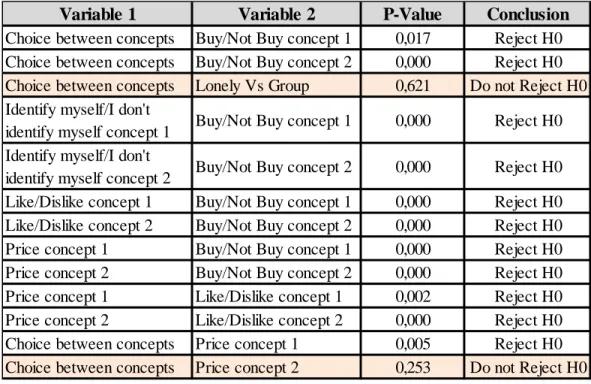
The following stage of the analysis was based on inductive analysis, particularly crosstabs or contingency tables, where the Chi-Square Test was performed. In this kind of test, the null hypothesis, Ho, is defined as the assumption that there is no association/interaction between variables. Every test was performed for the two concepts separately. The majority of the tests concluded the rejection of the null hypothesis, which means that in general the existence of association/interaction between variables should be considered.
27 The table above summarizes the results. The first two tests included the preferred choice between the concepts and the question about the buying intention. For both concepts, the p-value is small, so the null hypothesis should be rejected. In practical terms, this means that the choice between the concepts is associated with its buying intention; people who prefer concept 1 are more likely to buy a bottle of wine with the concept 1 and not so willing to buy a bottle of wine with concept 2; the same for concept 2. There were only two tests where the null hypothesis should not be rejected. One in particular is very interesting since the result changes according to the concepts. When the test was performed between the variables: choice between concepts (which of the concepts was the preferred) and the price that respondents were willing to pay for a bottle of wine with concept 1, the p-value was 0,005, which is very small, leading to reject the null hypothesis. This result means that the two variables are not independent, so there is a level of association between them; respondents who prefer concept 1 are willing to pay more for concept 1 than the ones who
Variable 1 Variable 2 P-Value Conclusion
Choice between concepts Buy/Not Buy concept 1 0,017 Reject H0 Choice between concepts Buy/Not Buy concept 2 0,000 Reject H0 Choice between concepts Lonely Vs Group 0,621 Do not Reject H0 Identify myself/I don't
identify myself concept 1 Buy/Not Buy concept 1 0,000 Reject H0 Identify myself/I don't
identify myself concept 2 Buy/Not Buy concept 2 0,000 Reject H0 Like/Dislike concept 1 Buy/Not Buy concept 1 0,000 Reject H0 Like/Dislike concept 2 Buy/Not Buy concept 2 0,000 Reject H0 Price concept 1 Buy/Not Buy concept 1 0,000 Reject H0 Price concept 2 Buy/Not Buy concept 2 0,000 Reject H0 Price concept 1 Like/Dislike concept 1 0,002 Reject H0 Price concept 2 Like/Dislike concept 2 0,000 Reject H0 Choice between concepts Price concept 1 0,005 Reject H0 Choice between concepts Price concept 2 0,253 Do not Reject H0
28 prefer concept 2 are willing to pay for a bottle of wine of concept 1. However, when the same test was performed for the second concept (choice between concepts and the price that respondents were willing to pay for a bottle of wine with concept 2), the p-value was higher (0,253), leading to the non rejection of the null hypothesis, which means that the non independence cannot be proven. In practical terms, this means that respondents who prefer concept 2 are also willing to try a bottle of concept 1; when they face concept 2, they prefer it but they do not discard the chance to experience concept 1.
To conclude this section, several insights can be highlighted:
Concept 2 is the preferred;
Respondents are more likely to buy concept 2 instead of concept 1; Respondents identify themselves more with concept 2;
The percentage of respondents who dislike is higher for concept 1;
The amount of money that respondents are willing to pay is more or less the same for both concepts, being the 2€-3.99€ the class with higher percentage; followed by <2€ class in case of the first concept and 4€-5.99€ class for the second (Exhibit 10, in the Appendix);
The most valued thing in the first concept is the friendship, friends and bonding while the least valued is the devaluation of the traditional choice criteria (Exhibit 10, in the Appendix);
The most valued thing in the second concept is the fact that the wine is an easy choice and drinks well, whereas the least valued is the name and slogan (Exhibit 10, in the Appendix).
29
6. Marketing Plan
Based on the concept 2, the following marketing plan aims to propose a strategy for the following 3 years for the brand Mata Ladrões, in order to have a successful entry in the market.
6.1 Positioning
To young wine consumers, from 18 to 30 years old, who have an unconventional attitude towards life and enjoy socializing with their group of friends, Mata Ladrões is a wine that makes the choice easier by not following the conventional selection criteria, of identifying region, grapes variety or enologist.
6.2 Marketing Goals & Objectives
There are several aspects that should be considered in this phase. Mata Ladrões is a new brand that will be launched in a very competitive market. As it has already been said, the market share achieved by each wine producer is very small and it cannot be said that there is a dominant brand.
The timeline for this project has 5 important timing phases: 3 months, 6 months, 12 months, 2 years and 3 years. The goals and objectives proposed are within this timeframe.
One of the main goals is related to awareness since Mata Ladrões is a new and unknown brand, it is necessary to create awareness and then increase it over time. For the first three months the goal is that 10% of the target population has heard about the brand. The target population was measured with a value of 1.494,5 thousands of people according Passport
30 database in 2014. For the first 6 months, 12 months, 2 years and 3 years the goal is to achieve 12,5%, 15%, 20% and 25% of awareness respectively.
Another important goal is to promote tasting. In the wine industry the first barrier to overcome is convince customers to try something new. The intention for the first three years is to achieve at least 12,5% of trial within the people aware.
In addition, Mata Ladrões intends to retain as many customers as possible. Retention is imperative in every competitive economic environment, so Mata Ladrões aims to achieve 6,5% of retention during the first 3 years.
Through all the goals above, it can be predicted that Mata Ladrões attains a total consumption (consumption from trial plus consumption from retention) of 445.547,8 liters during the first year, corresponding to 594.063,8 bottles of 0.75l each. The table with all calculations and values can be seen in Exhibit 11, in the Appendix.
In Exhibit 12, in the Appendix, it can be seen the Net Profit for the first 3 years of the project, as well as the payback period for the initial investment. According to the goals previously established, the brand Mata Ladrões will achieve a Net Profit of 707.972,6€ in the end of the first year. This amount will require a initial investment of 968.165,15€, which equates a payback period of 1 year and 14 days approximately.
6.3 Product Strategy
One of the main problems of the target population lies in the choosing process of wine. There is a huge wine offer available on the market which combined with the lack of knowledge about the traditional choice attributes (region, grapes, enologist…), makes the
31 choosing process increasingly difficult, when people just want to insure that they are making the right choice and has a good moment with friends enjoying a good wine. Mata Ladrões is focused on this problem, by helping customers choosing wine. Basically, they don’t need to be experts about wine; Mata Ladrões is helping them in the choosing process.
Mata Ladrões will be available in still red and white wine, since these are the two types most consumed in the Portuguese market. The brand is not focused on producing wine, but on choosing a good wine, that is easy1 and balanced2, easy to drink and with no complex or aggressive aromas and flavors. These conditions will allow having a pleasant wine, easy to drink for younger consumers.
The bottle and the label will be different than those traditional used by wine producers, showing the irreverence of the concept. The bottle will have the shape as the image below with 750ml of capacity. The label needs to be also different than usual, and very attractive.
Figure 1: Shape of the desirable bottle for Mata Ladrões. Source: Vetromarin
1
A simple and straightfoward wine, without complexity and enjoyable to drink. 2
A wine that incorporates its main components (tannins, acidity, sweetness…) in a way that no one single component stands out.
32 During the exploratory groups’ dynamics, individuals said that the label is very important to catch their attention and influencing their choice, so the label of Mata Ladrões’ bottles should show irreverence and innovation by being different from those available in the market.
6.4 Placing Strategy
The placing strategy will be divided into off-trade and on-trade channels. This will guarantee the presence of Mata Ladrões in strategic places where younger consumers are.
In relation to the off-trade channel, Mata Ladrões should be present in hypermarkets and supermarkets (the preferred location of purchase of Portuguese consumers), such as Continente, Pingo Doce, Intermarché and Lidl. These chains are spread around Portugal, there are 380 Pingo Doce’s stores3, 218 of Continente’s4, 228 of Intermarché’s5 and 235 of Lidl’s6
, which makes possible the approximation to the target, by covering the entire national territory.
Concerning the on-trade channel, this will be divided into direct and indirect. In order to increase capillarity, Mata Ladrões should be present in the two wholesalers Makro and Recheio (indirect on-trade channel). This will allow the possibility of retailers, the ones not covered by the sales’ team, buying Mata Ladrões. Adding to those, Garcias SA, which is a leading company focused and specialized in the sale of wines, spirits and also food, is a good partnership because it is a national storer, acting like a distributor with a strong sales’ 3 www.pingodoce.pt 4 www.continente.pt 5 www.lojj.pt/intermarche 6 www.lojj.pt/lidl
33 team that promote its products near the retailers. In relation to the direct on-trade, Mata Ladrões should be in strategic restaurants, which the target chooses to dinner or just to have a drink with friends. Three factors should be taken into account in the choice of the restaurants:
Cities with universities, since the students belong to the target market and they usually have group dinners and they like to be in groups and have good times with their friends;
Trendy restaurants, which can also fit with the “irreverence” of Mata Ladrões’ concept;
Restaurants with group menus or usually chosen to do academic dinners, basically restaurants that can gather a large amount of people.
The contact with all the distribution channels will be made directly through a sales’ team of Mata Ladrões, without intermediaries.
Another important issue, concerning location distribution, is the price allocation for each of the channels. The price charged needs to meet the expectations of each channel: the company cannot sell more expensive to restaurants or to wholesalers than to supermarkets, because in this way both would buy in supermarkets. Thus, to maximize the profit of clients and to manage possible conflicts between them, each channel has its own price as it can be seen in Exhibit 12, in the Appendix. The table also includes the percentage of each channel in the brand’s sales.
34 6.5 Price Strategy
Based on the qualitative and quantitative research made, and also on some competitors of Mata Ladrões, the most suitable selling price, to be on the off-trade channel, for a bottle of Mata Ladrões is 4.99€. There is a strong competition in the wine sector; however the company should not set a price too low because very cheap wines are perceived with lower quality. It will be premium inside the category.
Concerning the on-trade channel the company want to reach the customers with a price between 9€ and 10€. Once again, the price should be premium inside the category but at the same time affordable for young consumers.
6.6 Promotion Strategy
The promotion strategy will play a key role in the whole strategy. Due to the irreverence of the concept of Mata Ladrões, the promotion strategy needs to be in the same line by being different of what traditionally is made in the wine sector and motivating for retailers and distribution channels to sell.
The digital media are very present in the target’s life, so it will be one of the main focuses of Mata Ladrões promotion. Mata Ladrões should be on the social networks Facebook and Instagram. Both of them will allow the interaction with consumers, the promotion of the wine, the announcement of promotions and the share of photos; it will promote and increase the virality of the brand. To complement the social networks, Mata Ladrões should have also a website with a blog linked. One of the first things that younger consumers do, when they heard about something new, is “google it”, search information about that product
35 on the internet, so the brand needs to assure that presence. With these tools the brand aims to enable the access to information and the opportunity to interact and develop relationships with clients, to give credibility, to advertise the brand, to increase sales and promote loyalty.
Nowadays, brands such as Super Bock, Coca-Cola, and JB have been launching YouTube videos, with stories that create a real connection with their customers. They create real stories, about real problems or real issues (friendship, love, sharing…), which help people in identifying themselves with the brand. With this action, brands go viral, and increase the word-of-mouth around them and their products. That is the idea also for Mata Ladrões, the brand should launch promotional videos on YouTube, which can easily become viral. Factors such as surprise, the unusual, humor and friendship should be present.
Another part of the promotion strategy is the Mata Ladrões App. According to recent data published by Jornal Económico, Portuguese consumers are buying more and more smartphones; in 2014 they bought more than 2.7 million of smartphones, which represents an increase of 24% over the previous year. Adding to that, it is known from the same source, that the class with a higher penetration rate is the one that includes individuals from 15 to 24 years old, which corresponds to a part of the target involved. The mobile application should be a complement to the moments shared with Mata Ladrões; it should include group games, to promote friendship and funny moments within the group; it should also have information about the wine and the brand and provide possible promotional announcements. The application should be available for both Android and IOS systems.
36 With this app, Mata Ladrões can be closer to its customers, and improve their moments when they are together with their friends.
Finally, the last proposal for the promotion strategy is the creation of posters to promote the wine at strategic sales points. For example, in the wine section of the Continente store in the Colombo Shopping Center (one of the biggest stores of the country), Mata Ladrões should have a special exhibitor to attract customers and to encourage purchase. This should be multiplied in other important point of sales. But in order to have the permission to do that, the company should offer a discount to encourage the purchase by the supermarket (5% of discount) or to buy a mupi in the entrance.
Along the same lines, to encourage sellers from Garcias SA, the company should provide a monetary incentive for each box (6 bottles) of wine sold.
6.7 Implementation and Control
For the implementation of the marketing plan, a team is needed to develop and execute all the tasks required. As mentioned above, Mata Ladrões should have a sales’ team, with 3 individuals, to contact all the points of sales where the brand should and want to be; it can be argued that it is a small team, however, the brand will be part of a company that also has a sales’ team that should be requested whenever it is needed. There should be one person responsible for the accounting and financial issues of the company. It is needed also one person to update the social networks, the website and the blog and to be in charge of marketing activities and initiatives.
37 To control the activities, to understand the success of the marketing plan, it should be used some tools that will allow to see how Mata Ladrões is perceived by customers. With the Facebook page, previously proposed, several measures can be used:
Number of new “likes” in the page and its total amount
The interaction with customers: number of likes, comments, shares and visualizations of each post
On Instagram, other measures can be used such the number of followers, the number of hashtags and the comments in the photos.
For the website, it would be interesting to see the number of references made in other websites and blogs for Mata Ladrões website; in this way, it is possible to evaluate the awareness and the virality of the brand. In relation to the mobile application, the number of downloads of the application can be a good measure its success among customers.
Google Analytics can also be a great help in evaluating the success of the online platforms by measuring what people click on the most, from where visitors are, which online campaigns “catch” more traffic, the sales volume and others. This tool is very efficient because it can gather on one single platform information from many sources – Facebook, Instagram, the website, and the mobile application.
The features from the Facebook Business page and Google Analytics are valuable tools not only for control but also for possible improvements since both provide reports and insights allowing the improvement of future actions. Another benefit is the fact that both are costless.
38 6.8 Contingency Plan
As with any business, Mata Ladrões is not different in terms of possible risks that it can face. If the company is able to predict some risks with a proper action plan, in case they happen, its impact might be smaller and the losses lower. The speed with which the company acts is critical to minimize the losses.
Two possible risks were identified: a natural disaster that destroys the vineyards used by Mata Ladrões to produce the wine and the rejection or non entry of the wine in the off-trade channel.
Concerning the first, it is very common that heavy rains or severe weather can damage or even destroy the vineyards of that place. In the case of that happening, the company should have options to buy from another wine producer. Other fact that should take into consideration is that, the wine should be consistent, so the grapes used should be the same as the old producer to guarantee that consistency.
In relation to the second risk, the rejection or the non-entry of Mata Ladrões in the off-trade channel; it is a situation that can happen due to bureaucracy or simply because of the non-acceptance of the wine. This will mean a reduction in the expected profits, and there is no way to revert it. The only thing that the company can do is to be more “aggressive” on the on-trade channel, that is, increase the sales’ team to sell the wine in more restaurants for example. It is possible also to do some deals and discounts to increase and promote sales.
39
7. Conclusion
The purpose of this work was to study the hypothesis of a wine with an unconventional concept, based on the strengthening of relations and the easiness of its choice, instead of the region-of-origin, grape variety and the enologist as traditionally is made.
During the exploratory groups, the price and “have heard about it” were referred as key during the choosing process of the wine; individuals feel risk during that process due to the lack of knowledge of traditional choice criteria. Although they don’t like to be called “irreverent”, they like the irreverence of the concept and adding the fact that the label and the bottle should be in the same line of the concept.
After the research, it can be concluded that the concept is accepted by the target, however is polarized, the ones who like it, like it a lot and the ones who don’t like it, don’t like it at all. Even so, there is space in the market for Mata Ladrões, since there is no other wine directed for younger consumers and breaking with the traditional business model.
The marketing strategy for Mata Ladrões was focused on the internet, specifically social networks, since they are very present in consumers’ life. In this way, the virality of the brand will increase and consequently its word-of-mouth, a very important aspect also referred during the exploratory groups dynamics.
The importance of this work lies on the confirmation that there is space, acceptance and financial viability for an innovative product that has been living a traditional path since the beginning of its production. Mata Ladrões comes to break with tradition, with the conventional methods of selling wine.
40 7.1 Weaknesses and Limitations
The sample of 127 respondents, in the quantitative research, can be small and limited to represent the whole target;
The lack of numerical variables did not allow a deeper statistical analysis such as the correlation analysis and ANOVA tests between variables.
7.2 Areas for Further Research
Concerning Portuguese consumers, there is little information about the consumption of wine, so it would be interesting to see more research about the purchasing and choosing processes or the motivations behind the wine choice as an example;
Research with demographic variables such as income, sex or age, to understand if they are related with the choice of the concept;
This study can be applied to other products, such as other alcoholic or non alcoholic beverages.
41
References
Papers from Journals in research databases
Barber, N., Dodd, T. & Ghiselli, R., 2008. Capturing the Younger Wine Consumer. Journal of Wine Research, 19(2), pp.123–141.
Brunner, T.A. & Siegrist, M. 2011. A consumer-oriented segmentation study in the Swiss wine market. British Food Journal, 113(3): 353-373.
Bruwer J., Saliba A. & Miller B. 2011. Consumer behavior and sensory preference differences: implications for wine product marketing. Journal of Consumer Marketing, 28(1): 5–18. .
Carvalho, J.M. & Magalhaes Serra, E., 2010. How do Portuguese consumers select wine? Determinants of their buying decisions and consumption behaviours. International Journal, (2), pp.1–8.
Chrea, C., Melo, L., Evans, G., Forde, C., Delahunty, C., Cox, D.N., 2010. An investigation using three approaches to understand the influence of extrinsic product cues on consumer behavior: an example of Australian wines. Journal of Sensory Studies.
Dlacic, J. and Kadic-Maglajilic, S. (2013). The Role of Gender and Situational Factors in Wine Consumption of Generation Y. South East European of Economics and Business, pp.48-56.
42 Domingues Martinho, V.J.P., 2013. Consumers behavior of Portuguese wine. Journal of
Economics and Engineering, 4(1), pp.20–25.
Duarte, F., Madeira, J. & Barreira, M.M., 2010. Compra e consumo de vinho em Portugal - uma análise exploratória das motivações/atitudes e atributos de compra dos jovens adultos. Ciência e Técnica Vitivinícola, 25(2), pp.63–73.
Duarte, F., Madeira, J. & Barreira, M.M., 2010. Wine purchase and consumption in portugal - An exploratory analysis of young adults’ motives/attitudes and purchase attributes. Ciencia e Tecnica Vitivinicola, 25(2), pp.63–73.
Dubow, J.S. 1992. Occasion-based vs. user-based benefit segmentation: a case study. Journal of Advertising Research, 32(2): 11-18.
Euromonitor, 2014. Alcoholic Drinks in Portugal. , (August), pp.1–38.
Euromonitor International, 2011. Consumer Lifestyles – Croatia. London: Euromonitor International.
Gomes, G.C., 2012. Segmentação dos compradores de vinho : uma aplicação Segmentação dos compradores de vinho : uma aplicação.
Guerra, N., 2005. Análise Do Processo De Decisão De Compra Do. , (C).
43 Inglehart, R. 1997. Modernization and Postmodernization: Cultural, Economic, and
Political Change in 43 Societies. Princeton, NJ: Princeton University Press.
Kadic-Maglajlic, S. and Dlacic, J. (2011). Generation Y Wine Consumption Motivators - Do They Differ Across Situations and Gender?. University of Sarajevo, pp.806-821.
Keown, C., Casey, M., 1995. Purchasing behavior in the Northern Ireland wine market. British Food Journal 97 (1), 17–20.
Madeira, J., Duarte, F. & Barreira, M.M., 2008. Wine purchase and consumption behaviour of young adults in Portugal : Is age a differentiation factor ? , pp.0–4.
Olsen, J.E., Thach, E.C., Nowak, L., 2007. Wine for my generation: exploring how US wine consumers are socialised to wine. Journal of Wine Research 18 (1), 1–18.
Peskett, S. 2006, Under-30s are the big spenders in UK market, Harpers
Radman, M.,Kovacˇicˇ, D.,Gaˇsparec-Skocˇic´ , L.,2004.Wine perception and consumption among young adults in Croatia.In: Proceedings of the 28th World Congress of Vine and Wine,4–9 July.
Sanches, C.M.P., 2013. Comportamentos de Consumo de Vinho : Envolvimento , Estilos de Vida , Risco e Atributos.
44 Thach, E. & Olsen, J. 2004. The search for new wine consumers: marketing focus on consumer lifestyle or lifecycle?, International Journal of Wine Marketing, 16(3): 44-57.
Vrontis, D. and Papasolomou, I. 2007. Brand and product building: the case of the Cyprus wine industry. Journal of Product & Brand Management, 16(3): 159-167.
Wine Intelligence 2010. Generation wine: Getting to the heart of Millennial wine drinker around the world, paper presented at the London International Wine Fair LIWF, London, 18 May.
Websites used
Infovini.com, (2015). Infovini | O portal do vinho português. http://www.infovini.com/#tab2
Jornaldenegocios.pt, (2015). Portugal é o sétimo país onde cada pessoa bebe mais vinho. http://www.jornaldenegocios.pt/empresas/agricultura_e_pescas/vinho/detalhe/portugal _e_o_setimo_pais_onde_cada_pessoa_bebe_mais_vinho.html
PÚBLICO, (2013). Recessão e taxa de alcoolemia reduzem consumo de vinho em Portugal. http://www.publico.pt/sociedade/noticia/recessao-e-taxa-de-alcoolemia-reduzem-consumo-de-vinho-em-portugal-1590273.
Revistadevinhos.pt, (2015). Portugal e o mundo: os números do vinho e da vinha. http://www.revistadevinhos.pt/artigos/show.aspx?seccao=reportagens&artigo=15459& title=portugal-e-o-mundo-os-numeros-do-vinho-e-da-vinha&idioma=pt.
45
Revistadevinhos.pt, (2015). Revista de Vinhos.
http://www.revistadevinhos.pt/pesquisa/?t=vinhos%20portugueses.
Revistadevinhos.pt, (2015). Rótulos, a imagem do vinho.
http://www.revistadevinhos.pt/artigos/show.aspx?seccao=segredos-do-vinho&artigo=10590&title=rotulos-a-imagem-do-vinho&idioma=pt.
Viniportugal.pt, (2015). O Sector do Vinho. http://www.viniportugal.pt/OSector.
Wineinstitute.org, (2015). Statistics - The Wine Institute.
http://www.wineinstitute.org/resources/statistics.
Winesofportugal.info, (2015). Wines of Portugal | A world of difference | Produção. http://www.winesofportugal.info/pagina.php?codNode=118748.
46
Appendix
Exhibit 1 – Portugal wine market volume: million liters, 2009-13 and Portugal wine market value: $ million and € million, 2009-13, respectively.
Year Million Liters % Growth
2009 437,9 2010 436,8 -0,3% 2011 438,9 0,5% 2012 437,0 -0,4% 2013 435,7 -0,3% -0,1% Source: MarketLine CAGR: 2009-13 Market Volume
Year $ million € million % Growth
2009 5.531,9 4.167,3 2010 5.514,3 4.154,0 -0,3% 2011 5.508,6 4.149,8 -0,1% 2012 5.503,7 4.146,1 -0,1% 2013 5.495,8 4.140,1 -0,1% -0,2% Source: MarketLine CAGR: 2009-13 Market Value