Vol.57, n.3: pp. 427-433, May-June 2014 http://dx.doi.org/10.1590/S1516-89132014005000011
ISSN 1516-8913 Printed in Brazil
BRAZILIAN ARCHIVES OF BIOLOGY AND TECHNOLOGY
A N I N T E R N A T I O N A L J O U R N A L
Effect of Biologically Treated Petroleum Sludge on Seed
Germination and Seedling Growth of Vigna unguiculata (L.)
Walp. (Fabaceae)
Jeyabalan Sangeetha
1*and Devarajan Thangadurai
21Department of Environmental Sciences; Bishop Heber College; Trichy - Tamil Nadu - India. 2Department of
Botany; Karnatak University; Dharwad - Karnataka - India
ABSTRACT
The present investigation was carried out to study the response of different concentrations of treated petroleum sludge on seed germination, root and shoot length and tolerance of Vigna unguiculata (L.) Walp. The biologically treated petroleum sludge with bacterial consortium showed 54.8% reduction in total petroleum hydrocarbons. Treated sludge was utilized with agricultural soil in known concentration for the assessment of growth of V.
unguiculata. A remarkable absence of seed germination was observed at higher sludge concentration. The different concentrations of treated petroleum sludge showed severe decline on the length, weight and vigour index of the tested seedlings with increasing sludge concentrations. The results showed that the difference in rate of seed germination was significant among various concentrations. Under environmental stress condition, germination is the most critical phase of life cycle in crop plants. In this present study, the high oil content found to alter the osmotic relation between seed and water and thus reduce the amount of water absorbed. It was concluded that the concentration of nutrients and oil present in the treated sludge were toxic to the plant.
Key words: bacterial consortium, biodegradation, petroleum sludge, seed germination, total petroleum hydrocarbon,
Vigna unguiculata
*Author for correspondence:[email protected]
INTRODUCTION
Petroleum refineries are most desirable for any national development and improved quality of life. However the waste generated by these, cause unwholesome and environmentally unacceptable pollution effects (Ojumu et al. 2005). Most activities associated with the production of petroleum related products can introduce a serious environmental problem in the form of water, air, noise, thermal, solid and land pollution (Mall 2007). The development of petroleum industries into new frontier areas, the apparent inevitable spillage that usually occurs during routine operations and records of acute accidents during
accumulation of pollutants in the tissues of animals and plants may cause progeny death or mutation (Bahl and Bahl 2004). Many of the low
molecular weight hydrocarbons exhibit
phytotoxicity. Toxic responses to benzene, toluene, ethylbenzene and xylene (BTEX) have been reported for field crops (de Oliviera et al. 2012) and woody species (Burken et al. 2001). Petroleum refineries are generating large quantities of oily and viscous residues, which are formed during the production, transportation and refining. These residues, called petroleum sludge, are composed of oil, water and solids with specific characteristics such as varied composition, which make them highly recalcitrant and difficult to reutilize. Incineration of this sludge is not recommended due to the high energy costs involved, the potential risk of air pollution and the persistence of PAHs. Similarly, the inadequate disposal of such toxic residue in landfills encourages the search for alternatives (Englert et al. 1993). In general, remediation of polluted systems could be achieved by physical, chemical and biological methods. However, the negative consequences of the physicochemical methods make the biological alternatives as more attractive method of bioremediation.
One of the major challenges faced by the petroleum refineries is the safe disposal of oily sludge generated during equipment cleaning (sludge from the storage tank cleaning) and wastewater treatment (sludge from primary and secondary treatment). Improper disposal of petroleum sludge leads to environmental pollution, particularly soil contamination and poses a serious threat to groundwater quality (Deka 2001; Atlas and Philp 2005). The present study aimed to study the impact of biodegraded petroleum sludge on the seed germination and seedling growth of field crops with reference to Vigna unguiculata as a
common grain.
MATERIALS AND METHODS
Biodegradation of oily sludge
Sludge samples were collected from the sludge storage tank and characterized for the contents of sediments, water and oil using standard methods (Anonymous 1998). A wide array of bacterial population from the petroleum polluted soil collected near the sludge storage pit was isolated and identified (Breed et al. 1957; Hamme et al.
2003). Among the identified bacterial species, five were selected for bioremediation process based on their growth in crude oil mixed growth medium. Selected bacterial species were inoculated separately in mineral salt medium containing 2% of crude oil and incubated at 37°C for 48 h. After incubation, the bacterial consortium was prepared by adding 200 mL of each medium containing selected bacterial growth. The prepared bacterial consortium was then added into the oily sludge for bioremediation process. Nutrients such as magnesium sulphate (0.04 g), calcium chloride (0.004 g), monopotassium phosphate (0.2 g), diammonium hydrogen phosphate (0.2 g), potassium nitrate (0.2 g) and ferric chloride (0.01 g) were mixed in 200 mL of distilled water and were added to the treatment plot once in two days and this process was continued for the period of three months (Bushnell and Hass 1941; Marti et al. 2009).
Seed germination and seedling growth of Vigna
unguiculata (L.) Walp
Experiments were conducted to investigate the
influence of different concentrations of
biologically treated petroleum sludge on seed
germination and seedling growth of V.
unguiculata. Seed viability was determined using
triphenyl tetrazolium chloride (TTC). Two hundred seeds were soaked in distilled water for overnight, excised to expose the embryos, placed in a Petri dish, soaked in 0.1% TTC solution, covered the Petri dish with aluminum foil and kept at 25±1°C for 24h. Following the treatment, seeds were washed thoroughly with distilled water to remove the excess stain and examined under the microscope (Nag et al. 1981; Vujanovic et al. 2000; Kambizia et al. 2006; Sumathi et al. 2008). There were six treatments in the experiment such as control, 10, 25, 50, 75 and 100% treated sludge concentrations and they were replicated three times. Ten seeds of V. unguiculata were sown in
each pot at 1.0 cm depth and watered daily. The treated seeds were allowed to germinate and germination percentage was calculated on the 30th
day of seedling (Pourhadian and Khajehpour 2010). Seed germination was observed by
providing optimum conditions for each
experimental set. Germination in each
deviation was determined to evaluate the significance of the data (Chauhan and Kumar 1997; Mall 2007; Hatun et al. 2009; Dash 2012).
RESULTS AND DISCUSSION
Based on the biodegradation efficacy, five bacterial species were selected for the bioremediation treatment and nutrients were added. The identified bacterial species were
Bacillus macerans, Enterobacter cloacae, Proteus mirabilis, Pseudomonas aeruginosa and Staphylococcus aureus. In order to find out which
bacteria were active during the degradation phase, Popp et al. (2007) studied the diversity of the active microflora in a degrading soil remediation system and identified the dominant genera as
Pseudomonas, Acinetobacter, Sphingomonas, Acidovorax and Thiobacillus. In his study, the
occurrence of Zymomonas and Rhodoferax was
novel in mineral oil hydrocarbon contaminated soil. Giles et al. (2001) isolated and identified twenty indigenous bacteria from the sludge and found that all were mesophiles and grew with or without 3.6% sodium chloride. The physico-chemical characteristics of oily sludge is given in Table 1.
Table 1 - Physico-chemical characteristics of before
and after treatment of oily sludge.
Constituents Before
treatment
After treatment
pH 8.60 6.90
Oil (%) 45.10 20.40
Water (%) 2.30 7.10
Sediment (%) 52.60 72.50
Sulphide (mg/kg) 985 865
Zn (mg/kg) 1032 881
Hg (mg/kg) 1.72 BDL
Ni (mg/kg) 127 108
Cd (mg/kg) BDL* BDL*
Pb (mg/kg) 55.06 42.01
Total Cr (mg/kg) 158 107
Cu (mg/kg) 282 276
Mn (mg/kg) 188 109
*BDL – Below detectable limit
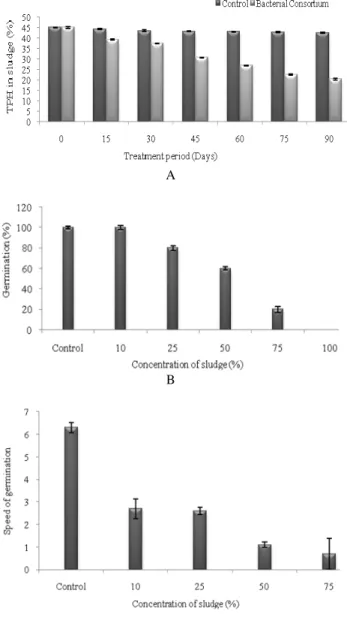
The sludge selected for this bioremediation process was black in color due to heavy oil. The concentration of solvent extractable total petroleum hydrocarbon (TPH) in untreated sludge was 45.1%. After bacterial treatment for 90 days, the TPH content was reduced to 20.4%, with the
percentage removal of 54.8 whereas the percentage reduction in the control was 5.5 (Fig. 1A). It has been reported earlier that the addition of bacterial consortium and nutrients resulted in the reduction of TPH as low as 48.5% (Mishra et al. 2001).
In the viability test, viable embryos are stained pink due to the reduction of 2,3,5-TTC by reparative activity in the cell, since hydrogenase enzyme releases hydrogen, which reduces 2,3,5-TTC (colourless) to triphenyl formazan (red) in the living cells of the seeds. Results showed that high concentration of petroleum sludge delayed the speed of germination of V. unguiculata seeds,
which could be due to the toxic effect of the sludge on the plants. In general, sludge was having minimal water holding capacity due to high oil content that would disturb osmotic relation between the seed and water and thus reduced the amount of water absorbed. These results were comparable with the findings of Korade and Fulekar (2009) who observed no germination in the field of loamy soil contaminated with high amount of hydrocarbons. Figure 1B showed 100% germination of V. unguiculata seedlings in the
control and 10% sludge concentration. Statistical observation of seed germination showed a direct proportion between the sludge concentration and inhibition of germination. High concentration of sludge also reduced the speed of the germination. Minimum concentration (10%) of sludge produced less stress on the speed of germination and the highest concentration (75 and 100%) drastically brought down the speed of germination to 0.7. Figure 1C shows the triplicate determination expressed on percentage of germination of V. unguiculata. The germination, growth
performance and the establishment of healthy young seedlings were affected adversely when the seeds were exposed to a wide range of environmental factors.
in the growth medium reduced the length of shoot and root in the seedlings of Sorghum bicolor and Vigna radiata, respectively and the reduction was
attributed to the absorption of more ions such as Cl- by the roots from the surroundings. High concentration of oil reduced the absorption of moisture in endosperm and embryonic axis and delayed the translocation of carbohydrates to embryonic axis, which resulted in the reduced seedling growth as observed earlier (Rahbar et al. 2012). Isoufi et al. (2006) showed a gradual reduction of the seedling height with increase in the petroleum hydrocarbon concentration. The reduction in seedling height could be due to high TDS, COD and presence of heavy metals in the waste. The heavy metals of most concern are Cu, Pb, Zn, Cd and Cr; if these are present in large amounts in the source, they act potentially toxic to the plants. Low concentration of pollutants in the effluent showed seedling growth whereas higher concentrations inhibited the growth. It has been evident from the earlier study that the refinery waste has adverse effect on the growth of the Lens esculanta at higher concentrations (Sumathi et al.
2008).
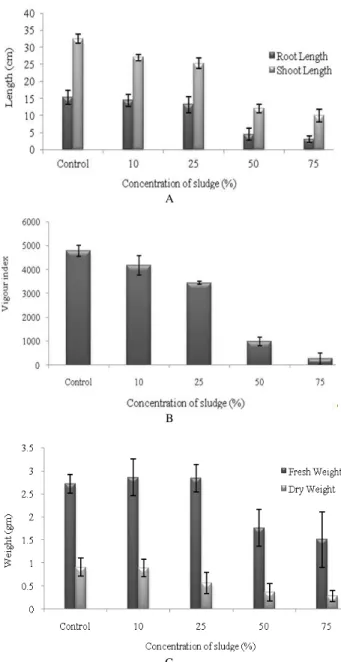
Sludge concentration of 10, 25, 50 and 75% reduced the vigour index to 4170, 3440, 990 and 260 respectively (Fig. 2B). The normal fresh weight of 30 days old seedling was 2.74 g. It was interesting to note that 10% concentration of sludge promoted the growth as control but growth reduction was observed from 25% onwards. The dry weight in the control and 10% concentration pot were 0.807 and 0.568, respectively. Figure 2C shows the triplicate determination of fresh weight and dry weight of V. unguiculata. Similar to fresh
weight, dry weight was also significantly reduced. With the increase in the concentration of sludge, decrease in fresh weight and dry matter accumulation were observed. The results were comparable with Sumathi et al. (2008) who reported better growth of plant in lower concentration of industrial effluent. The high concentration of petroleum sludge delayed the germination of V. unguiculata that could be
attributed to the toxic effect of the sludge on the plants and mainly to the altered photosynthesis.
A
B
C
Figure 1 - Treatment of petroleum sludge and its
effect on the growth of Vigna unguiculata (vertical bars indicate
A
B
C
Figure 2 - Effect of treated petroleum sludge on
seedling growth of Vigna unguiculata
(vertical bars indicate standard deviation). (A) Impact of treated sludge on root and shoot length; (B) Impact of treated sludge on vigour index; (C) Impact of treated sludge on fresh and dry weight.
In the present study, as the seeds were grown in the pots and field treated with various concentrations of refinery waste, the plants showed positive effect on vegetative growth at lower concentration of the added refinery waste, whereas higher concentration showed gradual decrease in vegetative growth. The results were comparable with the earlier findings of Nag et al.
(1981) and Upadhyaya et al. (2008). Nutrients such as nitrogen, potassium, calcium and magnesium present in the sludge at lower concentrations increase the growth of the plants. However, at higher concentration of the sludge, there was increased concentration of the nutrients, which probably became toxic, resulting in the inhibition of root and shoot growth. Salinity stress in the form of nutrients affects seed germination either through osmotic effects, by preventing or delaying the germination (Bybord and Tabatabaei 2009), or through ion toxicity, which can render the seeds unviable (Alatar 2011). NaCl has direct harmful effects on common bean seed germination (Phaseolus vulgaris L). Cokkizgin (2012) noted
that the germination of common bean was sensitive to high-level salt osmotic potentials. The petroleum sludge was having minimal water holding capacity and plant growth rate was minimum in 75% of sludge with 25% agricultural land soil. The pollutants could inhibit some beneficial microbial communities that were essential for biogeochemical cycles of that ecosystem as reported by Okerentugba and Ezeronye (2003). Marti et al. (2009) reported that the seedling emergencefrom the soils treated with 20% refinery sludge did not differ much from those in the unamended control. Shanmugavel (1993) studied the impact of sewage, paper and dye industry effluents on the germination of green gram and maize seeds.
CONCLUSION
In conclusion, it was found that the performance of plant growth in terms of shoot length, root length, fresh weight and dry weight were adversely affected by the high concentration of sludge. The reduction was directly proportional to the sludge concentrations. Since, the germination is the most critical phase of life cycle in crop plants under environmental stress, high oil content would disturb the osmotic relation between the seed and water, and thus, reduce the amount of water absorbed. The residue may require stabilization prior to disposal, also wherever possible generation of sludge should be minimized. Although bioremediation is an eco-friendly and relatively cost-effective alternative to conventional
physicochemical treatment techniques,
disposal of treated sludge into the agricultural land as they show toxic effects on the growth of the crop plants.
ACKNOWLEDGEMENTS
Financial support from the Directorate of Collegiate Education, Government of Tamil Nadu, India and University Grants Commission, Government of India (F.No.16-106/2006, SA II) is gratefully acknowledged.
REFERENCES
Alatar AA. Effect of temperature and salinity on germination of Achillea fragrantissima and Moringa peregrina from Saudi Arabia. Afr J Biotechnol. 2011;
10(17): 3393-3398.
Anonumous. American Standard for Testing Material. ASTM International, West Conshohocken, USA; 1998.
Ashok BT, Musarrat J. Mechanical, physico-chemical and microbial analysis of oil refinery waste receiving agricultural soil. Indian J Environ Health. 1999;
41(3): 207-216.
Atlas RM, Philp J. Applied microbial solutions for real-world environmental clean-up. ASM Press, Washington, DC; 2005.
Bahl A, Bahl BS. A text book of organic chemistry. S. Chand and Company Ltd., New Delhi; 2004.
Breed RS, Murray EGD, Smith NR. Bergey’s Manual of Determinative Bacteriology. The Williams and Wilkins Co., Baltimore; 1957.
Burken JG, Ross C, Harrison LM, Marsh A, Zetterstrom L, Gibbons JS. Benzene toxicity and removal in laboratory remediation studies. J Hazard Toxic Radioact Waste. 2001; 5(3): 161-171.
Bushnell LD, Hass HF. The utilization of hydrocarbons by microorganisms. J Bacteriol. 1941; 41: 653-673.
Bybord A, Tabatabaei J. Effect of salinity stress on germination and seedling properties in canola cultivars (Brassica napus L.). Not Bot Hort Agrobot Cluj. 2009; 37(1): 71-76.
Chauhan SVS, Kumar S. Effect of tannery effluent on total phenolics and some isozyme profile in Allium cepa roots. J Environ Poll. 1997; 4(2): 85-99.
Cokkizgin A. Salinity stress in common bean (Phaseolus vulgaris L.) seed germination. Not Bot Horti Agrobot Cluj. 2012; 40(1): 177-182.
Dash AK. Impact of domestic waste water on seed germination and physiological parameters of rice and wheat. Int J Res Rev Appl Sci. 2012; 12(2): 280-286.
Deka S. Bacterial strains degrading crude oil from petroleum polluted soil of Assam. Poll Res. 2001;
20(4): 517-521.
de Oliveira PJRG, Vieira LC, Nogueira AV, Corseuil HX, Mezzari MP. Tolerance of tree reforestation species (Schizolobium parahyba, Mimosa scabrella
and Enterolobium contortisiliquum) to gasoline and
diesel phytotoxicity assays. J Bioremed Biodeg. 2012;
S7:004. doi:10.4172/2155-619.S7-004.
Englert CJ, Kenzie EJ, Dragun J. Bioremediation of petroleum products in soil. Princ Prac Pet Contam Soils. API 1993; 40: 111-129.
Giles WR, Kriel KD, Stewart JR. Characterization and bioremediation of a weathered oil sludge. Environ Geosci. 2001; 8(2): 110-122.
Hamme JDV, Singh A, Ward OP. Recent advances in petroleum Microbiology. Microbiol Mol Biol Rev.
2003; 67(4): 503-549.
Hatun AK, Kabir G, Bhuiyan MAH. Effect of harvesting stages on the seed quality of lentil (Lens culinaris L.) during storage. Bangladesh J Agril Res.
2009; 34(4): 565-576.
Issoufi I, Rhykerd RL, Smiciklas KD. Seedling growth of agronomic crops in crude oil contaminated soil. J Agron Crop Sci. 2006; 192(4): 310-317.
Kambizia L, Adebolab PO, Afolayan AJ. Effects of temperature, pre-chilling and light on seed germination of Withania somnifera; a high value
medicinal plant. S Afr J Bot. 2006; 72(1):11-14.
Korade DL, Fulekar MH. Effect of organic contaminants on seed germination of Lolium multiflorum in soil. Biol Med. 2009; 1(1): 28-34.
Lakshminarayan B, Kishore N, Reddy SR. Influence of some industrial effluents on AM colonization. Poll Res. 2006; 25(2): 347-352.
Mall I.D. Petrochemical Process Technology. Sanat Printers, Haryana, India; 2007.
Martí MC, Camejo D, Fernández-García N, Rellán-Álvarez R, Marques S, Sevilla F, Jiménez A. Effect of oil refinery sludges on the growth and antioxidant system of alfalfa plants. J Hazard Mater. 2009; 171:
879-885.
Mishra S, Jyot J, Kuhad RC, Lal B. Evaluation of inoculum addition to stimulate in situ bioremediation
of oily sludge contaminated soil. Appl Environ Microbiol. 2001; 67(4): 1675-1681.
Morales SG, Trejo-Téllez LI, Merino FCG, Caldana C, Espinosa-Victoria D, Cabrera BEH. Growth, photosynthetic activity and potassium and sodium concentration in rice plants under salt stress. Acta Sci Agron. 2012; 34(3): 317-324.
Nag P, Pau AK, Mukherji SK. Heavy metal effects in plant tissues involving chlorophyllase, Hill reaction activity and gel electrophoretic patterns of soluble proteins. Ind J Exp Biol. 1981; 19:702-716.
Okerentuba PA, Ezeronye OU. Petroleum degrading potentials of single and mixed microbial cultures isolated from rivers and refinery effluent in Nigeria.
Afr J Biotechnol. 2003; 2(9): 288-292.
Popp N, Schlömann M, Mau M. Bacterial diversity in the active stage of a bioremediation system for mineral oil hydrocarbon-contaminated soils.
Microbiol. 2006; 152: 3291-3304.
Pourhadian H, Khajehpour MR. Relationship between germination tests and field emergence of wheat.
Asian J Appl Sci. 2010; 3: 160-165.
Rahbar FG, Kiarostami K, Shirdam R. Effects of petroleum hydrocarbons on growth, photosynthetic pigments and carbohydrate levels of sunflower. J Food Agric Environ. 2012; 10(1): 773-776.
Salunke KJ, Karande SM, Apparao BJ. Effect of pulp and paper mill effluent on carbohydrates metabolism during early seedling growth in Mungbean (Vigna radiata (L.) Wilkzek. Poll Res. 2007; 26(1): 67-69.
Shanmugavel P. Impact of sewage, paper and dye industry effluents on germination of greengram and maize seeds. J Ecobiol. 1993; 5(1): 69-71.
Suleiman MK, Bhat NR, Abdal MS, Zaman S, Jacob S, Thomas RR. Germination studies in Rhanterium epapposum Oliv. World App Sci J. 2009; 7(4):
468-471.
Sumathi K, Sundaramoorthy P, Baskaran L, Ganesh KS, Rajasekaran S. Effect of dye industry effluent on seed germination and seedling growth of green gram (Vigna radiata L.) varieties. Eco Env Cons. 2008;
14(4): 543-547.
Upadhyaya S, Shukla S, Bhadauria S. Growth responses of Lens esculenta under petroleum
contaminated soil in field and pot experiments. Nat Env Poll Tech. 2008; 7(3): 403-414.
Vujanovic V, St-Arnaud M, Barabé D, Thibeault G. Viability testing of orchid seed and the promotion of colouration and germination. Annals of Botany 2000;
86(1): 79-86.