ISSN 0103-8478
Rafaeli Aparecida Vieira de SouzaI Francyane Tavares BragaII Tesfahun Alemu SetotawII João Vieira NetoIII Patrícia Helena de AzevedoI Virgínia Helena de AzevedoI Geraldo Magela de
Almeida CançadoII*
Effect of coconut water on growth of olive embryos cultured
in vitro
Efeito da água de coco no crescimento de embriões de oliveira cultivados in vitro
ABSTRACT
The experiment was carried out to determine the appropriate dose of coconut water as supplement for in vitro cultivation of zygotic embryos from 19 olive genotypes. The isolated embryos of the olive seeds were immersed on culture medium containing 0 (control), 25, 50, and 100mL L-1 of fresh
and sterile coconut water and kept for 45 days under controlled environment. The percentage of germination, shoot length, number of roots, number of leaves and number of internodes were measured for all 19 olive genotypes. The ANOVA of the parameters evaluated showed significant genotypes x doses of coconut water interaction for shoot length, number of leaves and number of internodes and the dose of 100mL L-1 produced
the best results overall as indicated by the means of measured parameters. However, the study showed the importance of determining the appropriate dose of coconut water for each genotype under consideration as shown by significant genotype x dose of coconut water interaction effect.
Key words: Olea europaea, culture medium, complex mixture, tissue culture, zygotic embryos.
RESUMO
O experimento foi realizado para determinar a dose adequada de água de coco como suplemento para cultivo in vitro de embriões zigóticos de 19 genótipos de oliveira. Os embriões isolados das sementes de oliveira foram imersos em meio de cultura contendo 0 (controle), 25, 50, e 100mL L-1 de
água de coco fresca e estéril, em condição de ambiente controlado durante 45 dias. A porcentagem de germinação, comprimento da parte aérea, número de raízes, número de folhas e número de internódios foram medidos para todos os
19 genótipos de oliveira. A ANOVA dos parâmetros avaliados apresentou interação significativa entre genótipos e dose de água de coco para o comprimento da parte aérea, número de folhas e número de internódios, e a dose de 100mL L-1, de
forma geral, produziu os melhores resultados, como indicado pelas médias dos parâmetros analisados. No entanto, como mostra a interação significativa observada entre genótipos e tratamentos, é importante determinar a dose adequada de água de coco para cada genótipo.
Palavras-chave: Olea europaea, meio de cultura, mistura complexa, cultura de tecidos, embriões zigóticos.
INTRODUCTION
Olive cultivation beginning in the Mediterranean basin thousands of years ago and since then its cultivation is spreading to other parts of the world including Brazil. The commercial multiplication of olive tree is done predominantly by asexual propagation methods to avoid genetic segregation and long juvenile phase of plants originated by seeds. Therefore, the in vitro propagation in culture medium shall be an alternative method to speed up multiplication or even selection of new olive genotypes. In addition
in vitro cultures of plant embryos are used as an
important research tool for several purposes, such as rescue of rare hybrids; genetic manipulation;
IFaculdade de Agronomia e Medicina Veterinária, Universidade Federal de Mato Grosso (UFMT), Cuiabá, MT, Brasil.
IILaboratório de Biotecnologia Vegetal, Empresa de Pesquisa Agropecuária de Minas Gerais (EPAMIG), 37780-000, Caldas, MG, Brasil.
E-mail: [email protected]. *Autor para correspondência.
IIIEstação Experimental de Ituporanga, Empresa de Pesquisa Agropecuária e Extensão Rural de Santa Catarina (EPAGRI), Ituporanga,
propagation of elite and disease-free germplasm; and physiological, morphological and anatomical studies. One of the most important factors ruling the growth and morphogenesis of plant tissues in vitro is the composition of the culture medium. The basic nutrient requirements of cultured plant cells are very similar to those of whole plants. Therefore, the optimum condition should meet to each species for specific purpose.
Among the most usual compounds used to supplement the culture mediums are the yeast and malt extracts, potato and banana pulps, tomato juicy and coconut water (CALDAS et al., 1998). These compounds are also denominated as complex mixture due to variations in its nutrient composition. The use of coconut water as a supplement to the culture medium started in the 40’s by VAN OVERBEEK, on Datura
stramonium, and CAPLIN & STEWARD with Daucus
carotaas reported by GEORGE (2008). They observed
that the coconut water helps the development of embryos in early stages during in vitro growth (revised by GEORGE, 2008).
The coconut water contains several organic compounds and mineral nutrients important to plant development that plays a significant role as physiological buffer. It is rich in magnesium, phosphate and contains high amounts of sugar around 2.5% (w/ v). Besides that, coconut water has high levels of nitrogen in the form of amino acids and phytohormones in an adequate balance for plant requirements (KRIKORIAN, 1991). These reports indicated the use of coconut water as a component of culture medium might improve the response of olive embryos during its development and growth. In addition the use of coconut water to substitute an expensive organic compound called zeatin that is important during the in
vitro culture of olive cultivars was reported by (PEIXE
et al., 2007). The authors observed that coconut water combined with BAP successfully replaced the zeatin during in vitro culture of olive cultivar ‘Galega vulgar’. Since coconut water has high levels of zeatin in its composition it is frequently used in micropropagation protocols of economically important crops. Thus, coconut water might be used to replace expensive compounds like zeatin and other organic substances required for the growth and development of the seedling in culture medium. NASIB et al. (2008) also proved the advantage of using 20% (v/v) coconut water combined with BAP during the in vitro propagation of Kiwifruit indicated by the best shoot length and number of leaves. The same authors concluded that the use of coconut water help to prolong the sub-culturing time and produced highly robust plants which were more able to survive in greenhouse condition. TREVISAN
et al. (2005) also demonstrated the advantage of coconut water for stem elongation and plant development in passion fruit. VILLA et al. (2010) working with the olive cultivar ‘Ascolano 315’ reported that 25ml L-1 of coconut water associated with 500µg L-1
of BAP generated plantlets with higher shoot length and heavier fresh biomass than in plantlets cultivated without these compounds.
From the above works it can be observed the role of coconut water for in vitro culture. That showed the importance of studying the different doses of coconut water on in vitro culture by including more olive cultivars currently under cultivation in Brazil and the rest of the world. Therefore, the aim of this work was to identify the best doses of coconut water as organic supplement in MS medium during germination and growth of zygotic olive embryos.
MATERIALS AND METHODS
Plant material and embryo cultivation
Ripe fruits of 19 olive genotypes were harvested in the Olive Germplasm Bank of EPAMIG, located in Maria da Fé, MG, Brazil. The olive genotypes used were: ‘Alto D’oro’, ‘Halhali’, ‘Penafiel’, ‘MGSKOR007’, ‘Koroneike’, ‘Tafahi’, ‘CLO113’, ‘Negroa’, ‘Cerignola’, ‘MGSGRAP575’, ‘MGSGRAP541’, ‘MGSGRAP561’, ‘Santa Catalina’, ‘Ascolano USA’, ‘MGSASC315’, ‘MGSSAL488’, ‘Manzanilla’, ‘JB1’, and ‘Mission’. The collected fruits were stored at low temperature and relative humidity until the use as indicated by SOUZA et al. (2011).
After the skin and pulp removal, the seeds were rinsed in water, sterilized with 70% ethanol during 15 min and then let air-dried overnight. The seeds were vernalized at 4oC during 5 days to break the dormancy
and then the embryos were isolated at sterile environment following the methodology described in SOUZA et al. (2011).
Medium preparation and doses of coconut water The basic medium MS (MURASHIGE & SKOOG, 1962) supplemented with 30g L-1 of sucrose
and 6g L-1 of agar was used as standard medium in this
study. The pH of the medium was adjusted to 5.8 before autoclaving.
The coconut water was extracted in sterile chamber from green fruits, filtered using a 0.45µm sterile-mesh and stored at -20oC until use without autoclaving
before solidification. After the addition of coconut in the culture medium, ultra-pure and sterile water was added to keep the volume and the dilution effect constant among the different treatments.
Fifteen homogeneous and healthy embryos of each genotype were chosen and transferred into culture tubes with 10mL of solid culture medium. The tubes were identified and kept under controlled environment with temperature of 25±1C, irradiance of 36mol m-2 s-1 and photoperiod of 16h light and 8h dark.
Parameters evaluated and statistical analysis
The percentage of germination was evaluated in daily basis for the first two weeks. Shoot length, number of roots, number of leaves, and number of internodes were evaluated after 45 days of growth. The experiment was laid using a completely randomized design with five replications per treatment. Each replicate was composed of three culture tubes containing one embryo in each tube. The statistical software “Genes” (CRUZ, 2006) was used to analysis of variance, mean separation test and descriptive statistics analysis. The ANOVA with decomposition the treatment factor was used to understand the performance of each genotype across the treatments (different dose of coconut water).
RESULTS AND DISCUSSION
The study showed no significant difference among doses of coconut water and olive genotypes for embryo germination (data not shown), indicated that the doses of coconut water did not have any effect during the process of germination. The embryo germination was close to 100% to all genotypes and treatments including the control whose composition had no addition of coconut water (data not shown). The lack of difference to percentage of embryo germination for different doses of coconut water reinforces the fact that the nutrient reserve available in the cotyledon and embryo tissues plays a much more important role during the germination process than the nutrient composition of the culture medium at least during the early stages of this event. However, the culture medium was fundamental to maintaining the adequate moisture conditions for embryo development. The germination percentage obtained in this study was by far better than the result reported by ACEBEDO et al. (1997) reflecting the good physiological quality of the seeds used to isolate embryos in this study.
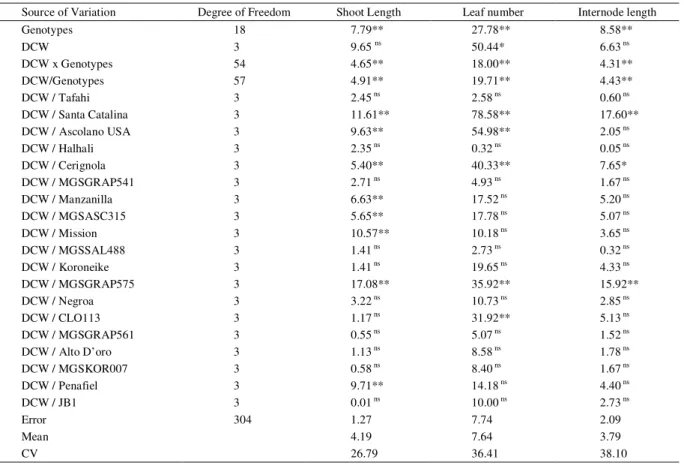
The analysis of variance showed significant difference among genotypes for all of the measured traits (shoot length, number of leaves and number of
internodes) at 5 % probability (Table 1). Nevertheless, no difference for number of roots was identified since all treatments showed similar number of roots (only one, data not shown). This can be explained by the fact that the experimental period of 45 days allowed only the development of seminal root originated from the embryonic axis. However, this reduced evaluation time was not enough for emission of adventitious and secondary roots.
Significant difference among the doses of coconut water was observed only in the leaf number, indicating it doesn’t have any significant impact on shoot length and number of internodes. On the other hand, significant interaction effect between genotype and doses of coconut water was observed for shoot length, number of leaves and number of internodes indicating that genotypes perform differently along the different doses of coconut water (Table 1). The high number of olive genotypes evaluated in this work associated to the significant interaction effect observed between genotypes and doses of coconut water is a strong indication about the need for identification of appropriate doses of coconut water to tissue culture medium to specific genotypes depending on its necessity and particular traits.
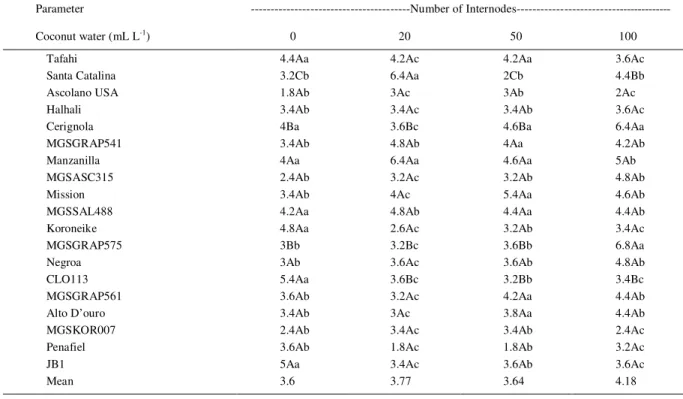
Therefore to understand the performance of genotypes and the suitability of culture medium we decompose the interaction between genotype and doses of coconut water for each genotype under study (Table 1). The decomposition of genotype x treatment interaction effect showed that ‘Santa Catalina’, ‘Cerignola’, and ‘MGSGRAP575’ showed significant differences for all measured traits along the different doses of coconut water. This results showed the performance of these genotypes was significantly affected by the doses of coconut water (Table 1, 2, 3 and 4) indicating the importance of determining the appropriate doses of coconut water for these genotypes during embryo culture. Consequently, the appropriate doses of coconut water for ‘Santa Catalina’ is 25mL L-1
in MS medium which gave maximum values for all the measured parameters while for ‘Cerignola’ the maximum dose of coconut water (100mL L-1) will be the best that
give the highest measurement for the shoot length, number of leaves and number of internodes (Table 2, 3 and 4).
The highest overall mean value of the measured parameters was observed when genotypes were cultured in culture medium with 100mL L-1 of
Table 1 - ANOVA table for measured traits and its decomposition of genotypes in different doses of coconut water(0, 25, 50, 100mL L-1).
Source of Variation Degree of Freedom Shoot Length Leaf number Internode length
Genotypes 18 7.79** 27.78** 8.58**
DCW 3 9.65 ns 50.44* 6.63 ns
DCW x Genotypes 54 4.65** 18.00** 4.31**
DCW/Genotypes 57 4.91** 19.71** 4.43**
DCW / Tafahi 3 2.45 ns 2.58 ns 0.60 ns
DCW / Santa Catalina 3 11.61** 78.58** 17.60**
DCW / Ascolano USA 3 9.63** 54.98** 2.05 ns
DCW / Halhali 3 2.35 ns 0.32 ns 0.05 ns
DCW / Cerignola 3 5.40** 40.33** 7.65*
DCW / MGSGRAP541 3 2.71 ns 4.93 ns 1.67 ns
DCW / Manzanilla 3 6.63** 17.52 ns 5.20 ns
DCW / MGSASC315 3 5.65** 17.78 ns 5.07 ns
DCW / Mission 3 10.57** 10.18 ns 3.65 ns
DCW / MGSSAL488 3 1.41 ns 2.73 ns 0.32 ns
DCW / Koroneike 3 1.41 ns 19.65 ns 4.33 ns
DCW / MGSGRAP575 3 17.08** 35.92** 15.92**
DCW / Negroa 3 3.22 ns 10.73 ns 2.85 ns
DCW / CLO113 3 1.17 ns 31.92** 5.13 ns
DCW / MGSGRAP561 3 0.55 ns 5.07 ns 1.52 ns
DCW / Alto D’oro 3 1.13 ns 8.58 ns 1.78 ns
DCW / MGSKOR007 3 0.58 ns 8.40 ns 1.67 ns
DCW / Penafiel 3 9.71** 14.18 ns 4.40 ns
DCW / JB1 3 0.01 ns 10.00 ns 2.73 ns
Error 304 1.27 7.74 2.09
Mean 4.19 7.64 3.79
CV 26.79 36.41 38.10
Observation: the mean square followed by * and ** refers significant at 5%, 1% level of probability and ns refers not significant at 5% probability. DCW: Doses of Coconut water.
Table 2 - The mean table of the measured parameter shoot length and its mean separation using Scott-Knott.
Parameter Shoot Length (cm)
---Coconut water (mL L-1) 0 20 50 100
Tafahi 4.06 Aa 5.40 Ab 5.16 Aa 4.10 Ac
Santa Catalina 3.50 Cb 6.70 Aa 3.50 Cb 5.00 Bb
Ascolano USA 2.10 Cc 3.80 Bc 3.80 Bb 5.50 Ab
Halhali 3.70 Ab 3.60 Ac 3.60 Ab 5.00 Ab
Cerignola 4.80 Aa 3.00 Bc 4.80 Aa 5.40 Ab
MGSGRAP541 4.20 Aa 5.20 Ab 5.50 Aa 4.00 Ac
Manzanilla 4.00 Ba 6.70 Aa 5.40 Ba 4.70 Bb
MGSASC315 3.20 Bb 3.60 Bc 3.40 Bb 5.50 Ab
Mission 3.70 Bb 4.10 Bc 5.80 Aa 6.80 Aa
MGSSAL488 4.70 Aa 3.80 Ac 3.50 Ab 3.70 Ac
Koroneike 4.40 Aa 3.40 Ac 3.50 Ab 3.20 Ad
MGSGRAP575 3.40 Bb 3.90 Bc 3.90 Bb 7.40 Aa
Negroa 3.30 Ab 4.50 Ac 4.00 Ab 5.20 Ab
CLO113 5.00 Aa 4.20Ac 3.90Ab 4.10 Ac
MGSGRAP561 4.90 Aa 4.60 Ac 4.20Ab 4.90 Ab
Alto D’ouro 4.30 Aa 3.30 Ac 4.10 Ab 4.30 Ac
MGSKOR007 3.10 Ab 3.50 Ac 3.80 Ab 3.10 Ad
Penafiel 4.60 Aa 1.60 Bd 1.70 Bc 2.80 Bd
JB1 3.70 Ab 3.70Ac 3.70 Ab 3.80 Ac
Table 3 - The mean table of the measured parameter number of leaves and its mean separation using Scott-Knott.
Parameter ---Number of
Leaves---Coconut water (mL L-1) 0 20 50 100
Tafahi 7.80Aa 8.60Ab 8.40Aa 7.00Ab
Santa Catalina 6.80Ba 12.60Aa 4.00Ba 11.20Aa
Ascolano USA 4.00Ba 6.00Bc 6.80Ba 11.80Aa
Halhali 6.60Aa 7.00Ac 7.00Aa 7.20Ab
Cerignola 7.40Ba 7.00Bc 8.80Ba 13.20Aa
MGSGRAP541 7.00Aa 9.40Ab 8.00Aa 8.40Ab
Manzanilla 8.40Aa 12.80Aa 9.60Aa 9.80Aa
MGSASC315 4.80Aa 5.80Ac 6.80Aa 9.20Aa
Mission 7.20Aa 8.40Ab 10.60Aa 9.20Aa
MGSSAL488 8.60Aa 10.00Ab 8.40Aa 8.60Ab
Koroneike 9.60Aa 4.80Ac 6.60Aa 6.80Ab
MGSGRAP575 6.20Ba 5.80Bc 7.00Ba 11.60Aa
Negroa 6.20Aa 7.20Ac 7.00Aa 9.60Aa
CLO113 11.00Aa 6.40Bc 5.20Ba 6.80Bb
MGSGRAP561 6.80Aa 5.20Ac 6.80Aa 7.60Ab
Alto D’ouro 7.00Aa 5.60Ac 7.20Aa 8.80Ab
MGSKOR007 4.40Aa 6.80Ac 7.00Aa 5.00Ab
Penafiel 7.00Aa 4.20Ac 3.80Aa 6.80Ab
JB1 10.20Aa 7.20Ac 8.20Aa 7.20Ab
Mean 7.21 7.41 7.22 8.73
Table 4 - The mean table of the measured parameter number of internodes and its mean separation using Scott-Knott.
Parameter ---Number of
Internodes---Coconut water (mL L-1) 0 20 50 100
Tafahi 4.4Aa 4.2Ac 4.2Aa 3.6Ac
Santa Catalina 3.2Cb 6.4Aa 2Cb 4.4Bb
Ascolano USA 1.8Ab 3Ac 3Ab 2Ac
Halhali 3.4Ab 3.4Ac 3.4Ab 3.6Ac
Cerignola 4Ba 3.6Bc 4.6Ba 6.4Aa
MGSGRAP541 3.4Ab 4.8Ab 4Aa 4.2Ab
Manzanilla 4Aa 6.4Aa 4.6Aa 5Ab
MGSASC315 2.4Ab 3.2Ac 3.2Ab 4.8Ab
Mission 3.4Ab 4Ac 5.4Aa 4.6Ab
MGSSAL488 4.2Aa 4.8Ab 4.4Aa 4.4Ab
Koroneike 4.8Aa 2.6Ac 3.2Ab 3.4Ac
MGSGRAP575 3Bb 3.2Bc 3.6Bb 6.8Aa
Negroa 3Ab 3.6Ac 3.6Ab 4.8Ab
CLO113 5.4Aa 3.6Bc 3.2Bb 3.4Bc
MGSGRAP561 3.6Ab 3.2Ac 4.2Aa 4.4Ab
Alto D’ouro 3.4Ab 3Ac 3.8Aa 4.4Ab
MGSKOR007 2.4Ab 3.4Ac 3.4Ab 2.4Ac
Penafiel 3.6Ab 1.8Ac 1.8Ab 3.2Ac
JB1 5Aa 3.4Ac 3.6Ab 3.6Ac
in culture medium (Table 2). Otherwise, 52% of the olive genotypes recorded the mean value higher than the overall mean (8.73cm) for number of leaves, where ‘Ascolano USA’, ‘Cerignola, and ‘MGSGRAP575’ showed the maximum value using 100mL L-1 of coconut
water. Highest mean value of the number of internodes was also observed by ‘Cerignola’ and ‘MGSGRAP575’ using 100mL L-1 of coconut water (Table 4). These
results indicate the effect of coconut water on the later developmental stage of the seedling during the in vitro
culture.
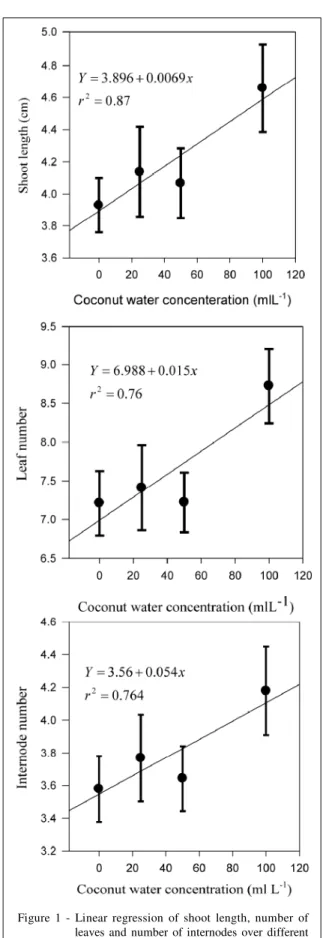
In general, the measured traits increased in proportion to the coconut water dose. The coefficient of determination that measured relationship of the parameters in relation to the different dose of coconut water showed a direct and positive relationship (Figure 1) with r2=0.76 for both number of leaves and number
of internodes and r2=0.87 for shoot length (Figure 1).
The strong and positive coefficient of determination presented in this work showed the general trend indicating the increase in coconut water dose from 0 to 100ml L-1 is positively associated with the increase in
shoot length, number of leaves and number of internodes which indirectly leads us to conclude about the positive effect of coconut water in the seedling development and growth. Similar observation was also reported in olive cultivar ‘MGSASC315’ by VILLA et al. (2010). The same variety (MGSASC315) included in our study the also perform well with 100ml L-1 of
coconut water in agreement with the conclusion made by VILLA et al. (2010). These authors also showed the positive effect of the coconut water in growth and development of the seedling during in vitro culture. KURAISHI & OKUMURA (1961) reported the cytokinin activity in fresh coconut water. This class of plant growth regulator has the main function to stimulate cell division, subsequently to morphogenesis. Some natural cytokinins have been isolated from coconut water, such, such as zeatin and N’-diphenyl urea (GEORGE, 2008), but levels of cytokinins and their specificity in coconut water are still unclear. PEIXE et al. (2007) also showed the positive effect of coconut water in vitro culture as substitute of Zeatin which is an important organic compound used in the process of micropropagation. This means that the supplementation of culture medium with coconut water can be beneficial to growth and morphogenesis of tissues, not only due the mineral nutrition that it provides but also because it is a source of natural growth regulators.
The beneficial effect of coconut water was clearly observed on plant growth parameters such as shoot length, number of leaves and number of internodes (Tables 2, 3 and 4), since these traits are
good indicators of the seedling developmental performance. These results confirm the contribution of the coconut water as source of mineral and organic nutrients required during the tissue culture of olive zygotic embryos.
Therefore, the result of this experiment allowed us to conclude that each olive genotype requires different doses of coconut water in the culture medium for its optimum development and growth during
the in vitro culture. We also observed that the
supplementation of culture medium with doses of coconut water is proportional with the better development and growth of zygotic embryo of the olive, and it can be omitted during germination and root development.
ACKNOWLEDGEMENTS
The authors would like to thank the Experimental Farm of EPAMIG in Maria da Fé for kindly providing olive seeds and FAPEMIG, FINEP, CAPES, CNPq and EMBRAPA for the financial support.
REFERENCES
ACEBEDO, M.M. et al. In vitro germination of embryos for speeding up seedling development in olive breeding programmes.
Scientia Horticulturae v.69, p.207-215, 1997. Available from: <http://www.sciencedirect.com/science/article/pii/ S0304423897000046>. Accessed: Oct 14, 2012. doi: 10.1016/ S0304-4238(97)00004-6.
CALDAS, L.S. et al. Meios nutritivos. In: TORRES, A.C. et al. (Eds.). Cultura de tecidos e transformação genética de plantas. Brasília: EMBRAPA - SPI/ CNPH, 1998. V1. 864p. CRUZ, C.D. Programa genes: análise multivariada e simulação. Viçosa: UFV, 2006. V.1. 175p.
GEORGE, E.F. Plant propagation by tissue culture. 3.ed. Great Britain: Exegetics, 2008. 479p.
KRIKORIAN, A.D. Medios de cultivo: generalidades, composición y preparación. In: ROCA, W.M.; MROFINSKI,
L.A. (Eds). Cultivo de tejidos em la agricultura. Colômbia: Centro Internacional de Agricultura Tropical, 1991. p.41-77. KURAISHI, S.; OKUMURA, F.S. A new green-leaf growth stimulating factor, phyllococosine, from coconut milk. Nature,
v.189, p.148-149, 1961. Available from: <http:// w w w. n a t u r e . c o m / n a t u r e / j o u r n a l / v 1 8 9 / n 4 7 5 9 / a b s / 189148a0.html>. Accessed: Oct 14, 2012. doi: 10.1038/ 189148a0.
MURASHIGE, T.; SKOOG, F. A revised medium for rapid growth and bioassays with tobacco tissue cultures. Physiologia Plantarum v.15, n.6, p.473-497, 1962. Available from: <http:/ / o n l i n e l i b r a r y . w i l e y . c o m / d o i / 1 0 . 1 1 1 1 / j . 1 3 9 9 -3054.1962.tb08052.x/pdf>. Accessed: Oct 14, 2012. doi: 10.1111/j.1399-3054.1962.tb08052.x.
NASIB, A. et al. An optimized and improved method for the in vitro propagation of Kiwifruit (Actinidia deliciosa) using coconut water. Pakistan Journal of Botany, v.40, n.6, p. 2355-2360, 2008.
PEIXE, A. et al. Coconut water and BAP successfully replaced zeatin in olive (Olea europaea L.) micropropagation. Scientia Horticulturae, v.113, p.1-7. 2007. Available from: <http:// w w w . s c i e n c e d i r e c t . c o m / s c i e n c e / a r t i c l e / p i i / S0304423807000313>. Accessed: Oct 14, 2012. doi: 10.1016/ j.scienta.2007.01.011.
SOUZA, R.A.V. et al. Viabilidade e germinação de embriões de oliveira após diferentes condições de armazenamento de frutos. Pesquisa Agropecuária Brasileira, v.46, p.309-314, 2011. Available from: <http://www.scielo.br/pdf/pab/v46n3/a12v46n3.pdf>. Accessed: Oct 14, 2012. doi: 10.1590/S0100-204X2011000300012.
TREVISAN, F. et al. Optimization of in vitro organogenesis in passion fruit (Passiflora edulis f. Flavicarpa). Scientia Agricola, v.62, n.4, p.346-350, 2005. Available from: <http:/ /www.scielo.br/pdf/sa/v62n4/25086.pdf>. Accessed: Oct 14, 2012. doi: 10.1590/S0103-90162005000400007.