Original Article Krug et al.
Rev Bras Ativ Fís Saúde 2017;22(1):35-45
DOI: 10.12820/rbafs.v.22n1p35-45 RBAFS
Atividade Física & Saúde
SOCIEDADE BRASILEIRA DE ATIVIDADE FÍSICA E SAÚDE Brazilian Journal of Physical Activity and Health
RBAFS
Revista Brasileira de Atividade Física & Saúde
SOCIEDADE BRASILEIRA DE ATIVIDADE FÍSICA E SAÚDE Brazilian Journal of Physical Activity and Health
RBAFS
Revista Brasileira de Atividade Física & Saúde
SOCIEDADE BRASILEIRA DE ATIVIDADE FÍSICA E SAÚDE
Brazilian Journal of Physical Activity and Health
Revista Brasileira de Atividade Física & Saúde Brazilian Journal of Physical Activity and Health
Sociedade BraSileira de atividade FíSica & Saúde
1 Federal University of Santa catarina (UFSc), Graduate Program in Medical Sciences (PPGcM), Florianópolis, Sc, Brazil.
2 University of Santa catarina State (UdeSc), Graduate Program in Human Movement Sciences (PPGcMH), Florianópolis, Sc, Brazil.
3 Federal University of Santa catarina (UFSc), Undergraduate course in Physiotherapy, araranguá, Sc, Brazil.
4 Federal University of Santa catarina (UFSc), Graduate Program in collective Health (PPGSc), Florianópolis, Sc, Brazil.
5 Federal University of Santa catarina (UFSc), Sports center (cdS), Florianópolis, Sc, Brazil.
Abstract
The aim of this study was to analyze the factors associated with positive self-perceived health of octogenarians partic-ipating in community groups in the city of Florianópolis, Southern Brazil. A cross-sectional study was conducted with 343 older adult individuals aged 80 years or older, of both sexes, participating in community groups. A questionnaire was applied through a face-to-face interview, including so-cio-demographic and economic data, self-reported health sta-tus, falls, lifestyle and leisure domain from the International Physical Activity Questionnaire. Poisson regression was used to identify the factors associated with positive self-perceived health, adjusted for socio-demographic, economic, behav-ioral, health condition and fall variables. The prevalence of positive self-perceived health among octogenarians was 49.0% (95%CI=44.0-54.0). The factors associated with positive self-perceived health were as follows: to receive a monthly in-come higher than six minimum wages (PR=1.39; 95%CI=1.01-2.11), to smoke currently (PR=1.75; 95%CI=1.25-2.46), to be physically active during leisure time (PR=1.33; 95%CI=1.06-1.67), to have arthritis or rheumatism (PR=0.55; 95%CI=0.37-0.80), diabetes (PR=0.54; 95%CI=0.37-0.79) and cardiovas-cular disease (PR=0.71; 95%CI=0.53-0.95), apart from using medications (PR=0.74; 95%CI=0.60-0.91). Thus, it could be concluded that some modifiable factors were identified, such as income, smoking, leisure physical activity, and use of med-ications, which can interfere with the positive self-perceived health of octogenarians participating in community groups.
Keywords
Aged, 80 and over; Health; Comorbidity; Lifestyle.
Resumo
O objetivo deste estudo foi analisar os fatores associados à auto-percepção positiva de saúde de octogenários participantes de gru-pos de convivência de Florianópolis. Estudo transversal com 343 idosos com 80 anos ou mais, de ambos os sexos, participantes de grupos de convivência. Aplicou-se um questionário em forma de entrevista face a face contendo dados sociodemográficos, econô-micos, autorrelato do estado de saúde, quedas, estilo de vida e o domínio de lazer do Questionário Internacional de Atividade Fí-sica. Para identificar os fatores associados à autopercepção positiva de saúde, utilizou-se regressão de Poisson, ajustada por variáveis sociodemográficas e econômicas, comportamentais, condições de saúde e quedas. A prevalência de autopercepção positiva de saú-de dos octogenários foi saú-de 49,0% (IC95% = 44,0-54,0). Os fatores associados à autopercepção positiva de saúdeforam receber renda mensal maior que 6 salário mínimos (RP=1,39; IC95%=1,01-2,11), fumar atualmente (RP=1,75; IC95%=1,25-2,46), ser fisica-mente ativo no lazer (RP=1,33; IC95%=1,06-1,67), o autorrelato de artrite ou reumatismo (RP=0,55; IC95%=0,37-0,80), de dia-betes (RP=0,54; IC95%=0,37-0,79) e de doenças cardiovasculares (RP=0,71; IC95%=0,53-0,95), além de, fazer uso de medicamento (RP=0,74; IC95%=0,60-0,91). Assim, conclui-se que foram detec-tados alguns fatores modificáveis, tais como renda, tabagismo, ati-vidade física no lazer, uso de medicamento, que podem interferir na autopercepção positiva de saúde de octogenários participantes de grupos de convivência.
Palavras-chave
Idoso de 80 anos ou mais; Saúde; Comorbidade; Estilo de vida
Positive self-perceived health of octogenarians
participating in community groups
Autopercepção positiva de saúde de indivíduos octogenários
participantes de grupos de convivência
Rodrigo de Rosso Krug1, Giovana Zarpellon Mazo2, Ione Jayce Ceola Schneider3, Susana Cararo Confortin 4, Marize
Am-orim Lopes5, Danielle Ledur Antes4, Maruí Weber Corseuil Giehl4, André Junqueira Xavier4, Eleonora d’Orsi1
Introduction
The world is undergoing a demographic transition caused by the advances in the area of health (early diagnoses of diseases and greater effectiveness of drugs and treatments), improvement in public health
mea-sures (vaccination and basic sanitation) and reduction in birth, fertility and mor-tality rates1. This set of factors is increasing the life expectancy of the population1,2.
The age group of 80 years and older, known as octogenarians, is the one increasing the most1,3. It is estimated that this population will total 379 million individuals
worldwide2 and more than 14 million in Brazil3 by 2050. Approximately 0.3% of
the-se older adult individuals live in the city of Florianópolis, Southern Brazil3.
Octogenarians have different characteristics when compared to other age groups, such as worse social conditions and a higher prevalence of disabilities, restrictions and diseases, especially chronic ones2,3. The most frequent diseases in
this group are arterial hypertension, stroke, cancer, cardiovascular diseases, hyper-cholesterolemia and arthritis3. In this sense, health care in this age group is one of
the greatest challenges of public health3.
The aging process, apart from causing several health and social problems, is also associated with a negative perception of health4,5. This fact can be explained
by self-perceived health being associated with good physical, cognitive and emo-tional aspects, in addition to a feeling of well-being and satisfaction with life4,5.
In Brazil, older adult community groups are an alternative to social promotion and health care. These groups primarily aim to increase social participation and in-teraction among older adults6. Older adult individuals participating in community
groups usually have better health and social interaction and a more active lifestyle7.
Considering the fact that the majority of studies focus on a negative percep-tion of health4, that few investigate this theme in octogenarians participating in
community groups, and that the identification of the factors associated with this can help to improve preventive and rehabilitating health actions for the popula-tion of older adults aged 80 years and more, the present study aimed to analyze the factors associated with positive self-perception of health among octogenari-ans participating in community groups in the city of Florianópolis.
Methods
Study design
A cross-sectional study was performed in the city of Florianópolis, state of San-ta CaSan-tarina, Southern Brazil, with a population of older adult individuals of both sexes, aged 80 years and more (octogenarians)3, participating in older adult
community groups registered with the Florianópolis City Hall.
Older adult community groups are based on educational practices developed in groups, aimed at participatory education, according to the perspective that everyone is active in the group work6. Manual activities such as knitting, crochet,
sewing, recreational activities such as bingo, card games and dominoes; educa-tional activities such as lectures and courses; and leisure activities such as tourist trips, balls and physical activities and snacks are developed in these older adult community groups. These groups usually meet once a week6.
Population and sample
The population of the present study was comprised of older adult individuals aged 80 years and more, of both sexes, registered with older adult community groups of the Florianópolis City Hall in 2010. A total of 497 octogenarians regis-tered with such groups were found. However, those who accepted to participate in this research project voluntarily on the data collection days were included in it (n=343). Only one visit was made to each of the 102 older adult community groups of Florianópolis. The present study was performed from August 2010 to
April 2011. A total of 19 individuals refused to participate, eight were excluded due to missing data and 127 were absent on the data collection days.
Instruments and data collection
Instruments were applied by previously trained researchers through face-to-face interviews, which were filled out in forms and subsequently tabulated in the Mi-crosoft Excel software.
Self-perceived health was assessed through the following question: “In general, would you say your health is: very good, good, fair, poor, or very poor? 8. For the
analysis, the outcome was divided into positive (“very good” and “good”) and neg-ative (“fair”, “poor”, “very poor”)9.
The following covariables were analyzed: age (in years), sex (male/female), marital status (married/cohabiting, single, divorced/separated, widowed), family arrangement (living alone/with others), level of education (illiterate, incomplete primary education, complete primary education, complete secondary education, higher education), ethnicity (white, black/mixed/Asian descendant), current em-ployment (working/not working), income in minimum wages (< 1 wage, 1 to 3 wages, 3 to 6 wages, > 6 wages), self-reported spine disease (yes, no), arthritis and/ or rheumatism (yes, no), cancer (yes, no), bronchitis and/or asthma (yes, no), stroke (yes, no), stomach ulcer (yes, no), urinary incontinence (yes, no), use of medication (yes, no), falls in the previous year (yes, no) and tobacco use (non-smoker, smoked and stopped, current smoker).
Alcohol use (no, moderate/high) was assessed with three questions from the Alcohol Use Disorders Identification Test (AUDIT)10. Older adult individuals who
do not consume alcohol were considered as “no”; those who consume a dose or less with any frequency, “moderate”; and those who usually consumed five or more doses or two or more doses when drinking, “high”. Current employment (yes, no) was assessed through the following question: “Do you have a paid job at the mo-ment?”. Physical activity level during leisure time was evaluated with the Interna-tional Physical Activity Questionnaire (IPAQ), version 8, long form and normal week, adapted to older adults11(<150 minutes per week, ≥150 minutes per week).
For the instruments to be applied, the Florianópolis City Hall was initially contacted, so as to obtain access to the number of registered older adult com-munity groups, their addresses, and data to contact group coordinators. Subse-quently, community group coordinators were contacted to request permission for the research project to be performed. Next, octogenarians were contacted in the community groups of which they were members and invited to participate in this project. Finally, the date and time of interviews were scheduled and the research instrument was applied.
Data analysis
Descriptive analysis was performed to identify the sample characteristics. The normality of continuous data was tested and a p-value≤0.05 was considered to be significant.
For the identification of factors associated with positive self-perceived health, crude and adjusted analysis was performed with Poisson regression. Variables showing a p-value higher than 5% were included in the model in steps; first, the so-cio-demographic and economic variables; second, the behavioral variables; third, health conditions; and, finally, falls in the previous year. All variables were includ-ed in their specific step in the adjustinclud-ed analysis. In the first step, variables
show-ing an association with the outcome (p-value≤0.05) adjusted the second step. The third step was adjusted by the significant variables from the first step and those with a p-value≤0.05 from the second step. A p-value≤0.05 was considered to be significant. STATA SE software, version 11.0 (Stata Corporation, College Station, United States), was used in all analyses.
Ethical aspects
All ethical principles for research were met, in accordance with the current reso-lution from the National Health Council. The present study was approved by the Human Research Ethics Committee (protocol 149/2010). All participants had to sign an informed consent form. Authors declared no conflicts of interest.
Result
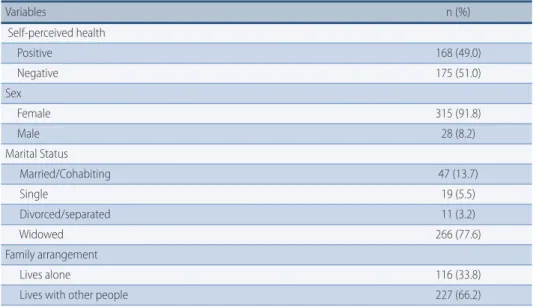
The study sample was comprised of 343 octogenarians with a mean age of 84.1±3.9 years. The prevalence of positive self-perceived health was 49.0% (95%CI= 44.0-54.0) (Table 1).
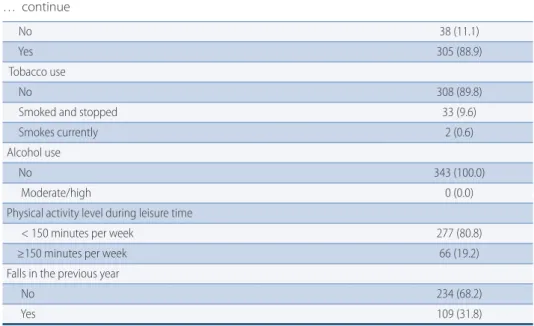
The majority of octogenarians were females (91.8%) and widowed (77.6%), lived with someone (66.2%), did not complete primary education (55.7%), were white (94.2%), did not have a paid and/or volunteer job (97.7%) and received less than three minimum wages (60.4%). Regarding health conditions, the majority had arterial hypertension (59.8%) and used at least one medication daily (88.9%). In terms of life habits, most had never smoked (89.8%) did not consume alcohol (100%), had not fallen in the previous year (68.2%) and were physically inactive during leisure time (80.8%) (Table 1).
After the adjusted analysis, Table 2 showed that the factors associated with positive self-perceived health were as follows: to receive a monthly income higher than six minimum wages (PR=1.39; 95%CI=0.91-2.11), to be smoking currently (PR=1.75; 95%CI=1.25-2.46), to be physically active during leisure time (PR=1.33; 95%CI=1.06-1.67), to report arthritis or rheumatism (PR=0.55; 95%CI=0.37-0.80), diabetes (PR=0.54; 95%CI=0.37-0.79) and cardiovascular diseases (PR=0.71; 95%CI=0.53-0.95), and to use medications (PR=0.74; 95%CI=0.60-0.91).
Table 1 – Socio-demographic, health and behavioral characteristics of octogenarians participating in community groups of the city of Florianópolis, Southern Brazil, 2011 (n=343).
Variables n (%) Self-perceived health Positive 168 (49.0) Negative 175 (51.0) Sex Female 315 (91.8) Male 28 (8.2) Marital Status Married/Cohabiting 47 (13.7) Single 19 (5.5) Divorced/separated 11 (3.2) Widowed 266 (77.6) Family arrangement Lives alone 116 (33.8)
Lives with other people 227 (66.2)
Level of education
Illiterate 44 (12.8)
Incomplete primary education 191 (55.7)
Complete primary education 52 (15.2)
Complete secondary education 42 (12.2)
Higher education 14 (4.1) Ethnicity White 323 (94.2) Black/mixed/Asian descendant 20 (5.8) Employment status Not working 335 (97.7) Working 8 (2.3) Income < 1 minimum wage 40 (11.7) 1 to 3 minimum wages 167 (48.7) 3 to 6 minimum wages 30 (8.7) > 6 minimum wages 106 (30.9) Spine disease No 332 (96.8) Yes 11 (3.2) Arthritis/rheumatism No 240 (70.0) Yes 103 (30.0) Diabetes No 269 (78.4) Yes 74 (21.6) Bronchitis/Asthma No 329 (95.9) Yes 14 (4.1) Hypertension No 138 (40.2) Yes 205 (59.8) Cardiovascular diseases No 252 (73.5) Yes 91 (26.5) Depression No 332 (96.8) Yes 11 (3.2) Stroke No 339 (98.8) Yes 4 (1.2) Stomach ulcer No 337 (98.2) Yes 6 (1.8) Urinary incontinence No 333 (97.1) Yes 10 (2.9) Use of medication Continue… … continue
No 38 (11.1)
Yes 305 (88.9)
Tobacco use
No 308 (89.8)
Smoked and stopped 33 (9.6)
Smokes currently 2 (0.6)
Alcohol use
No 343 (100.0)
Moderate/high 0 (0.0)
Physical activity level during leisure time
< 150 minutes per week 277 (80.8)
≥150 minutes per week 66 (19.2)
Falls in the previous year
No 234 (68.2)
Yes 109 (31.8)
n= absolute frequency; %= relative frequency; Value used to convert the crude family income va-riable: R$ 510.00.
Table 2 – Crude and adjusted analysis of the factors associated with positive self-perceived health of oc-togenarians participating in community groups of the City of Florianópolis, Southern Brazil, 2011 (n=343).
Variables self-perceived Positive health (%)
Crude analysis Adjusted analysis PR (95%CI) p-value PR (95%CI) p-value
Age -- 1.00 (0.97-1.03) 0.948 1.00 (0.97-1.03) 0.980 Sex 0.597 0.668 Female 45.9 1 1 Male 46.3 1.10 (0.77-1.59) 1.10 (0.72-1.67) Marital status 0.671 0.507 Married/cohabiting 46.4 1 1 Single 53.6 1.07 (0.64-1.80) 1.19 (0.71-1.99) Separated/divorced 50.0 0.56 (0.20-1.53) 0.55 (0.21-1.46) Widowed 45.2 1.01 (0.74-1.40) 1.06 (0.77-1.46) Family arrangement 0.681 0.573 Lives alone 47.2 1 1
Lives with other people 45.6 1.05 (0.83-1.32) 1.07 (0.84-1.36)
Level of education 0.241 0.195
Illiterate 35.2 1 1
Incomplete primary education 45.1 1.21 (0.83-1.78) 1.20 (0.82-1.75) Complete primary education 47.5 1.22 (0.78-1.91) 1.20 (0.77-1.87) Complete primary education 56.5 1.10 (0.68-1.80) 1.12 (0.69-1.81)
Higher education 52.9 1.75 (1.07-2.84) 1.74 (1.10-2.77) Ethnicity 0.724 0.770 White 47.2 1 1 Black/mixed/Asian descendant 33.3 0.91 (0.56-1.50) 0.93 (0.57-1.52) Income 0.046* 0.046* < 1 minimum wage 38.1 1 1 to 3 minimum wages 45.2 1.15 (0.76-1.74) 1.15 (0.76-1.74) 3 to 6 minimum wages 46.5 1.33 (0.80-2.21) 1.33 (0.80-2.21) > 6 minimum wages 47.7 1.39 (1.01-2.11) 1.39 (1.01-2.11) Continue… … continue
Variables self-perceived Positive health (%)
Crude analysis Adjusted analysis PR (95%CI) p-value PR (95%CI) p-value
Arthritis/rheumatism <0.001* <0.001* No 51.9 1 1 Yes 34.4 0.55 (0.40-0.75) 0.55 (0.37-0.80) Diabetes <0.001* 0.002* No 51.4 1 1 Yes 26.4 0.49 (0.33-0.73) 0.54 (0.37-0.79) Hypertension 0.230 0.798 No 48.0 1 1 Yes 44.8 0.88 (0.71-1.09) 1.03 (0.80-1.34) Cardiovascular diseases 0.010* 0.021* No 50.6 1 1 Yes 35.8 0.68 (0.50-0.91) 0.71 (0.53-0.95) Use of medication <0.001* 0.005* No 74.5 1 1 Yes 43.3 0.57 (0.47-0.70) 0.74 (0.60-0.91) Tobacco use <0.001* <0.002 No 46.6 1 1
Smoked and stopped 41.7 0.79 (0.51-1.23) 0.79 (0.51-1.24)
Smokes currently 70.0 2.01 (1.80-2.25) 1.75 (1.25-2.46)
Physical activity level during leisure time 0.003* 0.013*
< 150 minutes per week 42.8 1 1
≥150 minutes per week 61.0 1.40 (1.12-1.75) 1.33 (1.06-1.67)
Falls in the previous year 0.039* 0.237
No 47.8 1 1
Yes 41.8 0.76 (0.59-0.99) 0.86 (0.68-1.10)
PR= prevalence ratio; 95%CI= 95% confidence interval; *= level of significance lower than 5%.
Discussion
In the present study, the prevalence of positive self-perceived health of octogena-rians participating in community groups of the city of Florianópolis was 49.0% (95%CI = 44.0-54.0). A population-based cross-sectional study performed by Con-fortin et al.9 with 1705 older adult residents in Florianópolis aged 60 years and
more observed a prevalence of 51.2% of positive self-perceived health. A German study conducted by Moschny et al.12, which followed 1,937 older adult Germans
aged between 72 and 93 years for seven years, showed that individuals aged 80 years and more perceived their health to be poorer, compared to younger individuals.
The use of medication and self-report of certain chronic diseases (arthritis or rheumatism, diabetes and cardiovascular diseases) were associated with the preva-lence of positive self-perceived health. On the other hand, older adult individuals who received a monthly income higher than six minimum wages, smoked and were physically active during leisure time had a more positive self-perceived health.
Certain chronic diseases were inversely associated with positive self-perceived health. Octogenarians who self-reported the presence of arthritis/rheumatism showed a lower prevalence of positive self-perceived health when compared to old-er adults without such conditions. Similar results wold-ere found by Loyola Filho et al.13 in a study performed with older adult individuals from Bambuí, in the state of
Minas Gerais. Rheumatism is a disease that affects the joints, causes pain and joint stiffness, in addition to being pointed out as one of the chronic conditions that most frequently restrict one from performing activities, especially those related to self-care and mobility14, which can explain the association found in this study.
Octogenarians who self-reported diabetes had a lower prevalence of positive self-perceived health when compared to older adult individuals without such con-dition. A fact that can be influenced in this association is that older adult indi-viduals at a more advanced age end up becoming more resistant to degenerative processes as they have more functional limitations and morbidities than younger older adult individuals, thus comprising a “biological elite” because, at this age, they succeeded in overcoming child mortality, infectious diseases and chronic de-generative diseases15. Thus, even when having any type of disease, octogenarians
perceive their health positively due to psychological factors. Studies show that the level of satisfaction with health is usually high among older adult Brazilians, especially in this age group16,17.
With regards to the negative association between positive self-report of car-diovascular diseases and positive self-perceived health, this finding corroborates those from other authors that the presence of chronic diseases such as cardiovas-cular ones can result in difficulties or even restrictions to routine activities of daily living, which influences self-perceived health among older adult individuals12,13.
Additionally, it was evidenced that the association between positive self-per-ceived health and older adult individuals who do not use medication is also indi-cated by other studies. A study performed with older adult individuals from the state of Minas Gerais found an association between use of medication and reports of poorer self-perceived health18, a fact that was also reported among older adult
Finnish19. According to Loyola Filho et al.18, this association can be explained by
the relationship between health problems and use of medication, as individuals seek health services when they are or perceive themselves to be ill, aiming to allevi-ate or solve their problem and receiving drug prescriptions as treatment.
Regarding the results of the association between receiving a monthly income higher than six minimum wages and positive self-perceived health found in this study, other studies that have investigated this theme in older adult Brazilians also found such association4,20,21. According to some studies22,23, this association can be
attributed to the fact that individuals with a higher income have healthier behav-ior, as they seek health services more frequently and show better adherence to treat-ments, thus having a direct impact on older adult individuals’ health perception. Regarding behavioral factors associated with the outcome investigated, posi-tive self-perceived health was associated with current smoking. Previous studies5,24
found an association between smoking and poorer health perception, in contrast with the findings from the present study. This can be explained by the fact that older adult individuals who are experiencing the disease process tend to stop their smoking habit25,26. Thus, older adult individuals who currently smoke tend to
have a better self-perceived health.
With regards to behavior associated with physical activity practice during lei-sure time, it was positively associated with positive self-perceived health. This find-ing is in agreement with the literature, which shows that more active individuals perceive their health to be more positive, when compared to those who are less ac-tive20,27. Moreover, this finding may also have been due to the fact that older adult
that those participating in such groups are more physically active in all domains7.
Thus, the regular practice of physical activities can help to prevent several dis-eases and chronic conditions, improve one’s ability to perform activities of daily living, and bring psychological and social benefits, factors that can have an influ-ence on a more positive self-assessment of health28,29.
It should be emphasized that the present study has some limitations, among which are the use of a cross-sectional design, which does not allow cause-effect relationships between independent variables and the outcome to be inferred. Ad-ditionally, health variables were self-reported and, consequently, a certain existing disease could have been forgotten or some information could have been misre-ported. Moreover, the bias of survival, inherent in cross-sectional studies, cannot be ignored as an explanation for the results found, as only older adult individuals with a more adequate lifestyle reach this age as a rule.
The main positive aspect of the present study was the sample size (n=343) as a large sample was included, sufficient for the proposed statistical analyses. Addi-tionally, studies with octogenarians are still scarce in Brazil, due to the difficulty to contact these individuals.
Longitudinal studies can contribute to a better understanding of the direction of the associations found. Furthermore, home studies could also find important data on this theme.
Self-perception of health can be considered as a good indicator of the health condition of older adults. In this sense, to show the variables that interfere with a positive self-perceived health of octogenarians participating in community groups is essential for the overall health surveillance of this age group and it helps to improve health actions. Moreover, this knowledge can also help to strength-en strategies for a more frequstrength-ent use of health services that offer opportunities of social interaction and health promotion among older adults, considering the positive associations found between positive self-perceived health, the practice of physical activities during leisure time and having a job (paid or not). This increas-es the reduction in costs of hospitalizations and health treatments, which are very frequent in this older population.
In conclusion, working, smoking, and being physically active during leisure time were positively associated with self-perceived health in octogenarians par-ticipating in community groups in the city of Florianópolis. In contrast, having arthritis/rheumatism, diabetes and cardiovascular diseases and using medication were inversely associated with positive self-perceived health.
Author contributions
R. R. Krug contributed to data collection, writing, project planning, data inter-pretation, draft preparation, critical review of the content and approval of the final version. I. J. C. Schneider contributed to the writing, project planning, data interpretation, draft preparation, critical review of the content and approval of the final version. S. C. Confortin, D. L. Antes and M. W. C. Giehl contributed to the writing, draft preparation, critical review of the content and approval of the final version. M. A. Lopes and G. Z. Mazo contributed to data collection, writing, critical review of the content and approval of the final version. A. J. Xavier and E. d’Orsi contributed to the project planning, data interpretation, critical review of the content and approval of the final version.
References
1. Gottlieb MGV,Schwanke CHA, Gomes I, Cruz IBM. Aging and Longevity in Rio Grande do Sul: a historic, ethnic and morbi-mortality profile of older adults. Rev BrasGeriatr Gerontol 2011;14(2):9-20.
2. Kirkwood TBL. A systematic look at an old problem: as life expectancy increases, a systemsbiology approach is needed to ensure that we have a healthy old age. Nature. 2008;451(7): 644-7.
3. Instituto Brasileiro de Geografia e Estatística. A summary of social indicators – An analysis of living conditions of the Brazilian population. Rio de Janeiro: Brazilian Institute of Geography and Statistics; 2010. Available at: http://www.ibge.gov.br/ cidadesat/topwindow.htm?1> acesso em: 26 de junho de 2011.
4. Pagotto V, Bachion MM, Silveira EA. Self-assessment of health by older adult Brazilians: a systematic review of the literature. Rev Panam Salud Publica 2013; 33(4):302-10.
5. Pavão ALB, Werneck GL, Campos MR. Self-assessment of health status and association with socio-demographic factors, life habits and morbidity in the population: a national survey. Cad. Saúde Pública 2013; 29(4):723-34.
6. Brasil. Norma Operacional Básica da Assistência Social (NOB/SUAS). Brasília: Unified Social Welfare System (SUAS); 2005. Available at: http://www.assistenciasocial.al.gov.br/ sala-de-imprensa/arquivos/NOB-SUAS.pdf> acesso em: 16 de setembro de 2016.
7. Liu L, Newschaffer CJ. Impact of social connections on risk of heart disease, cancer, and all-cause mortality among elderly Americans: findings from the Second Longitudinal Study of Aging (LSOA II). Arch Gerontol Geriatr. 2011; 53(2):168-73.
8. Ware JE Jr, Kosinski M, Keller SD. A 12- item Short- Form Health Survey: construction of scales and preliminary tests of reliability and validity.Med Care 1996; 34(3):220-33.
9. Confortin SC, Giehl MWC, Antes DL, Schneider IJC, d’Orsi E. Positive self-perceived health in older adults: a population study in Southern Brazil. Cad. Saúde Pública 2015; 31(5):1049-60.
10. Babor TF, Higgins-Biddle JC, Saunders JB, Monteiro MG. Audit: The Alcohol Use Disorders Identification Test. Second Edition. Word Health Organization: Genebra; 1993. Pg.41.
11. Mazo GZ, Benedetti TRB. Adaptation of the International Physical Activity Questionnaire for older adults. Rev Bras Cineantropom Desemp Hum 2010;12(6):480-4.
12. Moschny A, Platen P, KlaaBen-Mielke R, Trampich U, Hinrichs T. Barriers to physical activity in older adults in Germany: a cross-sectional study. Int J Behav Nutr Phys Activity 2011;8(2):121-31.
13. Loyola Filho AI, Firmo JOA, Uchoa E, Lima-Costa MF. Factors associated with negative self-assessed health among hypertensive and/or diabetic older adults: results from the Bambuí project. Rev Bras Epidemiol 2013; 16(3):559-71.
14. Guccione AA, Felson DT, Anderson JJ, Anthony JM, Zhang Y, Wilson PW, et al. The effects of specific medical conditions on the functional limitations of elders in the Framingham Study. Am J Public Health1994; 84(3):351-8.
15. Capri M, Salvioli S, Monti D, Caruso C, Candore G, Vasto S, et al. Human longevity within an evolutionary perspective: The peculiar paradigm of a post-reproductive genetics. Exp Gerontol 2008; 43(2) 53-60.
16. Mazo GZ, Mota AJ, Gonçalves LHT, Matos MG. Physical activity level, health conditions and socio-demographic characteristics of female older adult Brazilians. Rev Port Cie Desp 2005; 5(2):202-12.
17. Benedettti TRB, Petroski EL, Gonçalves LHT. The profile of older adults in the city of Florianópolis: final report. Florianópolis: Pallotti; 2004. 88p.
18. Loyola Filho AI, Uchoa E, Lima-Costa MF. Population-based epidemiological study on the use of medication among older adults in the Metropolitan Region of Belo Horizonte, Minas Gerais, Brazil. Cad Saúde Pública 2006; 22(12):2657-67.
19. Linjakumpu T, Hartikainen S, Klaukka T, Veijola J, Kivelä SL, Isoaho R. Use of medications and polypharmacy are increasing among the elderly.J Clin Epidemiol 2002; 55(8):809-17.
20. Borim FSA, Barros MBA, Neri AL. Self-assessment of health in older adults: a population-based study in the city of Campinas, São Paulo, Brazil. Cad Saúde Pública 2012; 28(4):769-80.
21. Robert AS, Cherepanov D, Palta M, Dunham NC, Feeny D, Fryback DG. Socioeconomic status and age variations in health-related quality of life: results from the National Health Measurement Study. J Gerontol B Psychol Sci Soc Sci 2009; 64:S378-89.
Corresponding Author
Rodrigo de Rosso Krug
Received 19/02/2016
Revised 28/09/2016
Approved 09/10/2016
Centro de Ciências da Saúde, bloco A, sala 126, Campus Universitário, Trindade. Florianópolis, SC, Brazil. 88040-410
Tel: +55 48 37213418 +55 48 91476135
22. Travassos C, Viacava F, Laguardia J. Health Supplements in the National Household Sample Survey (PNAD) in Brazil. Rev Bras Epidemiol 2008; 11(suppl 1):98-112.
23. Lima-Costa MF, Barreto SM, Firmo JOA, Uchôa E. Socioeconomic position and health in a population of Brazilian elderly: the Bambuí Health and Aging Study (BHAS). Rev Panam Salud Publica 2003; 13(6):387–94
24. Peixoto SV,Firmo JO,Lima-Costa MF. Factors associated to smoking habit among older adults (The Bambuí Health and Aging Study). Rev Saude Pública.2005; 39(5):746-53.
25. Costa MFFvL, Peixoto SV, César CC, Malta DC, Moura EC. Health behavior among hypertensive older adults, Brazil, 2006. Rev. Saúde Pública. 2009; 43(2):18-26.
26. Azevedo RCS, Higa CMH, Assumpção ISMA, Frazatto CRG, Fernandes RF, Goulart W et al. Therapeutic group for smokers: results after two years of follow-up. Rev. Assoc. Med. Bras. 2009; 55(5):593-6.
27. Siqueira FV, Facchini LA, Piccini RX, Tomasi E, Thumé E, Silveira DS, et al. Physical activity in adults and older adults living in areas covered by primary health units of cities in Southern and Northeastern Brazil. Cad Saude Publica.2008; 24(1):39-54.
28. Lee IM, Shiroma EJ, Lobelo F, Puska P, Blair SN, Katzmarzyk PT. Effect of physical inactivity on major non-communicable diseases worldwide: an analysis of burden of disease and life expectancy. Lancet 2012; 380(9838):219-29.
29. Hamer M, Lavoie KL, Bacon SL. Taking up physical activity in later life and healthy ageing: the English longitudinal study of ageing. British J Sports Med2014; 48(3):6-15.