Original Article
Artigo Original
Cross cultural translation and adaptation
to Brazilian Portuguese of the
Hearing
Implant Sound Quality Index
Questionnaire
- (HISQUI19)
Tradução e Adaptação Transcultural para o
Português Brasileiro do Questionário Hearing
Implant Sound Quality Index - (HISQUI19)
Priscila Faissola Caporali1Sueli Aparecida Caporali2
Érika Cristina Bucuvic3
Sheila de Souza Vieira1
Zeila Maria Santos1
Brasília Maria Chiari1
Keywords
Questionnaire Translation Hearing Impairment Rehabilitation Cochlear Implantation Adult
Descritores
Questionários Traduções
Reabilitação da Deiciência Auditiva
Implante Coclear Adulto
Correspondence address: Priscila Faissola Caporali
Universidade Federal de São Paulo –
UNIFESP
Rua Borges Lagoa, 783, conj 21, São Paulo (SP), Brazil, CEP: 04038-901. E-mail: [email protected]
Received: May 10, 2015
Study conducted at the Department of Speech and Hearing Sciences, Universidade Federal de São Paulo –
UNIFESP - São Paulo (SP), Brazil.
1 Universidade Federal de São Paulo – UNIFESP - São Paulo (SP), Brazil. 2 Widex A/S - Lynge, Denmark.
3 Hospital de Reabilitação de Anomalias Crânio Faciais, Universidade de São Paulo – USP - Bauru (SP), Brazil.
Financial support: notinhg to declare.
Conlict of interests: nothing to declare. ABSTRACT
Purpose: Translation and cross-cultural adaptation of the instrument Hearing Implant Sound Quality Index
(HISQUI19), and characterization of the target population and auditory performance in Cochlear Implant (CI) users
through the application of a synthesis version of this tool. Methods: Evaluations of conceptual, item, semantic
and operational equivalences were performed. The synthesis version was applied as a pre-test to 33 individuals, whose inal results characterized the inal sample and performance of the questionnaire. The results were
analyzed statistically. Results: The inal translation (FT) was back-translated and compared with the original
version, revealing a minimum difference between items. The changes observed between the FT and the synthesis version were characterized by the application of simpliied vocabulary used on a daily basis. For the pre-test, the average score of the interviewees was 90.2, and a high level of reliability was achieved (0.83). Conclusion: The translation and cross-cultural adaptation of the HISQUI19 questionnaire showed suitability for conceptual, item,
semantic and operational equivalences. For the sample characterization, the sound quality was classiied as good with better performance for the categories of location and distinction of sound/voices.
RESUMO
Objetivo: Traduzir e adaptar transculturalmente o instrumento Hearing Implant Sound Quality Index (HISQUI19),
e caracterizar a população e o desempenho auditivo em usuários de Implante Coclear (IC) pela aplicação da versão síntese. Método: Realizou-se a avaliação das equivalências conceitual, de item, semântica e operacional.
A versão síntese foi aplicada como um pré-teste que contou com 33 sujeitos no resultado inal, caracterizando
a amostra e o desempenho do questionário. Os resultados foram analisados estatisticamente. Resultado: A
tradução inal (TF) foi retrotraduzida e comparada à versão original, mostrando diferença mínima entre itens, e as modiicações da TF para a versão síntese caracterizaram-se pela aplicação de vocabulário simpliicado utilizado no cotidiano. No pré-teste, o escore médio entre os entrevistados foi de 90,2 e conirmou-se alto grau de coniabilidade interna (0,83). Conclusão: A tradução e a adaptação do questionário HISQUI19 mostraram
INTRODUCTION
The cochlear implant (CI) has been an effective auditory rehabilitation device to promote hearing and psychosocial beneits which improve the quality of life for the hearing
impaired(1).
Although a very effective technology, the CI has limitations
in certain auditory situations. The most frequent complaint
is the dificulty for the user to understand speech in the
presence of background noise(2,3). Therefore, evaluating the performance of the CI users in various contexts of speech
perception is extremely important to measure the degree of patient satisfaction(4).
The evaluation of CI beneits to the user can be determined by
testing speech perception and self-assessment questionnaires that
subjectively assess hearing loss associated with communication
problems and life style(5).
In national and international literature, studies can be found on the performance of CI users associating mapping of electrodes, auditory training, mapping change, perception
tests with speech self-assessment questionnaires(6-9) as well as comparative studies of self-assessments in pre and post
use of CI(1,10).
Self-assessment questionnaires speciically developed for
the assessment of CI users are still scarce. There are three questionnaires in international literature, “The Nijmegen Cochlear Implantation Questionnaire” (NCIQ), “Spatial Hearing Questionnaire” (SHQ) and “Hearing Implant Sound Quality Index” (HISQUI19)(11-13) which have not yet been translated
into the Brazilian context.
Audiology in Brazil requires an approved instrument that tracks the hearing impairment dificulties in adult CI patients.
In this sense, the HISQUI19 was the instrument selected to be
developed for the adult CI population, which measures how good or how bad the individual considers the sound quality of the hearing implant to be in various everyday situations.
This paper analyzes the translation and cultural adaptation of the HISQUI19 questionnaire, fulilling the study of conceptual,
item, semantic and operational equivalences, in addition to
characterizing the population and the auditory performance of a group of implant users through the application of HISQUI19.
METHODS
This study was approved by the Research Ethics Committee of Brazil Platform, under number 451 624, without any conlict of interest, with the need for a Consent Statement, according to Resolution 196/96 of the National Health Council, which was signed by the research participants. Permission for the
use of HISQUI19 questionnaire was requested and approved
by the investigators of the original instrument (Annex A). The process of this study involved the following steps:
translation and cross cultural adaptation of the HISQUI19 according to Field Research(14-16) in the area and by applying
the pretest and sample characterization.
Translation and cross-cultural adaptation
The item and conceptual equivalence were simultaneously evaluated by a panel consisting of three competent evaluators
in the CI health and rehabilitation area. As an initial step, the
evaluators discussed whether the questionnaire represented the
target population and the importance of measuring the results
of the electronic device sound quality in its practical use. Subsequently the items of the original article were individually
analyzed and discussed in the Brazilian scope and context.
The semantic equivalence was initiated by three independent
translations of the original instrument from English to Brazilian Portuguese by health professionals born in Brazil. The three
translated versions were synthesized into a single version by two professionals which generated version “T1.2.3”. Consequently, the translated version “T1.2.3” was sent to a sixth professional with knowledge of the English and of the brazilian Portuguese language to perform the back-translation, “R1.2.3” version. This occurred independently and without prior knowledge of the original questionnaire. The back-translated version “R1.2.3” was compared with the original version based on
the literal meaning and the general meaning of each item. The
results of the comparison were observed and discussed among the professionals who had also participated in the item and conceptual evaluation, producing the synthesis version “S1” in Brazilian Portuguese with the correct modiications.
The Operational equivalence was assessed by researchers who evaluated the procedure in which the test content, questions and instructions were conducted.
As for the application method, the researchers of the original
study sent the questionnaire to the participants and received the
completed form back through the post.
The operational procedure of the original study was not
considered feasible for this particular population. The questionnaire
was chosen to be completed individually as an interview with the items read out loud. A table with seven response options were inserted in a Linkert-type scale together with the respective percentage, in which the respondent had to choose the options that were equivalent to their performance in listening situations
as described.
Pretest application
Thirty-five patients were selected who were being
accompanied and monitored in the Centro do Deiciente Auditivo
do Departamento de Otorrinolaringologia da Escola Paulista de Medicina. All selected patients were adults over the age
of 18, unilateral or bilateral CI users, acquisition of hearing impairment in pre-lingual or post-lingual stage, and the HISQUI19
questionnaire was activated after at least three months of CI use. There were no restrictions on the brand or model of external electronic devices and internal components, nor in relation to gender, level of education, socio-economic and / or cultural level of patients.
Of the thirty ive patients, two were excluded from the sample
which based on the original questionnaire disqualiies the use
of the responses from these patients in the sample.
As such, the inal sample consisted of thirty-three patients, 16 males and 17 females, who varied in terms of implant use
(right ear, left ear and bilateral) and three different CI companies
(Cochlear, Medel and Advanced Bionics).
After the questionnaire was performed (Annex A) the total score was obtained, derived from the sum of 19 questions: in each question the options “always (99%)”, “almost always (87%)”, “often (75%)”, “generally (50%)”, “occasionally (25%)”, “rarely (12%)”, “never (1%)” and “not applicable” received the scores of 7, 6, 5, 4, 3, 2, 1 and 0, respectively.
The total score ranged from a minimum value of 19 and a maximum of 133 points, minimum meaning very bad sound quality and maximum meaning very good sound quality. The score values were correlated with age variables, level of education, implant activation time and hearing loss time.
Finally, the 19 questions were grouped into the following seven categories of daily listening: location of sounds, distinction between different voices, identifying musical sounds, understanding telephone conversations, speech understanding of television and radio programs with background noises, speech understanding in noisy public environments and understanding conversations
in noisy backgrounds, to clarify situations of greater or lesser hearing ease.
Statistical procedures
The results were statistically analyzed with the aid of STATISTICA program version12 and each hypothesis test a 0.05 level of statistical signiicance was determined. In addition, Cronbach’s alpha was used to determine the degree of reliability
of the instrument studied by measuring the internal consistency
of the observed values.
RESULTS
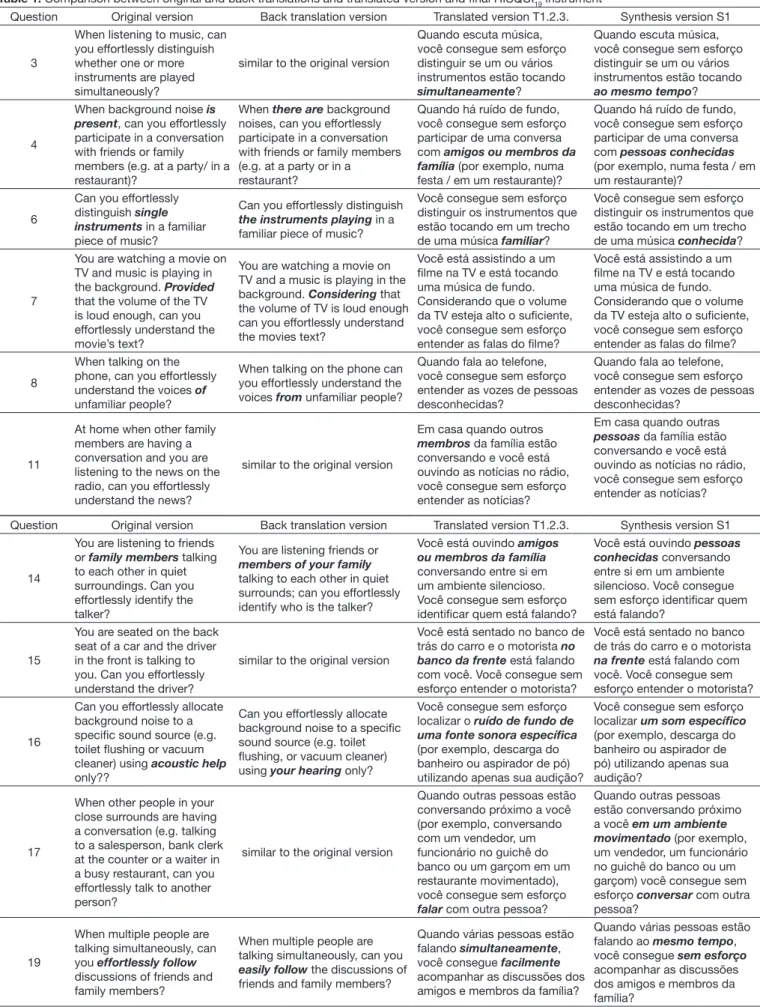
Each question was analyzed by comparing the original and
the back-translation “R.1.2.3” and the translation “T.1.2.3” and
the synthesis version “S1”, as shown in Table 1. Items 1, 2, 5, 9,
10, 12, 13 and 18 showed equal words used between the original
and back translation, besides there being full correspondence
between the translation text and synthesis version.
Items 3, 11, 15 and 17 had equal representation of words between the original and the back-translation, with the simple difference between the translation and the synthesis version. In item 3, the word “simultaneously” was changed to “the same time” to be a simpler term. In item 11, the noun “members” was
replaced by “people” to simplify the sentence according to the
context. In item 15, the word “bank” was removed in order to avoid redundancy. In item 17, the term “talk to” was translated as “falar” (to speak) and changed to “conversar” (to converse), as “conversar” is considered more appropriate considering the
context of the question.
For items 4, 6, 7, 8, 14, 16 and 19 of Table 1, there were
changes between the original version and the back-translation
due to words used in the translation. Even so, there was no change in the sense of denotative and connotative meaning between the two versions.
In the comparison between the original and the back-translation, item 4 showed the term “is present” translated to “há” (there is),
generating “there are” in the back translation; item 16 the
expression “acoustic help only” was translated to “apenas sua
audição” resulting in “your hearing only” in the back translation;
The only modiication of items 8 and 14 was the insertion of the
preposition “of” in exchange of “from” in item 8, and “family members” to “members of your family” in item 14.
Between the translated and the synthesized version, item 4 simpliied the expression “friends or family members” to “people you know”; item 16 summarized the expression “the background noise of a sound source” to “a speciic sound”; item 14, the term “friends or family members” was simpliied to “people you know”.
As for items 6, 7 and 19 there was a signiicant change between the terms of the original and back-translation version, however the real meaning was maintained. In item 6, the term “single instrument” was translated to “os instrumentos que
estão tocando” and back-translated to “the instrument playing.”
For the inal version, only the word “familiar” was changed to the word “known”.
However, in item 7 the word “provided” in the original version and “considering” in the back-translated version, both words being acceptable for the translation of the word “consider”, thus keeping the translation of this item in the inal version. In Item 19, the expression “effortlessly follow” in the original version was translated to “facilmente”(easily) and back-translated as “easily follow.” For the synthetic version, the term “facilmente” was replaced with “sem esforço”(without effort) and “simultaneamente” was simpliied to “at the same time.”
The analysis of the questionnaire scores indicates that most
respondents presented results for good sound quality with an average of 90.2 points.
It was found that question 13, “Can you hear the phone ringing effortlessly?” was elected by the participants as the easiest hearing situation, followed by questions 1, “Can you effortlessly distinguish between a male and a female voice?”; 5, “Can you easily hear the noise of a falling key, the whistle of the microwave or the purring of a cat?”; and 10, “Can you easily distinguish between a female voice and a child’s voice?”, with a predominance of responses being between “always” and “almost always”.
The degree of reliability of the questionnaire conirmed high reliability, with the value 0.83, with minimum and maximum values of coeficient of variation between 0.81 and 0.83, respectively. The minimum amount refers to Question 2, “When talking on the phone, can you easily understand the voices of
familiar people?”, and the maximum amount refers to question 13, “Can you effortlessly hear the phone ringing?”.
The analysis of grouped items in the same category showed performance variations in auditory tasks with the CI. The sound
Table 1. Comparison between original and back translations and translated version and final HISQUI19 instrument
Question Original version Back translation version Translated version T1.2.3. Synthesis version S1
3
When listening to music, can you effortlessly distinguish whether one or more instruments are played simultaneously?
similar to the original version
Quando escuta música, você consegue sem esforço distinguir se um ou vários instrumentos estão tocando
simultaneamente?
Quando escuta música, você consegue sem esforço distinguir se um ou vários instrumentos estão tocando
ao mesmo tempo?
4
When background noise is present, can you effortlessly participate in a conversation with friends or family members (e.g. at a party/ in a restaurant)?
When there are background noises, can you effortlessly participate in a conversation with friends or family members (e.g. at a party or in a restaurant?
Quando há ruído de fundo, você consegue sem esforço participar de uma conversa com amigos ou membros da família (por exemplo, numa festa / em um restaurante)?
Quando há ruído de fundo, você consegue sem esforço participar de uma conversa com pessoas conhecidas
(por exemplo, numa festa / em um restaurante)?
6
Can you effortlessly distinguish single instruments in a familiar piece of music?
Can you effortlessly distinguish
the instruments playing in a familiar piece of music?
Você consegue sem esforço distinguir os instrumentos que estão tocando em um trecho de uma música familiar?
Você consegue sem esforço distinguir os instrumentos que estão tocando em um trecho de uma música conhecida?
7
You are watching a movie on TV and music is playing in the background. Provided
that the volume of the TV is loud enough, can you effortlessly understand the movie’s text?
You are watching a movie on TV and a music is playing in the background. Considering that the volume of TV is loud enough can you effortlessly understand the movies text?
Você está assistindo a um filme na TV e está tocando uma música de fundo. Considerando que o volume da TV esteja alto o suficiente, você consegue sem esforço entender as falas do filme?
Você está assistindo a um filme na TV e está tocando uma música de fundo. Considerando que o volume da TV esteja alto o suficiente, você consegue sem esforço entender as falas do filme?
8
When talking on the phone, can you effortlessly understand the voices of
unfamiliar people?
When talking on the phone can you effortlessly understand the voices from unfamiliar people?
Quando fala ao telefone, você consegue sem esforço entender as vozes de pessoas desconhecidas?
Quando fala ao telefone, você consegue sem esforço entender as vozes de pessoas desconhecidas?
11
At home when other family members are having a conversation and you are listening to the news on the radio, can you effortlessly understand the news?
similar to the original version
Em casa quando outros
membros da família estão conversando e você está ouvindo as notícias no rádio, você consegue sem esforço entender as notícias?
Em casa quando outras
pessoas da família estão conversando e você está ouvindo as notícias no rádio, você consegue sem esforço entender as notícias?
Question Original version Back translation version Translated version T1.2.3. Synthesis version S1
14
You are listening to friends or family members talking to each other in quiet surroundings. Can you effortlessly identify the talker?
You are listening friends or
members of your family
talking to each other in quiet surrounds; can you effortlessly identify who is the talker?
Você está ouvindo amigos ou membros da família
conversando entre si em um ambiente silencioso. Você consegue sem esforço identificar quem está falando?
Você está ouvindo pessoas conhecidas conversando entre si em um ambiente silencioso. Você consegue sem esforço identificar quem está falando?
15
You are seated on the back seat of a car and the driver in the front is talking to you. Can you effortlessly understand the driver?
similar to the original version
Você está sentado no banco de trás do carro e o motorista no banco da frente está falando com você. Você consegue sem esforço entender o motorista?
Você está sentado no banco de trás do carro e o motorista
na frente está falando com você. Você consegue sem esforço entender o motorista?
16
Can you effortlessly allocate background noise to a specific sound source (e.g. toilet flushing or vacuum cleaner) using acoustic help
only??
Can you effortlessly allocate background noise to a specific sound source (e.g. toilet flushing, or vacuum cleaner) using your hearing only?
Você consegue sem esforço localizar o ruído de fundo de uma fonte sonora específica
(por exemplo, descarga do banheiro ou aspirador de pó) utilizando apenas sua audição?
Você consegue sem esforço localizar um som específico
(por exemplo, descarga do banheiro ou aspirador de pó) utilizando apenas sua audição?
17
When other people in your close surrounds are having a conversation (e.g. talking to a salesperson, bank clerk at the counter or a waiter in a busy restaurant, can you effortlessly talk to another person?
similar to the original version
Quando outras pessoas estão conversando próximo a você (por exemplo, conversando com um vendedor, um funcionário no guichê do banco ou um garçom em um restaurante movimentado), você consegue sem esforço
falar com outra pessoa?
Quando outras pessoas estão conversando próximo a você em um ambiente movimentado (por exemplo, um vendedor, um funcionário no guichê do banco ou um garçom) você consegue sem esforço conversar com outra pessoa?
19
When multiple people are talking simultaneously, can you effortlessly follow
discussions of friends and family members?
When multiple people are talking simultaneously, can you
easily follow the discussions of friends and family members?
Quando várias pessoas estão falando simultaneamente, você consegue facilmente
acompanhar as discussões dos amigos e membros da família?
Quando várias pessoas estão falando ao mesmo tempo, você consegue sem esforço
showed the best performance with the highest percentage of responses of “always” on the Linkert scale.
The answers obtained for the identiication of categories of
musical sounds, understanding on the phone, speech understanding
of television and radio programs with background noises, speech understanding in noisy public environments, understanding conversation in noisy backgrounds ranged evenly on the seven
point Linkert scale.
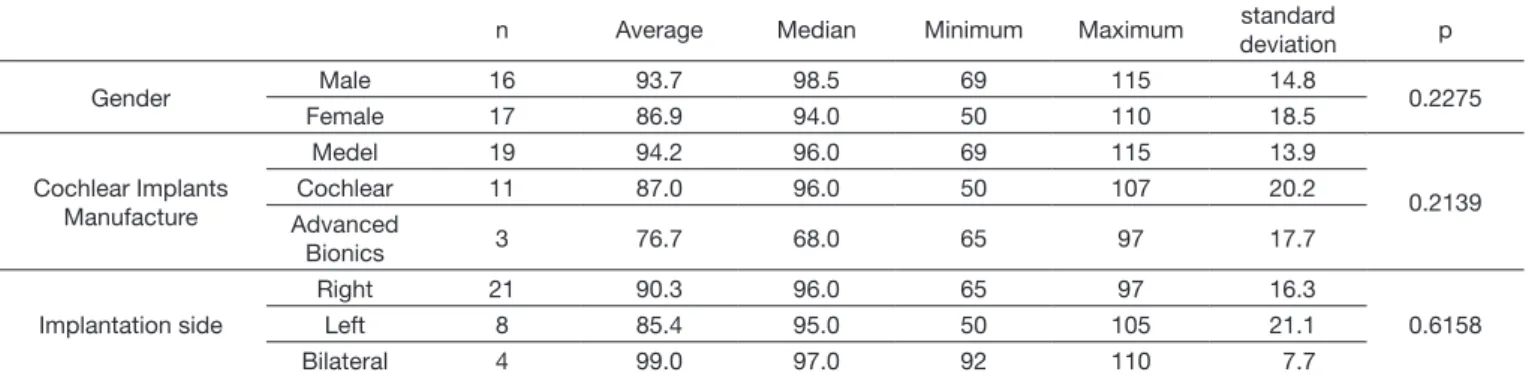
As shown in Table 2, there were no statistically signiicant
differences between female and male samples (p = 0.23). In the
cochlear implant brand category, Medel company had the most
representation and the best performance in the survey even though there was no statistically signiicant difference between companies (p = 0.21). As for the implant side, the bilateral implant showed better performance, but it was not statistically signiicant (p = 0.61).
In the correlation between the score of HISQUI19, age variable, level of education, hearing loss time and activation time, there was no signiicance (p> 0.05).
DISCUSSION
Self-assessment questionnaires provide subjective data that enable practicing professionals the knowledge of dificulties in hearing impaired patients in speciic daily(17) situations, allowing
CI mapping in the rehabilitation process in accordance with different technologies and performance of each individual in particular. One can minimize or even solve some of these dificulties in order to provide the CI users a better quality of life.
As for the HISQUI questionnaire in particular, this study further concludes that the questions and structure of the HISQUI
are well designed and appropriately elaborated to incorporate
the concepts related to hearing impairment and the analysis of
satisfaction of CI users. Taking into consideration the speciic
scenario of the Brazilian population, of any social class or region
of the country, all items remained without concept modiication from the original version, which conirms its versatility from a cross cultural perspective.
As a questionnaire for the hearing impaired population,
common words used in everyday life were chosen.
The pretest was an easy and quick application. The items questions were read out loud to analyze the possible dificulties of the participants, proper understanding of all questions were observed, which shows loyalty in the process of translation and back translation. The table presented with seven options of
responses associated to the percentage of situation occurrences
facilitated the respondent to adequately answer the questions. By analyzing the pretest values, it was found that 70% of respondents had results between good sound quality and very good in relation to the CI. This can be considered as positive for the performance of speech perception with the CI. The patients with bilateral implants indicated the best performance in the survey with an average of 99 points. However although the good performance of the bilateral implant patients, there was no statistically signiicant difference when compared with other implantation side, which is most likely a result of the reduced sample number of bilateral implant patients (n = 4).
However, the worst performers in the survey were two individuals with unilateral CI and of the same age. One of the respondents had the lowest activation time, which justiied the communication dificulties at the time of test administration; and the other, with more than ive years of activation, consistently commented on the dificulty of understanding speech in a noisy environment.
Hearing performance was grouped according to the original(13) study. It was found that the categories of location of sound and distinction of voices and speaker, showed the best performance
Figure 1. Graphic of questions in relation to Location of Sound category
Caption: Question 5 “Can you effortlessly hear noises such as falling keys, the beeping of the microwave or the purring of a cat?”; Question 13 “Can you effortlessly hear the ringing of the phone?”; Question 16 “Can you effortlessly allocate background noise to a specific sound source (e.g. toilet flushing or vacuum cleaner) using acoustic help only?”
Table 2. Statistical values and references between the score HISQUI19 and the categories gender, cochlear implant manufacture and implantation side
n Average Median Minimum Maximum standard
deviation p
Gender Male 16 93.7 98.5 69 115 14.8 0.2275
Female 17 86.9 94.0 50 110 18.5
Cochlear Implants Manufacture
Medel 19 94.2 96.0 69 115 13.9
0.2139
Cochlear 11 87.0 96.0 50 107 20.2
Advanced
Bionics 3 76.7 68.0 65 97 17.7
Implantation side
Right 21 90.3 96.0 65 97 16.3
0.6158
Left 8 85.4 95.0 50 105 21.1
Bilateral 4 99.0 97.0 92 110 7.7
(highest percentage in the option “always”). This leads to the
conclusion, as discussed in other studies(12,18), that rehabilitation through CI allows adults to easily and quickly develop the same auditory tasks, in this study, whether a unilateral or bilateral
CI user.
The answers in the categories that involve communicating with noise are far more varied in hearing performance, which reveals the dificulty in conversations with noisy backgrounds(18), regardless of whether the implant enables effective communication.
Despite technological advances, patients still have dificulty in understanding speech in noisy environments, speech
understanding on the phone and musical perception(7,8,18-20). For this reason, there has been an attempt to lessen these dificulties in
understanding through the use of auxiliary resources such as
frequency modulation (FM) system, a speciic accessory which helps in speech perception in noisy environments.
In self-assessment skills or daily hearing dificulties, the
HISQUI19 (Annex A) becomes an important tool to be used at the beginning of the process and during the use of the CI to
measure self-improvement in auditory perception.
CONCLUSION
The translation and adaptation of the questionnaire HISQUI19
showed suitability for semantic, cultural, item and conceptual equivalence.
In the sample characterization, the sound quality was rated as good with better performance in the location and distinction of sounds / voices categories and greater dificulty for the tasks
of speech understanding on the phone.
For future research and effective validation purposes of the
Brazilian population, it is suggested to apply the translated and adapted questionnaire into a broader sample and compare the
future results with those that formed the basis of this work and with those of other countries.
ACKNOWLEDGEMENTS
Thanks to the Department of Speech Language Pathology,
Universidade Federal de São Paulo in making this research possible which generated this dissertation. Thanks to the Center
of the Hearing Impaired, Department of Otorhinolaryngology,
Universidade Federal de São Paulo that allowed the collection of data with their patients. Thanks to translation employees. Ms. Zeila Santos, Ms. Sheila Vieira, PhD. Erika Bucuvic and
partner of PhD Sueli Caporali and PhD Brasilia Maria Chiari in the production of the study.
REFERENCES
1. Andrade S, Peixoto C, Alves M, Martins JH, Verissimo MT, Quadros J, et al.
Reabilitação auditiva por implante coclear na população geriátrica. Cad.
Otorrinolaringol. 2012;18:1-6.
2. Ricketts TA, Grantham DW, Ashmead DH, Haynes DS, Labadie RF. Speech recognition for unilateral and bilateral cochlear implant modes in
the presence of uncorrelated noise sources. Ear Hear. 2006;27(6):763-73. http://dx.doi.org/10.1097/01.aud.0000240814.27151.b9. PMid:17086085. 3. Santos KTP, Fernandes JC, Amorim RB, Bevilacqua MC. Avaliação da
percepção da fala no ruído em diferentes posições em adultos com implante
coclear. Int Arch Otorhinolaryngol. 2009;13(1):16-23.
4. Granço FS, Fernandes NF, Morettin M, Costa OA, Bevilacqua MC. The
relationship between the speech perception and the degree of satisfaction
among adult users of cochlear implants. Int Arch Otorhinolaryngol. 2013;17(2):202-7. PMid:25992014.
5. Garstecki DC, Erler SF. Older adult performance on the Comunication Profile for the Hearing Impairment: gender difference. J Speech Lang Hear Res. 1999;42(4):785-96. http://dx.doi.org/10.1044/jslhr.4204.785. PMid:10450900.
6. Magalhães ATM, Goffi-Gomez MVS, Hoshino AC, Tsuji RK, Bento RF, Brito R. Converted and upgraded maps programmed in the newer speech processor for the first generation of multichannel cochlear implant. Otol Neurotol. 2013;34(7):193-200. PMid:23921918.
7. Soares AD. Contribuição da percepção auditiva no mapeamento de processadores de fala em usuários de implante coclear [tese]. São Paulo:
Universidade Federal de São Paulo; 2014.
8. Fuller C, Free R, Maat B, Baskent D. Musical background not associated
with self perceived hearing performance or speech perception in postlingual
cochlear implant user. J Acoust Soc Am. 2012;132(2):1009-16. http:// dx.doi.org/10.1121/1.4730910. PMid:22894221.
9. Laske RD, Veraguth D, Dillier N, Binkert A, Holzmann D, Huber AM.
Subjective and objective results after bilateral cochlear implantation
in adults. Otol Neurotol. 2009;30(3):313-8. http://dx.doi.org/10.1097/ MAO.0b013e31819bd7e6. PMid:19318885.
10. Perreau A, Ou H, Tyler R, Dunn C. Self reported spatial hearing abilities across different cochlear implant profiles. Am J Audiol. 2014;23(4):374-84. http://dx.doi.org/10.1044/2014_AJA-14-0015. PMid:25093507. 11. Hinderink JB, Krabbe PFM, Van Den Broek P. Development and application
of a health- related quality-of-life instrument for adults with cochlear implants:
The Nijmegen Cochlear Implant Questionnaire. Otolaryngol Head Neck Surg. 2000;123(6):756-65. http://dx.doi.org/10.1067/mhn.2000.108203. PMid:11112975.
12. Tyler RS, Perreau AE, Ji H. The Validation of the Spatial Hearing Questionnaire. Ear Hear. 2009;30(4):466-74. http://dx.doi.org/10.1097/ AUD.0b013e3181a61efe. PMid:19494777.
13. Amann E, Anderson I. Development and validation of a questionnaire for
hearing implant users to self-assess their auditory abilities in everyday
communication situations: the Hearing Implant Sound Quality Index (HISQUI19). Acta Otolaryngol. 2014;134(9):915-23. http://dx.doi.org/1 0.3109/00016489.2014.909604. PMid:24975453.
14. Guillemin F, Bombardier C, Beaton D. Cross-cultural adaptation of health
related quality os life measure: literature review and proposed guidelines.
J Clin Epidemiol. 1993;46(12):1417-32. http://dx.doi.org/10.1016/0895-4356(93)90142-N. PMid:8263569.
16. Reichenheim ME, Moraes CL. Operacionalização de adaptação transcultural
de instrumentos de aferição usados em epidemiologia. Rev Saude Publica.
2007;41(4):665-73. http://dx.doi.org/10.1590/S0034-89102006005000035. PMid:17589768.
17. Noble W, Tyler RS, Dunn CC, Bhullar N. Younger- and older-age adults
with unilateral and bilateral cochlear implants: speech and spatial hearing
self-ratings and performance. Otol Neurotol. 2009;30(7):921-9. http:// dx.doi.org/10.1097/MAO.0b013e3181b76b3b. PMid:19692936. 18. Gatehouse S, Noble W. The speech, spatial and qualities of hearing scale (SSQ).
Int J Audiol. 2004;43(2):85-99. http://dx.doi.org/10.1080/14992020400050014. PMid:15035561.
19. Nascimento LT, Bevilacqua MC. Avaliação da percepção de fala com ruído
competitivo em adultos com implante coclear. Rev Bras Otorrinolaringol.
2005;71(4):432-8. http://dx.doi.org/10.1590/S0034-72992005000400006. 20. Lassaletta L, Castro A, Bastarrica M, Pérez-Mora R, Herrán B, Sanz
L, et al. Musical perception and enjoyment in post lingual patients with cochlear implant. Acta Otorrinolaringol Esp. 2008;59(5):228-34. http:// dx.doi.org/10.1016/S0001-6519(08)73300-4. PMid:18501158.
Author contributions
Annex A. Questionnaire HISQUI19 and score of the assessment performance
Hearing Implant Sound Quality Index (HISQUI19)
Check the answer boxes which correspond the closest to your everyday experiences. Each answer option also includes a percentage value. This percentage value will help the patients answering the questions. If a speciic situation/statement is not applicable, please check the box “N/A = not applicable“.
Always (99%)
Almost always (87%)
Frequently (75%)
Mostly (50%)
Occasionally (25%)
Rarely (12%)
Never
(1%) N/A
1. Can you effortlessly distinguish between a male and a female voice? 2. When talking on the
phone, can you effortlessly understand the voices of familiar people?
3. When listening to music, can you effortlessly distinguish whether one or multiple instruments are being played simultaneously? 4. When background noise
is present, can you effortlessly participate in a conversation with friends or family members (e.g. at a party/ in a restaurant)? 5. Can you effortlessly hear
noises such as falling keys, the beeping of the microwave or the purring of a cat?
6. Can you effortlessly distinguish single instruments in a familiar piece of music?
7. You are watching a movie on TV and music is playing in the background. Provided that the volume of the TV is loud enough, can you effortlessly understand the movie’s text?
8. When talking on the phone, can you effortlessly understand the voices of unfamiliar people? 9. Can you effortlessly
understand a speech/ lecture in a hall (e.g. lecture hall, church)?
10. Can you effortlessly distinguish between a female voice and a child’s voice (6-10 years of age)? 11. At home when other family
Annex A. Continued...
Always (99%)
Almost always (87%)
Frequently (75%)
Mostly (50%)
Occasionally (25%)
Rarely (12%)
Never
(1%) N/A
12. Can you effortlessly understand the announcement in a bus terminal, a train station or an airport?
13. Can you effortlessly hear the ringing of the phone? 14. You are listening to friends
or family members talking to each other in quiet surroundings. Can you effortlessly identify the talker?
15. You are seated on the back seat of a car and the driver in the front is talking to you. Can you effortlessly understand the driver? 16. Can you effortlessly
allocate background noise to a specific sound source (e.g. toilet flushing or vacuum cleaner) using acoustic help only? 17. When other people in your
close surrounding are having a conversation (e.g. talking to a salesperson, a bank clerk at the counter or a waiter in a busy restaurant), can you effortlessly talk to another person?
18. When background noise is present (e.g. in the office, printer, copier, air conditioning, fan, traffic noise, in busy restaurants, at parties, noisy children), can you effortlessly participate in a conversation with multiple people?
Calculation of the Total score (to be illed out by the tester):
The total HISQUI19 score lies between 19 and 133 points. Each response option corresponds to a numerical value (see below). 7
Always (99%)
6 Almost always
(87%)
5 Frequently
(75%)
4 Mostly
(50%)
3 Occasionally
(25%)
2 Rarely
(12%)
1 Never
(1%)
0 N/A Annex A. Continued...
Please enter the numerical value of each of the 19 questions in the HISQUI19 evaluation matrix shown below. If a question was not answered or the answer was “not applicable” (N/A), that question should be treated as a missing value. In the appropriate
box in the HISQUI19 evaluation matrix mark the ield concerned with an X.
HISQUI19 Evaluation Matrix
Question 1 Question 11
Question 2 Question 12
Question 3 Question 13
Question 4 Question 14
Question 5 Question 15
Question 6 Question 16
Question 7 Question 17
Question 8 Question 18
Question 9 Question 19
Question 10
Total Score
The total HISQUI19 score is obtained by adding the numerical values of all 19 questions. The score achieved overall indicates how good or poorly you find the sound quality in your personal, everyday listening situation with your hearing implant. The table should help you to interpret your individual result
Achieved Total Score
very poor sound quality < 30
poor sound quality 30-60
moderate sound quality 60-90
good sound quality 90-110