Photometric analysis of esthetically pleasant and
unpleasant facial profile
Helena Nunes da Rocha Fortes1, Thamirys Correia Guimarães1, Ivana Mara Lira Belo2, Edgard Norões Rodrigues da Matta3
How to cite this article: Fortes HNR, Guimarães TC, Belo IML, Matta ENR. Photometric analysis of esthetically pleasant and unpleasant facial profile. Dental Press J Orthod. 2014 Mar-Apr;19(2):66-75. doi: http://dx.doi.org/10.1590/2176-9451.19.2.066-075.oar
» The authors report no commercial, proprietary or financial interest in the prod-ucts or companies described in this article.
Contact address: Edgard Norões Rodrigues da Matta Rua Abdon Arroxelas, 448 – Apto. 504 – Maceió/AL — Brazil CEP: 57035-380 – E-mail: [email protected] » Patients displayed in this article previously approved the use of their facial and
intraoral photographs.
1 Degree in Dentistry, Federal University of Alagoas (UFAL).
2 Specialist in Orthodontics, School of Dentistry — University of São Paulo/
Bauru.
3 Adjunct professor, Federal University of Alagoas (UFAL).
Submitted: May 30, 2012 - Revised and accepted: December 10, 2012
Objective:To identify which linear, angular and proportionality measures could influence a profile to be considered esthetically pleasant or unpleasant, and to assess sexual dimorphism. Methods: 150 standardized facial profile photographs of dental students of both sexes were obtained and printed on photographic paper. Ten plastic surgeons, ten orthodontists and ten layperson answered a questionnaire characterizing each profile as pleasant, acceptable or unpleasant. With the use of a score system, the 15 most pleasant and unpleasant profiles of each sex were selected. The photographs were scanned into AutoCAD computer software. Linear, angular and proportion measurements were obtained using the software tools. The average values between groups were compared by the Student’s t-test and the Mann-Whitney test at 5%. Results: The linear measures LL-S, LL-H, LL-E, LL-B and Pn-H showed statistically significant differences (p < 0.05). Statistical differences were also found in the angular measures G’.Pn.Pg’, G’.Sn.Pg’ and Sn.Me’.C and in the proportions G’-Sn:Sn-Me’ and Sn-Gn’:Gn’-C (p < 0.05). Differences between sexes were found for the linear measure Ala-Pn, angles G’-Pg’.N-Pn, Sn.Me’.C, and proportions Gn’-Sn:Sn-Me’ and Ala-Pn:N’-Sn. (p < 0.05). Conclusion: The anteroposterior position of the lower lip, the amount of nose that influences the profile, facial convexity, total vertical proportion and lip-chin proportion appear to influence pleasantness of facial profile. Sexual dimorphism was identified in nasal length, nasofacial and lower third of the face angles, total vertical and nasal height/length proportions.
Keywords:Esthetics. Photography. Orthodontics.
Objetivo:identificar quais medidas lineares, angulares e de proporcionalidade influenciam para um perfil ser considerado agradável ou desagradável, e avaliar o dimorfismo sexual. Métodos: foram obtidas e impressas em papel fotográfico 150 fotografias padro-nizadas do perfil facial de acadêmicos de Odontologia de ambos os sexos. Dez cirurgiões-plásticos, dez ortodontistas e dez leigos responderam um questionário caracterizando cada perfil em agradável, aceitável ou desagradável. Com a utilização de um sistema de escore, foram selecionadas as fotografias dos 15 perfis mais agradáveis e dos 15 mais desagradáveis de cada sexo. As fotografias foram digitalizadas para o programa de computador AutoCAD, e medidas lineares, angulares e de proporcionalidade foram men-suradas utilizando-se ferramentas do programa. As médias obtidas entre os grupos foram comparadas pelos testes t de Student e de Mann-Whitney a 5%. Resultados: as medidas lineares Li-S, Li-H, Li-E, Li-B e Pn-H apresentaram diferenças estatisticamente significativas (p < 0,05). Os ângulos G’.Pn.Pg’, G’.Sn.Pg’ e Sn.Me’.C e as medidas de proporcionalidade G’-Sn:Me’ e Sn--Gn’:Gn’-C também apresentaram diferenças significativas (p < 0,05). Diferenças significativas entre os sexos foram identificadas na medida linear Ala-Pn, nos ângulos G’-Pg’.N’-Pn, Sn.Me’.C e proporções Gn’-Sn:Sn-Me’ e Ala-Pn:N’-Sn (p < 0,05). Conclusão:
o posicionamento anteroposterior do lábio inferior, a quantidade do nariz que influencia o perfil, a convexidade facial, a proporção vertical total e lábio-queixo parecem influenciar a agradabilidade do perfil facial. Dimorfismo sexual foi identificado na medida linear comprimento nasal, nos ângulos nasofacial e terço inferior da face e nas proporções vertical total e comprimento/altura nasal.
INTRODUCTION
Facial esthetics is considered a signiicant factor with regard to the perceptions of society and individuals in relation to themselves. Additionally, it plays an impor-tant role in the assessment of personality and social ac-ceptance.1 The ability in recognizing a beautiful face
is innate,2 and the development of esthetic perception
happens since childhood.1,3
A good facial esthetics is one of the factors that inlu-ences the judgement of beauty which is related to the individual’s relationship with society, thus enhancing self-esteem.1 80% of adults seeking orthodontic
treat-ment for themselves or their children do so based on esthetic motivations, regardless of functional and struc-tural conditions.4 Therefore, as the goal of most patients
is having an esthetically pleasing face, orthodontic treat-ment plays an important role by modifying the position of teeth, bones and associated sot tissues.
In this context, orthodontic treatment should aim not only at correcting the position of teeth in the bone bases, but also at achieving the best possible facial coniguration, associating a harmonious face with an ideal occlusion.5 It is known that the results obtained
from the cephalometric normative values otentimes do not correspond with the individual patterns of each patient.1,6 Many authors have attempted to deine the
facial features responsible for a pleasant facial esthet-ics and observed that the constituent parts of a facial proile, when in harmony and balance, were associated with facial pleasantness.7
Studying facial proile through sot tissues has be-come object of interest among professionals in the orth-odontic ield over the years. This analysis can be used to assess the face not only in terms of changes induced by orthodontic treatment or growth, but also facial esthet-ics,8 considered as the best determinant of orthodontic
treatment outcomes.9
There are several methods used to analyze cranio-facial morphology in cranio-facial proile, one of which is achieved at the expense of standardized photographs which occupy a prominent place in facial analysis, being routinely performed by most orthodontists.5
Photographs provide a good assessment of harmony between the external craniofacial structures, including the contribution of sot tissues, in addition to provid-ing reliable measurements,10 allowing a quick capture
of facial image, having long-term durability and the
possibility of taking repeated measurements.11 Through
photometric analysis of the facial proile, proportional-ity, angular and linear measurements can be obtained. To many researchers, these measures serve as a param-eter to better deine normal conditions, harmony and balance of the proile.12
Several studies have tried to ind the characteristics responsible for facial pleasantness, classifying facial pro-iles by subjective analysis of photographs, noting ortho-dontists and laypeople’s point of view.1,3,13,14 Others have
sought to study some characteristics that can inluence the esthetics of the proile,9,12,15 however, what makes a
facial proile to be considered more esthetic is not yet fully understood by all clinicians.16
Therefore, this study aimed at assessing through standardized photographs which linear, angular and proportionality measures difer from proiles classiied as esthetically pleasant and unpleasant.
MATERIAL AND METHODS
This research was approved by the Federal Universi-ty of Alagoas Institutional Review Board and was regis-tered under the number 007455/2009-43. The partici-pants who were photographed as well as the evaluators signed a consent form.
For this study, 150 (75 males and 75 females) dental students, aged between 17 years and 9 months to 32 years old, were selected. In selecting the sample, the following inclusion criteria were applied: the sub-jects should be caucasian; mesofacial; should not wear orthodontic appliances or any other intraoral device that could inluence the proile; and should not present facial asymmetry or evident vertical or sagittal discrep-ancy. Sample size was deined on the basis of conve-nience, gathering the largest number of students who agreed to participate in the study. Due to the diicul-ties of scientiically deining race and ethnicity, and because of the great racial mixture of Brazilian people, race was classiied by skin color in Caucasian, Mon-goloid and Melanoderm. This classiication method is widely used in Orthodontics, and for this study, only Caucasians were selected.
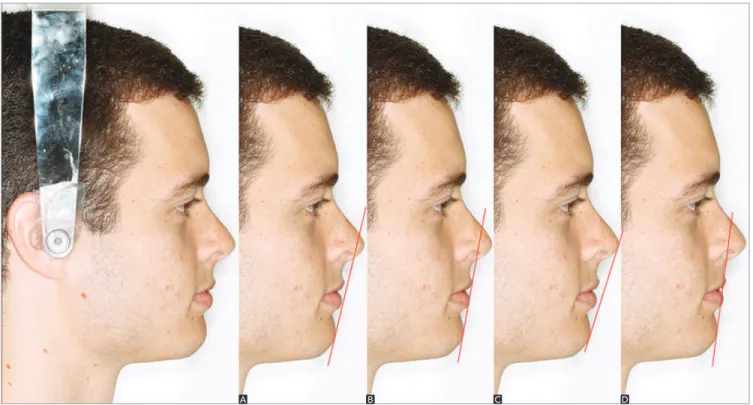
obtained by a single operator, in the same environ-ment, at the same distance between the research subject and the camera. Moreover, all the other pho-tographic parameters were also standardized, name-ly: aperture f11, shutter speed 1/125 and ISO 200. Patients were at rest position, completely relaxed and positioned in a cephalostat (Fig 1).
The photographs were printed on Kodak glossy photo paper (Kodak do Brasil, São José dos Campos, Brazil), size 15x21, using a Noritsu 1501 professional printer (Noritsu Koki Co Ltd, Tokyo, Japan). They were di-vided into two books, one comprising male photo-graphs and another comprising female photophoto-graphs, which were delivered to the evaluators — 10 ortho-dontists, 10 plastic surgeons and 10 laypeople — at their workplaces. The evaluators had to answer to a questionnaire, and for each photograph there were three choices: esthetically pleasant, acceptable or un-pleasant facial proile. Ater the questionnaires were collected, a score system was applied. The photo-graphs classiied as presenting an esthetically pleasant proile received a score of +1, acceptable proile was scored with 0 and unpleasant proile with -1. Thus, each photograph could receive a total score that ranged from -30 to +30. This scoring system was only used to select the 15 most pleasant and unpleasant photo-graphs, with no descriptive statistics being performed on the data obtained, only the total sum of points was performed. This study did not assess the diferences in perception of diferent groups of evaluators. The latter were used to ensure that the diferent concepts of fa-cial esthetics of professional and lay groups were pres-ent in the selection of pleasant and unpleasant proiles. Aterwards, the 15 males and 15 females’ photographs with the highest scores were selected as representative of an esthetically pleasant proile, whereas the 15 males and 15 females’ with the lowest scores were selected as esthetically unpleasant. In selecting the esthetically pleasant facial proiles, should there be a draw score , the following tie-breakers were used in the following priority order: photograph with the highest number of +1 scores, with the greatest number of 0 scores and the lowest number of -1 scores; classiication or not in the assessment of the 30 evaluators . In selecting the esthetically unpleasant facial proiles, should there be a draw score, the following tie-breakers were used in the following order of priority: photograph with the
highest number of -1 scores, with the highest number of 0 scores and the lowest number of +1 scores; clas-siication or not in the assessment of the 30 evaluators. Ater that, the photographs were scanned on a HP G2410 scanner (Hewlett-Packard Company, Palo Alto, Cali, USA), under 300 dpi resolution, and saved in the AutoCAD 2007 sotware (Autodesk, Inc, San Rafael, Cali, USA).
To eliminate distortion between the actual size of the face and the size of the photograph, the metal screw of the cephalostat, which is well deined on the photograph, served as a reference. Its actual size was measured with the use of a digital caliper. The actual diameter of the screw of the cephalostat is 15.79 mm. Thus, a circle with the same diameter of the cepha-lostat screw was designed in the AutoCad sotware. Then, the images of the screws in each photograph were adjusted to it the circle drawn in the sotware. Consequently, the measurements obtained in the sot-ware are equivalent to the actual measurements, thus, eliminating the need for obtaining a correction factor.
The facial points markings and measurements were performed by the same operator. The markings were done in two days and the measurements were taken within 6 days (10 photos a day) in order to avoid fatigue and, as a consequence, operator’s error. The photo-graphic reference points were selected according to pre-vious studies conducted by Trevisan and Gil8 as well as
Sutter and Turley,17 as shown in Figure 1.
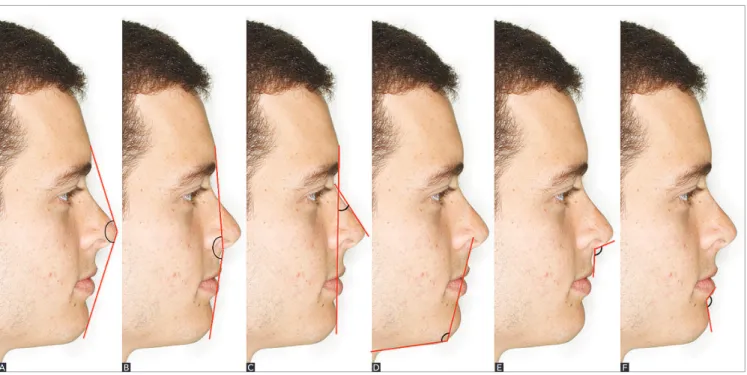
For proile analysis, the reference lines used in the cephalometric analysis of Steiner, Holdaway, Ricketts and Burstone were drawn to obtain linear measure-ments that assess the distance from points UL, LL, and Pn to these lines, as shown in Figure 2. As for mea-surement of nasal length, the distance between the Ala-Pn points was measured. Angular and propor-tionality measurements were obtained according to Trevisan and Gil8 as well as Sutter and Turley17 using
an AutoCAD sotware tool. Such measurements are shown in Figures 3 and 4, respectively.
Statistical analysis
Figure 1 - Photographic reference points.
Figure 2 - Reference lines - A) Steiner S line; B) Holdaway H line; C) Ricketts E line D) Burstone B line.
A B C D
Ls
Figure 3 - Angular measurements and reference lines: A) Total facial convexity angle (G’.Pn.Pg’); B) Facial convexity angle (G’.Sn.Pg’); C) Nasofacial angle (G’-Pg’.N’-Pn); D) Lower third angle (Sn.Me’.C); E) Nasolabial angle (UL.Sn.Co);F) Mentolabial angle (Pg’.B’.LL).
Figure 4 - Measures of proportionality used in this study: A) Total vertical proportion (G’-Sn:Sn-Me’); B) Inferior third of the face proportion (Sn-St:St-Me’);
C) Nasal height /length proportion (Ala-Pn:N’-Sn); D) Lip-chin proportion (Sn-Gn’:Gn’-C).
A B C D E F
distribution, a parametric test (Student’s t-test) was used, and for variables not normally distributed the non-parametric Mann-Whitney test was used, both with a signiicance level set at 5%.
Method error
For intra-examiner error, 30 days ater the measure-ments had been taken, 1/3 of the measures of all vari-ables were repeated and the irst and second measures were compared. The random error was calculated in ac-cordance with the formula proposed by Dahlberg and advocated by Houston.18 The deviation values were
ac-ceptable below 1 mm for the linear measurements,and 1.5o for angular measurements. The systematic error
was analyzed by paired Student’s t-test for the measures that were normally distributed, whereas the Wilcoxon test was used for measures that were not normally dis-tributed, both with a signiicance level set at 5%.
RESULTS
In order to test the hypothesis that the variables fol-low a normal distribution, the normality test of Kol-mogorov-Smirnov, with a signiicance level set at 5%, was employed. It showed that all linear measurements presented normal distribution, which allowed the use of a parametric test (Student’s t-test) when comparing the means. However, total facial convexity, nasofacial angles measurements and lip-chin proportion did not present normal distribution. For this reason, the non-parametric test of Mann-Whitney, with a signiicance level set at 5%, was used.
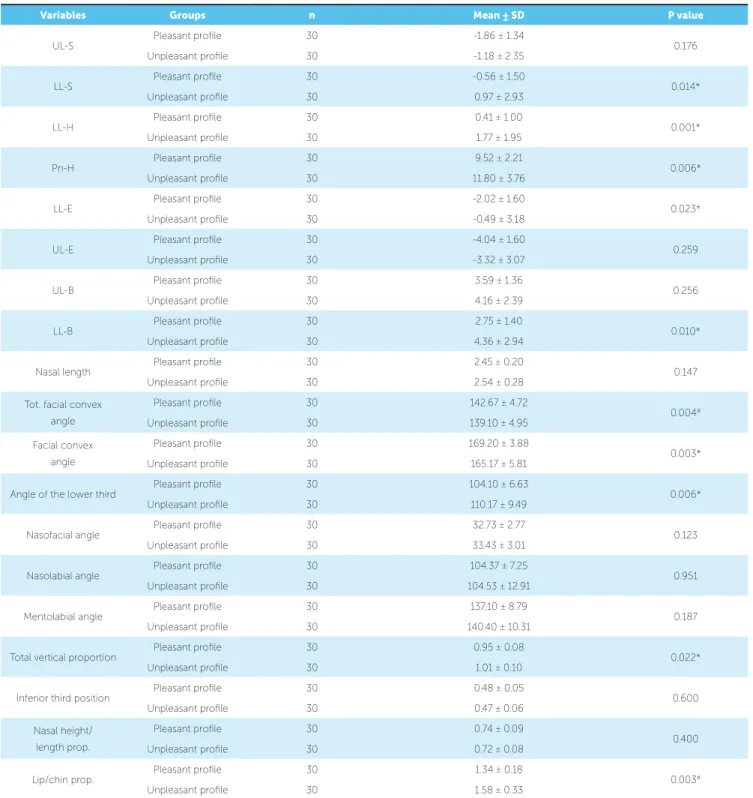
Random errors were detected in only two variables: angle of the lower third of the face and nasolabial angle. In assessing the systematic error, signiicant diferences were found in only two out of 19 variables: angle of the lower third of the face and lip-chin proportion. As shown in Table 1, which expresses the statistical results
of comparison between the linear measures of the two groups, all variables that assessed the position of the lower lip in relation to the reference lines (LL-S, LL H, LL-E, LL-B) and the distance Pn-H values, showed statistical signiicance diferences (p < 0.05).
The results presented in Table 1 show that the angular measurements (total facial convexity angle, facial convex-ity angle and angle of the lower third of the face), and the proportionality measurements (total vertical proportion and lip-chin proportion) showed p values < 0.05.
As for the assessment of sexual dimorphism, ac-cording to the Komogorov-Smirnov normality test at 5%, the following measures did not present a nor-mal distribution in the pleasant proile group: angle of the lower third of the face, nasal length/ height and lip-chin proportions. In the unpleasant proile group, nasofacial, nasolabial and mentolabial angles did not have a normal distribution either.
Table 2 reveals sexual dimorphism in nasal length, nasofacial and angle of the lower third of the face, total vertical, nasal height/length proportions in the pleasant proile group. Diferences between sexes were observed in the unpleasant proile group, in the linear measure nasal length, angle of the lower third of the face and the total vertical proportion.
DISCUSSION
Among the many goals of orthodontic treatment, proper teeth intercuspation and relationship with the skeletal bases, stability of results, correct occlusal func-tion and, at present, due to the great emphasis that has been given to esthetics, a harmonious facial proile, have taken a prominent position on the objectives to be achieved at the end of orthodontic treatment.
Variables Groups n Mean ± SD P value
UL-S Pleasant proile 30 -1.86 ± 1.34 0.176
Unpleasant proile 30 -1.18 ± 2.35
LL-S Pleasant proile 30 -0.56 ± 1.50 0.014*
Unpleasant proile 30 0.97 ± 2.93
LL-H Pleasant proile 30 0.41 ± 1.00 0.001*
Unpleasant proile 30 1.77 ± 1.95
Pn-H
Pleasant proile 30 9.52 ± 2.21
0.006*
Unpleasant proile 30 11.80 ± 3.76
LL-E Pleasant proile 30 -2.02 ± 1.60 0.023*
Unpleasant proile 30 -0.49 ± 3.18
UL-E Pleasant proile 30 -4.04 ± 1.60 0.259
Unpleasant proile 30 -3.32 ± 3.07
UL-B Pleasant proile 30 3.59 ± 1.36 0.256
Unpleasant proile 30 4.16 ± 2.39
LL-B
Pleasant proile 30 2.75 ± 1.40
0.010*
Unpleasant proile 30 4.36 ± 2.94
Nasal length Pleasant proile 30 2.45 ± 0.20 0.147
Unpleasant proile 30 2.54 ± 0.28
Tot. facial convex angle
Pleasant proile 30 142.67 ± 4.72
0.004#
Unpleasant proile 30 139.10 ± 4.95
Facial convex angle
Pleasant proile 30 169.20 ± 3.88
0.003*
Unpleasant proile 30 165.17 ± 5.81
Angle of the lower third
Pleasant proile 30 104.10 ± 6.63
0.006*
Unpleasant proile 30 110.17 ± 9.49
Nasofacial angle Pleasant proile 30 32.73 ± 2.77 0.123
Unpleasant proile 30 33.43 ± 3.01
Nasolabial angle Pleasant proile 30 104.37 ± 7.25 0.951
Unpleasant proile 30 104.53 ± 12.91
Mentolabial angle Pleasant proile 30 137.10 ± 8.79 0.187
Unpleasant proile 30 140.40 ± 10.31
Total vertical proportion Pleasant proile 30 0.95 ± 0.08 0.022*
Unpleasant proile 30 1.01 ± 0.10
Inferior third position
Pleasant proile 30 0.48 ± 0.05
0.600
Unpleasant proile 30 0.47 ± 0.06
Nasal height/
length prop.
Pleasant proile 30 0.74 ± 0.09
0.400
Unpleasant proile 30 0.72 ± 0.08
Lip/chin prop. Pleasant proile 30 1.34 ± 0.18 0.003#
Unpleasant proile 30 1.58 ± 0.33
Table 1 - Statistical results of comparison between groups.
* Statistical significance (p < 0.05) using Student’s parametric t test; # Statistical significance (p < 0.05) using Mann-Whitney non-parametric test.
Variables Sex Pleasant Unpleasant
P value p-valor Mean ± SD P value
UL-S Male -1.72 ± 1.26 0.587 -1.07 ± 1.74 0.815
Female -1.99 ± 1.45 -1.28 ± 2.90
LL-S Male -0.87 ± 1.33 0.276 0.75 ± 2.65 0.684
Female -0.26 ± 1.64 1.19 ± 3.26
LL-H Male 0.10 ± 0.75 0.089 1.45 ± 2.04 0.378
Female 0.72 ± 1.14 2.09 ± 1.88
Pn-H Male 9.75 ± 2.14 0.566 12.37 ± 3.58 0.411
Female 9.28 ± 2.32 11.22 ± 3.98
LL-E Male -2.35 ± 1.28 0.272 -0.75 ± 2.94 0.654
Female -1.69 ± 1.86 -0.22 ± 3.48
UL-E Male -3.78 ± 1.57 0.382 -3.61 ± 2.15 0.606
Female -4.30 ± 1.64 -3.02 ± 3.84
UL-B Male 3.86 ± 1.27 0.278 4.27 ± 1.69 0.817
Female 3.31 ± 1.44 4.06 ± 2.99
LL-B Male 2.55 ± 1.32 0.453 4.24 ± 2.66 0.823
Female 2.95 ± 1.50 4.49 ± 3.29
Nasal length Male 2.57 ± 0.16 0.000* 2.69 ± 0.27 0.002*
Female 2.33 ± 0.17 2.39 ± 0.20
Tot. facial convex angle
Male 141.60 ± 5.30
0.222 139.53 ± 5.33 0.640
Female 143.73 ± 3.95 138.67 ± 4.69
Facial convex
angle
Male 168.80 ± 4.44
0.581 165.40 ± 6.56 0.830
Female 169.60 ± 3.33 164.93 ± 5.19
Angle of the lower third Male 108.00 ± 5.92 0.001* 115.20 ± 7.76 0.002*
Female 100.20 ± 4.84 105.13 ± 8.48
Nasofacial angle Male 34.33 ± 2.66 0.001* 33.47 ± 3.72 0.629
Female 31.13 ± 1.81 33.40 ± 2.23
Nasolabial angle Male 103.47 ± 7.02 0.506 105.13 ± 12.70 0.604
Female 105.27 ± 7.61 103.93 ± 13.54
Mentolabial angle Male 137.47 ± 8.68 0.824 138.53 ± 10.33 0.290
Female 136.73 ± 9.18 142.27 ± 10.29
Total vertical proportion Male 0.92 ± 0.09 0.032* 0.96 ± 0.08 0.019*
Female 0.98 ± 0.05 1.05 ± 0.11
Inferior third position Male 0.48 ± 0.05 1.000 0.48 ± 0.05 0.247
Female 0.48 ± 0.05 0.46 ± 0.06
Nasal height/
length prop.
Male 0.78 ± 0.10
0.001# 0.72 ± 0.07 0.636
Female 0.69 ± 0.05 0.71 ± 0.10
Lip/chin prop. Male 1.35 ± 0.19 0.633 1.68 ± 0.38 0.073
Female 1.34 ± 0.18 1.47 ± 0.22
cephalometric radiographs were used for this purpose. Standardized photographs have currently gained signii-cant importance both clinically and in research, mainly because they reproduce the sot tissues in detail.7,8,10,13,19
When examining the error of the method, signii-cant diferences were found in three out of the 19 vari-ables analyzed, which can be interpreted as having used a very reliable method. The measures angle of the lower third of the face, nasolabial angle and lip-chin propor-tion showed signiicant errors. Thus, due the diiculty of reproducibility and/or precision of these variables, they should be clinically interpreted with caution.
In other articles, references have been made to the diiculty of measuring the angle of the lower third (Sn-Me ’and Me’-C) and lip-chin proportion (Sn-Gn’ and Gn’-C) due to the fact that both of them have the cervical point as reference, a point that is considered diicult to locate.10,19 The accumulation of adipose
tis-sue in the neck is cited as a factor that hinders mea-surement of the angle of the lower third of the face13
Reche et al19 also point out the diiculty of measuring
the nasolabial angle.
In this study, all linear measurements for the po-sitioning of the lower lip in relation to the reference lines were statistically diferent between the pleasant and unpleasant groups. With regard to the distance of the lower lip to the S line, the pleasant group present-ed a proile with slight lip retrusion (mean -0.57 mm), which agrees with the indings of Carvalho20.
Conse-quently, this study disagrees with the indings of Almei-da et al12 who claim that, in both sexes and regardless of
race, faces with lips touching the S line or with a slight protrusion are considered as pleasant. In recent research, Nomura et al15 investigated the preferences of evaluators
of diferent ethnic groups assessing the positioning of the lips, and concluded that the African group of evalu-ators selected as pleasant those proiles with an average of -2.13 mm for the E line, a value that is very close to -2,02 mm obtained in this study.
The distance Pn-H also difers in the comparison between groups, and clinically expresses the amount of the nose that afects the proile. In other words, it represents the relationship between the nose, the up-per lip and the chin, all of which are three important structures considered in the deinition of a proile. It is worth noting that nasal length showed no signiicant diference between the proiles considered pleasant
and unpleasant. For this reason, it can be deduced that the most important is not the size of the nose itself, but its relationship with other facial structures.
In the present study, the measures that assessed the inluence of facial convexity over pleasantness presented signiicant diferences between the pleasant and unpleas-ant groups. This diference was observed in both total facial convexity angle and angle of facial convexity and is in disagreement with Trevisan and Gil8 who found no
signiicant diferences in these variables between groups. However, these authors assessed patients with normal oc-clusion, whereas in this study, patient occlusion was not used as a criterion for inclusion or exclusion.
Data from this study corroborate the indings of a recent publication21 which found a strong
associa-tion between facial proile esthetics and facial convex-ity angles, and deduced that proiles of which angle is increased or reduced are considered less esthetically pleasant. The total facial convexity angle assesses how the nose contributes to face convexity.7 In this study,
the pleasant proiles mean of 142.37° (or 37.33° if we consider that some authors use the total value subtract-ed by 180°) agresubtract-ed with the average of 38.93° found by Reche et al.19 The facial convexity angle determines the
harmony of the face in the middle and lower thirds.19
In this study, the mean value for this angle was 169.2° (or 10.8°) in the pleasant group, a value that is very close to the average of 12° found among pleasant proiles in-vestigated by Almeida et al.12
The angle of the lower third of the face assesses the protrusion of the chin in relation to the middle third of the face.21 It is of great importance in facial
esthetics, and it appears, in another research7 as the
third reason given by evaluators justifying an unpleas-ant proile. There is an agreement between the mean values obtained in this study and other similar stud-ies,13,21 however, Trevisan and Gil8 found no
signii-cant diferences for this variable between pleasant and unpleasant groups.
The total vertical proportion allows comparison be-tween the height of the middle and lower thirds of the face, being the harmony and balance of the facial proile associated with a similar length of thirds.13 In our sample,
the mean value for the pleasant proiles was 0.95, very close to that obtained in other studies.13,21 With regard
In assessing sexual dimorphism, diferences were found for the length of the nose, nasofacial angle, angle of the lower third of the face and the total vertical and nasal height/length proportions. Sex diferences in the linear measure of nasal length are expected, since males are, in a homogeneous way, larger than females in nearly every physical aspect.22 In a previous study, Reis et al13 observed
diferences for the variables angle of lower third face and total vertical proportion. Other authors,9,23 as well as in
our study, did not ind dimorphism regarding the posi-tion of the lips in relaposi-tion to the reference lines.
In addition to the factors evaluated in this study, several others have an important inluence over facial
attractiveness and have already been referred to in the lit-erature, namely: color of teeth, hair,24 lips, skin,7,24 nose,
chin, jaws and eyes.7
CONCLUSION
The anteroposterior position of the lower lip, the amount of the nose that afects the proile, the facial convexity and total vertical and lip-chin proportions seem to inluence the pleasantness of facial proile. Sexual dimorphism was identiied in the linear mea-sure of nasal length, nasofacial angle, angle of the lower third of the face and the total vertical and nasal length/ height proportions.
1. Cadena SMD, Guerra, CMF. Aparência facial e a imagem ideal. Rev Dental Press Estét 2006;3(1):27-38.
2. Suguino R, Ramos AL, Terada HH, Furquim LZ, Maeda L, Silva Filho OG. Análise facial. Rev Dental Press Ortod Ortop Facial. 1996;1(1):86-107. 3. Cala L, Spalj S, Slaj M, Lapter MV, Slaj M. Facial proile preferences:
diferences in the perception of children with and without orthodontic history. Am J Orthod Dentofacial Orthop. 2010;138(4):442-500. 4. Giddon DB. Aplicações ortodônticas de estudos psicológicos e
perceptuais da estética facial. In: Sadowsky PL, Peck S, King G, Laskin DM. Atualidades em ortodontia. São Paulo: Premier; 1997. p. 79-88. 5. Macedo A, Moro A, Scavone Jr H, Martins LF. A análise facial
no diagnóstico e planejamento ortodôntico. Ortodontia SPO. 2008;41;(3):234-41.
6. Feres R, Vasconcelos MHF. Estudo comparativo entre a análise facial subjetiva e a análise cefalométrica de tecidos moles no diagnóstico ortodôntico. Rev Dental Press Ortod Ortop Facial. 2009;14(2):81-8. 7. Reis SAB, Abrão J, Capelozza Filho L, Claro CAA. Análise facial subjetiva.
Rev Dental Press Ortod Ortop Facial. 2006;11(5):159-72.
8. Trevisan F, Gil CTLA. Análise fotométrica e subjetiva do peril facial de indivíduos com oclusão normal. Rev Dental Press Ortod Ortop Facial. 2006;11(4):24-35.
9. Boneco C, Jardim L. Estudo da morfologia labial em pacientes com padrão vertical alterado. Rev Port Estomatol Cir Maxilofac. 2005;46(2):69-80.
10. Schlickmann IAC, Moro A, Anjos A. Análise do peril facial Male jovem, esteticamente agradável, em fotograias padronizadas: comparação da medição manual com a computadorizada. Rev Dental Press Ortod Ortop Facial. 2008;13(6):98-107.
11. Menezes M, Rosati R, Allievi C, Sforza C. A photographic system for the three-dimensional study of facial morphology. Angle Orthod. 2009;79(6):1070-7.
12. Almeida MD, Farias ACR, Bitencourt MAV. Inluência do posicionamento sagital mandibular na estética facial. Dental Press J Orthod.
2010;15(2):87-98.
REFERENCES
13. Reis SAB, Capelozza Filho L, Claro CAA. Estudo comparativo do peril facial de indivíduos Padrões I, II e III portadores de selamento labial passivo. Rev Dental Press Ortod Ortop Facial. 2006;11(4):36-47. 14. Morihisa O, Maltagliati LA. Avaliação comparativa entre agradibilidade
facial e análise subjetiva do padrão facial. Rev Dental Press Ortod Ortop Facial. 2009;14(8):46-9.
15. Nomura M, Motegi E, Hatch JP, Gakunga PT, Ng’ang’a PM, Rugh JD, et al. Esthetic preferences of European American, Hispanic American, Japanese, and African judges for soft-tissue proiles. Am J Orthod Dentofacial Orthop. 2009;135(4 Suppl):S87-95.
16. Camara CALP. Estética em ortodontia: parte II. Diagrama de referências estéticas faciais (DREF). Rev Dent Press Estét. 2005;2(2):82-104. 17. Sutter RE, Turley PK. Soft tissue evaluation of contemporary
Caucasian and African American female facial proiles. Angle Orthod. 1998;68(6):487-96.
18. Houston WJB. The analysis of errors in orthodontic measurements. Am J Orthod Dentofacial Orthop. 1983;83(5):382-90.
19. Reche R, Colombo VR, Verona J, Moresca CA, Moro A. Análise do peril facial em fotograias padronizadas. Rev Dental Press Ortod Ortop Facial. 2002;7(1):37-45.
20. Carvalho DM. Avaliação do peril facial em indivíduos brasileiros [monograia]. Niterói (RJ): Universidade Federal Fluminense; 2009. 21. Reis SAB, Capelozza Filho L, Claro CAA. Avaliação dos fatores
determinantes da estética do peril facial. Dental Press J Orthod. 2011;16(1):57-67.
22. Genecov JS, Sinclair PM, Dechow PC. Development of the nose and soft tissue proile. Angle Orthod. 1990;60(3):191-8.
23. Matoula S, Pancherz H. Skeletofacial morphology of attractive and nonattractive faces. Angle Orthod. 2006;76(2):204-10.