Study of face pleasantness using facial analysis in standardized frontal photographs
Imara de Almeida Castro Morosini1, Ana Paula Lazzari Marques Peron2, Keila Rodrigues Correia3, Ricardo Moresca4
Objective: The purpose of this research was to check if the numeric facial analysis can determine facial attractiveness. Meth-od: The sample consisted of frontal and lateral standard facial photographs, in natural head position, of 85 Brazilian Caucasian women, without facial plastic surgery report. The sample mean age was 23 years and 9 months. A group of 5 orthodontists, 5 layman and 5 plastic artists classified the photographs according to their own attractiveness graduation in: pleasant, acceptable and not pleasant. The numeric facial analysis was then performed using a computerized method. Linear, proportional and angu-lar measurements were compared among groups. Results: According subjective analysis the sample was consisted of 18.8% of pleasant, 70.6% of acceptable and 10.6% of not pleasant. In most measurements there were no differences among groups. Just in three of them significant statistical difference was observed and in two of them the comparison value was within decision limit. All the differences found were related to the lower third of the face and to facial pattern. Conclusion: On the present research, the numeric facial analysis, by itself, was not capable of detecting facial attractiveness, considering that beauty judgment seems to be very personal.
Keywords: Facial analysis. Attractiveness. Facial esthetics.
How to cite this article: Morosini IAC, Peron APLM, Correia KR, Moresca R. Study of face pleasantness using facial analysis in standardized frontal photographs. Dental Press J Orthod. 2012 Sept-Oct;17(5):24-34.
Submitted: July 27, 2008 - Revised and accepted: June 01, 2012.
» The authors report no commercial, proprietary or financial interest in the products or companies described in this article.
» Patients displayed in this article previously approved the use of their facial and in-traoral photographs.
Contact address: Imara de Almeida Castro Morosini Av. Cândido Hartmann, 1465 – Bigorrilho – Curitiba/ PR - Brasil. Zip code: 80.710-570 – E-mail: [email protected]
1 Specialist in Orthodontics and MSc in Dentistry, UFPR. Professor of Specialization
course in Orthodontics, Positivo University
2 Specialist in Orthodontics, UFPR. MSc student in Orthodontics, PUC-PR.
Professor of Specialization course in Orthodontics, Positivo University .
3 Specialist in Orthodontics, UFPR.
4 PhD in Orthodontics, FOUSP. Associate Professor of Orthodontics, UFPR. Full
Professor of MSc in Dentistry, Positivo University.
Objetivo: esse estudo foi desenvolvido com o propósito de verificar se a análise facial numérica realizada em fotografias frontais é sensível em detectar a atratividade da face. Métodos: a amostra foi composta por fotografias faciais padronizadas, frontais e laterais, em posição natural da cabeça, de 85 mulheres brasileiras, leucodermas, com idades entre 18 e 30 anos, sem histórico de cirurgia plástica facial. A idade média da amostra foi de 23 anos e 9 meses. As fotografias foram classificadas de acordo com o grau de atratividade da face por uma banca composta de cinco especialistas em Ortodontia, cinco leigos e cinco artistas plásticos. A partir dessa classificação, os indivíduos foram divididos em três grupos: esteticamente agradáveis, esteticamente aceitáveis e esteticamente desagradáveis. Em seguida, foram realizados os traçados fotométricos por meio computadorizado. As médias das variáveis lineares, proporcionais e angulares propostas foram comparadas estatisticamente entre os grupos. Resultados: pela análise subjetiva, 18,8% da amostra foram classificados como esteticamente desagradáveis, 70,6% como esteticamente aceitá-veis e 10,6% como esteticamente agradáaceitá-veis. Na maioria das variáaceitá-veis, não observou-se diferenças entre os grupos. Em apenas três delas houve diferenças estatisticamente significativas. Todas as diferenças encontradas relacionaram-se ao terço inferior da face e ao padrão facial. Conclusão: no presente estudo, a análise facial numérica utilizada isoladamente não foi sensível na detecção de padrões de atratividade, já que os critérios de beleza parecem ser altamente subjetivos.
INTRODUCTION
Since the beginning of the 20th century, it has been observed in Orthodontics a great concern about esthetics, especially involving concepts of balance and facial proportions.2,21,27
Beauty criteria are highly subjective, reflect-ing cultural peculiarities of a population, the re-gion where they live and a determined period of time.11 Over the years there were significant changes in facial esthetic standards, so orthodon-tists must be updated about what the population considers an ideal face.20
From the patient’s point of view, esthetics is the main motivation for seeking orthodontic treat-ment.26,28 For this reason it is recommended that orthodontic treatment is planned starting from a global evaluation of the face, paying attention to esthetic necessities as well as to cephalometric and functional matters.
Through diagnosis, the professional must try to identify the unpleasant facial characteristics which can be improved with the orthodontic treatment, as well as the aspects considered pleasant and must be preserved during treatment. It is important, how-ever, that this evaluation consider the ethnical and personal characteristics of the patient, trying to use the same esthetic evaluation parameters of the pa-tient and the society in which he belongs.
Several studies were developed focusing both nu-merical and subjective facial analysis,
Aiming to establish reference values for facial measurements and to verify esthetical tendencies of the studied populations.1,3,4,5,7-11,16,22,23,26
Some authors evaluated esthetics through clinical exams and measurements directly on the face.3,8,25 Studies with laser scanning techniques16 and computerized methods17,18 were also per-formed. Other authors chose to use facial photo-graphs to evaluate esthetics,4,9 considering that photographs allow a more accurate evaluation of measurements and proportions, which would be difficult directly on the face.
Photographs allow the observation of harmoni-ous relation between soft and hard facial tissues, also considering adipose tissue, besides not exposing the patient to radiation and having a very low cost.9
This study was developed to evaluate facial
at-tractiveness and facial characteristics of women in a frontal view through standardized photographs, in order to:
1) Characterize the studied sample according to subjective concepts of facial esthetics in esthet-ically pleasant, esthetesthet-ically acceptable and es-thetically unpleasant, considering frontal and lateral photographs together.
2) Verify agreement level between subjective eval-uations conducted by orthodontists, plastic art-ists and laypeople.
3) Verify the possible differences between means of the variables proposed in the three studied groups, considering only frontal photographs. 4) Verify whether the numerical frontal facial
anal-ysis is sensitive to detect facial attractiveness.
MaTeRIal aND MeTHODS Material
Sample
The present study was part of a series of per-formed researches with the objective of studying the facial esthetics in women, applying several fa-cial analysis, both numerical and proportional.
Standardized facial photographs from 85 individ-uals of female gender,Brazilians, Caucasians, living in the city of Curitiba, from 18 to 30 years old, with-out previous facial plastic surgery were used. The mean age of the sample was of 23 years and 9 months ± 3 years and 2 months. All individuals voluntarily participate in the research and signed a Term of In-formed Free Consent, which inIn-formed them about the study intentions.
Methods
Photographs
To obtain the photographs (frontal and lateral) individuals were sat and, looking directly to the eyes reflected in the mirror in front of them,6,14,30 keeping an upright and normal posture, with both arms free along the body.9 This position corresponds to the “Broca’s Natural Head Position”.
Behind individuals were placed a white screen to standardize the background, this way the ambiance would not influence photographs evaluation. For true vertical reference it was used a plumbline.14
stan-dardize the distance between it and the individual, also avoiding undesirable movements of operator while taking photographs. Configuring the camera, focal length, Shutter Speed and lens aperture were, respec-tively, 1.70 m, 1/200 and F 29. It was used ring flash as source of light.5,22,26 To verify correlation between real measurements and measures from the photographs, two reference points were marked in the forehead of 5 individuals distancing 1 cm from each other.5 After photographs revelation, the marks were measured and the value of 0.4 cm was obtained. It could be con-cluded in this sample that photographs corresponded to 40% of the real size.
The photographs were printed in the same QLab studio (international Kodak quality standard) in 10 x 15 cm size, color, matte paper.
Method of sample classification
The photographs were presented to 15 examiners divided into 3 groups:
5 specialists in Orthodontics, 5 laymen in Ortho-dontics and not related to the arts and 5 plastic artists. The mean age of evaluators was 44 years and 8 months ± 10 years and 8 months.
Evaluators were instructed to assign a value rang-ing from 1 to 9 to each participant usrang-ing their own esthetics criteria, always considering the two photo-graphs together. Value 1 meant the lowest facial at-tractiveness and 9 the highest level os facial attrac-tiveness. They were instructed to do all evaluations at the same time.
After results tabulation, it was calculated the means for each one of the 85 individual and they were classified into 3 groups according to the facial attrac-tiveness, being:
» Group 1: Esthetically pleasant (score 1, 2, 3 or 4); » Group 2: Esthetically acceptable (score 5 or 6); » Group 3: Esthetically pleasant (score 7, 8 or 9).
Facial analysis
The photometric tracings were performed only in frontal photographs, by the same trained observer, not from the group in charge of subjective evaluations, us-ing a computerized method. For this purpose, it was used the software Radiocef Studio 2®, in which was de-veloped a frontal facial analysis with the Mixcef tool.
The photographs were saved in JPEG format and
uploaded directly to the software, with 300 dpi resolu-tion. Aiming a better identification of the points, the software had also a tool for enlarging the image, which was used by the professional when it was needed.
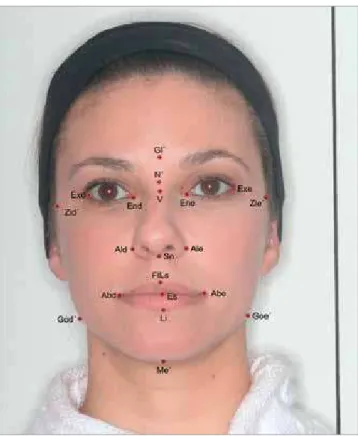
Photometric points
Photometric points used are displayed in Figure 1.
Linear measures
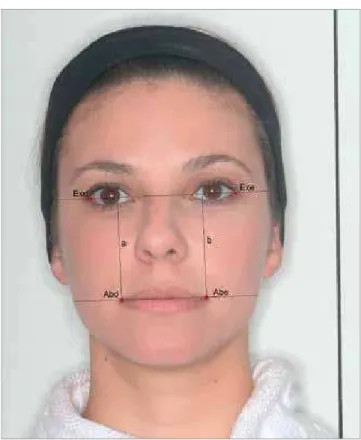
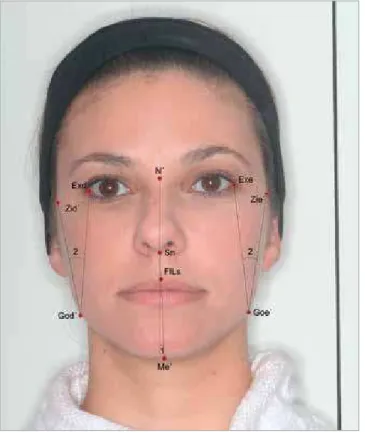
Linear measures are represented in Figures 2, 3 and 4, with its descriptions.
Proportional measures
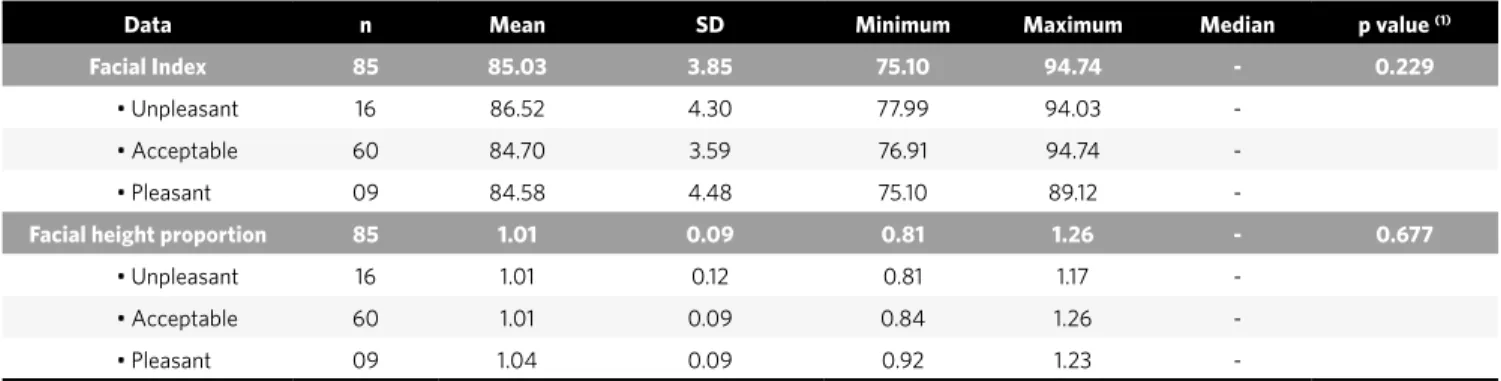
1) Facial index: Is the proportion between the facial height (N’-Me’) and the upper facial width (Zid’-Zie’) (Fig 5).
The Facial Index determines the facial type and is calculated this way:
facial height x 100 upper facial width
Figure 2 - Linear measurements from 1 to 9: 1) Upper lip length (Sn–Es); 2) Lower lip length (Es-Me’); 3); Philtrum length (Sn-U1); 4) Nose promi-nence (V- Sn); 5) Vermilion border of the upper lip ( Ul-Es); 6) Vermilion border of the lower lip (Es–Ll); 7) Mouth heigth (Ul-Ll); 8) Middle facial height (Gl’ to Sn); 9) Lower facial height (Sn to Me’).
Figure 3 - Linear measurement 10: Commissure line inclination - difference, in millimeters, from the commissure line to the line joining the external cor-ners of the eyes at Abd point height (a) and at Abe point height (b).
2) Facial Height Proportion: The proportion be-tween Middle facial height (Gl’-Sn) and lower facial height (Sn-Me’) (Fig 5).
Angular measures
Angular measurements used are shown in Figures 6 and 7, with their respective descriptions.
For the angle of facial symmetry the midline of the face was defined by the nasion (N’) and filter (F).
Statistical analysis
Comparisons between numerical measurements obtained in the 3 groups (esthetically pleasant, ac-ceptable and unpleasant) were performed using ANOVA and Kruskal-Wallis test, with the software “Primer of Biostatistics” The significance level was of 5% (p < 0.05).
To verify concordance level between evaluations of different groups, Kappa index was used and the percentage of reviewers agreeing by the Minitab soft-ware, 2007 version (www.minitabbrasil.com.br).
Error of method evaluation
The Error of method analysis was performed by repeating the marking points of the same operator, followed by measurement of factors by Radiocef Studio 2 software and 20 photographs of the sam-ple, randomly selected. The interval between evalu-ations was of 1 week.
Figure 4 - Linear measures 11 to 17: 11) Upper facial width (Zid’ and Zie’); 12) Lower facial width (God’ and Goe’); 13) Right eye width (Exd to End); 14) Left eye width (Exe to Ene); 15) intercanthal distance (End to Ene); 16) Nasal width (Ald to Ale); 17) Mouth width (Abd to Abe).
Figure 6 - Angular measures 1 and 2: 1) Facial symmetry angle - angle formed between facial midline (N’-F) and Sn’Me’ line 2) Symmetry between left and right side of the face - the difference between left and right angle measurements formed by intersection of Zi’-Go’ and Ex-Go’ lines
Figure 5 - Proportional measures – Facial Index: Proportion between upper facial height and facial width; Facial Height Proportion: Proportion between middle face height and lower face height.
ReSUlTS
The data found in this research will be described and presented in tables 1 to 5.
Considering all the evaluators together (five ortho-dontists, five artists and five laymen), the mean score was calculated for each photograph, ranging from 1 to 9. At this point, it were added the 15 marks given for each individual and calculated the mean value obtained by dividing the sum by the total number of evaluators who constituted the group, disregarding the first decimal point by rounding the scores to the nearest integer val-ue. Thus, to each participant it was given only one score mean, regardless the group of evaluators.
From the mean scores individuals were divided into 3 groups according to the degree of facial attrtiveness. Group 2, corresponding to esthetically ac-ceptable, was the one which contemplated the highest percentage of participants, 70.6% (Table 1).
To check the agreement level between the clas-sifications made by different groups of evaluators (orthodontists, artists and laymen) it was used the Kappa Index of Agreement and the percentage of concordant evaluators. It was observed that the lower concordance was found between laymen and orthodontists, and the highest among laymen and plastic artists (Table 2).
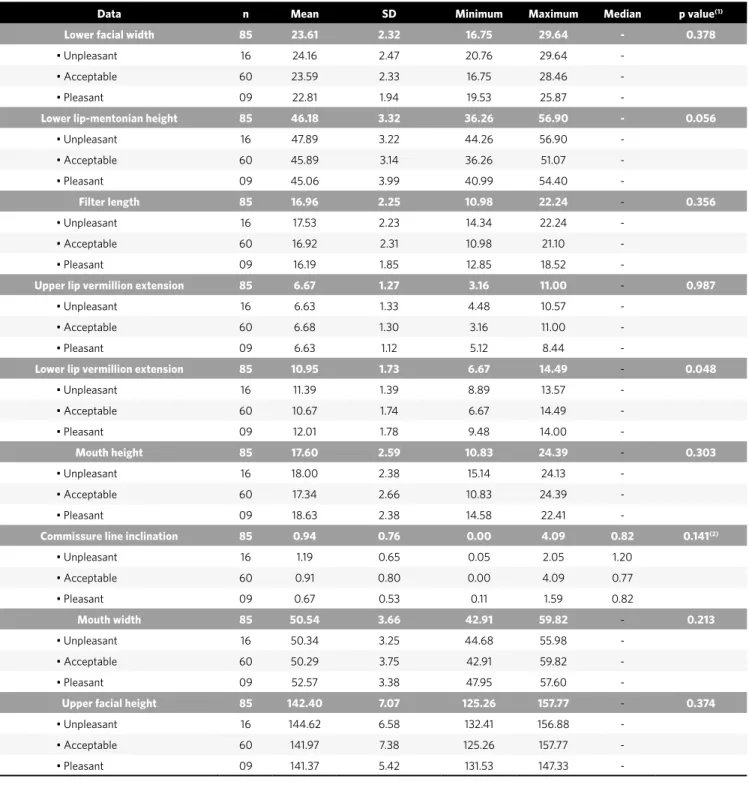
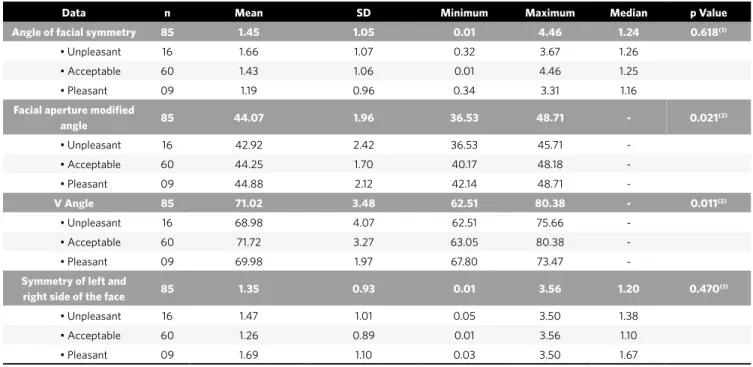
Seventeen linear measurements, 2 proportional and 4 angular, were performed on the groups pre-sented in Tables 3-5. Comparing the means, it was found that only 3 of these variables were statisti-cally significant different, 1 being linear (extension of the lower lip vermilion border) and two angular (angle of facial aperture modified and V angle). In the other measurements no statistically significant differences were found.
DISCUSSION
Beauty is represented by balance and harmo-ny of facial proportions, including skeletal struc-tures, teeth and soft tissues of the face. Orthodontic
Concept Scores Number %
Group 1 - Unpleasants 1, 2, 3 or 4 16 18.8 Group 2 - Acceptables 5 or 6 60 70.6 Group 3 – Pleasant 7, 8 or 9 9 10.6
Total 85 100.0
Table 1 - Subjective concept of facial esthetics.
Table 2 - Kappa Index of agreement between groups.
Evaluators % of agreements Kappa Interpretation
Lay x Plastic artists 41.2 0.2026 Slight
Lay x Orthodontists 21.2 -0.0364 Poor
Plastic artists x Orthodontists 38.8 0.1703 Slight
treatment frequently aims to preserve our increas-ing facial characteristics through visible changes on soft tissues. It is important to perform a global evalu-ation of face, paying attention to the patient´s esthet-ical necessities and not only to the functional and cephalometric matters. This study was developed to evaluate facial attractiveness and the characteristics of female faces in a frontal view through numeric fa-cial analysis.
Regarding the attractiveness, the sample was char-acterized by 16 individuals esthetically unpleasant (18.8%), 60 esthetically acceptable (70.6%) and 9 es-thetically pleasant (10.6%), indicating predominance of the esthetically acceptable standard, which was also found by other authors.11,21,23 The smaller group in this study was the esthetically pleasant, just like in the study of Reis23 and Morihisa,15 demonstrating how hard are the beauty standards imposed by society, many times looking for unreachable ideals.
Table 3 - Descriptive statistic of linear measurements in the study groups (mm).
Data n Mean SD Minimum Maximum Median p value(1)
Lower facial width 85 23.61 2.32 16.75 29.64 - 0.378
• Unpleasant 16 24.16 2.47 20.76 29.64
-• Acceptable 60 23.59 2.33 16.75 28.46
-• Pleasant 09 22.81 1.94 19.53 25.87
-Lower lip-mentonian height 85 46.18 3.32 36.26 56.90 - 0.056
• Unpleasant 16 47.89 3.22 44.26 56.90
-• Acceptable 60 45.89 3.14 36.26 51.07
-• Pleasant 09 45.06 3.99 40.99 54.40
-Filter length 85 16.96 2.25 10.98 22.24 - 0.356
• Unpleasant 16 17.53 2.23 14.34 22.24
-• Acceptable 60 16.92 2.31 10.98 21.10
-• Pleasant 09 16.19 1.85 12.85 18.52
-Upper lip vermillion extension 85 6.67 1.27 3.16 11.00 - 0.987
• Unpleasant 16 6.63 1.33 4.48 10.57
-• Acceptable 60 6.68 1.30 3.16 11.00
-• Pleasant 09 6.63 1.12 5.12 8.44
-Lower lip vermillion extension 85 10.95 1.73 6.67 14.49 - 0.048
• Unpleasant 16 11.39 1.39 8.89 13.57
-• Acceptable 60 10.67 1.74 6.67 14.49
-• Pleasant 09 12.01 1.78 9.48 14.00
-Mouth height 85 17.60 2.59 10.83 24.39 - 0.303
• Unpleasant 16 18.00 2.38 15.14 24.13
-• Acceptable 60 17.34 2.66 10.83 24.39
-• Pleasant 09 18.63 2.38 14.58 22.41
-Commissure line inclination 85 0.94 0.76 0.00 4.09 0.82 0.141(2)
• Unpleasant 16 1.19 0.65 0.05 2.05 1.20
• Acceptable 60 0.91 0.80 0.00 4.09 0.77
• Pleasant 09 0.67 0.53 0.11 1.59 0.82
Mouth width 85 50.54 3.66 42.91 59.82 - 0.213
• Unpleasant 16 50.34 3.25 44.68 55.98
-• Acceptable 60 50.29 3.75 42.91 59.82
-• Pleasant 09 52.57 3.38 47.95 57.60
-Upper facial height 85 142.40 7.07 125.26 157.77 - 0.374
• Unpleasant 16 144.62 6.58 132.41 156.88
-• Acceptable 60 141.97 7.38 125.26 157.77
-• Pleasant 09 141.37 5.42 131.53 147.33
-The agreement level between evaluators was as-sessed through Kappa index and also by the percentage of concordant evaluators, comparing groups in pairs.
Agreement between lay people and orthodontists was considered poor by the Kappa index (-0.0364), indicating only 21.2% of agreement. Between lay people and artists and then between artists and or-thodontists there were a slight agreement, being
respectively 0.2026 and 0.1703, corresponding to 41.2% and 38.8% of concordants. So it can be no-ticed that the lowest agreement was between lay people and orthodontists and the highest between lay people and plastic artists.
Data n Mean SD Minimum Maximum Median p value(1)
Lower facial width 85 113.71 7.36 95.87 131.91 - 0.647
• Unpleasant 16 113.25 6.80 103.53 129.46
-• Acceptable 60 114.12 7.74 95.87 131.91
-• Pleasant 09 111.75 5.84 101.10 121.04
-Nose length 85 44.73 4.57 35.85 57.21 - 0.195
• Unpleasant 16 46.33 6.29 37.79 57.21
-• Acceptable 60 44.16 4.19 35.85 53.11
-• Pleasant 09 45.69 2.77 40.76 49.27
-Nose width 85 36.20 3.01 28.86 43.89 - 0.661
• Unpleasant 16 36.20 2.85 32.43 43.70
-• Acceptable 60 36.33 3.18 28.86 43.89
-• Pleasant 09 35.34 2.13 31.70 38.01
-Right eye width 85 29.51 1.77 25.60 33.36 - 0.283
• Unpleasant 16 29.96 1.73 26.65 33.09
-• Acceptable 60 29.32 1.77 25.60 33.36
-• Pleasant 09 30.04 1.72 26.78 32.43
-Left eye width 85 29.85 1.92 26.02 34.52 - 0.347
• Unpleasant 16 30.28 1.84 26.55 34.52
-• Acceptable 60 29.65 1.94 26.02 34.26
-• Pleasant 09 30.38 1.90 27.48 33.06
-Intercanthal width 85 33.37 2.63 27.41 37.90 - 0.624
• Unpleasant 16 32.79 3.01 27.46 37.19
-• Acceptable 60 33.51 2.59 27.41 37.90
-• Pleasant 09 33.45 2.25 29.95 35.54
-Middle face height 85 70.56 5.85 57.42 87.83 - 0.215
• Unpleasant 16 72.87 7.94 59.07 87.83
-• Acceptable 60 69.99 5.32 57.42 83.97
-• Pleasant 09 70.26 4.40 63.71 74.96
-Lower facial height 85 69.76 4.89 56.86 80.88 - 0.080
• Unpleasant 16 72.02 4.20 66.67 80.88
-• Acceptable 60 69.45 4.90 56.86 78.26
-• Pleasant 09 67.85 5.12 60.50 78.00
-OBSERVATION: It is recommended to use median for very high SD values. (1) ANOVA; (2) Kruskal-Wallis.
(1) ANOVA.
Table 3 (continuation) - Descriptive statistic of linear measurements in the study groups (mm).
Table 4 - Descriptive statistics of proportional measurements in the study groups.
Data n Mean SD Minimum Maximum Median p value (1)
Facial Index 85 85.03 3.85 75.10 94.74 - 0.229
• Unpleasant 16 86.52 4.30 77.99 94.03
-• Acceptable 60 84.70 3.59 76.91 94.74
-• Pleasant 09 84.58 4.48 75.10 89.12
-Facial height proportion 85 1.01 0.09 0.81 1.26 - 0.677
• Unpleasant 16 1.01 0.12 0.81 1.17
-• Acceptable 60 1.01 0.09 0.84 1.26
-OBSERVATION: For very high SD values it is recommended to use the median. (1) Kruskal-Wallis; (2) ANOVA.
Table 5 - Descriptive statistics of angular measurements in the study groups.
Data n Mean SD Minimum Maximum Median p Value
Angle of facial symmetry 85 1.45 1.05 0.01 4.46 1.24 0.618(1)
• Unpleasant 16 1.66 1.07 0.32 3.67 1.26
• Acceptable 60 1.43 1.06 0.01 4.46 1.25
• Pleasant 09 1.19 0.96 0.34 3.31 1.16
Facial aperture modified
angle 85 44.07 1.96 36.53 48.71 - 0.021
(2)
• Unpleasant 16 42.92 2.42 36.53 45.71
-• Acceptable 60 44.25 1.70 40.17 48.18
-• Pleasant 09 44.88 2.12 42.14 48.71
-V Angle 85 71.02 3.48 62.51 80.38 - 0.011(2)
• Unpleasant 16 68.98 4.07 62.51 75.66
-• Acceptable 60 71.72 3.27 63.05 80.38
-• Pleasant 09 69.98 1.97 67.80 73.47
-Symmetry of left and
right side of the face 85 1.35 0.93 0.01 3.56 1.20 0.470
(1)
• Unpleasant 16 1.47 1.01 0.05 3.50 1.38
• Acceptable 60 1.26 0.89 0.01 3.56 1.10
• Pleasant 09 1.69 1.10 0.03 3.50 1.67
confirming the findings of Martins,11 besides showing a tendency of orthodontists being more complacent, giving higher scores to the participants.
A possible explanation would be the concern of or-thodontist with the symmetry, balance and facial pro-portions, not only with isolated shapes. Other factor is the fact that orthodontists know the facial limitations, being capable to recognize pleasant characteristics even among small imperfections. In this research the laymen were the most critical on the evaluation and the plastic artists assigned intermediate scores.
The more specialized and related to esthetics the evaluator groups, the higher were the scores assigned to the sample. However, these findings disagree with those presented in a study evaluating the attractive-ness of facial profile and stated that, in general, clini-cians (orthodontists and maxillofacial surgeons) were more strict about facial esthetics than non-clinician (plastic artists and laymen), although all groups have agreed on the choice of most attractive profile.31 Thus, for more conclusive results about the degree of agree-ment between the assessors and the tendency of es-thetic judgment between groups with different areas of expertise, it is important to emphasize that the ideal
would be a group with a larger number of participants than the used in this research.
Numeric facial analysis
In five variables it were found important dif-ferences and these were related to the lower facial third and the facial standard. In the group estheti-cally unpleasant it was observed a tendency to more elongated faces with increased lower third, which is considered very unfavorable to the facial balance, especially in female subjects.
In the present research the mean found for the vermillion extension of lower lip was of 10.95±1.73 mm. This variable presented higher val-ues for the esthetically pleasant group, with a mean value of 12.01 ± 1.78 mm. For the esthetically accept-able and unpleasant groups, the means were respec-tively 11.3 9 ± 1.39 mm and 10.67 ± 1.74 mm. The dif-ference found between values on the 3 groups was considered statistically significant. This fact can be explained by the current preference for more thick lips spread by media.
The general mean found was 46.18 ± 3,32 mm. In the esthetically pleasant group the mean was of 45.06 ± 3.99 mm. For esthetically acceptable and unpleas-ant groups the mean values were respectively 45.89 ± 3.14 mm and 47.89 ± 3.22 mm. However, there was no statistically significant difference The same way, the lower facial height was also higher for esthetically un-pleasant group. In this research, the mean was 69.76 ± 4,89 mm. The mean value found for the esthetically pleasant group was of 67.85 ± 5.12 mm; in the estheti-cally acceptable group 69.45 ± 4.90 mm and in the es-thetically unpleasant 72.02 ± 4.20 mm. It was not ob-served statistically significant difference. Both lower lip length and lower facial height were higher in the esthetically unpleasant group. These two variables are related to a long lower third of the face.
The facial aperture modified angle was lower in the esthetically unpleasant group, being that a significant difference. The mean value obtained in this study was of 44.07 ± 1.96°. In the pleasant group the mean was 44.88 ± 2.12°, in the acceptable group was 44.25 ± 1.70° and in the unpleasant was 42.92 ± 2.42°. Lower values for this angle indicate a longer and thinner face, what agrees with the re-sults obtained for the lower lip length and for lower facial height that also showed a tendency of estheti-cally unpleasant group presenting longer faces.
The V angle is related to the facial type. A lower value indicates a longer face and a higher value indi-cates a wider face. This angle presented significant difference compared to other groups, being higher for the esthetically acceptable group, indicating a tendency for a more horizontal facial growth for the individuals composing this group.
It was not found any other statistically signifi-cant difference for the other variables when com-paring the 3 groups. This result demonstrated that the numeric facial analysis used isolated was not able to detect the attractiveness standard since
beauty criteria are subjective, being influenced by cultural, racial, age and gender factors.11
This way, an orthodontic treatment just aiming to adequate to proposed standards by facial and cepha-lometric analysis do not guarantee an ideal beautiful face, but it is important that orthodontists and sur-geons have the esthetics standards of orientation.26,27
Instead of seeking absolute values, the harmony, balance and proportionality associated to the esthetic perception of the patient should substantiate the di-agnosis and treatment plan, so the esthetic benefits of the treatment is noticed by everyone.2,21,24,27,29
CONClUSIONS
1) The sample was characterized by 16 individuals esthetically unpleasant 18.8%), 60 esthetically acceptable (70.6%) and 9 esthetically pleasant (10.6%), indicating dominance for the estheti-cally acceptable standard.
2) Obtained data showed little agreement between evaluation of orthodontists, plastic artists and lay people. The more specialized and related to esthetics the evaluator group, the higher were the scores assigned to the participants of the re-search. This way, orthodontists were the most complacent, followed by plastic artists, being the laymen the most critical evaluators.
3) In the evaluation of facial measurements, it was observed that in only 3 variables there were statistically significant difference, which were: Lower lip vermillion border, facial aperture modified angle and V angle. In two measure-ments it was observed adjacent probability: Lower lip length and anterior facial height. 4) The numeric facial analysis, when used
1. Ackerman JL, Proffit WR. Soft tissue limitations in orthodontics: treatment planning guidelines. Angle Orthod. 1997;67(5):327-36.
2. Angle EH. Classification of malocclusion. Dent Cosmos. 1899 Apr;41(2):248-64, 350-357.
3. Arnett GW, Bergman RT. Facial keys to orthodontic diagnosis and treatment planning - Part I. Am J Orthod Dentofacial Orthop. 1993 Apr;103(4):299-312. 4. Bishara SE, Jorgensen GJ, Jakobsen JR. Changes in facial dimensions assessed from
lateral and frontal photographs. Part I - Methodology. Am J Orthod Dentofacial Orthop. 1995 Oct;108(4):389-93.
5. Colombo VL. Análise facial frontal em repouso e durante o sorriso em fotografias padronizadas [Monografia de Especialização]. Curitiba (PR): Associação Brasileira de Odontologia; 1998.
6. Cooke MS, Wei SH. The reproducibility of natural head posture: A methodological study. Am J Orthod Dentofacial Orthop. 1988 Apr;93(4):280-8.
7. Cox NH, Van Der Linden FPGM. Facial Harmony. Am J Orthod. 1971 Aug;60(2):175-83.
8. Farkas LG, Kolar JC. Antropometrics and art in the aesthetics of women’s faces. Clin Plast Surg. 1987 Oct;14(4):599-616.
9. Ferrario VF, Sforza C, Miani A, Tartaglia G. Craniofacial morphometry by photografic evaluations. Am J Orthod Dentofacial Orthop. 1993 Apr;103(4):327-37. 10. Foster EJ. Profile preferences among diversified groups. Angle Orthod. 1973
Jan;43(1):34-40.
11. Martins LF. Análise fotométrica em norma frontal, de adultos, brasileiros, leuodermas, não tratados ortodonticamente, classificados pela estética facial [Dissertação]. São Bernardo do Campo (SP): Universidade Metodista de São Paulo, Faculdade de Odontologia; 2001.
12. Matoula S, Pancherz H. Skeletofacial morphology of attractive and nonattractive faces. Angle Orthod. 2006 Mar;76(2):204-10.
13. McKoy-White J, Evans CA, Viana G, Anderson NK, Giddon DB. Facial profile preferences of black women before and after orthodontic treatment. Am J Orthod Dentofacial Orthop. 2006 Jan;129(1):17-23.
14. Moorrees CF. Natural head position - a revival. Am J Orthod Dentofacial Orthop. 1994 May;105(5):512-3.
15. Morihisa O. Avaliação comparativa entre agradabilidade facial, Proporção àurea e padrão facial [Dissertação]. São Bernardo do Campo (SP): Universidade Metodista de São Paulo, Faculdade de Odontologia; 2006.
16. Moss J P, Linney AD, Lowey MN. Uso das técnicas tridimensionais na estética facial. In: Sadowski PL, Peck S, King G, Laskin DM. Atualidades em Ortodontia. São Paulo: Premier; 1997. p. 89-97.
REFERENCES
17. Motoyoshi M, Namura S, Arai HY. A three-dimensional measuring system for the human face using three-directional photography. Am J Orthod Dentofacial Orthop. 1992 May;101(5):431-40.
18. Nanda RS, Ghosh J, Bazakidou E. Three-dimensional facial analysis using a vídeo imaging system. Angle Orthod. 1996;66(3):181-8.
19. Nguyen DD, Turley PK. A quantitative method for the evaluation of the soft-tissue facial profile. Am J Orthod Dentofacial Orthop. 1998 Aug;114(2):208-17. 20. Nguyen DD, Turley PK. Changes in the Caucasian male facial profile as depicted in
fashion magazines during the twentieth century. Am J Orthod Dentofacial Orthop. 1998 Aug;114(2):208-17.
21. Peck H, Peck S. A concept of facial esthetics. Angle Orthod. 1970 Out;40(4);284-317.
22. Reche R. Análise do perfil facial em fotografias padronizadas. R Dental Press Ortod Ortop Facial. 2002 Jan-Fev;7(1):37-45.
23. Reis SAB. Análise facial numérica e subjetiva do perfil e análise da relação oclusal sagital de Brasileiros, adultos, leucodermas não tratados ortodonticamente [Dissertação]. São Bernardo do Campo (SP): Universidade Metodista de São Paulo, Faculdade de Odontologia; 2001.
24. Ricketts RM. Planning treatment on the basis of the facial pattern and an estimate of its growth. Angle Orthod. 1957 Jan;27(1):14-37.
25. Suguino R, Ramos AL, Terada HH, Furquim LZ, Filho OGS. Análise Facial. R Dental Press Ortod Ortop Facial. 1996 Set-Out;1(1):86-107.
26. Verona J. Análise facial frontal masculina em repouso e durante o sorriso, métodos manual e computadorizado, em fotografias padronizadas. [Monografia de Especialização]. Curitiba (PR): Associação Brasileira de Odontologia; 2004. 27. Wuerpel EH. On facial balance and harmony. Angle Orthod. 1937;7:81-9. 28. Silva NCF, Aquino ERB, Mello KCFR, Mattos JNR, Normando D. Habilidade de
ortodontistas e leigos na percepção de assimetrias da mandíbula. Dental Press J Orthod. 2011 July-Aug;16(4):38.e1-8.
29. Reis SAB, Abrão J, Claro CAA, Capelozza Filho L. Avaliação dos fatores determinantes da estética do perfil facial. Dental Press J Orthod. 2011 Jan-Feb;16(1):57-67.
30. Pereira AL, De-Marchi LM, Scheibel PC, Ramos AL. Reprodutibilidade da posição natural da cabeça em fotografias de perfil de crianças de 8 a 12 anos, com e sem o auxílio de um cefalostato. Dental Press J Orthod. 2010 Jan-Fev;15(1):65-73. 31. Almeida MD, Farias ACR, Bittencourt MAV. Influência do posicionamento sagital