clinical case report
Cop
yright
© ABE&M t
odos os dir
eit
os r
eser
vados
.
Arq Bras Endocrinol Metab. 2010;54/8 728
A novel
GNAS
mutation in an infant
boy with pseudohypoparathyroidism
type Ia and normal serum
calcium and phosphate levels
Mutação nova no GNAS em um menino com
pseudo-hipoparatireoidismo tipo Ia e dosagens séricas normais de cálcio e fósforo
Mariana Tenorio Antunes Reis1,2, Andreina Cattani3,
Berenice Bilharinho Mendonca2, Pedro Henrique Silveira Corrêa1, Regina Matsunaga Martin1,2
SUMMARY
The objective of this study was to describe a new mutation in GNAS in a family with
pseudo-hypoparathyroidism type Ia (PHP Ia), a rare osteometabolic disease. An 8-month-old boy was seen by an Endocrinologist due to obesity and low growth velocity. Noteworthy, his mother exhibited typical Albright hereditary osteodystrophy (AHO) phenotype. The clinical diagnosis of PHP Ia was suspected. The GNAS coding region from mother and son was amplified and
direc-tly sequenced. A novel heterozygous missense mutation (c.673T>C) was identified in exon 5 in both patients. In this family, the mother’s clinical picture was the clue for the son’s diagnosis. Molecular analysis of GNAS confirmed the diagnosis of PHP Ia in both patients and the child’s
early diagnosis was possible. Moreover, this novel missense substitution expands the spectrum of GNAS mutations associated with this disorder and allows for genetic counseling of this family. Arq Bras Endocrinol Metab. 2010;54(8):728-31
SUMÁRIO
O objetivo deste estudo foi descrever uma nova mutação no GNAS em uma família com
pseudo--hipoparatireoidismo tipo Ia (PHP Ia), doença osteometabólica rara. Um garoto de oito meses foi visto por um endocrinologista por obesidade e baixa velocidade de crescimento. Chamava a atenção o fato de sua mãe apresentar fenótipo típico da osteodistrofia hereditária de Albright (OHA). O diagnóstico clínico de PHP Ia foi suspeitado. A região codificadora do GNAS da mãe
e do filho foi amplificada e submetida ao sequenciamento direto. Uma nova mutação missense
em heterozigose (c.673T>C) foi identificada no éxon 5 em ambos. O quadro clínico materno foi a pista para o diagnóstico do filho. A análise molecular do GNAS confirmou o diagnóstico de
PHP Ia nos dois pacientes possibilitando o diagnóstico precoce da criança. Além disso, essa nova substituição missense expande o espectro de mutações no GNAS associadas a essa
doen-ça e permite o aconselhamento genético nesta família. Arq Bras Endocrinol Metab. 2010;54(8):728-31
1 Diseases Unit Osteometabolic,
Endocrinology Service, Hospital das Clínicas, Faculdade de Medicina, Universidade de São Paulo (HC-FMUSP), São Paulo, SP, Brazil
2 Laboratório de Hormônios e
Genética Molecular (LIM/42), Division of Endocrinology, FMUSP, São Paulo, SP, Brazil
3 Unidad Endocrinología
Infantil, Servicio de Pediatría, Pontiicia Universidad Católica de Chile, Santiago, Chile
Correspondence to:
Regina Matsunaga Martin Av. Dr. Enéas de Carvalho Aguiar, 155, PAMB, 2º andar, Bloco 6 05403-900 – São Paulo, SP, Brazil [email protected]
Received on Aug/1/2010 Accepted on Nov/17/2010
INTRODUCTION
I
n 1942, Fuller Albright and cols. described the irst human disease attributed to hormonal resistance, which was named pseudohypoparathyroidism (PHP). This condition has the same biochemical features as hy-poparathyroidism, except for the elevation of PTH (1).Cop
yright
© ABE&M t
odos os dir
eit
os r
eser
vados
.
729 Arq Bras Endocrinol Metab. 2010;54/8
Novel GNAS mutation in a boy with PHP Ia
II (PHP II), when urinary cAMP excretion is normal but the phosphaturic response is absent. Lastly, PHP I is divided into subtypes Ia, Ib and Ic based on dif-ferent phenotypes, genetic indings and pathogenesis. The cause of these subtypes is mutations or imprinting abnormalities in the stimulatory alpha-subunit G pro-tein (Gsα) whose signaling is essential for the actions of PTH and of many other hormones (2).
PHP Ia is characterized by resistance to PTH and to several additional hormones that bind to G protein-coupled receptors (GPCRs). Affected patients display variable developmental and somatic features known as Albright hereditary osteodystrophy (AHO), which com-prises obesity, short stature, brachydactyly, round face, ectopic ossiication and/or mental retardation. Most of the PHP Ia patients have a loss-of-function of Gsα due to a maternal heterozygous mutation in exons 1-13 of
GNAS, the gene responsible for encoding Gsα (3).
The same mutations found in GNAS leading to
PHP Ia are found in patients with pseudopseudohy-poparathyroidism (PPHP), who display AHO features without hormonal resistance, so one family can pres-ent cases of PHP Ia and PPHP. The determination of which one is going to be found depends on parental origin, meaning that subjects that inherited GNAS mu-tations from the mother exhibit PHP Ia whereas those who inherited the same mutations from the father ex-hibit PPHP. This inheritance pattern is consistent with paternal imprint of Gsα (4).
In this paper, we present a family in which the mother has AHO features and hypocalcemia symptoms while her son has obesity and low growth velocity. Based on the mother’s clinical picture, diagnosis of PHP Ia was sus-pected and conirmed after complementary tests and the suspicion that her son had the same disease (PHP Ia) was raised. To validate this, the aim of this study was to search for mutations in GNAS in both individuals to establish the molecular etiology of PHP Ia and its heritability.
SUBJECT AND METHODS
Case report
The proband was a term newborn, weighting 3,400 g and measuring 47 cm, without history of perinatal com-plications. At 8 months, he was admitted to the Endo-crinology Unit of Universidad Catolica in Chile due to obesity and low growth velocity. His physical examina-tion showed a weight of 11.44 kg (SD = + 2.19), stature
of 68.2 cm (SD = - 0.78), body mass index (BMI) of 24.6 kg/m2 (weight-for-length percentile > P97),
with-out any other alterations. At that time, hypothyroidism was diagnosed and treated with levothyroxine.
Noteworthy, his mother (Figure 1) exhibited typi-cal AHO phenotype such as short stature, round face, short neck and brachydactyly. In addition, she had par-esthesia, hypothyroidism and basal nucleus calciication on cranial CT scan. These data and her laboratorial proile (Table 1) were compatible with PHP Ia.
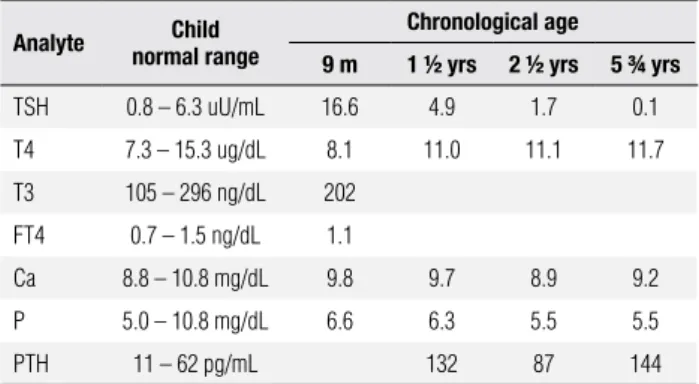
Although the patient had normal serum concentra-tions of calcium and phosphate for his age, the diag-nosis of PHP Ia was suspected because of his elevated levels of PTH and his mother’s background (Tables 1 and 2). To conirm this possibility, the GNAS coding region of both patients was studied.
Molecular analysis
The study protocol was approved by the ethics commit-tee, and the informed consent was obtained from the parents. After obtaining written informed consent for the study, peripheral blood leukocytes genomic DNA was extracted from the patient and his mother. Ten in-tronic primer pairs were used to amplify exons 1-13 from the GNAS gene. After ampliication conirmation by electrophoresis in agarosis gel, PCR products were submitted to automatic sequencing reaction. The re-sults were compared to the wild type GNAS sequence published at www.ensembl.org (ENST00000371085).
Cop
yright
© ABE&M t
odos os dir
eit
os r
eser
vados
.
730 Arq Bras Endocrinol Metab. 2010;54/8
Novel GNAS mutation in a boy with PHP Ia
cal features of AHO, symptoms of hypocalcemia and resistance to TSH, which were the clues for the son’s diagnosis.
Although hypocalcemia is one of the most promi-nent features in PHP Ia, some patients have been re-ported to have normocalcemia. To explain this inding, Tamadaand cols. (5) consider at least two hypothesis: a dietary intake rich in calcium and increased serum con-centrations of active vitamin D, or bone responsiveness to PTH may compensate for hypocalcemia. In the lat-ter, bone demineralization has been reported to occur frequently in PHP Ia and Ib, however, clinically signii-cant hyperparathyroid bone disease with radiologic or histologic features of osteitis ibrosa cystica is uncom-mon (5).
In this case, the patient was only one and a half years old when PTH levels were measured for the irst time. So, we believe that the patient was still normocalcemic as PHP Ia diagnosis was precocious. The raised PTH concentrations suggest PTH resistance and he would probably have developed hypocalcemia and its symp-toms if calcium and vitamin D supplementation were not introduced.
Because Gsα inheritance pattern is consistent with the parental origin-speciicity, it is known that PHP Ia results from a heterozygous inactivating mutation at
GNAS inherited from the maternal allele while PPHP results from a mutation in the paternal allele (6). Thus, in the family studied, Gsα proband’s mutation was ma-ternally inherited and this is consistent with PHP Ia. Not surprisingly, normocalcemia combined with the AHO phenotype could be misdiagnosed as PPHP.
A different substitution in the same codon (p.I106S) within Gsα coding region was previously described as the cause of PHP Ia in an infant boy. The clinical ind-ings of congenital hypothyroidism, calcinosis cutis and AHO phenotype during infancy were the reasons to consider that diagnosis. As for the boy described here, this patient had normocalcemia and elevated PTH lev-els at 7 months, however, our patient does not have skin lesions. The authors think that p.I106S substitu-tion results in a defective Gsα because the residue Ile-106 is located within the helical domain of the pro-tein, which is considered a regulator and activator of its function. Moreover, the part within the helical domain that extends from residue 70 to 140 is functionally im-portant for adenylyl cyclase activation. In addition, sub-stitution of the hydrophobic aa isoleucine by the polar aa serine probably leads to Gsα impaired function, as a Normal
height
27 yrs H: 139 cm
3.3 yrs H: 93 cm
A B C
Table 1. Mother’s laboratorial profile
Analyte Adult normal range Result
Ca 8.8 – 10.2 mg/dL 7.6
P 2.3 – 4.6 mg/dL 4.6
PTH 11 – 62 pg/mL 691
Table 2. Patient’s laboratorial profile
Analyte normal rangeChild Chronological age
9 m 1 ½ yrs 2 ½ yrs 5 ¾ yrs
TSH 0.8 – 6.3 uU/mL 16.6 4.9 1.7 0.1
T4 7.3 – 15.3 ug/dL 8.1 11.0 11.1 11.7
T3 105 – 296 ng/dL 202
FT4 0.7 – 1.5 ng/dL 1.1
Ca 8.8 – 10.8 mg/dL 9.8 9.7 8.9 9.2
P 5.0 – 10.8 mg/dL 6.6 6.3 5.5 5.5
PTH 11 – 62 pg/mL 132 87 144
RESULTS
A novel heterozygous missense mutation was identiied in exon 5 of GNAS in the proband: a substitution of T → C at nucleotide 673 (c.673T>C), leading to an ami-no acid (aa) replacement in codon 106 of isoIeucine → threonine (p.l106T). His mother had the same mutation conirming the proband’s mutation origin (Figure 2).
Figure 2. (A) Pedigree of the family. Electropherograms of part of GNAS exon 5 from a normal control (B) and the child sample (C); the arrow shows the substitution T → C, in heterozygous, that was also detected in the
mother’s child; the small boxes highlight the codon 106.
DISCUSSION
typi-Cop
yright
© ABE&M t
odos os dir
eit
os r
eser
vados
.
731 Arq Bras Endocrinol Metab. 2010;54/8
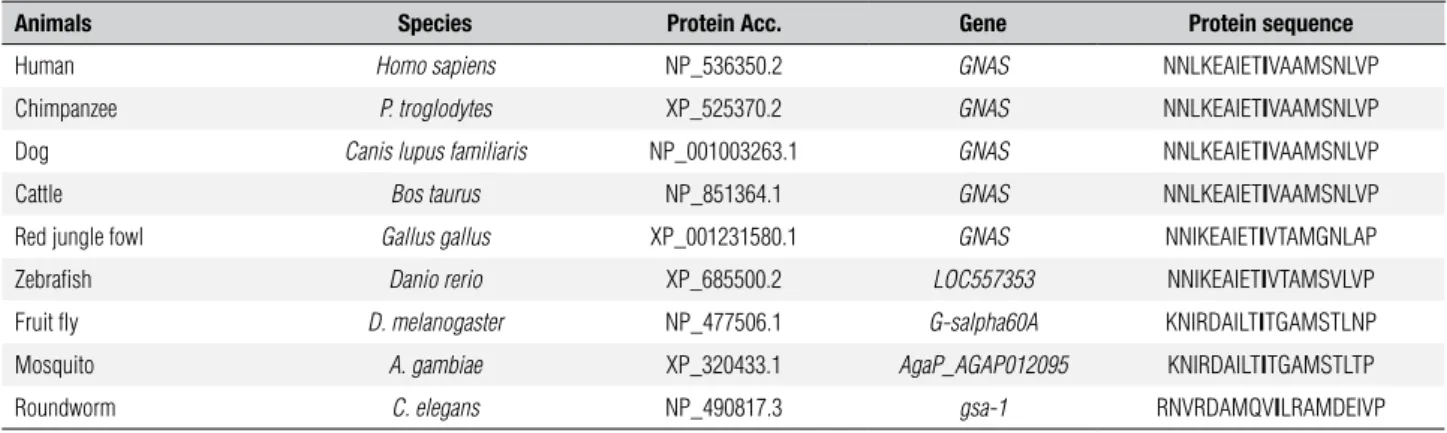
Table 3. Multiple sequence alignment of GNAS in different species
Animals Species Protein Acc. Gene Protein sequence
Human Homo sapiens NP_536350.2 GNAS NNLKEAIETIVAAMSNLVP
Chimpanzee P. troglodytes XP_525370.2 GNAS NNLKEAIETIVAAMSNLVP
Dog Canis lupus familiaris NP_001003263.1 GNAS NNLKEAIETIVAAMSNLVP
Cattle Bos taurus NP_851364.1 GNAS NNLKEAIETIVAAMSNLVP
Red jungle fowl Gallus gallus XP_001231580.1 GNAS NNIKEAIETIVTAMGNLAP
Zebrafish Danio rerio XP_685500.2 LOC557353 NNIKEAIETIVTAMSVLVP
Fruit fly D. melanogaster NP_477506.1 G-salpha60A KNIRDAILTITGAMSTLNP
Mosquito A. gambiae XP_320433.1 AgaP_AGAP012095 KNIRDAILTITGAMSTLTP
Roundworm C. elegans NP_490817.3 gsa-1 RNVRDAMQVILRAMDEIVP
The residue Ile-106 (I) is shown in bold at “protein sequence” column.
result of conformational changes within its helical do-main, affecting adenylyl cyclase activation for example. Furthermore, the “variant” allele type (p.I106S) was not found in over 100 analyzed alleles from healthy controls of German descent suggesting that it is not a polymorphism (7).
For the same reasons, we speculate that the substi-tution p.I106T is also the causative mutation of our patient even without performing a functional study. In both cases, serine and threonine are polar aa in opposi-tion to isoleucine which is a hydrophobic aa. Further-more, the correspondent human residue Ile-106 of Gsα is highly conserved in different species such as the chim-panzee, dog, cow, chicken, zebraish, fruit ly, mosquito and roundworm (C. elegans), indicating that a replace-ment of this aa may be deleterious. Table 3 shows the alignment generated by the MUSCLE software (8).
The presence of AHO features and normocalcemia does not always mean PPHP, especially if the mutation is maternally inherited. In the latter case, the correct diagnosis is PHP Ia and follow-up calcium and PTH levels should be recommended in order to start early treatment.
In our study case, the mother’s clinical picture al-lowed the child’s precocious diagnosis of PHP Ia and genetic counseling for this family. In both patients, PHP Ia was due to a novel missense mutation in the
GNAS gene (p.I106S) in the heterozygous state. Although PHP is a rare disorder, in many cases, clinical manifestations are insidious and even if hypocal-cemia symptoms are evident, sometimes the condition can be misdiagnosed as epilepsy. Therefore, its
preco-cious diagnosis and treatment are important to mini-mize the development of complications such as basal nuclei calciication, cataract, as well as the consequen-ces of wrong treatment.
Disclosure: no potential conlict of interest relevant to this article was reported.
REFERENCES
1. De Sanctis L, Romagnolo D, Olivero M, Buzi F, Maghnie M, Scire G, et al. Molecular analysis of the GNAS1 gene for the correct diagnosis of Albright hereditary osteodystrophy and pseudohy-poparathyroidism. Pediatr Res. 2003;53(5):749-55.
2. Donghi V, Mora S, Zamproni I, Chiumello G, Weber G. Pseudo-hypoparathyroidism, an often delayed diagnosis: a case series. Cases J. 2009;2:6734.
3. Mantovani G, de Sanctis L, Barbieri AM, Elli FM, Bollati V, Vaira V, et al. Pseudohypoparathyroidism and GNAS epigenetic de-fects: clinical evaluation of Albright hereditary osteodystrophy and molecular analysis in 40 patients. J Clin Endocrinol Metab. 2010;95(2):651-8.
4. Mantovani G, Bondioni S, Locatelli M, Pedroni C, Lania AG, Ferrante E, et al. Biallelic expression of the Gsalpha gene in human bone and adipose tissue. J Clin Endocrinol Metab. 2004;89(12):6316-9.
5. Tamada Y, Kanda S, Suzuki H, Tajima T, Nishiyama T. A pseudohy-poparathyroidism type Ia patient with normocalcemia. Endocr J. 2008;55(1):169-73.
6. Linglart A, Mahon MJ, Kerachian MA, Berlach DM, Hendy GN, Juppner H, et al. Coding GNAS mutations leading to hormone resistance impair in vitro agonist- and cholera toxin-induced ade-nosine cyclic 3’,5’-monophosphate formation mediated by hu-man XLalphas. Endocrinology. 2006;147(5):2253-62.
7. Riepe FG, Ahrens W, Krone N, Folster-Holst R, Brasch J, Sippell WG, et al. Early manifestation of calcinosis cutis in pseudohypo-parathyroidism type Ia associated with a novel mutation in the GNAS gene. Eur J Endocrinol. 2005;152(4):515-9.
8. Edgar RC. MUSCLE: multiple sequence alignment with high accu-racy and high throughput. Nucleic Acids Res. 2004;32(5):1792-7.