The art and learning patterns of knowing in
nursing
O
riginal
a
r
ticle
Cristina Lavareda Baixinho1,Isabel Carvalho Beato Ferraz Pereira2,Óscar Manuel Ramos Ferreira3,
Helga Marilia da Silva Rafael4
A Arte e A AprendizAgem dos pAdrões de conhecimento em enfermAgem
el Arte y el AprendizAje de lAs normAs de conocimiento en enfermeirA
1 master in school health; lisboa school of nursing; Unit of development and research in nursing, lisbon, portugal. 2 phd in nursing; lisboa school of nursing; Unit of development and research in nursing, lisbon, portugal. 3 phd in education; lisboa school of nursing; Unit of development and research doi: 10.1590/s0080-623420140000800024
ReSuMo
Objeivos: Ideniicar a perceção dos estu-dantes acerca da uilização da arte como estratégia pedagógica na aprendizagem dos padrões de conhecimento em enfermagem; Ideniicar as dimensões de cada padrão va-lorizadas na análise das obras de arte. Método: Estudo descriivo e misto. A co-lheita de dados com recurso a um quesio-nário, aplicado a 31 estudantes de enfer -magem.
Resultados: Na análise do discurso dos es-tudantes está implícito que o conhecimento empírico inclui: conhecimento cieníico, tradição e natureza dos cuidados. O conhe-cimento estéico implica: expressividade, subjeividade e sensibilidade. O autoconhe-cimento, a experiência, a aitude relexiva e a relação com os outros são as subcatego-rias do conhecimento pessoal e a moral e a éica suportam o conhecimento éico. Conclusão: É possível aprender os padrões de conhecimento através da arte, sobretu -do -do estéico, éico e pessoal. É necessário invesigar mais as estratégias pedagógicas que contribuam para a aprendizagem dos padrões de conhecimento em enfermagem.
deSCRItoReS
Enfermagem Aprendizagem Arte
ABStRACt
Objecives: To idenify the percepion of the students about the use of art as a peda -gogical strategy in learning the paterns of knowing in nursing; to idenify the dimen-sions of each patern valued in the analysis of pieces of art.
Method: Descripive mixed study. Data col-lecion used a quesionnaire applied to 31 nursing students.
Results: In the analysis of the students’ discourse, it was explicit that empirical knowledge includes scieniic knowledge, tradiion and nature of care. The aestheic knowledge implies expressiveness, subjec-ivity and sensisubjec-ivity. Self-knowledge, expe-rience, relecive aitude and relaionships with others are the subcategories of per-sonal knowledge and the moral and ethics support ethical knowledge.
Conclusion: It is possible to learn paterns of knowledge through art, especially the aestheic, ethical and personal. It is ne -cessary to invesigate further pedagogical strategies that contribute to the learning paterns of nursing knowledge.
deSCRIPtoRS
Nursing Learning Art
ReSuMen
Objeivos: Ideniicar la percepción de los estudiantes sobre la uilización del arte como estrategia pedagógica en el aprendi-zaje de los patrones del conocimiento en enfermería;
Ideniicar las dimensiones de cada patrón valoradas en el análisis de las obras de arte. Método: Estudio descripivo y mixto. La re-cogida de datos con recurso a una encuesta aplicada a treinta y un estudiantes de en-fermería.
Resultados: En el análisis del discurso de los estudiantes está tácito que el conoci-miento empírico incluye: conociconoci-miento cieníico, tradición y naturaleza de los cui-dados. El conocimiento estéico implica: expresividad, subjeividad y sensibilidad. El autoconocimiento, la experiencia, la ac-itud relexiva y la relación con los demás son las subcategorías del conocimiento personal, mientras que la moral y la éica soportan el conocimiento éico.
Conclusión: Es posible aprender los patrones del conocimiento a través del arte, sobretodo del estéico, del éico y del personal. Es nece-sario invesigar más las estrategias pedagógi-cas que contribuyan al aprendizaje de patro-nes de conocimiento de enfermería.
deSCRIPtoReS
IntRoduCtIon
Caring is a relaional process that depends on the relaionship between the caregiver and the person be -ing cared for. Every human be-ing is a be-ing in relaion(1),
from this meeing and this interacion afecion arises, this is not restricted to the being afected, but also the response that is sent to whom it afects. It is because we allow ourselves to be afected by an emoional force that makes a request to who afects us(1). This reciproc
-ity leave the people involved in a situaion of existenial equality(2).
If, indeed, the person can be defined as a being in relation, it is from this relation that affection is essen -tially linked to the personal dimension of human exis -tence(1).
On the other hand, the nursing work is between ethical action and technical work produced(1), the nurse
lives her/his openness to the world from the field of health and disease(1), and the individual and collective
processes of health/disease are extremely complex, re -quiring nursing, as a discipline and as an art, to become a mean that allows the transformation of knowledge and technical wisdom into a commodity put into ser -vice for others.
Under these assumpions, we assume that the provi -sion of health care is not only from empirical knowledge, it is necessary that professionals make use of other types of knowledge. Carper has ideniied four fundamental pat -terns of knowing in nursing: empiric, estheic, personal and ethics(3).
Learning the different patterns of knowing is com -plex, depends not only on pedagogical strategies, but also implies self-social and moral development of nurs -ing students. It is easier to learn from empirical knowl -edge, than the ethical, esthetic and especially person -al(2).
Based on the described above, and being professors of the Curriculum Unit of History and Epistemology of Nursing, in the Liceniate’s Degree in Nursing, we have diverse pedagogical strategies in order to promote the process of teaching-learning and moivate students to discover the core elements of the discipline and the nursing profession.
Regarding paterns of knowing in nursing, we chal -lenge its understanding through arisic expression, in or -der to awaken the sensiivity necessary to be a Nurse.
Therefore, the following objecives were established: To idenify the percepion of students about the use of art as a pedagogical strategy in learning the paterns of nurs -ing knowledge; to idenify the dimensions of each stan -dard valued in the analysis of pieces of art(3).
MetHodS
An exploratory and descripive study was conducted, with a predominantly qualitaive approach. The sample was composed by 31students (S) of the irst year of the Liceniate undergraduate course in Nursing. We used as instrument of data collecion a quesionnaire with closed and opened quesions, which was sent online to students ater they had paricipated in theoreical-pracical classes. The class occurred according to the previously planned phases by professors (Box I).
Box 1 - Research protocol.
Phase I Preparation of the methodology of theoretical-practical class. We included selection of piece of arts in group;
Phase II Analysis of pieces of art in group and presentation of results;
Phase III Sending the instrument of data collection with the questions. Response of students to the questionnaire;
Phase IV Data analysis ; Phase V Discussion.
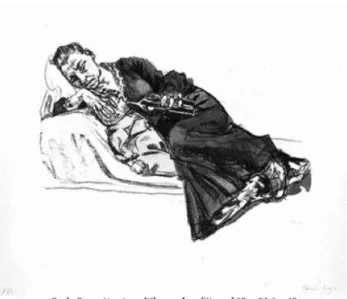
Firstly, we deined the objecives of each theoreical-pracical classes; selected pieces of art to be analyzed by the students (21 painings, 1 drawing, 2 lithographs and 6 sculptures). The pieces of art represented nature of care or forms of care. The script for class orientaion was made available 48 hours before the theoreical-pracical classes, through the e-learning plaform where objecives and methodology were explained, this plaform contained a photograph of each of the selected pieces of art with respecive subitle.
This phase was prepared carefully; we asked three judges to validate the choice of pieces of art. This crite -rion was important to avoid bias in the analysis of future data, because researchers are key tools in the perspecive of building data in order to know the reality(4).
In phase II groups were organized (4-6 students per group), who analyzed the pieces of art from the simulus placed: a) To idenify a piece of art that represents car -ing; b) To describe the feelings that the piece of art has caused; c) To relect on the inherent caring values present in the piece of art.
The students presented the results from work under -taken by the groups. In the end, the professor made an integraive synthesis of the main conclusions, showing Carper’s paterns of knowing that had been intuiively dis -covered by student groups.
results, comparing the proposed objecives and collect -ing the percepion of the students about the mainte -nance or not of the methodology. The second part was consisted of categories deined a priori (empirical knowl -edge, estheic knowl-edge, personal knowledge and ethi -cal knowledge) and sought to idenify the atributes of each patern of knowledge valued in the analysis of the students.
In phase IV, we proceeded to data analysis. Closed quesions were submited to descripive staisics and content of the opened quesions was subjected to con -tent analysis, in order to criically understand the meaning of communicaions, their content and their meanings(5).
Qualitaive research employs diferent philosophical concepts, research strategies, analysis and construcion methods, data interpretaion that allows us to understand the reality, always considering the complexity of factors that are involved(4).
In this study we used the categorical thematic anal -ysis proposed by Vala(6), data were analyzed, the mean
-ing contained therein was extracted and organized in subcategories from the previously defined categories, so that to be interpreted, always considering the ideas that are explicit and implicit(4) in the text written by stu
-dents.
ReSuLtS
The rate of paricipants was 48.3%, obtained from 31 responses, out of 64 possible paricipants.
The average age of the sample was 19.8, with 61.3% female and 38.7% male.
All paricipants considered that the pieces of art se -lected represented “care” and 84% considered that the pieces of art allowed the integraion of knowledge in re -laion to the four paterns of knowing deined by Carp -er(3,7).
Through the analysis of Table I, we found that most students considered that the methodology used contrib -uted greatly to the understanding of paterns of know -ing in nurs-ing. The methodology used promotes under -standing of paterns of personal, ethical, estheic and empirical knowledge. However, the later patern has the lowest expression in the responses of students
Table 1 - Contribution of theoretical- practical classes for understanding the patterns of knowing in nursing
Patterns of knowing in Nursing
1. No contribution
2. Little contribution
3. Suficiently
contribution
4. Good contribution
5. Integral
contribution total
Empirical 3.2% 29.1% 35.5% 25.8% 6.4% 100%
Esthetic 0% 6.4% 3.2% 54.9% 35.5% 100%
Personal 0% 6.4% 12.8% 48.5% 32.3% 100%
Ethical 0% 3.2% 6.4% 74.3% 16.1% 100%
Content analysis of opened responses enabled the de -velopment of subcategories from the previously deined categories of sensing elements of learning valued by stu -dents(6,7).
For empirical knowledge category, students recognize that the methodology used “allowed us to realize that em -pirical knowledge can be understood by art” (S26). Three subcategories stood out: scieniic knowledge, tradiion and nature of nursing care.
Scieniic knowledge is explicit in wriing as “scieniic knowledge, from research” (S1), “veriiable” (S7, S9, S21, S27, S31), “based on laws and theories” (S7), “which ex -plains phenomena”(S25), is “objecive” (S2, S10, S11, S12, S14), “based on the veriicaion of phenomena and tries to explain and foresee them” (E13), which “can be scien -iically veriied through research” (S28), corresponds to the knowledge of the “nursing science” (S18).
The tradiion appears in the deiniion of an own body of knowledge, based on what care have been throughout human evoluion, described as “the importance of the evoluion of knowledge over the centuries” (S19). The selected work represented “care situaions over the cen -turies and the representaion varied with the historical period, such as the piece of art” (S22), allowing the per -cepion “how care and caregivers have evolved over ime” (S20) related to the “experience” (S21).
In the subcategory nature of nursing care, the method -ology “allowed us to observe diferent perspecives of care since aniquity” (S22), being clear “pieces of art whose pic -tures refer to the biomedical ield by the presence of many medical equipment and other medical equipment’s refer to a more humane aitude from professionals” (S25).
In the Estheic knowledge category, the subcategories expressiveness, subjecivity and sensiivity emerge. This patern of knowing was also understood by the students from the class as something that “allowed us to see in pracice what was the estheic knowledge and how this could be understood from the art perspecive” (S3), it brings us to the history and to think in the perspecive of Florence Nighingale to deine nursing as the most beaui -ful of the arts” (S14).
dimension and refers to the creaion and assignment of meaning (...) expressed through acions and aitudes” (S25), visible in “acions/interacions that we can move to the nurse-client relaion” (S26), is “experienial” (S7, S8, S26), implies “involvement” (S30) and “is arisic because it involves creaing something to express” (S19).
Subjecivity is manifested by the “variety of percep -ions from individual to individual” (S8), depends on the “individual interacion” (S10) and involves “emoions and feelings” (S31). “We observed this patern in the piece of art that we chose, as it was possible to observe referenc -es to the importance of caring and the sensiivity of the meaning of a moment” (S23).
This type of knowledge comprises the sensiivity, be -cause despite being a “non-formal” (S9) knowledge, “is sensiive to the meaning of a paricular moment” (S1), “” “addresses the sensiivity of the other” (S2) and the own “sensiivity of the meaning of a moment” (S23), because it involves “seeing the other in its integrity” (S26), contem -plaing “fragility, sensiivity, compassion” (S30).
Described by this knowledge, “known as the art of nurs -ing” (S31), enables the “pracice of nursing as well as the extracion of meaning in meeings with paients” (S4), “es -tablishing as one of the meanings of the art of nursing” (S29).
The added value of the methodology to learn what is estheic knowledge have allowed to “understand the sensiivity of the meaning of a moment through the vari -ous representaions of care and recognize nursing as art” (S29), even though a knowledge has a “very symbolic di -mension and refers to the creaion of a unique and sub -jecive meaning which requires a certain sensiivity that can be expressed through acions and aitudes” (S22).
In the personal knowledge category, the subcategories are self-knowledge, experience, relecive aitude and re -laionship with others.
Students reinforces that this type of knowledge is “de -pendent on the self-knowledge (S2, S4, S7, S18) “and from the subjecivity inherent in every single individual” (S4), “the way I see myself and others” (S2) and how profes -sional “sees the situaion, which depends on the person -ality of each one” (S14). It is “important to know ourselves to know how to deal with others” (S17).
Incorporates the experience (S2, S6, S10, S11, S12, S15), because “the more experience she has, more able she will be” (S9). Experiences give us “a unique personal understanding” (S31), which contributes to the “experi -ence, maturity and freedom” (S7) and enables the devel -opment of “intuiion” (S17).
Depends on “relaionships with others” (S2), “the rec -ogniion of each opinion within each group” (S4) and how “I see others” (S21, S29).
It is relecive. It is crucial that there is “intro and ret
rospecion” (S10), as this knowledge is “generated by the person depending on her/his life experiences, which makes the self- relecion” (S11), “manifesing itself in pracice” (S16).
In the category ethical knowledge, moral and ethics emerges as the subcategories.
Regarding moral, paricipants value the “moral code” (S1, S2) and the “moral component of nursing” (S8, S21), arguing that nurses should “have a right conduct, wisdom in difering what is good from what is bad and respect for another hu -man being” (S5). This conduct includes “all deliberated and voluntary acions subjected to judgment” (S21).
Regarding ethics, students consider that “almost all pictures transpired ethical principles about the care” (S2). From an ethical view, reinforced the need to “respect hu -man life” (S1, S13), “evaluate what is good and valuable to humans and respect” (S3). This knowledge “understands the values, principles and ethical codes from which we can assess what is desirable and undesirable in the face of a situaion” (S8), deines “a set of moral values inherent to society” (S15) and allows the realizaion of “the muliplic -ity of values” (S23).
Thus, they consider that in clinical pracice there is a need to “assess what is desirable for humans” (S18). The complexity of ethical dilemmas, nurses have “paterns and ethics code of the profession (S21), which valued the importance of “informed consent” (S27, S30) and the “re -spect for life” (S4, S8, S30) .
Figure 1 - Lithograph by Paula Rego “Nursing”
Source: http://www.casadashistoriaspaularego.com/en/collection/ engraving.aspx
this ethical knowledge varies with the temporal, histori -cal and social contexts” (S12), the class allowed students to realize the “relaionship between the ethical paterns and the provision of care” (S23), because “almost all the pictures were transpired professionalism in the provision of health care” (S2).
The methodology “allowed the development of the ability to assess what is good, beneicial and desirable” (S7).
dISCuSSIon
When analyzing the nursing literature, Carper ideni -ied four paterns of knowing in nursing, which are cur -rently valued and used in research and nursing pracice(3).
Although there are more recent studies that cite other types of knowledge, including intuiive knowledge(8-10) we
used Carper’s classiicaion to be accepted and widely dis -cussed in the scieniic community.
The concern with the deiniion of a speciic ield of knowledge in Nursing did not start with this study, along with the historical process of the profession, there has been a concern of validaing this knowledge. Finding a variety of ways in which this has been built, expressed in models and theory produced by nurses and recognized by the scieniic community(7,10,11). It is generally agreed that
nursing, as a discipline is to deine its froniers and there -fore needs to deine its own ways of knowing, producing and validaing its knowledge(12).
The theories developed in the discipline and the knowledge it produces are essenial for Nursing, they do not only allow delimitaion of a ield of experise, but also promote an evidence-based pracice(8,9), allowing nurses
from clinical pracice to solve problems that arise in their daily basis(10). However, a clinical pracice based only on a
single type of knowledge is not possible because nurses deal with human beings(2) and due to the nature of nurs
-ing care depend on another type of knowledge to respond competently to the care needs, increasingly more com -plex from users of health care in order to promote a safe clinical pracice.
In the analysis of students’ discourse empirical knowl -edge emerges, apart from scieniic knowl-edge validated by research, it is delimitated by tradiion and nature of nursing care(7).
This patern of knowledge is objecive and generally amenable to quaniicaion, discursively formulated and veriiable(3). When conirmed by the use of repeated test
-ing over ime, allows scieniic generalizaions, laws and theories that explain principles and foresee phenome -na(10). It is factual and veriiable(7), as it appears in the re
-sponses.
The sample refers to the importance of empirical knowledge to pracice of care, since the purpose of the
research is to improve nursing care pracice(7,10) and under
-stand that the nature of knowledge and the way it is de -signed is condiioned by history, by the dominant values and resources(12).
The science of nursing relates to the construcion of knowledge on human responses(7,10,11), responses that
have varied over ime(13). The objecive of the science of
nursing is to represent the nature of nursing to under -stand, explain and use it for the beneit of humanity(10).
Therefore, the knowledge produced has to predict the na -ture of care and the diferent ways of caring(7).
The estheic knowledge, also known as the art of nurs -ing, is expressed through the acions, behaviors, aitudes, pracices and interacions with people(3), is expressive,
subjecive and becomes visible in the act of caring(7,12).
Florence Nighingale stated that nursing was an art(14),
an art that requires as exclusive as devoion, such a rigor -ous preparaion, as the work of any painter or sculptor, he considered one of the inest arts(14).
Art is related to professional pracice, in other words, the art is expressed in the interacion process between nurse and client, awakening the client’s ability to face challenges(7,12). Thus as art that nursing is, it not limited to
imitate the real, intervenes on it, transforms it(15).
The art of nursing cannot be reduced to simple tech -niques applicaions, in fact this was one of the factors that led to the devaluaion of this form of knowledge(12). We
assume to care for the other(15) and is expressed in the
interacion process between nurse and client, awakening the client’s ability to face challenges (12).
Students consider that this type of knowledge is sub -jecive, associated with expressiveness and sensiivity of the nurse, manifesing itself in the relaion to the per -son(7). Implicit here is the idea that aestheic knowledge
refers to how the care is shown to the percepion and ex -perience of the other(16). Are core elements of aestheic:
intuiion, interpretaion, understanding and value(3,12).
Students describe that this type of knowledge com -prises the sensiivity, because despite being a non-formal knowledge, has to meet the expectaions of the other and the signiicance of the moment(7). To the expressiveness of
this patern, which “is arisic” (S24), contributes to cre -aivity, this leads to the development of the caregiver and the cared person(7,12,15), implies “seeing the other in its in
-tegrality” (S26), which is a human capacity that is lacking on science and in general life(17).
The estheic knowledge can be related with the know how, which allows working with unquaniiable phenome -na and what cannot be explained by laws and theories(12).
subjecive, in order to know diferences you need creaiv -ity, sensiiv-ity, intuiion, knowledge, among other indis -pensable to own relecion(17). We highlight that not every
acion has an aestheic quality, because for this to occur, there must be a unit of ends and means(12).
Personal knowledge is the most dificult to master and
teach(7,12). It is the knowledge of oneself and is the basis of
the relationship that is established with others(3), it is
sub-jective, concrete and existential(12) and for students is
asso-ciated with self-knowledge, experience, relective attitude
and the relationship with each other(7). Includes intuitive
and humanistic knowledge proposed by other authors(16).
In the literature three aspects of personal knowledge are ideniied: knowing yourself, knowing what (explicit knowledge) and knowing how (implicit or pracical knowl -edge)(7,12).
As referred students, this knowledge is generated by the person, being crucial that there is “intro and retro -specion” (S10)(7).
Personal knowledge refers to the way nurses view themselves and others(3,10), related to the understanding
of the individual self, concrete(12). The therapeuic use of
self implies an approximaion of the client as subject and the acceptance of their freedom(16).
Relecing about the knowledge we use in care prac -ice provides understanding the complexity of the rela -ionship between knowing and doing in nursing(17).
This form of relaionship between doing and knowing, clearly links this patern with empirical knowledge, when -ever the professional express their knowledge through language. However, self-claiming leads to personal knowl -edge(12).
Students consider that the experience allows a beter personal knowledge, “personal knowledge is subjecive, relected in pracice and is shaped by the experience of the individual himself” (S13). This data can be explained by the average age and the uncertainty associated with clinical pracice, which may lack experience, but about which they know to be extremely complex(7).
The maturity and freedom are components of person -al knowledge, which may include spiritu-al and metaphysi -cal forms(10), because “the more experience she has more
able she will be” (S9)(7). Some consider the passage of
non-expert to non-expert of a relaion with oneself, with others and a relaionship with himself through relaionship with oth -ers is what allow us to establish a relaionship of distanc -ing-regulaion with the type of knowledge(12).
We believe that this variable should be explored in fu -ture studies to idenify the pedagogical experiences with greater potenial in developing this type of knowledge in students(7).
In the category ethical knowledge, moral and ethical emerged as subcategories. Ethics refers to the moral code of nursing and is based on the obligaion to serve and re -spect human life(3,10). The ethical knowledge is developed
as the moral dilemmas arise in situaions of ambiguity and uncertainty, and when the consequences are hard to pre -dict(10). The ethical knowledge determines what is good,
valuable and desirable(3,10).
In their daily pracice, nurses need to establish objec -ives and conduct intervenions that are appropriate to clients, implying assessments, evaluaions and decide on what is appropriate and suitable for every situaion(12).
For some authors, ethics and estheics are two sides of the same coin(16,17), whose combinaion determines the
type of care, including various ways to construct the pro -cess(17), allowing the construcion of responsible acions,
with the use of all knowledge, allowing an individualized and evidence-based care with respect for dignity and hu -man life(7).
The increasing technicality of health care and the complexity of disease processes make health profession -als facing ethical choices of nature that cannot be made solely from the code of ethics, which makes the develop -ment of ethical knowledge imperaive(12).
In the students’ opinion, the methodology used had a greater contribuion to the understanding of the paterns of estheic, personal and ethical knowledge than for un -derstanding the paterns of empirical knowledge. There was no jusiicaion for this fact in the literature. The re -sults may be due to the very nature of empirical knowl -edge, more objecive, measurable, observable and verii -able, and therefore, less associated with the pedagogical strategy used(7).
ConCLuSIon
The provision of care for a concrete client, in a given context is demanding, complex, and its exercise requires the experise of a number of skills and knowledge, which must be acquired in undergraduate training courses, which need to privilege the speciic ways to professional knowl -edge for a person who wants to be qualiied, thus planning the teaching-learning process is essenial to determine how to acquire the desired and necessary knowledge(12).
For the presentaion and discussion of results, we analyzed separately the four paterns of knowledge, but these are interconnected and inluence each other in the pracice of care(3), none is suicient alone and neither are
The strategy we used was diferent, having been posi -ively evaluated by paricipants. We conclude that art is a pedagogical tool that allows the development of skills while promoing conidence and the expression of emoions(7).
From the discourse analysis of students subcategories for diferent paterns emerged: empirical (scieniic knowl -edge, tradiion and nature of care), estheic (expressivity, sensiivity and subjecivity), personal (self-knowledge, ex -perience, relecive aitude and relaionship with others) and ethical (moral and ethics)(7).
As we relect on the learning process, we observed that teaching and learning also involves empirical, ethi -cal, estheic and personal knowledge expressed in the pedagogical relaionship and in the singular encounter be
-ReFeRenCeS
1. Renaud I. Ser pessoa: contributo para uma visão global da pessoa. Brotéria. 2007; 164:111-130.
2. Watson J. Nursing: the philosophy and science of caring. Bos
-ton: Litle Brown; 2002.
3. Carper B. Fundamental paterns of knowing in Nursing. Ad
-vances in Nursing Science. 1978; 1(1):13-24.
4. Creswell W. Métodos qualitaivos. In: Creswell JW, organiza
-dores. Projeto de pesquisa. Porto Alegre: Artmed; 2010.
5. Chizzoi A. Pesquisa em ciências humanas e sociais. São Pau
-lo: Cortez; 2002.
6. Vala JA. Análise de conteúdo. In: Silva, AS, Pinto JM. Metodo
-logia das ciências sociais. Porto: Editora Afrontamento; 1999.
7. Baixinho C, Pereira I, Ferreira O, Rafael H. A arte como estraté
-gia pedagógica: para a aprendizagem dos padrões de conhe
-cimento em enfermagem de Carper. In Costa C, Reis L, Souza F, Luengo R, editores. Livro de Atas do 3º Congresso Ibero
--Americano de Invesigação Qualitaiva; 2014 Jul 14-16; Bada
-józ, Espanha. vol. II,. P. 32-37.
8. Kenny C. Nursing intuiion: can it be researched? Briish Jour
-nal of Nursing. 1994; 3(22):1191-119.
9. English I. Intuiion as a funcion of the expert nurse: a criique of Benner’s novice to expert model. Journal of Advanced Nur
-sing. 1993; 18(3):387-393.
10. McEwen M, Wills E. Theoreical basis for Nursing. Philadel
-phia: Lippincot Willians & Wilkins; 2011.
11. Meleis A. Theoreical nursing: development and progress. Philadelphia: Lippincot Williams & Wilkins; 2012.
12. Cestari M. Padrões de conhecimento da enfermagem e suas implicações no ensino. Rev Gaúcha Enfermagem. 2003;24(1):34-42.
13. Coliére M. Promover a vida. Lisboa: Sindicato dos Enfermei
-ros Portugueses; 1989.
14. Nighingale F. Notes on nursing. What it is, and what it is not. New-York: D. Appleton and Company; 1860.
15. Rodrigues A. A dimensão estéica do cuidar em Enferma
-gem. Revista Referência. 2002; supl.
16. Madureira V. Os saberes da enfermagem. Rev Bras Enferm. 2004; 57(3):357-360.
17. Hammerschmidt K, Borghi A, Lenardi M. Éica e estéica na promoção do cuidado gerontológico em enfermagem. Texto Contexto Enfermagem. 2006; 15(Esp):114-124.
tween those who teach and those who learn, where both actors are involved in a relaionship of discovery not only knowledge, but also in existence(7).
We believe that this methodology can be extended to the self-study of students, providing museums visits, ex -hibiions, among others, as one student stated “I never thought I could learn nursing from the art, but here I’ve seen some movies about people who have inluenced the care, I have analyzed pieces of art... and I think I have an -other sensiivity when I go to the hospital” (S31)(7).