Building health care technologies
based on health promotion
*A CONSTRUÇÃO DE TECNOLOGIAS DE ATENÇÃO EM SAÚDE COM BASE NA PROMOÇÃO DA SAÚDE
LA CONSTRUCIÓN DE TECNOLOGÍAS EN SALUD BASADAS EN LA PROMOCIÓN DE LA SALUD
* Extracted from the projects developed by the Study Group “Modelos Tecno-Assistenciais e a Promoção da Saúde”. Nursing School, University of São Paulo. 1 Nurse. Associate Professor. Public Health Nursing Department at School of Nursing, University of São Paulo. São Paulo, SP, Brazil. [email protected] 2 Nurse. Associate Professor. Public Health Nursing Department at School of Nursing, University of São Paulo. São Paulo, SP, Brazil. [email protected] 3 Nurse. Ph.D. Professor. Maternal-Infant and Psychiatric Nursing Department at School of Nursing, University of São Paulo. São Paulo, SP, Brazil. [email protected] 4 Nurse. Ph.D. Professor. Maternal-Infant and Psychiatric Nursing Department at School of Nursing, University of São Paulo. São Paulo, SP, Brazil. [email protected] 5 Nurse. Ph.D. Professor. School of Medical Sciences of the Santa Casa de São Paulo. São Paulo, SP, Brazil. [email protected]
R
EPOR
TS
ON
E
XPERIENCE
RESUMO
Este artigo de reflexão discute as bases te-órico-metodológicas da Promoção da Saú-de e seu potencial na construção Saú-de tecno-logias de caráter emancipatório, bem como a complexidade de pesquisas de avaliação de ações nesse campo. Para tanto, descre-ve e analisa um projeto de promoção de desenvolvimento infantil, construído segun-do as bases da Promoção da Saúde na ver-tente crítica e implementado por equipes de saúde da família em regiões prioritárias no município de São Paulo, e pesquisas de avaliação de suas tecnologias e estratégi-as de implantação. Conclui que o referen-cial da Promoção da Saúde contribuiu para reorientação das ações dos profissionais para a atenção integral e fortalecimento dos potenciais de saúde das crianças e fa-mílias e que as pesquisas de avaliação de ações no campo da Promoção demandam instrumentos e abordagens múltiplos, que possibilitem abranger a complexidade de processos e resultados das ações.
DESCRITORES
Promoção da saúde. Saúde pública. Saúde da família.
Avaliação de Programas e Projetos de saúde.
Anna Maria Chiesa1, Lislaine Aparecida Fracolli2, Maria De La Ó Ramallo Veríssimo3, Elma Lourdes Campos Pavone Zoboli 4, Lívia Keismanas de Ávila5, Alfredo Almeida Pina de Oliveira6
ABSTRACT
The article describes a reflection about the implication of the theoretical and method-ological bases of Health Promotion to the development of empowerment technolo-gies. It also discusses the complexity of car-ing out researches to evaluate the actions in this field. We initiated with a description of a protocol on child development focused on the critical bias of Health Promotion prin-ciples. The protocol was implemented by family health teams in critical regions of São Paulo city. The researches linked to the pro-tocol evaluated used technologies and the strategies for its implementation. The re-sults pointed that frameworks of Health Promotion contributes to the comprehen-sive care and strengthening of children and families health. Researches for evaluating the actions in Health Promotion require a variety of approaches, to cover the complex-ity of the processes and outcomes.
KEY WORDS
Health promotion. Public health. Family health. Program evaluation.
RESUMEN
El artículo discute la contribución de las bases teóricas y metodológicas de la pro-moción de la salud y tecnologías hacia la emancipación del sujeto. También plantea la complejidad de investigaciones para evaluar las acciones en este campo. Se describió y analizó un proyecto para de pro-moción del desarrollo infantil elaborado con base en los principios de la promoción de la salud en su vertiente crítica. El pro-yecto se desarrolló en regiones prioritarias de la ciudad de São Paulo a cargo de equi-pos de salud de la familia. Las investigacio-nes relativas a este proyecto evaluaron las tecnologías y estrategias de implementa-ción. Se concluyó que la adopción de los principios de la promoción de la salud ha contribuido en la reorientación de las prác-ticas de los profesionales sanitarios con vistas a la atención integral y el fortaleci-miento de salud de los niños y sus familias. Las investigaciones para evaluar las accio-nes a nivel de la promoción de la salud re-quieren instrumentales y abordajes varia-dos, a fin de abarcar la complejidad de los procesos involucrados y sus resultados.
DESCRIPTORES
Promoción de la salud. Salud pública. Salud de la familia.
THEORETICAL-METHODOLOGICAL BASIS OF HEALTH PROMOTION: A SHORT INTRODUCTION
The Health Promotion area has been described as a new and promising paradigm in health, due to the extent of its theoretical-methodological approaches, configur-ing its complexity and main conceptual basis, for instance: the emphasis on the care integrality and on the prevention of health deterioration; the social commitment to life qual-ity; and the adoption of participatory process participa-tion as planning and evaluaparticipa-tion of the programs. On such basis, Health Promotion supports the reorganization of the health work, so that it is constituted as a way of social response organized to tackle the health problems and needs of a certain population.
As an applied theoretical-methodological area, the dif-ferent conceptions of Health Promotion influence the ways of operating these concepts and implicate the need to con-tinuously review the comprehension of its conceptual body in order to respond to the constantly changing historical and social transformations.
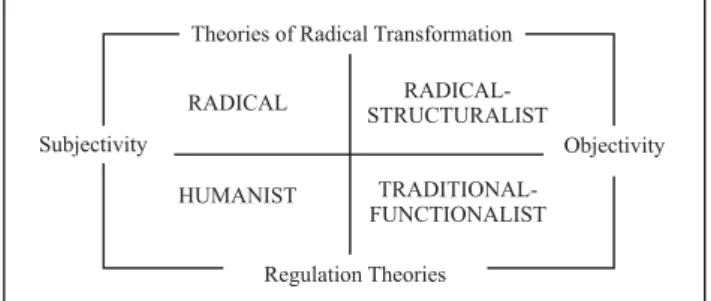
In this context, the understanding of the political pro-cesses that influence Health Promotion projects allows to understand the significant differences among the various proposals presented in its scope. The analysis of Health Promotion actions allows to classify them in four differ-ent groups(1), as presented in Figure 1.
In the Radical-structuralist actions, the theoretical ap-proach is based on the comprehension that the social con-flicts are supported by the irregular distribution of in-come, power and opportunities to the different social groups. The interventions for Health Promotion designed according to this point of view fundamentally compre-hend the development of public policies.
Traditional-functionalist actions are based on the com-prehension of society from common values, in which hu-manity may be comprehended from the natural sciences, with incorrect behaviors, lifestyles and habits, and dis-eases as the origin to health problems. Therefore, Health Promotion interventions are characterized by the modifi-cation of individual attitudes and the adoption of healthy lifestyles.
In the group of Humanist actions, society is constituted from the subjectivity of the individuals and their rules are created, supported and modified through the relationships among people. Health problems are configured as changes in the meaning attributed to the person for his identity and action, and the interventions aim at the improvement of the communication and at the meaning of self-knowledge(2-4).
Recently, the reflections on the concept of health and its articulation to the others areas of life support the con-struction of another theoretical model for the comprehen-sion of Health Promotion. The model proposed by Labonte(5),
presented in Figure 2, represents a dialectical concept for health and welfare. This model highlights the existence of dimensions and interfaces that express the complexity and dynamism existing in the health-disease process, from the logic of the Health Promotion critical paradigm.
Theories of Radical Transformation
Regulation Theories
Subjectivity Objectivity RADICAL
RADICAL-STRUCTURALIST HUMANIST
TRADITIONAL-FUNCTIONALIST
Figure 1 - Caplan’s Diagram - São Paulo - 1993
In the presented model(1), the theoretical basis of Health
Promotion circulate around opposite poles that go from the subjectivity to the objectivity and from regulationist theories to social theories that promote the radical trans-formations. The interfaces between these poles design groups of actions that are considered radical, radical-structuralist, humanist and traditional-functionalist.
Radical actions initiate in the comprehension of the irregular distribution of power in society, which charac-terizes it as oppressive and alienating. Health problems are originated in the social institutions that, by defining values, affect the human conscious. In this perspective, the way of coping with the social order stands on the com-munity development, on the comcom-munity empowermentand the encouragement to the self-discovery.
Vital Energy
Macro-structure Ability
to do one's wish
Control over life Life
project
Community life Social relations Welfare
Autonomy Resilience
Community Empowerment
Figure 2 - Diagram of health and welfare - São Paulo - 2001
This new model(5-6) exceeds the biomedical
them, which represent the range of the individual’s power to control and change the determinants of his health. The intersection of all dimensions expresses the possible wel-fare at a certain historical moment, inside a macro-struc-tural context of society.
According to the previous diagram, the three health dimensions are: the Physics or Vital Energy – related to the vitality level of the biological body to perform daily life activities; the Emotional or Life Project – represents the emotions, aspirations and wishes, which affect the mean-ing of life projected by the individual; the Social or Com-munity Life – expresses the relationships and interactions of the individual in his environment, through the repre-sentations and other social institutions(5).
The intersection of the health dimensions highlights the areas of Health Promotion action together with indi-viduals and groups: Control over life – implicates the in-crease of social power of the groups in order to exercise their freedom and socially participate to transform real-ity; Abilities to do one’s wish – comprehends the capability
presented by the individual to make decisions resulting in his self-fulfillment and other personal achievements; So-cial relations – comprehends the individual and/or group potential to build social networks, to have and keep par-ticipative and supportive relationships with family, friends, neighbors, community and government representatives.
The work of health professionals in the promotion per-spective may be strengthened when considering also other theoretical explanatory concepts of the previously de-scribed dimensions and added to the model of Labonte:
Resilience, building social spaces in face of adversities, in order to take advantage of good experiences in the context of life and work; Autonomy, comprehending the relation of the physical vitality with the life project, in order to at-tribute a positive meaning to living; and Community Em-powerment, including the future projects of the individu-als in the interior of the social relations to generate trans-formation processes over the determinants of life(6).
THE DEVELOPMENT OF EXTENSION PROJECTS AND STUDIES ON HEALTH PROMOTION: THE CHALLENGE OF
THE PROJECT JANELAS
During the implementation of the Family Health Strat-egy in the city of São Paulo, the project Nossas Crianças: Janelas de Oportunidades(7) (Our Children: Windows of
Op-portunities) was created and implemented, based on the referential of Health Promotion recommended by Labonte. This project constitutes an innovative intervention given the need for new care technologies, in the perspective of the promotion and complementary to the already approved healing practices, and a health technology aimed at trig-gering a movement of appreciation of the professional subject, instead of a movement to subordinate him to work.
It was implemented in prioritary regions in the city, in which children health indicators were more fragile, aimed at serving the children population with a greater demand of care.
In consonance with the theoretical-methodological basis of Health Promotion, the Project Janelas involved a partnership between the City Department of Health, The United Nations Children’s Fund (UNICEF), the University of São Paulo (USP), the Federal University of São Paulo (UNIFESP) and institutions with experience in community work with families, such as the Pastoral da Criança, the Japan International Cooperation Agency (JICA) and the NGO Monte Azul.
The Project Janelas aimed to integrate actions in differ-ent levels and influence a broad number of factors related to the development of the child, since the daily care and the opportunities she receives in her daily life, aimed at her full development, complementing the traditional ap-proach, centered in the evaluation of development abili-ties and goals.
In this context, it proposes a systematic structure for monitoring the care offered by the families and other caregivers to children under 6 years old, since the gesta-tional period, which allows professionals to organize their care to the families in order to reinforce favorable as-pects and promote the improvement of care, as necessary. Considering care as one of the determinants on chil-dren development, the concepts that subsidized the Proj-ect Janelas stand on the following pillars: Health Promo-tion as the guiding area; the importance of the stimulaPromo-tion in the first years of life; the centrality of the family in the child care; the importance of the child development in the scope of the health monitoring; the commitment of the public sector in the guarantee to properly stimulate the child; the organization of the actions for development con-tinuation from a new approach; the knowledge derived from work experiences with families in need.
These pillars aim at the construction of an enlarged clinic(8) in the assistance to children, since they
comphend the ethical commitment, and the commitment of re-sponsibility to the families in the production of care to the child, the intersectorial and team performance, and the review of the health actions and technologies, with the support of other sectors and knowledge.
As an essential part of the proposal for applying the technologies of the project Janelas, an educational course was developed for health professionals aimed at promot-ing the use of the material, structured on the emancipato-ry education(10-11). Besides, the handbookToda Hora é Hora
de Cuidar (Every Time it is Time for Care) was also produced, with contents on the subjects and practical suggestions of participative and emancipatory strategies of operation-alization with the families. Available on the internet at http://www.unicef.org/brazil/pt/manualtodahora.pdf.
One year after the implementation of the project ac-tions in several family health units, in the public network of the city of São Paulo, technological evaluation studies in health(12) were carried out, aimed at evaluating the
project Janelas. These studies perceived that the instru-ments of the project Janelas constitute a technology medi-ated by knowledge, attitude, commitment and responsi-bility of the professional, as basis for the transforming practices and substitution of the biomedical model in health care. The theoretical referential adopted was the Evaluation in Health in the Promotion Perspective(5).
The studies highlighted that the main con-tributions of the project were to evidence: the pertinence of the applicability of the pro-motion concepts in basic care projects; the qualitative pertinence of the processes for partnership and collective construction of the products textbook, handbook and form(7,10-11,13-15); the pertinence of the
educa-tional and instrumentalizing process of the professionals based on emancipatory meth-odologies(10-11, 14); the importance of the
tech-nical and social support network of the Proj-ect Janelas during the moment of dissemina-tion and identificadissemina-tion of the problems in the use of the new material; the appreciation
of the contents on Health Promotion and children devel-opment by the professionals(14) and by the families(15); as
well as the adjustment of the products that constitute the technologies in question(14-15).
At the initial stage of implementation, at the moment of the studies, it was not possible to verify impacts in the ways of care and consequent benefits to children develop-ment. On the other hand, it was evidenced that the project encouraged and supported the leading role of health pro-fessionals in the dialogue with families regarding the ef-fective care for better development of the child(7). This
hap-pened due to two main reasons: 1) the material and con-tents of the Project Janelas were perceived as instruments for the Health Promotion actions and effective approach to the families and, therefore, they were adopted in the practice by the professionals who were concerned about meeting their needs in an integral and broadened way (13-14); 2) strategies of participative and emancipatory
educa-tion supported the collective and creative construceduca-tion of local projects for implementing the Project Janelas,
pro-moting its capability to generate changes and satisfac-tion with the practices(13).
It is worth highlighting that the development of the studies brought important contributions to the analysis of the theoretical-methodological referentials in face of the studies on Health Promotion. They confirmed the need for different methodological approaches and different study techniques for approaching the complexity of the interventions in this area, which articulate the acquisi-tion and analysis of subjective and objective data, through quantitative and qualitative strategies, besides the ad-justment of the language of the collecting instruments given the diversity of the social actors involved in the process. Another aspect verified was that the methodologies for studying the effectiveness of Health Promotion still need to articulate the evaluation of processes and results, since the results with the target population of the health actions can only be evidenced in a long term temporal space. Fur-thermore, the impact of the actions developed does not take place only in the health area, which demands mastering knowledge in other areas to define the place and the way to identify, collect and analyze the data. In this context, there is still the need to improve the research instruments and theoretical charts in order to be entitled to the complexity of the phenomena and provide quality approaches to the Health Promotion actions, increasing the emerging production aimed at the broad-ened clinic in health services.
FUTURE PERSPECTIVES ON THE STUDY AND PRACTICE OF HEALTH PROMOTION
As an axis for the practices of the Brazil-ian National Health System, Health Promotion reinforces as essential purposes the production of health and the co-construction of the capability of autonomous action for the individuals involved: workers and users(16). Therefore,
there are demands such as the establishment of processes generators of autonomy and appropriation of the com-plexity of the new object by these individuals. The matters of human relationship, essential to the construction and consolidation of autonomous and emancipatory ex-changes are found rather fragile at the National Health System(17). The listening spaces, such as committees and
conferences, are dissociated from the daily routine of the professionals. The technicians, based on their knowledge, assume they know what people need, especially the most vulnerable ones.
Health Promotion has been incorrectly executed through
orthopedic interventions in the communities, suggesting lifestyle changes. The educative or preventive practices, generally confused with promotion, operate as if techni-cians have the only existing and valid knowledge. There-There is still the need to
improve the research instruments and theoretical charts in order to be entitled to the complexity of the phenomena and provide
quality approaches to the Health Promotion
fore, both the clinic and the health actions of collective and community character, developed in the health services, are still predominantly prescritive and restricted(16,18).
The experience of the Project Janelas showed that the incorporation of instruments based on the population autonomy and empowerment construction as well as the use of mild technologies in the health work are capable of reorientating the attention of the professional from the needs to the health potentials present in the users (and their families). It also indicated that Health Promotion requires intersectorial actions that involve not only the individuals, but their families and communities, as well as the importance of guaranteeing didactic-pedagogical resources to facilitate the learning and promote the dia-logue between professionals and families. These resources, besides transmitting information, must handle the empow-erment of the communities and the place of the individu-als in the leading role of their health care(10-11,16).
Another lesson learned with this project refers to the educational processes of health professionals. It was
learned that they must be continuous, based on the re-spect to others, and they must take the conversation net-work in order to establish pacts between the team and the family for actions and/or changes to strengthen health or better cope with disease situations. It is important to high-light that professional practices based on these principles increase the probability of bond and compliance to the care in health, since they radicate in a relation of mutual trust and validate the indispensable broadening of the clinic in basic care(10-11). Provided with the clinic
broaden-ing, it will be possible to meet the complex demand to consider an individual (users and professionals) in his singularity, integrality and social-cultural insertion, as protagonists of the care process. The peculiarities of Health Promotion in the scope of the National Health System re-quire the reorientation of the clinical practice and the ethical equation. Both must be unfocused from the hospi-tal-centrism and the high specialization that mark the con-formation of the health system, and the education of the professionals must incorporate the richness of the biog-raphy of the care protagonists’ lives: the people(19).
REFERENCES
1. Caplan R. The importance of social theory for health promotion: from description to reflexivity. Health Promotion Inter. 1993;8(2):147-57.
2. Domingues J. A percepção de trabalhadores de saúde da família sobre intersetorialidade [dissertação]. São Paulo: Escola de Enfermagem, Universidade de São Pau-lo; 2006.
3. Carvalho SR. Saúde coletiva e promoção da saúde: su-jeito e mudança. São Paulo: Hucitec; 2005.
4. Ávila LK. A promoção da saúde na organização das ações de enfermagem em saúde da criança no município de São Paulo [tese]. São Paulo: Escola de Enfermagem, Universidade de São Paulo; 2009.
5. Labonte R. Health promotion and empowerment: practice frameworks. Toronto: Centre for Health Promotion, University of Toronto; 1996.
6. Chiesa AM, Westphal MF. The ingration of quali-quantitative techniques in health promotion: experiences developed in Brazil. In: Book of abstracts of World Conference on Health Promotion and Health Education; 2001; Paris, FR. Paris: UIPES; 2001. p. 20.
7. Chiesa AM, Fracolli LA, Veríssimo MLÓR, Solymos GMB. Avaliação da implantação de novos instrumentos para o fortalecimento das ações de promoção do desenvolvi-mento infantil, na área de atuação do programa saúde da família do município de São Paulo [relatório de pes-quisa]. São Paulo: Escola de Enfermagem da USP; 2007.
8. Brasil. Ministério da Saúde. Secretaria Executiva. Nú-cleo Técnico da Política Nacional de Humanização. Humaniza SUS: a clínica ampliada. Brasília; 2004. (Série B - Textos Básicos de Saúde).
9. Veríssimo MLÓR, Chiesa AM. A promoção do desenvolvi-mento infantil: instrudesenvolvi-mento para o acompanhadesenvolvi-mento dos cuidados familiares. In: Fujimori E, Ohara CVS, organizadoras. Enfermagem e a saúde da criança na atenção básica. Barueri: Manole; 2009. p. 328-48.
10. Oliveira AAP. Análise documental do processo de ca-pacitação dos multiplicadores do projeto “nossas cri-anças: janelas de oportunidades” no município de São Paulo à luz da promoção da saúde [dissertação]. São Paulo: Escola de Enfermagem, Universidade de São Paulo; 2007.
11. Correia KMA. Avaliação da capacitação dos multipli-cadores do projeto Nossas crianças: janelas de opor-tunidades, a partir da percepção dos sujeitos partici-pantes do processo [dissertação]. São Paulo: Escola de Enfermagem, Universidade de São Paulo; 2007.
12. Novaes HMD. Avaliação de programas, serviços e tecnologias em saúde. Rev Saúde Pública. 2000;34(5): 547-59.
14. Martins J, Veríssimo MLÓR, Oliveira MA. Avaliação dos instrumentos do projeto “nossas crianças: janelas de oportunidades”, segundo agentes comunitários de saúde. Texto Contexto Enferm. 2008;17(1):106-14.
15. Grippo MLVS, Fracolli LA. Avaliação de uma cartilha educativa de promoção ao cuidado da criança a partir da percepção da família sobre temas de saúde e cida-dania. Rev Esc Enferm USP. 2008;42(3):430-6.
16. Campos R, Campos GW. Co-construção de autonomia: o sujeito em questão. In: Campos GW, Minayo MCS, Akerman M, Drumond Júnior M, Carvalho YM, organizadores. Trata-do de saúde coletiva. São Paulo: Hucitec; 2006. p. 669-88.
17. Lima AC, Morales DA, Zoboli ELCP, Sartório NA. Proble-mas éticos na atenção básica: a visão de enfermeiros e médicos. Cogitare Enferm. 2009;14(2):294-303. No prelo.
18. Cortina A. Ética de la razón cordial: educar en la ciudadanía en el siglo XXI. Oviedo: Ediciones Nobel; 2007.