*Correspondence: M. P. D. Gremião. Departamento de Fármacos e Medi-camentos, Faculdade de Ciências Farmacêuticas de Araraquara, Universi-dade Estadual Paulista Júlio de Mesquita Filho. Rodovia Araraquara – Jaú, km 1 – 14801-902 – Araraquara – SP, Brasil, Caixa-postal: 512. E-mail: [email protected]
A
vol. 49, n. 1, jan./mar., 2013
Preparation and characterisation of Dextran-70 hydrogel for
controlled release of praziquantel
Flávio dos Santos Campos
1, Douglas Lopes Cassimiro
2, Marisa Spirandeli Crespi
2, Adélia Emília
Almeida
1, Maria Palmira Dalon Gremião
1,*1School of Pharmaceutical Sciences, Universidade Estadual Paulista, Araraquara , São Paulo, Brazil, 2Institute of Chemistry, Universidade Estadual Paulista, Araraquara , São Paulo, Brazil
A hydrogel was developed from 70 kDa dextran (DEX-70) and praziquantel (PZQ) incorporated as a model drug. Biopharmaceutical properties, such as solubility and dissolution rate, were analysed in the design of the hydrogel. Furthermore, the hydrogel was also characterized by IR spectroscopy and DSC. Tests of the swelling rate showed that the hydrogel swelled slowly, albeit faster than the rate for the free polymer. In dissolution tests, the hydrogel released the drug slowly and continuously. This slow release was similar to that observed in the swelling tests and resulted in controlled release of the drug. Thus, this dextran is a suitable polymer for the development of hydrogels as vehicles for the controlled release of drugs.
Uniterms: Hydrogel/development. Hydrogel/biopharmaceutical properties. Dextran/hydrogel development. Praziquantel/controlled release. Hydrogel/swelling test.
Um hidrogel foi desenvolvido a partir de dextrano 70 kDa (DEX-70) e praziquantel incorporado (PZQ) como fármaco modelo. Propriedades biofarmacêuticas, como solubilidade e velocidade de dissolução, foram analisadas no desenvolvimento do hidrogel. Além disso, o hidrogel também foi caracterizado por espectroscopia na região do infravermelho e calorimetria diferencial exploratória (DSC). Testes da taxa de intumescimento mostraram que o hidrogel intumesce lentamente, embora tenha sido mais rápido do que a taxa do polímero livre. Nos testes de dissolução, o hidrogel liberou o fármaco lenta e continuamente. Esta liberação lenta foi semelhante a observada nos testes de intumescimento e resultou em uma liberação controlada do fármaco. Assim, o dextrano 70 kDa é um polímero adequado para o desenvolvimento de hidrogéis como veículos para a liberação controlada de fármacos.
Unitermos: Hidrogel/desenvolvimento. Hidrogel/propriedades biofarmacêuticas. Dextrano/ desenvolvimento de hidrogel. Praziquantel/liberação controlada. Hidrogel/teste de intumescimento.
INTRODUCTION
Schistosoma mansoni infection causes intestinal schistosomiasis andis one of the most common parasitic diseases in the tropics and subtropics (Enk et al., 2008). One treatment approach for this disease is chemotherapy using praziquantel (PZQ). PZQ is a broad spectrum anti-helminthic drug effective against all important species of
adult latworms and their immature forms. The poor bio
-availability of PZQ can be attributed to its fast metabolism and low water solubility (Mourão et al., 2005; USP 31, 2008). According to González-Esquivel et al. (2005), the
apparent permeability coeficient of PZQ is 4.4 x 10⁻⁵ cm/s.
For this reason, PZQ has been classiied as a Class II drug
in the Biopharmaceutics Classification System (BCS) (Passerini et al., 2006; Breda et al., 2009).
Drugs such as praziquantel, as well as those which do not have any biopharmaceutical property impaired by
a physicochemical property, may beneit from improved
properties with the use of controlled release systems. Drug delivery in conventional dosage forms often suffers from the drawbacks of repeated drug administration and large
systems are a convenient way of controlling the dosing frequency responsible for rapid absorption and distribution of drug in conventional dosage forms, and are dependent upon two intrinsic properties of the drug, namely, elimina-tion half-life (t1/2) and therapeutic index (TI). The goal is
to give a drug at a suficient rate, frequency and dose so
that the ratio Cmax/Cmin in plasma at steady state is always maintained at effective concentrations during the course of therapy, reducing side effects or improving physico-chemical and biopharmaceutical properties. A number of controlled release drug delivery systems such as oral, transdermal, injectable and implantable drug delivery systems have been investigated (Sood, Panchagnula, 2003; Sun et al., 2003).
In the development of controlled drug release systems, various strategies have employed polymers to modify the characteristics of the substances or particles thereby improving targeting action, prolonging release or decreasing toxicity. The use of polymers in the design of systems for controlled drug release has been intensively studied in recent years and some authors foresee major developments at the interface between the chemistry of polymers and the biomedical sciences (Takakura, Hashida, 1995; Duncan, 2003; Ettmayer et al., 2004).
The main interest in Polymeric Delivery Systems is their programmability. The use of these systems provides the potential to control drug delivery both temporally and spatially. A very simple example is sustained drug release from polymeric matrices that generates a continuous plasmatic concentration for a prolonged period within their therapeutic window, similar to non-polymeric drug delivery systems. Polymeric systems for drug delivery can be used for several purposes to improve biopharmaceuti-cal and pharmacokinetic properties of drugs. One of these applications is in the dynamic release of insulin from a polymeric matrix that occurs only in response to increased glucose concentration among diabetic patients. To extend blood circulation time, drugs have been encapsulated in polymeric nano- or micro- particles. Polymer-drug conju-gation can also increase drug circulation time and stability in blood. The products obtained from those systems thus improve drug performance, provide patient convenience, and prolong drug stability. Moreover, development of these products can also be less expensive than searching for new drugs. In addition, re-formulation is an effective means of extending patent protection of an existing drug (Leong, Langer, 1987; Pillai, Panchagnula, 2001; Kim et al., 2009).
Polysaccharides are the most popular of all polymer compounds used for drug release systems, due to a number of characteristics that make these materials ideal for
phar-maceutical use. These characteristics include the variety of chemical functional groups that can be attached to their
chains for both chemical and biochemical modiications,
as well as being highly stable, safe, non-toxic, hydrophilic and able to form gels upon hydration. Furthermore, poly-saccharides are biodegradable and thus attractive for use in targeted drug-release systems (Sinha, Kumria, 2001; Liu et al., 2008; Kim et al., 2009). Examples of poly-saccharides used for drug release include poly (alginic
acid), modiied starch, dextran and cellulose derivatives,
which have all been widely used because they control the release of the drug, albeit through different mechanisms (Adrianov, Payne, 1998; Lopes et al., 2005). Dextran, a polymer produced by microorganisms, is nontoxic, bio-degradable, biocompatible and highly hydrophilic. It can be produced in a wide range of molecular weights, giving rise to variable physical and chemical properties, such as different solubilities and viscosities. Dextran is degraded by dextranases in various organs of the human body, such as the liver, spleen, kidney and colon (Ferreira et al., 2004; Hiemstra et al., 2006; Barsbay, Güner, 2007). Dextran and its derivatives are used as plasma expanders, bone regeneration promoters and for skin and subcutaneous
illing. Thus, dextrans number among the most promising
candidates for the design of hydrogels capable of control-ling the release of both small molecule and protein drugs (Barsbay, Güner, 2007; Coviello et al., 2007) and have gained much attention due to their utility in a variety of other applications (Van Thienen et al., 2007). Additionally, dextrans have helped achieve optimal release and desir-able therapeutic characteristics in a wide range of systems. Hydrogels prepared from naturally occurring polymers
can therefore confer highly beneicial properties to a drug
(Hamidi et al., 2008). The objective of this study was to
develop a modiied release system consisting of a dextran
hydrogel containing praziquantel.
MATERIAL AND METHODOLOGY
Material
Dextran 70000 (TCI®), absolute ethanol 99.5% (Synth®), hydrochloric acid 37% (Chemis®), sodium lauryl sulphate (BDH Chemicals Ltda.) and Praziquantel (Shangai Pharmaceutical®) were used as received.
Method
Preparation of hydrogels and physical mixtures
hydrogels by the solvent casting process. Briely, PZQ was
dissolved by stirring in a water-ethanol solution. Dextran was then added. Subsequently, this mixture was placed in a rotary evaporator, and held at 55 oC until all solvent was
removed. Separately, physical mixtures were prepared by weighing PZQ and DEX-70 at the same ratio as above, and mixing. After mixing, the samples were sieved and stored.
Solubility assays
The solubility of the incorporated PZQ in water was determined by dispersing aliquots of hydrogels contain-ing 10 mg of PZQ in 10 mL of water, accordcontain-ing to the approach adapted from work carried out by Nepal et al.
(2010) and Vippagunta et al. (2002). These samples were stirred for 24 h, then centrifuged at 3400 rpm for 10 min and the amount of dissolved PZQ determined by UV spectrophotometry at 263 nm. The experiments were per-formed in triplicate and results expressed as mean values.
Sample characterisation
The systems were characterized by infrared absorp-tion spectroscopy (IR), X-Ray diffracabsorp-tion (XRD) and differential scanning calorimetry (DSC).
Infrared Absorption Spectroscopy
To investigate the existence of physical or chemical interactions between drug and polymer, absorption spec-tra in the infrared region were obtained using a Fourier transform infrared spectrophotometer (IRPrestige-21, Shimadzu®). Samples of PZQ, physical mixture and
hy-drogels mixed with KBr were analysed. The IR spectra were recorded and peaks compared to published data.
X-Ray Diffraction (XRD)
The identiication of the crystalline structure and/
or amorphous forms of PZQ, DEX, PZQ/DEX physi-cal mixture and PZQ /DEX hydrogels was carried out in diffraction patterns obtained from X-ray diffraction on a Siemens ® model D5000 goniometer at a speed of
0.05/min under Cu-Kα radiation (λ = 1.5406 Å) and scan
-ning X-ray wide angle 2θ of between 4 and 60.
Differential scanning calorimetry (DSC)
For thermal analysis of PZQ, DEX, PZQ/DEX physical mixture and PZQ/DEX hydrogels, a DSC-2910 differential scanning calorimeter (TA Instruments®),
capable of operating from room temperature up to 600 °C, was employed. DSC curves were obtained from samples of 1.9 to 2.1 mg in aluminium crucibles heated at 10 °C/min under a nitrogen atmosphere flowing at 25 mL/min.
Swelling ratio
The swelling ratio of the samples was recorded over 2 h in an adapted Enslin device (Cury, 2009). For these tests, a 0.05 g aliquot of each sample was used, and the volume of water absorbed was assessed at time intervals of 1, 5, 10, 15, 20, 30, 40, 60, 90 and 120 min. All assays were performed in triplicate and the results expressed as a percentage of absorbed water relative to the initial sample mass.
In vitro dissolution assays
The rate of dissolution of PZQ was evaluated for those hydrogels that showed improvement in the water solubility of PZQ. The percentage drug dissolved was estimated by the method described in USP 31 for PZQ tablets, which was adapted to the conditions required to analyse the hydrogel parameters. Samples of free PZQ, hydrogels or physical mixture (10 mg) were incu-bated in 150 mL of a dissolution medium composed of 2 mg/mL sodium lauryl sulphate in 0.1 N HCl. Aliquots of this medium were withdrawn at 5, 10, 15, 20, 30, 45 and
60 min, iltered and analysed by HPLC. On withdrawal,
each aliquot was replaced with fresh medium.
For the HPLC analysis, a Varian - ProStar system for High Performance Liquid Chromatography was used, equipped with two solvent injection pumps (Prostar ® /
Dy-namax ® 210/215), a photodiode assay spectrophotometric
detector (Prostar ® 330 UV-VIS PDA), Star system data
integration, an injection system (Rheodyne ® VS 7125)
with a 100 μL loop and a Varian ® HPLC octadecyl silane
RP 18 column (250 mm, 5 µm particle size). The mobile phases were water (55%) and acetonitrile (45%). Aliquots
of 150 μL of collected sample were injected, and a low
rate of 1 mL/min was used.
RESULTS AND DISCUSSION
Preparation of hydrogels
Hydrogels have been widely studied as potential systems for drug delivery and, in particular, as a viable means of improving the dissolution rate of poorly water soluble drugs. The small intestine is highly permeable to PZQ, but due to its poor water solubility it has low drug bioavailability. Dextran was chosen as the polymeric car-rier as it is a natural polymer with low toxicity, high bio-compatibility and biodegradability, and especially because it is hydrophilic. All of these properties are considered ideal for hydrogels.
ethanol facilitates drug dissolution and also the physical cross-linking of the polymer through intermolecular inter-actions, such as hydrogen bonding or weaker interactions. Water then hydrates the polymer, completing the formation of the hydrogel. It is likely that during this for-mation process, there is competition between ethanol and the polymer for water molecules, causing the drug to be incorporated into the polymer matrix during this process. In the present study, this method proved to be successful
and eficient, as well as being easy to execute and low cost.
Solubility Assays
Figure 1 shows the results of water solubility of PZQ for the different samples. All tests were performed in triplicate and the results correspond to the mean of the three determinations. The solubility of 0.22 mg/mL for
free PZQ served as a control to assess the inluence of the
polymer carrier on this drug property. The data in Figure 1 show that the hydrogel altered the drug’s solubility in water. The solubility of PZQ in the samples of the 1:0.5 PZQ:DEX hydrogel was slightly lower than that of the free
drug. This solubility behaviour relects the fact that dextran
is a hydrophilic polymer and PZQ is very poorly soluble in water. Thus, the dissolution of the drug is hindered by the dextran binding to most of the water.
Infrared Absorption Spectroscopy
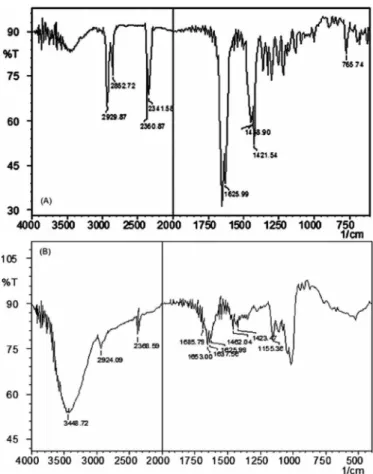
The PZQ absorption spectrum (Figure 2a) shows an OH stretching band at 3400 cm-1 which, in this case, is
attributed to the presence of water molecules. The bands at 2929.87 cm-1 and 2852.72 cm-1 are CH vibrations of the
symmetric and asymmetric CH3 and CH2 axial
deforma-tions, which have previously been observed in PZQ-loaded nanoparticles by Mainardes et al. (2006). According to these authors, a band at 1630 cm-1 stems from carbonyl
stretching, and is observed at 1649.14 cm-1 (Figure 2a) in
this case. Furthermore, several overlapping bands are seen between 1350 and 1000 cm-1, indicating CN axial
defor-mation (Mainardes et al., 2006). As noted by Stenekes
et al. (2001) and Pitarresi et al. (2007), in the absorption spectrum of dextran (Figure 2b) there is a broad band at 3448 cm-1, resulting from OH stretching in the polymer
chain. Stenekes et al. (2001) also reported the presence of a band at 2900 cm-1 related to CH/CH
2 vibrations, which
can be observed at 2922 cm-1 and 2924 cm-1 in this
experi-ment (Figure 2b). Comparing the IR absorption spectra of the physical mixture and the hydrogel (Figure 3), it can be observed that the characteristic functional groups of drug
and polymer are maintained, conirming the integrity of
the components in each case.
X-Ray Diffraction
Figure 4 show X-Ray patterns of PZQ, DEX, physi-cal mixtures and hydrogel. The X-Ray pattern of free PZQ shows crystalline structure of drug, as demonstrated by sharp and intense diffraction peaks close to 6o, 7.5o and a
range of peaks between 10o and 30o, similar to those
ob-served by Passerini et al. (2006) and Cheng et al. (2010).
FIGURE 1 - Solubility of PZQ incorporated into hydrogels (Pzq:Dex-70 1:0.5 HG) and physical mixture (Pzq:Dex-70 1:0.5 MF) in water.
FIGURE 3 - Infrared Spectrum of Physical Mixture PZQ:DEX-70 (A) and Hydrogel PZQ:DEX-70 (B).
Dextran presents a broad peak centered at 2θ of 18o,
sug-gesting some level of crystallinity, as noted also by Yuan
et al. (2009). It is also evident in the physical mixture that PZQ maintained peaks close to 6o and 7.5o, although
the intensity was reduced slightly, whereas the series of peaks between 10o and 30o were unchanged. In hydrogel,
the x-ray pattern showed some changes, such as the peak around 6o which did not appear in the pattern and the peak
at 7.5o that was signiicantly reduced in intensity. Both
X-Ray patterns failed to show evidence of an X-X-Ray pattern of DEX, probably owing to the concentration of polymer in the formulation. In addition, these results showed that DEX and PZQ did not interfere with each other in the formulation.
Differential Scanning Calorimetry (DSC)
Figure 5 show DSC curves of PZQ, DEX, physical mixture and hydrogel. In Figure 5a, the DSC curve for praziquantel has a sharp endothermic peak at 137.7 °C. This peak corresponds to the melting point of the drug and indicates that it is crystalline in nature (Hus-sein, Abdullah, 1998; Mainardes, Gremião, Evangelista,
FIGURE 4 - XRD patterns of praziquantel, dextran 70 kDa, physical mixture and hydrogel.
2006). As observed by Zhang and Chu (2002), the glass transition of dextran can be seen near 220 oC. This glass
transition temperature indicates that there is no
crystal-line dextran and thus conirms the amorphous structure
of the polymer. A possible cause of such a high glass transition temperature could be the existence of strong hydrogen bonds between the macromolecules of dextran (Zhang, Chu, 2002). The PZQ:DEX physical mixture shows an endothermic peak at 139.4 oC (Figure 5c),
in-dicating that the drug-polymer mixture does not generate changes in the thermal behaviour of PZQ. However, the PZQ-DEX hydrogel exhibited an endothermic peak at 138.7 °C, showing a higher energy input than that ob-served for the equivalent physical mixture. Furthermore, both of these energy inputs are lower than that required by PZQ (Table I). The amount of energy needed to melt the free PZQ is higher in its pure crystals because the intermolecular interactions are much stronger in PZQ than those between PZQ molecules incorporated into the hydrogel or those in the physical mixture. It should also be noted that there are interactions between the molecules of PZQ and dextran, but these are extremely weak. The same interactions occur in the hydrogels, but because the drug molecules are further apart within the polymer network formed by dextran macromolecules these occur in a milder form and consequently the amount of energy needed to generate the fusion of PZQ is further reduced.
A summary of data obtained by DSC can be seen in Table I. Based on this data, it can be concluded that there is a weak solid-solid interaction between the polymer and drug, although this did not interfere with the physi-cochemical properties of the drug, polymer or delivery
FIGURE 5 - DSC curves of praziquantel (a), dextran 70 kDa (b), the physical mixture PZQ:DEX-70 (c) and the hydrogel PZQ:DEX-70 (d).
TABLE I - DSC data
Sample (mg) Tonset (
oC) T peak (
oC) ΔH (J/g)
PZQ 137.7 141.2 89.87
DEX70 - -
-PZQ:DEX70(1:0.5) 138.7 142.3 74.86
MF-PZQ:DEX70(1:0.5) 139.4 143.2 64.63
Swelling ratio
Figure 6 shows the swelling proile of the samples
over time. The swelling ratio of samples containing the drug was higher than that of the polymer alone. Initially, the dextran did not show any swelling, but after 40 min-utes of contact with the moistened surface of the sintered
plate, the polymers began to swell until inally, after 120
minutes, a swelling ratio of 384% was observed. However, the hydrogels showed a quite different swelling behaviour from that of the free polymer. The dextran hydrogel had a swelling ratio of 58% at 10 min, gradually rising to 358% in relation to its original weight at 40 min. It then remained constant until 90 min, after which time it began to increase, continuing to do so until 120 min, at which time it had increased by 536%.
An explanation for this swelling pattern is that
dex-FIGURE 6 - Swelling proile of dextrans 70kDa (Dex-70), and
hydrogel containing praziquantel (PZQ:DEX-70 (1:0.5)).
tran is a linear polymer, by more than 50% of consecutive
α-(1 → 6) linkage in its main chains, and having side chains starting from branched linkages of α-(1 → 2), α-(1 → 3) and α-(1 → 4) (Coviello, 2007). These side chains
are more than likely responsible for the physical interac-tion between the polymer chains and, consequently the formation of the hydrogel networks. The polymer also has a large number of hydroxyl groups, responsible for the polymer’s hydrophilicity and probably also for the formation of hydrogen bonds between polymer chains.
much smaller than the distance between many of the other hydroxyl groups in the same molecule. This tight binding would hinder the entry of water into the polymer network. The presence of the drug may cause a rearrangement of the OH groups, increasing the distance between various chains of dextran and reducing the amount of free hydroxyl groups able to form hydrogen bonds. This rearrangement, in turn, would make these groups more available for con-tact with water and thus accelerate hydrogel formation.
In vitro dissolution assays
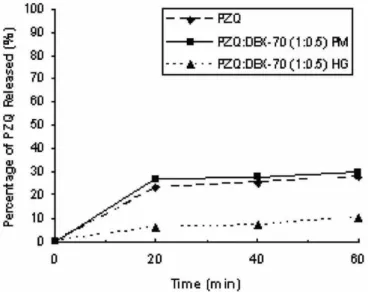
Figure 7 shows the results of PZQ release. Accord-ing to the analysis, the 1:0.5 PZQ:DEX hydrogel sample reached the maximal amount of drug released in 60 min. The maximal amount of drug released was 10.2%, a value much smaller than the 27.6% from the free drug and the 29.7% from the physical mixture.
From the proile for the 1:0.5 PZQ:DEX hydrogel, a
continuous release of the drug was observed, proving that this dextran hydrogel acted as a controlled drug release system. The swelling ratio of hydrogels determines the
drug release proile. Therefore, it is possible to show a relationship between the swelling proiles of the dextran hydrogels, noted earlier, and their drug release proiles.
A likely explanation for the observed release proile
would be that the hydrogel swelling capacity was affected by a very strong molecular interaction between the poly-mer chains, despite the likely rearrangement of the OH groups. These types of interactions have also been reported in DSC analyses. The existing hydrogen bonds likely
par-FIGURE 7 - Release Proile of hydrogel PZQ: DEX-70 (1:0.5),
their physical mixture and free drug.
tially hinder the separation of polymer chains, allowing for the entry of water, as seen in the swelling tests, but also
obstruct the outlow of the drug, leading to prolonged drug
release. This mechanism may afford an improvement in various properties of the drug, such as its bioavailability and half-life, while also reducing its adverse effects.
CONCLUSIONS
The use of hydrogels as delivery systems for drugs has shown interesting results. In the in vitro release assays,
the proile of PZQ release was prolonged by incorporation
into dextran molecules, effectively trapping PZQ in the matrix and releasing it gradually.
Swelling analysis proved to be crucial in the char-acterisation of the hydrogels. While the physical charac-teristics of a polymer result from its structural properties,
alterations in swelling rate can change the release proile.
DSC analysis and IR absorption spectroscopy verified the absence of any strong interaction between drug and polymer.
Finally, in addition to the continuous release of PZQ, the incorporation of the drug into the polymer matrix could
give rise to signiicant changes in several pharmaceutical
properties of praziquantel, such as its solubility and dis-solution rate.
ACKNOWLEDGEMENTS
We greatly appreciate and thank Tim Robert for his help in the careful review of this manuscript.
REFERENCES
ADRIANOV, A.K.; PAYNE, L.G. Polymeric carriers for oral uptake of microparticles. Adv. Drug Del. Rev., v.34, p.155-177, 1998.
BARSBAY, M.; GÜNER, A. Miscibility of dextran and poly (ethylene glycol) in solid state: effect of the solvent choice. Carbohydr. Polym, v.69, p.214-223, 2007.
B R E D A , S . A . ; J I M E N E Z - K A I R U Z , A . F. ; M A N Z O , R.H.; OLIVERA, M.E. Solubility behaviour and
biopharmaceutical classiication of novel high-solubility ciproloxacin and norloxacin pharmaceutical derivates. Int. J. Pharm., v.371, p.106-113, 2009.
CHENG, L.; LEI, L.; GUO, S. In vitro and in vivo evaluation of praziquantel loaded implants based on PEG/PCL blends.
COVIELLO, T.; MATRICARDI, P.; MARIANECCI, C.; ALHAIQUE, F. Polysaccharide hydrogels for modified release formulations. J. Control Release, v.119, p.5-24, 2007.
CURY, B.S.F.; CASTRO, A.D., KLEIN,S.I., EVANGELISTA, R.C. Modeling a system of phosphatated-cross-linked high amylase for controlled drug release Part 2: Physical parameters, cross-linking degrees and drug delivery relationship. Int. J. Pharm., v.371, p.8-15, 2009.
DUNCAN, R. The dawning era of polymer therapeutics. Nat. Rev. Drug Discov., v.2, p.347-360, 2003.
ENK, M.J.; LIMA, A.C.L.; DRUMMOND, S.C.; SCHALL, V.T.; COELHO, P.M.Z. The effect of the number of stool samples on the observed prevalence and infection intensity with Schistosoma mansoni among a population in an area of low transmission. Acta Trop., v.108, p.222-228, 2008.
ETTMAYER, P.; AMIDON, G.L.; CLEMENT, B.; TESTA, B. Lessons learned from marketed and investigational prodrugs. J. Med. Chem., v.47, p.2393-2404, 2004.
FERREIRA, L.; GIL, M.H.; CABRITA, A.M.S.; DORDICK, J.S. Biocatalytic sythesis of highly ordered degradable dextran-based hydrogels. Biomaterials, v.26, p.4707-4716, 2005.
GIORDANO, F.; BETTINETTI, G.P.; LA MANNA, A.; MARINI, A.; BERBENNI, V. Thermal analysis of a drug-polymeric excipient solid system. J. Therm. Anal. Calorim, v.34, p.531-536, 1988.
GONZÁLEZ-ESQUIVEL, D.; RIVERA, J.; CASTRO, N.; YEPEZ-MULIA, L.; HELGI, J.C. In vitro characterization of some biopharmaceutical properties of praziquantel. Int. J. Pharm., v.295, p.93-99, 2005.
HAMIDI, M.; AZADI, A.; RAFIEI, P. Hydrogel nanoparticles in drug delivery. Adv. Drug Deliv. Rev., v.60, p.1638-1649, 2008.
HIEMSTRA, C.; AA, L.J.V.D.; ZHONG, Z.; DIJKSTRA, P.J.; FEIJEN, J. Novel in situ forming, degradable dextran hydrogels by Michael addition chemistry: synthesis, rheology, and degradation. Macromolecules, v.40, p.1165-1173, 2007.
HUSSEIN, I. EL-SUBBAGH; ABDULLAH, A. AL-BADR. Praziquantel. Anal. Prof. Drug Subs. and Exc., v.25, p.464-500, 1998.
KIM, S.; KIM, J.; JEON, O.; KWON, I.C.; PARK, K. Engineered polymers for advanced drug delivery. Eur. J. Pharm. Biopharm, v.71, p.420-430, 2009.
LEONG, K.W.; LANGER, R. Polymeric controlled drug delivery. Adv. Drug Del. Rev., v.1, p.199-233, 1987.
LIU, Z.; JIAO, Y.; WANG, Y.; ZHOU, C.; ZHANG, Z. Polysaccharides-based nanoparticles as drug delivery systems. Adv. Drug Deliv. Rev., v.60, p.1650-1662, 2008.
LOPES, C.M.; LOBO, J.M.S.; COSTA, P. Formas farmacêuticas
de liberação modiicada: polímeros hidrifílicos. Rev. Bras.
Ciênc. Farm., v.41, p.143-154, 2005.
MAINARDES, R.M.; GREMIÃO, M.P.D.; EVANGELISTA, R.C. Thermoanalytical study of praziquantel loaded-PLGA nanoparticles. Rev. Bras. Ciênc. Farm., v.42, p.523-530, 2006.
MOURÃO, S.M; COSTA, P.I.; MARORA, H.R.; GREMIÃO, M.P.D. Improvement of antischistosomal activity of praziquantel by incorporation into phosphatidylcholine-containing liposomes. Int. J. Pharm., v.295, p.157-162,
2005.
NEPAL, P.R.; HAN, H.; CHOI, H. Enhancement of solubility and dissolution of Coenzyme Q10 using solid dispersion
formulation. Int. J. Pharm., v.383, p.147-153, 2010.
PA S S E R I N I , N . ; A L B E RT I C I , B . ; P E R I S S U T I , B . ; RODRIGUEZ, L. Evaluation of melt granulation and ultrasonic spray congealing as techiniques to enhance the dissolution of praziquantel. Int. J. Pharm., v.318, p.92-102, 2006.
PILLAI, O.; PANCHAGNULA, R. Polymers in drug delivery.
Curr. Opin. Chem. Biol., v.5, p.447-451, 2001.
PITARRESI, G.; CASADEI, M.A.; MANDRACCHIA, D.; PAOLLICELLI, P.; PALUMBO, F.S.; GIAMMONA, G. Photocrosslinking of dextran and polyaspartamide
derivatives: A combination suitable for colon-speciic drug
delivery. J. Cont. Rel., v.119, p.328-338, 2007.
SINHA, V.R.; KUMRIA, R. Polysaccharides in colon-speciic
SOOD, A.; PANCHAGNULA, R. Design of controlled release delivery systems using a modified pharmacokinetic approach: a case study for drugs having a short elimination half-life and a narrow therapeutic index. Int. J. Pharm.,
v.261, p.27-41, 2003.
STENEKES, R.J.H.; TALSMA, H.; HENNINK, W.E. Formulation of dextran hydrogel by cristalization.
Biomaterials, v.22, p.1891-1898, 2001.
SUN, Y.; PENG, Y.; CHEN, Y., SHUKLA, A.J. Application
of artiicial neural network in design of controlled release
drug delivery systems. Adv. Drug Del. Rev., v.55, p.1201-1215, 2003.
TAKAKURA, Y.; HASHIDA, M. Macromolecular drug carrier systems in cancer chemotherapy: macromolecular prodrugs. Crit. Rev. Oncol. Hematol., v.18, p.207-231, 1995.
THE UNITED SATAES PHARMACOPEIA (USP 31). The National Formulary (NF 23). By authority of the United States Pharmacopeial Convention. Rockville: United States Pharmacopeial Convention, 2008. p.3056-3057.
VAN THIENEN, T.G.; HORKAY, F.; BRAECKMANS, K.; STUBBE, B.G.; DEMEESTER, J.; DE SMEDT, S.C.
Inluence of free chains on the swelling pressure of
PEG-HEMA and dex-PEG-HEMA hydrogels. Int. J. Pharm., v.337, p.174-185, 2008.
VIPPAGUNTA, S.R.; MAUL, K.A.; TALLAVAJHALA, S.; GRANT, D.J.W. Solid-state characterization of nifedipine solid dispersions. Int. J. Pharm., v.236, p.111-123, 2002.
YUAN, W.; GENG, Y.; WU, F.; LIU, Y.; GUO, M.; ZHAO, H.; JIN, T. Preparation of polysaccharides glassy microparticles with stabilization of proteins. Int. J. Pharm., v.366, p.154-159, 2009.
ZHANG, Y.; CHU, C.C. Thermal and mechanical properties of biodegradable hydrophilic-hydrophobic hydrogels based on dextran and poly(lactic acid). J. Mater. Sci-Mater. M.,
v.13, p.773-781, 2002.
Received for publication on 22sd April 2012