*Correspondence: Satyanshu Kumar. Directorate of Medicinal and Aromatic Plants Research Boriavi, Anand-378310, Gujarat, India. E-mail: [email protected]
A
vol. 49, n. 1, jan./mar., 2013
Development and validation of a rapid high performance liquid
chromatography – photodiode array detection method for
estimation of a bioactive compound wedelolactone in extracts of
Eclipta alba
Satyanshu Kumar
*, Tushar Dhanani
Directorate of Medicinal and Aromatic Plants Research Boriavi, Anand, Gujarat, India
Following optimization of extraction, separation and analytical conditions, a rapid, sensitive and simple reverse-phase high performance liquid chromatography-photo diode array (HPLC-PDA) method
has been developed for the identiication and quantiication of wedelolactone in different extracts of Eclipta alba. The separation of wedelolactone was achieved on a C18 column using the solvent system consisting of a mixture of methanol: water: acetic acid (95: 5: 0.04) as a mobile phase in isocratic elution mode followed by photo diode array detection at 352 nm. The developed method was validated as per the guidelines of the International Conference on Harmonization (ICH). Calibration curve presented good linear regression (r2>0.998) within the test range and the maximum relative standard deviation
(RSD, %) values for intra-day assay were found to be 0.15, 1.30 and 1.1 for low (5 µg/mL), medium (20 µg/mL) and high (80 µg/mL) concentrations of wedelolactone. For inter-day assay the maximum RSD (%) values were found to be 2.83, 1.51 and 2.06 for low, medium and high concentrations,
respectively. Limit of detection (LOD) and limit of quantiication (LOQ) were calculated to be 2 and 5 μg/mLrespectively. Analytical recovery of wedelolactone was greater than 95%. Wedelolactone in different extracts of Eclipta alba was identiied and quantiied using the developed HPLC method. The
validated HPLC method allowed precise quantitative analysis of wedelolactone in Eclipta. alba extracts.
Uniterms:High performance liquid chromatography/quantitative analysis. High performance liquid chromatography/photo diode array/method validation. Eclipta alba/extracts/analysis.Wedelolactone/
quantiication.
Desenvolveu-se método rápido, sensível e simples de Cromatograia Líquida de Alta Eiciência em fase
reversa, utilizando-se arranjo de fotodiodo (HPLC-PDA), visando à separação, extração e às condições
analíticas para a identiicação e quantiicação de wedelolactona em diferentes extratos de Eclipta alba. A separação de wedelolactona foi efetuada por meio de uma coluna C18, utilizando mistura de metanol:água:ácido acético (95:5:0.04) como fase móvel, em sistema de eluição isocrática, seguida de detecção por arranjo de fotodiodo a 352 nm. O método desenvolvido foi validado de acordo com as
diretrizes da Conferência Internacional de Harmonização (ICH). As curvas de calibração apresentaram
boa regressão linear (r2>0,998), dentro dos intervalos de teste, e os valores máximos de desvio padrão
relativo (RSD,%) dos ensaios intra-dia foram 0,15, 1,30 e 1,1 para concentrações de wedelolactona baixa (5 µg/mL), média (20 µg/mL) e elevada (80 µg/mL) Para o ensaio inter-dia,os máximos de RSD
(%) foram 2,83, 1,51 e 2,06 para as concentrações baixa, média e alta, respectivamente. O Limite de
Detecção (LD) e o Limite de Quantiicação (LOQ) foram de 2 e 5 µg/mL, respectivamente. A recuperação
analítica de wedelolactona foi maior do que 95%. A wedelolactona em diferentes extratos de Eclipta alba foi identiicada e quantiicada pelo método de HPLC desenvolvido. O método de HPLC validado
permitiu a análise quantitativa precisa de wedelolactona em extratos de Eclipta alba.
Unitermos:Cromatograia líquida de alta eiciência/análise quantitativa. Cromatograia líquida de
alta eiciência/em fase reversa/validação de método.Eclipta alba/extratos/análise. Wedelolactona/
INTRODUCTION
Eclipta alba (L.) Hassk. Syn. E. erecta L. “bhrin-garaja” belonging to the family of Asteraceae, is a small, branched annual herb with white lower heads. The plant grows abundantly as weed in cool, moist places throughout India (Chopra et al., 1956; Rastogi, Mehrotra, 1991). In
Ayurvedic system of medicine, this plant is described as the best drug for treatment of liver cirrhosis and infective hepatitis. The plant juice is applied locally to treat inger decay caused due to infection during rainy season and extract is given in chronic fever. Leaf juice with buttermilk is used as antidote for snakebite. Shoot juice of E. alba
mixed in equal amount with shoot juice of Oxalis cornicu-lata Linn. is used as drops in injured eyes. The decoction of the plant is given for headache. The herb is reported to exhibit immuno-stimulatory activity and aqueous extract possessed myocardial depressant and hypotensive effect, unrelated to cholinergic acid and histaminergic effect in experimental animals. Coumestans, polypeptides, poly-acetylenes, thiophene derivatives, steroids, triterpenes, and lavonoids have been reported as the main constituents of
E. alba (Sarg et al., 1981). β-Amyrin, wedelolactone and
luetolin 7-O-glucoside have been isolated from the aerial parts of the plant (Sikoria et al., 1982). Hentricontanol, 14-heptacosanol and stigmasterol have been reported from the roots of the plant (Singh et al., 1985). The coumestan, wedelolactone (Figure 1), is the bioactive principle of aerial parts of E. alba. Various biological activities such as hepatoprotective, antiplasmodial, sedative, anxiolytic, noo-tropic and anti-stress have been reported for wedelolactone (Saxena et al., 1993; Simonsen et al., 2001; Thakur et al., 2005). Wedelolactone exhibited activity as an antidote to snake venom (Bothrops jararaca). Albino mice (20 g aver-age weight) were given a dose of 100 mg/kg of wedelolac-tone isolated from Eclipta prostrata by oral administration of one hour prior to envenomation. Ninety percent albino mice survived after six hours of envenomation and after 24 and 48 hours of being envenomed, forty percent survival was reported (Pereira et al., 1994). Although, chemical synthesis of wedelolactone has been reported by several groups (Chang et al., 2008), there are only few high per-formance liquid chromatography method for identiication and quantiication for wedelolactone in extracts of E. alba. Furthermore, reported methods are time consuming with analysis time varying from 30-40 minutes (Murali et al., 2002; Wagner et al., 1986) and not validated as per ICH guidelines. Therefore, present investigation was undertaken to develop a rapid, sensitive high performance liquid chro-matography method for identiication and quantiication of wedelolactone in extracts of E. alba.
MATERIAL AND METHODS
Material and Chemicals
Whole plant of E. alba was collected from the ex-perimental ield of Directorate of Medicinal and Aromatic Plants Research, Boriavi, Anand in 2010. HPLC grade acetonitrile, methanol and water (Merck, Mumbai, In-dia) were used. Standard wedelolactone purchased from Sigma-Aldrich was used for identiication of peak and preparation of calibration curve.
Instrumentation
The HPLC system consisted of a Waters 600 E pump (Milford, MA, USA) equipped with quaternary solvent delivery system, 2996 photodiode array detector. Instru-ment control and data processing were performed using Empower software. The chromatographic separation was achieved using a SunFireTM C
18 column (4.6 × 150 mm
packed with 5 µm particle size; Waters, USA) at 25 oC.
Methodology
Preparation of extract samples
Whole plant of E. alba was dried in shade. Dried plant was inely powdered using an electric grinder and used for preparation of the extract. Powdered sample was extracted with methanol (250 mL X 6) for 24 h at 25 ºC. The methanol extracts thus obtained were pooled together and concen-trated under reduced pressure to obtain methanolic extract. Methanolic extract was suspended in water (200 mL) and fractionated with hexane (100 mL × 6), chloroform (100 mL × 6), ethyl acetate (100 mL × 6) and n-butanol (100 mL × 6) successively. The hexane extracts obtained were combined together, dried over anhydrous sodium sul-fate and concentrated under reduced pressure to a residue of hexane extract. Similar processing of chloroform, ethyl acetate and n-butanol extracts provided their concentrated extracts, respectively. These concentrated extracts were further vacuum dried to remove traces of solvents.
Preparation of standard solution
The standard stock solution (1000 µg/mL) of we-delolactone was prepared in HPLC grade methanol and stored at 4 ºC. Working solutions of lower concentrations were prepared by appropriate dilution of the stock solution in methanol. Stock solutions of different extracts of E. alba
were prepared by dissolving 1 mg of the extract in 1 mL methanol and iltered through a 0.45 µm membrane ilter.
HPLC analysis
To obtain HPLC chromatogram with good resolu-tion and short analysis time per run, the chromatographic conditions were optimized, including the mobile phase and low rate. The mobile phase was iltered through 0.45 µm membrane ilter in solvent iltration apparatus (Mil -lipore, USA). The solvents were degassed using vacuum before use. Several reverse phase HPLC columns were explored for the optimal separation including Symmetry C18 (250 × 4.6 mm, 5 µm), X Terra (250 × 4.6 mm, 5 µm) and SunFire (4.6 × 150 mm, 5 µm) (Waters, Milford, MA, USA) and Lichro CARTR 250-4 C
18 column (250 × 4.6 mm
packed with 5µm particle size) (Merck, Germany). How-ever, the best chromatographic separation was achieved using SunireTM C
18 column at 25
oC. Both
acetonitrile-water and acetonitrile-water-methanol were tested as the mobile phase system under isocratic as well as gradient elution mode. However, methanol-water-acetic acid (95: 5: 0.04) as mo-bile phase in isocratic elution with a low rate 0.6 mL/min provided better peak shape and resolution. Analysis was performed with a total runtime of 10 min. Detector wave-length was 352 nm and the injection volume was 10 µL. At
FIGURE 2 - HPLC-PDA chromatogram of standard wedelolactone (concentration=20 ppm) at 352 nm, mobile phase consisting
of methanol: water: acetic acid (95: 5.0: 0.04) on Sunire (4.6 × 150 mm, 5 µm) column at a low rate of 0.6 mL/min.
this wavelength, wedelolactone has adequate absorption according to its three-dimensional ultraviolet absorption spectra. Mean retention time was 2.9 min (Table I). A chromatogram of standard wedelolactone has been shown in Figure 2.
RESULTS AND DISSCUSSION
Validation of the HPLC method
Linearity
As the linear range of analytical method is known to be limited, linearity of the calibration curve prepared and its working range was determined. Determination of linearity was based on detector response of the different concentrations of standard used for calibration curve. Regression analysis was used to access the linearity of the developed HPLC method using the equation, y = bx + c , where, x correspond to the concentration of the standard solution (µg/mL), y is the peak area, b is slope of the line,
TABLE I - Method validation data for determination of
wedelolactone
Data Value
Mean retention time 2.89 min (RSD 0.7%)
Linear range 5-100 µg/mL
Regression coeficient 0.998
Limit of detection (LOD) 2 µg/mL
and c is intercept of the straight line with y axis. In the present study, linearity was studied in the concentration range of 5-100 µg/mL of the standard solution of wedelo-lactone (Table I). The calibration curve was linear in this concentration range and showed good linear regression (Y = 86558 x - 125096, r2 = 0.998).
Limit of detection (LOD) and limit of quantification (LOQ)
Lowest concentration of analyte detectable and quantiiable with a stated degree of reliability is one of the many important parameters of any analytical method. Limit of detection (LOD), signal to noise ratio (S/N) = 3 or above is the lowest amount of analyte in a sample that can be detected but not necessarily quantiied. Limit of quantiication (LOQ) is deined as the lowest concentra -tion, which can be reproducibly quantiied above baseline level, typically for LOQ, S/N = 10 or above. The LOD and LOQ for the present HPLC method developed were measured as per guidelines described by the International Conference on Harmonization (ICH, 1996). LOD and LOQ as determined were found to be 2 and 5 µg/mL re -spectively (Table I).
Precision
Intraday precision (repeatability) was evaluated for three concentrations (low, medium and high) of standard with duplicate injections during the same day, under the same experimental conditions. Inter day precision was also measured for the same three concentrations during three different days. Intraday precision of the analyte was in the range of 0.15-1.1 % and the inter day precision varied from 2.06-2.83% (Table II). The speciicity of the method was examined by analyzing blank sample and blank sample spiked with a known concentration of wedelolactone. No interference in the retention time of the analyte was observed.
Accuracy
The accuracy of an analytical method is the close-ness of test results obtained by that method to the true
value and was determined based on the recovery of known amounts of analyte. Analytical recovery was performed by analyzing analyte by spiking 60 µg/mL of the standards in blank extract (aqueous extract) for six different days. The recovery ranged from 95.80 to 101.76%.
Application to the identification and
quantification of wedelolactone in different extracts of E. Alba
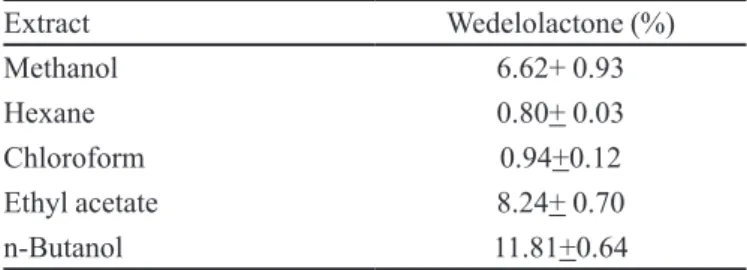
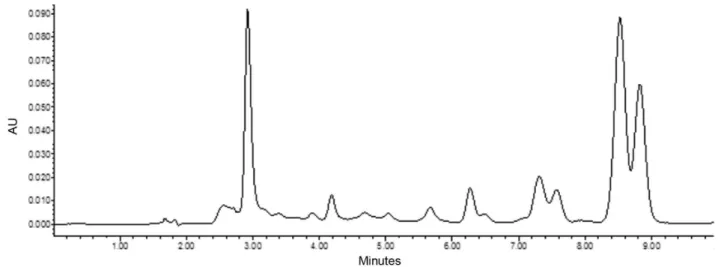
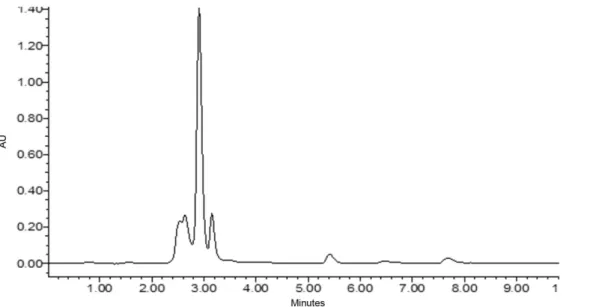
For locating the best fraction enriched with we-delolactone, methanol extract was further fractionated using solvents of varying polarity to get hexane, chlo-roform, ethyl acetate and n-butanol extracts. Thereafter, the developed HPLC method was applied to determine the concentration of wedelolactone in different extracts. Peak of wedelolactone in different extracts was identiied on the basis of retention time of standard wedelolactone (Figure 3-7). From the chromatograms of different ex-tracts, it was concluded that as the polarity of solvent used for liquid-liquid fractionation increased the extracts were puriied and the area of additional peaks decreased. Many additional peaks were recorded in HPLC chromatogram of hexane extract, however, no additional peak was observed in n-butanol extract. Quantity of wedelolactone in different extracts was calculated from the peak area of HPLC chro-matograms of the extracts and its content in different ex-tracts has been summarized in Table III. This information could be utilized for development of up-scaling process.
Solvent and method used for extraction affects the functional eficacy of medicinal plants extracts. Kulkarni
et al. (2011), reported extraction of wedelolactone from
E. alba using six different methods of extraction and its estimation by HPTLC. The highest percentage of we-delolactone was found in extract prepared by Soxhlet extraction and lowest in case of Supercritical luid extrac -tion; the yield difference was attributed to polar nature of wedelolactone. It has been reported that partitioning with polar solvents led to enrichment of wedelolactone
TABLE II - Accuracy and precision (R.S.D.) of the method
developed at three different concentrations
Analyte Concentration (µg /mL) RSD (%)
Intra-day Inter-day
5 (Low) .15 2.83
Wedelolactone 20 (Medium) 1.31 1.51
80 (High) 1.1 2.06
TABLE III - Wedelolactone content (mean ± S.D) in different
extracts of E. alba
Extract Wedelolactone (%)
Methanol 6.62+ 0.93
Hexane 0.80+ 0.03
Chloroform 0.94+0.12
Ethyl acetate 8.24+ 0.70
FIGURE 3 - HPLC-PDA chromatogram of methanol extract of E. alba.
FIGURE 4 - HPLC-PDA chromatogram of hexane extract of E. alba.
FIGURE 6 - HPLC-PDA chromatogram of ethyl acetate extract of E. alba.
FIGURE 7 - HPLC-PDA chromatogram of n-butanol extract of E. alba.
in extract. Wagner et al. (1986) reported 1.6% and 15.9% wedelolactone in methanol and ethyl acetate extracts of E. alba respectively. In the present study, the butanol fraction has highest content of wedelolactone; we speculate that this fraction of E. alba may provide maximum bioactivity. Similar results have been reported by Kim et al., (2008). The earlier reported HPLC methods (Murali et al., 2002; Wagner et al., 1986) were not validated; we validated the developed method as per ICH guidelines. Further, use of acetic acid in place of phosphoric acid will enhance the longevity of HPLC column.
CONCLUSION
The validated HPLC method allows a simple, ac-curate and precise quantitative analysis of a biologically
important molecule wedelolactone from E. Alba. Pres-ence or absPres-ence of wedelolactone in different extracts of E. Alba, related species and commercial formulations can be conirmed by comparing their retention times (tR)
using developed method. Moreover, maximum wedelo-lactone content was found in n-butanol extract followed by ethyl acetate extract, thus it appears that n-butanol or ethyl acetate would be a suitable solvent for partitioning of the methanol extract for isolation of wedelolactone from E. alba.
ACKNOWLEDGEMENTS
REFERENCES
CHANG, C.F.; CHANG, S.W.; FANG, Y.T.; YANG, L.Y.; LEE, Y.J. Total synthesis of demethylwedelolactone and wedelolactone by Cu-mediated /Pd (O)-catalysis and oxidative cyclization. Tetrahedron, v.64, n.17, p.3661-3666, 2008.
CHOPRA, R.N.; CHOPRA, I.C.; NAYAR, S.L. Glossary
of Indian medicinal plants. New Delhi: CSIR, 2008. 1041956 p.
INTERNATIONAL CONFERENCE ON HARMONIZATION. Technical requirements for registration of pharmaceuticals for human use: harmonized triplicate guidelines on validation of analytical procedures: methodology, recommended for adoption at step 4 of the ICH. Process on: Nov 1996. Process by: ICH steering committee, IFPMA. Switzerland, 1996.
KIM, D.; LEE, S.H.; CHOI, J.H.; LILLEHOJ, S.H.; YU, M.H.; LEE, G.S. The butanol fraction of Eclipta prostrata
(Linn) effectively reduces serum lipid levels and improves antioxidant activities in CD rats. Nutr. Res., v.28, n.8, p.550-554, 2008.
KULKARNI, S.; KHATWANI, P. Optimization of extraction conditions of a sensitive HPTLC method for estimation of wedelolactone in different extracts of Eclipta alba. IJPSDR., v.3, n.1, p.56-61, 2011.
M U R A L I , B . ; A G R AWA L , A . ; A N A N D , M . S . ; SAMIULLA, D.S. Estimation of wedelolactone and demethylwedelolactone in Eclipta alba Hassk by improved chromatographic analysis. J. Nat. Remedies, v.2, n.1, p.99-101, 2002.
PEREIRA, N.A.; PEREIRA, B.M.R.; NASCIMENTO, M.C.; PARENTE , J.P; MORS, W.B. Pharmacological screening of plants recommended by folk medicine as snake venom
antidotes; IV- protection against Jararaca venom by
isolated constituents. Planta Med., v.60, n.2, p.99-100, 1994.
RASTOGI, R.P.; MEHROTRA, B.N. Compendium of Indian medicinal plants. v.2 New Delhi: CSIR, 1991. v.2, p.288.
SARG, T.M.; SALAM, N.A.A.; EL-DOMIATY, M.; KHAFAGY, S.M. The steroid, triterpenoid and lavonoid constituents of
Eclipta alba (L.) Hassk. (compositae) grown in Egypt. Sci. Pharm., v.49, n.30, p.262-264, 1981.
SAXENA, A.K.; SINGH, B.; ANAND, K.K. Hepatoprotective effects of Eclipta alba on subcellular levels in rats. J. Ethnopharmacol., v.40, n.3, p.155-161, 1993.
SIKRORIA, B.C.; SRIVASTAVA, S.J.; NIRANJAN, G.S. Phytochemical studies on Eclipta alba. J. Indian Chem. Soc., v.59, n.7-12, p.905-909, 1982.
SIMONSEN, H.T.; NORDSKJOLD, J.B.; SMITT, U.W.;
NYMAN, U.; PALPU, P.; JOSHI, P.; VERGESE, G. In
vitro screening of Indian medicinal plants for antiplasmodial activity. J. Ethnopharmacol., v.74, n.2, p.195-204, 2001.
SINGH, P.; SHARMA, A.K.; JOSHI, K.C.; BOHLMANN,
F. A further dithienylacetylene from Eclipta erecta.
Phytochemistry, v.24, n.4, p.615-616,1985.
THAKUR, V.D., MENGI, S.A. Neuropharmacological proile
of Eclipta alba (Linn.) Hassk. J. Ethnopharmacol., v.102, n.1, p.23-31, 2005.
WAGNER, H.; GEYER, B.; KISO, Y.; HIKINO, H.; RAO, G.S. Coumestans as the main active principles of the liver drugs
Eclipta alba and Wedelia calendulacea. Planta Med., v.52, n.5, p.370-374, 1986.
Received for publication on 12th April 2012