*Correspondence: Laboratório de Bacteriologia Médica. Departamento de Análises Clínicas e Biomedicina, Universidade Estadual de Maringá. Av. Colombo, 5790, Bloco T-20, sala 202, 87020-900 - Maringá - Paraná, Brasil. Telefone: 55 44 3011-5376. E-mail: [email protected]
vol. 49, n. 1, jan./mar., 2013
High genetic diversity among
Pseudomonas aeruginosa
and
Acinetobacter
spp. isolated in a public hospital in Brazil
Vera Lúcia Dias Siqueira
1,*, Rosilene Fressatti Cardoso
2, Rubia Andreia Falleiros de Pádua
2,
Katiany Rizzieri Calefi-Ferracioli
2, Cesar Helbel
3, Adolfo Carlos Barreto Santos
4,
Elisabeth Eyko Aoki
3, Celso Vataru Nakamura
11Postgraduate Program in Pharmaceutical Science, 2Department of Clinical Analysis and Biomedicine, 3 University Hospital
of Maringá, State University of Maringá, 4Laboratory of Mycobacteriology, Department of Biological Science, School of Pharmaceutical Science, Paulista State University
In Brazil and other regions of the world, Pseudomonas aeruginosa and Acinetobacter spp. have emerged as important agents of nosocomial infection and are commonly involved in outbreaks. The main objective of the present study was to evaluate the genetic relationship among P. aeruginosa and Acinetobacter spp. isolated from patients in a public university hospital in northwestern Paraná, Brazil, and report their antimicrobial resistance proile. A total of 75 P. aeruginosa and 94 Acinetobacter spp. isolates were phenotypically identiied and tested for antibiotic susceptibility using automated methodology. Polymyxin B was tested by disk diffusion for P. aeruginosa. Metallo-β-lactamase (MBL) was detected using a disk approximation test.
Genotyping was performed using enterobacterial repetitive intergenic consensus polymerase chain reaction (ERIC-PCR). Approximately 55% of the P. aeruginosa isolates and 92% of the Acinetobacter spp. isolates were multiresistant, but none were MBL-producers. ERIC-PCR revealed the presence of small clusters of carbapenem-resistant Acinetobacter spp., most likely OXA-type carbapenemase producers. Furthermore, high genetic diversity in P. aeruginosa and Acinetobacter spp. clinical isolates was observed, suggesting that cross-transmission is not very frequent in the studied hospital.
Uniterms: Pseudomonas aeruginosa/antimicrobial resistance proile. Pseudomonas aeruginosa/genetic study. Acinetobacter spp./antimicrobial resistance proile. Acinetobacter spp./genetic study. Antimicrobial resistance. Bacterial typing.
No Brasil, bem como em outras regiões do mundo, Pseudomonas aeruginosa e Acinetobacter spp. surgiram como importantes agentes de infecção nosocomial e são comumente envolvidos em surtos. O objetivo principal deste estudo foi descrever a relação genética de P. aeruginosa e Acinetobacter
spp. isoladas de pacientes internados em hospital universitário público do noroeste do Paraná - Brasil e reportar o peril de resistência dessas bactérias. Um total de 75 P. aeruginosa e 94 Acinetobacter spp. isolados foi fenotipicamente identiicado e testado para a suscetibilidade aos antibióticos por metodologia automatizada. A polimixina B foi testada por difusão em disco para P. aeruginosa. Metalo-β-lactamase (MBL) foi detectada por disco-aproximação. Análise genotípica foi realizada por enterobacterial repetitive intergenic consensus polymerase chain reaction (ERIC-PCR). Aproximadamente 55% dos isolados de P. aeruginosa e 92% de Acinetobacter spp. isolados foram multirresistentes, mas nenhum foi produtor de MBL. Os resultados de ERIC-PCR revelaram pequenos grupamentos de Acinetobacter spp. resistentes aos carbapenêmicos, provavelmente pela produção de carbapenemases do tipo OXA. Além disso, alta diversidade genética entre os isolados de P. aeruginosa e Acinetobacter spp. foi observada, sugerindo que a transmissão cruzada destas espécies bacterianas não é muito frequente em nosso hospital.
Unitermos: Pseudomonas aeruginosa/peril de resistência. Pseudomonas aeruginosa/estudo genético.
INTRODUCTION
Pseudomonas aeruginosa and Acinetobacter spp. have been the cause of nosocomial outbreaks worldwide (Cortes et al., 2009; Hosoglu et al., 2011), including in Brazil (Brito et al., 2003; Prates et al., 2011), where mul-tidrug resistance is common among these isolates (Rossi, 2011). Carbapenems often represent the only effective treatment. However, carbapenem-resistant isolates have frequently been detected, leading clinicians to resume the use of older classes of antibiotics, such as polymyxins (Giamarellou, 2010). The production of carbapenemase enzymes has been an important mechanism of resistance in these bacteria. Metallo-β-lactamases (MBLs), enzymes able to hydrolyze all β-lactam antibiotics with the ex -ception of monobactams, are particularly common in P. aeruginosa, and the genes that encode them are carried by highly mobile elements that play an important role in hospital environments (Cornaglia, Giamarellou, Rossolini, 2011).
Enterobacterial repetitive intergenic consensus
-polymerase chain reaction (ERIC-PCR) has shown good applicability in typing A. baumannii and P. aeruginosa
(Presterl et al., 1997; Syrmis et al., 2004; Kidd et al., 2011). Although some studies have used ERIC-PCR to epidemiologically study P. aeruginosa and Acinetobacter
spp. nosocomial isolates in Brazil (Costa et al., 2006; Saalfeld et al., 2009; Stehling, Leite, Silveira, 2010; Ferreira et al., 2011; Viana et al., 2011), the specific epidemiology of these microorganisms remains unknown.
The main objective of the present study was to de-scribe the genetic relationship among P. aeruginosa and
Acinetobacter spp. clinical isolates using ERIC-PCR and report their resistance proiles against antimicrobial agents that are routinely used in a public university hospital in northwestern Paraná, Brazil.
MATERIAL AND METHODS
Seventy-ive P. aeruginosa and 94 Acinetobacter
spp. isolates from various clinical specimens from patients admitted to a public hospital in northwestern Paraná, Brazil, between January 2007 and July 2009 were stud-ied. Only one isolate from each patient was selected and stored at -80 ºC in the Laboratory of Medical Bacteriology, Department of Clinical Analysis and Biomedicine, State University of Maringá. No personal data were retrieved from the patients, so privacy could be assured and legal transgressions concerning human research could be avoided (Resolution 196/96 Brazil National Health Coun-cil, Health Ministry). The present study was approved by
the Regulatory Commission of Academic Activities and Voluntary Services of the studied hospital.
Phenotypic identiication and antimicrobial suscep -tibility testing (AST) were performed using an AUTO-SCAN-4 automated system (Siemens Microscan, Deer-ield, IL, USA), with the exception of polymyxin B for P. aeruginosa, which was tested by disk diffusion. The data were interpreted according to the criteria of the Clinical and Laboratory Standards Institute (CLSI; 2007-2009).
Ceftazidime-resistant P. aeruginosa and Acineto-bacter spp. isolates were evaluated for the presence of MBL using the disk-approximation test, 2-mercaptopropionic acid (2-MPA; Acros, Bridgewater, NJ, USA), and ethyl-enediaminetetraacetic acid (EDTA; Invitrogen, Carlsbad, CA, USA; Arakawa et al. 2000). IMP-1-producing Acineto-bacter baumannii (A-3227) and P. aeruginosa ATCC 27853 were used as positive and negative controls, respectively.
Genomic DNA of P. aeruginosa and Acinetobacter
spp. isolates was extracted from overnight bacterial growth on Mueller-Hinton agar (Difco, Becton Dickinson, Sparks, MD, USA; Swanenburg et al., 1998). The PCRs were performed using primers ERIC1R (5’-ATGTA-AGCTCCTGGGGATTCAC-3’) and ERIC2 (5’-AAGTA-AGTGACTGGGGTGAGCG-3’) as described by Szczuka and Kaznowski (2004). The gels were stained with ethid-ium bromide, and the spectral band analysis on agarose gels was performed using BioNumerics software (version 4.45, Applied Maths, Sint-Martens-Latem, Belgium). The Dendrogram was constructed using the Dice coeficient, and the phylogenetic distance was determined using the Unweighted Pair Group Method with Arithmetic Mean algorithm (Sneath and Sokal, 1973). Isolates with ≥ 95% similarity were considered closely related.
RESULTS
The studied institution is a small-size public hospital with three intensive care units (ICUs): adult, pediatric, and neonatal. P. aeruginosa and Acinetobacter spp. were isolated more frequently in male patients (62.7% and 59.6%, respectively), especially in patients older than 60 years (54.7% and 39.4%, respectively) and in ICUs (41.4% and 71.3%, respectively). P. aeruginosa isolates were detected at a higher frequency in urine samples, whereas
Acinetobacter spp. isolates were mainly recovered from tracheal aspirate.
spp. isolates, the β-lactam resistance rate was greater than 90% to cephalosporins and greater than 50% to the tested carbapenems (Table I). Multiresistance was observed in 91.5%. None of the P. aeruginosa (n = 39) and Acineto-bacter spp. (n = 88) isolates with total or intermediate resistance to ceftazidime were positive for MBL.
The ERIC-PCR applied to P. aeruginosa and Aci-netobacter spp. clinical isolates showed a banding pattern with sizes that rang, from approximately 120 pb to 1200 pb and 120 pb and 1900 pb, respectively.
Considering a Dice correlation coeficient ≥ 0.95, 72 ERIC-PCR patterns were obtained in 75 P. aeruginosa
clinical isolates. Seventy isolates (93.3%) were orphans, and the remaining five (6.7%) were included in two clusters comprising two (cluster A) and three (cluster B) isolates (Figure 1).
Two isolates that belonged to cluster A showed identical antimicrobial resistance proiles and were iso -lated from patients in different clinical units within a time interval of approximately 2 months. Isolates that belonged to cluster B, two with 100% similarity, had equal resistance proiles and were isolated from patients in an adult ICU within a time interval of only 4 days. The third isolate that belonged to cluster B, despite having the same resistance proile, was isolated 13 days later in a patient admitted to the pediatric unit (Table II).
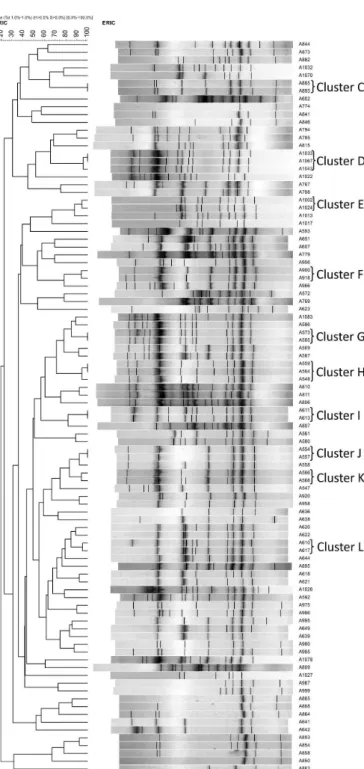
A total of 70 Acinetobacter spp. isolates (74.5%)
showed orphan ERIC-PCR patterns, and the remaining 24 (25.5 %) were included in 10 clusters (C-L) comprising two isolates each, with the exception of clusters D and H with three isolates each (Figure 2).
The several small clusters found in Acinetobacter
spp. were generally detected in the same unit or units with displacement of patients, such as the adult ICU and medi-cal clinic. Exceptions were observed in clusters D and J, which were composed of isolates from the adult and pedi-atric ICUs. Acinetobacter clusters included isolates with similar resistance proiles, with some differences related to aminoglycosides and carbapenems. Notably, 60% of the small clusters were carbapenems-resistant Acinetobacter
spp. (Table II).
TABLE I - Resistance proiles of Pseudomonas aeruginosa and
Acinetobacter spp. isolates from inpatients in a public hospital in northwestern Paraná, Brazil
Antimicrobial agent
Resistant isolates (%)
P. aeruginosa
(n = 75)
Acinetobacter spp. (n = 94)
Aztreonam 13 (29.3)a NT
Amikacin 30 (40.0) 53 (56.4)
Ampicillin/Sulbactam NT 21 (27.6)b
Cefepime 22 (29.3) 87 (92.5)
Ceftazidime 21 (28.0) 85 (90.4)
Ciproloxacin 37 (49.3) 88 (93.6)
Gentamicin 33 (44.0) 70 (74.5)
Imipenem 19 (25.4) 52 (54.8)
Meropenem 19 (25.4) 53 (56.4)
Piperacillin/Tazobactam 10 (13.3) NT
Polymyxin B 0.0 (0.0) NT Trimethoprim/
Sulfamethoxazole NT 88 (93.6)
NT, not tested; aTested isolates = 46; bTested isolates = 76.
FIGURE 1. Dendrogram and DNA-banding proiles that
represent the genetic relationship among Pseudomonas
TABLE II - Demographics and phenotypic and genotypic features of Pseudomonas aeruginosa and Acinetobacter spp. isolates
with similarity ≥ 95%
Cluster Microorganism (isolate) Clinical Specimens Date of Isolation Hospital Ward Antimicrobial Resistance Pattern
A P. aeruginosa (786) Urine 4 Mar 2008 Pediatrics Susceptible to all tested
antimicrobials
A P. aeruginosa (833) Tracheal aspirate 12 May 2008 Adult ICU Susceptible to all tested
antimicrobials
B P. aeruginosa (1048) Tracheal aspirate 12 Jun 2009 Adult ICU Cip; Azt; Cef; Cfz
B P. aeruginosa (1052) Blood 8 Jun 2009 Adult ICU Cip; Azt; Cef; Cfz
B P. aeruginosa (1066) Urine 25 Jun 2009 Medical clinic Cip; Azt; Cef; Cfz
C Acinetobacter spp. (885) Urine 13 Jul 2008 Medical clinic Amp/Sul; Cip; Sut; Cef; Cfz
C Acinetobacter spp. (893) Tracheal aspirate 14 Aug 2008 Adult ICU Amp/Sul; Cip; Sut; Cef; Cfz;
Gen; Ami
D Acinetobacter spp. (1033) Tracheal aspirate 14 May 2009 Pediatric ICU Amp/Sul; Cip; Sut; Cef; Cfz; Gen; Ami; Imp; Mer
D Acinetobacter spp. (1067) Tracheal aspirate 24 Jun 2009 Adult ICU Amp/Sul; Cip; Sut; Cef; Cfz;
Gen; Ami; Imp; Mer
D Acinetobacter spp. (1043) Tracheal aspirate 25 May 2009 Adult ICU Amp/Sul; Cip; Sut; Cef; Cfz;
Gen; Ami; Imp; Mer
E Acinetobacter spp. (1002) Urine 4 Mar 2009 Adult ICU Amp/Sul; Cip; Sut; Cef; Cfz;
Gen; Ami; Imp; Mer
E Acinetobacter spp. (1024) Blood 23 Mar 2009 Medical clinic Amp/Sul; Cip; Sut; Cef; Cfz;
Gen; Ami; Imp; Mer
F Acinetobacter spp. (900) Tracheal aspirate 20 Aug 2008 Adult ICU Cip; Sut; Cef; Cfz; Gen; Ami
F Acinetobacter spp. (918) Tracheal aspirate 24 Sep 2008 Adult ICU Cip; Sut; Cef; Cfz; Gen; Ami
G Acinetobacter spp. (573) Urine 17 Feb 2007 Adult ICU Amp/Sul; Cip; Sut; Cef; Cfz;
Gen; Ami; Imp; Mer
G Acinetobacter spp. (585) Blood 15 Mar 2007 Adult ICU Amp/Sul; Cip; Sut; Cef; Cfz;
Gen; Imp; Mer
H Acinetobacter spp. (559) Surgical wound 29 Jan 2007 Adult ICU Amp/Sul; Cip; Sut; Cef; Cfz;
Gen; Ami; Imp; Mer
H Acinetobacter spp. (564) Tracheal aspirate 29 Jan 2007 Adult ICU Amp/Sul; Cip; Sut; Cef; Cfz;
Gen; Ami; Imp; Mer
H Acinetobacter spp.(548) Tracheal aspirate 3 Jan 2007 Adult ICU Amp/Sul; Cip; Sut; Cef; Cfz;
Gen; Ami; Imp; Mer
I Acinetobacter spp. (611) Tracheal aspirate 17 Apr 2007 Adult ICU Cip; Sut; Cef; Cfz; Gen; Ami;
Imp; Mer
I Acinetobacter spp. (613) Tracheal aspirate 26 Apr 2007 Adult ICU Amp/Sul; Cip; Sut; Cef; Cfz;
Gen; Imp; Mer
J Acinetobacter spp. (554) Tracheal aspirate 16 Jan 2007 Adult ICU Cip; Sut; Cef; Cfz; Gen; Ami
J Acinetobacter spp. (557) Tracheal aspirate 4 Feb 2007 Pediatric ICU Cip; Sut; Cef; Cfz; Gen; Ami
K Acinetobacter spp. (566) Tracheal aspirate 22 Jan 2007 Medical clinic Cip; Sut; Cef; Cfz; Ami
K Acinetobacter spp. (568) Tracheal aspirate 15 Feb 2007 Adult ICU Cip; Sut; Cef; Cfz; Gen; Ami
L Acinetobacter spp. (610) Tracheal aspirate 17 Apr 2007 Adult ICU Amp/Sul; Cip; Sut; Cef; Cfz;
Gen; Ami; Imp; Mer
FIGURE 2. Dendrogram and DNA-banding proiles that
represent the genetic relationship among Acinetobacter spp.
isolated from clinical specimens of inpatients in a public hospital in northwestern Paraná, Brazil.
DISCUSSION
In the present study, the ERIC-PCR assessment and antimicrobial resistance profiles of P. aeruginosa and
Acinetobacter spp. isolates from inpatients in a small-size teaching hospital in northwestern Paraná showed a high
percentage of multiresistance and genetic diversity. Wor-rying rates of ceftazidime and carbapenems resistance were observed in P. aeruginosa isolates. However, they were smaller than those observed in isolates from other university hospitals in Brazil, where resistance to these antimicrobials was near or greater than 50% (Zavascki, Cruz, Goldani, 2004; Rocha et al., 2008).
In recent years, MBL production has represented an important mechanism of resistance to most β-lactam antibiotics, including carbapenems, especially in P. aeru-ginosa (Kunz, Brook, 2010). However, despite a resistance rate of just over 25% detected for carbapenems, none of the P. aeruginosa isolates tested were positive for MBL, demonstrating the probable participation of other resis-tance mechanisms. The isolation rates of MBL-producing
P. aeruginosa have widely varied among Brazilian hos-pitals, with incidences ranging from 3.1% (Wirth et al., 2009) to 35% (Gonçalves et al., 2009). According to Rossi (2011), São Paulo metallo-β-lactamase (SPM) is the most prevalent MBL in Brazilian isolates. For Acinetobacter
spp. isolated in the present study, the observed resistance rates of > 90% for third-generation cephalosporins and nearly 55% for carbapenems may be responsible for the dificulty treating these cases, which has been reported in other studies (Towner, 2009; Kunz, Brook, 2010). MBL was not detected in isolates from this genus, which cor-roborates other studies that found a low contribution of this enzyme to the increasing rates of resistance in Acineto-bacter spp. (Mostachio et al., 2009; Kunz, Brook, 2010). OXA-type β-lactamases have shown an important role in carbapenem-resistant Acinetobacter spp. (Poirel, Naas, Nordmann, 2010). In Acinetobacter spp. isolates from Bra-zilian hospitals, carbapenem resistance is mostly related to β-lactamase OXA-23 (Gales et al., 2012). However, a recent study found a high prevalence of OXA-143 in these bacterial genera (Mostachio et al., 2012). Therefore, the small clusters of carbapenem-resistant Acinetobacter spp. isolated in this study may have been OXA-type carbapen-emase producers.
Although clonal spread is commonly found in hospi-tals worldwide (Scott and Pitt, 2004; Cortes et al., 2009), including Brazil (Stheling, Leite, Silveira, 2010), the pres-ent study detected high genetic diversity, especially among
P. aeruginosa isolates. Only two (2.7%) of the 75 isolates
considered, in which high genetic similarity was found among clinical and environmental Acinetobacter spp. isolates in an adult ICU in the same hospital from January to July 2008. These authors suggested that an endemic situation existed by observing the genotypic similarity of isolates using a Dice correlation coeficient > 90%.
CONCLUSION
Using ERIC-PCR, the present study found high genetic diversity among P. aeruginosa and Acinetobacter
spp. isolates, suggesting that cross-contamination is not very frequent in the studied hospital. Because of the known applicability of ERIC-PCR, its good discriminatory power and reproducibility allowed an understanding of the epidemiology of these bacteria in the studied hospital environment.
ACKNOWLEDGEMENTS
The present research received inancial support from Agência Nacional de Vigilância Sanitária (ANVISA)/Pan-American Health Organization (PAHO).
REFERENCES
A R A K AWA , Y. ; S H I B ATA , N . ; S H I B AYA M A , K . ; KUROKAWA, H.; YAGI, T.; FUJIWARA, H.; GOTO, M. Convenient test for screening metallo-beta-lactamase-producing gram-negative bacteria by using thiol compounds.
J. Clin. Microbiol., v.38, n.1, p.40-43, 2000.
BRITO, D.V.D.; OLIVEIRA, E.J.; DARINI, A.L.C.; ABDALLAH, V.O.S.; GONTIJO-FILHO, P.P. Nosocomial o u t b r e a k s d u e t o P s e u d o m o n a s a e r u g i n o s a a n d
Acinetobacter baumannii in a neonatal intensive care unit
(nICU) of the Uberlândia federal university hospital. Braz. J. Microbiol., v.34, suppl.1, p.27-28, 2003.
CLINICAL AND LABORATORY STANDARDS INSTITUTE.
CLSI. Performance Standards for Antimicrobial
Susceptibility Testing: Wayne, 2007. 177 p. (M100-S-17 Seventeenth Informational Supplement).
CLINICAL AND LABORATORY STANDARDS INSTITUTE.
CLSI. Performance Standards for Antimicrobial
Susceptibility Testing:. Wayne, 2008. 181 p. (M100-S-18 Eighteenth Informational Supplement).
CLINICAL AND LABORATORY STANDARDS INSTITUTE.
CLSI. Performance Standards for Antimicrobial
Susceptibility Testing: Wayne, 2009. 149 p. (M100-S19 Nineteenth Informational Supplement).
CORTES, J.A.; CUERVO, S.I.; URDANETA, A.M.;
POTDEVIN, G.; ARROYO, P.; BERMÚDEZ, D.;
CORREA, A.; VILLEGAS, M.V. Identifying and
controlling a multiresistant Pseudomonas aeruginosa
outbreak in a Latin-American cancer centre and its associated risk factors. Braz. J. Infect. Dis., v.13, n.2, p.99-103, 2009.
COSTA, G.F.M.; TOGNIM, M.C.B.; CARDOSO, C.L.; CARRARA-MARRONE, F.E.; GARCIA, L.B. Preliminary evaluation of adherence on abiotic and cellular surfaces of
Acinetobacter baumannii strains isolated from catheter tips.
Braz. J. Infect. Dis., v.10, n.6, p.346-351, 2006.
CORNAGLIA, G.; GIAMARELLOU, H.; ROSSOLINI, G.M. Metallo-β-lactamases: a last frontier for β-lactams? Lancet Infect. Dis., v.11, n.5, p.381-393, 2011.
FERREIRA, A.E.; MARCHETTI, D.P.; CUNHA, G.R.; O L I V E I R A , L . M . ; F U E N T E F R I A , D . B . ; D A L L BELLO, A.G.; BARTH, A.L.; CORÇÃO, G. Molecular characterization of clinical multiresistat isolates of
Acinetobacter sp. From hospitals in Porto Alegre, State of Rio Grande do Sul, Brazil. Rev. Soc. Bras. Med.Trop., v.44, n.6, p.725-730, 2011.
GALES, A.C.; CASTANHEIRA, M.; JONES, R.N.; SADER, H.S. Antimicrobial resistance among Gram-negative bacilli isolated from Latin America: results from SENTRY antimicrobial surveillance program (Latin America, 2008-2010). Diagn. Microbiol. Infect. Dis., v.3, n.4, p.354-360, 2012.
GIAMARELLOU, H. Multidrug-resistant Gram-negative bacteria: how to treat and for how long. Int. J. Antimicrob. Agents, v.36, suppl 1, p.S50-S54, 2010.
GONÇALVES, D.C.P.S.; LIMA, A.B.M.; LEÃO, L.S.N.O.; CARMO FILHO, J.R.; PIMENTA, F.C.; VIEIRA, J.D.G.
Detecção de metalo-beta-lactamase em Pseudomonas
aeruginosa isoladas de pacientes hospitalizados em
HOSOGLU, S.; HASCUHADAR, M.; YASAR, E.; USLU, S.;
ALDUDAK, B. Control of an Acinetobacter baumannii
outbreak in a neonatal ICU without suspension of service:
a devastating outbreak in Diyarbakir, Turkey. Infection.
Publicação on line, DOI 10.1007/s15010-011-0180-y, 2011.
KIDD, T.J.; GRIMWOOD, K.; RAMSAY, K.A.; RAINEY, P.B.; BELL, S.C. Comparison of three molecular techniques for
typing Pseudomonas aeruginosa isolates in sputum samples
from patients with cystic ibrosis. J. Clin. Microbiol., v.49, n.1, p.263-268, 2011.
KUNZ, A.N.; BROOK, I. Emerging Resistant
Gram-Negative Aerobic Bacilli in Hospital-Acquired Infections.
Chemotherapy, v.56, n.6, p.492-500, 2010.
MAGIORAKOS, A.P.; SRINIVASAN, A.; CAREY, R.B.; C A R M E L I , Y. ; FA L A G A S , M . E . ; G I S K E , C . G . ; HARBARTH, S.; HINDLER, J.F.; KAHLMETER, G.; OLSSON-LILJEQUIST, B.; PATERSON, D.L.; RICE, L.B.; STELLING, J.; STRUELENS, M.J.; VATOPOULOS, A.; WEBER, J.T.; MONNET, D.L. Multidrug-resistant,
extensively drug-resistant and pandrug-resistant bacteria: an international expert proposal for interim standard deinitions
for acquired resistance. Clin. Microbiol. Infect., v.18, n.3, p.268-281, 2012.
MOSTACHIO, A.K.; HEIDJEN, I.; ROSSI, F.; LEVIN,
A.S.; COSTA, S.F. Multiplex PCR for rapid detection of genes encoding oxacillinases and metallo-β-lactamases
in carbapenem-resistant Acinetobacter spp. J. Med.
Microbiol., v.58, n.11, p.1522-1524, 2009.
MOSTACHIO, A.K.; LEVIN, A.S.; RIZEK, C.; ROSSI, F.; ZERBINI, J.; COSTA, S.F. High prevalence of OXA-143
and alteration of outer membrane proteins in carbapenem-resistant Acinetobacter spp. isolates in Brazil. Int. J. Antimicrob. Agents, v.39, n.5, p.396-401, 2012.
POIREL, L.; NAAS, T.; NORDMANN, P. Diversity,
Epidemiology, and genetics of class D β-lactamases.
Antimicrob. Agents Chemother., v.54, n.1, p.24-38, 2010.
PRESTERL, E.; NADRCHAL, R.; MAKRISTATHIS, A.; KOLLER, W.; ROTTER, M.L.; HIRSCHL, A.M. Molecular
typing of Acinetobacter baumannii from ten different
intensive care units of a university hospital. Eur. J. Clin. Microbiol. Infect. Dis., v.16, n.10, p.740-743, 1997.
PRATES, C.G.; MARTINS, A.F.; SUPERTI, S.V.; LOPES, F.S.;
RAMOS, F.; CANTARELLI, V.V.; ZAVASCKI, A.P. Risk
factors for 30-day mortality in patients with
carbapenem-resistant Acinetobacter baumannii during an outbreak
in an intensive care unit. Epidemiol. Infect., v.139, n.3, p.411-418, 2011.
ROCHA, L.A.; VILELA, C.A.P.; CEZÁRIO, R.C.; ALMEIDA,
A.B.; GONTIJO-FILHO, P. Ventilator-associated pneumonia in an adult clinical-surgical intensive care unit of a Brazilian university hospital: incidence, risk factors, etiology, and antibiotic resistance. Braz. J. Infect. Dis., v.12, n.1, p.80-85, 2008.
ROSSI, F. The challenges of antimicrobial resistance in Brazil.
Clin. Infect. Dis., v.52, n.9, p.1138-1143, 2011.
SAALFELD, S.M.; VIANA, G.F.; SIQUEIRA, V.L.D.; CARDOSO, C.L.; GARCIA, L.B.; TOGNIM, M.C.B.
Endemic carbapenem-resistant Acinetobacter baumannii
in a Brazilian intensive care unit. J. Hosp. Infect., v.72, n.4, p.365-368, 2009.
SCOTT, F.W., PITT, T. Identiication and characterization of
transmissible Pseudomonas aeruginosa strains in cystic
ibrosis patients in England and Wales. J. Med. Microbiol., v.53, n.7, p.609-615, 2004.
SNEATH, P.H.A., SOKAL, R.R. Numerical taxonomy: the
principles and practice of numerical classification. San
Francisco: Freeman, 1973. 573 p.
STEHLING, E.G.; LEITE, D.S.; SILVEIRA, W.D. Molecular
typing and biological characteristics of Pseudomonas
aeruginosa isolated from cystic ibrosis patients in Brazil. Braz. J. Infect. Dis., v.14, n.5, p.462-467, 2010.
SYRMIS, M.W.; O’CARROLL, M.R.; SLOOTS, T.P.; COULTER, C.; WAINWRIGHT, C.E.; BELL, S.C.;
NISSEN, M. Rapid genotyping of Pseudomonas aeruginosa
isolates harboured by adult and paediatric patients with
cystic ibrosis using repetitive-element-based PCR assay.
J. Med. Microbiol., v.53, n.11, p.1089-1096, 2004.
SWANENBURG, M.; URLINGS, H.A.P.; KEUZENKAMP,
SZCUKA, E.; KAZNOWSKI, A. Typing of clinical and
environmental Aeromonas sp. strains by random ampliied
polymorphic DNA PCR, repetitive extragenic palindromic
PCR, and enterobacterial repetitive intergenic consensus
sequence PCR. J. Clin. Microbiol., v.42, n.1, p.220-228,
2004.
TOWNER, K.J. Acinetobacter: an old friend, but a new enemy.
J. Hosp. Infect., v.73, p.355-363, 2009.
VIANA, G.F.; DOS SANTOS SAAFELD, S.M.; GARCIA, L.B.; CARDOSO, C.L.; PELISSON, M.; TOGNIM, M.C.
Evolution of antimicrobial resistance of Acinetobacter
baumannii in a university hospital. Lett. Appl. Microbiol., v.53, n.3, p.374-378, 2011.
ZAVASCKI, A.P.; CRUZ, R.P.; GOLDANI, L.Z. High Rate of
Antimicrobial resistance in Pseudomonas aeruginosa at a
tertiary-care teaching hospital in southern Brazil. Infect. Control Hosp. Epidemiol., v.25, n.10, p.805-807, 2004.
W I RT H , F. W. ; P I C O L I , S . U . ; C A N TA R E L L I , V. V. ; GONÇALVES, A.L.S.; BRUST, F.R.; SANTOS, L.M.O.;
BARRETO, M.F. Metallo-β-lactamase-producing
Pseudomonas aeruginosa in two hospitals from Southern Brazil. Braz. J. Infect. Dis., v.13, n.3, p.170-172, 2009.
Received for publication on 09th April 2012