EXPERIMENT
AL THERAPY OF EPILEPSY WITH
TRANSCRANIAL MAGNETIC STIMULATION
Lack of additional benefit with
prolonged treatment
Joaquim P
. Brasil-Neto
1, Doralúcia P. de Araújo
2, Wagner A. Teixeira
3,
Valéria P. Araújo
4, Raphael Boechat-Barros
5ABSTRACT - Objective:To investigate the effect of three months of low-frequency repetitive transcranial magnetic stimulation (rTMS) treatment in intractable epilepsy. Methods: Five patients (four males, one female; ages 6 to 50 years), were enrolled in the study; their epilepsy could not be controlled by medical treatment and surgery was not indicated. rTMS was performed twice a week for three months; patients kept records of seizure frequency for an equal period of time before, during, and after rTMS sessions. rTMS was delivered to the vertex with a round coil, at an intensity 5 % below motor threshold. During rTMS sessions, 100 stimuli (five series of 20 stimuli, with one-minute intervals between series) were deliv-ered at a frequency of 0.3 Hz. Results: Mean daily number of seizures (MDNS) decreased in three patients and increased in two during rTMS- one of these was treated for only one month; the best result was achieved in a patient with focal cortical dysplasia (reduction of 43.09 % in MDNS). In the whole patient group, there was a significant (p<0.01) decrease in MDNS of 22.8 %. Conclusions: Although prolonged rTMS treatment is safe and moderately decreases MDNS in a group of patients with intractable epilepsy, individual patient responses were mostly subtle and clinical relevance of this method is probably low. Our data suggest, however, that patients with focal cortical lesions may indeed benefit from this novel treat-ment. Further studies should concentrate on that patient subgroup.
KEY WORDS: transcranial magnetic stimulation, rTMS, epilepsy.
Terapia experimental da epilepsia com estimulação magnética transcraniana: ausência de me-lhora adicional com tratamento prolongado
RESUMO - Objetivo: investigar o efeito de três meses de estimulação magnética transcraniana repetitiva (EMTr) de baixa freqüência, na epilepsia de difícil controle. Método: Cinco pacientes (quatro homens, uma mulher, idades entre 6 e 50 anos), participaram do estudo; suas crises epilépticas não puderam ser contro-lados por tratamento medicamentoso e não tinham indicação cirúrgica; a EMTr foi realizada duas vezes por semana durante três meses, sendo que os pacientes anotaram o número diário de crises neste perío-do, assim como nos três meses anteriores e posteriores ao tratamento. A aplicação da EMTr foi feita no vértex com bobina circular, com intensidade 5% abaixo do limiar motor. Durante as sessões de EMTr, 100 estímulos (5 séries de 20 estímulos, com um minuto de intervalo entre as séries) foram realizadas na fre-qüência de 0,3 Hz. Resultados: A média diária de crises (MDC) decresceu em três pacientes e aumentou em dois durante o uso da EMTr; um destes casos foi tratado somente por um mês; o melhor resultado foi encontrado em um paciente com displasia cortical focal (redução de 43,09% na MDC). Em todo o grupo de pacientes, houve decréscimo significativo na MDC de 22,8% (p<0,01). Conclusão: Embora o tratamen -to prolongado com a EMTr seja seguro e tenha sido registrado decréscimo moderado da MDC em um grupo de pacientes com epilepsia de difícil controle, respostas individuais de pacientes foram impre-visíveis e a relevância clínica deste método é provavelmente baixa. Nossos dados sugerem, contudo, que pacientes com lesões corticais focais podem ser beneficiar deste novo tipo de tratamento. Estudos futuros devem se concentrar neste grupo de pacientes.
PALAVRAS-CHAVE: estimulação magnética transcraniana, EMTr, epilepsia.
1MD, PhD, Professor of Neurophysiology, Laboratório de Neurociências e Comportamento, (LNC) Departamento de Ciências Fisio-lógicas (DCF), Instituto de Biologia, (IB) Universidade de Brasília (UNBR) Brasilia DF, Brasil; 2MSc, LNC/DCF/IB/UNBR; 3MD, Unidade de Neurologia, Hospital de Base do Distrito Federal Brasília DF, Brasil; 4MD, LNC/DCF/IB/UNBR, 5MD, Professor of Psychiatry, LNC/DCF/IB/UNBR.
Received 2 July 2003, received in final form 18 September 2003. Accepted 23 October 2003.
Since its introduction in 19851, transcranial magnetic stimulation (TMS) has been used as a neurophysiological research tool2-5 and more re-cently, following studies that showed a significant effect of repetitive transcranial magnetic stimu-lation (rTMS) upon cortical excitability6-8 it has also been considered for the treatment of patho-logical conditions in which brain excitability is probably abnormal, such as in writer’s cramp9 and depression10. Modulation of cortical excitability by TMS in epilepsy was first attempted as a means of causing a silent epileptic focus to become acti-ve; this would be useful in the pre-operative eva-luation of epilepsy surgery patients. However, des-pite encouraging initial results11it was subsequen-tly found that single pulse TMS rarely, if ever, in-duces seizures, even in epileptic patients12. On the other hand, repetitive, rapid-rate TMS may precipitate seizures even in normal subjects, de-pending on stimulus rate and intensity13. Low-frequency rTMS appears to decrease cortical exci-tability for some time after stimulation sessions14.
Recently, two studies have used low-frequen-cy rTMS as a means of decreasing cortical excita-bility in epileptic patients15,16. Tergau et al.15 stud-ied nine epileptic patients, using rTMS at a fre-quency of 0.3 Hz, in daily sessions, for a period of five days, and found a 20 % decrease in the mean weekly number of seizures in one patient; other three patients had a decrease between 20 and 50%, and another three subjects had a decrease of over 50%. Comparisons were made between one month periods immediately before and after treatment. Menkes and Gruenthal16treated one patient with focal cortical dysplasia with bi-wee-kly low frequency (0.5 Hz) rTMS sessions for a pe-riod of one month. Daily seizure frequency was recorded for three months before rTMS sessions, during the month of treatment and for another month after the last experimental session. This patient had a decrease of 70 % in the number of seizures during the four weeks of rTMS treat-ment, compared to the other two months. Since epileptic patients may show spontaneous variabi-lity in seizure frequency which often persists for more than just a few weeks, these studies could have been biased by these random fluctuations. In a recent, randomized, blinded trial of rTMS in patients with localization-related epilepsy, pati-ents were also treated for only one week17. This latter study had several important differences with respect to the previous ones: it used a
high-er rTMS frequency (1 Hz), a butthigh-erfly coil and su-prathreshold stimuli.
Therefore, we decided to study a smaller group of patients, but to follow them for a much lon-ger period of time, i.e., nine months (three months of treatment, and equal periods of observation before and after rTMS sessions). We also follo-wed more closely the rTMS methods that had proven successful in the initial studies by Tergau et al.15and Menkes and Gruenthal16.
METHOD
Five patients (four males, one female; ages 6 to 50
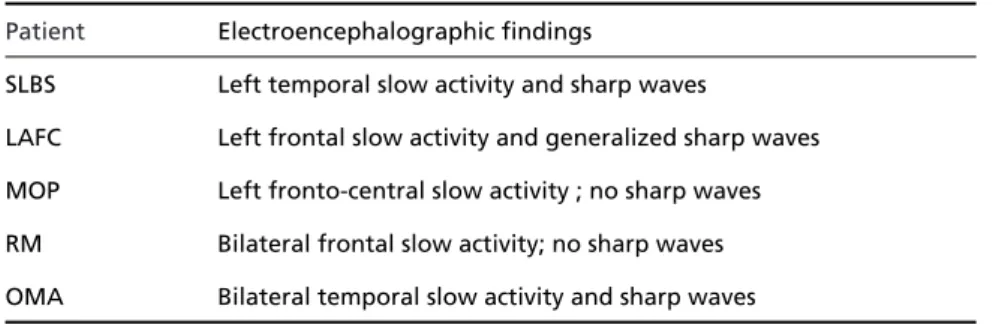
years) participated in the study. All had a diagnosis of medically intractable epilepsy and surgery was not indicated (one patient had already been operated on without satisfactory results). All had very good compli-ance with medical prescriptions. Table 1 summarises the clinical data of all patients and EEG data are shown in Table 2. Medications were not discontinued in any patient, and were kept unchanged throughout the whole study: four patients were on carbamazepine (SLBS, LAFC, MOP and OM); LAFC also used topiramate and OM, clobazam; RM was on lamotrigine, phenytoin and phenobarbital.
The experimental protocol was approved by the Health Sciences Faculty Ethics Commitee and all sub-jects (or their parents in the case of the child) gave written informed consent for the study. A Dantec Mag-Lite®Magnetic Stimulator (Skovlunde, Denmark)
was used. Subjects sat comfortably on a chair. A round coil was positioned over the Cz position of the interna-tional 10-20 electrode placement system.
ing rTMS- one of these was treated for only one month; the best result was achieved in a patient with suspected focal cortical dysplasia (reduction of 43.09% in MDNS). In the whole patient group, there was a significant (p<0.01) decrease in MDNS of 22.8 %.
Table 3 shows the mean number of seizures in each patient before, during and after treatment, as well as the results of statistical analysis.
Although patient LAFC showed a steady de-crease in MDNS during the whole experimental period, this trend was not statistically significant; MOP also had a decrease in MDNS that did not reach statistical significance; RM, on the other hand, showed a significant decrease in MDNS, fo-llowed by an equally significant increase upon discontinuation of the treatment. The remaining two patients, SLBS and OMA, did not improve and even increased their MDNS; this increase, howev-er, was not statistically significant.
Taking together the data from all patients, MDNS was 1.426 (SE=0.089) before treatment, 1.100 (SE=0.073) during treatment and 1.613 (SE= 0.105) after treatment. MDNS during treatment was significantly lower than before or after tre-atment (ANOVA, p<0.01).
An interesting result was obtained when a
long periods of time in this and other epileptic pati-ents, we decided to increase treatment duration to 3 months in all subsequent patients. The number of dai-ly seizures was recorded by the patients or their parents in a diary especially designed for these experiments. A comparison was made between seizure frequency in the treatment period and in the three months preced-ing and followpreced-ing rTMS treatment.
Repeated measures ANOVA was used for statistical analysis, with significance limits set at p<0.01. Post-hoc tests used included Scheffe F test, Dunnett t and Fisher PLSD. Since each patient served as his own control, mean daily number of seizures (MDNS) was compared in the three periods (before, during and after rTMS) both in individual patients (n= 270, i.e, the number of days in nine months) and in the patient group as a whole (n=1080, since the data for the patient who was treated for only four weeks could not be used for that analysis).
We did not use sham stimulation because the pati-ents were critically affected by their epilepsy, with daily seizures, and there were two previous reports of sig-nificant benefits of rTMS in epilepsy15,16. We felt it would
be unethical to deprive any patient from a treatment that had been described as effective in the literature.
RESULTS
Mean daily number of seizures (MDNS)
decre-ased in three patients and incredecre-ased in two
dur-Table 1. Clinical characteristics of the patients enrolled in the study.
Patient Age Sex Diagnostic hypothesis Seizure characteristics (Years)
SLBS 32 M Temporal focal epilepsy CPS (secondarily generalized),TCGS
LAFC 19 M Frontal focal epilepsy CPS with complex automatisms
MOP 6 F Frontal focal epilepsy Asymetrical tonic seizures; CPS with complex automatisms
RM 30 M Frontal focal epilepsy Tonic seizures
OMA 50 M Temporal focal epilepsy CPS and TCGS
CPS, complex partial seizures; TCGS, tonic-clonic generalized seizures
Table 2. Electroencephalographic characteristics of the patients enrolled in the study.
Patient Electroencephalographic findings
SLBS Left temporal slow activity and sharp waves
LAFC Left frontal slow activity and generalized sharp waves
MOP Left fronto-central slow activity ; no sharp waves
RM Bilateral frontal slow activity; no sharp waves
comparison was made of the number of seizures on the day immediately following an rTMS ses-sion in the only patient who showed a significant decrease in MDNS (RM): the mean number of sei-zures on those particular days was significantly lower when rTMS had been carried out with side B of the coil facing upwards, thus stimulating pre-ferentially the suspected pathological (right) ce-rebral hemisphere. This difference is shown in the Figure.
DISCUSSION
This study partially confirms previous
obser-vations that slow-rate rTMS is capable of
decreas-ing seizure frequency in epileptic patients15,17. However, the reduction in seizure frequency was not as impressive as in those studies, which em-ployed short courses of rTMS treatment; our re-sults are more in keeping with those of a recent randomized, blinded trial, in which patients were also treated for just one week, with slight reduc-tions in seizure frequency16. Those authors specu-late that maybe more prolonged periods of rTMS treatment would result in more robust responses. However, their methodology was quite different from that employed in the other reported stud-ies, including ours, and that may have been the reason for their lack of more impressive results. As to prolongation of treatment time, in spite of having treated four patients for three months, we have not found an enhancement of the previ-ously described effects of rTMS.
There were no untoward effects from prolon-ged rTMS treatment. There was a significant vari-ability in the responses of individual patients to rTMS: the patient who experienced the most sig-nificant decrease in MDNS was RM, who has a focal cortical dysplasia; this result is in accordance with the report by Menkes and Gruenthal16, who were able to produce a dramatic decrease in sei-zure frequency in a patient with a similar lesion. Theodore et al.17, although using different stimu-lation frequencies, suprathreshold stimuli and a butterfly coil, also point out a tendency for pati-ents with neocortical rather than mesial foci to have a greater mean reduction in seizure frequen-cy. Consistent with that view, we have been able to demonstrate a significant decrease in the num-ber of seizures experienced by patient RM on the days immediately following preferential stimula-Figure. Mean number of seizures for patient RM on the days
immediately after rTMS, with either side A of the coil facing upwards (A) or side B positioned in the same way (B). Error bars are standard deviations. The number of seizures was sig-nificantly lower when side B was used (Student t-test, p < 0.1). This coil position preferentially stimulated the suspected pa-thological (right) cerebral hemisphere.
Table 3. Mean daily number of seizures (MDNS) for each patient before, during and after rTMS treatment.
Patient pre TMS MDNS MDNS during TMS post TMS MDNS Significant comparisons (ANOVA, p <0.01)
SLBS 0.154 (SE=0.072) 0.192 (SE=0.079) 0.192 (SE=0.136) none
LAFC 0.506 (SE=0.124) 0.470 (SE=0.125) 0.361 (SE=0.087) none
MOP 1.951 (SE=0.137) 1.765 (SE=0.125) 1.852 (SE=0.140) none
RM 2.970 (SE=0.159) 1.690 (SE=0.152) 3.710 (SE=0.205) pre X during pre X post during X post
tion of the suspected pathological cerebral hemi-sphere (Figure).
On the other hand, the two patients who sho-wed a complete lack of improvement (SLBS and OMA) either had extensive brain lesions (OMA) or a lesion in a location which is certainly com-pletely out of reach for rTMS (mesial temporal sclerosis in patient SLBS).
Future research into this new treatment mo-dality should probably concentrate on those pa-tients with neocortical abnormalities and try to apply focal rTMS to the pathological area, since our study and those of Menkes and Gruenthal16 and even Theodore et al.17, all suggest that a clin-ically significant effect would be more likely un-der such circumstances. As far as other epileptic disorders are concerned, however, our data sug-gest an effect that, although interesting and sta-tistically significant if this small and heteroge-neous group of subjects is considered as a whole, is not significant for individual patients and is of doubtful clinical relevance. The one exception, again, is the patient with a diagnostic hypothesis of a neocortical lesion.
REFERENCES
1. Barker AT, Jalinous R, Freeston IL. Non-invasive magnetic stimula-tion of the human motor cortex.Lancet 1985;2:1107.
2. Brasil-Neto JP, Cohen LG, Panizza M, Nilsson J, Roth BJ, Hallett M. Optimal focal transcranial magnetic activation of the human motor cortex: effects of coil orientation, shape of the induced current pulse, and stimulus intensity. J Clin Neurophysiol 1992;9:132-136.
3. Cohen LG, Sato S, Rose D. Correlation of transcranial magnetic stim-ulation (TCMS), direct cortical stimstim-ulation (DCS), and somatosensory evoked potentials (SEPs) for mapping of hand motor representation area (HMRA). Neurology 1998;39:375.
4. Cohen LG. A window into the role of inhibitory and excitatory mech-anisms of perception. J Physiol 2000;529:283.
5. Conforto AB, Marie SK, Cohen LG, Scaff M. Transcranial magnetic stimulation. Arq Neuropsiquiatr 2003;61:146-152
6. Pascual-Leone A, Tormos JM, Keenan J, Tarazona F, Canete C, Catala MD. Study and modulation of human cortical excitability with tran-scranial magnetic stimulation. J Clin Neurophysiol 1998;15:333-343. 7. Maeda F, Keenan JP, Tormos JM, Topka H, Pascual-Leone A.
Interin-dividual variability of the modulatory effects of repetitive transcra-nial magnetic stimulation on cortical excitability. Exp Brain Res 2000;133:425-430.
8. Romero JR, Anschel D, Sparing R, Gangitano M, Pascual-Leone A. Subthreshold low frequency repetitive transcranial magnetic stimula-tion selectively decreases facilitastimula-tion in the motor cortex. Clin Neuro-physiol 2002;113:101-107.
9. Pascual-Leone A, Tormos JM, Siebner HR, et al. Low-frequency repet-itive transcranial magnetic stimulation of the motor cortex in writer’s cramp. Neurology 1999;52:529-537.
10. Brasil-Neto JP, Boechat-Barros R, Mota-Silveira D. O uso da estimu-lação magnética transcraniana de baixa freqüência no tratamento da depressão no Hospital Univeesitário de Brasília. Arq Neuropsiquiatr 2003;61:83-86.
11. Hufnagel A, Elger CE. Induction of seizures by transcranial magnetic stimulation in epileptic patients. J Neurol 1991;238:109-110. 12. Dhuna A, Gates J, Pascual-Leone A. Transcranial magnetic
stimula-tion in patients with epilepsy. Neurology 1991;41:1067-1072. 13. Pascual-Leone A, Valls-Solé J, Brasil-Neto JP, Cohen LG, Hallett M.
Seizure induction and transcranial magnetic stimulation. Lancet 1992;339:997.
14. Chen R, Classen J, Gerloff C, et al. Depression of motor cortex excitability by low-frequency transcranial magnetic stimulation.
Neurology 1997;48:1398-1403.
15. Tergau F, Naumann U, Paulus W, Steinhoff BJ. Low-frequency repeti-tive transcranial magnetic stimulation improves intractable epilepsy. Lancet 1999;353:2209.
16. Menkes DL, Gruenthal M. Slow-frequency repetitive transcranial magnetic stimulation in a patient with focal cortical dysplasia. Epilepsia 2000; 41:240-242.