Health care integrality of
cardiovascular diseases and
diabetes mellitus: the role of
the Uniied Health System in the
State of São Paulo
*
Tereza Etsuko da Costa ROSA
Ana Aparecida BERSUSA
Lenise MONDINI
Silvia Regina Dias Médici SALDIVA
Paulo Roberto NASCIMENTO
Sonia Isoyama VENANCIO
Institute of Health - State of São Paulo Health Department
* This study forms part of the Research Project “Regional Referencing: Making Universality and Comprehensiveness Compatible within SUS in the State of São Paulo”, with funding from a FA-PESP-CNPq-SUS covenant; Procedure No. 05/58542-7
Funding: FAPESP-CNPQ-SUS covenant; Procedure No. 05/58542-7
Correspondência: Tereza Etsuko da Costa Rosa. Instituto de Saúde da Secretaria de Es-tado da Saúde de São Paulo. Rua Santo Antônio, 590 - São Paulo, SP - CEP 01314-000. E-mail: [email protected]
Abstract
Objective: To analyze the indicators for adult healthcare structures, processes and results relating to diabetes mellitus and arterial hypertension, in the light of the re-gionalization of the National Health System (SUS) in the State of São Paulo. Methods: Analyses were performed for five healthcare regions. Structure indicators (human devel-opment index, hospital index, intensive care unit bed index, outpatient index, human resources index and management type), process indicators (coverage of the family health program (FHP) strategy, coverage of basic and specialized consultations, inflow/ outflow index and management effort) and result indicators (% early death due to stroke, acute myocardial infarction, heart failure and diabetes complications) were analyzed. Results: Mogi das Cruzes region presented the highest mortality rates for the four events assessed and the highest propor-tion of early deaths. São José do Rio Preto region had the lowest proportion of early deaths, among the health regions studied. This may be related to greater adequacy of healthcare provision, larger FHP coverage and greater basic and specialized consulta-tion coverage, along with the presence of ini-tiatives for strengthening the formal mecha-nisms for regional agreement-making. Final Considerations: The comprehensiveness of healthcare for diabetes mellitus and arterial hypertension seems to depend on achieving a design that is technically appropriate for putting service referencing and adequate management and care practices into effect.
Introduction
Diseases of the circulatory system are the main cause of morbidity and mor-tality throughout Brazil. In 2007, there were 1,157,509 hospitalizations due to disease of the circulatory system over the whole country, giving rise to a cost of R$ 1,468,441,279.46 to the public purse1. In the State of São Paulo, in 2005, 32.3% of the deaths were due to diseases of the circula-tory system. The specific rates for ischemic heart disease, cerebrovascular disease and other diseases of the circulatory system were 60.42, 49.35 and 67.25 per 100,000 inhabitants, respectively1. In the year 2007, the data for the same state showed 263,284 hospitalizations due to diseases of the circulatory system, implying a cost of R$ 405,387,635.941.
Since the confirmation that arterial hypertension is the risk factor most strongly associated with cardiovascular diseases2 and in view of its high prevalence among the population, it has become an important public health problem in Brazil.
Studies carried out over the last two of decades in different locations in Brazil have revealed that the prevalence of arterial hypertension among the adult population has an approximate range from 20 to 45%. Among age groups over 60 years, higher values may be achieved3. More recently, data from population-based studies have also revealed high levels of this disease in municipalities in the State of São Paulo. In the cities of São Paulo and São José do Rio Preto, the prevalences found were 24.3% (in the age range from 15 to 59 years)4 and 25.2% (among subjects over 18 years of age)5.
In addition to the role of diabetes melli-tus as a risk factor for cardiocirculatory dise-ases, it has been increasing in importance, along with arterial hypertension, through its increasing prevalence and as a disease that in itself contributes towards morbidity and mortality through its complications.6
A multicenter study on the prevalence of diabetes mellitus in Brazil showed 7.6% of Brazilians aged between 30 and 69 years
Resumo
Objetivo: Analisar indicadores de estrutu-ra, processo e de resultados da atenção à saúde do adulto, especificamente de Dia-betes Mellitus (DM) e Hipertensão Arterial (HA), à luz da regionalização do Sistema Único de Saúde no estado de São Paulo. Métodos: As análises foram realizadas para cinco Regionais de Saúde. Foram anali-sados os indicadores de estrutura (Índice de Desenvolvimento Humano, índices de hospitais, de leitos de UTI, de ambulatórios, de recursos humanos e tipo de gestão), de processo (cobertura de Estratégia Saúde da Família [ESF], cobertura de consultas básicas e especializadas, índice de invasão/ evasão e esforço gestor) e de resultado (% de mortalidade precoce por Acidente Vas-cular Cerebral, Infarto Agudo do Miocárdio, Insuficiência Cardíaca e por complicações de DM). Resultados: A Regional de Mogi das Cruzes apresentou os valores mais elevados das taxas de mortalidade para os quatro eventos estudados e também quanto à proporção de mortalidade precoce. Em relação a este último indicador, a Regional de Rio Preto apresentou o menor valor en-tre as Regionais de Saúde estudadas, o que poderia estar relacionado com a adequação da oferta de serviços, maior cobertura da ESF e de consultas básicas e especializadas, além de iniciativas para o fortalecimento de mecanismos formais de pactuação regio-nal. Considerações finais: A integralidade da atenção nesta linha de cuidado parece depender de um desenho tecnicamente adequado para a efetividade do referencia-mento dos serviços e de práticas adequadas de gestão e de cuidado.
were diabetic, and this proportion reached 20% among the population over 70 years of age7. More recent information has shown that, in Brazil in the year 2007, diabetes mellitus was responsible for 123,483 hos-pitalizations, representing public expendi-ture of R$ 52,409,158.30. In the State of São Paulo alone, there were 21,554 hospitali-zations, responsible for expenditure of R$ 10,612,374.75 in the public sector alone1.
Adequate management of arterial hypertension and diabetes mellitus at all he-althcare levels would increase the chances of avoiding the sequelae and complications of the disease, as well as the adverse social and economic effects. Therefore, ensuring universal and comprehensive healthcare coverage for individuals with these diseases has been the great goal to be achieved by the Brazilian National Health System ( Sis-tema Único de Saúde, SUS). It represents a challenge for health sector managers, especially with regard to primary care. On the other hand, discussion regarding the quality of such care has indicated the need to reorganize the healthcare actions such that they should be delineated according to the epidemiological profile of each region.
From this perspective, comprehensive planning logic envisaged so as to confi-gure functional health systems presenting communication mechanisms and interre-lationship flows could contribute towards ensuring users’ access to actions and ser-vices at the necessary levels of complexity for resolving their health problems, thereby optimizing the available resources8.Within this context, regionalization of healthcare is, without doubt, one of the necessary and indispensable strategies for moving SUS forward. Nonetheless, numerous difficul-ties have been encountered in putting this into effective operation such that adequate technical, geographical, scientific and operational distribution of health actions at interconnected care levels is achieved.
With the aim of providing support for the discussions on reorganizing healthcare with a view to controlling chronic diseases in the State of São Paulo, the present study
had the objective of analyzing structure, process and result indicators for healthcare provision for patients with diabetes mellitus and arterial hypertension, in the light of the process of regionalizing SUS within the State of São Paulo.
Methods
of regional wealth and living conditions; and group 5- low levels of managerial effort for regional referencing and healthcare service provision and medium levels of regional wealth and living conditions. The following regional divisions were selected to represent these groups in the study: Campinas (group 1), Piracicaba (group 2), São José do Rio Preto (group 3), Mogi das Cruzes (group 4) and São José dos Campos (group 5). These regional divisions were defined at a seminar with the partners of the research project: the Healthcare Region Coordination Office (Coordenadoria das Regiões de Saúde, CRS) and the Council of Municipal Departments of the State of São Paulo (Conselho de Secre-tarias Municipais do Estado de São Paulo, COSEMS).
It needs to be noted that in December 2006, the health regions of the State of São Paulo were resized to form a total of 17 and were renamed Regional Health De-partments (Departamentos Regionais de Saúde, DRS). Considering that at the time of developing the research project, there were 24 health regions called Regional He-alth Boards (DIRs) and all the analysis were carried out using this configuration as the reference, this designation will be maintai-ned in this paper.
To analyze the selected DIRs, the model for assessing healthcare service quality proposed by Donabedian10 was used, with analysis categories named structure, pro-cess and results. All the quality measure-ments used here were indirect, and it was assumed that the presence or absence of certain characteristics/situations or index levels could be associated with healthcare service quality and that, in turn, their rela-tionships with desirable changes in health status had already been established.
Within the context of this study, “struc-ture” was understood to be the material, human and organizational resources of each region. For this, the following indicators were analyzed: population size of the
mu-nicipalities11, Human Development Index (HDI)12, types of healthcare management licensed through the Basic Operating Stan-dards (NOB-96)13 or Healthcare Operating Standards (NOAS)8, hospital index, inten-sive care unit (ICU) bed index, outpatient service index and human resource index (clinicians)14.
“Process” was taken to be the coverage of the Family Healthcare Program (FHP) strategy, coverage of basic and specialized consultations, inflow/outflow index and managerial effort. The FHP coverage, one of the basic healthcare agreement indica-tors, was analyzed based on information generated from the Outpatient Informa-tion System of DATASUS (2003). The four remaining indices were calculated based on the relationship between the quantity of equipment or human resources and the resident population, per 1,000 inhabitants, in each of the regions.
Healthcare coverage parameters within the scope of SUS were used15. These were established from the ideal technical recom-mendations for guiding managers, i.e. two to three consultations per inhabitant/year. Thus, the following values were obtained: 1.26 and 1.89 basic consultations and 0.44 and 0.66 specialized consultations, in rela-tion to the recommendarela-tions of two and three consultations per inhabitant/year, respectively. These values were defined based on the distribution of consultation categories: 63% relating to basic consulta-tions, 22% to specialized ones and 15% to trauma and urgent/emergency ones.
To calculate the number of consulta-tions/year in the selected DIRs, data from the Outpatient Information System* of DATASUS were used16
.
Based on the available data in the Hos-pital Information System* (DATASUS17), the inflow/outflow ratio for hospitalizations due to stroke was calculated, according to the place of residence in the year 2003. This was done by means of the formula (Im-Em)/
(Im+Em), in which I = total number of hospi-talizations that occurred in the municipality, excluding those relating to the population residing in the municipality itself; and E = total number of hospitalizations among the resident population in the municipality in question that occurred in other municipali-ties. The result from this formula could vary between -1 and +1. The closer to -1 that it was, the smaller the number of hospitali-zations in the municipality itself would be, while the closer to +1 that it was, the greater the number of hospitalizations of patients from other municipalities would be. Values near zero would indicate a tendency towar-ds balance between the inflow/outflow of hospitalizations due to the event analyzed. For analysis purposes, the following cutoff points were used: < -0.5; -0.5 to 0; 0 to 0.5; 0.5 to 1.
Managerial effort was assessed through analyzing the interviews with the regional managers (DIR directors) and municipal managers (secretaries or their representati-ves) and the respective technical specialists responsible for the lines of care for arterial hypertension and diabetes mellitus. These social players were selected because they were considered responsible for the policy of regional referencing of healthcare, over the period from 2001 to 2006.
The interviews were conducted based on an instrument containing closed ques-tions and guidance notes containing items of relevance for delineating the subject. The questions concerned the presence of instruments for healthcare planning, management reports, a master plan for regionalization and referencing agreements for the lines of care in question, referral and counter-referral instruments and regulation centers. They also evaluated referrals made in relation to bed availability and perfor-ming examinations (adequate, absent or insufficient). The guidelines were composed of open questions that made it possible to qualify the process of constructing regional referencing.
The interviews were structured in such a way that certain topics had to be covered.
The following topics were confirmed throu-gh content analysis18: referral agreements; referral and counter-referral instruments; comprehensive agreed programs; master plan for regionalization; players involved in the process of regional referencing; rela-tionships with other DIRs; medication regu-lation; preventive actions; and initiatives for evaluating the referencing.
The “result” consisted of selected indica-tors relating to the diseases likely to be most common due to arterial hypertension and relating to the complications of diabetes mellitus, along with their respective coeffi-cients of mortality and proportions of early mortality: stroke, acute myocardial infarc-tion, heart failure and the complications of diabetes mellitus. The following codes were used based on the 10th International Classification of Diseases (ICD-10): 160 to 169 (stroke); 150 (heart failure); I21 (acute myocardial infarction); and E10 to E14 (diabetes mellitus).
The database that was used was the Hospital Information System of SUS17 and the Mortality Information System19 of DA-TASUS, using 2003 as the reference year. The demographic database that was used for calculating the populations in the selected regions was the IBGE database from the 2000 census11 and the estimative for 2003 from SEADE9.
The indicators that were used were the mortality coefficient (number of deaths among individuals aged 20 years or more per 100,000 population within this age group) and the proportion (%) of early mor-tality (number of deaths among individuals aged between 20 and 59 years in relation to the number of deaths due to the correspon-ding event x 100).
considering that the proportions of early mortality that are found make it possible to identify avoidable deaths20,21. Although acute myocardial infarction is not one of the indicators used by federal or state bodies, it was selected here because of its high lethality.
Taking into account the differences between the regions regarding population composition, the comparative analyses on mortality coefficients were carried out after standardizing the composition. The popu-lation of the State of São Paulo in 2003 was taken as the standard.
The project “Regional Referencing: Making Universality and Comprehensive-ness Compatible within SUS in the State of São Paulo” was submitted to and approved by the Ethics Committee of the Institute of Health of the Health Department of the State of São Paulo. All the individuals interviewed signed a free and informed consent state-ment. There were no conflicts of interest in developing the study.
Results
The structural indicators for the Regio-nal Health Boards of the State of São Paulo are presented in Table 1.
Initially, considering the variation in municipal population size between the re-gions, attention was drawn to the region of Mogi da Cruzes. There, more than half of the municipalities presented high population density (more than 100,000 inhabitants). On the other hand, in the region of São José do Rio Preto, almost all the municipalities (95%) were small in population size (< 50,000 inhabitants).
None of the municipalities that com-posed the regions studied were classified with a HDI lower than 0.65, i.e. none of the municipalities presented the worst develo-pment conditions. Although the proportion of municipalities with high HDI (0.8 to 1.0) ranged from 21% (São José do Rio Preto) to 60% (Campinas), these municipalities are the most densely populated and
accoun-Table 1 – Structure indicators in Regional Health Boards, State of São Paulo.
Indicators Regional Health Boards
Campinas Mogi das Cruzes Piracicaba São José dos
Campos
São José do Rio Preto
Population size (%)
<50,000 61.9 36.4 76.9 50 95.0
50,000 – 100,000 14.3 9.1 7.7 33.3 3.0
>= 100,000 23.8 54.5 15.4 16.6 2.0
HDI (%)
<0.65 0 0 0 0 0
0.65 – 0.80 40.5 81.8 50.0 66.6 79.0
>=0.80 59.5 18.2 50.0 33.3 21.0
Type of management (%)
PAB [??? por extenso] 45.2 81.8 61.5 50.0 97.0
Full 54.8 9.1 30.8 50.0 3.0
Not licensed 0 9.1 3.9 0 0
Hospitals/1000 inhab 0.01 0.01 0.01 0.02 0.04
ICU beds /1000 inhab 0.06 0.07 0.10 0.08 0.18
Outpatient services/1000 inhab 0.18 0.10 0.19 0.21 0.35
Human resources (clinicians/1000 inhab)
ted for more than 80% of the populations of Campinas and Piracicaba. On the other hand, in the DIR of Mogi das Cruzes, 82% of the municipalities were classified with a slightly smaller HDI (0.65 to 0.8) and the same proportion of its population was living in them.
It was observed that the regions of Campinas and São José dos Campos were the ones that presented the greatest per-centage of municipalities licensed for full management of the healthcare system, followed by Piracicaba, while the regions of Mogi das Cruzes and São José do Rio Preto presented small numbers of municipalities in this condition.
Regarding equipment, São José do Rio Preto presented the best rates for most of the indicators studied. It had practically four times the hospital/inhabitant ratio and twice the ratio for other equipment and human resources, compared with the other DIRs. On the other hand, it must be noted that the DIR of Mogi das Cruzes was in the worst situation regarding these indicators.
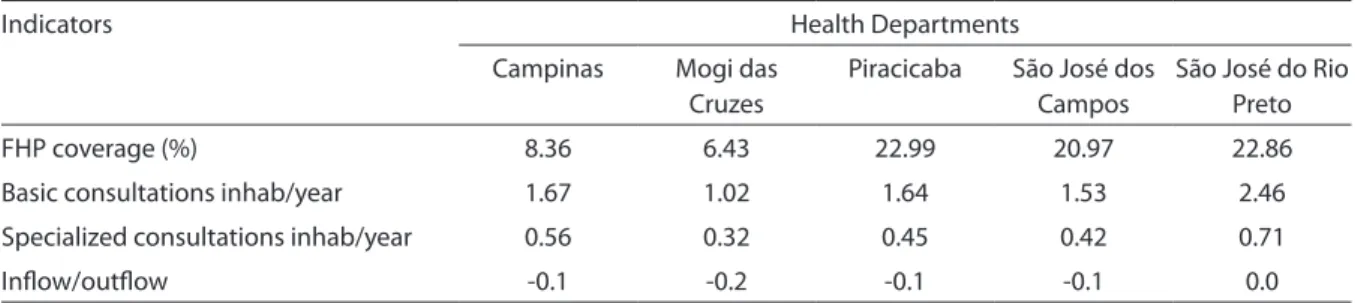
The process indicators for the DIR of the state are presented in Table 2. The FHP coverage in the regions of São José dos Campos, Piracicaba and São José do Rio Preto were very similar (around 20%), and more than twice that of Campinas and Mogi das Cruzes.
Regarding the numbers of basic and spe-cialized consultations per inhabitant/year, it was observed that only São José do Rio Preto reached the targets for of both types of consultations. The region of Mogi das Cruzes stood out through not reaching the goals of either the basic or the specialized
consultations, and not in relation to either two or three consultations.
Analysis of the inflow/outflow rela-tionship for hospitalizations due to stroke showed that the index values among the regions came close to zero. This means that, on average, there was a tendency towards a balance between the numbers of patients who were hospitalized within their own region of residence and those who were hospitalized outside of it.
Some peculiarities regarding inflows and outflows between municipalities were observed between the regions. For example, in the region of Mogi das Cruzes, there was only one referral municipality for all of the others; in Campinas, the inflows significan-tly exceeded the outflows in three munici-palities (Campinas, Jundiaí and Bragança Paulista); in Piracicaba, the municipalities of Piracicaba and Limeira were both seen to be referral locations for hospitalizations due to stroke; the municipality of São José dos Campos was the referral municipality for hospitalizations for all the other muni-cipalities in the region; and, in most of the municipalities in the region of São José do Rio Preto, the outflows surpassed the inflo-ws, i.e. these municipalities depended on others for hospitalizations, while São José do Rio Preto and Catanduva were referral municipalities. Regarding the referrals for hospitalization due to stroke, it was obser-ved that the region generally presented high capacity to resolve this type of hospitaliza-tion of cases (data not presented).
The managerial effort towards referen-cing, which was also a process indicator, was evaluated by analyzing the interviews
Table 2- Process indicators in Regional Health Boards, State of São Paulo.
Indicators Health Departments
Campinas Mogi das Cruzes
Piracicaba São José dos Campos
São José do Rio Preto
FHP coverage (%) 8.36 6.43 22.99 20.97 22.86
Basic consultations inhab/year 1.67 1.02 1.64 1.53 2.46
Specialized consultations inhab/year 0.56 0.32 0.45 0.42 0.71
with the regional managers (DIR directors), municipal managers (secretaries or their representatives) and the respective tech-nical specialists responsible for the lines of care. This was expressed in terms of relevant characteristics that are described below.
Process facilitators:
· The Integrated Agreed Program of 2002 was considered to be a facilitator of this process in most regions, even though it was not implemented, since it favored identifying healthcare needs and capa-city provision in the municipalities; · The managers’ comprehension of SUS
was considered fundamental for the referencing process;
· Strengthening of the negotiation spaces between managers and providers; · Establishment of contracts with
univer-sity hospitals;
· Establishment of fixed values for hiring service providers, rather than hiring according to production;
· Partnership between the municipalities in order to expand the provision of me-dium complexity services, in which the regional management has a regulatory role;
· Implementation of evaluation and con-trol units in the municipalities.
Impediments to the process:
· The formal mechanisms for referencing (centers for regulating spare capacity and referrals to auxiliary diagnosis and therapy services) are insufficient. Likewise, the instruments for moni-toring it are insufficient, considering that inflows from the populations of neighboring regions are spontaneous and that referrals are done directly by contact between health professionals; · The nonexistence of referral protocols
and the profile of the doctors may lead to increased demand for medium and high complexity services;
· Discrepancies in the prices in the SUS tables for contracting procedures and the lack of financial resources create a
situation in which, even in regions where the service provision is adequate, the needs of the population are not met; · In regions that have university hospitals
and a wide range of high complexity service provision, these factors may lead to inappropriate use of these services; · In metropolitan regions, it also seems
there is greater difficulty in agreeing on referrals, because managers do not always make it clear what their real ca-pacity for service provision is;
· The actions of the regional management may be impaired when there is a lack of providers under state management in the region;
· Distribution of the medications avai-lable through SUS: but usually there is no monitoring and regulation of such distribution;
· Specific preventive actions regarding ar-terial hypertension and diabetes melli-tus are mostly implemented at times of national campaigns, and such actions are not actively sought on a routine basis.
· Investments in primary care are rarely made.
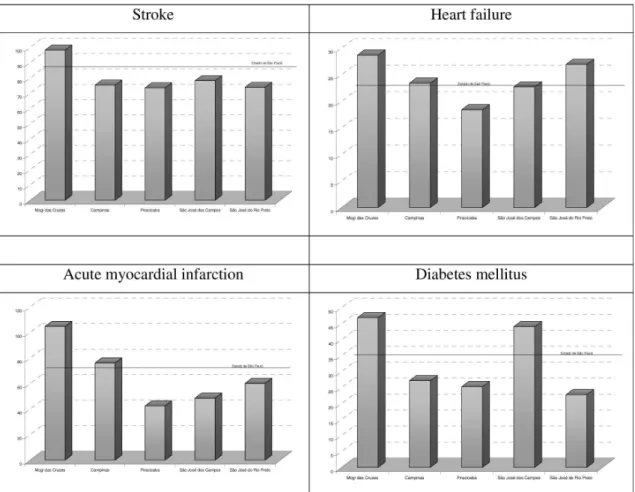
The result indicators are shown in Figure 1 and Table 3.
Figure 1 - Outcome indicators – Standardized mortality rates for coronary heart diseases and diabetes mellitus in Health Districts, compared to the State of São Paulo, 2003.
Table 3 - Result indicators – mortality indicators (per 100,000 inhabitants) standardized for stroke, acute myocardial infarction, heart failure and complications due to diabetes mellitus, for the Regional Health Boards, compared with State of São Paulo, 2003
Indicators Regional Health Boards
Campinas Mogi das Cruzes
Piracicaba São José dos Campos
São José do Rio Preto
Stroke Overall mortality rate 74.26 72.09 79.59 66.92 90.48
Proportion of early mortality
23.27 32.15 20.27 31.65 17.60
Acute myocardial infarction
Overall mortality rate 75.29 79.41 45.79 41.51 72.94
Proportion of early mortality
30.39 36.38 23.83 28.57 23.30
Heart failure Overall mortality rate 22.97 19.62 20.17 18.49 33.67
Proportion of early mortality
12.57 17.12 8.82 12.21 7.99
Diabetes mellitus
Overall mortality rate 26.72 34.00 27.16 36.99 27.86
Proportion of early mortality
the state (73.68 deaths/100,000 inhabitants). Piracicaba presented the lowest rate among the regions. Finally, regarding mortality due to diabetes mellitus, the regions of Mogi das Cruzes and São José dos Campos presented the highest rates, which surpassed the rate for the state (33.58 deaths/100,000 inhabi-tants). São José do Rio Preto presented the lowest rate among the DIRs.
The proportions of early mortality due to stroke, acute myocardial infarction, heart failure and diabetes mellitus in the five DIRs of the state of São Paulo are presented in Table 3, along with the gross mortality rates for the same events, to show the particular risks of each region. The regions of São José do Rio Preto and Mogi das Cruzes occupied the best and worst positions, respectively, regarding early mortality due to all events.
Discussion
In the present study, structure, process and result indicators were analyzed. These were correlated with two lines of care: dia-betes mellitus and arterial hypertension. It was assumed that the regionalization was an instrument for organizing healthcare and that comprehensiveness was one of the main principles of SUS. These would induce organization of the healthcare services in an integrated manner and would consequently give rise to interdependence among the players involved (regional referencing).
Through organizing healthcare services within a context of their decentralization, regionalization becomes a fundamental instrument for healthcare organization. In this respect, it can be observed that there is a need for greater connectivity between municipal systems and for strengthening of the state health department’s function as a regulator. This ensures that regionalized, hierarchical and resolutive care networks are organized, thereby providing positive results for the population’s health22. Never-theless, the mechanisms proposed through the NOB and NOAS standardization8,13, in their vertical implementation model, have often been difficult to implement and
diffi-cult for managers to understand23, 24. This was the perspective from which the analysis put forward here resorted to quantitative indicators. These were used as markers that would serve as an empirical basis for a theoretical reflection on the scope of comprehensive healthcare, starting from experiences of agreements for healthcare regionalization.
Given the complexity and multiplici-ty of senses and approaches relating to comprehensiveness, it is worth noting that understanding of the indicators studied was sought essentially by taking comprehensi-veness as the dimension of health policy characteristics or government responses to certain health problems and as the organi-zational aspect of health services25.
Within the field of “adult healthcare”, faced with the high prevalence, social cost and great impact of morbidity and mortality due to arterial hypertension and diabetes mellitus among the Brazilian population, the Ministry of Health implemented a heal-thcare reorganization plan regarding these chronic diseases, in 2001. The aim was to make the healthcare for this population more effective and efficient, starting from primary care. In 2003, a policy of integra-ted comprehensive care was implemenintegra-ted for these diseases, within the lines of care, through the following strategies: the Family Healthcare Program (FHP) in large urban centers; the Health Promotion Policy to-gether with the Food and Nutrition Policy and the Fight Against Sedentarism; the National Health Information Policy, to link and integrate information systems in order to generate indicators that would enable impact evaluation; and the Pharmaceutical Care Policy, with the aim of supplying of medications within the healthcare network, with the incorporation of supplies that would make self-care possible for diabetic patients26.
The term “line of care”, which is used in the healthcare policies relating to arterial hypertension and diabetes mellitus, gives rise to the inference that the notion of com-prehensiveness underlying the organization of these services is in relation to the path followed by users. For example, this may begin at the primary care unit and then go through different services, in such a way that, ultimately, the range of care needed for the most appropriate approach to the he-alth problem has been completed. Lines of care have been used as an auxiliary tool for organizing services, as a more appropriate approach towards care practices. They make it possible to simulate all the situations resulting from the initial health problem, in order to develop managerial actions that can provide users’ needs27.
However, it can be said that although the expression “line of care” has been presented as an ideal model for organizing care with a view to achieving comprehensiveness, its operation is in practice still at an incipient stage, considering the results obtained in this study.
Since the pre-grouping of the regions took three characteristics into account – managerial effort regarding referencing, installed healthcare capacity (from the perspective of the regional manager) and regional wealth and living conditions – some results had already theoretically been accep-ted. However, taking the circumstances of the analysis into account, some unexpected differences in the indicators investigated were shown.
Attention was drawn to the region of Mogi das Cruzes, which forms a significant proportion of the so-called Greater São Paulo area. This is characterized by high and concentrated demographic density, along with large populations living in municipali-ties that are classified as presenting medium HDI. These populations come close to the concept of the inequality profile presented by Freese & Fontbonne28. The presence of a greater proportion of municipalities without licensing for SUS, and consequent generali-zed difficulties in organizing primary care,
and their low qualification levels, together with the precarious living conditions found in this region, may provide strong expla-nations for the negative outcomes such as those found there.
On the other hand, attention was drawn equally to the region of São José do Rio Preto because of its characteristics that different greatly from Mogi das Cruzes. It is located in the interior of the state and it has an older age structure that showed mortality coefficients that were lower than those of the other regions, based on standardization of these indicators. It also had better indices for services, human resources and process indicators.
It is worth emphasizing that patients with the diseases in question require high-technology supplies and equipment and qualified professionals, because of the the-rapeutic and diagnostic complexity of these conditions29. Therefore, the resources of the region of São José do Rio Preto regarding the number of hospitals, ICU beds and outpa-tient services relative to its population may indicate that the care levels for such patients are adequate.
Added to this favorable structural confi-guration, a greater number of measures that are considered to facilitate the referencing process have been concentrated in this re-gion. Among these measures, the following can be highlighted: investment in primary care, partnerships between municipali-ties for expansion of medium complexity service provision and lack of autonomy in most of the small-sized municipalities, which is compensated through regional management as the regulatory agent for negotiations.
the result indicators.
Specifically in relation to primary care performance, this was not measured throu-gh its dimension of organization of the pro-cess of healthcare work, but only through the coverage of the FHP. However, if the FHP is taken to be the main care response provided by government bodies, within the context of the crisis of the care model, with widespread implementation as a healthcare policy for arterial hypertension and diabetes mellitus, the low coverage of this care model in all regions of the city of São Paulo may indicate that primary care within the state performs poorly. Moreover, it needs to be noted that many studies evaluating primary care in the state of São Paulo have empha-sized the difficulties in this reorganization, along with the critical knots in qualifying this level of assistance, considering both the FHP model and the traditional one30,31,32. The context described by these authors probably reflects the low numbers of basic and spe-cialized consultations that were observed, in which most regions barely reached the SUS recommended parameters.
What can be seen from this context is that the services are fragmented, even if provided in abundance. They are offered discontinuously, at each event of the di-sease, without communication between them. The effect of this arrangement on the population’s health, and notably in re-lation to arterial hypertension and diabetes mellitus, which are chronic conditions that are known to be sensitive to primary or outpatient care, can be seen especially in the proportions of early mortality obser-ved. In other words, the fragmentation of the services, to varying degrees, seems to be a tonic for the regions studied, unlike the organization of an integrated health system that aims to ensure continuity and comprehensiveness of the services required from different professionals, with services conceptualized according to the line of care.
This inference is confirmed by the fact that the key points identified as essential for lines of care to function, such as identi-fying the players that control the resources
(collegiate management), instruments for safe referrals to different levels of comple-xity, counter-referrals to primary care basic units and policies to ensure that actions are intersectoral in nature33, were the same ones pointed out as the main obstacles for regional referencing, by the regional and municipal managers of the DIRs studied.
Finally, it needs to be indicated that the adequacy of management practices for effective and efficient organization of healthcare also seems to depend on im-provement of knowledge about SUS among managers, professionals and the popula-tion. This matter, which was also brought to light by the present study, has not been extensively examined here, but it raises the ideas of “institutional capacity” and “insti-tutional learning” that were investigated by Viana et al30 .
effectiveness and efficiency of the system as a whole, reaching the networks of primary, specialized and hospital care that attend to health plan clients”35. In this respect, by way of example, using the rate of supplementary healthcare coverage (one of the rare indi-cators for this sector), it was observed that the proportion of the population benefiting from health plans of medical assistance type in the regions of Mogi das Cruzes and São José do Rio Preto were similar (23.7% and 21.3%, respectively*), even if the indicators for mortality due to cardiovascular disease and the complications of diabetes mellitus are very different. This may indicate the relative importance of the possible effects of this type of medical care in relation to the indicators that were analyzed here.
Final considerations
The characteristics that were analyzed here show, on the one hand, the complexity of the healthcare system and, on the other,
some challenging but possible directions to follow, such as those observed in the DIR of São José do Rio Preto. Greater adequacy of service provision, greater coverage of the Family Health Program and greater health-care coverage (basic and specialized consul-tations) seem to exert a positive influence on the result indicators for the lines of care that were analyzed. In addition, initiatives for strengthening of formal mechanisms for regional agreements have a positive influence. On the other hand, the realities of the metropolitan regions seem to cause difficulties in achieving agreement between managers regarding referrals, and this point deserves special attention.
The most challenging and unavoidable point raised by this study is perhaps the need to correlating the strengths of society. Nevertheless, this study supports the notion that it is feasible to create lines of care based on technically adequate designs for effective referencing of services and adequate mana-gement and care practices.
References
1. Brasil, Ministério da Saúde. Banco de dados do Sistema Único de Saúde-DATASUS. Disponível em: http://www. datasus.gov.br, Acessado em [03 de Mar de 2008].
2. Kannel WB,. Vasan RS, Levy D. Is the Relation of Systolic Blood Pressure to Risk of Cardiovascular Disease Continuous and Graded, or Are There Critical Values?
Hypertension. 2003;42:453-456.
3. Passos VMA, Assis TD, Barreto SM. Hipertensão arterial no Brasil: estimativa de prevalência a partir de estudos de base populacional. Epidemiologia e serviços de Saúde. 2006; 15(1):35-45.
4. Marcopito LF, Rodrigues SSF, Pacheco MA, Shirassu MM, Goldfeder AJ, Moraes MA. Prevalência de alguns fatores de risco para doenças crônicas na cidade de São Paulo. Rev Saúde Pública. 2005; 39(5):738-745.
5. Cesarino CB et al. Prevalência e fatores
sociodemográficos em hipertensos em São José do Rio Preto – SP. Arq Bras Cardiol. 2008; 91(1):31-35.
6. Rosa RS, Shmidt MI, Duncan BB, Souza MFM, Lima AK, Moura L. Internações por Diabetes Mellitus como diagnóstico principal na rede pública do Brasil, 199-2001. Rev Bras Epidemiol. 2007; 10(4): 465-478.
7. Malerbi DA, Franco LJ. Multicenter study of the prevalence of diabetes mellitus and impaired glucose tolerance in the urban Brazilian population aged 30-69 yr. Diabetes Care. 1992; 15(11):1509-1516.
8. Brasil, Ministério da Saúde. Norma operacional da assistência à saúde do Sistema Único de Saúde -NOAS –SUS, 2002.
9. Fundação SEADE. Índice Paulista de responsabilidade Social - IPRS Disponível em: http://www.seade.gov.br/ produtos/iprs/pdf/oiprs.pdf .Acessado em [30 de Mar de 2006].
10. Donabedian A., 1980. Explorations in Quality Assessment and Monitoring: The Definition of Quality and Approaches to its Assessment. Vol. 1. Ann Harbor: Michigan H. A. Press, 1980. p 163.
11. Instituto Brasileiro Geografia Estatística – IBGE Censos Demográficos. Disponível em: http://www.ibge.gov.br/ home/estatistica/populacao/default_censo_2000.shtm. Acessado em [19 de Jul de 2007].
12. Organização das Nações Unidas, Brasil. Programa das Nações Unidas para o Desenvolvimento-PNUD Índice de Desenvolvimento Humano –IDH. Disponível em: http://www.pnud.org.br/idh/. Acessado em [13 de Mai de 2008].
13. Brasil, Ministério da Saúde. Norma operacional básica do Sistema Único de Saúde – NOB-SUS-96, 1997.
14. Brasil, Ministério da Saúde. Banco de dados do Sistema Único de Saúde-DATASUS, Cadastro Nacional de Estabelecimentos de atenção à Saúde –CNES Fluxo de Clientela. Disponível em: http://cnes.datasus.gov.br/ Mod_Ind_Clientela.asp. Acessado em [23 de Abr de 2005].
15. Parâmetros Assistenciais do Sistema Único de Saúde do Brasil, Portaria 1101/GM. Acessado em [12 de Jun de 2002].
16. Brasil, Ministério da Saúde. Banco de dados do Sistema Único de Saúde -DATASUS, Informações de Saúde, Rede assistencial Disponível em: http://w3.datasus.gov.br/ siasih/siasih.php?area=11784A4B0C0D0E0F11784G4HI Jd4L5M0N&VInclude=../site/texto.php Acessado em [6 de Jun de 2003].
17. Brasil, Ministério da Saúde. Banco de dados do Sistema Único de Saúde-DATASUS, Sistema de Informações Hospitalares Disponível em: http://www.datasus.gov.br/ catalogo/sihsus.htm, Acessado em [28 de Mai de 2003].
18. Bardin, L. Análise de Conteúdo. Lisboa: Edições 70, 1991.
19. Brasil, Ministério da Saúde. Banco de dados do Sistema Único de Saúde -DATASUS, Informações de Saúde, Sistema de Informações sobre Mortalidade. Disponível em: http://www.datasus.gov.br/catalogo/sim.htm. Acessado em [ 28 de Mai de 2006].
20. SISMA-SUS. Sistema de Monitoramento e Avaliação do SUS a partir da Atenção Báscia no Estado de São Paulo. São Paulo: Instituto de Saúde, 2006. Temas em Saúde Coletiva, 4.
21. REDE Interagencial de Informação para a Saúde - RIPSA Indicadores básicos para a saúde no Brasil: conceitos e aplicações. 2ª. Ed. – Brasília: OPAS, 2008.
22. Souza RR. A regionalização no contexto atual das políticas de saúde. Rev Ciência & Saúde Coletiva. 2001; 6(2): 451-455.
23. Nascimento VB. SUS: pacto federativo e gestão pública. São Paulo: Aderaldo & Rothschild Ed; Santo André, SP: Cesco, 2007.
24. Mendes EV. Os grandes dilemas do SUS. Salvador, BA: Casa da Qualidade Editora, 2001, Tomo I.
25. Mattos RA. A integralidade na prática (ou sobre a prática da integralidade). 2004; Cad. Saúde Pública. 20(5):1411-1416.
26. Ministério da Saúde, Organização Pan-Americana da Saúde. Avaliação do plano de reorganização da atenção à hipertensão arterial e ao diabetes mellitus no Brasil. Brasília–DF: Ministério da Saúde, 2004.
27. Magalhães Jr HM, Oliveira RC. Concretizando a integralidade nos serviços de saúde: a aposta do SUS em Belo Horizonte. In: : Pinheiro R, Ferla AA, Mattos RA (orgs). Gestão em redes: tecendo os fios da integralidade em saúde. Rio de Janeiro: EDUCS:IMS/UERJ:CEPESQ, 2006. p 51-64.
28. Freese E, Fontbonne A. Transição epidemiológica comparada: modernidade, precariedade e vulnerabilidade. In: Freese E (org.). Epidemiologia, políticas e determinantes das doenças crônicas não transmissíveis no Brasil. Recife: Ed. Universitária da UFPE, 2006. p 17-45.
29. Rocha JSY, Silva JSE, Gleiton C M. Hospitalizações por infarto agudo do miocárdio segundo o dia da semana: estudo retrospectivo. Rev. Saúde Pública. 2000; 34(2):157-162.
30. Viana ALd’A, Rocha JSY, Elias PE, Ibañez N, Novaes MHD. Modelo de atenção básica nos grandes municípios paulistas: efetividade, eficácia,
sustentabilidade e governabilidade. Rev Ciência & Saúde Coletiva. 2006; 11(3):577-606.
31. Elias PE, Ferreira CW, Alves MCG, Cohn A, Kishima V, Escrivão Jr A, et al.. Atenção básica em saúde: comparação entre PSF e UBS por estrato de exclusão social no município de São Paulo. Rev Ciência & Saúde Coletiva. 2006; 11(3):633-641.
32. Ibañez N, Rocha JSY, Castro PC, Ribeiro MCSA, Forster AC, Novaes MHD, Viana ALd’A. Avaliação do desempenho da atenção básica no Estado de São Paulo. Rev Ciência & Saúde Coletiva. 2006; 11(3):683-703.
33. Franco TB, Magalhães Jr HM. Integralidade na assistência à saúde: a organização das linhas do cuidado. In: Elias EM, Magalhães Jr HM, Rimoli J, Franco TB, Bueno WS (orgs) O trabalho em saúde: olhando o SUS no cotidiano. 3ª ed. São Paulo:Hucitec, 2006. p.125-133.
34. Ministério da Saúde. Diretrizes operacionais pelo pacto pela vida em defesa do SUS e da gestão. Editora do Ministério da Saúde, Brasília, 2006.