abstract
INtrODUctION
Many studies about the hybridization of the root canal dentin are conclusive with respect to the factors that can lead to poor bonding in this environment. It is known that the cavity
coniguration and the dentin structure of the root canals make hybridization dificult. However, the
effects of other factors such as the type of adhesive have been scarcely explored.
The cavity coniguration is one of the most
critical variables in bonding to the root canal dentin. Even though the C factor varies from 1 to
5 in coronal restorations, it might be higher than
200 when posts are luted in the three-dimensional
The adhesive system and root canal region do
not inluence the degree of conversion of dual
resin cement
Priscilla Cristoforides PereirA1, renata Marques de MelO2, Carolina ChAveS3, Graziela A. P. GAlhAnO2,
Marco Antonio BOttinO4, ivan BAlduCCi5
1- Research Fellow, Department of Dental Materials and Prosthodontics, São José dos Campos Dental School, São Paulo State University, São José dos Campos, SP, Brazil.
2- DDS, PhD student, Department of Dental Materials and Prosthodontics, São José dos Campos Dental School, São Paulo State University, São José dos Campos, SP, Brazil.
3- DDS, DMD, PhD student, Dental Materials and Prosthodontics, Araraquara Dental School, São Paulo State University, Araraquara, SP, Brazil.
4- DDS, DMD, Professor, Department of Dental Materials and Prosthodontics, São José dos Campos Dental School, São Paulo State University, São José dos Campos, SP, Brazil.
5- DDS, DMD, PhD, Professor, Department of Social Science and Pediatric Dentistry, São José dos Campos Dental School, São Paulo State University, São José dos Campos, SP, Brazil.
Correspnding address: Renata Marques de Melo - DMOP - Av. Engenheiro Fco. José Longo, 777 - 12245-200 - São Dimas - São José dos Campos, SP - Brasil - Phone: (12) 3947-9060 - e-mail: [email protected]
Received: February 25, 2009 - Modiication: September 28, 2009 - Accepted: February 16, 2010
O
bjectives: The aim of this study was to evaluate the inluence of two adhesivesystems and the post space region on the degree of conversion of dual resin cement
and its bond strength to root dentin. Material and Methods: One three-step
etch-and-rinse (All-bond 2, Bisco) and another one-step self-etch (Xeno III, Dentsply) adhesive systems were applied on 20 (n=10) crownless bovine incisors, at 12-mm-deep post space preparation, and a iber post (FRC Postec, Ivoclar) was cemented using a dual cure resin cement (Duo-Link, Bisco). Three transverse sections (3 mm) were obtained, being one from each study region (cervical, middle and apical). The degree of conversion of the dual cure resin cement was determined by a micro-Raman spectrometer. The data (%) were
submitted to repeated-measures analysis of variance and Tukey’s test (p<0.05).Results:
For both groups, the degree of conversion means (%) (All bond 2cervical = 69.3; All bond
2middle =55.1; All bond 2apical= 56; Xeno III cervical = 68.7; Xeno IIImiddle = 68.8; Xeno III apical =
54.3) were not signiicantly different along the post space regions (p<0.05).Conclusions:
Neither the adhesive nor the post space region inluenced the degree of conversion of the
cement layer.
Key words: Root canal. Resin Cements. Raman spectroscopy. Adhesives.
environment of the root canal2.Another problem is
the dentin root canal structure. Usually, the root dentin tubules are straighter, less divergent and
less dense than in the coronal dentin6,12.Because
of the increasing use of iber posts associated to
dual cure resin adhesive materials the discussion was also turned towards the polymerization of the resin cement along the root canal15,19.
Therefore, one must always consider such
issues when using resinous materials in the root canal. The remaining factors such as the behavior of dental adhesives on dentin depend mostly on the
material used. Currently, several presentations of
dentin adhesives are available: total dentin etching with previous acid etching followed by primer and
or in combination (two-step systems); and self-etch systems, which contain a self-self-etching primer and an adhesive, separately (two-step systems) or in one solution (all-in-one systems). The increasing preference for using simpliied systems (two-step total-etch and all-in-one self-etch systems) is due to the shortening of chair time. However, for a number of reasons, the use of these materials
is always harmful to bonding when compared to multi-bottle materials (three-step etch-and-rinse
and two-step self-etch systems)4,17,18.One reason
is that the acidic monomers present in the oxygen-inhibited layer of one step-self-etch adhesives are brought in direct contact with the chemical-
or dual-cure composite, titrating the basic amine
accelerators and inactivating them4,8,16.
Concerning the methods to determine the
degree of conversion of dental composites, the most
commonly used are indirect analyses by means of
lexural and hardness test, differential scanning
calorimetry and direct analyses using infrared
spectroscopy (FTIR) or Raman spectroscopy.
Microspectroscopy is obtained by using the
spectroscope with a microscope, and can be used to analyze microscopic samples. In dentistry, this
technique has been mainly used to evaluate the degree of conversion of methacrylate resins in the initial stages of polymerization14.
Most studies about the incompatibility
between simpliied adhesive systems and dual
cure resin cements measured the bond strengths
at the dentin/adhesive/cement interfaces1,4,8,11.
However, no investigation determining the degree
of conversion in situ has ever been conducted. With the recent interest in bondable root-illing materials to intraradicular dentin, such analysis is
also of clinical importance to prevent debonding
of the restoration. Therefore, this study evaluated the inluence of two adhesives systems (all-in-one self-etch and three-step etch-and-rinse) and
root canal regions on the degree of conversion of
dual cure resin cement by means of micro-Raman
analysis. It was hypothesized that the degree of conversion would be lower for the self-etch group in the deepest levels of the post space.
MatErIaL aND MEtHODs
Twenty bovine lower incisors were extracted and stored in distilled water at -4°C. They were
randomly divided into two groups (n=10), according to the adhesive system (Figure 1).
The root lengths were standardized at 16 mm. The teeth had their root canals prepared with a low
speed calibrated drill (size 2) of a glass- FRC post system (FRC Postec, Ivoclar, Schaan, Lichtenstein)
at a working length of 12 mm. The remaining 4
mm were sealed with gutta-percha. Afterwards,
the outer surface of each tooth was covered with black nail varnish to allow passage of light only through the most coronal portion.
The adhesive application followed the
Figure 1- Materials tested in the study Material
(manufacturer) Composition Application procedures
All Bond 2 (Bisco Inc., Schaumburg, IL, USA)
Primer A: Acetone, Ethanol, Na-N-totylglycine glycidylmethacrylate; Primer B: Acetone, Ethanol, Biphenyl
dimethacrylate; Pre-Bond resin: Bisphenol A diglycidymethacrylate, Triethyleneglycol
dimethacrylate, Benzoyl Peroxide
1- Etch with 32% phosphoric acid (UNI-ETCH, Bisco Co., Schaumburg, IL, USA for 15 s.
2- Water rinse.
3- Dry with absorbent paper points (#80).
4- Apply Primer A + B with a microbrush (SDI BRASIL INDÚSTRIA E COMÉRCIO LTDA., São Paulo, SP, Brazil).
5- Apply “Pre-Bond resin” with a microbrush.
Xeno III (Dentsply DeTrey, Konstanz,
Germany)
Universal: 2-Hydroxiethyl methacrylate, aerosol R947, 2,6-di-tert-butyl-p-cresol,
ethanol (BHT), water
Catalyst: tetra-metacryl-ethyl-pyrophosphate,
Penta-methacryl-oxy-ethyl-cyclo-phosphazen-monoluoride, Urethane
dimethacrylate, BHT, camphorquinone, p-dimethyl amine ethyl benzoate
1- Mix Universal liquid and Catalyst. 2- Apply and leave undisturbed for 20 s. 3- Air dry
4- Light-cure for 10 s.
DUO-LINK (Bisco Inc., Schaumburg, IL, USA)
Bisphenol A diglycidyl methacrylate (5-30%) Triethyleneglycol dimethacrylate (5-20%)
Glass iller (50-80%)
**Urethane dimethacrylate (5-15%) ** Base only
1- Mix equal amounts of DUO-LINK base and catalyst into a uniform paste for 10 s.
2- Carry the cement into the canal with a lentulo spiral.
manufacturer instructions (Figure 1). The cement was then applied to the root canal with a Lentulo No 40 spiral (Dentsply Maillefer, Tulsa, Oklahoma, USA), the FRC Postec post (Ivoclar) was positioned
and the set was light-cured through the post for
40 s (Optilight 600; Gnatus Equipamentos Médico-Odontológicos LTDA, Ribeirão Preto, SP, Brazil) at
a light intensity of 600 mW/cm2. Afterwards, the
teeth were sectioned perpendicular to their long
axis with a diamond saw (Microdont, São Paulo, SP, Brazil) under water irrigation. The irst 0.5
mm section was discarded because of the excess
cement. Three segments measuring nearly 3 mm were obtained, being one from each study region (cervical, middle and apical regions of the root canal preparation).
The specimens were stored in distilled water
at 37°C for 48 h. The degree of conversion was determined with a computer-controlled Raman Microscope (System-2000, Renishaw, Wotton-under-Edge, Gloucestershire, UK). Each root
section was excited at a wavelength of 514 nm by an Ar laser through an optical microscope. The
specimen was placed on the X-Y stage and the laser
beam was focused on the specimen surface through
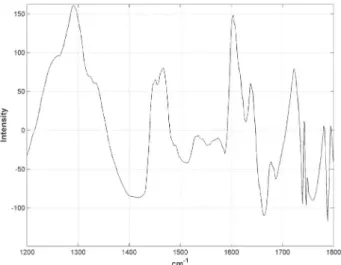
a 50x microscope objective with 1 μm of lateral spatial resolution. After calibration of Raman shift frequency, using known lines of silicon, both the spectra of the base paste of the cement (uncured) (Figure 2) and the spectra of the cement in the post space (cured) (Figures 3 and 4) were obtained
(spectral range: 1500-1800 cm-1). The dual-cure
resin cement was scanned in three different points approximately at 1 µm distance from the hybrid layer and equidistant to one another.
The analyses of the acquired spectra were made
using Origin 7.0 with Peak Fitting module (Microcal Software Inc., Northampton, MA, USA), which is a curve itting program. The measurement of
residual double bonds was made on a relative basis by comparing the uncured methacrylate stretching
vibration (1638 cm-1) to that of the aromatic ring
(1610 cm-1 ), which serves as internal reference,
before (Resinuncured) and after (Resincured) curing.
The percentage of residual double bonds was calculated using the following equations:
Residual double resin bonds (%) = Resincured/
Resinuncured, where,
Resincured = band area of aliphatic C=C at 1640 cm-1
band area of aromatic C∙∙∙C at 1610 cm-1
Resinuncured = band area of aliphatic C=C at 1640 cm-1
band area of aromatic C∙∙∙C at 1610 cm-1
The following step was to measure the degree of conversion of the resin cement in each root section:
DC (%) = 100 - (% of Residual double resin bonds).
Figure 2- Raman spectra for Duo-link uncured. The 1610 cm-1 and the 1640 cm-1 peaks correspond to the aromatic ring and to the c=c bonds of the uncured cement, respectively
Figure 3- Raman spectra for Duo-link cured cement layer used with All bond 2 (middle region)
In order to evaluate the inluence of the
adhesive and root region on the resin cement
degree of conversion, the data, in percentage,
were subjected to the repeated measures ANOVA
test (RM ANOVA, p<0.05). Tukey’s test (p<0.05)
was used to compare the mean values in the six experimental conditions.
rEsULts
The degree of conversion values (Means±SD), in percentage, are presented in the dot plot and corresponding column graph (Figure 5).
There was no interaction between the variables
“adhesive system” and “root region” (RM ANOVA: Fdf(2;36)=1.15; p-valor=0.33). Tukey’s test (p<0.05) showed no statistically signiicant differences
between the means: All bond 2cervical = 69.3 %, All bond 2middle =55.1 %, All bond 2apical= 56 %, Xeno IIIcervical = 68.7 %, Xeno IIImiddle = 68.8 %, Xeno IIIapical = 54.3 %.
DIscUssION
There is a trend to reduce the number of steps
necessary to apply adhesives. The simpliied
adhesives currently in use are the etch-and-rinse with primer and adhesive applied simultaneously
(two-step) and the self-etch systems, which
contain a self-etch primer and an adhesive in one
solution (all-in-one).
The increasing preference for using simpliied
systems is due to the decrease in chair time.
However, using such materials has some drawbacks. Firstly, thin resin layers of these adhesives generate
great amounts of uncured acidic monomers1,4,11,16,
which is a result of the resin not totally cured by the presence of oxygen10. It is well known that
these monomers can adversely react with the basic amine catalysts of chemically and dual cure
composites, retarding the cement polymerization. Secondly, the same adhesive layer inhibited by
the oxygen creates an osmotic gradient capable
of attracting water that can cause some delay in the resin self cure and/or degrade the adhesive/ cement interface5,16,17.Therefore, one should expect
a poor polymerization reaction from the combined
Xeno III/Duo-link layer, but this was not seen.
This results suggests that the suboptimal bond
strengths of all-in-one adhesives, rather than a
cause of poor resin cement polymerization is due to comparatively more complex interface with dentin18,
great hidrophilicity5,10, hydrolytic instability19 and
ability to activate latent enzymes of the substrate
(MMPs), destroying the collagen ibrils13. Recently,
a practical way to minimize the effects of simpliied adhesive systems has been proposed by Cadenaro,
et al.3 (2006), who employed longer curing times
than those recommended by the manufacturers. Another different approach to improve bonding has been the use of an additional layer of hydrophobic adhesive on the polymerized adhesive layer10.
The pendant double bonds is also known (pendant methacrylate groups tied into the
network) to lead to increased degree of conversion
but not improve physical properties7. However, in
root canal restorations they must remain trapped to the network and eventually react to increase cement physical properties as these restorations
are not exposed to the oral medium, where pendant
groups tend to be leached to saliva.
In spite of what was said before, a few specimens
from both groups in the present study showed close to zero polymerization. We believe that the presence of residual water (used to cleanse the root
canal before hybridization) hampered the degree of conversion in the middle and apical regions, which
are very sensitive to moist control6.
The problem of resin cement polymerization is further aggravated by the light gradation along the root canal dentin during the post cementation19.
Nevertheless, our results showed no differences
between the degrees of conversion obtained in the three post space regions. The use of a
light-transmitting glass iber post has been claimed
to improve polymerization through the depth of post spaces19, explaining the absence of regional
Figure 5- Degree of conversion values (%) obtained in 20 specimens (n=10), according to the adhesive system and post space regions
differences. More recently Kim, et al.9 (2009)
demonstrated that the degree of conversion of a luting agent depended on the on the light
transmission capacity of the posts tested, which
suggests that the post herein used was appropriate.
Foxton, et al.8 (2005) measured the Knoop
hardness in post spaces cemented with dual cure resin cement and found no differences between what they called “cervical” and “apical regions”.
However, the microhardness test was ineffective
for measuring the depth of cure of resins beyond 10 mm19.On the other hand, the micro-Raman
analysis was proven an eficient tool to measure
the degree of conversion of luting materials in apical regions.
The anticipated hypothesis was rejected. It was found that the two adhesive systems tested can be equally associated to the dual resin cement in
root canal restorations. However, other aspects, e.g., resistance to fatigue, bonding strategy to dentin and time in aqueous storage, need to be
considered and are of similar importance for the study of durable restorations.
cONcLUsIONs
No difference on the degree of conversion of the cement was observed between the two tested groups in relation to either the adhesive type or the different dentin zones.
acKNOWLEDGEMENts
This research was supported by FAPESP (05/60700-0), the State of São Paulo Research Foundation (São Paulo, Brazil). Special thanks to Prof. Evaldo José Corat from the National Institute for Space Research (INPE) at São Jose dos Campos (SP, Brazil), for his help with the Raman analysis.
rEFErENcEs
1- Aksornmuang J, Nakajima M, Foxton RM, Tagami J. Effect of
prolonged photo-irradiation time of three self-etch systems on
the bonding to root canal dentine. J Dent. 2006;34:389-97. 2- Bouillaguet S, Troesch S, Wataha JC, Krejci I, Meyer JM, Pashley DH. Microtensile bond strength between adhesive cements and root canal dentin. Dent Mater. 2003;19:199-205.
3- Cadenaro M, Antoniolli F, Sauro S, Tay FR, Di Lenarda R, Prati C, et al. Degree of conversion and permeability of dental adhesives. Eur J Oral Sci. 2006;113:525-30.
4- Cheong C, King NM, Pashley DH, Ferrari M, Toledano M, Tay FR. Incompatibility of self-etch adhesives with chemical/dual-cured composites: two-step vs one-step systems. Oper Dent. 2003;28:747-55.
5- Chersoni S, Acquaviva GL, Prati C, Ferrari M, Grandini S, Pashley DH, et al. In vivo luid movement through dentin adhesives in endodontically treated teeth J Dent Res. 2005;84:223-7. 6- Ferrari M, Mannocci F, Vichi A, Cagidiaco MC, Mjor IA. Bonding to root canal: structural characteristics of the substrate. Am J Dent. 2000;13:255-60.
7- Floyd CJ, Dickens SH. Network structure of Bis-GMA- and UDMA-based resin systems. Dent Mater. 2006;22:1143-9. 8- Foxton RM, Nakajima M, Tagami J, Miura H. Adhesion to root
canal dentine using one and two-step adhesives with dual-cure
composite core materials. J Oral Rehabil. 2005;32:97-104.
9- Kim YK, Kim SK, Kim KH, Kwon TY. Degree of conversion of dual-cured resin cement light-cured through three ibre
posts within human root canals: an ex vivo study. Int Endod J. 2009;42:667-74.
10- King NM, Tay FR, Pashley DH, Hashimoto M, Ito S, Brackett WW, et al. Conversion of one-step to two-step self-etch adhesives for improved eficacy and extended application. Am J Dent. 2005;18:126-34.
11- Latta MA, Kelsey WP 3rd, Kelsey WP 5th. Effect of
polymerization mode of adhesive and cement on shear bond
strength to dentin. Am J Dent. 2006;19:96-100.
12- Mannocci F, Pileck P, Bertelli E, Watson TF. Density of dentinal tubules affects the tensile strength of root dentin. Dent Mater. 2004;20:293-6.
13- Nishitani Y, Yoshiama M, Wadgaonkar B, Breschi L, Manello F, Mazonni A, et al. Activation of gelatinolytic/collagenolytic activity in dentin by self-etching adhesives. Eur J Oral Sci.
2006;114:160-6.
14- Pianelli C, Devaux J, Bebelman S, Leloup G. The micro-Raman spectroscopy, a useful tool to determine the degree of conversion of light-activated composite resins. J Biomed Mater Res. 1999;48:675-81.
15- Sigemori RM, Reis AF, Giannini M, Paulillo LA. Curing depth of a resin-modiied glass ionomer and two resin-based luting agents. Oper Dent. 2005;30:185-9.
16- Suh BI, Feng L, Pashley DH, Tay FR. Factors contributing to the incompatibility between simpliied-step adhesives and self-cured or dual self-cured composites. Part III. Effect of acidic resin monomers. J Adhes Dent. 2003;5:267-82.
17- Tay FR, Suh BI, Pashley DH, Prati C, Chuang S, Li F. Factors contributing to the incompatibility between simpliied-step adhesives and self-cured or dual cured composites. Part II. Single bottle, total etch adhesive. J Adhes Dent. 2003;5:91-105. 18- Wang Y, Spencer P. Physiochemical interactions at the interfaces between self-etch adhesive systems and dentine. J Dent. 2004;32:567-79.