ABSTRACT
INTRODUCTION
Due to their improved physicochemical properties, resin-based cements are widely used to lute metal and ceramic indirect restorations30. In general, these materials are constituted of a polymeric particles, pigments, and chemical substances to start their polymerization reaction7.The variation in physicochemical properties of the material2.
The polymerization reaction of resin-based cements can be started chemically, physically or using a dual mode that involves the two processes. In clinical practice each mode presents some advantages. For example, due to its characteristic of polymerization on-demand, physical activation allows an extension of the working time and the possibility of removing the excess cement around the restoration before the
11. However, there
A critical analysis of the degree of conversion of
resin-based luting cements
NORONHA FILHO1 BRANDÃO1, Laiza Tatiana POSKUS2,
GUIMARÃES2, Eduardo Moreira da SILVA2
1- DDS, Undergraduate student,Department of Restorative Dentistry, School of Dentistry, Federal Fluminense University, Niterói, RJ, Brazil. 2- DDS, MSc, PhD, Associate Professor Department of Restorative Dentistry, School of Dentistry, Federal Fluminense University, Niterói, RJ, Brazil.
Corresponding address: Dr. Eduardo Moreira da Silva - Universidade Federal Fluminense / Faculdade de Odontologia - Rua Mário Santos Braga, nº 28 - Campus Valonguinho, Centro - Niterói, RJ, Brasil - 24020-140 - Phone: 55 21 2629-9832 - fax: 55 21 2622-5739 - e-mail: [email protected]
!""#$% $&'!"'"#( $!'!"'"
O
bjective: This study analyzed the degree of conversion (DC%) of four resin-basedcements (All Ceram, Enforce, Rely X ARC and Variolink II) activated by two modes (chemical and dual), and evaluated the decrease of DC% in the dual mode promoted by the interposition of a 2.0-mm-thick IPS Empress 2 disc. Material and Methods: In the chemical activation, the resin-based cements were prepared by mixing equal amounts of base and catalyst pastes. In the dual activation, after mixing, the cements
were light-activated at 650 mW/cm2 for 40 s. In a third group, the cements were
light-activated through a 2.0-mm-thick IPS Empress 2 disc. The DC% was evaluated in a FT-IR ! analyzed by two-way ANOVA and Tukey’s HSD test. Results: For all resin-based cements, "#$ &'& IPS Empress 2, and chemical activation (p<0.05). Irrespective of the activation mode, Rely X presented the highest DC% (p<0.05). Chemically activated Variolink and All Ceram *+!+8! "#$ & was performed through a 2.0-mm-thick IPS Empress 2 disc (p<0.05). Conclusions: The results of the present study suggest that resin-based cements could present low DC% when the materials are dually activated through 2.0 mm of reinforced ceramic materials with translucency equal to or less than that of IPS-Empress 2.
Key words: Resin cements. Cure.
will be a limitation to the use of physical activation when luting metal-ceramic or metal-free restorations produced with a high aluminum content system, e.g., Procera and In-Ceram, which prevent or decrease light transmission through the restoration24. On the other hand, chemical activation will theoretically allow the material to reach an adequate degree of conversion even in the absence of light. Thus, the dual activation mode was introduced to combine the advantages of physical and chemical activation modes. In other words, to reach an adequate degree of conversion (DC%) irrespective of the presence of ' restoration3.
polymerization progresses, however, the diffusion rate of the propagating free radicals undergoes a strong reduction. Thus, monomer conversion is not complete, and at the end of the reaction, part of the monomers remains as pendant double bonds or unreacted monomers trapped in the polymeric matrix. This amount of unconverted carbon double bonded will diminish the physical properties16, increase the degradation of the material8 and may cause damage to the pulp-dentinal complex in deep preparations29.
Although in theory dual-activated resin-based cements will develop an adequate DC%, it is clear that clinically, the restorative materials used to produce indirect restorations will decrease the transmittance of the light emitted by the light unit4,24. Moreover, the thicker the restoration, the less the light intensity to permit optimal light-activation of the resin-based cement13,28. The minimum reduction of the occlusal surfaces for posterior all-ceramic onlays and crowns is around 1.5 to 2.0 mm19. Therefore, this thickness may represent a crucial aspect for the studies carried out to investigate the behavior of resin-based cements with regard to the DC%.
This study analyzed the DC% of four resin-based cement started by two activation modes (chemical and dual), and evaluated the decrease of the DC% in the dual activation mode promoted by a 2.0-mm-thick lithium disilicate-glass ceramic disc (IPS Empress 2) placed between the light-curing tip and the cement surface. The research hypothesis was that the DC% & through the 2.0-mm-thick IPS Empress 2 disc.
MATERIAL AND METHODS
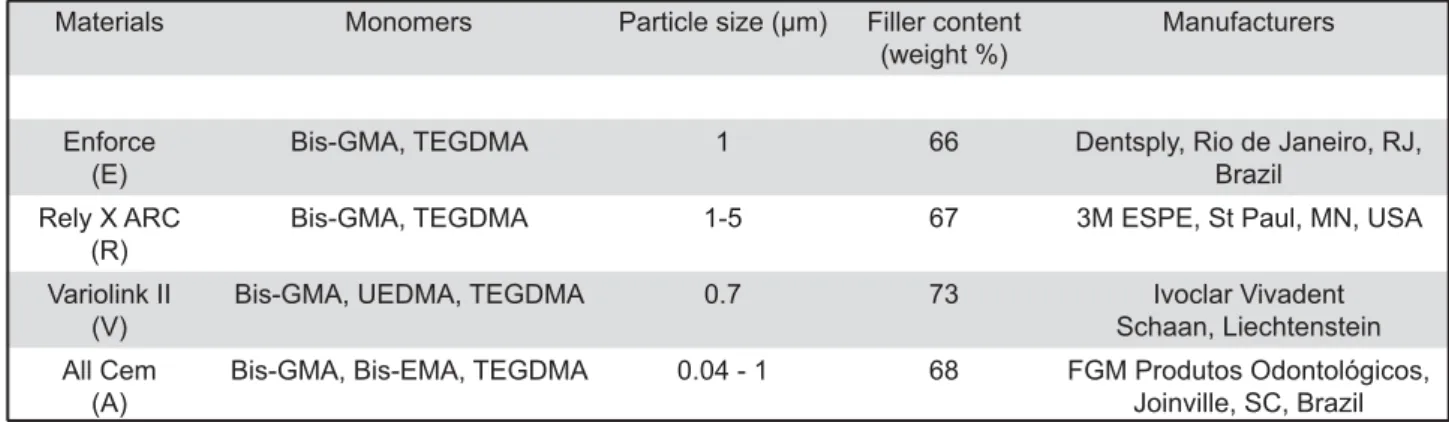
The compositions of the four resin-based cements analyzed in the present study are presented in the Figure 1. A quartz-tungsten-halogen unit (Optilux 501, Kerr, Danbury, CT, USA), using an irradiance of 650 mW/cm2 for 40 s, was used to light-activate the specimens in the dual activation mode. The radiant exposure, calculated as the product of the irradiance
of the curing unit, by using a radiometer (model 100, Demetron Inc.), and the time of irradiation was 26 J/cm2.
Degree of Conversion (DC%)
All the steps of DC% measurements were carried out in a light-reduced environment. Spectra of the unpolymerized and polymerized specimens of each resin-based cement were recorded by a FT-IR spectrometer22 (Varian 3100 FT-IR, Varian Inc, Palo Alto, CA, USA), equipped with an attenuated > ?@ BG Technologies, Madison, WI, USA) operating with 120 scans at a resolution of 4 cm-1. For unpolymerized specimens, standard amounts of base and catalyst pastes of each resin-based cement were separately compressed between two polyethylene strips and LQ@ spectra were obtained27. For polymerized specimens, equals amounts of base and catalyst pastes were ' 10 s. In Group I (chemical activation - Ch), 90 s after mixing, the specimens were stored in light-proof containers. In Group II (dual activation-D), immediately after mixing, the specimens were light-polymerized with the light tip in contact with a polyester strip positioned on the mixed past. In Group III (dual activation through a ceramic disc - DC), after mixing and immediately before light-polymerization, a ceramic disc (12 mm in diameter and 2.0-mm-thick), consisting of a 1-mm-thick framework of a castable pressed ceramic and a 1-mm-thick layering ceramic (IPS-Empress 2 system, Ivoclar Vivadent Inc, Amherst, NY, USA), was positioned between the mixed resin-based cement and the light guide tip of the light-curing unit. The framework surface was [+$'\+ ' 30 s, and air dried. FT-IR spectra of the polymerized specimens were recorded 24 h after dry storage in light-proof containers at 37°C. Five specimens (n=5) were made per group. The DC% was calculated from the ratio between the absorbance peaks of the
Materials Monomers Particle size (µm) Filler content (weight %)
Manufacturers
Enforce (E)
Bis-GMA, TEGDMA 1 66 Dentsply, Rio de Janeiro, RJ, Brazil
Rely X ARC (R)
Bis-GMA, TEGDMA 1-5 67 3M ESPE, St Paul, MN, USA
Variolink II (V)
Bis-GMA, UEDMA, TEGDMA 0.7 73 Ivoclar Vivadent Schaan, Liechtenstein All Cem
(A)
Bis-GMA, Bis-EMA, TEGDMA 0.04 - 1 68 FGM Produtos Odontológicos, Joinville, SC, Brazil
Figure 1- Resin-based luting cements used in this study
aliphatic C=C bond (1638 cm-1) to the aromatic C=C (1608 cm-1), used as an internal standard, obtained from the polymerized and unpolymerized specimens by the following equation:
DC (%) = 100 x [1 – (Rpolymerized / Runpolymerized)] where R=peak at 1638 cm-1/peak at 1608 cm-1
Statistical analysis
Statistical analysis was performed using Statgraphics 5.1 Software (Manugistics, Rockville, MD, USA). After the normal distribution of the errors and the homogeneity of variance had & & _Q`G{ and Levene’s test, the DC% data were analyzed by two-way ANOVA and Tukey’s HSD test for multiple comparisons. All statistical analyses were
' &'D=0.05.
RESULTS
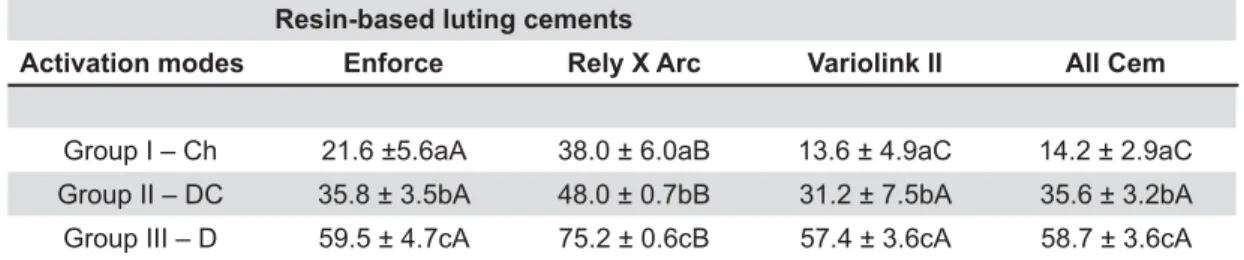
The results of the DC% are presented in the Table [!Q}~ for the two independent factors (resin-based cement and activation mode), (p<0.05). Comparisons by Tukey’s HSD test showed that Rely-X ARC activated by dual mode presented the highest DC% (75.2±0.6).
Chemically activated Variolink (13.6±4.9) and All Ceram (14.2±2.9) showed the lowest results. For Q "#$ higher with dual activation, followed by dual activation through IPS Empress 2, and chemical activation (p<0.05). Irrespective of the activation mode, Rely X ARC presented the highest DC% values of all the tested resin-based cements (p<0.05). Figure 2 shows the decrease of DC% for dual activation (D) through the 2.0-mm-thick IPS Empress ceramic disc (C). Comparisons of the DC% between chemical activation (Ch) and dual activation (D) through the 2.0-mm-thick IPS Empress ceramic disc (C) is presented in Figure 3.
DISCUSSION
Among other aspects, the clinical longevity of indirect restorations is dependent upon the properties of the resin-based cement used for luting them. Moreover, the higher the DC% of resin-based cements, the better their physicomechanical properties14. Several studies have analyzed the polymerization of resin-based cements3,11-13,18,23-25. Most of these studies, however, have used Knoop or Vickers hardness as indicative of their degree of polymerization. Although it is well known that hardness is strongly correlated with the DC%7, it is
Figure 2- Decrease of DC% for dual activation (D) through the 2.0-mm-thick IPS Empress ceramic disc. E= Enforce; R= Rely X ARC; V= Variolink II; A= All Cem
Figure 3- Comparison of the DC% between chemical activation (Ch) and dual activation performed through 2.0 mm IPS Empress 2 ceramic disc material. E= Enforce; R= Rely X ARC; V= Variolink II; A= All Cem
#
Enforce Rely X Arc Variolink II +
Group I – Ch 21.6 ±5.6aA 38.0 ± 6.0aB 13.6 ± 4.9aC 14.2 ± 2.9aC Group II – DC 35.8 ± 3.5bA 48.0 ± 0.7bB 31.2 ± 7.5bA 35.6 ± 3.2bA Group III – D 59.5 ± 4.7cA 75.2 ± 0.6cB 57.4 ± 3.6cA 58.7 ± 3.6cA
Means with same capital letter are not statistically different within the same line. Means with same lower case letter are not statistically different within the same column (D=0.05). Ch= chemical activation; DC= ceramic dick; D= dual activation.
reasonable to assume that inferences based on the DC% of C=C bonds could be more representative of the material behavior.
In the present study, the DC% was evaluated
after activation through a 2.0-mm-thick disc of
ceramic spacer. This was made to approximate the experimental conditions to those of clinical practice. During indirect restoration luting, the ceramic will attenuate the light intensity4,12 and reduce the quantity of photons that reach the resin-based cement. The consequence is a low DC%. IPS-Empress 2 was used in this study in view of two aspects. Firstly, according to its manufacturer (Ivoclar Vivadent Inc, Amherst, NY, USA), this material can be used to fabricate all types of posterior indirect restorations, i.e. inlays, onlays, and crowns. Secondly, published studies9,10 have shown that IPS-Empress 2 has a translucency equal to or greater than that of other reinforced-ceramic materials indicated for building up posterior indirect restorations, i.e., Procera, In Ceram Alumina and In Ceram Zirconia. Thus, the rationale was that the results obtained here could be extrapolated to the other ceramic materials with translucency equal to or less than that of IPS Empress 2.
According to Ivoclar Vivadent (IPS-Empress 2’s manufacturer) the framework surface of this ceramic [+$ for 20 s before luting it. Thus, reinforcing the attempt to approximate the experimental protocol as closely as possible to clinical practice, the IPS-Empress 2 ' [+$'\+ s before resin-based cements were light-polymerized.
For all the cements analyzed in this study, the "#$ & reduced when the materials were light-activated through IPS Empress 2 (Table 1). Thus, the research hypothesis was proved. This result was expected and can be explained by the light attenuation promoted by IPS Empress 24. During light-activation, the light that passes through the ceramic is absorbed and scattered. Thus, the light irradiance produced by the light source is attenuated and its effectiveness is reduced as the ceramic thickness increases. Therefore, Meng, et al.21 (2006) showed that a light intensity of 800 mW/cm2 was reduced to 160 mW/ cm2 after being transmitted through 2.0 mm of a machinable ceramic. Furthermore, El-Mowafy, et al.5 (1999) analyzing the hardening of 8 resin-based cements dual-polymerized through 1-6-mm-thick ceramic spacer, showed that hardness decreased G \Q more. In the same study, the curing-light intensity fell by about 75% through a 1-mm-thick ceramic spacer. Since clinicians believe that even in absence of light, dual-resin-based cements will develop a suitable "#$ ! If resin-based cements reach a low DC%, their physicomechanical properties will certainly decrease. Consequently, the clinical performance of indirect restorations could be compromised.
On the other hand, the results obtained in the
present study disagree with those of Caughman,
et al.3 (2001), who showed a DC% of up to 50%
for 6 resin cements, including Variolink II, when polymerized through a 3-mm-thick disc of a dental porcelain (Ceramco, Ceramco Inc, Burlington, NJ, USA). However, there are two important aspects to discuss here. Firstly, Ceramco is a feldspathic porcelain that presents a higher translucency than IPS-Empress 21. This difference in optical behavior of the two studies. Secondly, because of its superior mechanical properties, IPS-Empress 2 is more suitable for building up posterior indirect restorations6. From this viewpoint, it is reasonable to claim the results of the present study as representative of the behavior of resin-based cements when light-activated through ceramic materials suitable for producing indirect restorations.
Several studies have claimed that when resin-based cements are polymerized in a dual mode, the chemical component of polymerization can be hindered by the faster reaction promoted by the light-activation17. This behavior could be explained by the polymerization kinetics of dimethacrylate matrixes. When light-activation begins, several growth centers are formed and the matrix is transformed from a liquid to a viscous state by producing a large polymer network, i.e. a gelation process. After gelation, the polymeric network becomes highly crosslinked and the propagation and termination steps of polymerization, which involve the link between monomers and oligomers with the polymer network, are restricted, i.e., diffusion is limited26.
Taking into account that the chemical reaction occurs at a slower rate than the physical one, it is probable that the free radicals formed by the chemical component of polymerization are entrapped in the polymer network, so they could not contribute to an increase in the overall DC%15,23.This was
'?!20 (2008),
who showed that even under low light intensity irradiation, dual-polymerized luting cements still had a large amount of free radicals, mostly from chemical catalysts trapped in the hardening resin matrix, which did not contribute to the overall DC% of materials. For Variolink and All Cem, the DC% after chemical activation reached only 43.6% and 39.8%, respectively, compared with the DC% after dual activation through IPS Empress 2 (Figure 2). # & ' Meng, et al.20 (2008), it is reasonable to speculate that the chemical component of polymerization of these cements contributed very little to the total DC% after dual activation through IPS Empress 2.
words, the higher the amount of chemical catalyst in their formulation, the greater the hardness of the materials. In the above-mentioned study, the hardness of chemically activated Enforce increased 23.57% (from 32.1 to 42) after 24 h, while with Variolink II, this increase was only 17.2% (from 7.7 to 9.3). Furthermore, in a recent study, Ozyesil, et al.23 (2004) found no difference in the DC% of Variolink II when light-polymerized and dual-polymerized through a 2.0-mm-thick disc of Empress 2. Based on these studies, it is reasonable to hypothesize that Variolink II has lower chemical catalyst content than Enforce and Rely X ARC. The statistical similarity between the results of Variolink II and All Cem in the chemically activated group (Table 1) allows one to assume that these resin-based cements have a similar content of chemical initiators.
Rely X ARC presented the highest DC% under the three polymerization conditions (Table 1). It also can be noted that its DC% when dual polymerized through IPS Empress 2 (48.0±0.7) was, by rounding off, close to 50%. Moreover, the DC% after chemical activation reached 79% compared with the DC% after dual activation through IPS Empress 2. These results allow one to suppose that this resin-based cement presents a larger amount of chemical and physical initiators than the other three resin-based cements analyzed in the present study.
CONCLUSIONS
The results of the present study suggest that resin-based cements could present low degree of conversions when the materials are dually activated through 2.0 mm of reinforced ceramic materials with translucency equal to or less than that of IPS-Empress 2.
ACKNOWLEDGEMENTS
The authors are grateful to FGM Produtos Odontológicos and to 3M ESPE for supplying the materials used in this study, and to the Institute of Macromolecules of the Federal University of Rio de Janeiro (IMA/UFRJ) for performing the DC% measurements.
REFERENCES
1- Antonson SA, Anusavice KJ. Contrast ratio of veneering and core ceramics as a function of thickness. Int J Prosthodont. 2001;14:316-20.
2- Braga RR, Cesar PF, Gonzaga CC. Mechanical properties of resin cements with different activation modes. J Oral Rehabil. 2002;29:257-62.
3- Caughman WF, Chan DCN, Rueggeberg FA. Curing potential of dual-polymerizable resin cements in simulated clinical situations. J Prosthet Dent. 2001;86:101-6.
4- Dias MC, Piva E, Moraes RR, Ambrosano GMB, Sinhoreti MAC, Correr-Sobrinho L. UV-Vis spectrophotometric analysis and light irradiance through hot-pressed and hot-pressed-veneered glass ceramics. Braz Dent J. 2008;19:197-203.
5- El-Mowafy OM, Rubo MH, El-Badrawy WA. Hardening of new resin cements cured through a ceramic inlay. Oper Dent. 1999;24:38-44.
6- Esquivel-Upshaw JS, Anusavice KJ, Yang MC, Lee RB. Fracture resistance of all-ceramic and metal-ceramic inlays. Int J Prosthodont. 2001;14:109-14.
7- Ferracane JL, Greener EH. The effect of resin formulation on the degree of conversion and mechanical properties of dental restorative resins. J Biomed Mater Res. 1986;20:121-31.
8- Gonçalves L, Noronha Filho JD, Guimarães JGA, Poskus LT, Silva EM. Solubility, salivary sorption and degree of conversion of dimethacrylate-based polymeric matrixes. J Biomed Mater Res B Appl Biomater. 2008;85:320-5.
9- Heffernan MJ, Aquilino SA, Diaz-Arnold AM, Haselton DR, Stanford CM, Vargas MA. Relative translucency of six all-ceramic systems. Part I: core materials. J Prosthet Dent. 2002;88:4-9.
10- Heffernan MJ, Aquilino SA, Diaz-Arnold AM, Haselton DR, Stanford CM, Vargas MA. Relative translucency of six all-ceramic systems. Part II: core and veneer materials. J Prosthet Dent. 2002;88:10-5.
11- Hofmann N, Papsthart G, Hugo B, Klaiber B. Comparison of photo-activation versus chemical or dual-curing of resin-based ' hardness. J Oral Rehabil. 2001;28:1022-8.
12- Ilie N, Hickel R. Correlation between ceramics translucency ' ! " ?! 2008;24:908-14.
13- Jung H, Friedl KH, Hiller KA, Furch H, Bernhart S, Schmalz G. B ' ' '' ceramic discs. Oper Dent. 2006;31:68-77.
14- Jung H, Friedl KH, Hiller KA, Haller A, Schmalz G. Curing ' ' '' restorations. Clin Oral Investig. 2001;5:156-61.
15- Komori PCP, Paula AB, Martin AA, Tango RN, Sinhoreti MAC, Correr-Sobrinho L. Effect of light energy density on conversion degree and hardness of dual-cured resin cement. Oper Dent. 2010;35:120-4.
16- Kunbuloglu O, Lassila LV, User A, Vallitu PK. A study of the physical and chemical properties of four resin composite luting cements. Int J Prosthodont. 2004;17:357-63.
17- Lee IB, Um CM. Thermal analysis on the cure speed of dual cured resin cements under porcelain inlays. J Oral Rehabil. 2001;28:186-97.
18- Lopes LG, Franco EB, Neto NA, Herrera FS, Kurachi C, Castañeda-Espinosa JC, et al. Polymerization of a dual-cured cement through ceramic: led curing light vs. halogen lamp. J Appl Oral Sci. 2004;12:312-6.
19- Marchack BW, Futatsuki Y, Marchack CB, White SN. Customization of milled zirconia copings for all-ceramic crowns: a clinical report. J Prosthet Dent. 2008;99:169-73.
\+Q ? ?! @ ' G on mechanical properties and polymer structure of dual-cured resin luting agents. Dent Mater. 2008;24:594-9.
21- Meng X, Yoshida K, Atsuta M. Hardness development of dual-cured resin cements through different thicknesses of ceramics. Dent Mater J. 2006;25:132-7.
\\Q ? B _L ? ? G K, Moraes JCS. Infrared spectroscopy: a tool for determination of the degree of conversion in dental composites. J Appl Oral Sci. 2008;16:145-9.
\Q ~ ! ' ' '' light sources to polymerize composite beneath a simulated ceramic restoration. J Prosthet Dent. 2004;91:151-7.
24- Rasetto FH, Driscoll CF, Prestipino V, Masri R, Von Fraunhofer JA. Light transmission through all-ceramic dental materials: a pilot study. J Prosthet Dent. 2004;91:441-6.
25- Reges RV, Costa AR, Correr AB, Piva E, Puppin-Rontani RM, Sinhoreti MAC, et al. Effect of light-curing units, post-cured time and shade of resin cement on Knoop hardness. Braz Dent J. 2009;20:410-3.
26- Sideridou I, Tserki V, Papanastasiou G. Effect of chemical structure on degree of conversion in light-cured dimethacrylate-based dental resins. Biomaterials. 2002;23:1819-29.
27- Sostena MMDS, Nogueira RA, Grandini CR, Moraes JCS. Glass transition and degree of conversion of a light-cured orthodontic composite. J Appl Oral Sci. 2009;17:570-3.
28- Tezvergil-Mutluay A, Lassila LV, Vallittu PK. Degree of conversion of dual-cure luting resins light-polymerized through various materials. Acta Odontol Scand. 2007;65:201-5.
29- Thonemann B, Schmalz G, Hiller KA, Schweikl H. Responses '\ & papilla-derived cell lines to dental resin components. Dent Mater. 2002;18:318-23.