i
Bull Pan Am H&h Orp 16(l), 1982.
ELECTROCARDIOGRAPHIC
CLASSIFICATION
AND
ABBREVIATED
LEAD SYSTEM FOR POPULATION-BASED
STUDIES OF CHAGAS’
DISEASE1
James H. Maguire, 2 Kenneth E. Mott,3 Jo& AntBnio A. Sowa,
Ed&on Carvalho Almeida,s Nilson Borges Ramos,G and
ArmCnio C . GuimarHes798
A modification of the Minnesota Code to standardize recording of electrocardio- graphic data in population-based studies of Chagas’ cardiopathy is presented and evaluated. A five-lead electrocardiographic system for rapid screening of
large populations is also described.
Introduction
Epidemiologic studies offer important clues regarding the pathogenesis, evolution, and prognosis of Chagas’ heart disease. In this context immunologic procedures provide an index of the prevalence of infection, while the electrocardiogram remains the basic tool for determining the prevalence of disease and for studying its natural history.
There is no generally accepted classification system with clearly-defined criteria for record- ing the electrocardiographic findings of
‘Also appearing in Spanish in the Bole& de la Oficina
Sanitaria Parumwkma 93(Z), 1982.
ZResearch Associate, Department of Tropical Public Health, Harvard School of Public Health, 655 Hunting-
ton Ave., Boston Mass. 02115, U.S.A.
3Visiting Lecturer, Department of Tropical Public Health, Harvard School 0; Public Health. _
4Assistant Professor, Department of Cardiolow, Hos- pital Professor Edgard Sktos, Federal Univkity of Bahia, Salvador, Bahia, Brazil.
5Collaborating Professor, Department of Cardiology, Hospital Professor Edgard Santos, Federal University of Bahia.
kardiology Intern, Department of Cardiology, Hos- pital Professor Edgard Santos, Federal University of Bahia.
7Professor of Cardiology, Department of Cardiology, Hospital Professor Edgard Santos, Federal University of Bahia.
8The Harvard component of this team, supported by a grant from the Wellcome Trust and by NIH Grant No. AI-16305, is directed by Dr. Thomas H. Weller. Its col- laborative activities in Brazil have been carried out under the aegis of the Pan American Health Organization.
population-based studies of Chagas’ disease. Reports of epidemiologic surveys in the past often failed to include criteria for electrocar- diographic interpretation (I, 2, 3, 4), and dif- ferent research centers have employed differ- ent standards (5, 6, 7, 8). As a result, it is dif- ficult to compare results of one study with those of another, and there is no guarantee of consistency within the same study.
In an attempt to standardize the recording of electrocardiographic data in our field studies, we developed a classification system for Chagas’ cardiomyopathy. The Minnesota Code (8, 9) was chosen as the basis for this system because of its broad use in population- based studies (10, II), its easy employment by the electrocardiographer, and its organization in a form suitable for computer analysis. Although the Minnesota Code was designed for studies of coronary artery disease and does not permit coding of many of the complex arrhythmias and conduction defects character- istic of chronic Chagas’ cardiomyopathy, it has been used in Chagas’ disease studies (7, 12). Nevertheless, modifications of the code have not been published, and the code’s suita- bility for population-based studies of Chagas’ disease has not been tested.
In this article we present and evaluate an amplification of the Minnesota Code for population-based studies of Chagas’ heart disease. We also describe an abbreviated lead
l
48 PAHO BULLETIN l vol. 16, no. 1, 1982
system (13, 14) that we have used since 1973 to screen large populations. The system, which employs only leads I, II, aVL, VI, and V,, has been particularly useful in rural areas where electrocardiogram recording facilities are limited.
Electrocardiographic Classification System Our modifications of the Minnesota Code are shown in detail in the Appendix. The orig- inal code’s procedural rules (9) for measuring heart rate, intervals, and wave forms were not changed, and the basic sections of the original code were retained. However, a code was added to each section to document the absence of specific abnormalities or (in the case of sec- tions 2 and 8) to record the normal axis and normal sinus rhythm. The modifications of the code were adapted from the diagnostic criteria of the New York Heart Association (15), definitions proposed by an international task force (IS), and tables of normal para- meters (15, 17).
Sections 1 and 4 of the original code were not changed. In Section 2, the restriction not to code QRS axis deviation in the presence of ventricular conduction defects was removed in view of the frequent combinations of right bundle branch block and fascicular block in Chagas’ disease (18). Also, the criteria for axis deviation were modified to facilitate the coding of the fascicular blocks.
Qualifying statements were amended to permit coding of electrocardiograms for chil- dren, since the criteria of the original code ap- ply only to adult men. Thus, we recommend that tall left precordial R waves (categories 3- 1 and 3-3) not be coded for individuals under 35 years of age and that T-wave inversions in the right- and mid-precordial leads (5- 1, 5-2, and 5-3) not be coded in individuals under 25 years of age because these patterns may repre- sent normal findings. The upper limits of nor- mal for PR interval and QRS duration were reduced for the purpose of coding conduction defects in younger individuals (Sections 6 and 7) (15, 17).
Second degree A-V block in the original code was divided into types I and II in the modified code (6-2 and 6-3). Section 7, “Ven- tricular Conduction Defects,” was expanded to encompass the combinations of ventricular conduction defects common in Chagas’ car- diomyopathy. Section 8, “Arrhythmias,” was expanded to include a wide spectrum of rhythm disturbances, with particular em- phasis on ventricular ectopic activity. The Lown-Wolf classification of ventricular extra- systoles (19) was incorporated into the code, and the severity of these was graded according to frequency, multiformity, repetitive pattern, and degree of prematurity. Although it has been demonstrated in patients with coronary heart disease that advanced grades of ven- tricular extrasystoles carry an enhanced risk of sudden death (ZO), such prognostic informa- tion is not yet available for patients with Chagas’ disease. It is hoped that use of such a classification system in longitudinal popula- tion-based studies will help clarify the prog- nostic significance of arrhythmias for Chagas’ disease patients. In Section 9, “Miscella- neous,” categories for artificially-paced rhythms are included.
Reliability and Sensitivity
Methoa!s
The reproducibility of results derived from coding electrocardiograms according to this classification system was tested by comparing the observations of two independent readers, both internists. The electrocardiograms exam- ined consisted of 100 from hospitalized or am- bulatory patients from the Hospital Professor Edgard Santos in Salvador, Bahia, with posi- tive complement fixation tests for T. cruzi and 110 from all individuals over five years of age living on a singlefazenda (plantation) in Castro Alves, Bahia (21). Forty-one per cent of the latter group showed serologic evidence of Chagas’ infection.
Manire et al. l ECG CLASSIFICATION FOR CHAGAS’ DISEASE 49
.thirty-second lead II or VI rhythm strip was recorded for all individuals in the rural area. Readings were made without the benefit of clinical information. To compare the sensitiv- ity of the five-lead system with that of the twelve-lead system, each reader analyzed all tracings with only five leads showing; then, one or two weeks later, he reread the same tracings with all 12 leads showing but without knowledge of his previous interpretation.
Results
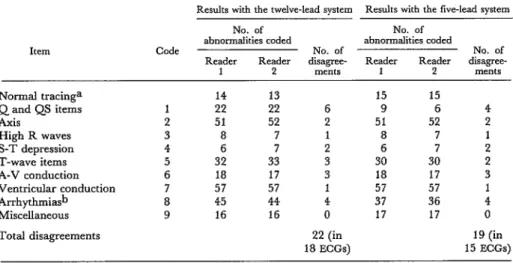
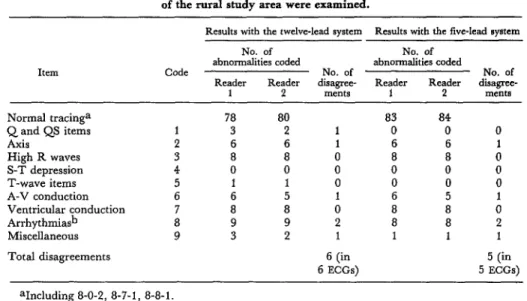
Tables 1 and 2 compare the coded interpre- tations of the two readers.
The different frequency of abnormalities found in the hospital (Table 1) and rural area (Table 2) groups reflected the characteristics of the two populations. The large numbers of axis deviations, conduction defects, and arrhythmias in the hospital patients were con- sistent with their 100 per cent seropositivity, high prevalence of apparent heart disease, and greater mean age (42.7 years). The rural group had a lower degree of seropositivity, ex- hibited few cases of clinically apparent heart disease, and included many children (the
population’s mean age was 28.0 years); as ex- pected, the prevalence of conduction defects and arrhythmias was low.
The two readers agreed upon their coding of 82 per cent of the twelve-lead ECGs from the hospital group, upon 94.5 per cent of the tracings from the rural area, and upon 88.6 per cent of the total. Concordance was slightly greater with the five-lead tracings. Inter- observer variation in ECG interpretation of similar or even greater degree has been docu- mented by several workers (A??, 23) including Blackburn, who used the Minnesota Code (8).
Ten per cent of the disagreements repre- sented differences of interpretation, most commonly in differentiating ventricular ecto- pit impulses from aberrantly conducted supra- ventricular impulses. More than half of the disagreements were due to small differences in measuring intervals of wave dimensions-dif- ferences that nevertheless resulted in the assignment of different codes. Some oversight on the part of one or the other reader ac- counted for other disagreements. To minimize such errors, we now require that our readers record the frequency, PR interval, and QRS duration for each tracing, and that the two
Table 1. Hospital electrocardiogram interpretations of the two readers using five-lead and twelve-lead systems. A total of 100 electrocardiograms obtained
from hospital patients were examined.
Results with the twelve-lead system Results with the five-lead system
ItEXTl
No. of No. of
abnormalities coded abnormalities coded
Code No. of No. of
Reader Reader disagree- Reader Reader disagree-
1 2 ments 1 2 rnents
Normal tracinga Q and QS items Axis
High R waves S-T depression T-wave items A-V conduction Ventricular rduction Arrhythmias Miscellaneous
Total disagreements
14 13
22 22
51 52
8 7
6 7
32 33
18 17
57 57
45 44
16 16
22 (in 18 ECGs)
15 15
9 6 4
51 52 2
8 7 1
6 7 2
30 30 2
18 17 3
57 57 1
37 36 4
17 17 0
19 (in 15 ECGs)
50 PAHO BULLETIN l vol. 16, no. 1, 198.i?
Table 2. Rural area electrocardiogram interpretations of the two readers using five-lead and twelve-lead systems. A total of 110 electrocardiograma from residents
of the rural shady area were examined.
Results with the twelve-lead system Results with the five-lead Bystem
No. of No. of
ahnormalities coded abnormalities coded
Item Code No. of No. of
Reader Reader disagree- Reader Reader disagree-
1 2 InentS 1 2 ments
Normal tracinga 78 80 83 84
Q and QS items 1 3 2 1 0 0 0
Axis 2 6 6 1 6 6 1
High R waves 3 8 8 0 8 8 0
S-T depression 4 0 0 0 0 0 0
T-wave items 5 1 1 0 0 0 0
A-V conduction 6 6 5 1 6 5 1
Ventricular conduction 7 8 8 0 8 8 0
Arrhythmia& 8 9 9 2 8 8 2
Miscellaneous 9 3 2 1 1 1 1
Total disagreements 6 (in 5 (in
6 ECGs) 5 EGGS)
aIncluding 8-O-2, 8-7-1, 8-8-l. bExcluding 8-O-2, 8-7-1, 8-8-l.
readers code each tracing independently but review discrepant readings together to decide on a final coding.
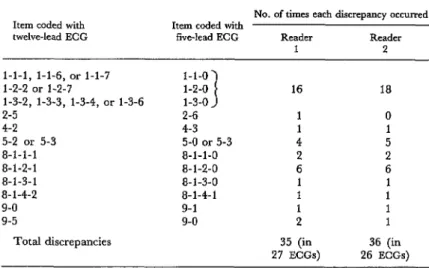
The observed discrepancies do not lessen the usefulness of the code for studies of Chagas’ cardiomyopathy. Twenty per cent of the disagreements involved minor differences in R-wave height, S-T depression, and T-wave inversions that by themselves would not contribute to the final classification of the tracing as unequivocally abnormal or consis- tent with Chagas’ cardiopathy. One-third of the disagreements concerned the coding of Q and QS waves, items that are more important in the diagnosis of coronary disease than of Chagas’ disease. In this study, pathological Q and QS waves in tracings of seropositive indi- viduals occurred only in the presence of ven- tricular conduction defects. Hence, errors in coding Q and QS items were compensated for by the coding of ventricular conduction defects, where the discrepancy rate was low. Table 3 lists the differences in the coding performed by both readers with the five-lead as compared to the twelve-lead ECG. Overall,
the five-lead classifications were in agreement with the twelve-lead classifications in 87 per cent of the cases. The items missed in the five- lead tracings were Q and QS items, S-T de- pressions, T-wave items, and arrhythmias- all items recorded only by leads III, R, F, V2-4, or v6. None of the Qand QS items oc- curred in the absence of bundle branch or fascicular block in the seropositive group.
Ma.guire et al. l ECG CLASSIFICATION FOR CHAGAS’ DISEASE 51
Table 3. Differences in the results obtained with the five-lead system as compared to the twelve-&ad system, showing the discrepancies
recorded by both readers in examining 210 EGGS.
Item coded with twelve-lead ECG
No. of times each discrepancy occurred Item coded with
five-lead ECG Reader Reader
1 2
l-l-l, l-l-6, or l-l-7 1-1-o
l-2-2 or l-2-7 1-2-o 1 16 18
l-3-2, l-3-3, l-3-4, or l-3-6 1-3-o
2-5 2-6 1 0
4-2 4-3 1 1
5-2 or 5-3 5-o or 5-3 4 5
8-l-l-l 8-l-l-O 2 2
8-1-2-l 8-1-2-O 6 6
8-1-3-1 8-1-3-O 1 1
8-l-4-2 8-1-4-1 1 1
9-o 9-l 1 1
9-5 9-o 2 1
Total discrepancies 35 (in 36 (in
27 ECGs) 26 ECGs)
Discussion and Conclusions
Our experience with the modified Minneso- ta Code has demonstrated that it is a useful and reproducible system for classifying elec- trocardiograms in cases of possible Chagas’ disease. Its criteria for coding abnormalities are objective and thus eliminate subjective decisions from the data-collecting process. The format of the code is amenable to addi- tions, subtractions, and modifications as re- quired by the individual researcher. How- ever, strict adherence to the code is desirable to allow comparability within and among studies.
Nevertheless, like the original Minnesota Code, the modified code contains criteria that may appear “arbitrary, and arrived at by compromises not likely to please anyone en- tirely” (9). Furthermore, it suffers from the variability and limitations in sensitivity com- mon to the original Minnesota Code (9, 24) and other electrocardiographic codes (25).
We believe that the five-lead electrocardio-
52 PAHO BULLETIN l vol. 16, no. 1, I%?,?
ACKNOWLEDGMENT
We wish to thank Dr. Thomas H. Weller for his excellent advice and criticism of the manuscript.
SUMMARY
A lack of standardized criteria for electrocardio- graphic interpretation has made it difficult to com- pare studies of Chagas’ heart disease from different geographic areas. To achieve uniform reporting of electrocardiographic data from our field project, we developed a coding system especially adapted for studies of Chagas’ disease.
This system was devised by modifying the Min- nesota Code to allow recording of the complex con- duction disturbances and arrhythmias characteris- tic of Chagas’ disease. The reproducibility of the
system was tested by evaluating 100 electrocardio- grams of hospital patients with Chagas’ disease and
110 electrocardiograms of people living in an area with endemic Chagas’ disease.
A live-lead recording system was also tested with a view to facilitating the screening of large popula- tions. Its sensitivity in detecting the electrocardio- graphic abnormalities of chronic Chagas’ heart disease compares favorably with that of the tradi- tional twelve-lead recording.
REFERENCES
(1) Baruffa, G. Preval&ncia serologica da doenca de Chagas e correlaczo serologic0 electrocardio- gr&fica em populacaes nlo selecionadas do munici- pio de Encruzilhada do Sul, Rio Grande do Sul. Rev Sot Bras Med Trap 9:95-104, 1975.
(2) Laranja, F. S., E. Dias, E. Duarte, and J. Pellegrino. ObservacBes clinicas e epidemiologicas sabre a moltstia de Chagas no oeste de Minas Gerais. 0 Hos,&ul40:945-988, 1951.
(3) Dias, J.C.P., and K. Kloetzel. The prog- nostic value of the electrocardiographic features of chronic Chagas’ disease. Rev Inst Med Trap Sco Paul0 10:158-162, 1968.
(4) Rofeld, A., M.A.O.C. Fernandes, N. B. Camargo, A. P. Moraes, E. Nero, J. Tranchesi, and L. V. Decourt. Electrocardiograma em indivi- duos corn reac5.o de Guerreiro-Machado positiva. Arquivos Brasileiros de Cardiologia 31:191-194, 1978.
(5) Macedo, V. S. Influ&ncia da exposi@o a reinfeccgo na evolucgo da doenca de Chagas. Thesis, Federal University of Rio de Janeiro, 1973,
125 pp.
(6) Puigbo, J. J., J. R. Nava Rhode, H. Garcia Barrios, J. A. Su&ez, and C. G. Yepez. Clinical and epidemiological study of chronic heart involve- ment in Chagas’ disease. Bull WHO 34:655-669, 1966.
(7) Zeledon, R., G. Solano, L. Burstin, and J. C. Swartzwelder. Epidemiological pattern of
Chagas’ disease in an endemic area of Costa Rica. Am J Trap Med Hyg 241214-225, 1975.
(8) Blackburn, H., A. Keyes, E. Simonson, P. Rautaharju, and S. Punsar. The electrocardiogram in population studies: A classification system. Cir- culation 21:1160-1175, 1960.
(9) Rose, G. A., and H. Blackburn. Cur- diovascular Survq, Methods. WHO Monograph Series, No. 56. World Health Organization, Geneva, 1968, 188 pp.
(10) Ostrander, L. D., R. L. Brandt, M. 0. Kjelsberg, and F. H. Epstein. Electrocardiographic findings among the adult population of a total natural community, Tecumseh, Michigan. Circula- tion 31:888-898, 1965.
(11) Miall, W. E., E. Del Campo, J. Fodor, J, R. Nava Rhode, L. Ruiz, K. L. Standard, and A. V. Swan. Longitudinal study of heart disease in a Jamaican rural population. Bull WHO 46:429-442,
1972.
Ma-mire et al. ’ ECG CLASSIFICATION FOR CHAGAS’ DISEASE 53
(13) Makous, N. Electrocardiographic leads and techniques in mass screening. JAMA 192801-805, 1965.
(14) Rosettani, E., S. Gandolfo, E. Braguzzi, F. CapelIaro, and P. 0. Gaido. Proposta di un sistema semplificato di derivazioni convenzionali in studi elettrocardiografici di massa. Minerva Medica
55: 1988-1990, 1964.
(15) New York Heart Association, Criteria Committee. Nomenclature and Criteria for Diagnosis of Diseases of the Heart and Great Vessels. Little Brown, Boston, 1979, 349 pp.
(16) WHO/ISFC Task Force. Definition of terms related to cardiac rhythm. Eur J Cardiol 8: 127-144, 1978.
(17) Namin, E. P., and R. A. Miller. The nor- mal electrocardiogram and vectorcardiogram in children. In D. E. Cassels and R. F. Zeigler (eds.). Electrocardiography in Infants and Children. Grune and Stratton, New York, 1966, pp. 99-108.
(18) Rosenbaum, M. B., M. V. Elizari, and J. 0. Lazzari. The Hemiblocks: New Concepts of Intraven- tricular Conduction Based on Human Anatomical, Physio- logical and Clinical Studies. Tampa Tracings, Oldsmar, 1970, 269 pp.
(19) Lown, B., and M. Wolf. Approaches to sudden death from coronary heart disease. Circula- tion 44:130-142. 1971.
(20) Ruberman, W., E. Weinblatt, J. D. Gold- berg, C. W. Frank, and S. Shapiro. Ventricular premature beats and mortality after myocardial in- farction. N. Engl J Med 297:750-757, 1977.
(2I) Hoff, R., K. E. Mott, J. F. Silva, V. Menezes, J. Hoff, T. V. Barrett, and I. Sherlock. Prevalence of parasitemia and seroactivity to Tryfia- nosorna cnui in a rural population of Northeast Brazil. Am J Trap Med Hyg 28:461-466, 1979.
(22) Davies, L. G. Observer variation in reports on electrocardiograms. Br HeartJ20:153-161, 1958.
(23) Epstein, F. H., J. T. Doyle, A. A. Pollack, H. Pollack, G. P. Robb, and E. Simonson. Ob- server interpretation of electrocardiograms: Sug- gestions for objective interpretations. JAMA 175: 847-850, 1961.
(24) Rautaharju, P. M. Use and abuse of elec- trocardiographic classification systems in epide- miologic studies. Eur J Cardiol8:155-171, 1978.
(25) Bonner, R. E., C. A. Cgceres, T. E. Cuddy, F. L. Meijler, J. A. Milliken, P. M. Rautaharju, E. 0. Robles de Medina, J. L. Willems, and H. K. Wolf. Recommendations for ECG diagnostic coding. EurJ Cardiol8:173-176, 1978.
(26) Lown, B., A. F. Calvert, R. Armington, and M. Ryan. Monitoring for serious arrhythmias and high risk of sudden death. Circulation 3 (Suppl. 51-52):189-198, 1975.
APPENDIX
Directions for Modifying the Minnesota Code for Use in Pc&ulation-based Studies of Chagas’ Disease1
1) Q and QS Patterns: 2) QRS Axis Deviation:
Add: l-l-0, absence of any item l-l Remove: (Do not code in presence of low
mentioned below voltage QRS, code 9-1, or ven-
l-2-0, absence of any item l-2 tricular conduction defect 6-4, mentioned below 7-1, 7-2, 7-4.)
l-3-0, absence of any item l-3 Remove: 2-3, 2-4, 2-5
mentioned below Add: 2-6, right axis deviation:
QRS axis from + 91’ through -119O
2-7, extreme right axis deviation:
QRS axis from -120° through
1Definitions of terms and criteria are taken from the original Minnesota Code (9) and references 1.5 and 16,
with modifications by the authors of the present paper. The criteria for PR and QRS duration in children were modified on the basis of tables of normal values (15, 17).
-91°
2-8, normal axis:
54 PAHO BULLETIN l vol. 16, no. 1, 1982
3) High-Amplitude R Waves:
Add: Do not code 3-l or 3-3 in individu- als under 35 years of age Add: 3-0, absence of any item 3 men-
tioned below
4) ST Junction (J) and Segment Depres- sion:
Add: 4-0, absence of any item 4 men- tioned below
5) T-Wave Items:
Add: Do not code T-wave items 5-1, 5-2, 5-3 in leads V,, V,, V, in individuals under 25 years of age
Add: 5-0, absence of any item 5 men- tioned below
6) A-V Conduction Defect:
Add: 6-0, absence of any item 6 men- tioned below
Substitute: 6-2, 6-3, 6-4, 6-5 with the follow- ing:
6-2, advanced second-degree AV block (includes Mobitz type II and incomplete atrioventricu- lar block with 2:l atrioven- tricular response):
Intermittent failure of propa- gation of impulses to the ven- tricle following one or more conducted impulses showing constant conduction items. PR interval of normal beats is normal or prolonged.
6-3, second-degree A-V block, type I (Wenckebach): Inter- mittent failure of atrioven- tricular impulse conduction in which the blocked impulse is preceded by progressive prolongation of the PR inter- val relative to that of the first conducted impulse.
6-4, first-degree A-V block: Prolonged PR interval with a 1: 1 conduction ratio in any leads of I, II, III, aVL, aVF:
Age group Rate Criteria for
prolonged PR
5 100 20.22 seconds 2 15 years (adults) 101-120 20.21 seconds >120 ~0.20 seconds
22 100 >0.20 seconds 5- 14 years (children) 101-120 >0.19 seconds >120 >0.18 seconds
6-5, Wolff-Parkinson-White pat- tern:
PR interval <O. 12 seconds (adults) or ~0.09 seconds (children); QRS > 0.10 sec- onds (adults) or >0.09 sec- onds (children) and presence of delta-wave (slow slurring of initial part of QRS complex). 6-6, short PR interval:
PR interval CO.12 in adults and < 0.09 in children mea- sured in all complexes of any two of the following leads: I, II, III, aVL, aVF. Not coded in presence of 8-4-1, 8-4-2, 8-6-1, 8-6-2, 8-7-l.
7) Ventricular Conduction Defect:
In 7-1, 7-2, and 7-4 replace the phrase “QRS duration 0.12 sec. or more” with “QRS duration 0.12 sec. or more in adults or 0.11 sec. or more in children.”
In 7-3 and 7-6 replace the phrases “QRS duration less than 0.12 sec.” and “QRS duration at least 0.10 sec. and less than 0.12 sec.” with the phrase “QRS duration at least 0.10 sec. and less than 0.12 sec. in adults, or at least 0.09 sec. and less than 0.11 sec. in children.”
Maguire et al. l ECG CLASSIFICATION FOR CHAGAS’ DISEASE 55
a) presence of 2-l
b) QRS duration less than or equal to 0.10 sec.
c) small (non-codable) Q waves in I, aVL, Vg, and Ve
d) S in II, III, and aVF with S greater than R in leads II and aVF
7-8, RBBB and AFB (takes prece- dence over 7-2 and 7-7):
a) presence of 2-l or 2-7 b) meets requirements for 7-2 c) small (non-codable) Q in I and
aVL
d) R wave in aVL equal to or greater than S wave
e) S wave in lead II greater than R wave
7-9, IRBBB and AFB (takes prece- dence over 7-3 and 7-7):
a) presence of 2-l and 2-7 b) meets requirements for 7-3 c) small (non-codable) Q in I and
aVL
d) R wave in aVL equal to or greater than S wave
e) S wave in lead II greater than R wave
7-O-0, absence of all items 7-O be- low
7-O-1, posterior fascicular block (PFB):
a) presence of 2-6
b) QRS duration less than or equal to 0.10 sec.
c) small Q in II, III, aVF not meeting requirements for l- 1 or l-2
d) large R waves in II, III, and F with R wave greater than S wave in lead II
e) R wave greater than S wave in V, and V,
f) absence of 3-2
7-O-2, RBBB and RFB (takes pre- cedence over 7-2 and 7-O-l): a) meets requirements of 7-2 b) meets requirements of 7-O-l ex-
cept that QRS duration meets requirements of 7-2
7-O-3, IRBBB and RFB (takes precedence over 7-3 and 7-O-l): a) meets requirements of 7-3 b) meets requirements of 7-O-l ex-
cept that QRS duration meets requirements of 7-3
7-O-4, transient intraventricular defects (specify)
8) Arrhythmias:
Add: 8-O-0, absence of all items 8-O below
8-O-1, sinus rhythm (code in pres- ence of 8-7-l and 8-8-l): Regular rhythm with P to P interval varying less than 0.16 sec. P wave upright in I, II, aVF, V,, and V,. P wave followed by ventricu- lar deflections QRS-T, unless there is atrioventricu- lar block.
8-O-2, irregular sinus rhythm (sinus arrhythmia) : P to P intervals varying more than 0.16 sec. Fixed PR interval followed by QRS-T complex except in case of atrioventricular block.
8-l-1-0, absence of any items in 8-l- 1 mentioned below 8-l-1-1, atrial extrasystole 8-l-l-2, junctional extrasystole 8-l-l-3, atrial and junctional ex-
trasystoles (8-l-l-l and and 8-l-l-2)
8-l- l-4, frequent atrial extrasysto- les:
10 per cent or more of re- corded cycles are atrial extrasystoles.
8-l-l-5, frequent junctional extra- systoles:
56 PAHO BULLETIN l ~01. 16, no. 1, 1982
8-i-l-6, irregular, multiform,
8-l-l-7,
supraventricular rhythm (wandering atrial pace- maker):
Supraventricular rhythm with changing P-wave morphology, varying PR intervals, and rate less than 100 per minute.
combination of 8- l-1-6 and 8-l-l item
8-l-l-8, multifocal atrial tachycar- dia:
Supraventricular arrhyth- mia with changing P-wave morphology, varying PR intervals, and rate exceed- ing 100 per minute. 8-l-2-0, absence of all items 8-l-2
mentioned below
8-1-2-1, infrequent ventricular ex- trasystoles (requires a codein 8-l-4): less than 10 per cent of recorded cycles or Lown Grades IA and B 8-l-2-2,
8-l-2-3,
8-l-3-0, 8-l-3-1,
frequent ventricular extra- systoles (requires a code in 8-l-4): 10 per cent or more of recorded cycles or Lown Grade 2
ventricular extrasystolic bigeminy (ventricular bigeminy) (requires a code in 8-l-4; takes prece- dence over 8-l-2-2)
absence of 8-l-3 men- tioned below
repetitive ventricular ex- trasystoles-pairs (cou- plets, Lown Grade 4A) 8-l-4-1, unifocal ventricular ex-
trasystole (Lown Grade 1 or 2)
8-l-4-2, multiform ventricular ex- trasystole (Lown Grade 3) 8-l-5-0, absence of 8-l-5 items
mentioned below
8-l-5- 1, early ventricular extrasys- tole (QRS of extrasystole occurring before termina- tion of T wave of previous complex; Lown Grade 5) 8-l-6-0, absence of all 8-l-6 items
mentioned below 8- l-6- 1, A-V dissociation without
antegrade block
a) atrial rate less than ventricular
b) P waves independent of QRS complex 8-l-6-2, complete sino-atrial exit
block:
Failure of sinus impulse to reach or discharge the atria; P wave and QRS-T fail to appear at expected interval; resultant P-P pause an exact multiple of the dominant P-P inter-
VL3.l.
8-l-6-3, incomplete sino-atrial exit block (sino-atria1 exit block with Wenckebach phenomenon):
P to P intervals preceding the pause progressively shorten; the pause is less than a multiple of the basic P to P interval; and the P to P interval follow- ing the pause is longer than the preceding P to P interval,
8-l-6-4, sinus arrest:
Ma.&-e et al. l ECG CLASSIFICATION FOR CHAGAS’ DISEASE 57
8-2-0, absence of 8-2-l
8-2-l) ventricular tachycardia (Lown Grade 4B):
Three or more consecutive extrasystoles at a rate ex- ceeding 100lmin.
8-3-0, absence of all 8-3 items men- tioned below
8-3- 1, atrial fibrillation:
Absent P waves; baseline consists of irregular wave forms which continuously change in shape, duration, amplitude, and direction; ventricular response totally irregular except in the pres- ence of complete AV block. 8-3-2, atrial flutter:
Atrial activity represented by regular biphasic oscilla- tions (flutter waves) which are uniform in shape and occur at rates between 200 and 400 per min. ; absence of isoelectric line between deflections; 2:l or higher degree A-V block may be present.
8-4-0, absence of all 8-4 items men- tioned below
8-4-l) atrial rhythm:
Rate less than 100 with form of P-wave differing from that of normal sinus beat (P wave may be negative in II, III, and aVF, and positive in aVR).
8-4-2, atrial tachycardia:
Atrial rate greater than 100, usually between 140 and 200; P-wave form different from P wave of sinus rhythm; PR normal or pro- longed, QRS complex nor- mal or slightly aberrant; iso- electric baseline between P waves; atrioventricular con- duction 1: 1 or with an ad-
vanced degree of A-V block (usually 2: 1 conduction). 8-4-3, supraventricular rhythm:
Rate less than 100 per min- ute, rhythm regular, QRS complexes of normal dura- tion (except if a period of normal sinus rhythm shows bundle branch block), and no atrial waves seen. 8-4-4, supraventricular tachycar-
dia:
Rate exceeding 100 per minute, rhythm regular, QRS complexes of normal duration, and no atrial waves seen.
8-5-0, absence of all 8-5 items men- tioned below
8-5- 1, ventricular fibrillation: QRS and T waves not iden- tifiable, recorded deflections continuously change in shape, duration, magni- tude, and direction.
8-5-2, ventricular asystole: Cessation of ventricular electrical activity.
8-5-2, ventricular rhythm:
Rate under 70 with regular- ly occurring, wide QRS complexes not preceded by P waves. P waves may be absent or there may be com- plete AV block.
8-5-2, accelerated ventricular rhythm:
Ventricular rhythm with rate between 70 and 100. 8-5-4, any combination of the
above
8-6-0, absence of all 8-6 items men- tioned below
8-6-1, atrioventricular junctional rhythm:
58 PAHO BULLETIN l Vol. 16, 120. 1, 1982
val less than 0.12 seconds), during, or after the QRS
complex, and is inverted in II, III, and aVF. (If the P wave occurs during the
QRS complex and is not seen, code as 8-4-3.) 8-6-2, atrioventricular junctional
tachycardia:
Rate exceeding 100 per minute; rhythm regular with P wave occurring be- fore (with PR interval less than 0.12 seconds), during, or after the QRS complex. P wave inverted in II, III, and aVF.
a-7-0, absence of 8-7-l 8-7- 1, sinus tachycardia:
Sinus rhythm with rate over 100 per minute.
a-8-0, absence of 8-8-l
8-a- 1, sinus bradycardia:
Sinus rhythm with rate under 50 per minute. a-9-0, absence of 8-9-l
a-9- 1, arrhythmia not mentioned above
9) Miscellaneous Items at Rest:
Remove: 9-0, 9-4-1, 9-4-2, 9-5
Add: 9-0, absence of any item 9 below 9-4, functioning artificial pace-
maker
9-5, malfunctioning artificial pace- maker
9-6, T-wave amplitude greater than 12 mm in any leads of I, II, III, aVL, aVF, V,-V,. (Do not code in the presence of codes 6-4, 7-1, 7-2, or 7-4.) 9-9, any combination of items