G. Adinarayana et al. Int. Journal of Engineering Research and Applications www.ijera.com
ISSN : 2248-9622, Vol. 4, Issue 10( Part - 6), October 2014, pp.145-147
www.ijera.com 145 | P a g e
Design and Analysis of Bus Front Panel Usin G FRP
G. Adinarayana
1, Ch. Ashok Kumar
2, M. Ramakrishna
31
(Associate professor, Nimra college of engineering and technology, Ibrahim patnam)
2
(Assistant professor, Anurag engineering college, kodad)
3
(M.Tech student , Anurag engineering college, kodad)
ABSTRACT
Recently, Advance composite materials have taken the significant share with other engineering materials due to its mechanical properties and high strength to weight ratio. Advance composite like E-glass, S-glass, Carbon fiber, Kevlar are not yet confined at the aerospace industry but gradually these are taking over the position of other industries as well. Because of its attaining high intricacy in designing factors and as well as cheaper mould design and also less cost in production of few numbers. The applications of FRPs are spirally increasing. The aim of this project is to develop a BUS FRONT PANEL with a help of FRPs in order to sustain all the mechanical properties which are equivalent to the metals with the help of advanced computer aided software designs like ANSYS. In computer aided engineering to make the product proven in the realistic market.
Keywords -
Polymer-matrix composites ; Finite element analysis; Ansys.I.
INTRODUCTION
As of 2002 there were 190 million passenger buses worldwide (roughly one car for every eleven people), of which 20 million in the USA (approximately one car for every two people).As automobiles increased in number and became larger and faster, between 1945 and 1995, 2 million people died and about 200 million were injured in automobile accidents—many more than were wounded and injured in all the wars in the nation's history combined (Answers.com, 2006).In year 2005 328,264 road accident, 47.012 road casualties, and 6200 road death was reported in Malaysia which 3,523 (7.49%) is pedestrian accident and 7372 (15.68%) buses accident(Nizam,2005) and the cost of the road accidents in 2003 was about 9,374,000,000RM (ADB-ASEAN,2003).According to the Association of British Insurers report (ABI) in year 2002 about70% of 10 billion Pounds of total annual cost of vehicle insurance is related to damage repair from low speed impact crashes, and about 80% of damage claims have no associated injury claim. It is clear that low speed crash constitutes a large portion of the total cost to society for repairing crash vehicle. Consequently, reducing vehicle damage in low speed crashes could have a massive global benefit. Alignment of structures could also have a key part in ensuring better compatibility of vehicles in higher speed crashes. Better bumper, front panels design could have a positive benefit Since bumper and front panel units are often the first components to connect in frontal car to bus crashes (Avery and Weeks, 2006).From 1965 to 1995, more than fifty safety standards were imposed on vehicle manufacturers, regulating the construction of
windshields, safety belts, head restraints, brakes, tires, lighting, door strength, roof strength, and bumper strength(Answers.com, 2006). The North American and Canadian bumper performance standards have been issued and it is more severe than European ones. The former stipulates impact speed of 5 mph (8km/h) whereas the European pendulum impacts are performed at 2.5 mph (4 km/h). There are no damages allowed to other parts of the vehicle. Also the key to developing a front panel system capable to fulfill the upcoming performance requirements as well as the design criteria lies in a differential stiffness profile over a restricted total deformation. At the beginning of the compression, the stress should be kept low to comply with pedestrian leg criteria, after that the stiffness increase with increasing stroke to cover the energy absorption necessary for 2.5 mph impact (Murata and Shioya, 2004).Each bumper system consists of three main components namely bumper beam, fascia and energy absorber (Sapuan et al., 2005).The energy absorber is a key part in bumper system which has to dissipate the impact energy in collision. New front panel system consists of two types of energy absorbers, low stiffener absorber which is called the reversible absorber in this research and located between fascia and reinforcement beam and the irreversible energy absorber which is consist of the beam and the crushable energy absorber that it located at the back of the beam and attached to the main face bar. Therefore the suitable geometry, light weight
G. Adinarayana et al. Int. Journal of Engineering Research and Applications www.ijera.com
ISSN : 2248-9622, Vol. 4, Issue 10( Part - 6), October 2014, pp.145-147
www.ijera.com 146 | P a g e
II.
MODELING
AND
ANALYSIS
Fig .1 Bus panel front view
Fig.2 Final Design
III.
RESULTS
&
DISCUSSION
COMPARISON BETWEEN STEEL AND E-GLASS EPOXY BY USING ANSYS
Fig .3 Stress in X- directi Fig .4 Stress in Y- direction
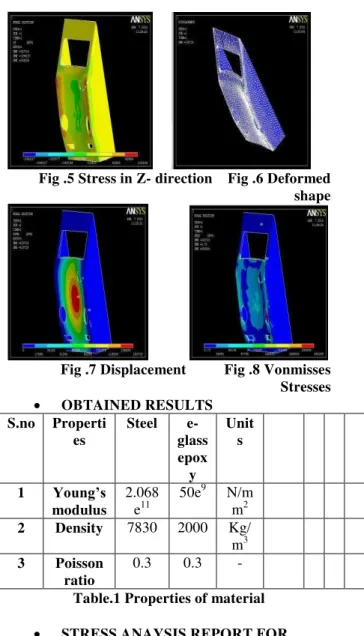
Fig .5 Stress in Z- direction Fig .6 Deformed shape
Fig .7 Displacement Fig .8 Vonmisses Stresses
OBTAINED RESULTS S.no Properti
es
Steel e-glass epox
y
Unit s
1 Young’s modulus
2.068 e11
50e9 N/m m2
2 Density 7830 2000 Kg/ m3
3 Poisson ratio
0.3 0.3 -
Table.1 Properties of material
STRESS ANAYSIS REPORT FOR STEEL
Fig.9 Stress distribution Fig.10 shear stress in xy
STRESS ANALYSIS REPORT FOR E GLASS EPOXY
G. Adinarayana et al. Int. Journal of Engineering Research and Applications www.ijera.com
ISSN : 2248-9622, Vol. 4, Issue 10( Part - 6), October 2014, pp.145-147
www.ijera.com 147 | P a g e
OBTAINED RESULTS
Property Units Steel E glass epoxy
Stress N/mm2 77.072 77.072
Shear stress
N/mm2 23.823 23.927
Table .2 Properties of material
I have considered composites steel and E – Glass Epoxy for body panel material. By observing structural analysis results, the stress values for steel and E –Glass Epoxy are less than their respective allowable stress values. So using composites for body panel is safe. By using composites instead of steel, the weight of the vehicle reduces 2 times than by using steel because density of steel is more than the composite
IV.
C
ONCLUSIONThe desigining of the bus panel and analyzing it in the ansys has successfully done and the
manufacturing is completed .
R
EFERENCES[1] WIKIPEDIA
[2] Achillides, Z and Pilakoutas, K. (2006).
FE Modelling of Bond Interaction of FRP Bars to Concrete.website
[3] Pesic, N. and Pilakoutas, K. (2005).
Flexural Analysis and Design of Reinforced Concrete Beams with Externally Bonded
FRP Reinforcemen. Materials and
Structures,website
[4] Neocleous K, Pilakoutas K. and Guadagnini M. (2005). Failure-mode-hierarchy Based Design for Reinforced Concrete Structures, website
[5] Achillides, Z. and Pilakoutas, K. (2004).
Bond Behavior of Fiber Reinforced Polymer
Bars under Direct Pullout Conditions.