Comparison of Acetaminophen with or without Codeine to Ibuprofen on the
Postoperative Pain of Pediatric Tonsillectomy
Shahin Abdollahi Fakhim1,*Nikzad Shahidi2, Mohammad Reza Siahi3, Ali Nokhodchi4, Farnaz Monajemzadeh5
Abstract Introduction:
Management of pain in children is often inadequate andnumerous clinical practice guidelines and policy statements have been published on the subject of pediatric pain. Tonsillectomy is among the most frequentotorhinolaryngologic surgeries, especially in the pediatric age group and after tonsillectomy the patients usually suffer from mild to severe pain for three postoperative days which may limit activity level and intake, leading to dehydration and a prolonged hospital stay. In this study acetaminophen, acetaminophen codeine and ibuprofen have been compared in a single study.
Materials and Methods:
A randomized, prospective, double-blind study was conductedat the Tabriz pediatric hospital. Patients were selected randomly from the hospitalized patients undergoing tonsillectomy sufferingfrom recurrent tonsillitis or adenotonsillar hypertrophy and assigned to one of three groups(acetaminophen (ACT)-acetaminophen codeine (ACT/C)-ibuprofen (IBU) according to a predetermined randomization code. All the operations were taken place under same conditions by the same surgeon. Objective pain score used for pain assessment and adverse drug reactions were collected on checklists andanalyzed using SPSS software.
Results:
Chi square test results revealed a significant difference between ACT ACT/C IBU groups. Neither acetaminophen nor Ibuprofen at the doses given was able to provide sufficient analgesia. The rateof bleeding in all groups did not show any significant difference according to Pearson-chi-square test (P=0.22). The incidence of anorexia in ACT, ACT/C and IBU groups was 15.7, 7.8 and 25.8 percent, respectively, which showed asignificant difference by chi-square test (P=0.045).
Conclusion:
According toour study it can be concluded that acetaminophen codeine posses more analgesic effect than acetaminophen and ibuprofen in post tonsillectomy pain management in pediatric patients.
Keywords:
Acetaminophen, Acetaminophen codeine, Ibuprofen, Pain, Tonsillectomy
Received date: 27 Nov 2010 Accepted date: 1 Feb 2011
1
Department of otorhinolaryngology, Tabriz University of Medical Sciences, Tabriz, Iran
2
Department of otorhinolaryngology, Tabriz University of Medical Sciences, Tabriz, Iran
3
Department of pharmacy, Tabriz University of Medical Sciences, Tabriz, Iran
4
Department of pharmacy, Medway school of pharmacy, University of Kent, UK
5
Department of pharmacy, Tabriz University of Medical Sciences, Tabriz, Iran
Corresponding author:
Department of otorhinolaryngology, Tabriz University of Medical Sciences, Tabriz, Iran Email: [email protected]
Introduction
Awareness and treatment of postoperative pain in children has improved over the past few years. Numerous clinical practice guidelines and policy statements have been published on the subject of pediatric pain (1). Management of pain in children is often inadequate and there is no evidence to support the idea that pain is less intense in neonates and young children due to their developing nervous system (2). According to Verghese and colleagues, children suffer from postoperative pain in the same way as adults do, but factors such as fear, anxiety, coping style and lack of social support can further exaggerate the physical pain in children (3).
Tonsillectomy is one of the most frequent otorhinolaryngologic surgeries, especially in the pediatric age group (4). After tonsillectomy the patients usually suffer from mild to severe pain for three postoperative days whereas the pain gradually decreases in the following days (5).
Respectfully, postoperative pain and nausea can limit the patient’s activity level and intake of liquids, leading to dehydration and a prolonged hospital stay (6). As already known, pain assessment is a critical component in pain management; although the assessment of pain in young children can be challenging.
Self reporting is possible only in older children, but the measurement of pain in infants and young children who are unable to self-report is particularly challenging and merits increased attention (1). Therefore, objective assessments have great benefits in young children (7).
Non-steroidal anti-inflammatory drugs such as acetaminophen and salicylates, and opioid analgesics are commonly used to minimize postoperative pain in children (8, 9,10). Severe side effects such as nausea, vomiting and respiratory depression have been reported after the application of opioid analgesics therapeutic regimens. These could be potentially problematic, especially in the management of post operative pain in
children, for example after tonsillectomy, and may worsen the morbidity related to this type of surgery (10,11).
Materials and Methods
A randomized, prospective, double-blind study was conducted at Tabriz pediatric hospital. Study cases were selected randomly from the hospitalized patients undergoing tonsillectomy, suffering from recurrent tonsillitis or adenotonsillar hypertrophy and assigned to one of the three groups: acetaminophen (ACT)- acetaminophen/codeine (ACT/C) and ibuprofen (IBU), based on a predetermined randomization code. Those with mental disorders or under chronic drug therapy were excluded from the study. In total 70 patients in the acetaminophen group, 77 patients in the acetaminophen-codeine group and 31 patients in the ibuprofen group were selected for the study.
All operations were performed by the same surgeon. General anesthesia protocol remained the same for every patient. Accordingly, anesthesia was initially achieved using thiopental 5-6 mg/kg and succinyl choline 1-2 mg/kg. Subsequently, oxygen and nitrogen oxide both (3-4 L/min) and Halothane (1%) were used during the surgery. All patients received fentanyl with 3µg/kg dosage, and none of the patients received any additional analgesic during surgery. After surgery and total recovery the patients received either acetaminophen 10 mg/kg, acetaminophen/codeine (with the dosage of 10 mg/kg and 0.5 mg/kg, respectively) or Ibuprofen with the dosage of 5mg/kg. The analgesics were used at 4-hour dosing interval.The objective pain score (OPS) was used for the assessment of pain (17).
Ten hours after surgery a check list containing information such as pain score, drug adverse effects and need for the administration of additional analgesics was filled in for each patient.
Results
Because of severe adverse gastro-intestinal reactions in the ibuprofen group, total number of patients in this group was reduced to 31. In acetaminophen and
acetaminophen/codeine groups 70 and 77 patients were studied, respectively.
According to student t-test (P= 0.176) there was no significant age difference between the three groups (mean age was 8.94, 8.59 and 7.99 for ibuprofen, acetaminophen and acetaminophen-codeine groups, respectively). Table 1 summarizes the Chi-square test results which revealed no statistical difference in the sex of the examined patients (P= 0.168).
Table 1: Sex distribution of each group
puorG Female Male Total
Acetaminophen 40(46%) 30(33%) 70(39.3%)
necponiAoGecA
-eoiciAc 32(36.8%) 45(49.5%) 77(43.3%)
Ibuprofen 15(17.2%) 16(17.6%) 31(17.4%)
Total 87 91 178
Table 2: Objective pain score for each group
Table 3: Objective pain score comparison of acetaminophen and acetaminophen codeine
groups P value Acetaminophen Codeine Acetaminophen Objective pain score 0/001 58 27 0 0/467 7 10 1 0/059 9 19 2 0/083 3. 9 3
Table 4: Objective pain score comparison of ibuprofen and acetaminophen codeine groups
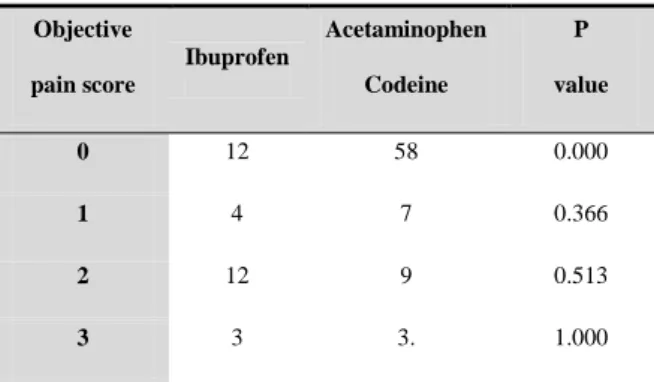
P value Acetaminophen Codeine Ibuprofen Objective pain score 0.000 58 12 0 0.366 7 4 1 0.513 9 12 2 1.000 3. 3 3
Table 5: Objective pain score comparison of ibuprofen and acetaminophen groups
In some cases bleeding occurred immediately after surgery which was due to impaired haemostasis. Acetaminophen and acetaminophen-codeine groups each had one incidence of bleeding with the ibuprofen group showing two cases of bleeding. However, the difference between the groups in terms of bleeding incidence was not statistically significant (P=0.221). In the cases of post-operative bleeding the patients were immediately transferred to the operating room where the bleeding was controlled. It should be noted that there was no coagulation disorder in the studied cases.
Anorexia was experienced in 11 patients (15.7%) taking acetaminophen, 6 patients taking acetaminophen codeine (7.8%), and 8 patients taking ibuprofen (25.8%). A significant difference was observed between the drugs in terms of this side effect (P=0.045).
The prevalence of nausea and vomiting was significantly different between the mentioned drugs (P=0.000); it was higher in the patients taking ibuprofen and particularly high in the second day after the operation. This often resulted in epigastric pain and feeding difficulty. Therefore, the ibuprofen therapy had to be terminated due to severe side effects. Four patients all in the acetaminophen group had to be seen by the physician because of severe pain. Furthermore, two patients in the acetaminophen group required more analgesic doses which did
OPS Acetaminophen Acetaminophen
-codeine Ibuprofen Total
P value
0 27 (
38.6%
) (75.3%58 (
12
(
38.7%
) ) 54.5%97 ( 0.000
1 10 (
14.3%
) ) 9.7%7 (
4
(
12.9%
) ) 11.8%21 ( 0.276
2 19 (
27.1%
) ) 11.7%9 (
12
(
38.7%
) ) 22.5%40 ( 0.139
3 9 (
12.9%
) ) 3.9%3 (
3
(
9.7%
) ) 8.4%15 ( 0.091
4 1 (
1.4%
) 0 0 ) 0.6%1 (
5 3 (
4.3%
) 0 0 ) 1.7%3 (
6 1 (
1.4%
) 0 0 ) 0.6%1 (
Total 70 77 31 178
not show any significance difference (P=0.21).
Discussion
The rate of analgesia in the acetaminophen codeine, acetaminophen and ibuprofen groups was 75.3, 38.6 and 38.7 percent, respectively; which is obviously higher in the first group. There was no meaningful difference between the other two groups (P=0.992). This indicates that in contrast to acetaminophen codeine, ibuprofen and acetaminophen were not able to relieve pain significantly. Similar results were obtained by Romsing et al, indicating no significant reduction in patient’s pain after tonsillectomy by diclofenac sodium or paracetamol (12). Contrary to our results, Moir et al showed that both acetaminophen and acetaminophen codeine had a similar effect on pain relief on the basis of Wong-Baker FACES (14). In another study, Charles stated that ibuprofen had similar effect on pain relief to acetaminophen codeine (15).
Although the results of Charles et al are in contrast to our study, but Earl and colleagues reported that acetaminophen codeine could be a safer drug than ibuprofen in post tonsillectomy pain management (15,16). The rate of bleeding in all groups did not show any significant difference according to Pearson chi-square test (P=0.22).
It should be noted that post tonsillectomy bleeding in the ibuprofen group was not due to coagulation dysfunction. Romsing et al reported that none of the studies were able to clarify the relationship between bleeding and NSAIDs (13).
The results showed that the incidence of anorexia in acetaminophen, acetaminophen codeine and ibuprofen groups was 15.7, 7.8 and 25.8 percent, respectively, which showed a significant
difference by Chi-square test between these three groups (P=0.045). Moir et al reported a high percentage of anorexia in the acetaminophen codeine group in comparison to the acetaminophen group (14).
Number of patients having suffered from nausea and vomiting after drug therapy is listed in Table 5. The table shows a significant difference between these groups using Pearson Chi-square test, (P=0.000)
According to Table 5, the incidence of nausea in the ibuprofen group was higher than the other groups. In some cases we decided to exclude the patient because of severe side effects such as dehydration. Because Charles et al did not report any similar side effects in their study, it is highly recommended to be further investigated by future studies. Nevertheless, It may be due to the fasting period (12 hours or more) or racial differences.
Conclusion
References
1. Rouke D. The measurement of pain in infants, children, and adolescents: From policy to practice. Phys Ther 2004; 84: 560-70.
2. Charlton ED. The management of postoperative pain. Pain Relief in children, update in anaesthesia. Pract Proced 1997; 1: 1-7.
3. Verghese ST, Hannallah RS. Postoperative pain management in children. Anaesthesiol Clin N Am 2005; 23: 163-84.
4. Ozcan M, Altuntas A, Unal A, Nalc AY, Aslan A. Sucralfate for posttonsillectomy analgesia. Otolaryngol. Head Neck Surg 1998; 119: 700-4.
5. Unal Y, Pampal K, Korkmaz S, Arslan M, Zengin A, Kurtipek O. Comparison of bupivacaine and ropivacaine on postoperative pain after tonsillectomy in paediatric patients. Int J Pediatr Otorhinolaryngol 2007; 71: 83-7.
6. Sampaio AL, Gonc T¸ Pinheiro A, Furtado PL, Araujo MF, Olivieira C. Evaluation of early postoperative morbidity in pediatric tonsillectomy with the use of sucralfate. Int J Pediatr Otorhinolaryngol 2007; 71: 645-51.
7. McCullough HN. Acetaminophen and ibuprofen in the management of fever and mild to moderate pain in children. Pediatr Child Health 1998; 3: 98-101.
8. Kokki H. Nonsteroidal anti-inflammatory drugs for postoperative pain: A focus on children. Pediatr Drugs 2003; 5: 103-23.
9. American Academy of Pediatrics, Committee on Drugs. Acetaminophen toxicity in children. Pediatrics 2001; 108(4): 1020-4.
10.Sutters KA, Miaskowski C, Holdridge-Zeuner D, Waite S, Paul SM, Savedra MC, et al. Time-contingent dosing of an opioid analgesic after tonsillectomy does not increase moderate to severe side effects in children. Pain Manag Nurs 2005; 6: 49-57. 11.Ozalevli M, Unlugenc H, Tuncer U, Gunes Y, Ozcengiz D. Comparision of morphine
and tramadol by patient-controlled analgesia for postoperative anlgesia after tonsillectomy in children, Paediatr. Anaesthesiology 2005; 15: 979-84.
12.Romsing J, Ostergaard D, Drozolziewicz D, Schultz P, Ravn G. Diclofenac or acetaminophen for analgesia in pediatric tonsillectomy outpatients. Acta Anaesthiol Scand 2000; 44: 291-5.
13.Romsing J, Hertel S, Harder A, Rasmussen M. Examination of acetaminophen for outpatient management of postoperative pain in children. Pediatr Anesthesiol 1998; 8: 235-9.
14.Moir M, Bair E, Shinnick P, Messner A. Acetaminophen versus acetaminophen with codein after pediatric tonsillectomy. Laryngoscope 2000; 110: 1824-7.
15.Charles CS, Matt BH, Hamilton MM, Katz BP. A comparison of ibuprofen versus acetaminophen with codein in the young tonsillectomy. Otolaryngol Head Neck Surg 1997; 117: 76-82.
16.Earl H, Harley RF. Ibuprofen for tonsillectomy pain in children: Efficacy and complication. Otolaryngol Head Neck Surg 1998; 119: 492-6.