0103 - 5053 $6.00+0.00
* e-mail: [email protected]
Voltammetric and Rotating Ring-Disk Studies of the Influence of Anions in the
Underpotential Deposition of Zinc on Platinum
Lucia H. Mascaroa, M. C. Santosb, S. A. S. Machadob and L. A. Avacab,*
a
Departamento de Química, Universidade Federal do Paraná, CP 19081, 81531-990 Curitiba - PR, Brazil
b
Instituto de Química de São Carlos, Universidade de São Paulo, CP 780, 13560-970 São Carlos - SP, Brazil
A deposição em regime de subtensão de Zn sobre Pt policristalina foi estudada em três diferentes soluções ácidas para diferentes concentrações de Zn2+. As cargas voltamétricas e a inibição, promovida
pelo recobrimento máximo da superfície com Znads, na adsorção e na reação de desprendimento de hidrogênio foram usados para se postular modelos de adsorção. A co-adsorção dos ânions HSO4-,
ClO4- e F-, tanto sobre o substrato de Pt como sobre os ad-átomos, exercem um papel muito
importante na natureza da camada adsorvida. Sobre Pt, a carga máxima de redissolução do Znads encontrada foi aproximadamente 210 C cm-2, exceto para o meio de fluoreto com Zn2+ 10-3 mol L-1,
onde se encontrou um valor de aproximadamente 350 C cm-2. Uma pequena inibição na reação de
desprendimento de hidrogênio foi observada em ácido sulfúrico e perclórico, mas uma intensa inibição foi constatada em meio de ácido fluorídrico. Estes resultados foram associados com a interação dos volumosos oxi-ânions tanto com os ad-átomos como com o substrato. Finalmente, experimentos de coleção com o eletrodo rotatório de disco-anel foram feitos em meio de HF e os resultados confirmaram a carga máxima obtida dos voltamogramas. Os experimentos feitos com o eletrodo rotatório confirmaram que os picos voltamétricos analisados são relacionados com a deposição em subtensão do Zn.
The underpotential deposition of Zn on polycrystalline Pt was studied in three different acid solutions for different Zn2+ concentrations. The voltammetric charges and the inhibition promoted by
the maximum coverage of Znads in the hydrogen adsorption and evolution reactions were used to postulate adsorption models. It was shown that the co-adsorption of anions HSO4-, ClO
4- and F-,
either on the substrate or on the ad-atoms, exerts a marked influence in the ad-layer nature. On Pt, the maximum values found for the redissolution charge were around 210 C cm-2, except for 10-3 mol
L-1 Zn2+ in fluoride medium where a value of 350 C cm-2 was obtained. A negligible inhibition of
the hydrogen evolution reaction was recorded in sulfuric and perchloric acid solutions while a strong inhibition was found for fluoride medium. These results were related to the interaction of the large oxy-anions either with the substrate or the ad-atoms. Collection experiments were performed with the rotating ring-disk electrode system (RRDE) and the results confirmed the large charge value obtained in the HF electrolyte. The experiments performed with the RDDE also demonstrated that the voltammetric peaks analyzed here are associated with UPD Zn.
Keywords: underpotential deposition, zinc, ad-atoms, hydrogen evolution reaction, ad-anions
Introduction
The electrocrystallization of Ni-Zn alloys on different substrates is one of the most interesting subjects in applied electrochemistry. This is mainly due to the intensive utilization of such deposits in several technological applications like protection against corrosion in
automotive industry,1 hydrogen production by water
electrolysis,2,3 energy storage devices4 and inhibition of
hydrogen embrittlement on Ni/Cu Monel K500 alloy5 or
AISI 4340 steel.6 As already observed by Brenner,7 the most
important characteristic of such system is the anomalous character of Zn deposition. In the electrochemical deposition of alloys, the term anomalous applies for the reduction of the less noble ion component preferentially than the one predicted only from thermodynamic
consideration.8 An interesting model proposed by
The underpotential deposition of metals has been extensively studied due to the possibility of promoting modifications on the catalyst surface in a specially controlled way. This phenomenon is associated to the interactions between ad-atoms and substrate that make it possible to deposit a metal M in a potential range more positive than the Nernst potential for the couple M/Mz+.
The main characteristics of these systems have been well described in several papers and reviews.10-12
The underpotential deposition of Zn on different substrates have been recently studied by Aramata et al., mainly
on polycrystalline Pt, Pd and Au13,14 and on Pt single crystals.15
These authors have investigated the effect of pH on the anodic shift of the Zn UPD dissolution peak suggesting a two-electron mechanism with repulsive interaction between ad-atoms. Nevertheless, a model for Zn adsorption was not discussed. Dorda et al.4 have analyzed the deposition of Zn
on Pt from alkaline solutions by cyclic voltammetry, proposing a poisoning of the surface by zinc ad-atoms, which was revealed by the inhibition of the hydrogen adsorption peaks. El-Shafei16 investigated the sensitivity of the
crystallographic orientation of electrochemically oriented Pt surfaces for UPD Zn in acid medium using cyclic voltammetry. The UPD Zn was found to be a very convenient process for surface characterization due to the sensitivity of the ad-atom to surface orientation and to the fact that the deposition occurs in a potential range where no changes in the Pt surface structure are observed.16
Taguchi and Aramata17 have examined the UPD Zn in
pH 4.4 solutions with and without halide anions by cyclic voltammetry. The UPD peak potentials were shifted negatively by anion adsorption that also increases the peak width. These authors assumed a three-step mechanism for the UPD process, namely, (i) desorption of initially adsorbed anions from the substrate, (ii) adsorption of the ad-atom and (iii) re-adsorption of the anions on the UPD metal. This model was used to study the adsorption of Zn in phosphate medium by cyclic voltammetry, FTIR and electrochemical quartz crystal microbalance (EQCM).18
The FTIR measurements pointed to the adsorption of HPO42- ions on Zn through a Zn-O bond. The effect of
anion adsorption on UPD metal atoms was also discussed by Varga et al.19 for bisulfate on UPD Cu systems. The
electrochemistry of Zn2+ in sulfate medium was also
analyzed by Zouari and Lapicque.20 The authors had
studied the thermodynamics of the Na2SO4-ZnSO4-H2O system proposing the existence of (Zn2+)(SO
42-) ion pairs
in the liquid phase. Finally, Horányi and Aramata21, 22 have
studied the adsorption of Cl-, HSO
4- and H2PO4- on Pt
surfaces induced by the co-adsorption of Zn ad-atoms. The authors concluded that the specific adsorption of the
species induced by Zn ad-atoms depends on pH and at a given potential on the concentration of Zn2+ ions.
From the discussion above it is clear that UPD Zn is not, up to now, sufficiently explored in the literature. Perhaps some difficulties arise in the interpretation of experimental data by the overlap of the Znads oxidation peaks with desorption of UPD H on Pt or by alloy formation with Au. Moreover, there is a lack of studies indicating the structure of the monolayer with regard to the number of active sites occupied by each ad-atom as well as to the maximum coverage of the surface.
The hydrogen adsorption/evolution reaction is an
adequate tool to analyze the blockage of active sites on the Pt (and even Au) surfaces. As each hydrogen atom needs one site to adsorb (and evolve H2, in the sequence), any decrease in the hydrogen adsorption charge or inhibition of hydrogen evolution means a blockage of the surface by a different foreign ad-atom. This particular behavior is proposed to be used here in order to postulate adsorption models for UPD Zn.
Therefore, the objective of this work is to study the underpotential deposition of Zn on polycrystalline platinum surfaces in 0.5 mol L-1 H
2SO4, HClO4 and HF
solutions The electrochemical techniques to be used are cyclic voltammetry and rotating ring-disk electrodes and the UPD Zn response will be analyzed in relation to the behavior of the hydrogen adsorption/evolution on platinum and gold, aiming to explore some aspects of this system that still remain under discussion.
Experimental
A three-compartment electrochemical cell was constructed in Pyrex glass and provided with a Luggin capillary for the reference electrode. The working electrode for the voltammetric experiments was a platinum disc with 0.199 cm2 electrochemical area, as evaluated by the charge
associated with the desorption of one monolayer of Hads.23,24
For the hydrodynamic experiments a Pt-Pt configuration with a 0.001 cm2 Pt ring and a 0.160 cm2 Pt disk was used.
The collection coefficient was determined with the Fe2+/
Fe3+ couple as 0.195. A 5 cm2 platinum foil was used as the
auxiliary electrode while the reversible hydrogen electrode (RHE) was the reference system.
The acid solutions used in this work were prepared with H2SO4 (Merck, Suprapur), HClO4 (Merck, P.A.) or HF (Merck, P.A.), ZnO (Merck, P. A.) and water purified in a Milli-Q system (Millipore Inc.) and were deaerated by bubbling N2 (SS White Martins).
IBM compatible PC 486 microcomputer controlled by the software M270 (EG&G PARC) while for the rotating ring-disk experiments a model 366A EG&G PARC bipotentiostat, a rotating system model 636 EG&G PARC and a model 7046B Hewlett Packard recorder were used.
Results and Discussion
Cyclic voltammetric studies
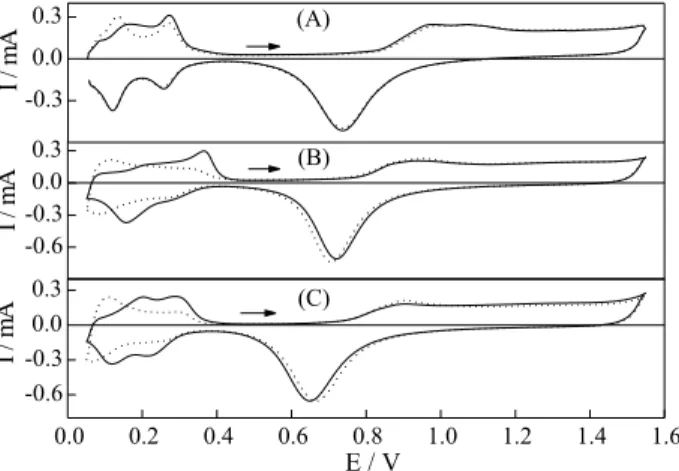
The voltammetric behavior of Pt at 0.2 V s-1 in the three
different media under investigation is presented in Figure 1. The dotted-line curves represent the steady-state voltammetric response of the surface in the blank solutions. On the sequence, ZnO was added to the blank solutions, the electrode was held for 300 s at the initial potential (0.05 V) and the first voltammetric cycle recorded afterward. To achieve maximum surface coverage with Znads the Zn2+
concentration was varied from 10-5 to 10-3 mol L-1 and
further up. It was found that 10-3 mol L-1 Zn2+ in the solution
was sufficient for that purpose in three electrolytes under investigation, all other conditions maintained constant. This is shown by the full-line voltammograms in Figure 1.
The two anodic peaks observed in Figure 1A, 1B and 1C in the potential range between 0.05 and 0.4 V could be either associated to the dissolution of Znads deposited for 300 s at 0.05 V or to the oxidation of H-atoms adsorbed on the electrode surface. It is very difficult to distinguish these oxidation processes by cyclic voltammetry. However, the use of a rotating ring-disk electrode system will be useful to clarify this point (see later).
Meanwhile, the dissolution responses are clearly affected by the anions of the electrolyte as their shape and peak potentials are quite different in the three cases. Thus, for sulfuric acid solutions (Figure 1A) a well-defined peak is observed at around 0.27 V and this can be associated with the strongly adsorbed Zn while the shoulder appearing at approximately 0.16 V is due to the weakly adsorbed Zn, as previously reported.13 The maximum dissolution charge
density obtained here after deposition at 0.05 V during 300 s was 225 C cm-2. By comparison with the charge density
value associated to the desorption of a complete hydrogen monolayer (210 C cm-2), a well-known one-electron transfer
reaction where each H ad-atom is bonded to one active site on the platinum surface23,25 it can be proposed that the present
case corresponds to the occupancy of only one-half of a monolayer with Znads in a two-electron transfer reaction. This is because each Zn ad-atom is assumed to deposit onto only one Pt active site, in accordance with their very close atomic radii values (1.39 Å for Pt and 1.38 Å for Zn26).
To investigate the influence of bisulfate adsorption in the measured partial coverage with Znads described above, the experiments performed in 0.5 mol L-1 HClO
4 under the
same conditions (Figure 1B) were comparatively analyzed. The most significant difference in relation to the profile in Figure 1A is the shift to 0.36 V of the peak potential for the strongly adsorbed Zn and the ill-defined shoulder at 0.23 V. For the maximum desorption charge density the value was 230 µC cm-2 in this case. These observations suggest that
the adsorption of bisulfate ions on the Pt surface might not
be the main reason for low value measured for Znads
coverage since perchlorate adsorption on Pt is much weaker than that of bisulfate27 and, in both media, the Zn
ads
desorption charge densities have almost identical values. The next step towards a better understanding of the Zn UPD process was to analyze the experiments in 0.5 mol L-1
HF. Here, the electrolyte was selected due to the low adsorbability of fluoride ions on Pt (similar to that of perchlorate) together with the fact that F- is not an
oxy-anion. The proposition here is that oxy-anions could adsorb on top of Znads, as previously reported17 and block the
neighbor site of the substrate by means of a hydrogen bond. The corresponding voltammogram (Figure 1C) shows two well-defined oxidation peaks at approximately 0.29 and 0.20 V, respectively, in an overall behavior similar to that observed for sulfuric acid. On the other hand, the maximum charge density measured for the desorption of Znads was 360 µC cm-2, a value significantly higher than those for
perchlorate and for sulfate ions. Only small differences are observed if the Zn2+ concentration is diminished down to
10-5 mol L-1. Such charge density value implies in a 86%
maximum coverage with Zn ad-atoms.
Figure 1. Steady-state profiles (dotted lines) for Pt in 0.5 mol L-1
H2SO4 (A), HClO4 (B) and HF (C) and first-cycle voltammograms at
0.2 V s-1 after the addition of 1x10⁻³ mol L_1 ZnO (full lines). Prior to
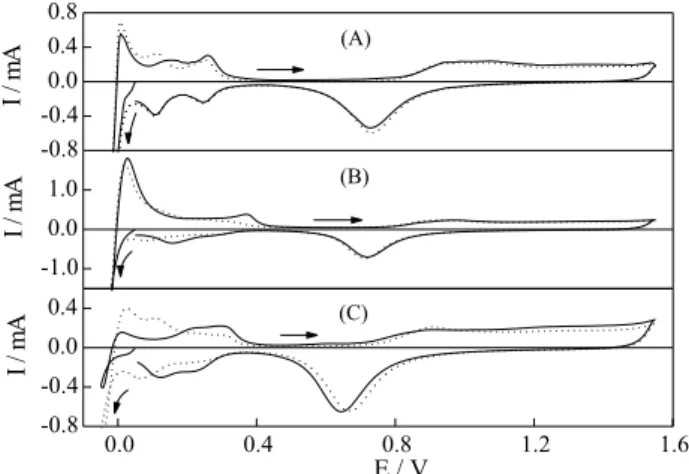
To provide more evidence for the effect of the anions on the Zn UPD on Pt, the influence of the adsorbed metal monolayer in the hydrogen adsorption/evolution reactions was analyzed in the three electrolytes. Figure 2 shows the voltammetric profiles (first cycle) obtained after extending the initial potential value to -0.05 V to detect the response of the hydrogen evolution reaction (her). The experimental
conditions and the lines representation are the same of those of Figure 1 but for HF (Figure 2C) the response for 10-4 mol L-1 Zn2+ was also included.
The results in Figure 2 show that only the Zn UPD monolayer obtained with 10-3 mol L-1 Zn2+ in 0.5 mol L-1
HF is able to inhibit the her, in accordance with the surface
coverage by Znads measured under those conditions. The occupancy of only one-half of a monolayer with Znads in sulfate and perchlorate solutions, together with the lack of a considerable inhibition of the her, suggests that the
oxy-anions must be responsible for the low surface coverage with Zn, allowing the her to proceed on the free active
sites. A possible model for the representation of this effect of the oxy-anions has been given by Taguchi and Aramata17
and can be represented by:
HSO4– / Pt ®HSO 4
– (1)
Zn2+ + 2e–® Zn0
Ads / Pt (2)
HSO4–® HSO 4
– / Zn0
Ads (3)
with the oxy-anions adsorbed on Znads through one of the oxygen atoms.
At the same time, the HSO4- ions already adsorbed on
the Zn ad-atom could be bonded to the neighbor active site of the platinum surface. This will result from the interaction between one of the O atoms in the bisulfate ion and the Pt substrate thus blocking the whole surface for the hydrogen UPD. At high cathodic potentials, the weak anion adsorption on the substrate would be eliminated allowing the her to occur. This interpretation could also
be valid for the ClO4- ions and will account for the charge
density of 210 C cm-2 measured for the half of a monolayer
of Zn arranged in such a way that each ad-atom occupies one active site on the surface and blocks the neighbor site.
Rotating ring-disk studies
In this work, the rotating ring-disk experiments, performed at 2000 rpm, consisted in polarizing the ring electrode at a sufficiently negative potential, in this case at -0.75 V, in order to allow the massive deposition of Zn to occur. In this situation, the constant current flowing through the ring surface is due to the Nernstian process Zn2+/Zn, depending only in the rotating rate and in the
Zn2+ concentration, without any influence of the
substrate.28,29 The next step, with the ring under constant
polarization, is related to the deposition of a full Zn monolayer on the disk electrode surface. This was achieved by polarizing the disk electrode at sufficient negative potentials during different deposition times. After each deposition time, the electrode was submitted to a positive potential sweep up to 1.40 V, at 0.2 V s-1, aiming to reach
the total dissolution of Znads. This procedure promotes an increase in the Zn2+ concentration in the diffusion layer,
during the dissolution of the monolayer. This extra amount of zinc was collected by the ring electrode originating a variation in the constant Nernstian ring current, which is associated with the charge of dissolution of the Zn monolayer on the disk.
The experiments with the rotating ring-disk system for UPD Zn in 0.5 mol L-1 H
2SO4 or HClO4 solutions on Pt
electrodes, as defined above, did not succeed, probably due to the strong interference of the hydrogen evolution reaction on the ring electrode. In this way, only the experiments with 0.5 mol L-1 HF yielded results to be
analyzed. This can be associated to the higher surface coverage with Znads obtainable in this electrolyte, which can minimize the hydrogen evolution on the disk or on the ring electrodes.
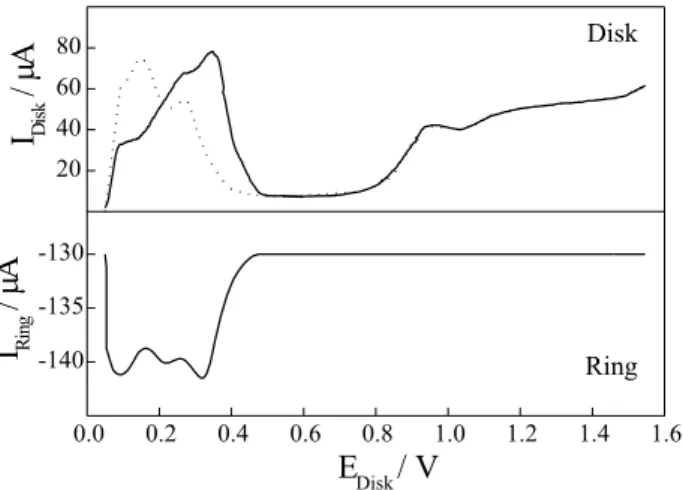
The results obtained for the rotating ring-disk system in 0.5 mol L-1 HF + 10-3 mol L-1 ZnO solution and in the
same conditions given above, are presented in Figure 3. It can be noted the sensibility of the ring electrode to collect
Figure 2. First-cycle voltammograms for Pt in 0.5 mol L-1 H 2SO4
(A), HClO4 (B) and HF (C) at 0.2 V s-1 and after the addition of:
1x10⁻⁵ mol L-1 (dotted lines) and 1x10⁻³ mol L-1 (full lines) ZnO. The
the excess of Zn2+ from the dissolution of Zn monolayer
occurred in the disk electrode. Here, the monolayer of Zn was obtained by keeping the disk potential at -0.05 V by 300 s. Further increasing in deposition time does not promote any effect in the dissolution profile. The results obtained in the disk are in close agreement with that obtained with the stationary electrode. The voltammetric charge due to the dissolution of Zn monolayer was calculated from the disk response as 360 C cm-2. On the
other hand, the current variation in the ring electrode was also transformed in charge and, using the collecting factor and the disk electrochemical area, transposed to the value of the dissolution charge on the disk. By these procedures, a charge of 350 C cm-2 was calculated for the disk process,
also in agreement with the previous values.
Conclusions
The results presented above can be interpreted as an example of the strong interactions that exist in the early stage of metals electrodeposition between ad-atoms, anions and substrates. The adsorption and evolution of hydrogen were used as adequate test reactions to point out the number of active sites covered by the UPD Zn.
As the atomic radius of Zn is slightly smaller than that of Pt, it should be expected that at maximum coverage each active site on the electrode surface would be occupied by one ad-atom following a two-electron transfer. However, the interactions mentioned above led the depositions to follow quite different pathways.
In sulfuric and perchloric acid media, the total charge obtained corresponds only to one-half of a monolayer and
this justifies the partial inhibition of the hydrogen evolution reaction. In hydrofluoric acid medium, the much higher coverage obtained (about 86%) is responsible for the intense inhibition of the her.
The origin of such different behavior can be related to the participation of the ClO4- and HSO
4- molecules in the
adsorption model that accounts for the blocking of one extra platinum site per Zn ad-atom. This was confirmed by the higher coverage found in F- medium.
Acknowledgments
Thanks are due to CNPq and FAPESP (proc. No 97/ 2978-3) for the financial support.
References
1. Miura N.; Saito T.; Kanamura T.; Shindo Y.; Kitazawa Y.; Trans. Iron Steel Inst. Jpn.1983, 23, 913.
2. Chen L.; Lasia A.; J. Electrochem. Soc.1991, 138, 3321. 3. Giz, M.J. de; Machado, S.A.S.; Avaca; L.A.; Gonzalez; E.R.;
J. Appl. Electrochem.1992, 22, 973.
4. Dorda, A.A.; McLarnon, F.R.; Cairns, E.J.; J. Electroanal. Chem.1994, 364, 71.
5. Zheng, G.; Popov, B.N.; White, R.E.; J. Electrochem. Soc. 1994, 141, 1220.
6. Zheng, G.; Popov, B.N.; White, R.E.; J. Electrochem. Soc. 1993, 140, 3153.
7. Brenner, A.; Electrodeposition of Alloys, Academic Press: New York, 1963.
8. Nicol, M.J.; Philip, H.I.; J. Electroanal. Chem.1976, 70, 233.
9. Swathirajan, S.; J. Electroanal. Chem.1987, 221, 211. 10. Kolb, D.M.; Adv. Electrochem. Electrochem. Eng.1978, 11,
125.
11. Adzic, R.R.; Adv. Electrochem. Electrochem. Eng.1984, 13, 159.
12. Szabó, S.; Int. Phys. Chem.1991, 10, 207.
13. Aramata, A.; Quaiyyum; Md.A.; Balais, W.A.; Atoguchi, T.; Enyo, M.; J. Electroanal. Chem.1992, 338, 367.
14. Quaiyyum, Md.A.; Aramata, A.; Moniwa, S.; Taguchi, S.; Enyo, M.; J. Electroanal. Chem.1994, 373, 61.
15. Taguchi S.; Aramata A.; Quaiyyum, Md.A.; Enyo, M.; J. Electroanal. Chem.1994, 374, 275.
16. El-Shafei, A.A.; J. Electroanal. Chem.1995, 380, 269. 17. Taguchi, S.; Aramata, A.; J. Electroanal. Chem. 1995, 396,
131.
18. Aramata, A.; Terui, S.; Taguchi, S.; Kawaguchi, T.; Shimazu, K.; Electrochim. Acta1996, 41, 761.
19. Varga, K.; Zelenay, P.; Wieckowski, A.; J. Electroanal. Chem. 1992, 330, 453.
Figure 3. Linear sweep voltammograms for the disk electrode in the Pt/Pt rotating ring-disk system and the corresponding ring response in 0.5 mol L-1 HF (dotted line) and after the addition of 10-3 mol L-1
ZnO (full line) to the electrolyte. Scan rate of 0.1 V s-1, E
dep = 300 s,
20. Zouari, I.; Lapicque, F.; Electrochim. Acta1992, 37,439. 21. Horányi, G.; Aramata, A.; J. Electroanal. Chem. 1997, 434,
201.
22. Horányi, G.; Aramata, A.; J. Electroanal. Chem. 1997, 437, 259.
23. Woods, R. In Electroanalytical Chemistry; Bard, A.J. ed., Marcel Dekker: New York, 1976.
24. Angerstein-Kozlowska, H.; Conway, B.E.; Barnett, B.; Mozota, J.; J. Electroanal. Chem.1979, 100, 417.
25. Woods, R.; J. Electroanal. Chem.1974, 49, 217.
26. Furuya, N.; Motoo, S.; J. Electroanal. Chem.1979, 98, 189.
27. Angerstein-Kozlowska, H.; Conway, B. E.; Hamelin, A.; Stoicoviciu, L.; Electrochim. Acta1986, 31, 1051.
28. Santos, M. C.; Mascaro, L. H.; Machado, S. A. S.; Avaca, L. A.; J. Chem. Soc., Faraday Trans.1997, 93,3999.
29. Santos, M. C.; Mascaro, L. H.; Machado, S. A. S.; Electrochim. Acta1998, 43,2263.
Received: January 16, 2002 Published on the web: August 1, 2002