CHANGES IN QUANTITATIVE EEG ABSOLUTE
POWER DURING THE TASK OF CATCHING
AN OBJECT IN FREE FALL
Sergio Machado
1,5, Cláudio Elidio Portella
1, Julio Guilherme Silva
1,5,
Bruna Velasques
1,5, Patrícia Terra
3, Camila Ferreira Vorkapic
1,
Vernon Furtado da Silva
3, Luis Miana
3, Luis Basile
4, Mauricio Cagy
1,5,
Roberto Piedade
1,5, Pedro Ribeiro
1,2,3,5ABSTRACT - The aim of this study was to verify changes in absolute power (qEEG), in theta, during the catch of a free falling object. The sample consisted of 10 healthy individuals, of both genders, with ages between 25 and 40 years. A three-way ANOVA followed by Post-Hoc analysis was applied. The results dem-onstrated main effects for time and position. In conclusion, a motor task that involves expectation produc-es deactivation of non-relevant areas in the ipsilateral hemisphere of the active limb. On the other hand, the patterns of results showed activation in areas responsible for planning and selection of motor reper-tories in the contralateral hemisphere.
KEY WORDS: absolute power, qEEG, planning, sensorimotor integration.
Mudanças na potência absoluta no EEG quantitativo durante tarefa de apreensão de um obje-to em queda livre
RESUMO - O objetivo deste estudo foi verificar mudanças na potência absoluta (EEGq), em teta, durante a pegada de objeto em queda livre. A amostra consistiu de 20 indivíduos saudáveis, de ambos os gêneros, com idade entre 25 e 40 anos. Foi utilizada uma ANOVA three-way seguida de uma análise Post-Hoc. Os resultados demonstraram efeito principal para momento e posição. Concluindo, uma tarefa motora que envolve expectativa produz desativação de áreas não-relevantes no hemisfério ipsilateral do membro ati-vo. Por outro lado, o padrão dos resultados mostrou ativação em áreas responsáveis por planejamento e seleção de repertórios motores no hemisfério contralateral.
PALAVRAS-CHAVE: potência absoluta, EEGq, planejamento, integração sensório-motora.
1Laboratório de Mapeamento Cerebral e Integração Sensório-Motor, Instituto de Psiquiatria, Universidade Federal do Rio de
Ja-neiro, Rio de Janeiro RJ, Brazil (IPUB/UFRJ); 2 Departamento de Biociências da Atividade Física, Escola de Educação Física e Desportos
(EEFD/UFRJ); 3
Universidade Castelo Branco (PROCIHM); 4
Departamento de Psiquiatria, Faculdade de Medicina, Universidade de São Paulo, São Paulo SP, Brazil (USP); 5Instituto Brasileiro de Biociências Neurais (IBBN).
Received 9 November 2006, received in final form 9 February 2007. Accepted 3 April 2007.
Dr. Sergio Eduardo de Carvalho Machado - Rua Professor Sabóia Ribeiro 69 / 104 - 22430-130 Rio de Janeiro RJ - Brasil. E-mail: [email protected]
Arq Neuropsiquiatr 2007;65(3-A):633-636
Motor behavior is the product of a fine integra-tion between cortical and peripheral components associated to afferent information. The central ner-vous system (CNS) captures, identifies and processes sensory stimuli in order to prepare and adjust mo-tor behavior1
. The prefrontal cortex (PFC) is an inte-gration cortex. It is considered neither a sensory nor a motor cortex; it is an association region, provid-ing integration sensory stimuli to motor centers2,3.
The PFC is involved in cognition, attention mainte-nance, planning and organization, including the ca-pacity to follow certain thought sequences and be-havior strategy choices4. Plastic alterations might
oc-cur in this area regarding motor reactions (reaction
time, anticipatory movements and motor learning), which might lead to performance and gesture preci-sion improvement5.
Quantitative electroencephalography (qEEG) has made possible the elucidation of cognitive process-es and motor learning6, 7
. Specific electroencephalo-graphic variables are particularly related to such pro-cesses. Absolute power, defined as total energy in-tensity of an electrode on a certain region at differ-ent frequency bands8
. Therefore, the present study examined the theta band (4–7 Hz), due to its rela-tion with attenrela-tion processes, particularly, sustained attention9. Previous experimental data showed an
visual-634 Arq Neuropsiquiatr 2007;65(3-A)
spatial tasks10. Such tasks involve dynamic and
com-plex sensory-motor integration processes11.
This study aimed at trying to elucidate electro-physiological and cortical mechanisms involved in an-ticipatory actions when individuals had to catch a free falling object; specifically through qEEG theta absolute power changes.
METHOD
The sample was composed for 20 healthy individuals of both sexes with ages varying between 25 and 40 years, ab-sence of mental and physical illness (previous anamnesis), right handed (Edinburgh), and do not using any psychoac-tive or psychotropic substance at the time of the study. The experiment consisted of a task of catching an object in free fall. The balls were discharged by an electromagnetic sys-tem, composed of two solenoids. The interval between the
falling balls was 11 seconds, each ball was a trial and each block was made of 15 trials. The entire experiment consist-ed of three blocks, lasting 2 min and 30 sec each, with 1 min interval between the blocks. The intervals favored the recovery of the active limb, avoiding muscular fatigue. The qEEG acquisition occurred during 2 seconds before the ball fall and 2 seconds after the ball fall12.
Spatial electrode localization and frequency bands – Since motivation, planning and execution of voluntary movements are mediated by the frontal lobes13,14, the
fron-tal area was investigated in the present study. Electrodes investigated were: F7, F3, FZ, F8, F4. The theta band (4–7 Hz) was also chosen due to its association with attention processes particularly sustained attention9, and
space-visu-al tasks10.
Statistical analysis – A Three-Way ANOVA and a Post Hoc were used for each electrode combination. The factors time (pre and post ball fall) blocks (whole task time) and position (the three electrode combinations) a) F3/F4; b) F7/ F8; and c) F3F7/F4F8, were compared (p≤0.05).
RESULTS
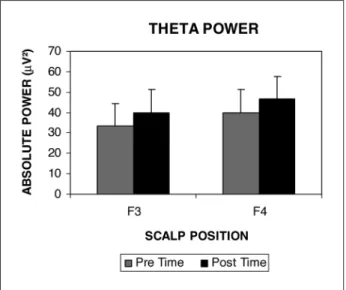
In the first analysis, when the left prefrontal cor-tex was compared to the right prefrontal corcor-tex (F3/ F4), one main effect for the factors time (p=0.002) and position (p=0.002) (Fig 1) was observed. In the second analysis, when the left prefrontal cortex was compared to the right prefrontal cortex (F7/F8), an-other main effect was observed for time (p=0.006) and position (p=0.000) factors (Fig 2). In the third analysis, when the left prefrontal cortex was com-pared to the right prefrontal cortex (F3F7/F4F8), an additional main effect for the time (p=0.002) and po-sition (p=0.000) factors was observed (Fig 3). No in-teractions among effects were detected.
Fig 1. Absolute power means in theta frequency band between F3 and F4 positions in prefrontal cortex in pre and post time.
Fig 2. Absolute power means in theta frequency band between F7 and F8 positions in prefrontal cortex in pre and post time.
Arq Neuropsiquiatr 2007;65(3-A) 635
DISCUSSION
The current experiment is an attempt to elucidate cortical/electrophysiological mechanisms regarding anticipatory actions involved in voluntary move-ments, specifically, when subjects had to catch a free falling object (in this case, a ball). Through qEEG, changes in the theta frequency band power were examined. No interactions among the factors were observed, so discussion will only refer to the main effects.
Time factor – In this experiment, subjects had to observe the fall of a certain object with the objec-tive of catching it. An electromagnetic system, made of two solenoids, was positioned ahead of the sub-jects in order to send information about the pre and post fall time to the computer12
. Results demonstrat-ed a theta absolute power increase in the post fall period, when compared to the pre fall period. This increase suggests a decrease in neural activity and consequently a reduced readiness engagement sub-sequent to the task. Inversely, the period before the object fall revealed a diminished power value, which seems to reflect an increase in neural activity. This might suggest increased expectation, alertness and readiness15
when the object was falling. Our data are in agreement with previous investigation showing reduced theta values in the pre-stimulus period and increased theta values in the post stimulus period during continuous motor activities10.
Position factor – Differences in absolute power values between the left prefrontal and the right prefrontal cortices were observed. According to our results, there was a theta absolute power augmenta-tion when certain regions were isolated, F3/F4, and F7/F8; and when electrodes were summed F3F7/F4F8. Considering that a theta power increase could be interpreted as a deactivation of the involved corti-cal area, the power augmentation observed in the right hemisphere suggests disengagement during the task. Traditionally, the right hemisphere is relat-ed to spatial functions such as memory, learning and orientation16-18
. A specialization of the right hemi-sphere in spatial functions might be related to (spa-tial) attention control of visual representation19,20, or
a regulation function in conflict situations21, as when
experiencing a bad interaction between motor and proprioceptive interaction and/or visual feedback22
.
Hatfield et al.23 observed, through EEGq, an
al-pha power increase in the left hemisphere of elite shooters during the preparatory period and even after the shot was fired. Besides, this alpha power
increase was followed by relative power stability in right hemisphere. Alpha power has an inverse rela-tionship with cortical activation. High power values means diminished neuronal activity23,24.
Investiga-tions in motor performance area reveal that an al-pha power increase remains relatively stable or even decreases in the right hemisphere during the prepa-ratory period, suggesting that these regions could be highly activated during the preparatory phase of complex motor tasks25. Considering the hypothesis
that theta presents the same behavior as alpha, our findings suggest an activation of the responsible ar-eas for planning and selection of motor patterns in the contralateral hemispheres of the active limb. It also suggests a deactivation of non relevant areas of the ipsilateral hemisphere.
Thalamic structures (interaction between thalamic nuclei and thalamic reticular nucleus) activate specific cortical areas at a certain time of the relevant infor-mation processing and deactivate others not used during the task execution26. Such process could be
in-terpreted as an electroencephalographic correlate of activated cortical areas involved in the sensory infor-mation processing and motor behavior production27.
This might indicate a participation of a broader neu-ral network in the information processing28
.
In conclusion, our findings demonstrate that the execution of a motor task involving expectation, such as an object fall, produces deactivation of non relevant areas in the ipsilateral hemisphere of the utilized limb. An activation of responsible areas for planning and motor pattern selection was also ob-served in the contralateral hemisphere of the utilized limb. Different population, other than healthy sub-jects, should also be considered for new experiments, for example, patients suffering from Alzheimer’s and Parkinson’s disease, in an attempt to observe specific variables such as attention, anticipatory movements, reaction time and motor planning and execution.
REFERENCES
1. Nargeot R. Votage-dependent switching of sensorimotor integration by a lobster central pattern generator. J Neurosci 2003;23:4803-4808. 2. Miller EK, Cohen JD. An integrative theory of prefrontal cortex
func-tion. Annu Rev Neurosci 2001;24:167-202.
3. Roland P, Larsen B, Lassen N, Skinhoj E. Supplementary motor area and other cortical areas in organization of voluntary movements in man. J Neurophysiol 1980;43:118-136.
4. Koechlin E, Basso G, Pietrini P, Panzer S, Grafman J. The role of the an-terior prefrontal cortex in human cognition. Nature 1999;399:148-151. 5. Karni A, Meyer G, Rey-Hipolito C, et al. The acquisition of skilled
mo-tor performance: fast and slow experience-driven changes in primary motor cortex. Proc Natl Acad USA 1998;95:861-868.
636 Arq Neuropsiquiatr 2007;65(3-A)
8. Cunha M, Bastos VH, Veiga H, et al. Alterações na distribuição de potência cortical em função da consolidação da memória no apren-dizado de datilografia. Arq Neuropsiquiatr 2004;62:662-668. 9. Portella C, Silva JG, Bastos VH, et al. Aprendizagem de procedimentoAprendizagem de procedimento
e efeitos ansiolíticos: medidas eletrencefalográficas, motora e atencio-nal. Arq Neuropsiquiatr 2006;64:478-484.
10. Caplan JB, Madsen JR, Schulze-Bonhage A, Aschenbrenner-Scheibe R, Newman EL, Kahana MJ. Human theta oscillations related to sensorim-otor integration and spatial learning. J Neurosci 2003;23:4726 -4736. 11. Tesche CD, Karhu J. Interactive processing of sensory input and motor
output in the human hippocampus. J Cogn Neurosci 1999;11:424-436 12. Portella CE, Silva JG, Machado S, et al. Eeg spectral coherence inter and
intrahemispheric during a catching object fall task. Arq Neuropsiquiatr 2007;65:63-67.
13. Koechlin E, Corrado G, Pietrini P, Grafman J. Dissociating the role of the medial and lateral anterior prefrontal cortex in human planning. Proc Natl Acad Sci USA 2000;97:7651-7656.
14. Barry R, Clarke A, McCarthy R, Selikowitz M, Johnstone S. EEG coher-ence adjusted for inter-electrode distance in children with attention-deficit/hyperactivity disorder. Int J Psychophysiol 2005;58:12-20. 15. Gomez CM, Vaquero E, Lopez-Mendoza D, Gonzalez-Rosa J,
Vazquez-Marrufo M. Reduction of EEG power during expectancy periods in hu-mans. Acta Neurobiol Exp 2004;64:143-151.
16. Coull JT, Nobre AC. Where and when to pay attention: the neural sys-tems for directing attention to spatial locations and to time intervals as revealed by both PET and fMRI. J Neurosci 1998;998:7426-7435. 17. Garavan H, Ross TJ, Stein EA. Right hemisphere dominance of
inhib-itory control: an event- related functional MRI study. Proc Natl Acad Sci USA 1999;96:8301-8306.
18. Ghilardi MF, Ghez C, Dhawan V et al. Patterns of regional brain activa-tion associated with different forms of motor learning. Brain Res 2000; 871:127-145.
19. Corbetta M, Miezin FM, Shulman GL, Petersen SE. A PET study of vi-A PET study of vi-suospatial attention. J Neurosci 1993;13:1202-1226.
20. Mesulam MM. Spatial attention and neglect: parietal, frontal and cin-gulate contributions to the mental representation and attentional tar-geting of salient extrapersonal events. Phil Trans R Soc Lond B Sci 1999; 354:1325-1346.
21. Wenderoth N, Debaere F, Sunaert S, van Hecke P, Swinnen, SP. Pari-eto-premotor areas mediate directional interference during bimanual movements. Cereb Cortex 2004;14:1153-1163.
22. Fink GR, Marshall JC, Halligan PW, et al. The neural consequences of conflict between intention and the senses. Brain 1999;122:497-512. 23. Hatfield BD, Landers DM, Ray WJ. Cognitive processes during
self-paced motor performance: an electroencephalographic profile of skilled marksmen. J Sport Exerc Psychol 1984;6:42-59.
24. Lawton GW, Hung TM, Saarela P, Hatfield BD. Electroencephalogra-phy and mental states associated with elite performance. J Sport Exerc Psychol 1998;20:35-53.
25. Crews DJ, Landers DM. Electroencephalographic measures of
attention-al patterns prior to the golf putt. Med Sci Sports Exerc 1993;25:116–126.
26. Suffczynski P, Pijn JMP, Pfurtscheller G, Lopes da Silva FH. Event-re-lated dynamics of alpha band rhythms: a neuronal network model of focal ERD/surround ERS. In Pfurtscheller G, Lopes da Silva FH (Eds). Event-related desynchronization handbook of electroencephalography and clinical neurophysiology, vol. 6. revised edition, Amsterdam: Else-vier, 1999:67-85.
27. Pfurtscheller G, Klimesch W. Functional topography during a visuover-bal judgement task studied with event-related desynchronization map-ping. J Clin Neurophysiol 1992;9:120-131.