1 0 6 1 0 6 1 0 6 1 0 6 1 0 6
Sharovsky et al
Increase in mortality due to MI during winter
Arq Bras Cardiol 2002; 78: 106-9.
Instituto do Coração do Hospital das Clínicas - FMUSP
Mailing address: Luiz Antônio Machado César – Rua Constantino de Souza, 1580 04605-004 – São Paulo, SP, Brazil – E-mail: [email protected]
English version by Stela Maris C. e Gandour
Objective - To study the seasonal variation in
morta-lity due to myocardial infarction in the city of São Paulo.
Methods - We analyzed the database of PROAIM
(Pro-grama de Aprimoramento de Informações de Mortalidade) containing the registrations of the certificates of deaths due to myocardial infarction (International Classification of Diseases, 10th edition, classification I21) of the residents of
the municipality of São Paulo during 12 months (from December 1996 to November 1997). The number of deaths was corrected for a standard period of 90 days and then it was divided by the corresponding population to obtain the event rate per 10 thousand inhabitants. The magnitude of the seasonal variation, which was defined by the difference of the relative risks between the seasons with higher and lower mortality, was estimated.
Results - A total of 5,615 deaths due to myocardial
infarction were included in the study. Sixty-one per cent occurred in the male sex, and the mean age was 68 years. The mortality rate during winter was always higher and that during summer was lower than that during the other seasons (P<0.01), independent from age and sex. Seaso-nal variations in deaths due to myocardial infarction was 30% in the general group, being 23% in individuals who died younger than 75 years, and 44% in the older ones.
Conclusion - A marked seasonal variation in
mortali-ty due to myocardial infarction was observed in the cimortali-ty of São Paulo, with a significant increase in its magnitude and age distribution during the winter, similar to those reported in regions of North America and Europe with temperate climates.
Key words: seasons, myocardial infarction, epidemiology
Arq Bras Cardiol, volume 78 (nº 1), 106-9, 2002 Rodol f o Shar ovsk y, Lui z Ant ôni o Machado César
São Paulo, SP - Brazil
Increase in Mortality due to Myocardial Infarction in the
Brazilian City of São Paulo During Winter
Original Article
Seasonal variation in mortality due to acute myocardial infarction with an increase in the number of deaths during winter has been observed in several countries, such as Canada, New Zealand, the United States, and others 1-3.
Most studies indicate that low temperatures are the direct causal factors; some authors suggest the participation of respiratory infections 4,5, air pollution 6, or the effect of the
number of hours of solar radiation 7.
Recently, studies on “triggers” have been intensified. Triggers are acute risk factors for coronary events that cau-se pathophysiological alterations, such as arterial hyper-tension, an increase in blood clotting, or vasoconstriction. In the presence of a vulnerable atherosclerotic plaque, triggers may lead to instability of the plaque and consequent acute coronary insufficiency 8-10. Environmental factors,
such as temperature, air pollution, and respiratory infec-tions, have been associated with effects that fit into this concept of triggers.
However, most studies on this subject were carried out in countries with cold climates, with greater variations in temperature and well-defined seasons, and the validity of their conclusions applied to other climatic conditions has not been well defined. The mechanism involved in these deaths has not yet been well clarified.
The clinical relevance of this annual rhythmic variation may be estimated by the observation of a more than 50% increase in the number of hospitalizations and deaths due to acute myocardial infarction during winter, as compared with those occurring during summer 3. A possible intervention
for decreasing this winter peak depends on clarifying the pathophysiology of this seasonal variation.
Observational delineation is an objective and low-cost form of studying the participation of the environment in triggering cardiac events, which may indicate associations and suggest causal relations for further experimental and clinical investigation.
Arq Bras Cardiol 2002; 78: 106-9.
Sharovsky et al Increase in mortality due to MI during winter
1 0 7 1 0 7 1 0 7 1 0 7 1 0 7
Methods
We included in this study all deaths occurring in individuals older than 34 years during the period from 12/1/ 1996 to 11/30/1997, certificates for which were recorded in the PROAIM (Programa de Aprimoramento de Informações de Mortalidade) database. This is a municipal agency that registers, processes, and revises death certificates of people living in the city of São Paulo, Brazil, which is located at 800 meters of altitude and is crossed by the Tropic of Capricorn, on the west longitude of 46°.
The International Classification of Diseases 10th
edition was used to classify the deaths due to acute myo-cardial infarction (classification I21). Data were analyzed using the methodology described by Sheth et al 1 according
to month and season as follows: winter (June to August), spring (September to November), summer (December to February), and fall (March to May). The mean daily tempera-tures, with the variation enclosed within parentheses, were as follows: 22.9°C (17.3 to 28.3) during summer, 19.6°C (12.8 to 25.7) during fall, 15.8°C (8.8 to 22.3) during winter, and 19.2°C (12.2 to 26.2) during spring.
The values of the daily counts of deaths obtained in 90 to 92 days, which corresponded to each season, were corrected to a standard period of 90 days and divided by the estimate of the population, corresponding to age, sex, and date of death. These data were obtained at SEADE (Fundação Estadual de Análise de Dados – SP) to calculate the rate of death per 10 thousand inhabitants. The indivi-duals were divided according to 2 age brackets (<75 years, and >75 years) and sex.
Data on mortality underwent linear regression analy-sis, and the Poisson distribution was adopted. The homoge-neity of death distribution in the 4 seasons was assessed with the chi-square test. The seasonal variation in the number of deaths was also estimated based on the differen-ce in the relative risks between the periods of greater and lower mortality 1. The probability of P<0.01 was considered
statistically significant.
Results
We identified 5,615 deaths due to acute myocardial infarction, 3,453 (61%) being in males and 2,162 (39%) being in females, with a mean age of 68 ± 14 years.
The mortality rate was greater in males than in females (P<0.01) and in elderly individuals than in those younger than 75 years by the time of death (P<0.01).
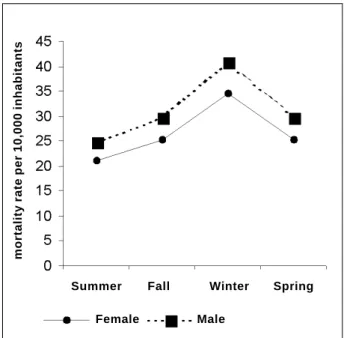
A heterogeneous pattern of seasonal distribution of deaths due to acute myocardial infarction was obser-ved (P<0.001). The mortality rate due to acute myocar-dial infarction was always higher in the winter months and lower in the summer months, when compared with those of the other seasons (P<0.01) (fig. 1). No signi-ficant difference between the mortality rates during spring and fall was observed (P=0.36) for both sexes
and for the 2 age brackets considered. When compared 2-by-2, all other seasons showed significant differences (P<0.01) (tab. I). Age bracket and sex, did not influence significatively the seasonal behavior of mortality rate (P=0.19) (figs. 2 and 3).
The seasonal variation estimated was 30% in the ge-neral group, 23% for individuals younger than 75 years, and 44% for the older ones.
Discussion
The present study is the first to assess the seasonal variation in mortality due to acute myocardial infarction in the South American continent using current criteria of diagnosis and classification of death and based on audited data with a low frequency of deaths due to undefined cau-ses. In 1941, however, Chiaverini et al 11 reported very
simi-lar findings when assessing the causes of death in indivi-duals undergoing autopsy at the coroner’s office in São Paulo. These authors also found a higher frequency of deaths due to cardiovascular diseases in winter.
In our environment, the results confirmed the occur-rence of the concentration of deaths due to acute myocar-dial infarction in the winter months, as had already been ob-served in other countries with very distinct population and climatic conditions. This suggests that the low absolute temperatures in these cold regions are not essential for the wide seasonal variation in mortality due to acute myocar-dial infarction observed. In addition, a greater proportional increase in mortality in the elderly in Canada, as reported by Sheth et al 1, is consistent with the findings here reported.
Table I – Mortality rate ± standard deviation due to myocardial infarction, according to seasons, age bracket, and sex
Seasons Mortality rate ± standard deviation Female sex Male sex
<75 years ≥75 years <75 years ≥75 years Summer 1.55±0.06 21.18±1.13 3.42±0.12 24.92±1.39 Fall 1.79±0.06 25.34±0.95 3.84±0.10 29.62 ± 1.22 Winter 2.09±0.08 34.63±1.51 4.60±0.15 40.75 ± 1.90 Spring 1.81±0.08 25.17±0.95 3.90±0.11 28.61 ± 1.20 Fig. 1 – Mortality rate due to myocardial infarction according to the seasons.
mortality rate per 10,000 inhabitants
1 0 8 1 0 8 1 0 8 1 0 8 1 0 8
Sharovsky et al
Increase in mortality due to MI during winter
Arq Bras Cardiol 2002; 78: 106-9.
Fig. 3 – Mortality rate due to myocardial infarction according to the seasons and sex, in the age bracket < 75 years.
mortality rate per 10,000 inhabitants
Fall
Summer Winter Spring
Male Female
The approximately 30% magnitude of the seasonal variation in mortality due to acute myocardial infarction observed in our findings is compatible with that reported in the literature, which ranges from 10% to 38% 1-3. This fact
may be explained by the low use of active heating, and poor housing and inadequate clothing in a large amount of our population, which is, therefore, exposed to winter extremes, even, if in comparative terms, our winter is much milder than that in other countries 12.
The mechanisms involved in this phenomenon are not
yet clearly understood. Most authors, however, attribute the increase in winter mortality mainly to the reduction in temperature 13-15. This excess in deaths may be explained by
the increase in the incidence of disease and its lethality, as already shown in the report of the Second National Registry of Myocardial Infarction, encompassing 1,474 hospitals in the United States 3.
Cold weather has the following well-characterized effects: cardiovascular effects, such as the increase in heart rate, blood pressure, and systemic vascular resistance 16,17;
neuroendocrine effects, such as the increase in sympathetic activity, elevation in plasma noradrenaline 18,19, activation
of the renin-angiotensin system 20,21; and alterations in blood
and hemostasia, such as the increase in plasmatic volume, in blood viscosity, and in platelet aggregation, in addition to hypercoagulability 16,22 .
The increase in the incidence of respiratory infections during winter and the consequent activation of the acute inflammatory phase has been related to an elevation in fibrinogen and in the activity of factor VII with a possible increase in thrombogenesis 4,5.
The advantage of choosing the database used here was its universal characteristic, encompassing almost all deaths in the municipality of São Paulo; death certificates, however, were considerably imprecise 23. The objective of
our study, however, was not to assess the absolute value of the mortality rate, but its seasonal distribution.
Data obtained support the principle that environmen-tal factors have the capacity to trigger faenvironmen-tal coronary events and allow confirmation of the existence of a wide seasonal variation in mortality due to acute myocardial infarction in the city of São Paulo, with magnitude and population characteristics similar to those found in regions with temperate climates in North America and Europe.
Our study stresses the need for further investigation to explore the role played by the environment, especially temperature and infections, in the genesis of acute myocar-dial infarction. Studies on the seasonal behavior of the sympathetic nervous and renin-angiotensin systems and the clinical value of the adaptation of the medicamentous dosage to seasonal variations would be of special interest, as already proposed by Green et al 24. Another field to be
studied is the better definition of the role played by res-piratory infections, such as influenza and chlamydia infections, in determining the seasonal pattern and the opportunity of preventive strategies.
Based on these data and on the literature, the recom-mendation for better protection against cold weather is noteworthy, through active heating, better residential insulation, and use of adequate clothing, especially in patients at risk or with coronary artery disease 25.
Fig. 2 - Mortality rate due to myocardial infarction according to the seasons and sex, in the age bracket ≥ 75 years.
mortality rate per 10,000 inhabitants
Summer Fall Winter Spring
Arq Bras Cardiol 2002; 78: 106-9.
Sharovsky et al Increase in mortality due to MI during winter
1 0 9 1 0 9 1 0 9 1 0 9 1 0 9 1. Sheth T, Nair C, Muller, et al. Increased winter mortality from acute myocardial
infarction and stroke: The effect of age. J Am Coll Cardiol 1999; 33: 1916-9. 2. Marshall RJ, Scragg R, Bourke P. An analysis of the seasonal variation of coronary
heart disease and respiratory disease mortality in New Zealand. Int J Epidemiol 1988; 17: 325-31.
3. Spencer FA, Goldberg RJ, Becker RC, et al. Seasonal distribution of acute myocardial infarction in the second national registry of myocardial infarction. J Am Coll Cardiol 1998; 31: 1226-33.
4. Woodhouse PR, Khaw K-T, Plummer M, et al. Seasonal variations of plasma fibrinogen and factor VII activity in the elderly: winter infections and death from cardiovascular disease. Lancet 1994; 343: 435-9.
5. Biemond BJ, Levi M, Cate HT, et al. Plasminogen activator and plasminogen activator inhibitor 1 release during experimental endotoxaemia in chimpanzees: effect of interventions in the cytokine and coagulation cascade. Clin Sci (Colch) 1995; 88: 587-94.
6. Rossi G, Vigotti MA, Zanobetti, et al. Air pollution and cause specific mortality in Milan, Italy, 1980-1989. Arch Environ Health 1999; 54: 158-64. 7. Scragg R, Jackson R, Holdaway IM, et al. Myocardial infarction is inversely
associated with plasma 25-hydroxy vitamin D3 levels: a community-based study. Int J Epidemiol 1990; 19: 559-63.
8. Willich SN, Klatt S, Arntz H-R. Circadian variation and triggers of acute coronary syndromes. Eur Heart J 1998; 19(suppl C): C12-23.
9. Muller JE, Tofler GH, Stone PH. Circadian variation and triggers of acute cardiovascular disease. Circulation 1989; 79: 733-43.
10. Gertz SD, Roberts WC. Hemodynamic shear force in rupture of coronary arterial atherosclerotic plaques. Am J Cardiol 1990; 66: 1368-72.
11. Chiaverini R, Rey C. Ensaio acerca das possíveis influências meteorológicas sobre a mortalidade cardiovascular. Rev Bras Med 1947; 4: 673-80. 12. Lerchl A. Changes in the seasonality of mortality in Germany from 1946 to 1995:
the role of temperature. Int J Biometeorol 1998; 42: 84-8.
13. Enquselassie F, Dobson AJ, Alexander HM, et al. Seasons, temperature and coronary disease. Int J Epidemiol 1993; 22: 632-6.
14. Donaldson GC, Keatige WR. Early increases in ischaemic heart disease mortality dissociated from and later changes associated with respiratory mortality after
cold weather in south east England. J Epidemiol Commun Health 1993; 47: 121-6.
15. Pan W-H, Li L-A, Tsai M-J. Temperature extremes and mortality from coronary heart disease and cerebral infarction in elderly Chinese. Lancet 1995; 345: 353-5.
16. Kawahara J, Sano H, Fukuzaki H, et al. Acute effects of exposure to cold on blood pressure, platelet function and sympathetic nervous activity in humans. Am J Hypertens 1989; 2: 724-26.
17. Giaconi S, Ghione S, Palombo C, et al. Seasonal influences on blood pressure in high normal to mild hypertensive range. Hypertension 1989; 14: 22-7. 18. Marchant B, Donaldson G, Mridha K, et al. Mechanisms of cold intolerance in
patients with angina. J Am Coll Cardiol 1994; 23: 630-6.
19. Janský L, Srámek P, Savlíková J, et al. Change in sympathetic activity, cardiovascular functions and plasma hormone concentrations due to cold water immersion in men. Eur J Appl Physiol 1996; 74: 148-52.
20. Cassis L, Laughter A, Fettinger M, et al. Cold exposure regulates the renin-angiotensin system. J Pharmacol Experim Therap 1998; 286: 718-26. 21. Peng J-F, Kimura B, Fregly MJ, et al. Reduction of cold-induced hypertension by
antisense oligodeoxynucleotides to angiotensinogen mRNA and AT
1-receptor
mRNA in brain and blood.Hypertension 1998; 31: 1317-23.
22. Keatinge WR, Coleshaw SRK, Cotter F, et al. Increases in platelet and red cell counts, blood viscosity, and arterial pressure during mild surface cooling: factors in mortality from coronary and cerebral thrombosis in winter. Br Med J 1984; 289: 1405-8.
23. World Health Organization – MONICA Project Principal Investigators. The World Health Organization MONICA Project (MONItoring trends and determinants in Cardiovascular diseases): a major international collaboration. J Clin Epidemiol 1988; 128: 105-14.
24. Green MS, Harari G, Kristal-Bone E, et al. Excess winter mortality from ischaemic heart disease and stroke during colder and warmer years in Israel. An evaluation and review of the role of environmental temperature. Eur J Public Health 1994; 4: 3-11. 25. Danet S, Richard F, Montaye M, et al. Unhealthy effects of atmospheric temperature and pressure on the occurrence of myocardial infarction and coronary deaths. Circulation 1999; 100: E1-E7.