https://doi.org/10.1590/0004-282X20170091
ARTICLE
Quality of life in Parkinson’s disease patients:
progression markers of mild to moderate stages
Qualidade de vida de indivíduos com doença de Parkinson: marcadores da progressão da
fase leve para moderada
Raissa Carla Moreira1, Marise Bueno Zonta2, Ana Paula Serra de Araújo3, Vera Lúcia Israel4, Hélio A. G. Teive5
Parkinson’s disease (PD) is a chronic degenerative dis-ease of the central nervous system that evolves slowly and progressively and is characterized by bradykinesia, muscle rigidity and resting tremor among other motor signs and symptoms1,2.Quality of life is signiicantly impaired not only
by motor symptoms, but also by non-motor symptoms such as depression, anxiety, pain, constipation, hyposmia and sleep disturbances3,4.
here are few studies on the incidence and prevalence of
PD in Brazil; however, the most recent study shows that the
disease afects 3.3% of Brazilians over the age of 60 years4. One
of the concerns when treating PD patients is to improve their
quality of life. his includes their physical, functional and
emotional well-being, their degree of independence and their family relationships, as well as social, economic and political aspects of their lives5,6.
A decline in quality of life in individuals with PD has been associated with worsening motor symptoms and the com-bination of neurodegenerative phenomena, psychological
sufering and stigma associated with the disease7. However,
1Universidade Federal do Paraná, Curitiba PR, Brasil;
2Universidade Federal do Paraná, Hospital de Clínicas, Departamento de Reabilitação, Curitiba PR, Brasil;
3Secretaria Municipal de Saúde, Prefeitura Municipal de Guarapuava, Guarapuava PR, Brasil;
4Universidade Federal do Paraná, Departamento de Fisioterapia, Curitiba PR, Brasil;
5Universidade Federal do Paraná, Departamento de Medicina, Curitiba PR, Brasil.
Correspondence: Raissa Carla Moreira; Rua XV de Novembro, 1299; 80060-000 Curitiba PR, Brasil; E-mail: [email protected]
Conflict of interest: There is no conlict of interest to declare.
Received 25 November 2016; Received in inal form 31 March 2017; Accepted 11 May 2017.
ABSTRACT
Objective: To investigate which factors are associated with the quality of life decline in Parkinson’s disease patients from mild to moderate stages. Methods: The Uniied Parkinson’s Disease Rating Scale and Parkinson’s Disease Questionnaire-39 were used to evaluate clinical/functional data and the quality of life. Results: The markers of clinical/functional worsening were drooling (p < 0.004), need for assistance with hygiene (p = 0.02), greater freezing frequency (p = 0.042), bradykinesia (p = 0.031), greater intensity of the resting tremor (p = 0.035) and “pill rolling” (p = 0.001). The decline in quality of life was related to stigma (p = 0.043), greater impairment in cognition (p = 0.002), mobility (p = 0.013) and for daily living activities (p = 0.05), and was considered more signiicant in men, married, older individuals, and those with a longer time of disease. Conclusions: The quality of life worsening markers at the moderate stage were related to stigma, worsening of cognition, and to greater impairment in mobility and daily living activities.
Keywords: Parkinson disease; quality of life;surveys and questionnaires.
RESUMO
Objetivo: Veriicar os fatores relacionados ao declínio clínico/funcional e de Qualidade de Vida de indivíduos com Doença de Parkinson, da fase leve para moderada. Métodos: Foram utilizadas as escalas Uniied Parkinson’s Disease Rating Scale and Parkinson’s Disease Questionnaire-39 (UPDRS e PDQ-39) para avaliação clínico/funcional e de qualidade de vida Resultados: Os marcadores de piora clínico/funcional na fase moderada foram: sialorréia (p < 0,004), necessidade de ajuda para higiene (p = 0,02), maior frequência do “freezing” (p = 0,042), bradicinesia (p = 0,031) e maior intensidade do tremor de repouso (p = 0,035) e bater dos dedos (p = 0,001). O declínio da qualidade de vida esteve relacionado ao estigma (p = 0,043), ao maior comprometimento da cognição (p = 0,002), da mobilidade (p = 0,013) e da independência para realizar as atividade de vida diária (AVD’s) (p = 0,05), sendo mais importante nos homens, nos casados, nos indivíduos com maior idade e naqueles com maior tempo de evolução da doença. Conclusão: Os marcadores de piora da qualidade de vida na fase moderada estiveram relacionados ao estigma, à piora da cognição, ao maior comprometimento para mobilidade e AVD’s.
in-depth studies are required to diferentiate between the impact of PD at diferent stages of the disease6,7.
The objective of this study was to investigate which factors are associated with clinical/functional decline and a decline in quality of life in individuals with mild and moderate PD.
METHODS
he study was a cross-sectional one, and data on individ
-uals who had been diagnosed with PD, and were registered at the Paraná Association for Individuals with Parkinson’s
Disease (APPP), were collected from January to May 2012 in
the city of Curitiba, in the state of Paraná, Brazil. he con
-venience sample comprised 100 individuals of both sexes between the ages of 60 and 80 years with impairment rated between 1 and 3 on the Hoehn and Yahr (HY) scale. he
group with mild PD (MIG), consisting of 50 individuals clas
-siied as HY 1-2, was compared with the group with moder
-ate PD (MOG), which consisted of 50 individuals classiied as
HY 38,9. he demographic data are shown in Table 1.
Individuals were only included in the study if they agreed to take part, signed a voluntary informed-consent form and were present on the days when the data were collected. Individuals with dementia or any other concomitant
neu-rodegenerative disease were excluded. he study started
after it had been approved by the Human Research Ethics
Committee of the Hospital de Clínicas, Federal University of
Paraná (ref. no. 2654.261/2011-11).
he evaluation protocol covered clinical history and
demographic, clinical, functional and quality-of-life data.
he demographic data were collected in the interview, and
the clinical history was obtained from the patients’ medical records. Clinical/functional data were obtained by applying
the Uniied Parkinson’s Disease Rating Scale (UPDRS) (activi
-ties of daily living [ADL] and motor examination sections)9.
Quality-of-life data were collected with the Parkinson’s
Disease Questionnaire (PDQ-39)10. he UPDRS and PDQ-39
were illed out by the researcher.
he UPDRS evaluates an individual’s signs, symptoms
and activities based on self-reports and clinical observation
and consists of 42 questions in four sections. he ADL and
motor examination sections were analyzed.
he PDQ-39 is an easily-applied, widely-used question
-naire on quality of life in individuals with PD, which
evalu-ates the individual’s health in the previous month. he 39
multiple choice questions cover eight domains and have
ive possible answers: never, occasionally, sometimes, often
and always11,12. he questionnaire is normally illed out by
the individual. However, it was decided to complete it with the help of the researcher during a one-to-one interview because of the possibility of some of the respondents having
a limited education or diiculty writing due to the motor
symptoms of the disease.
Information on HY staging was obtained from the
patients’ medical records at APPP. he inluences of age,
gender, education, marital status and disease duration on quality of life and ADL and motor examination scores were also examined.
Statistics
Quantitative variables were described in terms of their mean, median, minimum, maximum and standard devia-tion, and qualitative variables in terms of frequency and
per-centage. he non-parametric Mann-Whitney test was used
to compare the two groups (MIG and MOG) based on the
UPDRS and PDQ-39 scores.
Spearman’s coeicient was used to evaluate the correla
-tion between the UPDRS and PDQ-39 scores and HY staging
and between the UPDRS and the PDQ-39 scores. he signii
-cance level was set at p < 0.05. he data were analyzed with Statistica 8.0.
RESULTS
he mean disease duration in the MIG was 3.4 (± 2.2) years and 8.1 (± 4.7) in the MOG. he MOG had greater impairment in the ADL domain (UPDRS). his inding
had borderline signiicance and was particularly notice
-able in the increased drooling (p < 0.004), greater need for
Table 1. Comparison of mild Parkinson’s disease and moderate
Parkinson’s disease groups in terms of gender, age, race, marital status and level of education.
Variable Mild Moderate p-value* n (%) n (%)
Gender
Female 28 (56) 22 (44)
Male 22 (44) 28 (56) 0.317
Age (years)
60-65 11 (22) 13 (26)
66-70 16 (32) 8 (16)
71-75 10 (20) 17 (34)
76-80 13 (26) 12 (24) 0.196
Race
White 45 (90) 46 (92)
Yellow/Black 5 (10) 4 (8) 1
Marital status
Married 32 (64) 38 (76)
Separated/widow(er)/single 18 (36) 12 (24) 0.275
Level of education
Primary education (incomplete) 9 (18) 11 (22) Primary education (complete) 27 (54) 19 (38) High school (complete or
incomplete) 5 (10) 8 (16)
Third-level education (complete
or incomplete) 9 (18) 12 (24) 0.438
assistance with personal hygiene (p = 0.02) and increased frequency of freezing (p = 0.042) in this group. Although
greater impairment was observed in motor examination
items in the MOG, this was not statistically signiicant (p = 0.220). Nevertheless, when each item in this domain was considered individually, signiicant diferences were
observed in resting tremor (p < 0.035), pill-rolling (p < 0.001) and bradykinesia (p < 0.031) (Table 2).
In the evaluation of quality of life as measured by the
PDQ-39, the means of seven of the eight items analyzed were greater in the MOG than in the MIG. hese diferences were statistically signiicant in the mobility (p < 0.013), stigma (p < 0.043) and cognition (p < 0.002) domains (Table 3). he diference in the bodily discomfort domain between the
groups was not statistically signiicant, but individual anal
-ysis of the items showed that painful muscle cramps and
spasms caused signiicantly more impairment of quality of life in the MOG group (p = 0.04). he answers to the PDQ-39 for which there was a statistically signiicant diference
between the two groups are shown in Table 4.
here was no correlation between gender and clinical/
functional status or quality of life in individuals in the MIG. In the MOG, a decline in quality of life was associated with a
lack of support from friends and family members (p = 0.01).
Among married individuals, a decline in quality of life
was associated with stigma (p = 0.02) in the MOG and with
a lack of support from friends and family members in both
groups (p < 0.001).
here was no correlation between age and clinical/func
-tional status or quality of life in individuals in the MIG. In the MOG, increasing age was associated with greater
depen-dence in ADLs (p = 0.02) and greater cognitive impairment (concentration and memory, p = 0.01).
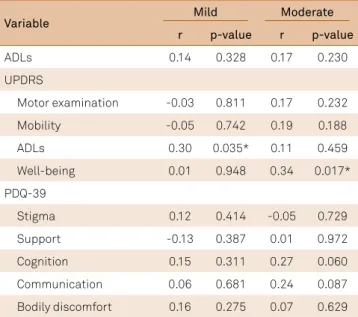
Greater disease duration was associated with a decline
in quality of life in the ADL (MIG, p = 0.03) and emotional well-being (MOG, p = 0.01) domains (Table 5).
Table 2. Comparison of the mild Parkinson’s disease group
with the moderate Parkinson’s disease group in the activities of daily living and motor-examination sections of the UPDRS items with a statistically signiicant difference.
UPDRS –
ADLs Stage
Number of individuals and %
for each answer p-value*
0 1 2 3 or 4
Drooling Mild 24 (48) 15 (30) 11 (22) 0 (0) Moderate 9 (18) 18 (36) 19 (38) 4 (8) 0.004*
Personal hygiene
Mild 5 (10) 34 (68) 10 (20) 1 (2) Moderate 0 (0) 38 (76) 6 (12) 6 (12) 0.020*
Freezing Mild 7 (14) 23 (46) 12 (24) 8 (16) Moderate 8 (16) 11 (22) 13 (26) 18 (36) 0.042* UPDRS - Motor examination
Resting tremor
Mild 5 (10) 30 (60) 12 (24) 3 (6) Moderate 1 (2) 33 (66) 6 (12) 10 (20) 0.035*
Pill-rolling Mild 25 (50) 23 (46) 2 (4) 0 (0) Moderate 7 (14) 39 (78) 3 (6) 1 (2) 0.001**
Bradykinesia Mild 3 (6) 21 (42) 1 (2) 25 (50) Moderate 1 (2) 32 (64) 4 (8) 13 (26) 0.031* UPDRS: Uniied Parkinson’s Disease Rating Scale. ADLs: Activities of Daily living. Categories 2, 3 and 4 were combined for the statistical analysis. Motor Examination: Categories 3 and 4 were combined for the statistical analysis. *Chi-square test, p < 0.05.
Table 3. Comparison of quality-of-life scores in the Parkinson’s Disease Questionnaire-39 domains for the mild, and moderate
Parkinson’s disease groups.
Domain Stage n Mean Median Minimum Maximum Standard
deviation p-value*
Mobility Mild 50 19.2 20.0 1.0 37.0 7.5
Moderate 50 23.4 23.0 10.0 38.0 7.1 0.013*
ADLs Mild 50 9.4 9.0 0.0 19.0 4.6
Moderate 50 11.6 11.0 2.0 24.0 4.8 0.050
Well-being Mild 50 10.0 12.0 0.0 26.0 5.1
Moderate 50 10.5 11.0 1.0 18.0 4.4 0.724
Stigma Mild 50 2.7 1.5 0.0 12.0 3.1
Moderate 50 3.9 2.0 0.0 18.0 3.8 0.043*
Support Mild 50 6.7 8.0 1.0 12.0 2.3
Moderate 50 7.4 8.0 2.0 11.0 2.1 0.089
Cognition Mild 50 5.8 7.0 0.0 12.0 2.6
Moderate 49 7.3 8.0 2.0 12.0 2.4 0.002*
Communication Mild 50 3.3 3.5 0.0 8.0 2.6
Moderate 50 3.6 4.0 0.0 8.0 2.4 0.614
Bodily discomfort Mild 50 6.3 7.0 0.0 11.0 2.3
Moderate 50 6.2 6.0 2.0 10.0 1.8 0.525
DISCUSSION
he domain that evaluates independence in ADLs was signiicantly more afected in patients with moderate PD.
his inding corroborates the results reported in the litera
-ture, in which mild PD is characterized by complete func-tionality and moderate PD by functional impairment due to the more severe signs and symptoms, which act as precur-sors of disability13,14.
Detailed analysis of the responses in this domain showed that the need for assistance with personal hygiene together with drooling and more frequent freezing were markers of
loss of independence and diiculty living with embarrass -ment and limited social interaction. Drooling is associated with muscle rigidity and bradykinesia, symptoms that also lead to a greater need for assistance with personal hygiene15.
For Khoo et al.16, non-motor signs such as drooling were common in the early stages of PD and may adversely afect
patients’ functional status and well-being.
A sudden loss of the ability to start or sustain a spe-cific motor activity ( freezing) can also adversely affect performance in ADLs and subject the individual to more frequent falls17.
While there was no signiicant diference between
the mild and moderate PD groups in the motor
examina-tion secexamina-tion of the UPDRS as a whole, analysis of each item showed that there was a signiicant diference in resting
tremor, pill-rolling and bradykinesia between the groups.
Bradykinesia, or slowness of movement, directly afects per
-formance of activities such as turning in bed, standing up, getting dressed and walking2,15. It can be inferred from the
results of the ADL section that the ability to perform
activi-ties related to personal hygiene is also afected.
Resting tremor, which is usually the irst sign reported by
individuals with PD15,16,17,18, was identiied as the sign most
closely associated with perceived worsening of the patient’s
health. Santos, Menezes and Souza19 reported that
individu-als in their series experienced embarrassment, particularly in connection with tremor because of its association with alco-holism. In addition to embarrassment, symptoms such as
Table 4. Answers in the PDQ-39 domains with statistically signiicant, or borderline statistically signiicant differences between
the mild, and moderate Parkinson’s disease groups.
PDQ-39 domains Difference between the MIG and MOG groups
Mobility
Q1. Have you had dificulty doing the leisure activities you like? p = 0.041
Q10. Have you been conined to the house more than you would like? p = 0.052
ADLs domain
Q5. Have you had dificulty cutting up your food? p = 0.048
Q6. Have you had dificulty holding a drink without spilling it? p = 0.043
Emotional well-being domain
Q5. Have you felt anxious? p = 0.01
Q6. Have you felt worried about your future? (p=0.054) p = 0.054
Stigma domain
Q2. Have you avoided situations which involve eating or drinking in public? p = 0.045 Cognition domain
Q2. Have you had problems with your concentration? p = 0.018
Q3. Have you felt your memory was bad? p = 0.027
Bodily discomfort domain
Q1. Have you had painful muscle cramps or spasms? p = 0.04
MIG: group with mild PD; MOG: group with moderate PD; PDQ-39: Parkinson’s disease questionnaire-39.
Table 5. Relation between UPDRS and PDQ-39 domains
and disease duration in the mild, and moderate Parkinson’s disease groups.
Variable Mild Moderate
r p-value r p-value
ADLs 0.14 0.328 0.17 0.230
UPDRS
Motor examination -0.03 0.811 0.17 0.232
Mobility -0.05 0.742 0.19 0.188
ADLs 0.30 0.035* 0.11 0.459
Well-being 0.01 0.948 0.34 0.017*
PDQ-39
Stigma 0.12 0.414 -0.05 0.729
Support -0.13 0.387 0.01 0.972
Cognition 0.15 0.311 0.27 0.060
Communication 0.06 0.681 0.24 0.087
Bodily discomfort 0.16 0.275 0.07 0.629
tremor and pill-rolling evolve in parallel with prejudice and reduced self-esteem and self-image, as they lead to shame, anxiety, a risk of depression, shyness in public spaces and social isolation19.
Akinetic-rigid syndrome generally manifests when there
has already been a 60% to 80% loss in dopaminergic neu
-rons in the substantia nigra. Here, these symptoms were more important in individuals in the MOG, who had a mean disease duration of eight years, compared with three years in the MIG17,20.
he greatest impairment in terms of quality of life in the
MOG was observed in the domains of mobility, stigma,
cog-nition and ADLs, corroborating the indings of studies by Navarro-Peternella et al.,9 Pinheiro et al.,13 Navarro-Peternella
and Marcon14, and Quintella et al.21
In the mobility domain, having diiculty doing pleasur
-able leisure activities was one factor that adversely afected quality of life, a inding also reported in studies by Mandira22
andTavares et al.23. Normal mobility is required to perform
ADLs and leisure activities; reduced mobility compromises performance of these activities, limits the activities that can be performed and increases the time required to perform them. Individuals in the MOG also reported that they were
conined to the home more than they would like, indicating
that they are increasingly less able to perform activities out-side their homes. Increasing physical impairment associated with the main symptoms of the disease causes individuals with PD to become isolated, while at the same time making them more dependent on others to perform activities that previously gave them a sense of personal satisfaction, in turn further reducing their quality of life13,24.
A greater dependence on others to carry out daily activi-ties such as cutting food and drinking without spilling was a further factor in the decline in quality of life in these patients, particularly when the disease was in the moderate stage. Rigidity, bradykinesia and tremor impose limitations on these activities15, which in turn leads to irritability, anxiety,
insecurity and pessimism as the individual is faced with the prospect of increasing dependence on others24.
Anxiety and concern about the future were signiicantly
more important in the MOG, corroborating the study by Correia et al.20, showing that depressive symptoms, including
anxiety, contribute to a decline in quality of life in these
indi-viduals. Navarro-Peternella and Marcon14 studied
individu-als with PD and found that fear and insecurity about depen-dence on others, about loss of independepen-dence at work and in ADLs and about the future in general, help to aggravate the
condition. he individuals in their study reported that under
-standing the unstable nature of the disease and the fact that it was incurable is something that sadly they have to face for the rest of their lives and that will be part of their relation-ships and day-to-day activities.
More individuals in the MOG than the MIG reported avoiding situations that involved eating or drinking in
public. This difference was statistically significant. Stigma
in the MOG was an important social factor that adversely affected quality of life in the individuals assessed.
Werle et al.25 investigated quality of life in individuals with
cervical dystonia, a chronic disease that is also associated with stigma. They found that the need to hide the dis-ease, insecurity in the presence of new people, problems with friends and family members, fear about the disease and sadness and irritation were factors that reduced their quality of life.
In our sample, problems related to concentration and
poor memory were more signiicant in the MOG and pro
-gressively impaired quality of life, corroborating the study by Rodríguez-Violante et al.26 Motor symptoms are no
lon-ger considered the only important determinants of quality of life in individuals with PD, and the importance of non-motor symptoms, such as depression, apathy, fatigue, pain and cog-nitive deterioration, have been increasingly recognized9,17.
Here, the groups were similar in terms of gender, and the decline in quality of life among men was related to lack of support from friends and family members, corroborating
the study by Navarro-Peternella and Marcon9. In a study by
Tavares et al.,23 the domain that evaluated social relations
was a predictor of decline in quality of life in men with PD. Quality of life among married individuals in our series was worse in the social support domain in both the mild and moderate stages. Among married individuals with moderate PD, greater impairment of quality of life was also associated with stigma. This finding is unexpected as married individuals are normally considered to have greater support and acceptance. On the other hand, this finding may be explained by the fact that a chronic dis-ease that causes increasing dependence can be a source of conflict and strengthen or weaken affective ties and family bonds14,27.
While in the present study older age among individuals
in the moderate stage was related to worse scores for ADLs
and cognition in the PDQ-39, in a study by Tedrus et al.,28 the
greatest impairment was observed for the ADL and mobil-ity domains. Longer disease duration was associated with greater impairment of quality of life in the ADL and
emo-tional well-being domains in the PDQ-39, a inding also
reported in other studies26,29. In the study by Tedrus et al.,28
a decline in quality of life in individuals with PD was associ-ated not only with disease duration but also with advanced age and age of onset.
In conclusion, markers of decline in quality of life in the moderate stage of PD were related to stigma, worsening cog-nition, greater mobility impairment and reduced indepen-dence in ADLs. Drooling, a greater need for assistance with personal hygiene and a greater frequency of freezing caused
signiicant quality-of-life impairment in individuals in the
References
1. Kalia LV, Kalia SK, Lang AE. Disease-modifying strategies for Parkinson’s disease. Mov Disord. 2015;30(11):1442-50. https://doi.org/10.1002/mds.26354
2. Postuma RB, Berg D, Stern M, Poewe W, Olanow CW, Oertel W et al. MDS clinical diagnostic criteria for Parkinson’s disease. Mov Disord. 2015;30(12):1591-601. https://doi.org/10.1002/mds.26424 3. Lees AJ, Hardy J, Revesz T. Parkinson’s
disease. Lancet. 2009;373(9680):2055-66. https://doi.org/10.1016/S0140-6736(09)60492-X
4. Souza A, Barreto MM, Santos SMS. [Evaluation of functional activity and quality of life in women with Parkinson’s disease]. Saúde Pesqui. 2010;3(2):167-72. Portuguese.
5. Ferreira FD, Ferreira FMD, Heleno RB, Mella-Júnior SE. [Parkinson’s disease: physiopathologic and therapeutic aspects]. Saúde Pesqui. 2010;3(2):221-8. Portuguese
6. Silva PFC, Pereira RPR, Silva SM, Corrêa JCF, Corrêa FI. [Correlation between clinical profile, quality of life and disability of the patients of Associação Brasil Parkinson]. ConScientiae Saúde. 2010;10(4):650-6. Portuguese. https://doi.org/10.5585/conssaude.v10i4.3095
7. Martinez-Martín P, Damián J. Parkinson’s disease: depression and anxiety in Parkinson’s disease. Nat Rev Neurol. 2010;6:243-5. https://doi.org/10.1038/nrneurol.2010.49
8. Hoehn MM, Yahr MD. Parkinsonism: onset, progression and mortality Neurology. 1967;17(5):427-42. https://doi.org/10.1212/WNL.17.5.427 9. Navarro-Peternella FM, Marcon SS. Quality of life of a
person with Parkinson’s disease and the relationship between the time of evolution and the severity of the disease. Rev Lat Am Enfermagem. 2012;20(2):384-91. https://doi.org/10.1590/S0104-11692012000200023
10. Fahn S, Elton R. Members of the UPDRS. Development Committee. The unified Parkinson’s disease rating scale. In: Fahn S, Marsden CD, Calne DB, Goldstein M, editors. Recent developments in Parkinson’s disease. New York: McMellam Health Care Information; 1987. p.153-63.
11. Peto V, Jenkinson C, Fitzpatrick R, Greenhall R. The development and validation short measure of functioning and well being for individuals with Parkinson’s disease. Qual Life Res. 1995;4(3),241-8. https://doi.org/10.1007/BF02260863
12. Borges AEA, Mendes LM, Lemos MTM. [Physiotherapeutic perception of parkinsonian individuals correlating assessment scales]. Rev Bras Ci Saúde. 2014;18(3):187-94. Portuguese. https://doi.org/10.4034/RBCS.2014.18.03.01
13. Pinheiro IM, Santos LLS, Paula LCN, Costa ACN. [Impact of Parkinson’s Disease in functionality and quality of life of elderly in a geriatric unit reference in the city of Salvador – Bahia]. Rev Ciênc Méd Biol. 2014;13(3):292-7. Portuguese. https://doi.org/10.9771/cmbio.v13i3.12933
14. Navarro-Peternella FM, Marcon SS. [Living with Parkinson’s disease from the perspective of parkinsonians and their relatives]. Rev Gaúcha Enferm. 2010;31(3):415-22. Portuguese. https://doi.org/10.1590/S1983-14472010000300002
15. Soares GS, Peyré-Tartaruga LA. [Parkinson’s disease and physical exercise: a literature review]. Cien Movimento. 2011;12(24):69-85. Portuguese. https://doi.org/10.15602/1983-9480/cmbs.v12n24p69-85 16. Khoo TK, Yarnall AJ, Duncan GW, Coleman S, O’Brien JT,
Brooks DJ et al. The spectrum of nonmotor symptoms in early Parkinson disease. Neurology. 2013;80(3):276-81. https://doi.org/10.1212/WNL.0b013e31827deb74
17. Massano J. [Parkinson’s disease: a clinical update]. Acta Med Port. 2011;24(84):827-34. Portuguese.
18. Souza CF, Almeida HC, Sousa JB, Costa PH, Silveira YSS, Bezerra JC. [Parkinson’s disease and the process of aging motor: literature review]. Rev Neurocienc. 2011;19(4):718-23. Portuguese. 19. Santos ISC, Menezes MR, Souza AS. [Elderly people’s conceptions
of living with Parkinson’s disease]. Rev Enferm UERJ. 2009;17(1):69-74. Portuguese.
20. Correia MGS, Paixão AO, Jesus AVF, Silva FS, Messias GMS, Nunes TGM et al. Doença de Parkinson: uma desordem neurodegenerativa. Cad Grad Ciênc Biol Saúde. 2013;1(16):57-65. 21. Quintella RS, Sachetti A, Wibelinger LM, Oliveira SG. Qualidade
de vida e funcionalidade na doença de Parkinson. RBCEH. 2013;10(1):104-12. https://doi.org/10.5335/rbceh.2012.1823 22. Mandira ALS. [Study of positive inluence on quality of life patients
with Parkinson’s Disease participants Group Lotus]. Kairós Gerontol. 2012;15(4):185-99. Portuguese.
23. Tavares DMS, Dias FA, Santos NMF, Haas VJ, Miranzi SC. Factors associated with the quality of life of elderly men. Rev Esc Enferm USP. 2013;47(3):678-85. https://doi.org/10.1590/S0080-623420130000300022
24. Vara AC, Medeiros R, Striebel VLW. [Physical therapy in Parkinson’s disease]. Rev Neurocienc. 2012;20(2):266-72. Portuguese. 25. Werle WR, Takeda SYM, Zonta MB, Guimarães ATB,
Teive HAG. The physical, social and emotional aspects are the most affected in the quality of life of the patients with cervical dystonia. Arq Neuropsiquiatr. 2014;72(6):405-10. https://doi.org/10.1590/0004-282X20140044
26. Rodríguez-Violante M, Cervantes-Arriaga, A, Corona T, Martínez-Ramírez D, Morales-Briceño H, Martínez-Martín P. Clinical determinants of health-related quality of life in Mexican patients with Parkinson’s disease. Arch Med Res. 2013;44(2):110-4. https://doi.org/10.1016/j.arcmed.2013.01.005
27. Cetolin SF, Trzcinski C, Mahl AC, Steffani JÁ, Luccas TN, Presta AA. Alterações Sociofamiliares na vida de pessoa com mal de Parkinson usuárias da saúde pública. UNOESC Ciência – ACHS. 2012;3(2):203-12. 28. Tedrus GMAS, Fonseca LC, Kange PM. Parkinson’s
diseasei of clinical and cognitive aspects on quality of life. Dement Neuropsychol. 2010;4(2):131-7. https://doi.org/10.1590/S1980-57642010DN40200010 29. Filippin NT, Martins JS, Libera LBD, Halberstadt BF,