Instituto de Cardiologia RS/Fundação Universitária de Cardiologia Mailing address: Domingos Hatem - Unidade de Pesquisa do IC/FUC Av. Princesa Isabel, 370 - Cep 90620-001 - Porto Alegre, RS, Brazil E-mail: [email protected]
Received: 12/30/02 Accept: 6/5/03
English version by Stela Maris C. e Gandour
Arq Bras Cardiol, volume 82 (nº 3), 228-34, 2004
Domingos M. Hatem, Iran Castro, José Carlos Haertel, Raul I. Rossi, Paulo Zielinsky, Flávio C. Leboute, Nara Pomar, Maristela Winckler, Rogério N. Kersten, Carlos Roberto Cardoso, Carlos A.M. Gottschall
Porto Alegre, RS - Brazil
Short- and Long-Term Results of Percutaneous Balloon
Valvuloplasty in Pulmonary Valve Stenosis
Pulmonary balloon valvuloplasty, initiated in 1982, was 1 of the first therapeutic procedures to use catheters for the treatment of congenital heart diseases 1,2. It was first
perfor-med in 1982 with the static technique, which is still currently used by Kan et al 1. From then on, the percutaneous
pulmona-ry valvuloplasty technique underwent few changes; in re-gard to the material used, however, great progress has been made. The improvement in the technology of balloon-cathe-ter confection allowed the production of lower-profile bal-loons, therefore, reducing the complications of the procedure, notably the vascular ones, enabling the performance of the procedure in neonates, in addition to improving the chances of passing across the stenotic orifice 3,4. Balloons whose
dia-meters exceeded the ring measurement by 20% to 40% on angiography were shown to be safe and more effective than those used in the initial procedures, which adopted the dia-meter of the pulmonary ring as the upper limit. This increased the success rate with lower residual gradients and no increa-se in the number of complications 5,6.
Initially, most hemodynamic data of patients with pul-monary valve stenosis were obtained from cardiac cathete-rization. Currently, the use of Doppler echocardiography allows the reliable and serial assessment of the stenotic le-sion by determining the gradient through the pulmonary valve in any age group, which enables one to follow the na-tural history of the disease 7-9.
The immediate results and the short- and medium-term follow-up of pulmonary valve dilation have already been well documented in the literature. Reports on long-term fol-low-up, however, are still scarce 10-19.
Methods
A noncontrolled cohort study of incidence was carried out in patients undergoing percutaneous pulmonary valvu-loplasty as a treatment for pulmonary valve stenosis.
The outcome axis is dynamic, because the major clini-cal outcomes considered were immediate success, efficacy, and the intermediate and late results of balloon pulmonary valvuloplasty, using the measurement of the maximum
ins-Objective - To assess the long-term results of percuta-neous balloon valvuloplasty at a single institution.
Methods - This study comprised 189 patients with pulmonary valve stenosis undergoing percutaneous bal-loon valvuloplasty from 1984 to 1996, whose mean age was 7.97±9.25 years. The procedure was classified as suc-cessful when the RV-PA gradient was reduced to levels < 36 mmHg; restenosis was indicated by RV-PA gradients ≥ 36 mmHg after an effective procedure.
Results - After the procedure, the peak-to-peak trans-valvular gradient decreased from 70.12±30.06 to 25.11 ±20.23 mmHg (P<0.001). Immediate success was obtained in 148 (78.72%) patients. A later reduction in the gradient to values < 36 mmHg was obtained in 24 other patients previously categorized as unsuccessful. Therefore, percu-taneous balloon valvuloplasty was considered effective in 172 (91.01%) patients. Effectiveness increased to 93.53% (159/170) in the cases of typical morphology. Follow-up ranged from 4.39±3 years to 13.01 years. Restenosis was observed in 24 (13.95%) patients. Pulmonary regurgita-tion was detected in 95.1% of the patients, being more in-tense than mild in 29.5% of the patients. The probability of maintaining an appropriate result, at any time point, with no restenosis was 92.29% in 2 years, 87.38% in 5 years, 82.46% in 8 years, and 64.48% in 10 years.
Conclusion - Percutaneous balloon valvuloplasty was effective and safe for the treatment of pulmonary valve stenosis with excellent short- and long-term results.
tantaneous gradient on Doppler echocardiography and the peak-to-peak gradient obtained through cardiac catheteriza-tion. In regard to the temporal axis, the study may be consi-dered mixed, because part of the data were collected in a his-torical (retrospective) way and part in a contemporary (prospective) way.
From September 1984 to October 1996, 252 consecutive patients diagnosed with pulmonary valve stenosis were re-ferred to the hemodynamics department of the Instituto de Cardiologia of Rio Grande do Sul/Fundação Universitária de Cardiologia to undergo balloon pulmonary valvuloplasty.
The following patients were excluded from the study: those requiring balloon valvuloplasty as a palliative treat-ment for cyanosis, and those with pulmonary valve steno-sis and large defects in the interventricular septum. Patients with interatrial septal defects or patent oval foramen were included in the study. The criteria for indicating percuta-neous pulmonary valvuloplasty were a peak-to-peak pul-monary transvalvular systolic gradient obtained during any previous hemodynamic study or during the therapeutic procedure, or a maximum instantaneous gradient obtained on Doppler echocardiography, or both, greater than 50 mmHg with a normal cardiac index, independent of the symptoms, in addition to the evidence of right ventricular hypertrophy on the electrocardiogram with symptoms of heart failure, angina, or syncope. Two hundred and thirty-eight patients underwent percutaneous balloon valve dila-tion, 45 dropped out during follow-up, and 4 had only 1 echocardiogram performed within the 30 days following the procedure. The population actually studied comprised 189 patients, all of whom underwent at least 1 Doppler echocar-diographic study 30 days after the procedure until 12/31/97, corresponding to 79.41% of the patients eligible for the ana-lysis of the final follow-up.
Ninety-six (50.79%) patients were females. The mean age of the patients followed up, at the time of valvuloplasty, was 7.97±9.25 years, ranging from 0.1 to 48.88 (median of 5.04) years. No patient was a neonate, 30 (15.88%) were 1 to 12 months old, 114 (60.32%) were 1 to 10 years old, 24 (12.7%) were 10 to 20 years old, and 21 (11.1%) were older than 20 years.
The criterion used for characterizing the immediate success of the procedure was the reduction in the residual peak-to-peak systolic gradient between the right ventricle and the pulmonary artery, measured after valve dilation, to values < 36 mmHg. The efficacy of pulmonary valvuloplasty comprised the cases in which immediate success occurred or those in which, despite lack of immediate success, a later reduction was observed in the maximum instantaneous resi-dual gradient to values < 36 mmHg in subsequent Doppler echocardiographic studies. In assessing the results of late follow-up, the same values of the gradients already used to define success or unsuccess immediately after valvuloplas-ty were used. The occurrence of restenosis was defined as a new elevation in the transvalvular gradient to levels
≥ 36 mmHg after effective valvuloplasty. The patients were also analyzed in regard to the morphology of the stenotic valve, which was classified as typical, dysplastic, or
com-plex, in the case of previous surgical valvotomy (postopera-tive restenosis).
The technique of valvuloplasty used was similar to that reported by Kan et al 1, in which the procedure was
per-formed, depending on age, with the patient under general anesthesia. Special attention was given to the withdrawal tracings between the pulmonary artery and the right ventri-cle, as well as to the measurement of the systolic pressure in that ventricle, because the final indication of the procedure depended on these measurements. Ventriculography was performed in the left profile and in the 30o right anterior
obli-que projection with cranial angulation to exclude the pre-sence of subvalvular obstruction, and to allow an appro-priate measurement of the pulmonary ring, which directly influenced the choice of the diameter of the balloon. The ana-tomy and the diameter of the balloon to be used were defi-ned as being up to 40% greater than the systolic diameter between the points of insertion of the pulmonary leaflets in the arterial wall. The technique with a single balloon was used in 157 patients and that with 2 balloons in 32 patients. The Doppler-echocardiographic studies consisted initially of the sequential morphologic assessment 20.
The degree of severity of the obstruction determined by pulmonary valve stenosis was assessed and quantified with continuous Doppler. The maximum instantaneous gradient was calculated through the maximum velocity ob-tained with the modified Bernoulli equation. In case of asso-ciated pulmonary subvalvular obstruction, a mosaic of colors indicated the presence of flow turbulence below the plane of the pulmonary valve and also a characteristic pattern of the spectral curve on Doppler with an increase from the beginning to the end of systole. The presence and intensity of pulmonary regurgitation were also assessed through color flow mapping, as reported by Cooper et al 21,
considering the extension of the regurgitating jet and its width at the origin.
In regard to the gradients, the groups were compared at baseline with the Student t test. The chi-square test was used for the categorical variables. The transvalvular gradients be-fore and after valvuloplasty were compared with the t test for paired samples. An actuarial survival curve was built with the aid of SPSS 8 statistical software. The continuous variables were expressed as means ± standard deviation. The characte-rization of the result of pulmonary valvuloplasty was trans-formed into a dichotomous variable (success x unsuccess) using the value of 35 mmHg as the cut point.
Results
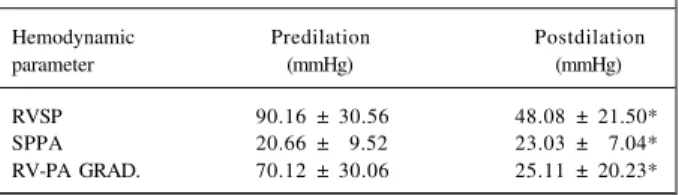
Immediately after the procedure (tab. I), the patients had a reduction in the right ventricular systolic pressure from 90.16±30.56 to 48.08±21.50 mmHg (P<0.001). The pulmonary systolic pressure had a slight elevation from 20.66±9.52 to 23.03±7.04 mmHg (P<0.001). The peak-to-peak pulmonary transvalvular gradient had a reduction from 70.12±30.06 to 25.11±20.23 mmHg (P<0.001) (tab. I).
gra-dient measurements after balloon inflation due to the occur-rence of complications during the procedure, which was then interrupted. A Doppler echocardiographic study car-ried out after percutaneous dilation revealed the presence of an elevated residual gradient.
The 188 patients undergoing the hemodynamic measu-rements after the procedure were considered for analyzing the immediate results. The gradient measured represents the to-tal residual gradient between the right ventricle and the pul-monary trunk, and the contributions of the valvular and in-fundibular components were not routinely individualized, which was the reason why this factor was not analyzed.
One hundred forty-eight (78.72%) patients had a peak-to-peak pulmonary transvalvular gradient < 36 mmHg, representing the group that obtained immediate success with percutaneous dilation of the pulmonary valve. On the other hand, 40 (21.28%) patients had a peak-to-peak resi-dual gradient ≥ 36 mmHg, characterizing an unsuccessful procedure in regard to alleviating pulmonary valve stenosis. Among the patients with typical pulmonary valve stenosis (n=170), 137 (80.59%) had immediate success after the pro-cedure; on the other hand, among those with pulmonary valve stenosis with a dysplastic valve and complex morpho-logy consequent to the previous surgery (n=18), the rate of success was 61.11% (P<0.05).
Analyzing separately the patients with stenosis in a dysplastic pulmonary valve (n=9) and those with a complex valvular morphology (n=9), success was obtained in 66.67% and 55.56% (NS), respectively.
The patients who did not obtain immediate success after valvuloplasty had more severe pulmonary valve steno-sis, characterized by a greater peak-to-peak pulmonary trans-valvular gradient (P<0.001) and a more elevated right ventri-cular systolic pressure (P<0.001). No difference regarding age and the degree of reduction in the peak-to-peak transvalvular gradient was observed between the 2 groups (tab. II).
Regarding the reduction in the peak-to-peak systolic gradient obtained with valvular dilation, no significant diffe-rence was observed between the groups of patients with immediate success or unsuccess (tab. II). Among the for-mer, a reduction of 46.31±24.85 mmHg was observed, and, among the latter, a reduction of 40.58±29.25 mmHg (NS) was observed. In both groups, the reduction in the gradient ran-ged from -1 to -142 mmHg, an elevation of 15 mmHg being observed in 1 patient consequent to infundibular reaction. Acute complications occurred in 8 (4.23%) patients.
Dissection of the inferior vena cava occurred in 1 case, but no retroperitoneal bleeding or hematoma was observed. Two patients had convulsions during the procedure, more pre-cisely during the inflation of the balloon catheter. Nontran-sient supraventricular arrhythmia (atrial fibrillation) occurred in 2 patients. One patient had deep venous throm-bosis in the right lower limb after the procedure. Rupture of the tricuspid subvalvular apparatus was observed in 1 patient, determining a significant tricuspid regurgitation. The procedure was interrupted in 1 patient due to the occurrence of cardiac arrest that required resuscitation maneuvers.
For analyzing the efficacy of the valvuloplasty, the 189 patients were considered. The efficacy of valvuloplasty was assessed over an intermediate follow-up period compri-sing the time interval between the performance of valvulo-plasty and the first Doppler echocardiography performed. The efficacy of balloon pulmonary valvuloplasty en-compassed those patients who obtained immediate success in the procedure and those who maintained a peak-to-peak residual gradient immediately after valvuloplasty ≥ 36 mmHg and who had a spontaneous reduction to levels < 36 mmHg in the first Doppler echocardiography during follow-up.
The first Doppler echocardiography was performed 2.15±2.52 years after valvuloplasty, and a reduction in the RV-PA gradients to values below 36 mmHg was observed in 24 patients in the group with no success immediately after percutaneous balloon valvuloplasty. Of those, 22 had typi-cal morphology, and 2 had complex morphology, but none of the latter had a dysplastic pulmonary valve.
Valvuloplasty was considered effective in 172 (91.01%) patients, 148 of whom had a reduction in the pul-monary transvalvular gradient right after the procedure, and another 24 had it during follow-up (fig. 1). One hundred and seventy (89.95%) patients had pulmonary valve steno-sis with the typical dome-like morphology, an appropriate result being obtained in 159, corresponding to a success rate of 93.53%. Of the 24 patients evolving with a reduction in the transvalvular gradient, 22 had typical morphology, while 2 had complex morphology (fig. 1).
The mean follow-up duration was 4.39±3 years, until a maximum of 13.01 years. The mean maximum instantaneous pulmonary transvalvular gradient was 26.12 ±19.08 mmHg, ranging from 5 to 100 mmHg (fig. 2).
Table I - Hemodynamic findings before and immediately after balloon valvuloplasty
Hemodynamic Predilation Postdilation
parameter (mmHg) (mmHg)
RVSP 90.16 ± 30.56 48.08 ± 21.50*
SPPA 20.66 ± 9.52 23.03 ± 7.04*
RV-PA GRAD. 70.12 ± 30.06 25.11 ± 20.23*
RVSP - right ventricular systolic pressure; SPPA - systolic pressure in the pulmo-nary artery; RV-PA GRAD - pulmopulmo-nary transvalvular gradient; *P<0.001 compa-ring pre-and postdilation values.
Table II - Predictive factors of immediate result in pulmonary valvuloplasty
Factor Success group Unsuccess group (mean ± SD or number) (mean ± SD or number)
N°of patients 148 40
Age (years) 7.40 ± 8.34 10.39 ± 11.81 RVSP 83.02 ± 25.39 117.23 ± 33.33 * Peak-to-peak RV-PA 62.80 ± 24.92 97.58 ± 32.15 * gradient (mmHg)
Reduction in the RV-PA -46.31 ± 24.85 -40.58 ± 29.25 gradient (mmHg)
One hundred forty-nine (78.84%) patients had a maxi-mum instantaneous gradient < 36 mmHg, characterizing the maintenance of the success of pulmonary valvuloplasty, and the patients remained free from restenosis during the follow-up period. Forty (21.16%) patients had a maximum instantaneous gradient ≥ 36 mmHg, 16 (8.47%) of whom maintained the noneffective result (unsuccess) of valvulo-plasty and 24 (12.7%) had a new elevation in the transvalvu-lar gradient during follow-up, characterizing the occurrence of pulmonary valve restenosis (fig. 1).
Valves with typical or dysplastic stenoses, or steno-ses with complex morphology were found in, respectively, 170, 9, and 10 patients. The rate of success in the group with typical stenosis remained 81.18%; for the others, 55.56% and 60% were the rates for the patients with dysplastic and complex morphology, respectively (P<005).
A new elevation in the pulmonary transvalvular gradient to levels ≥ 36 mmHg after relief of the pulmonary valve stenosis through dilation with the balloon characteri-zed the occurrence of restenosis. Of the 172 patients of the cohort whose procedures were successful (effective
per-cutaneous balloon valvuloplasty), with gradients < 36 mmHg immediately after valvular dilation or later due to a reduction in infundibular hypertrophy, 24 (13.95%) had pulmonary valvular restenosis, and only 2 had a dysplastic pulmonary valve (fig. 1). The detection of valvular restenosis occurred 3.56±3.50 years after percutaneous dilation, and, in 29.2% of the cases, it occurred after 5 years of follow-up. In the group of patients with restenosis, the mean age was 7.69±7.89 years, the peak-to-peak gradient before valvuloplasty was 69.63±40.19 mmHg, and that immediately after valvuloplasty was 26.88±13.07 mmHg. No significant difference was observed between the patients who developed restenosis and those who remained free from restenosis in regard to age or the gradient before valvuloplasty and the residual gradient after valvuloplasty. Sixty-one sequential patients, corresponding to 32.3% of the cohort, underwent the last Doppler echocardiogra-phy in a single device (HP Sonos 2500). They were carefully assessed by 2 observers and by a third in case of disagree-ment in regard to the degree of pulmonary regurgitation. Some degree of regurgitation was observed in 95.1% of the patients (58/61), and a more intense than mild degree was observed in 29.5% (18/61).
The probability of persistence of a good result in pulmonary valvuloplasty, with no restenosis, was 92.29% in 2 years, 87.38 % in 5 years, 82.46% in 8 years, and 64.48% in 10 years (fig. 3).
Discussion
The percutaneous dilation of the pulmonary valve with a balloon is currently considered the therapeutic moda-lity of choice for the treatment of pulmonary valve stenosis in any age group and any valvular morphology 17. It is an
ef-fective and safe technique, with low indices of mortality and of incidence of important complications when used in a pe-riod other than the neonatal 12,17. The method was
develo-ped to replace surgical valvotomy, reported by Brock in 1948, with a mortality rate around 1.5 to 2% 22.
The study of the follow-up of the patients of this co-hort was based on the maximum instantaneous gradient
ob-% 100
90
80
70
60
50
40
30
20
10
0
2 0 2 4 6 8 10 12 14
Patients years
168 122 86 48 24 11 2
Fig. 3 - Analysis of the permanence of a good result of pulmonary balloon valvulo-plasty, using the actuarial method.
Sucess Spont. Red. Grad. < 36 mmHg Restenosis Unsuccess
%
100
80
60
40
20
0
40
17
24
16
24
Immediate n = 188
Intermediate n = 189
Fig. 1 - Immediate results and periods of medium- and long-term follow-up of patients undergoing percutaneous balloon valvuloplasty.
Late n = 189
mmHg
80
70
60
50
40
30
20
10
0
p < 0.001
p < 0.001 p < 0.05 p < 0.01
70.12 ± 30.06
25.11 ± 20.23
28.63 ± 18.89
26.12 ± 19.08
Prevalvuloplasty gradient
Immediately postvalvuloplasty
gradient
Intermediate follow-up
gradient
Late follow-up
gradient
tained on Doppler echocardiography and comparable to the gradient obtained on cardiac catheterization 23,24.
This high degree of correlation and concordance is re-duced when the measurements obtained with the 2 methods are assessed unsimultaneously. This difference is usually small, < 10 mmHg. Some authors suggest that the greater gradient should be used, even if obtained in an unsedated patient, reflecting a more actual physiological condition 25.
This explains the findings in some patients in this cohort, who, at the time of valvuloplasty, had peak-to-peak gradients significantly lower than those obtained on Dop-pler echocardiography before valvuloplasty, even in those already known as having previously documented signifi-cant pulmonary valve stenosis.
Immediate success documented in 78.72% (148/188) of the patients, comprising all valve morphologies is consistent with those observed by other authors, which ranged from 54% to 87.1% 10,19,26. The patients who did not obtain
im-mediate success with percutaneous dilation had a significan-tly greater pulmonary transvalvular gradient and right ventri-cular systolic pressure than those who obtained immediate success. No significant difference between the 2 groups in regard to age, sex, and degree of reduction in the peak-to-peak pulmonary transvalvular gradient was observed.
Ray et al 19, studying 139 patients, also observed that
those who obtained incomplete relief of the obstruction right after valvuloplasty had a more significant degree of pulmonary valve stenosis characterized by greater RV-PA gradients and right ventricular systolic pressure. In this same study, the mean age of the patients whose procedures were unsuccessful was higher.
In the present study, the reduction in the transvalvular gradient obtained was similar in both groups, 46.31±24.85 mmHg and 40.85±29.25 mmHg (NS), respectively, in those who obtained immediate success and in those who did not. Mendelsohn et al 27 also found an almost identical
re-duction in the gradients between the 2 groups, with values around 40 mmHg, suggesting that this decrease in the gra-dient was finite. The success of valvuloplasty related to the initial gradient value, which could have a limited reduction. The authors suggested an earlier intervention, indicating balloon valvuloplasty in patients with lower degrees of pul-monary valve stenosis, with gradient values of lower mag-nitude, such as 40 mmHg. The consequence of this earlier intervention would be a lower residual systolic gradient, with a consequent decrease in the occurrence of symptoms and of right ventricular hypertrophy in the long run, and a higher rate of success.
The results of the patients with dysplastic valve and re-sidual stenosis after surgical valvotomy (61.11%) were less effective when compared with those of the group of patients with typical pulmonary valve stenosis (80.59%) P<0.05.
Ballerini et al 28 continue to perform percutaneous
bal-loon valvuloplasty in dysplastic valves and in those with complex morphology, although with less effective results in this group of patients, aiming at avoiding or delaying the need for surgery.
The efficacy of pulmonary balloon valvuloplasty has been underestimated when only the immediate results are considered, because a progressive reduction in the trans-valvular gradient is frequently documented as being similar to that observed after surgical valvotomy 3, which occurs
due to a regression in the infundibular obstruction, consi-dered a dynamic process that regresses after a variable period of time. Therefore, the apparent poor immediate result observed in some cases, mainly in the more severe pulmonary valve stenoses, may temporarily mask the re-sults of an effective valvuloplasty, which later may be con-firmed with the reduction in infundibular hypertrophy 12,29,30.
In the cases of residual infundibular stenosis, complete re-gression may take up to 2 years to occur, and no relation with severity or the patient’s age may exist 30,31.
Of the 40 patients in our case series who did not obtain immediate success, 24 (60%) evolved with a reduction in both the maximum instantaneous and the peak-to-peak resi-dual pulmonary transvalvular gradients to levels < 36 mmHg without undergoing any additional intervention. This evo-lution characterized the percutaneous valve dilation as ef-fective, despite the unsatisfactory pressure results, imme-diately after the procedure.
Mahnert et al 11, studying 52 patients who had
under-gone percutaneous balloon valvuloplasty, obtained a re-duction in the mean pulmonary transvalvular gradient from 79.9±37.3 mmHg to 37.2±29.6 mmHg (P<0.001) immediately after the procedure, a residual gradient > 36 mmHg persis-ting in 19 patients. During a period shorter than 2 years, de-fined by the authors as an intermediate follow-up, the gra-dient assessed on catheterization or Doppler echocardio-graphy dropped to values < 36 mmHg in 10 out of 19 (52.63%) patients, without any other additional intervention. Several reports exist in the literature on the immediate results of per-cutaneous balloon valvuloplasty and their short- and me-dium-term follow-up. Studies on the effectiveness of valvu-loplasty in the long run, ie, a follow-up longer than 2 years, are scarce. In our patients assessed on Doppler echocardio-graphy for up to 13 years, a mean of 4.39±3 years after pul-monary valvuloplasty, persistent success with permanence of a maximum instantaneous gradient < 36 mmHg was obser-ved in 78.84% (149/189) of the patients.
Data about the follow-up of the patients in the largest case series published can be found in the VACA study 18,
comprising 533 patients from 22 institutions and with a fol-low-up of up to 8.7 years, 77% of whom maintained gra-dients < 36 mmHg, a percentage similar to that observed at our institution (78.84%).
Ray et al 19 reported a case series with 139 patients, 79
undergoing catheterization 13±8.7 months after the proce-dure, and 81% of whom showed a peak-to-peak systolic gradient < 36 mmHg.
Rao et al 14 reported the following results of a
The occurrence of complications related to pulmonary valvuloplasty is considered small. The number and severity of the complications are greater when the procedure is per-formed in the neonatal period. Therefore, although the tech-nique is relatively safe, it is worth stressing that potential complications may occur and that the correct technique should be used, as should the balloon with appropriate dia-meter and length 17.
The presence of patent oval foramen protects against arterial hypotension. Shuck et al 32 observed that the
occur-rence of arterial hypotension is minimal in individuals with patent oval foramen at the time of balloon inflation, probably due to maintenance of the left ventricular filling and right atrial decompression through the oval foramen. The use of the double balloon technique 33, bifoil or trifoil balloons that allow
the passage of some flow from the right ventricle around the balloon, and the use of short periods of inflation (5 s or less) reduce the occurrence of systemic hypotension.
In the follow-up studies after percutaneous pulmonary valvuloplasty, the initial impression was that the incidence of residual pulmonary valve regurgitation was small. Subse-quent larger studies showed that that was a freSubse-quent finding, usually of small magnitude after successful percutaneous di-lation 34. The incidence in the most recently published series
ranged from 74% to 100% 10,14,18,19,29. The occurrence of
resi-dual pulmonary regurgitation after the procedure may be ex-plained by the fact that the mechanism of valvular opening through the use of balloon catheters consists of commissural separation, rupture, or even avulsion of the leaflets 35.
In our group of patients, pulmonary insufficiency was present in 95.1% of the cases, usually being mild; however, 26.2% had a moderate reflux, and 3.3% had a severe reflux. Ray et al 19 detected pulmonary insufficiency on Doppler
echocardiography in 86% of the 139 patients in their case series, but only 3 had a reflux greater than mild.
In the results of the VACA study published by McCrindle 18, residual pulmonary regurgitation was
detected in 74% of the patients, being classified as trivial in 22%, mild in 45%, and moderate in 7%. No case of severe pulmonary insufficiency was detected, and the following factors were identified as favoring the occurrence of mode-rate pulmonary insufficiency: the ratio between the balloon and the pulmonary ring greater than 1.4, and complex valvu-lar morphology due to a previous surgical valvotomy or the presence of valvular dysplasia.
Rao et al 14, in a case series with 85 patients from 2
uni-versity-affiliated centers, assessed the incidence of pulmo-nary regurgitation and performed its semiquantification using color Doppler in 4 periods of time: before valvuloplas-ty, 1 day after, within the period of 2 years, and, finally, in the period from 3 to 10 years. The quantification was perfor-med using the ratio between the width of the jet in its origin and the diameter of the pulmonary ring in the short axis ob-tained in the parasternal window, considering that the va-lues ≤ 10%, 11-25%, 26-50%, and > 50% indicated, respecti-vely, degrees of regurgitation from I to IV. The incidence of pulmonary regurgitation had a gradual, but significant,
in-crease, being greater in the late follow-up, when present in 70 of the 80 (87.5%) patients assessed. No patient had de-gree IV of pulmonary insufficiency or required surgical inter-vention because of this reason.
The frequency of restenosis, in several case series, has ranged from 4.8% to 21% 10,14,16,35, being related to the
use of an inappropriate-sized balloon and the presence of valvular dysplasia 35. In our case series, 13.95% (24/172) of
the patients evolved with elevation in the gradients at va-ried time intervals after an effective valvuloplasty. The time of progression of the residual gradient to levels ³ 36 mmHg was 3.56±3.5 years, and in only 29.2% of the cases they were detected after 5 years of follow-up.
In the series by Rao et al 14, 11% of the patients had
restenosis, all cases occurring in the first 2 years of follow-up. The criterion used for characterizing restenosis was an elevation in the pulmonary transvalvular gradient to levels
≥ 50 mmHg.
In the VACA study 18, of the patients with adequate
im-mediate results, only 12% had inadequate late results, main-taining residual gradients ≥ 36 mmHg or requiring a new percutaneous or surgical pulmonary valvuloplasty.
Jarrar et al 16, in a study of invasive and noninvasive
follow-up in children, adolescents, and adults undergoing percutaneous balloon valvuloplasty, reported restenosis in 3 of 62 patients (4.8%). The low rates of restenosis and per-sistence of stenosis found in the study were attributed to the use of high balloon/annulus ratios (BARs), such as 1.4±0.38 and > 1.5 in 5 adults. Although most authors re-commend that the BAR should not exceed the value of 1.5, others have suggested its use above that value mainly in adults, when the residual gradient immediately after the procedure is > 35 mmHg 16.
Rao et al 36 investigated the causes of restenosis after
balloon valvuloplasty and identified the following factors as predisposing to its occurrence: the use of a balloon/pul-monary ring ratio < 1.2, and gradient measured immediately after valvuloplasty > 30 mmHg.
In our cohort, the probability of the maintenance of a good result of pulmonary valvuloplasty, with no restenosis, was 94.39% in 1 year, 92.29% in 2 years, 87.38% in 5 years, 82.46% in 8 years, 64.48% in 10 years, and 56.42% in 13 years. The estimates after 10 years of follow-up were based on a smaller number of patients, and, therefore, the results observed after that period are less reliable. Rao et al 14
repor-ted the results of a 3-to-10-year follow-up in 80 patients aged 7±6.4 years, who underwent pulmonary balloon valvu-loplasty. The permanence of the success of percutaneous dilation in 1, 2, 5, and 10 years was, respectively, 94%, 89%, 88%, and 84%. In the series by Quereshi 37, with 92 patients,
76% maintained an adequate result with no need for reinter-vention in 5 years, and 67% in 10 years.
re-1. Kan JS, White Jr RI, Mitchell SE, Anderson JH, Gardner TJ. Percutaneous bal-loon valvuloplasty: A new method for trating congenital pulmonary-valve ste-nosis. N Engl J Med 1982;307:540-2.
2. Lázaro Castillo JL, Munayer Calderón J, Aldana Pérez T et al. Pulmonary valvu-loplasty. Long term results at the Centro Medico la Raza. Arch Inst Cardiol Mex 1999;69:338-43
3. Chen CR, Cheng TO, Huang T et al. Percutaneous balloon valvuloplasty for pulmonic stenosis in adolescents and adults. N Engl J Med 1996;335:21-5. 4. Rao PS. Long term follow up results after balloon dilatation of pulmonic
steno-sis, aortic stenosteno-sis, and coarctation of the aorta: A review. Prog Cardiovasc Dis 1999;42:59-74.
5. Zabal C, Lince R, Buendia A, Attié F, Rios MA. Interventional cardiology in con-genital heart disease. Arch Inst Cardiol Mex 1999;69:63-8.
6. Melgares R, Prieto JA, Azpitarte J. Succes determining factors in percutaneous transluminal balloon valvuloplasty of pulmonary valve stenosis. Eur Heart J 1991;12:15-23.
7. Gielen H, Daniëls O, van Lier H. Natural history of congenital pulmonary valvar stenosis: an echo and Doppler cardiographic study. Cardiol Young 1999;9: 129-35.
8. Rowland DG, Hammill WW, Allen HD, Gutgesell UP. Natural course of isolated pulmonary valve stenosis in infants and children utilizing Doppler echocardio-graphy. Am J Cardiol 1997;79:344-9.
9. Vermilion RP, Snider R, Bengur AR, Meliones JN. Long-term assesment of right ventricular diastolic filing in patients with pulmonic valve stenosis successful-ly treated in childhood. Am J Cardiol 1991;68:648-52
10. Hernáez-Cobeño MA, Bermúdez-Cañete R, Herraiz I, Fernández-Pineda L, Quero-Jiménez C, Díaz-García P. Percutaneous balloon pulmonary valvulo-plasty: the medium-term results in a series of 100 consecutive pediatric patients. An Esp Pediatr 1998; 49:264-72.
11. Mahnert B, Paul TH, Luhmer I, Kallfelz HC. Medium- to long-term results after percutaneous balloon pulmonary valvuloplasty in childhood. Z Kardiol 1996;85:482-8.
12. Sadr-Ameli MA, Firoozi I, Emran MTS, Hashemi MJ. Late results of balloon pul-monary valvuloplasty in adults. J Am Coll Cardiol 1995; 25(Supll.A):167. 13. Santoro G, Formigari R, Pasquini L, Zorzi A, Ballerini L. Vavuloplastica
polmo-nare in età pediatrica:resultati immediati e follow-up a lungo termine. G Ital Cardiol 1995; 25:139-47.
14. Rao PS, Galal O, Patnana M, Wilson AD. Results of three to 10 year follow up of balloon dilatation of the pulmonary valve. Heart 1998;80:591-5.
15. TeupeCHJ, Burger W, Schräder R, Zeiher AM. Late (Five to Nine Years) Follow-Up after Balloon Dilation of Valvular Pulmonary Stenosis in Adults. Am J Car-diol 1997;80:240-2.
16. Jarrar M, Betbout F, Ben Farhat M, et al. Long-term invasive and noninvasive re-sults of percutaneous balloon pulmonary valvuloplasty in children, adoles-cents, and adults. Am Heart J 1999;138:950-4.
17. Stanger P, Cassidy SC, Girod DA, Kan JS, Lababidi Z, Shapiro SR. Balloon pul-monary valvuloplasty:Results of the valvuloplastyand angioplasty of congeni-tal anomalies registry. Am J Cardiol 1990;65:775-83.
18. McCrindle BW. Independent predictors of long-term results after balloon pulmo-nary valvuloplasty. Circulation 1994;89:1751-9.
References
19. Ray DG, Subramanyan R, Titus T, et al. Balloon pulmonary valvuloplasty: fac-tors determining short- and long-term results. Int J Cardiol 1993;40:17-25. 20. Zielinsky P, Haertel JC, Lucchese FA. Abordagem seqüencial das cardiopatias
congênitas:um enfoque ecocardiografico bidimensional. Arq Bras Cardiol 1985;45:129-44.
21. Cooper JW, Nanda NC, Philipot EF. Evaluation of valvular regurgitation by co-lor Doppler. J Am Soc Echocardiogr 1989;2:56-66.
22. Kirklin JN, Barratt-Boyes BG. Pulmonary stenosis and intact ventricular sep-tum. In: Kirklin JN, Barratt-Boyes BG. Cardiac Surgery. New York: Churchill Li-vingstone, 1992:1013-34.
23. Johnson GL, Kwan OL, Handshoe S, Noonan JA, DeMaria AN. Accuracy of combined two-dimensional echocardiography and continuous wave Doppler recordings in the estimation of pressure gradient in right ventricular outlet obs-truction. J Am Coll Cardiol 1984;3:1013-8.
24. Lima CO, Sahn D, Valdes-Cruz LM, et al. Noninvasive prediction of transvalvu-lar pressure gradient in patients with pulmonary stenosis by quantitative two-dimensional echocardiographic doppler studies. Circulation 1983;67:866-71. 25. Lim MK, Houston AB, Doig WB, Lilley S, Murtagh EP. Variability of the Dop-pler gradient in pulmonary valve stenosis before and after balloon dilatation. Br Heart J 1989;62:212-6.
26. Beghetti M, Oberhänsli I, Friedli B. Short and long term results of pulmonary bal-loon valvuloplasty in children. Schweiz Med Wochenschr 1998;128:491-6. 27. Mendelsohn AM, Bannerjee A, Meyer RA, Schwartz DC. Predictors of
success-ful pulmonary balloon valvuloplasty: 10 year experience. Cathet Cardiovasc Diagn 1996;39:236-43.
28. Ballerini L, Mullins CE, Cifarelli A, et al. Percutaneous balloon valvuloplasty of pulmonary valve stenosis, dysplasia, and residual stenosis after surgical val-votomy for pulmonary atresia with intact ventricular septum: Long term results. Cathet Cardiovasc Diagn 1990;19:165-9.
29. Masura J, Burch M, Deanfield JE, Sullivan ID. Five-year follow-up after balloon pulmonary valvuloplasty. J Am Coll Cardiol 1993;21:132-6.
30. Fontes VF, Esteves CA, Sousa JEMK, Silva MGD, Bemborn MCB. Regression of infundibular hypertrophy after pulmonary valvuloplasty for pulmonic stenosis. Am J Cardiol 1988;62:977-9.
31. Fontes VF, Sousa JEMR, Esteves CA, Silva MVD, Cano MN, Maldonado G. Pul-monary valvuloplasty-experience of 100 cases. Int J Cardiol 1988;21:335-42 32. Shuck JW, McCormick DJ, Cohen IS, Oetgen WJ, Brinker JA. Percutaneous
bal-loon valvuloplasty of the pulmonary valve:role of right to left shunting through a patent foramen ovale. J Am Coll Cardiol 1984;4:132-5.
33. Mullins CE, Nihill MR, Vick GW III, et al. Double balloon technique for dilation of valvular or vessel stenosis in congenital and acquired heart disease. J Am Coll Cardiol 1987;10:107-14.
34. Rao PS, Fawzy ME, Solymar L, et al. Long-term results of balloon pulmonary val-vuloplasty of valvar pulmonic stenosis. Am Heart J 1988;115:1291-6. 35. Walls JT, Lababidi Z, Curtis JJ. Morphologic effects of percutaneous balloon
pul-monary valvuloplasty. South Med J 1987;80:475-8.
36. Rao PS, Thapar MK, Kutayli F. Causes of reestenosis after balloon valvuloplasty for valvular pulmonary stenosis. Am J Cardiol 1988;62:979-82.
37. Qureshi SA. Practical interventional paediatric cardiology. In: Gresch ED, Rams-dale DR. Practical Interventional Cardiology. St. Louis: Mosby, 1997:343-69.
main in the medium and long runs; the maintenance of a good result was 92.29% in 2 years, 87.38% in 5 years, 82.46% in 8 years, and 64.48% in 10 years; the complications of the procedure were small and not frequent; nonsignificant