A Work Project carried out as part of the requirements for the Award of a Masters degree in Management from the NOVA School of Business and Economics
“The influence of a fun packaging on
children’s sensory evaluation of a healthy product”
Paula Catarino Castelo | #1058
Masters in Management
A project carried out on the Field Lab on Children Consumer Behaviour,
under the supervision of Professor Luísa Agante
1 Index
Abstract 2
Introduction 2
Literature Review & Hypotheses 3
Children as a Market 3
Children Food Preferences 4
The attractiveness of fun food 5
Food Packaging 6
Children and Fruits &Vegetables 6
Hypotheses 7
Methodology 8
Ethics in Research and Legal Issues 8
Population 8
Sampling 9
Research Design 9
Scaling 11
Packaging Design 11
Pre-Test 14
Results 15
Hypotheses Testing 15
Global Evaluation of the products 18
Independent Sample t-tests 19
Discussion 20
Limitations and Further Research 22
2 Abstract
This study aims at deepening the knowledge about the influence of packaging on children, more specifically about the impact it has on the post-consumption evaluation they do of the products.
The experiment was done through individual interviews to 101 children in Portugal, between 7 and 10 years-old, using a paired comparison technique. Children had to choose between the apples of two different packages - one fun, targeted at children and one more simple and adult-like; although they did not know that inside the package it was the same apple on both.
The results suggested that the fun packaged apple tastes better and is more likely to be requested at the supermarket. However, no inferences could be done in terms of differences in the evaluation of smell and sweetness of both apples. Moreover, it was found that the influence on children that live in the rural region is smaller than on those that live in the more urbanized area.
In this sense, and since the study was done using a fruit, these findings may reinforce the use of packaging as a tool to promote healthier eating habits on children and they also show its importance in-store and their role in influencing children’s decisions and perceptions.
Introduction
According to the International Association for the Study of Obesity, the latest data (2011) on the OECD report, tells that in Portugal 22.6% of the children and adolescents (5-17) are overweight (including obese). Greece and the USA lead the statistics, with the first having 41% of them being overweight.
However, if we take a look at kids from 2 to 8 years old only, according to the World Health Organization (WHO), then one in every three kids in Portugal has excess weight or suffers from obesity1. The same conclusions are taken for most middle and high income countries around the globe (de Onis et al., 2010) and is a growing trend2. Current diets among the population dictate these statistics. And although there is evidence that the intake of fruits and vegetables prevents some chronic diseases such as
1 http://www.apcoi.pt/obesidade-infantil/
3
heart problems and cancer3, the intake of food of low nutritional value by most children is higher than the recommended intake of fruits and vegetables (Guenther et al., 2006). And this trend gets even more worrying when children are practising less than the necessary physical exercise to burn the excess calories they consume currently (Nestle, 2006).
These eating habits that people have as children are also important once they have an influence on the diets these people follow as adults (Skinner et al. 2002). This means that, once food preferences are set during childhood, they will influence their food choice over their life, and will have as a consequence implications on health (Kemm, 1987).
In this sense, their liking or not of fruits and vegetables as children is also a powerful predictor of their consumption of these foods during adulthood, more than parental intake and attitude to child feeding are (Gibson et al., 1998).
The massive advertisement of energy dense food is one of the drivers of current
children’s diets, as well as other ways of communication targeted at them (packaging, advergames, and the use of characters). In this sense, among other measures, some countries in Europe have banned advertising of fast food, as the UK in 20074, and some companies and countries are also adopting self-regulation restricting the amount of advertising to children (the EU Pledge5).
However, it has not been enough, and other innovative ways have to be explored to promote healthy eating habits among children.
Literature Review & Hypotheses
“Food consumption plays an important role in health, and understanding the process of food choice is central to health promotion.” (Devine et al., 1998, 361)
Children as a Market
For the purpose of studying eating habits on children, parents are seen as the only responsible for the food that children eat. However, family food decision making is not
3 National Research Council. Diet and health: implications for reducing chronic disease risk. Washington,
DC: National Academy Press, 1989.
4 http://www.epha.org
5
4
centred on parents only. Instead, they are influenced by their children on this field (Nørgaard et al., 2006, Belch et al., 1985, Atkin, 1978), and it can go up to 80% of those purchases (Hunter, 2002). In this sense, given the role of kids as a primary and future market, but especially as an influencing market (McNeal, 1992), it is very important to know what they prefer and what tastes better to them. Although parents are concerned about the healthiness of the food they buy to their children, they also want to buy the food that they like (Lake et al., 2003). Thus, what we see is that children eat too much unhealthy food, resulting in the mentioned problem of overweight and other related diseases. Moreover, children have more influence on small and easy prepared meals and also on unhealthy food compared to healthy, which makes the understanding of the issue even more important.
Apart from their influence, children also carry money with them since the age of 5-7 (pocket money and small allowances) (Furnham & Thomas, 1984), and so they have independence in some of their purchases. Children spend most of this money on sweets, food/snacks and drinks (Farrel & Shields, 2007), so they have also control over some eating products they consume (which are generally not healthy).
Furthermore, and still on the issue of children independence, they make individual choices not only at the supermarket, but also at home, once it is common to see nowadays different food on the same meal for each family member (Hunter, 2002). In order to know the roots of the problem, a look was given at what defines children’s food preferences.
Children Food Preferences
In a study done with British children it was concluded that, in general, children’s preferences “are not consistent with a healthy diet” (Cooke & Wardle, 2005).
5
Contributing to this, there is the “exposure” issue as well. It was studied that once there is enough variety and repetition of exposure to foods high in sugar, fat, and salt (as it is the case of fast-food), a generalized preference for these and similar foods is also achieved (O’Dougherty et al., 2006).
Another mentioned feature, according to Cooke (2007), is that children “like what they
know and they eat what they like.” And the fact that children like what they know and is familiar to them is related with the concept of “neophobia”. Neophobia is defined as the fear of trying something new – an avoidance and reluctance to taste. This is a trait that characterizes omnivores, and works as a protective capability from harmful toxins (Roznin, 1976). On children, neophobia arises around the age of two years-old and “is associated with lower dietary quality and variety and lower intake of fruits and
vegetables” (Cooke, 2007).
Apart from that, also the sensory evaluation of food determines preferences. People in general have different sensory evaluations of food, for biological reasons. However, this evaluation has a subjective component and so it may change according to the expectation that people create before eating it (Schiffersteinand et al.,1999).
The attractiveness of Fun Food
The characteristic that children most value is fun. Nowadays, fun food targeted at children, has an immense importance at the supermarkets. And children are driven by it. According to Elliot (2009), fun “emphasizes food’s play factor, interactivity,
artificiality, and general distance from ‘regular’ foods” (Elliot, 2009: 359). Children associate this food as being more appealing and appropriate for their age, making it distant from adult products. However, although it plays an extremely important role in
children’s lives, it is not for being nutritive (Newton, 1992). Elliot also claims that they do not make an association with healthiness, because “healthy food looks serious”. Fun food is typically low in nutrients and high in calories, and there is not much “fun
6
Food Packaging
The influences of packaging on children’s preference have already been object of study, and marketers recognize its power. In 2006, $3 billion were spent to develop the proper packaging to attract kids (Palmer & Carpenter, 2006). To put simply, packaging is a
marketing tool to win the customer’s “share of heart” (Dhir & Sharma, 2012).
In a recent study, Pires & Agante (2011) concluded that a fun packaging influences the attitude children have towards a healthy product. That is, children show preference for a
fun package with “junk” food characteristics than for an opaque package with tangible
characteristics as the name of the product only.
In the same way, other studies did a similar experiment as, for example, to look for the impact of branding to promote healthy eating habits (Keller et al. 2012, Connor, 2006). In laboratory test-meals, children showed not only an affective reaction to branded fruits and vegetables, but also ate more in quantity. The same conclusions were reached when using licensed cartoon characters.
The power of food branding can also be illustrated by a study done with pairs of
products with and without the McDonald’s logo (Robinson et al. 2007), where kids
show a preference for the branded one. However, McDonald’s is a heavily marketed
source, and it would be interesting to see if a similar effect was achieved with unknown fictitious brands, to make sure that it has not been previous exposure to the product and logo.
However, there is a gap in literature concerning children post-consumption evaluation of healthy food, and how it changes and what influences it. More specifically, as it is the case of this study, the influences that packaging may have in taste preferences for healthier products, such as fruits and vegetables. In the end, if it improves the post consumption evaluation it can be a way of boosting not only preference (through packaging), but also a re-purchase behaviour (through perceived flavour and smell).
Children and Fruits & Vegetables
7
To see how to improve children’s eating habits, a study was done based on exposure. The conclusions of the experiment (using a vegetable) found that repeated exposure increased both liking and consumption of that vegetable (Wardle et al., 2003).
But although this is known, vegetables still appear on children’s least-liked food lists (Cooke & Wardle, 2005) and the number of vegetables they say to not like increases with age (Zeinstra et al., 2007). Most of them do not eat the daily amount of vegetables and fruits they should, and since one of the predictors of intake is preference, one of the
challenges is to increase children’s preference for these products. We have seen that children have a preference for non-healthy foods– both for their SFS palate scale and also due to advertising. This means that their palate is playing a role in obesity as well. The challenge is to work with a tool – packaging – to change their evaluation of the healthy product they are eating, and thus improving preference.
Hypotheses
Given the expectation that packaging creates on people, and the relationship of children
with “fun” packaging:
H1: A healthy product with a fun packaging has a positive sensory evaluation post-consumption
H1.1: In terms of smell H1.2: In terms of flavour
Given that food high in Salt/Fat/Sugar is heavily advertised to children, and they are constantly exposed to them:
H2: A healthy product with a fun packaging is perceived as being sweeter (post-consumption)
Given the influence that children exert on parents to buy mainly “fun food”:
8 Methodology
Ethics in Research and Legal Issues
All the requirements on ethics in research with children were respected. More
specifically, the UNICEF’s guidelines for children’s participation in research (UNICEF, 2002) were taken into account on this research, as well as the considerations suggested by Greig et al. (2007), recommending the protection of the interests of children, their privacy and also their will.
In Portugal this type of research involves the formal consent of three parties: the Education authorities, the school where the research takes place and the parents of the children involved. This way, all these legal procedures were undertaken before starting the experience.
Apart from the request of the mentioned consents, the children involved in the study were also asked if they wanted to participate, even if their parents had permitted. That is, the objective of the study and the implications of their participation were explained. Furthermore, not only they knew in advance that they may have decided to participate or not, but also that they could withdraw from the experience or not answering a question if they do not wished so.
Population
The age group selected for the study is children between 7 and 10 years old. The
reasoning behind the choice is that an intervention in children’s eating habits is
preferred to be the sooner the better. The problem with older children is that they may have some preferences already set, and it would be harder to change them if necessary.
Cognitive abilities’ impediments were analyzed and it was concluded that they would not constitute a problem. Firstly, according to Piaget’s Theory of Cognitive Development, children on this age group are on the ‘Concrete Operational Stage’ and so
they “can consider several dimensions of a stimulus at a time and relate the dimensions in a thoughtful and relatively abstract way” (John, 1999, 185). And also in terms of
9
sense they analyze products with basis in more than one attribute, putting thought on their choices.
To reinforce this, it was also considered the opinion of a psychologist specialized in Development and Education Psychology6. Apart from the valuable insight given in terms of language to be used, attitude when interviewing and questionnaire development, it was mentioned that there is no cognitive impediment to do the research in the way suggested. The psychologist also reinforced that, to make sure that the interviewed child understood his or her role on the research, the interviewer had to have special care with the language and speech used – using short sentences and simple vocabulary was advisable.
Sampling
The respondents were all from a primary school in the north interior of Portugal, in the Vila Real district. Although being an urban area, the school gathers students from the entire rural region around the town, where there are no active primary schools.
The parents’ consent was sent to two classes of each grade between 1st and 4th grade, which were selected randomly. This resulted in 185 parents’ consents sent.
The parents’ positive response rate was of 56.74% (105 children). From those, one of the interviews was not included on the study, because the child was older than the age group previously selected (12 years-old), and three were absent on the days of the experience. Thus, 101 interviews were considered valid for this study.
Among those children, 63.4% lived in the town and 36.6% in a village; 51.5% were boys and 48.5% were girls, and 32.7%, 33.7%, 21.8% and 11.9% were 7, 8, 9 and 10 years-old respectively (average age of 8.13 years old).
Research Design
The method used to collect data was an in-school structured interview. This way, each child was interviewed individually and asked to play a “Food Tasting Game”.
6
10
Before starting, the child was also told that there were no wrong or right answers, that their answers would be anonymous (Podsakoff et al., 2003) and that they could withdraw from the experience at any time.
The food chosen was packaged sliced apples. This way, each child was given two packages – one that was fun and targeted at them and another which was more adult-like and opaque, with the exact same apple on both, although they were not told that. To compare the expectation created by the packaging against the evaluation done when the child actually tastes the product, they were asked to give an overall appreciation of each of the products they see twice. Firstly, in the beginning of the experience before they try the products, and finally in the end of the experience.
Afterwards, they were asked to try the product that corresponded to each package – smelling and then eating it, one at a time. The order by which they had to eat the products was defined by the interviewer in a pre-determined random order.
After having tried both products, the child was asked the following questions: “Which of the products smells better to you? Is it this one [fun package], this one [non fun package] or do they both smell the same?”; “Which of the products tastes better to you? Is it this one [fun package], this one [non fun package] or do they both taste the
same?”; “Which of the products is sweeter to you? Is it this one [fun package], this one
[non fun package] or are they equally sweeter?”; and “Imagine you are at the supermarket with your parents. Would you ask them for any of these products? If yes,
for which one?”.
An important feature of the interview was that the correct answer is provided among the possible answers (that both products taste the same, for example), so that the hypothesis
confirmation wouldn’t be forced and they wouldn’t feel that they have to choose just
one of the products.
11
Scaling
To test each of the hypotheses on smell, flavour, evaluation of sweetness and request at the supermarket of the apples, it was used a scale adapted from a similar study of food tasting with children (Robinson et al., 2007). In the original study, children were also confronted with two products, but what was being tested was branding. On this study
children had to choose between the “Fun Apple” (coded as +1), the “Simple Apple” (coded as -1), or “No difference/Cannot Answer” (coded as 0).
Moreover, to measure the general appreciation of each of the products, it was used the same scale as Pires & Agante (2011). The scale uses smiley faces ranking within
“Tastes Bad – Tastes Good” and the child will be asked to choose the face that best represents what he or she believes (prior to the trial of the product) or felt (post-consumption).
Afterwards, the data gathered on the interviews was analyzed using IBM SPSS Statistics version 21 – software used for statistical analysis.
Packaging Design
The study used fictitious brands, and two different packages were developed: one fun, targeted at children, and one more simple and adult-like. To do so, an architecture student7 helped with the design tools to create them. To know how it should look like, several sources were considered. Firstly, the preferences referred by children in a similar study with packaging for children (Pires & Agante, 2011). Then, some literature on fun packaging design for children was also taken into account (Hunter, 2002); as well as an insight of the colours and graphics used on the sweets and snacks’ section in a supermarket8. Furthermore, the opinion of the referred psychologist was considered, in terms of the words used and elements contained.
The conclusions were that the fun packaging should: use wild colours (blue, orange, yellow, green); communicate a creative flavour (that can be hinted by the name with words such as rocket, eclipse, dragon fruit); use bright packaging through graphics and colours (metallic foils, holographs, and graffiti); the text may refer what usually parents
do not like, as ‘dangerous’, ‘crazy’, but at the same time should be simple; and use a cartoon (an animal, a kid, fruits with faces).
7
Sofia O’Neill Esquível, student at Faculdade de Arquitectura da Universidade Técnica de Lisboa
8
12
The final design of the fun package used a cartoon of an apple, and used colours as yellow and orange. Colours as green were excluded, so that it was not associated with
nature and freshness. Moreover, the name was “Sliced Apples” only, so that children
would not give answers based on the name of the product, and to make sure that it was being tested only the “fun packaging effect” and not the branding effect.
To inspire the simple packaging, it was considered the only existent sliced apples package in Portugal – Maçã de Alcobaça9. That exact package was not used to be sure that both packages were fictitious and that no child had been exposed to any of the products. The conclusion was that the packaging should be white, containing the name of the product only (“Sliced Apples”), and no more than one colour. The final design had the picture of the product in a white background.
To guarantee that both the fun and the simple packages would look real, their back contained nutritional information and general information (origin and expiration date). This information was the same on both to make sure that this would also not influence the answers.
In the end, the packaging designs were sent to the brand manager of a Portuguese brand of gelatines10, who agreed in collaborating. They were both considered to be appropriate for the study with children. Although in commercial terms they could not be appropriate, since they would not be evaluated by adults in the study, they would fit the purpose.
9
www.macadealcobaca.pt
10
13
Figure 1 – Packages Final Design (Fun above and Simple below)
14
Figure 2 – Experience setting at the school
Pre-Test
A pre-test was conducted with a group of four children within the age group of the study. The aim was to test both the packaging and the questions of the interview. In the end, the conclusion was that asking the children if they thought the packages to be real would be confusing and would lead them to question their reality even if they did not notice that they were fictitious. In this sense, the control question was substituted for
“Do you think that these packages could be sold in the supermarket? Do you find
anything strange about them?”.
To evaluate the packaging, they were given both the simple and the fun packages and asked what they thought of them, whether or not they could be sold at the supermarket and if there was anything strange about them. The comments were mainly about the fun
one, and about the design and the product, “This one is beautiful” (Boy, 10 years-old),
15 Results
Every child accepted to participate in the study and they have all identified the packaging that was developed with the purpose of being “Fun” as funnier that the simple one.
During the experience, the fun packaging was presented on the left side 49.5% of the times.
The sample was previously randomly divided by stimulus, meaning that each child was assigned to start with one of the two stimuli (Fun Packaging or Simple Packaging Apple). This resulted in 51.5% of the children subject to the fun packaging firstly.
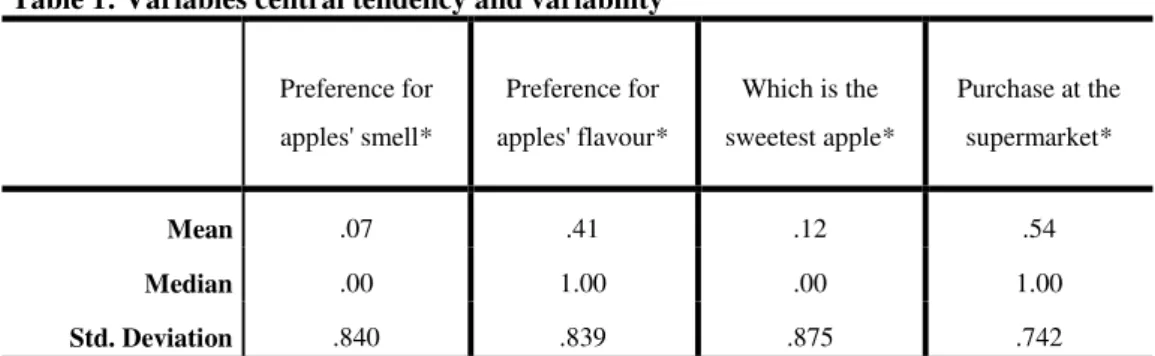
Table 1 shows the variables analyzed with the average response, standard deviation and
median for each one.
Table 1: Variables central tendency and variability
Preference for
apples' smell*
Preference for
apples' flavour*
Which is the
sweetest apple*
Purchase at the
supermarket*
Mean .07 .41 .12 .54
Median .00 1.00 .00 1.00
Std. Deviation .840 .839 .875 .742
*Where the answers could be “Fun” (=1), “Simple” (=-1) or “Both the same/Does not know” (=0)
To test the hypothesis linked to each of these variables, also their distribution was taken into account.
In this sense, a one sample t-test (95% confidence level) was performed to each one, to see if the differences in the average response were statistically significant (that is, to see
to what extent was packaging influencing children’s answers)
16 H 1.1 : A healthy product with a fun packaging has a positive sensory evaluation
post-consumption in terms of smell
Table 2: Children's answers distributions and t-test (for Hypothesis 1.1)
Distributions T-test
Preference for apples' smell Simple No difference Fun p-value
31.70% 29.70% 39% 0.409
Since the p-valuesmell > 0.05, then the null-hypothesis cannot be rejected, meaning that
we cannot say that packaging affects the perception of smell that children have of the apples.
Since the apple slices were taken from the children after they would have tasted them,
some of them said they couldn’t state a preference, “I don’t remember the smell” (Girl,
8 years-old, interviewee 39), and they were not very convict on their choice “I think this one [simple packaging] smells a little bit better, but I am not sure... but I think this one,
yes.” (Girl, 7 years-old, interviewee 62).
H 1.2 : A healthy product with a fun packaging has a positive sensory evaluation
post-consumption in terms of flavour
Table 3: Children's answers distributions and t-test (for Hypothesis 1.2)
Distributions T-test
Preference for apples' flavour
Simple No difference Fun p-value
22.80% 13.90% 63.40% 0.000
Given that p-valueflavour<0.05, then we reject the null-hypothesis. This means, that
17 H 2: A healthy product with a fun packaging is perceived as being sweeter
(post-consumption)
Table 4: Children's answers distributions and t-test (for Hypothesis 2)
Distributions T-test
Sweetest apple Simple No difference Fun p-value
32.70% 22.80% 44.60% 0.175
Since the p-valuesweetness > 0.05, the hypothesis that children do not perceive differences
in the level of sweetness between the apples cannot be rejected.
For “sweetness” it was not always true whether or not being sweet was a positive thing,
“This one [simple packaging]! That is why I didn’t like it!” (Boy, 8 years-old, interviewee 59), and one did not know what being sweetness was (and was considered as 0 = Does not feel difference/ Does not know)
H3: A healthy product with a fun packaging is more likely to be requested by children
after they have consumed it
Table 5: Children's answers distributions and t-test (for Hypothesis 3)
Distributions T-test
Purchase at the supermarket
Simple No difference Fun p-value
14.90% 15.80% 69.30% 0.000
Since that p-valuesupermarket < 0.05, the null hypothesis is rejected. This means that, as
well as the perception of flavour, also the purchase intention at the supermarket is
18
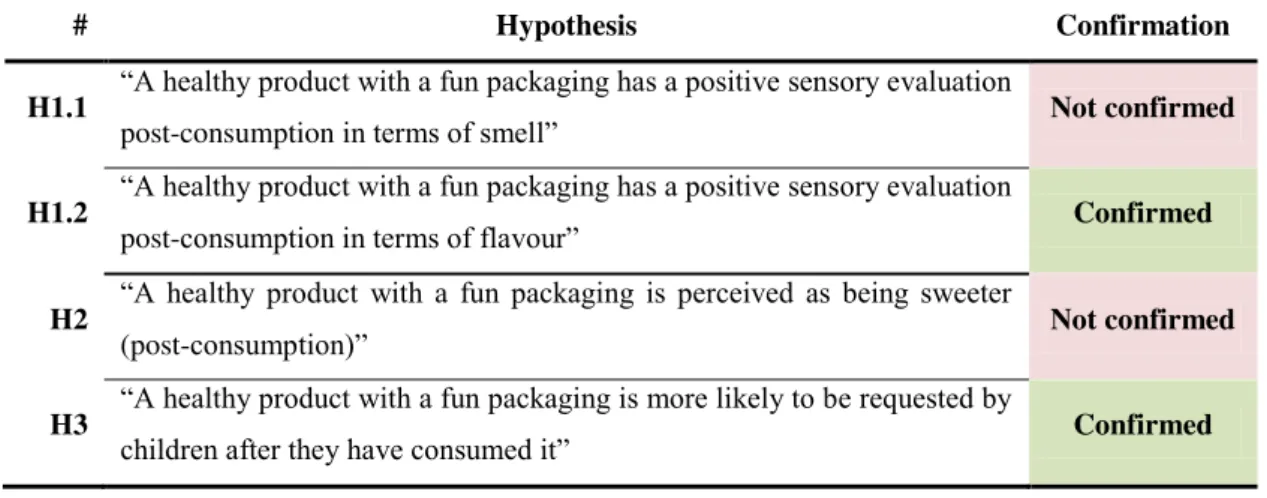
It is below presented a summary of the conclusions for the hypothesis.
Table 6: Hypothesis testing
# Hypothesis Confirmation
H1.1 “A healthy product with a fun packaging has a positive sensory evaluation
post-consumption in terms of smell” Not confirmed H1.2 “A healthy product with a fun packaging has a positive sensory evaluation
post-consumption in terms of flavour” Confirmed H2 “A healthy product with a fun packaging is perceived as being sweeter
(post-consumption)” Not confirmed
H3 “A healthy product with a fun packaging is more likely to be requested by
children after they have consumed it” Confirmed
Global evaluation of the products
Apart from the direct questions post consumption (on smell, flavour, sweetness and purchase intention), a global appreciation of the products was asked before the experience and in the very end, to check if they would confirm their expectation or not, and in case there was any apple that was better than the other, by how much would it be. For both apples, the global evaluation increases after consumption, and the average rate is in general high. Although the simple packaged apple follows closely the fun packaged one, it always stays behind (before and after consumption).
19
Graph 1 – Global Evaluation of the Fun and the Simple Apples, pre and post consumption
Independent Sample t-tests – Gender and Place of Residence
To check if there was a significant difference on the averages of each variable according to gender and place of residence, an independent sample t-test was performed on each one.
The conclusion was that preferences were not significantly different at any confidence level for the “Gender” variable.
However, significant differences were found according to the “Place of Residence”, for the “Preference for Apple’s Flavour”and “Purchase Intention” variables.
For the first variable related to flavour preference, the null hypothesis was that the average values for those living in the village or in the town would not be significantly different, for a 95% confidence level. This hypothesis was rejected (p-value = 0.048), and is supported by the following results: 73.4% of the children living in the town
preferred the “Fun” flavour, against 45.9% of those living in the villages; within those that claimed to have no preference for any of the flavours, 71.4% lived in the villages, and within those that claimed to prefer the “Fun”, 73.4% lived in the town.
20 would buy the “Fun”, whereas among the children that live in the villages 48.6% would buy it; within those that would be indifferent in purchasing one or another, 75% were from the villages, “I prefer to take the apples from the tree” (Girl, 9 years-old, rural area, interviewee 31), “We always buy 1kg of normal apples, we wouldn’t buy those” (Boy, 7 years-old, rural area, interviewee 89); and within those that would buy the
“Fun”, 74.3% are from the town.
It is also important to mention that an independent sample t-test was also performed
between the analyzed variables and the variable “Which apple did the child try first?”.
Since the hypothesis could not be rejected, it is concluded that their choices were independent of which of the apples (fun or simple packaging) they tried first.
Discussion
The aim of this study was to deepen the knowledge about the influence of packaging on children. More specifically, to check if a fun packaging would exert an influence on
children’s preferences and choices after consuming the product. To do so, the
characteristics of “fun products” were transferred to a product that it is not usually packaged (an apple) and, when it is, it is not typically targeted at children. This study reinforces conclusions from previous research, complementing with the post-consumption perceptions.
The main conclusion was that a fun packaging does influence taste perception for the better, for children between 7 and 10 years-old. In this sense, and although, in general, apples are the most liked fruits by children (Wong et al., 2010), they do feel that, if in a fun packaging, they will “taste better” than if put in a simple packaging.
In general, “fun packages” are not seen in healthy products, or most of the times they
21
Another conclusion was that the fun packaging is more likely to be requested at the supermarket by the same children, after they have consumed it. So, not only packaging promotes a purchasing behaviour, but it may also reinforce a re-purchasing one. Children may ask for a product based on packaging, but if it turns out that the product tastes better, then they will continue asking for it. In this sense, it is important that producers and packaging designers focus on the use of packaging design (colours, text, cartoons) targeted at children so that they feel that those are also their products, and so that they request them at the point of purchase.
In the same way, special care and also an ethical behaviour should be taken into account when producing packaging for unhealthy food (e.g. chips, snacks, sweets). Given that the effects of packaging on children are now better known, it is assumed that the same influence occurs when children are confronted with unhealthy products. In this sense, adding up to advertising regulations, some other should be put in place: either regulatory measures to restrict the use of some features on packaging for unhealthy food, or having some entities (for instance, consumer protection organizations) promoting the use of packaging next to healthy food producers.
Moreover, this study may also justify the use of product promoters in-store, who may deliver samples of these “healthy fun products”. Not only they are attracted by the packaging itself, but this is also reinforced by the flavour that they perceive as better. In this sense, and although retailing was not the focus of this study, if in general the
fruits &vegetables section of a supermarket turns out to be a “fun and adventurous
place”, perhaps children feel more attracted to go into it, play, and request more healthy products.
22
Summing up, this study shows how marketing techniques, in this case packaging, are
powerful and how they can influence children’s senses, namely taste. Since it was done
doing a healthy product, this study may constitute a contribution as one of the ways to promote healthier eating habits among children – using packages for these products that transmit a fun message and that are targeted at children.
Limitations and Further Research
As it was seen, there are differences on the influence of packaging on children living in rural areas or in the town. And although the study was conducted in an urban area, it was in a small town, with one McDonald’s restaurant only and no other fast-food
restaurants’ chain or shopping centres. Given the differences in the results shown for preferences of children living in the town or in a village, further research could do the same study with children that live in more urbanized regions, to check if the influence was even greater.
Moreover, since the purchase decision (and thus, influence) for low involvement products (as fruits & vegetables) is done in-store, other studies could repeat the study but with a sample of children interviewed inside the supermarket, instead of their school where they put more thought on the choice and it is a less natural behaviour.
Also, since this study was done using one fruit only, more research should be done with other items, including vegetables.
23
References
Atkin CK. 1978. Observation of parent-child interaction in supermarket decision-making. Journal of Marketing 42 (4), 41-45.
Belch GE, Belch MA, Ceresino G. 1985. Parental and teenage child influences in family decision-making. Journal of Business Research 13 (2), 163-176.
Brownell KD, Horgen KB. 2004. Food fight: the inside story of the food industry, America's obesity crisis, and what we can do about it. New York, McGraw-Hill
Cooke L. 2007. The importance of exposure for healthy eating in childhood: a review. The Journal of Human Nutrition and Dietetics 20, 294–301.
Cooke L, Wardle J. 2005. Age and gender differences in children’s food preferences, British Journal of Nutrition 93, 741–746.
Connor SM. 2006. Food-related advertising on preschool television: building brand recognition in young viewers. Pediatrics 118, 1478–85.
Cornwell TB, McAlister AR. 2011., Alternative thinking about starting points of obesity. Development of child taste preferences, Appetite56 (2), 428-39.
Devine CM., Connors M, Bisognia CA., Obal JS. 1998. Life-Course Influences on Fruit and Vegetable Trajectories: Qualitative Analysis of Food Choices, Journal of Nutrition Education 30, 361-370.
Dhir S, Sharma B. 2012. Packaging: Changing with the Change, International Journal of Research in Management 4 (2) 2249 – 5908.
Drewnowski A. 1997. Taste preferences and food intake. Annual Reviews - Nutrition 17, 237–253.
Elliott C. 2009. “Healthy Food Looks Serious”: How Children Interpret Packaged Food Products, Canadian Journal of Communication 34, 359-380.
Farrel L, Shields M. 2007. Children as consumer: investigating child diary expenditure data, Canadian Journal of Economics 40 (2), 445-467.
Furnham A, Thomas P. 1984. Pocket money: a study of economic education, British Journal of Developmental Psychology 2, 205–12.
Gibson EL, Wardle J, Watts CJ. 1998. Fruit and Vegetable Consumption, Nutritional Knowledge and Beliefs in Mothers and Children, Appetite 31, 205–228.
Guenther PM, Dodd KW, Reedy J, Krebs-Smith SM. 2006. Most Americans eat much less than recommended amounts of fruits and vegetables. Journal of the American Dietetic Association 106, 1371– 9.
Greig A, Taylor J, MacKay T. 2007. Doing research with children. 2nd edition. London: Sage Publications Inc.
Hunter BT. 2002. Marketing Food to Kids: Using Fun to Sell. Journal of Consumer Research 85 (3), 16-20.
24
Keller KL, Kuilema LG, Lee N, Yoon J, Mascaro B, Combes AL, Deutsch B, Sorte K, Halford JC. 2012. The impact of food branding on children's eating behavior and obesity, Physiology & Behavior 106, 379– 386
Kemm JR. 1987. Eating patterns in childhood and adult health, Nutrition and Health 4, 205–215.
Lake AA, Rugg-Gunn A, Hyland RM, Wood CE, Methers JC, Adamson AJ. 2003. Longitudinal dietary change from adolescence to adulthood: perceptions, attributions and evidence, Appetite 42, 255-63.
McGinnis M, Gootman J, Kraak V. 2005. Food marketing to children and youth: threat or opportunity. The National Academies Press, Committee on Food Marketing and the Diets of Children and Youth
McKinley MC, Lowis C, Robson PJ, Wallace JMW, Morrissey M, Moran A, Livingstone MBE. 2005.
It’s good to talk: children’s views on food and nutrition, European Journal of Clinical Nutrition 59, 542-551.
McNeal J. 1992. Children as a market of influencers, Kids as Customers – A Handbook of Marketing to Children, Lexington Books/The Free Press, New York, 63-87.
Nestle M. 2006. Food Marketing and Childhood Obesity — A Matter of Policy, 354 (24), The New England Journal of Medicine, p. 2527
Newton S. 1992. The Jell-O Syndrome: Investigating Popular Culture/Foodways, Western Folklore 51 (3/4) 249-267
Nørgaard MK, Bruns K, Christensen PH, Mikkelsen MR. 2007. Children's influence on and participation in the family decision process during food buying, Young Consumers: Insight and Ideas for Responsible Marketers 8 (3), 197 – 216
O’Dougherty M, Story M, Stang J. 2006. Observations of parent–child co-shoppers in supermarkets.
Children’s involvement in food selections, parental yielding, and refusal strategies, Journal of Nutrition Education & Behavior 38, 183–188.
OECD: http://www.oecd.org/health/49716427.pdf
de Onis M, Blossner M, Borghi E. 2010. Global prevalence and trends of overweight and obesity among preschool children, American Journal of Clinical Nutrition 92, 1257–64.
Palmer, Edward, Carpenter. 2006. Food and beverage marketing to children and youth: Trends and issues, Media Psychology 8, 165-190.
Pires C, Agante L. 2011. Encouraging children to eat more healthily: The influence of packaging, Journal of Consumer Behaviour 10, 161–168
Robinson TN, Borzekowski DLG, Matheson DM, Kraemer HC. 2007. Effect of fast food branding on young children's taste preferences. Archive of Pediatrics & Adolescent Medicine 161, 792–797.
Schifferstein HNJ, Kole APW, Mojet J. 1999. Asymmetry in the disconfirmation of expectations for natural yogurt, Appetite 32, 307–29.
Skinner J, Carruth B, Bounds W, Ziegler P. 2002. Children’s Food Preferences: A Longitudinal Analysis, Journal of America Dietetic Association 102 (11), 1638-47
Sodhi MK. 2010. TV Viewing versus Play – Trends and Impact on Obesity, Online Journal of Health and Allied Sciences 9 (2)
25
Wardle J, Herrera ML, Cooke L, Gibson EL. 2003. Modifying children’s food preferences: the effects of exposure and reward on acceptance of an unfamiliar vegetable, European Journal of Clinical Nutrition 57, 341–348.
Wong WP, Lakkakula A, Zanovec M, Tuuri G. 2010. Examination of fruit and vegetable preferences of low-income public elementary school children, FASEB Journal (Journal of the Federation of American Societies for Experimental Biology 24, 732.8