CONTRIBUTION OF THE CERVICAL AUSCULTATION IN CLINICAL
ASSESSMENT OF THE OROPHARYNGEAL DYSPHAGIA
Contribuição da ausculta cervical para a avaliação
clínica das disfagia orofaríngeas
Geovana de Paula Bolzan(1), Mara Keli Christmann(2), Luana Cristina Berwig(3),
Cintia Conceição Costa(4), Renata Mancopes Rocha(5)
(1) Speech-language pathologist, Postgraduate Student in Human Communication Disorders, Santa Maria Federal University, Santa Maria/RS, Brazil
(2) Speech-language pathologist, Postgraduate Student in Human Communication Disorders, Santa Maria Federal University, Santa Maria/RS, Brazil
(3) Speech-language pathologist; Master in Human Commu-nication Disorders, Specialist in Management and Hospital Care in the Public Health System, Santa Maria Federal Uni-versity, Santa Maria/RS, Brazil
(4) Speech-language pathologist; Specialist in Management and Hospital Care in the Public Health System - Santa Maria Federal University, Santa Maria/RS, Brazil
(5) Ph.D. in Linguistics, Santa Catarina Federal University, Adjunct Professor, Speech Department, Santa Maria Fede-ral University, Santa Maria, RS, Brazil
Grants: CAPES/ CNPq. Conlict of interest: non-existent
allows the speech therapist to identify: the dificulties
the patient displays in the swallowing process, signs of laryngeal penetration and/or laringo-tracheal aspiration of the food swallowed, security in the maintenance or reintroduction of food orally, the best consistency to be used and the possible causes of
the alterations identiied1,2.
During clinical assessment, it is observed the
eficiency of the food bolus capture and preparation,
the number of swallows, laryngeal elevation, the presence of coughing, choking or other suggestive signs of laryngeal penetration or laryngo-tracheal aspiration, oral escape of the food and nasal regur-gitation, length of feeding, the presence of food residues in the oral cavity and changes in vocal quality after deglutition, as well as the need of using postural and/or facilitator maneuvers. To help in this process, most of speech therapists adopt
instru-mental resources such as the pulse oximetry and
cervical auscultation1-4.
ABSTRACT
In order to assist on the functional assessment of swallowing, most speech therapists make use of instrumental resources such as cervical auscultation. Thus, the objective of this study was to search the
literature in order to ind the contribution of cervical auscultation for assessing dysphagias. To this end, international and national journals were reviewed. These journals were indexed in Springer, Lilacs,
Bireme, Medline and Scielo databases, comprising the period between 1992 and 2011. From the analysis of the studies, it was possible to verify that: cervical auscultation has been modernized with the technologic evolution, enabling the realization of quantitative studies of the swallowing sounds; there are still few clear evidence of the connections between the sound components of swallowing and the physiological events of the pharyngeal phase; no differences were observed between the swallowing sounds in children and adults; in some studies, cervical auscultation was positively correlated with the
videoluoroscopic assessment of swallowing, and others presented positive correlation between these two assessment procedures. Hence, considering that the swallowing videoluoroscopy examination is still dificult to access, with relatively high cost, it is believed that cervical auscultation constitutes
an important resource for the diagnosis and clinical monitoring in cases of oropharyngeal dysphagia.
KEYWORKS: Auscultation; Swallowing; Swallowing Disorders
INTRODUCTION
Associated to a detailed anamnesis and careful
the use of cervical auscultation as an instrument.
Studies affecting the thematic were excluded.
LITERATURE REVIEW
Cervical Auscultation
Cervical auscultation is a method consisting of listening to the swallowing sounds to assess mainly the pharyngeal phase competence and its interaction with breathing through the use of an instrument of
ampliication. In a conventional way, this technique
is performed by using a stethoscope. However, other instruments have been used recently, such as a microphone, the accelerometer and the Doppler sonar11. These transducer instruments allow the
digitalization of the signal, a resource that enables the analysis of the sounds in a more objective way, considering their duration, signal frequency and the wave amplitude, among other aspects,9,15,19,20.
According to the literature, several sites in the region of the neck were suggested for the
positioning of the instrument of ampliication in
order to obtain the best acoustic response during the assessment. The relevance of the appropriate instrument positioning is based on the signal/sound relationship, which tends to be low in this region due
to the circulatory function and the gas exchange. From scientiic evidence, three points on the neck
are indicated in the literature for cervical auscultation, as they show a better signal/sound relationship and lesser variation of the swallowing signal, such as the lateral border of the trachea, immediately inferior to the cricoid cartilage, the midpoint between just below the center of the cricoid cartilage and the site immediately above the jugular incision and the center of the cricoid cartilage3,7,17,21.
Some authors also point that the best site for positioning the stethoscope would be the lateral neck, above the cricoid cartilage, in front of the sternocleidomastoid muscle and the large vessels.13,18,22.
A study investigated the best cervical site to perform auscultation. Among the four sites inves-tigated, the placement of the acoustic detector device on the median line of the cricoid cartilage was the ideal positioning at the cervical, as it is a distinguished anatomic region. According to the authors, the cricoid cartilage presents itself as a potential resonator, which in addition to be a point of reference, may improve the acoustic sound21.
Among the advantages of this technique appli-cation is the fact of being low cost, easy to perform and noninvasive, and it may be applied in every age groups, although it is found in the literature a preponderance of studies using this assessment method with adults. Despite the advantages,
The use of oximeter to detect the risk of aspiration
is based on the hypothesis that laryngo-tracheal
aspiration would provoke a bronchospasm relex,
decreasing the respiratory perfusion and provoking
a decrease in oxygen saturation4,5. In the case of
cervical auscultation, performed with stethoscope
located in speciic points in this region, it allows
for the acoustic analysis of the swallowing sounds, before, during, and after the food bolus goes through
the pharynx, giving additional clues regarding the
food entrance in the lower airway or not3,4,6-13.
Swallowing sounds occur during the pharyngeal phase due to the pressure on the oropharyngeal tract with its valves represented by the lips,
velopha-ryngeal region, larynx and cricophavelopha-ryngeal muscle6.
A failure in the airway protection mechanism, such as uncoordination of muscle movements and the structures involved in the process of swallowing and/or delay in opening the upper oesophageal sphincter may then change this process and result
in aspiration, which modiies the sound heard at
cervical auscultation, and it may generate secondary medical complications3.
Several studies have been developed to verify the accuracy of cervical auscultation and for the improvement of this technique with resources that, besides the acoustic analysis, permit the graphical analysis of the swallowing sounds. In the literature,
however, controversies are veriied regarding the
use of cervical auscultation due to the criteria and instruments used9,14, for being a subjective method
of assessment9,15, for being dificult to establish
agreement among the examiners and because it does not contain speciic data of physiological
correspondence 16-18.
Accordingly, the aim of this study was to verify in the literature the contribution of cervical auscultation to clinical assessment of dysphagias.
METHOD
A review of the literature was performed on the proposed theme by using books, dissertations,
thesis and articles from scientiic journals. Articles
were searched in Springer, Lilacs, Bireme, Medline and Scielo databases.
was associated to laryngeal elevation, with the
bolus in oropharynx or hypopharynx, present in
81% of swallows and lasting 106± 47ms. The second sound was associated to upper esophageal sphincter opening, with the bolus transit through this sphincter, present in all swallows and lasting 185± 103ms. And the third sound corresponded to the structures return to the resting posture, the bolus in the esophagus, lasting 72± 38ms26. The indings of
this study are in accordance with those of a previous study, which also described three sound compo-nents as constituting the swallowing sound, related respectively to laryngeal elevation and the bolus
passing through the pharynx, the cricopharyngeal
opening and the laryngeal descent25.
Other authors, however, stated that in normal swallowing, there are three marked sounds in the pharyngeal phase, with two audible clicks corre-sponding to laryngeal elevation and the bolus transit through the upper oesophagic sphincter, and a third
sound corresponding to expiratory murmur 4,6,27,30.
From this assumption, a study was conducted aimed to characterize the swallowing process of 60 healthy elderly by using a 1, 3, 5, 10, 15 and 20 ml-water swallowing test and recordings of
pulse oximetry and cervical auscultation with digital
stethoscope. The data were analyzed by acoustic analysis and spectrogram visualization. The sounds
of swallowing were classiied as follows: type 1- two audible clicks followed by an expiratory murmur;
type 2- two audible clicks followed by an inspi-ratory murmur; type 3- two audible clicks, neither
expiration nor inspiration identiied; type 4- the two swallowing clicks were not identiied due to noise interference. Among the results, the authors veriied
the preponderance of sound type 3 with the varied volumes of water used in the study. This way, it
was discussed that the dificulty in capturing the
respiratory sound through cervical auscultation
might be inluenced by the physiological changes
of age, with the decrease of diaphragmatic strength
and the expiratory strength. In view of this, they
stated that the stethoscope did not prove to be the best instrument to detect the coordination between respiration and swallowing, an important aspect for the assessment of the risk of aspiration30, which
should be taken in account in the clinical practice of the speech therapist when assessing the risk for dysphagia.
Also, in clinical assessment it is tried to quantify the swallowing duration, according to the terms slow or delayed, even without normality standards being established for this length of time3. It is well-known
that the duration of the acoustic signal of swallowing displays differences according to the food information regarding the sounds heard is still
unclear, sometimes limiting the use of auscultation
to speech therapists having greater experience in
the area7. Furthermore, it is known that this
instru-mental resource does not allow for the quantiication
of certain changes in swallowing such as food accumulation or stasis on the pharyngeal route,
penetration and aspiration, as well as the identii -cation of silent aspiration23. It is possible to observe
that the utilization of cervical auscultation is
deter-mined by the examiner`s experience, which makes
it a subjective process, whose application must be associated to other methods, and should not be
exclusive for the assessment of swallowing or the
risk for dysphagia.
Some authors stated that for cervical auscul-tation to be used with the aim of increasing the reliability of the clinical assessment, studies are required that characterize acoustically normal swallowing, so as to have parameters to compare and characterize dysphagic swallowing24. Thus,
it is evident an increasing number of studies with the purpose of studying the swallowing sounds and its correspondence with other physiological events in healthy subjects9,11,25-27. The latter,
relating the cervical auscultation indings with other
assessment methods. Some research has been conducted aiming to identify the most appropriate instrument to perform the auscultation of swallowing sounds9,14,19-21.
It is veriied in the literature that although cervical auscultation is extensively used by the speech
therapists, there are a few studies presenting data regarding accuracy and the contribution of this technique to help identify suggestive signs of penetration and aspiration, which is essential for the diagnosis of dysphagia in the clinical practice for the assessment of both adults and children9,10,27-29.
Correspondence of swallowing sounds with physiological events
In order to understand the relationship of the swallowing sounds components with the physi-ological events of the pharyngeal phase, a study with 15 youth without swallowing alterations was conducted. The participants swallowed 10 ml barium suspension while performing simultaneously
a videoluoroscopic assessment of swallowing
and the recording of cervical auscultation. During assessment, each sound component was
associated to a speciic position of the food bolus
and to the anatomical structure in movement. The authors highlighted three sound components from the pharyngeal phase of swallowing in relation to the anatomical structures movement and the
found in the measurements performed. This study made it possible to quantify the normal duration of the three main swallowing sounds, which may be used for comparison with the swallowing sounds in pathological conditions31.
Based on the knowledge that the swallowing
morphology modiies with normal growth and aging,
and that anatomical differences among men and
women exist, a study was conducted aimed to identify
the duration of acoustic events during swallowing in individuals with no complaint of dysphagia, and to compare them in the different age groups and genders27. The sample comprised 164 individuals,
88 females and 76 males, aged between 6 and 85, divided into 4 groups according to the age. The swallowing sounds were captured by microphone, recorded on the computer and acoustically analyzed. Every individual performed nine swallows, as follows: three of saliva; three of 5 ml water; and three of 10
ml water. With this study, the authors veriied that
the average length of time elapsed between the two
swallowing explosions peaks (T) tended to be lesser
than the greater volume swallowed. The average duration of swallowing apnea (dA) was getting longer, according to the volume swallowed. The
time measured was not inluenced by age27,
differ-ently from that veriied in previous studies using a
different methodology13,23,28. Regarding gender, only
in relation to the rate obtained through the ratio T/ dA in 5 ml swallows it should be taken into account the individual’s gender, since men presented higher rates than women27.
Overall, it is possible to observe a frequent allusion to the three important sound events during the pharyngeal phase in a normal swallow. However, despite the several studies conducted, a correspondence between the swallowing sounds
and the physiological events has not been deinitely
established. Likewise, regarding the duration of swallowing sounds, the studies diverge, probably due to the different methodologies employed.
Figure 1 displays the description of method-ologies and conclusions of the studies addressing the correspondence of swallowing sounds with the physiological events.
consistency ingested7, and the higher the viscosity
of the bolus, the longer the time of swallowing9.
In a study conducted to verify the swallowing sound and the time of its occurrence based on
the cervical auscultation examination, the average
time of swallowing was 1.19s, 1.07s and 17.33s for swallows of saliva, liquids and solids, respectively. In this study, the functional assessment of swallowing with 32 women was performed, with a mean age of 25.84 years. In addition, the study showed that the time for swallowing solids was longer in older subjects28. This increased duration of pharyngeal
transit associated to the increase of age, was also reported in other studies, and should be considered in clinical practice13,23.
Another recent study veriied the acoustic signal
of cervical auscultation in normal swallowing in 3
groups of individuals of different age groups, the irst
group comprising young adults (20-39 years); the second group composed of mature adults (40-59 years), and the third group composed of elderly (60 years or more). The recording of swallows was made during the ingestion of various boluses of different consistencies and volumes. The peak intensity of the swallowing signal, peak frequency, and the duration of peak intensity were analyzed. The results showed that the swallowing time was longer in the group of elderly. In addition, the peak intensity was also more intense and the signal peak frequency was more acute in the group of the elderly, showing that an increased time in the pharyngeal phase occurs parallel to the increase of age11.
Another study analyzed the duration of swallowing sounds in healthy subjects, 20 males and 10 females (age 37 ± 11). Each subject was asked to swallow a solution of 10 ml composed of 50% barium and 50% water, which was offered with a syringe and each subject carried out eight swallows
with at least 30 seconds of interval each. The exams
Authors Sample Methodology Conclusions
Morinière, Beutter and Boiron (2006)31
30 healthy subjects, 20 males
and 10 females, with mean age
37±11.
Swallowing of 10 ml solution composed by 50% barium and 50%
water offered with a syringe. Eight swallows were performed with at least
30 seconds of interval each. The
exams were recorded and analyzed
acoustically. For each swallowing sound recorded, overall averages and average according to the gender
were measured for total duration of sound, the duration of each sound component and the interval between
the sound components.
- No gender differences were found in the measurements performed. - This study made it possible to quantify the normal duration of the three main swallowing sounds, which may be used for comparison with the swallowing sounds in pathological
conditions.
Morinière et al. (2008)26
15 youth without swallowing alterations
Swallowing of 10 ml barium suspension and simultaneous VF of
swallowing and AC recording.
Three sound components from the pharyngeal phase of swallowing
became evident:
- 1st Sound: associated to laryngeal
elevation, with the bolus in
oropharynx or hypopharynx, present
in 81% of swallows and lasting 106±47ms.
- 2nd Sound: associated to upper
esophageal sphincter opening with the bolus transit through this sphincter, present in all swallows and
lasting 185±103ms. - 3rd Sound: corresponded to the
structures return to the resting posture, the bolus in the esophagus,
lasting 72±38ms.
Dantas and Andrade (2010)30
60 healthy elderly
Swallowing of liquid volumes ranging
from 1 to 20 ml. Pulse oximetry and
AC were recorded. Data analyzed by means of acoustic analysis and spectrogram. Swallowing sounds
were classiied as:
Type 1: two audible clicks followed by
an expiratory murmur;
Type 2: two audible clicks followed by an inspiratory murmur; Type 3: two audible clicks, neither
expiration nor inspiration identiied;
Type 4: the two swallowing clicks
were not identiied due to noise
interference
Preponderance of sound type 3 with the varied volumes of water used for
Cardoso and Gomes (2010)28
32 women, mean age 25,84.
To verify the swallowing sound and the time of its occurrence, based on
AC.
- Average time of swallowing: 1,19s for swallowing of saliva, 1,07s for swallowing of liquids and 17,33s for
solids.
- The time for swallowing solids was longer in older subjects.
Youmans and Stierwalt
(2011)11
Group 1: young adults (20-39
years); Group 2: mature
adults (40-59 years); Group 3: elderly
(60 years or more).
AC of the acoustic signal in normal
swallowing was veriied. The
recording of swallows was made during the ingestion of various boluses, with different consistencies and volumes. The peak intensity and
frequency of the swallowing signal and the duration of peak intensity
were analyzed.
The swallowing time was longer, the peak intensity was the more intense and the signal peak frequency more
acute in the group of the elderly.
Patatas et al. (2011)27
164 individuals with no complaint
of dysphagia, 88 females and 76 males, age group
between 6 and 85 years, divided
into 4 groups according to the
age.
Swallowing sounds were captured by microphone, recorded and
acoustically analyzed. Every individual performed nine swallows: 3
of saliva, 3 of 5 ml water and 3 of 10 ml water.
- The average length of time elapsed between the two swallowing
explosions peaks (T) tended to
be lesser than the greater volume swallowed.
- The average duration of swallowing apnea (dA) was getting longer, according to the volume swallowed.
- The time measured was not
inluenced by age.
- Regarding gender, only in relation to the rate obtained through the ratio T/ dA in 5 ml swallows it should be taken
into account the individual’s gender, since men presented higher rates
than the women.
Legend: AC = cervical auscultation; VF = videoluoroscopy
Figure 1 – Contribution of the Cervical Auscultation in Clinical Assessment of Oropharyngeal Dysphagia
Relationship between cervical auscultation and other methods of assessment
Nasopharyngoscopy of swallowing enables the visualization of the structures involved in the process of swallowing, enables the test of pharyngeal and laryngeal sensitivity and the assessment of laryngeal penetration and/or laryngo-tracheal aspiration32.
The videoluoroscopy exam of swallowing, in
turn, is regarded as the golden standard in the assessment of the physiology of swallowing and its respective disturbances, as in addition to the visualization of the anatomical structures, it enables the dynamic analysis of the different events of swallowing23. Several authors have investigated
the relationship between cervical auscultation and
nasopharyngoscopy and videoluoroscopy, in view
of their importance for the diagnosis of dysphagia. Also object of study were the sound components of cervical auscultation and the length of time for swallowing6,10,13,18,33,34.
A study was conducted aimed to assess the relationship between the swallowing sounds and its physiological events by means of cervical auscul-tation, respiratory pattern assessment and
videoen-doscopy of swallowing, to verify whether a deinitive set of sound components could be identiied; to
reliability did not correlate with the years of
profes-sional experience18.
In another study, some of the proposed objec-tives were to assess cervical auscultation reliability in detecting dysphagia, as well as the agreement
among the examiners with and without experience
in performing this procedure. Reliability among the
examiners was moderate, i.e., there was some disagreement among the examiners, which may be justiied by the examiner`s experience. In addition,
when assessing swallowing auscultation associated
to videoluoroscopy, it was veriied 70% of speciicity
and 94% of sensitivity for auscultation. This way, the authors state that the swallowing sounds contain
important clues for the identiication of patients at
high risk for aspiration, however, auscultation is not recommended as the only assessment tool13.
Hence, in order to assess swallowing and the risk of dysphagia, it seems to be important to take into account the combination of methods and
instru-ments associated to the examiner`s expertise.
A research was conducted with the objective of
inding an agreement inter- and intra-examiner when
recording the cervical auscultation sounds to detect the presence or absence of aspiration in dysphagic patients. To this end, parallel to the performance of
videoluoroscopy, the recording of cervical auscul -tation sounds was performed, being assessed 16 patients, three of which presented with aspiration
at videoluoroscopy. Five speech therapists with
previous training in cervical auscultation listened to the sounds recorded in two distinct moments.
The result of the inter-examiner comparison was a Kappa index of 0.28, suggesting a weak level of agreement. The inter-examiner Kappa index ranged
from 0.31 to 0.85, presenting a weak to very good agreement level. It was also possible to verify a high level of agreement between cervical auscultation
and videoluoroscopy in the presence of aspiration
and a high occurrence of false positive in the absence of aspiration33.
A recent research aimed to compare the detect-ability of tracheal aspiration through cervical
auscul-tation related to the videoluoroscopic assessment
of swallowing in 101 children with spastic tetrapa-retic cerebral palsy with oropharyngeal dysphagia. The results of this study showed that there is a
signiicant relationship between positive cervical
auscultation and penetration or laryngeal aspiration
noticed at swallowing videoluoroscopy and that
negative cervical auscultation is associated to non-penetration/aspiration10. This way, it was
possible to conclude according to the this study that cervical auscultation may be used to infer the risk of aspiration for early intervention in this population, having as an advantage the fact of being among them. Nineteen subjects were assessed,
8 males and 11 females, with normal swallowing.
The authors identiied six sound components during
swallowing; however, none of them could be clearly
identiied in all of the individuals. There was a broad
overlap of swallowing sounds with the physiological events and no individual sound component could
be associated to a speciic physiologic swallowing
event. Hence, the authors concluded that no
consistent evidence exists that cervical auscul -tation should be adopted in clinical practice, and further studies must be conducted addressing the relationship of cervical auscultation with imaging
scan, such as videoluoroscopy. In addition, they highlight that the endoscopic exam of swallowing
may not be appropriate for this kind of study as it does not permit the oral phase visualization and the moment of laryngeal elevation34.Such studies
reinforce the idea that swallowing assessment should not be performed by a single instrument.
As imaging exams are best suited to correlate
with cervical auscultation34, a study was conducted
to verify the ability of cervical auscultation to predict tracheal aspiration, in terms of sensitivity and
speciicity, based on videoluoroscopic swallowing
assessment6. Fifty male subjects were assessed,
aged between 23 and 103. The clinical examination war performed by two professionals with experience
in dysphagia and cervical auscultation. The
comparison of the indings in both exams showed that cervical auscultation allowed the identiication
of 72% of the occurrences of delay in oral transit; 62% of residues in the oral cavity; 66% delay in pharyngeal transit; 42% of presence of residuals in
the pharynx and 76% of tracheal aspiration6.
In another study, the objective was to determine the accuracy of cervical auscultation and its clinical
value, when compared to videoluoroscopy. The
sample was composed of 10 sounds of auscul-tation from subjects with normal swallowing (mean age 72) e 10 samples of sounds of auscultation from subjects with aspiration (mean age 78). The collection was performed with a Littmann stetho-scope and the samples were recorded during the
videoluoroscopy. In distinct moments, 5 and 20
ml liquid barium were offered in a cup, and 5 ml yogurt in a spoon, asking the subjects to perform a single swallowing of each volume and consistency. Subsequently, the sounds of auscultation recorded were analyzed by speech therapists having at least
six years of experience in the area, classifying the
samples as normal or abnormal. The assessment results from the auscultation sound associated to
suggesting aspiration, among which coughing, dyspnea and wet voice10.
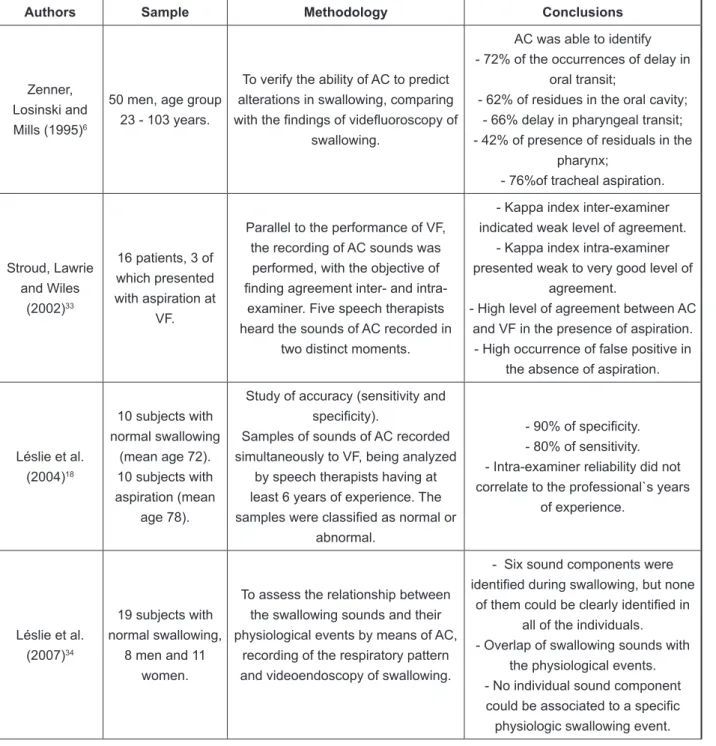
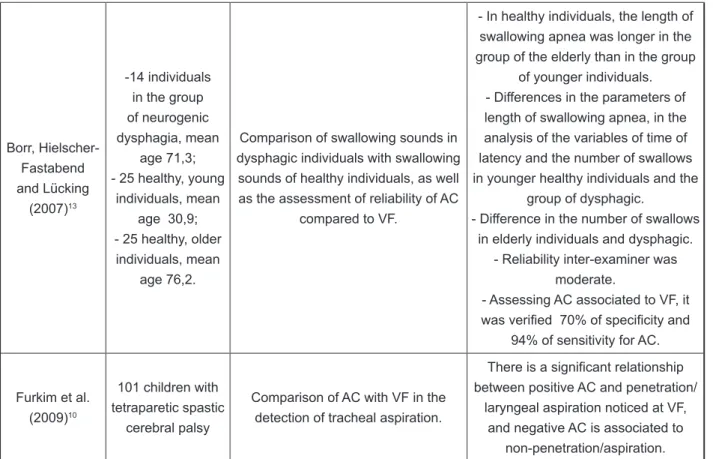
Figure 2 shows the description of methodologies and conclusions of the studies regarding the relationship between cervical auscultation and other assessment methods.
a noninvasive assessment method. However, the authors highlight the importance of carrying out at the same time other clinical assessment procedures
which are also positively related to the videoluoro -scopic assessment8, such as observation of labial
sealing, preparing of the bolus and clinical signs
Authors Sample Methodology Conclusions
Zenner, Losinski and Mills (1995)6
50 men, age group 23 - 103 years.
To verify the ability of AC to predict alterations in swallowing, comparing
with the indings of videluoroscopy of
swallowing.
AC was able to identify - 72% of the occurrences of delay in
oral transit;
- 62% of residues in the oral cavity; - 66% delay in pharyngeal transit; - 42% of presence of residuals in the
pharynx;
- 76%of tracheal aspiration.
Stroud, Lawrie and Wiles
(2002)33
16 patients, 3 of which presented with aspiration at
VF.
Parallel to the performance of VF, the recording of AC sounds was
performed, with the objective of
inding agreement inter- and
intra-examiner. Five speech therapists heard the sounds of AC recorded in
two distinct moments.
- Kappa index inter-examiner indicated weak level of agreement.
- Kappa index intra-examiner presented weak to very good level of
agreement.
- High level of agreement between AC and VF in the presence of aspiration. - High occurrence of false positive in
the absence of aspiration.
Léslie et al. (2004)18
10 subjects with normal swallowing
(mean age 72). 10 subjects with aspiration (mean
age 78).
Study of accuracy (sensitivity and
speciicity).
Samples of sounds of AC recorded simultaneously to VF, being analyzed
by speech therapists having at least 6 years of experience. The
samples were classiied as normal or
abnormal.
- 90% of speciicity.
- 80% of sensitivity. - Intra-examiner reliability did not correlate to the professional`s years
of experience.
Léslie et al. (2007)34
19 subjects with normal swallowing,
8 men and 11 women.
To assess the relationship between the swallowing sounds and their physiological events by means of AC,
recording of the respiratory pattern and videoendoscopy of swallowing.
- Six sound components were
identiied during swallowing, but none of them could be clearly identiied in
all of the individuals. - Overlap of swallowing sounds with
the physiological events. - No individual sound component
could be associated to a speciic
others showed a positive correlation between both assessments, mainly when associated to other procedures of clinical assessment. As such, and
taking into account that swallowing videoluoroscopy
is still found only in a few hospital centers, and with relatively high costs, it is considered that cervical auscultation constitutes an important resource for the diagnosis and clinical monitoring of intervention in cases of oropharyngeal dysphagia, even though it
is inluenced by the examiner experience.
There are still little clear evidence of the connec-tions between the sound components of swallowing and the physiological events of the pharyngeal phase, which culminates in a few descriptions regarding dysphagic sounds and what they might suggest in terms of physiological alterations.
In view of the studies analyzed, it is possible to perceive differences between those regarding accuracy and those regarding agreement, as the formers aim to determine the sensitivity and
speciicity of the cervical auscultation procedure
compared to golden standard methods in the assessment of swallowing or the risk of dyshagia. In turn, the studies of agreement show how much cervical auscultation is consonant with other assessment methods.
CONCLUSION
It was veriied that some studies presented
agreement between cervical auscultation and
vídeoluoroscopic swalowing assessment, and
Borr, Hielscher-Fastabend and Lücking
(2007)13
-14 individuals in the group of neurogenic dysphagia, mean
age 71,3; - 25 healthy, young
individuals, mean age 30,9; - 25 healthy, older
individuals, mean age 76,2.
Comparison of swallowing sounds in dysphagic individuals with swallowing sounds of healthy individuals, as well as the assessment of reliability of AC
compared to VF.
- In healthy individuals, the length of swallowing apnea was longer in the group of the elderly than in the group
of younger individuals. - Differences in the parameters of length of swallowing apnea, in the analysis of the variables of time of latency and the number of swallows in younger healthy individuals and the
group of dysphagic.
- Difference in the number of swallows in elderly individuals and dysphagic.
- Reliability inter-examiner was moderate.
- Assessing AC associated to VF, it
was veriied 70% of speciicity and
94% of sensitivity for AC.
Furkim et al. (2009)10
101 children with tetraparetic spastic cerebral palsy
Comparison of AC with VF in the detection of tracheal aspiration.
There is a signiicant relationship
between positive AC and penetration/ laryngeal aspiration noticed at VF,
and negative AC is associated to non-penetration/aspiration.
Legend: AC = cervical auscultation; VF = videoluoroscopy
crianças com paralisia cerebral tetraparética espástica. Arq Neuropsiquiatr. 2003;61(3-A):611-6. 9. Reynolds EW, Vice FL, Gewolb IH.Variability of Swallow-associated Sounds in Adults and Infants. Dysphagia. 2009; 24(1):13-9.
10. Furkim AM, Duarte ST, Sacco AFB, Sória FS. O uso da ausculta cervical na inferência de aspiração traqueal em crianças com paralisia cerebral. Rev CEFAC. 2009;11(4):624-9.
11. Youmans SR, Stierwalt, JAG. Normal Swallowing Acoustics Across Age, Gender, Bolus Viscosity, and Bolus Volume. Dysphagia. 2011. In press.
12. Marrara JL, Duca AP, Dantas RO, Trawitzki LVV, Lima RAC, Pereira JC. Deglutição em crianças com alterações neurológicas: avaliação clínica e
videoluoroscópica. Pró-Fono. 2008;20(4):231-6.
13. Borr C, Hielscher-Fastabend M, Lücking A. Reliability and Validity of Cervical Auscultation. Dysphagia. 2007;22(3):225-34.
14. Hamlet SL, Penney DG, Formolo J. Stethoscope acoustics and cervical auscultation of swallowing. Dysphagia. 1994;9(1):63-8.
15. Spadotto AA. Análise quantitativa do sinal da deglutição [tese]. São Carlos (SP): Universidade de São Paulo; 2009.105p.
16. Selley WG, Ellis RE, Flack FC, Bayliss CR, Pearce VR. The synchronization of respiration
and swallow sounds with videoluoroscopy during
swallowing. Dysphagia. 1994;9(3):162-7.
17. Takahashi K, Groher ME, Michi K. Methodology for detecting swallowing sounds. Dysphagia. 1994;9(1):54-62.
REFERENCES
1. Alves NSG. O fundamental da avaliação fonoaudiológica do paciente disfágico. In: Costa MMB, Castro LP. Tópicos em deglutição e disfagia. Rio de Janeiro: Medsi, 2003. Cap 2. p. 9-18
2. Furkim AM, Wolf AE. Avaliação clínica e instrumental da deglutição. In: Rehder MIBC, Branco A. Disfonia e disfagia: interface, atualização e prática clínica. Rio de Janeiro: Revinter, 2011.Cap 2.p. 12-21
3. MacKaig TN. Ausculta: cervical e torácica. In: Furkim AM, Santini CR. Disfagias Orofaríngeas. 2ª Ed. São Paulo: Pró Fono; 2004. p. 171-88.
4. Padovani AR, Moraes DP, Mangili LD, Andrade CRF. Protocolo fonoaudiológico de avaliação do risco para disfagia (PARD). Rev Soc Bras Fonoaudiol. 2007;12(3):199-205.
5. Cardoso MC, Silva AM. Oximetria de Pulso:
Alternativa Instrumental na Avaliação Clínica junto ao Leito para a Disfagia. Arq. Int. Otorrinolaringol. 2010;14(2):231-8.
6. Zenner PM, Losinski DS, Mills RH. Using cervical
auscultation in the clinical dysphagia examination in
long-term care. Dysphagia. 1995;10(1):27-31. 7. Almeida ST. Detecção dos sons da deglutição através da ausculta cervical. In: Jacobi JS, Levy DS, Silva LMC. Disfagia: avaliação e tratamento. Rio de Janeiro: Revinter; 2004. p. 373-81.
8. Furkim AM, Behlau MS, Weckx LL. Avaliação clínica e videoluoroscópica da deglutição em
RESUMO
Para auxiliar na avaliação funcional da deglutição, a maior parte dos fonoaudiólogos utiliza recur
-sos instrumentais como a ausculta cervical. Em vista disso, o objetivo deste estudo foi veriicar
na literatura a contribuição da ausculta cervical para a avaliação clínica das disfagias. Para tanto,
foram revisados periódicos nacionais e internacionais, indexados nas bases de dados Springer,
Lilacs, Bireme, Medline e Scielo, entre os anos de 1992 e 2011. A partir da análise dos estudos foi
possível veriicar que a ausculta cervical vem se modernizando com a evolução tecnológica, pos
-sibilitando a realização de estudos quantitativos dos sons da deglutição; que ainda há evidências pouco claras das correspondências entre os componentes sonoros da deglutição e os eventos
isiológicos da fase faríngea; que não foram evidenciadas diferenças nos sons da deglutição entre
crianças e adultos; e que alguns estudos apresentaram concordância entre a ausculta cervical e a
avaliação videoluoroscópica da deglutição, e outros ainda apresentaram correlação positiva entre estas duas avaliações. Assim, considerando-se que a videoluoroscopia da deglutição em nosso país ainda é um exame de difícil acesso, com custo relativamente alto, acredita-se que a ausculta
cervical constitui um importante recurso para o diagnóstico e acompanhamento clínico em casos de disfagia orofaríngea.
27. Patatas OHG, Gonçalves MIR, Chiari BM, Gielow I.Parâmetros de duração dos sinais acústicos da
deglutição de indivíduos sem queixa Rev Soc Bras
Fonoaudiol. 2011;16(3):282-90.
28. Cardoso MCAF, Gomes DH. Ausculta cervical
em adultos sem queixas de alteração na deglutição.
Arq Int Otorrinolaringol. 2010;14(4):404-9.
29. Cardoso MCAF, Fontoura EG. Valor da ausculta cervical em pacientes acometidos por disfagia neurogênica. Arq Int Otorrinolaringol. 2009;13(4):431-9.
30. Dantas MORL, Andrade CRF. Evaluating swallowing function in healthy older individuals: the
role of cervical auscultation and pulse oximetry.
Bulgarian Journal of Communication Disorders. 2010;22(4):54-61.
31. Morinière S, Beutter P, Boiron M. Sound component duration of healthy human pharyngoesophageal swallowing: a gender comparison study. Dysphagia. 2006;21(3):175-82. 32. Manrique, D. Avaliação otorrinolaringológica da deglutição. In: Furkin AM, Santini CR. Disfagias Orofaríngeas. 2ª Ed. São Paulo: Pró Fono; 2004. p. 49-59.
33. Stroud AE, Lawrie BW, Wiles CM. Inter- and intra-rater reliability of cervical auscultation to detect aspiration in patients with dysphagia. ClinRehabil. 2002;16(6):640-5.
34. Léslie P, Drinnan MJ, Zammit-Maempel I, Coyle JL, Ford GA, Wilson JA. Cervical auscultation synchronized with images from endoscopy swallow evaluations. Dysphagia. 2007;22(4):290-8.
18. Léslie P, Drinnan MJ, Finn P, Ford GA, Wilson JA. Reliability and validity of cervical auscultation:
a controlled comparison using videoluroscopy.
Dysphagia. 2004;19(4):231-40.
19. Santos RS, Macedo Filho ED. Sonar Doppler como instrumento de avaliação da deglutição. Arq Int Otorrinolaringol. 2006;10(3):182-91.
20. Cagliari CF, Jurkiewicz AL, Santos RS, Marques, JM. Análise dos sons da deglutição pelo sonar Doppler
em indivíduos normais na faixa etária pediátrica.
BrazJOtorhinolaryngol.2009;75(5):706-15.
21. Cichero JAY, Murdoch BE. Detection of Swallowing Souds: Methodology Revisited. Dysphagia. 2002;17(1):40-9.
22. Corrêa SMA, Felix VN, Gurgel JL, SallumRAA,
CecconelloI. Clinical evaluation of oropharyngeal dysphagia in Machado-Joseph disease. Arq. Gastroenterol. 2010;47(4):334-8.
23. Vale-Prodomo LP. Caracterização
videoluoroscópica da fase faríngea da deglutição
[tese]. São Paulo Carlos (SP): Fundação Antônio Prudente; 2010.115p.
24. Youmans SR, Stierwalt JA. An acoustic proile of
normal swallowing. Dysphagia. 2005;20(3):195-209. 25. Hamlet SL, Patterson RL, Fleming SM, Jones LA. Sounds of swallowing following total laryngectomy. Dysphagia. 1992;7(3):160-5.
26. Morinière S, Boiron M, Alison D, Makris P, Beutter P. Origin of the sound components during pharyngeal swallowing in normal subjects. Dysphagia. 2008;23(3):267-73.
Received on: November 22, 2011 Accepted on: July 16, 2012
Mailing Address:
Geovana de Paula Bolzan RST 287, 6885, sala 102 Santa Maria – RS – Brasil CEP: 97105-030