ABSTRACT
BACKGROUND AND OBJECTIVES: Facial pain seems to
be related to physiological responses to stress and sexual dimor-phism. However, the relationship among facial pain, cortisol secretion and gender has been poorly investigated. his study aimed to investigate diferences in morning salivary cortisol pro-ile between males and females either with or without perceived facial pain symptoms.
METHODS: Participated in the study 39 individuals report-ing facial pain and 33 painless controls of both genders. Facial pain symptoms were evaluated with Axis II Research Diagnostic Criteria for Temporomandibular Disorders, which has supplied chronic pain scores. Saliva was collected in the morning to obtain cortisol peaks, being stored for further use. Salivary cortisol levels were evaluated by immunosorbent assay. Statistical analysis has in-cluded hypotheses tests and ANOVA with signiicance level of 5% and a binary logistic regression, which has tested the association between gender, cortisol and each facial pain symptom.
RESULTS: here has been no association between facial pain and gender. Cortisol levels were similar among individuals with and without facial pain, regardless of gender. he adjusted model has shown that most symptoms were not associated to gender, regardless of cortisol levels.
CONCLUSION: In individuals with and without facial pain symptoms, morning salivary cortisol levels regulation has been similar for both genders.
Keywords: Chronic pain, Comorbidity, Cortisol, Facial pain, Gender, Psychological stress.
Morning salivary cortisol with regard to gender in individuals with
perceived facial pain
Cortisol salivar matutino em relação ao sexo em indivíduos com sintomas de dor facial
Leonardo Victor Galvão-Moreira1, Cláudia Monteiro de Andrade2, Jéssica Francisca Fernandes de Oliveira2, Silvio Gomes
Monteiro2, Patricia de Maria Silva Figueiredo3, Luciana Salles Branco-de-Almeida2,4
1. Universidade Federal do Maranhão, Faculdade de Medicina, São Luís, MA, Brasil. 2. Universidade Ceuma, Departamento de Pós-Graduação, São Luís, MA, Brasil. 3. Universidade Federal do Maranhão, Departamento de Farmácia, São Luís, MA, Brasil. 4. Universidade Federal do Maranhão, Departamento de Odontologia II, São Luís, MA, Brasil.
Submitted in July 20, 2016.
Accepted for publication in October 28, 2016.
Conlict of interests: None – Sponsoring sources: Funding for this study was provided by FAPEMA, the State Government Agency for Support to Research and Scientiic and Tech-nological Development (Maranhão, Brazil; grant numbers 366/12, 2209/12, 588/13, and 877/16).
Correspondence to:
Universidade Federal do Maranhão, Departamento de Odontologia II Av. dos Portugueses, 1.966 – Bacanga
65085-580, São Luís, MA, Brasil. E-mail: [email protected]
© Sociedade Brasileira para o Estudo da Dor
RESUMO
JUSTIFICATIVA E OBJETIVOS: A percepção da dor facial parece estar relacionada com respostas isiológicas ao estresse e com o dimorismo sexual. No entanto, a relação entre dor facial, secreção de cortisol e o sexo ainda foi pouco investigada. O obje-tivo deste estudo foi investigar as diferenças nos peris de cortisol salivar matutino em homens e mulheres com ou sem sintomas de dor facial.
MÉTODOS: Trinta e nove indivíduos que relataram dor facial e 33 controles sem dor, de ambos os sexos, participaram deste estudo. Os sintomas de dor facial foram avaliados utilizando o Eixo II do Critério de Diagnóstico para Pesquisa das Disfunções Temporomandibulares, que forneceu os escores de dor crônica. A saliva foi coletada dos participantes no turno matutino a im de obter os picos de cortisol, sendo armazenada até utilização posterior. Os níveis salivares de cortisol foram avaliados por ensaio imunoenzimático. A análise estatística incluiu testes de hipóteses e ANOVA com nível de signiicância de 5%, e uma regressão logística binária que testou a associação entre o sexo, cortisol, e cada sintoma de dor facial.
RESULTADOS: Não foi observada associação entre dor facial e o sexo. Os níveis de cortisol foram semelhantes entre indivíduos com ou sem dor facial, independentemente do sexo. O modelo ajustado mostrou que a maioria dos sintomas não teve associação com o sexo, independentemente dos níveis de cortisol.
CONCLUSÃO: Nos indivíduos com e sem dor facial, a regu-lação dos níveis de cortisol salivar matutino ocorreu de forma semelhante em ambos os sexos.
Descritores: Comorbidade, Cortisol, Dimorismo sexual, Dor Crônica, Dor facial, Estresse psicológico.
INTRODUCTION
Facial pain has been commonly associated with a multifactorial scenario that includes musculoskeletal disorders, biomechanical unbalances of the temporomandibular joint and the mastica-tory system, or pre-existing pain conditions triggering several orofacial symptoms1-4. Neuropsychological comorbidities are of-ten present, including neuroendocrine abnormalities, sleep dis-turbance, pain ampliication, and psychological distress due to hormonal response to stress or to excitation of the sympathetic nervous system5-8.
Moreover, neuroendocrine, psychosocial and psychological fac-tors have been suggested as predisposing females to the
opment of facial pain, the severity of which has been shown to be greater in women than in men9-11. Although previous inves-tigations have demonstrated higher prevalence of psychological comorbidities in females, data regarding sex diferences in facial pain prevalence require further investigation4,9,12. Interestingly, females, either with or without chronic pain, exhibit higher responsiveness to stress13,14, and the gender was shown to con-tribute signiicantly to the relationship between distress, muscle tension and facial pain15. However, the impact of facial pain on cortisol secretion in both genders remains unclear, deserving greater attention.
Cortisol is considered to be a stress biomarker6, and temporo-mandibular joint disorder (TMD) has been linked to increased levels of cortisol in women16. Nevertheless, recent but limited data found no association between distress, psychological fac-tors and cortisol levels in women with TMD and facial pain17,18. Accordingly, since most research that analyzed the connection between facial pain and cortisol levels included only female par-ticipants, evidences of the efects of both facial pain and gender on cortisol secretion are scarce.
Although psychoneuroendocrine factors involved in facial pain pathogenesis support its association with cortisol secretion and gender, a potential relationship remains controversial. Hence, this study was aimed at investigating whether morning salivary cortisol proiles would be afected by sexual dimorphism in indi-viduals reporting facial pain symptomatology.
METHODS
his study was advertised throughout a Brazilian University (São Luis, Brazil), and interested volunteers contacted the research team for further information. hose who agreed to participate in the study received no inancial compensation. Volunteers under-going exams or other stressful activities were not included. Eighty-ive individuals were initially enrolled, including undergraduate or graduate students. However, 11 participants were identiied with history of chronic daily headache or migraine in the past 12 months, being then excluded from this study for not meeting the selection criteria. Yet, 2 voluntary participants were excluded due to inadequate saliva samples. Finally, a total of 72 individuals (46 females and 26 males) aged 18-39 years were included in the study. he following exclusion criteria were applied: presence of diabetes mellitus; history of hyper- or hypocortisolism, mood disorders, sleep apnea or other neurologic disorders; pregnant or climacteric women; premenopausal women during the menstrual cycle; indi-viduals taking antibiotics, nonsteroidal anti-inlammatory drugs, anxiolytics, antidepressants, contraceptives, and immunosuppres-sants; individuals with any musculoskeletal or craniofacial disor-der, and those under treatment for such dysfunctions; history of neuropathic or dental pain, cluster or chronic daily headache, or migraine19 in the past twelve months, and all participants signed an informed consent form after being informed about the aims, potential risks, and beneits of the study.
Individuals were irstly evaluated in terms of presence or absence of perceived facial pain by answering questions on the Axis II of the Research Diagnostic Criteria for Temporomandibular
Dis-orders (RDC/TMD)20,21. he RDC/TMD Axis II was applied to investigate disabilities related to facial pain and psychologi-cal condition. Axis II main criteria included pain intensity, psy-chological stress, sleep quality, limitations related to mandibular function, among others20.
hese data allowed investigators to assign scores to determine each patient’s chronic pain-related disability through the scores of the Graded Chronic Pain Scale (GCPS). GCPS scores ranged from 0 to IV. GCPS 0 indicates no disability in the past 6 months. GCPS I indicates low disability and low pain intensity. GCPS II indicates low disability and high pain intensity. GCPS III indicates high disability and moderately limiting. GPCS IV indicates high disability and severely limiting20.
After data collection, study participants were separated into two groups: facial pain (n=39; 25 females and 14 males), which included patients with GCPS scores ranging I-IV, and control (n=33; 21 females and 12 males), including individuals with GCPS 0. To model the relationship between perceived facial pain symptomatology, cortisol and gender, the status of facial pain symptoms was labeled as present or absent. For the com-parison of cortisol levels according to symptoms associated with sleep quality, these symptoms were classiied according to their intensity as following: “no”, indicating the absence of the symptom, and “mild”, “moderate”, “severe”, or “very severe” symptomatology20.
After the collection of clinical data, participants underwent saliva collection for the evaluation of salivary cortisol levels. Individuals of both groups (facial pain and control) had non-stimulated saliva collected in the morning shift between 9 and 10 am. Samples were stored in sterile graduated lasks and kept in ice to be used for the evaluation of cortisol levels by the im-munoenzymatic test. hese saliva samples were then centrifuged (11,900 rpm, 10 min). hen, supernatants received a protease inhibitor (phenylmethylsulfonylluoride; inal concentration of 1 mM), and were stored at -20°C for posterior utilization. Salivary concentrations of cortisol were determined by Enzyme Linked Immunosorbent Assay (ELISA) using a commercially available speciic kit (Cortisol Parameter Kit, R&D Systems, Inc., Minneapolis, MN, USA).
Sample size was calculated using the 11 PASS program (NCSS, LLC, Kaysville, UT, USA). A prevalence of 65.5% of at least one episode of facial pain as reported by Slade et al.22 was considered to produce a power of 80%.
Statistical analyses
Chi-square test of independence was applied to investigate as-sociations between facial pain symptomatology and gender. Sha-piro-Wilk test was used in the comparison of numerical variables between groups, followed by Student t test, which was used in
Insti-tute Inc., Cary, NC, USA). A Human Research Ethics Com-mittee (Protocol #633/11, Brazil) approved this study that was conducted according to the W.M.A. Declaration of Helsinki.
RESULTS
In the male group, 46% of patients presented with GCPS 0, 27% with GCPS I, 19% with GCPS II, 4% with GCPS III, and 4% with GCPS IV. In the female group, 46% of patients presented with GCPS 0, 19.5% with GCPS I, 15% with GCPS II, 13% with GCPS III, and 6.5% with GCPS IV. Similar GCPS scores were observed in male and female participants with perceived fa-cial pain (p=0.72). he risk of having some level of fafa-cial pain (GCPS scores > 0) was also found to be similar in both men and women (odds ratio [OR] = 1.02, 95% conidence interval [CI] = 0.38–2.67). Still, when the relationship between facial pain symp-toms and gender was established, as shown in table 1, no associa-tion between facial pain and the gender was found (p>0.05). Figure 1A shows the values of salivary cortisol in male and female participants considering only the facial pain group. Statistically similar values were observed for men and women, regardless of
the presence of pain. When considering both facial pain and the control group, although there has been a trend for higher cortisol means in female as compared to male participants, the diference did not reach signiicance (p=0.05). Figure 1B shows the compari-son of cortisol values between participants with orofacial symp-toms and controls, respectively, in men and women separately. For both situations, no statistically signiicant diference was obtained (p>0.05). Yet, the comparison of cortisol levels according to GCPS scores in each gender showed similar levels of morning salivary cortisol in both men (p=0.74) and women (p=0.65).
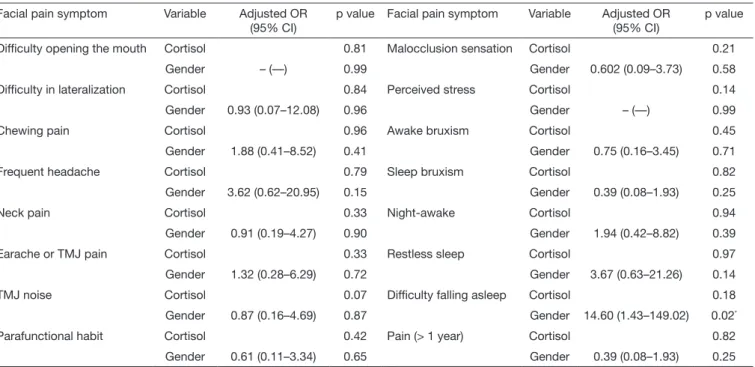
Table 2 shows the results of a standard binary logistic regression developed for modeling the relationship between facial pain symp-tomatology and gender. Adjusted ORs (95% CI) were obtained taking cortisol levels into consideration. Gender was found to be associated with “diiculty falling asleep” (p<0.05). Figure 2 shows the distribution of means and standard deviation of salivary corti-sol, according to scores of disturbed sleep symptoms in both men and women, men only, and women only. In all these situations, no statistically signiicant diference was demonstrated between groups (p>0.05), similarly to the comparison according to other evaluated symptoms (data not shown).
Table 1. Association between perceived symptoms of facial pain reported by participants, gender and scores of the Graded Chronic Pain Scale obtained from the Research Diagnostic Criteria for Temporomandibular Disorders, Axis II
Facial pain symptom Gender Facial pain symptom Gender
OR (95% CI) p value OR (95% CI) p value
Dificulty opening the mouth 0.3 (0.03 – 2.9) 0.27 Malocclusion sensation 1.0 (0.2 – 4.2) 0.99
Dificulty in lateralization 1.4 (0.2 – 7.6) 0.57 Perceived stress 0.9 (––) 0.46
Chewing pain 1.5 (0.4 – 5.8) 0.79 Awake bruxism 0.7 (0.2 – 2.7) 0.61
Frequent headache 2.5 (0.6 – 10.2) 0.09 Sleep bruxism 0.3 (0.07 – 1.3) 0.10
Neck pain 0.9 (0.3 – 3.6) 0.87 Night-awake 1.7 (0.5 – 6.4) 0.68
Earache or TMJ pain 1.5 (0.4 – 5.8) 0.68 Restless sleep 1.6 (0.4 – 6.3) 0.09
TMJ noise 1.3 (0.3 – 4.8) 0.20 Dificulty falling asleep 3.2 (0.8 – 12.9) 0.58
Parafunctional habit 0.8 (0.2 – 3.7) 0.70 Pain (> 1 year) 0.3 (0.07 – 1.3) 0.10
CI = conidence interval; OR = odds ratio; TMJ = temporomandibular joint; *p<0.05, according to Chi-square test of independence.
Figure 1. Comparison of values of salivary cortisol concentration according to gender or presence of perceived facial pain
A – Comparison of cortisol means ± standard deviation between male (801.8 ± 415.6) and female (863.3 ± 403.6) participants, considering the facial pain group isolated (p=0.69), and then males (949.1 ± 432.5) and females (873.3 ± 425.9), considering both facial pain and the control group (p=0.50); B – Comparison of cortisol means between controls and participants with facial pain in males (932.9 ± 443.2; 801.8 ± 415.7; p=0.48) and females (1058.6 ± 454.6; 863.3 ± 403.6; p=0.15); Student t test.
Male Female
Facial pain Facial pain and control
1000
950
900
850
800
750
700
A
Salivary cortisol (ng/mL)
Control Facial pain
Male Female
1200
1000
800
600
400
200
0
B
Table 2. Standard binary logistic regression testing the effect of gender on each symptom reported. The adjusted model included the level of morning salivary cortisol as a covariate. The presence or absence of facial pain symptoms was obtained from the Research Diagnostic Criteria for Temporomandibular Disorders, Axis II
Facial pain symptom Variable Adjusted OR
(95% CI)
p value Facial pain symptom Variable Adjusted OR
(95% CI)
p value
Dificulty opening the mouth Cortisol 0.81 Malocclusion sensation Cortisol 0.21
Gender – (––) 0.99 Gender 0.602 (0.09–3.73) 0.58
Dificulty in lateralization Cortisol 0.84 Perceived stress Cortisol 0.14
Gender 0.93 (0.07–12.08) 0.96 Gender – (––) 0.99
Chewing pain Cortisol 0.96 Awake bruxism Cortisol 0.45
Gender 1.88 (0.41–8.52) 0.41 Gender 0.75 (0.16–3.45) 0.71
Frequent headache Cortisol 0.79 Sleep bruxism Cortisol 0.82
Gender 3.62 (0.62–20.95) 0.15 Gender 0.39 (0.08–1.93) 0.25
Neck pain Cortisol 0.33 Night-awake Cortisol 0.94
Gender 0.91 (0.19–4.27) 0.90 Gender 1.94 (0.42–8.82) 0.39
Earache or TMJ pain Cortisol 0.33 Restless sleep Cortisol 0.97
Gender 1.32 (0.28–6.29) 0.72 Gender 3.67 (0.63–21.26) 0.14
TMJ noise Cortisol 0.07 Dificulty falling asleep Cortisol 0.18
Gender 0.87 (0.16–4.69) 0.87 Gender 14.60 (1.43–149.02) 0.02*
Parafunctional habit Cortisol 0.42 Pain (> 1 year) Cortisol 0.82
Gender 0.61 (0.11–3.34) 0.65 Gender 0.39 (0.08–1.93) 0.25
CI = conidence interval; OR = odds ratio; TMJ = temporomandibular joint; *p<0.05.
Figure 2. Comparison of means and standard deviation of salivary cortisol in both genders, in the male group only and, lastly, in the female group, according to the scores of symptoms related to disturbed sleep (“no” indicates absence, and the intensity of the symptom ranged from “mild” to “very severe”)
A – Comparison according to the scores of “night-awake” (p>0.05); B – Comparison according to the scores of “restless sleep” (p>0.05). C – Comparison according to the scores of “dificulty falling asleep” (p>0.05); one-way ANOVA, followed by Bonferroni test.
Male and female
Male Female
2000
1500
1000
500
0
No Mild Moderate Severe Very severe
A
Salivary cortisol (ng/mL)
Male and female
Male Female
2000
1500
1000
500
0
No Mild Moderate Severe Very severe
A
Salivary cortisol (ng/mL)
Male and female
Male Female
2000
1500
1000
500
0
No Mild Moderate Severe Very severe
A
DISCUSSION
Facial pain, as most chronic conditions, is unlikely to be char-acterized by a homogenous and unmixed disease picture. In the present study, no perceived symptom of facial pain was signii-cantly associated with gender, and no relationship was found between facial pain, gender and morning salivary cortisol lev-els. his suggests that the regulation of morning salivary corti-sol might occur similarly in both genders in individuals with or without perceived facial pain.
he severity of facial pain has been reported to be elevated in women, mainly due to psychoneuroendocrine factors, as well as the role of estrogen in temporomandibular joint inlammation. Estrogen replacement therapy was associated with high prevalence of TMD, and serum estradiol levels during the luteal phase or in synovial luid are higher in TMD women than in controls10,11. his indicates that sex hormones, particularly estrogens, may be involved in facial pain, reason by which women during menstrual cycle, pregnancy and climacteric phase were excluded from our sample population. Conversely, the involvement of psychological distress in pain perception is becoming clearer as higher stress lev-els were found to enhance hyperalgesia, regardless of gender8. Moreover, this study failed to observe changes in morning sali-vary cortisol levels when comparing male versus female par-ticipants, with and without perceived facial pain. Recent data have also found no diference in cortisol levels between women with facial pain and controls; however, sex diferences were not taken into account as men were excluded from such studies17,18. High correlation between salivary and blood levels of cortisol have been reported, and diferences between measures during the circadian cycle with peaks occurring soon after awakening were shown6. Moreover, about 30% of free cortisol is enzymatically converted to cortisone and about 14% is bound to corticoste-roid-binding globulin in saliva. hus, one can imply that saliva contains lower levels of free cortisol when compared to plasma23. Nevertheless, the salivary measure includes important advantag-es, such as stress-free collection and processing6.
Importantly, the diferences between each gender in cortisol and distress levels might be impacted by social interactions and by the scenario where data were collected24. Strini et al.25 demonstrated that patients of both genders with diferent scores of orofacial dysfunction, including pain, were found to experience similar cortisol responses. Still, while most of the studies have reported women to be more susceptible to changes in HPA-axis function related to gender-oriented pain sensitivity14,26,27, the relationship between facial pain and HPA-axis activity requires further explo-ration. In addition, the present study had some limitations, as it was not possible to develop a case-matched control design. Persistent facial pain shows several aspects associated with a multisystem deregulation in sensory, autonomic, inlammatory, and psychological domains28. In the present investigation, fre-quent headache was not found to be associated with variations in morning salivary cortisol levels between male and female par-ticipants. his is in agreement with previous data, which showed that sexual dimorphism do not inluence salivary cortisol levels in patients with headache29.
It is important not to confuse “frequent headache” with “chronic daily headache”. One major criteria to deine chronic headache is the frequency of headache symptoms, which must appear at least ifteen days per month19. Hence, we considered frequent head-ache as that experienced less than ifteen days per month, with-out characteristics of migraine or cluster headache syndromes. Furthermore, both sleep and awake bruxism were not found to be associated with either gender or morning salivary cortisol lev-els in the group of individuals with facial pain evaluated here. A previous report observed reduced levels of morning cortisol in patients with sleep bruxism in comparison to controls; however, no efect of gender on sleep bruxism was detected30. It is impor-tant to emphasize that their population sample was composed by children, whereas we focused on young adults. hus, despite the relevance of such preliminary indings, it can be diicult to draw conclusions based solely on them, particularly due to the impact of age on psychoneuroendocrine activity23.
Notably, in the population studied, disturbed sleep was found to be frequent in patients of both genders with perceived facial pain. he relationship between pain and sleep has been a topic of wide discussion since sleep fragmentation was signiicantly associated with decreased levels of conditioned pain modula-tion in patients with facial pain31,32. Additionally, sleep quality is also thought to be involved in HPA-axis activity, probably act-ing through distinct pathways in men and women in terms of capability to recover from sleep deprivation33. herefore, eforts to treat sleep disturbance early in the course of a pain condition should be kept in mind towards reducing the severity and impact of clinical pain and psychological stress7,32,33.
CONCLUSION
Considering the data obtained, our results suggest that the regu-lation of morning salivary cortisol levels may occur similarly in individuals of both genders, either with or without facial pain symptoms. Such preliminary indings deinitely require fur-ther investigation, considering that the exposition to facial pain symptomatology and comorbidity can dramatically impair pa-tients’ quality of life.
ACKNOWLEDGMENTS
he authors would like to thank FAPEMA for the research sup-port (grant numbers 366/12, 2209/12, 588/13, and 877/16).
REFERENCES
1. Harper DE, Schrepf A, Clauw DJ. Pain mechanisms and centralized pain in temporo-mandibular disorders. J Dent Res. 2016;95(10):1102-8.
2. Sanders AE, Slade GD, Bair E, Fillingim RB, Knott C, Dubner R, et al. General health status and incidence of irst-onset temporomandibular disorder: the OPPERA prospective cohort study. J Pain. 2013;14(Suppl 12):T51-62.
3. Bender SD. Temporomandibular disorders, facial pain, and headaches. Headache. 2012;52(Suppl 1):22-5.
4. da Silva Junior AA, Krymchantowski AV, Gomes JB, Leite FM, Alves BM, Lara RP, et al. Temporomandibular disorders and chronic daily headaches in the community and in specialty care. Headache. 2013;53(8):1350-5.
6. Hellhammer DH, Wüst S, Kudielka BM. Salivary cortisol as a biomarker in stress research. Psychoneuroendocrinology. 2009;34(2):163-71.
7. Lavigne GJ, Sessle BJ. he neurobiology of orofacial pain and sleep and their interac-tions. J Dent Res. 2016;95(10):1109-16.
8. Bement MH, Weyer A, Keller M, Harkins AL, Hunter SK. Anxiety and stress can pre-dict pain perception following a cognitive stress. Physiol Behav. 2010;101(1):87-92. 9. Slade GD, Ohrbach R, Greenspan JD, Fillingim RB, Bair E, Sanders AE, et al. Painful
temporomandibular disorder: decade of discovery from OPPERA studies. J Dent Res. 2016;95(10):1084-92.
10. Turner JA, Mancl L, Huggins KH, Sherman JJ, Lentz G, LeResche L. Targeting tem-poromandibular disorder pain treatment to hormonal luctuations: a randomized cli-nical trial. Pain. 2011;152(9):2074-84.
11. Kou XX, Wu YW, Ding Y, HaoT, Bi RY, Gan YH, et al. Estradiol aggravates temporo-mandibular joint inlammation through the NF-κB pathway in ovariectomized rats. Arthritis Rheum. 2011;63(7):1888-97.
12. Slade GD, Bair E, Greenspan JD, Dubner R, Fillingim RB, Diatchenko L, et al. Signs and symptoms of irst-onset TMD and sociodemographic predictors of its develop-ment: the OPPERA prospective cohort study. J Pain. 2013;14(Suppl 12):T20-32. 13. Weekes NY, Lewis RS, Gotoc SG, Garrison-Jakela J, Patelb F, Lupien S. he efect of
an environmental stressor on gender diferences on the awakening cortisol response. Psychoneuroendocrinology. 2008;33(6):766-72.
14. Turner-Cobb JM, Osborn M, Silva L, Keogh E, Jessop DS. Sex diferences in hy-pothalamic–pituitary–adrenal axis function in patients with chronic pain syndrome. Stress. 2010;13(4):292-300.
15. Glaros AG, Marszalek JM, Williams KB. Longitudinal multilevel modeling of facial pain, muscle tension, and stress. J Dent Res. 2016;95(4):416-22.
16. Korszun A, Young EA, Singer K, Carlson NE, Brown MB, Croford L. Basal cir-cadian cortisol secretion in women with temporomandibular disorders. J Dent Res. 2002;81(4):279-83.
17. Nilsson AM, Dahlström L. Perceived symptoms of psychological distress and salivary cortisol levels in young women with muscular or disk-related temporomandibular disorders. Acta Odontol Scand. 2010;68(5):284-8.
18. Jasim H, Louca S, Christidis N, Ernberg M. Salivary cortisol and psychological factors in women with chronic and acute oro-facial pain. J Oral Rehabil. 2014;41(2):122-32. 19. Headache Classiication Committee of the International Headache Society (IHS). he
International Classiication of Headache Disorders, 3rd edition (beta version). Cepha-lalgia. 2013;33(9):629-808.
20. Manfredini D, Winocur E, Ahlberg J, Guarda-Nardini L, Lobbezoo F. Psychosocial
impairment in temporomandibular disorders patients. RDC/TMD axis II indings from a multicentre study. J Dent. 2010;38(10):765-72.
21. de Lucena LB, Kosminsky M, da Costa LJ, de Góes PS. Validation of the Portuguese version of the RDC/TMD Axis II questionnaire. Braz Oral Res. 2006;20(4):312-7. 22. Slade GD, Sanders AE, Bair E, Brownstein N, Dampier D, Knott C, et al. Preclinical
episodes of orofacial pain symptoms and their association with healthcare behaviors in the OPPERA prospective cohort study. Pain. 2013;154(5):750-60.
23. Levine A, Zagoory-Sharon O, Feldman R, Lewis JG, Weller A. Measuring cortisol in human psychobiological studies. Physiol Behav. 2007;90(1):43-53.
24. Allen AP, Kennedy PJ, Cryan JF, Dinan TG, Clarke G. Biological and psychological markers of stress in humans: focus on the Trier Social Stress test. Neurosci Biobehav Rev. 2014;38:94-124.
25. Strini PJ, Strini PJ, Barbosa TS, Gavião MB. Assessment of orofacial dysfunctions, salivary cortisol levels and oral health related quality of life (ORHQoL) in young adults. Arch Oral Biol. 2011;56(12):1521-7.
26. Godfrey KM, Strachan E, Dansie E, Croford LJ, Buchwald D, Goldberg J, et al. Salivary cortisol and cold pain sensitivity in female twins. Ann Behav Med. 2014;47(2):180-8.
27. Allen LB, Lu Q, Tsao JCI, Worthman CM, Zeltzer LK. Sex diferences in the as-sociation between cortisol concentrations and laboratory pain responses in healthy children. Gender Med. 2009;6(Suppl 2):193-207.
28. Chen H, Nackley A, Miller V, Diatchenko L, Maixner W. Multisystem dysregulation in painful temporomandibular disorders. J Pain. 2013;14(9):983-96.
29. Fernández-de-Las-Peñas C, Fernández-Mayoralas DM, Arroyo-Morales M, Ambite-Quesada S, Rivas-Martínez I, Ortega-Santiago R, et al. Lower immunglobulin A lev-els but not lower cortisol or a-amylase activity in children with chronic tension-type headache. Cephalalgia. 2011;31(4):481-7.
30. Castelo PM, Barbosa T de S, Pereira LJ, Fonseca FL, Gavião MB. Awakening salivary cortisol levels of children with sleep bruxism. Clin Biochem. 2012;45(9):651-4. 31. Smith MT, Wickwire EM, Grace EG. Sleep disorders and their association
with laboratory pain sensitivity in temporomandibular joint disorder. Sleep. 2009;32(6):779-90.
32. Edwards RR, Grace E, Peterson S, Klick B, Haythornthwaite JA, Smith MT. Sleep continuity and architecture: associations with pain-inhibitory processes in patients with temporomandibular joint disorder. Eur J Pain. 2009;13(10):1043-7.