Epidemiology of long face pattern in
schoolchildren attending
middle
schools at
the city of Bauru - SP
Mauricio de Almeida Cardoso*, Leopoldino Capelozza Filho*, Tien Li An**, José Roberto Pereira Lauris***
Objective: This study aimed to classify and determine the prevalence of individuals with vertical alteration of facial relationships, according to the severity of discrepancy, espe-cially individuals with long face pattern. Methods: The sample was composed of 5,020 individuals of Brazilian nationality, of both genders, aged 10 years to 16 years and 11 months, attending middle schools at the city of Bauru-SP, Brazil. Examination of facial morphology comprised direct observation of the face in frontal and lateral views, always with the lip at rest, aiming to identify individuals presenting vertical alteration of facial relationships. After identification, these individuals were scored, according to severity, into three subtypes, namely mild, moderate and severe. The prevalence of individuals with long face pattern considered only the individuals scored as subtypes moderate and severe. Results: There was prevalence of 34.94% of vertical alteration of facial relation-ships and 14.06% of long face pattern. Conclusions: The results obtained in this study revealed that the prevalence of vertical alteration of facial relationships and long face pattern was higher than that reported in the literature.
Abstract
Keywords: Epidemiology. Craniofacial abnormalities. Diagnosis.
* Professors in the Program of Dental School and Specialty and Master Degree Programs in Orthodontics in the University of Sagrado Coração – USC, Bauru.
** Temporary Professor in Orthodontics, Department of Dentistry, Health Science School – University of Brasília.
*** Associate Professor in the Department of Dental Pedriatrics and Public Health in the Dental School of Bauru, at the University of São Paulo – USP, Bauru.
IntROduCtIOn
The denomination of long face represents a stig-ma from the conventional perspective of stig- malocclu-sion classification,3 because it suggests the presence
of a large morphological deviations in comparison to the normal pattern,5-10 often with significant esthetic
impact.8 Since a long time, in orthodontic practice,
it was more acceptable that for these individuals,
when the face was unattractive, a surgical approach is indicated.3,5,8,9,26,27,29
This deformity manifests early in life, main-tains the features of the individual,17 and may
magnify or not during adolescence.12 It may be
The children and adults that express this excessive vertical facial growth present a char-acteristic face, labeled in the literature as long face syndrome,3,22 hyperdivergent face14 and,
recently, long face pattern.5-10 Other
denomi-nations, such as skeletal open bite4 or open bite
face,17 disregard the primary skeletal error5,9,10
and are mistaken, since the open bite condi-tion may be less frequent than normal in these individuals.5,8,10,18
The main characteristic of these individu-als is excessive maxillary incisor exposure—an-teroposterior, with the lips at rest, and gummy smile1—due to the excessive increase in the
low-er facial height.1,22,29 Under a classic perspective,
these morphological signs constitute the essence of the deformity, which generally provides un-attractive faces. In this context, the orthodontic treatment alone is very limited, and a surgical ap-proach would be more appropriate.5-10,12,26
The facial analysis, the first tool in diagnostic hierarchy, provides a more appropriate perspec-tive to the examination and qualification of the long face, the deformity that, despite the verti-cal component, presents a three-dimensional expression. Thus, besides giving a more realis-tic tone to the many features common to these individuals, such as increased total anterior fa-cial height,1,5-10,14,18 as consequence of increased
lower anterior facial height,1,3,5-11,13,14,22,29 which
result in an oval29 or tapered1 facial appearance
associated with normal middle13,14 and upper
fa-cial thirds,13,14,22 it aggregates the visualization of
other characteristics.
The lip incompetence, a mandatory character-istic in long face deformity, caused by the inability of passive lip sealing, is evident with the lips at rest posture.1,3,11,13,22,29 During lip sealing, it occurs
the contraction of perioral musculature, which ac-centuates the deficiency of the chin contour.1,3,13,22
This provides a more retrognathic mandibular ap-pearance14,29 and generates a short chin-neck
con-tour line as well as chin-neck angle.5
Excessive teeth and gingival structures are ev-idenced at smile,3,13,22 a reflection of anterior and
posterior maxillary dentoalveolar growth excess,1
which provokes overexposure of upper incisors, normally, the chief complain of patients.1,13,14,22,29
Also, a deficiency may be observed in the zy-gomatic proeminence1,29 and chin,11 besides the
accentuated nasolabial depression.22 The length
of the upper lip is normal13,14,22 and the
defor-mity is aggravated when the patient presents a short upper lip.9 The lower lip posture often is
impaired, with excessive lip vermilion display at rest.13,14 The nose is long1,3,13,14 and the nostrils are
narrow1,11,13,14,22,29 with prominent nasal dorsum
at facial profile view. 3,13,14,22
Dental relationship analysis is helpful to un-derstand why long face pattern malocclusions have been evaluated from a different perspec-tive since a long time.5 The most relevant factor
is the impossibility of defining this pattern by molar relationship which can be Class I or Class III, despite the tendency for Class II (prevalence of 13.2%, 15.8% and 71.0%, respectively).10 In
addition, the expressive variation in the den-tal arch morphology in long face pattern—that fluctuates from open bite to deepbite, negative to significantly positive overjet, even the pres-ence or not of a crossbite10—makes the dental
parameters useless for its denomination.5,18 The
literature presents varied data with regard to the prevalence of long face pattern. Wolford and Hilliard29 reported that vertical maxillary
excess is the most frequently found facial de-formity, and often misdiagnosed as anteropos-terior mandibular deficiency, although they have not specified the prevalence. Woodside and Linder-Aronson30 found lower facial height
excess in 18% of young Caucasian males, aged from 6 to 20 years.
In contrast, a survey conducted by the Na-tional Center for Health Statistics15 found a
In this study, the authors reported that a surgical procedure would be necessary for half of these individuals (0.75%), due to facial unattractive-ness. This prevalence of 0.75% was very close to the estimate of 0.6% reported by Proffit and White.20 The low percentages referred in these
surveys were probably related to the severity that the deformity imposes on the patients.
Therefore, it seems necessary that the mag-nitude that the vertical impairment affects the face should be considered in the investigation of the prevalence of long face pattern. From this perspective, the spectrum of variation would be large, ranging from individuals without tempo-rary passive lip sealing, a reflection of imposed functional deviations2 considered as typical
disarrangements during growth in humans,19
until those individuals traditionally identified as long face due to facial unattractiveness. This may result in a proper understanding of the oc-currence of vertically involved malocclusions, and within this broader context, in the correct determination of the prevalence of long face pattern malocclusion.
The literature lacks of epidemiological survey that considers uniquely the facial pattern, corre-lating the prevalence with the severity in indi-viduals with vertically impaired facial relation-ships by excess, with emphasis on the absence of lip sealing. This is of great importance for clini-cians, especially with regard to the determination of the prognosis for treatment to be approached, whether in the correction of malocclusion or in the management of the effects of malocclusions on intra and perioral functions.7,18
PROPOSItIOn
This survey, with middle school students in Bauru - SP (Brazil), aimed to classify and deter-mine the prevalence of individuals with vertically impaired facial relationships by excess (accord-ing to three levels of severity), and especially, of individuals with long face pattern.
MAtERIAL And MEtHOdS
This cross-sectional descriptive study, held in Bauru-SP (Brazil), is in accordance with National Health Board 196/96 Resolution, with the Hel-sinki Declaration and the Nuremberg Code for human experimentation, and was approved by the Ethics Committee of the São Paulo State Uni-versity at Araçatuba (FOA 2005-01085).
The sample consisted of 5,020 Brazilian eth-nicity subjects: 2,480 females (49.40%) and 2,540 males (50.60%). The sample ages ranged from 10 years to 16 years and 11 months, with an average age of 13 years (SD = 1 year and 3 months) for the total sample, 12 years and 11 months (SD = 1 year and 3 months) for females, and 13 years (SD = 1 year and 3 months) for males. This epidemiologi-cal survey period comprised from August 17 of 2005 to May 15 of 2006.
This study aimed to evaluate all individuals en-rolled in public and private middle schools (5th to 8th grades), regardless of age, dentition and race. The percentage of student participation was 88.4%. The percentage of loss (11.6% - 660 stu-dents) in the sample was due to absence on the examination day or, for some reason, unavailabil-ity to participate in the survey.
The sample size was calculated assuming a 95% of confidence interval. According to the literature, the estimated prevalence of long face pattern in the population is 1.5%.15 By assuming
a margin of error of 0.35% in the population es-timate, a necessary sample size of 4,643 subjects was determined. Added to an estimate of poten-tial loss of approximately 10%, a final sample size of approximately 5,000 subjects was established for achieving the desired accuracy.
indicate a coverage of 89.0% of participation in the public sphere in offering this type of education in Brazil.4 Among the students assessed by the
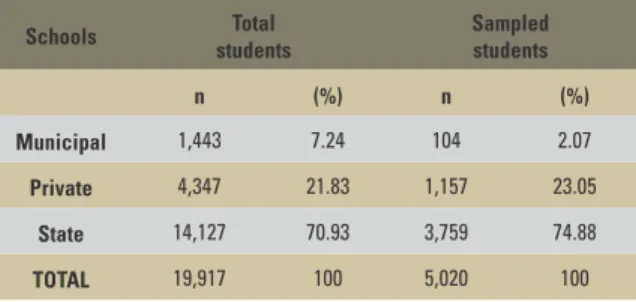
pres-ent survey, 3,759 (74.88%) belonged to the state schools, 1,157 (23.05%) to private schools and 104 (2.07%) to the municipal schools (Table 1).
With regard to the sample of this survey, the prevalence and the percentages of the sampled stu-dents from the municipal, private and state schools were very similar in relation to the distribution of all enrolled students in the middle school in Bauru (Table 1 and Fig 4). Concerning the amount and the similarity of distributions of the sample in rela-tion to all the students enrolled in middle schools, the sample from this survey can be considered as representative for the population of middle school students in Bauru-SP. From this myriad, 14 schools were selected by convenience—eight state schools, five private and one municipal school—in search of respecting the ratio of students enrolled in middle schools in Bauru.
All students present on the day of evaluation, who agreed to participate in the study, were eval-uated with basis only on the facial morphology.11
The criterion for the identification of individuals with vertically impaired facial relationships by excess was the lack of lip sealing. Assuming that the study concerns the identification of long face patients, the term “by excess” should be implied as a reference to the vertical facial impairment. Ac-cording to Capelozza Filho5 diagnostic criteria, first
permanent molar anteroposterior relationships as
well as the vertical distance of upper and lower incisors were not considered.
As inclusion criteria, the individual should not present clinically observed syndromes and/or his-tory of surgery or fractures in the facial or skull re-gion. The history of previous or ongoing orthopedic and/or orthodontic treatment was not an exclusion factor for sampling, considering that such treat-ments are known to be unable to change signifi-cantly the facial proportions and relationships.26,30
All subjects were evaluated under natural light by one examiner who is experienced in orthodontics and properly calibrated for facial morphology evaluation.7 The individuals were
evaluated in standing natural head posture with the lips at rest without the help of any special equipment.24
The diagnosis of patients with vertically im-paired facial relationships by excess is morpho-logical, based on the subjective facial analysis.5,7-10
The subjects of this study were evaluated based on direct observation of the face in the frontal and lateral norms, with their lips always at rest, trying to identify those who had incompetency in this relationship. The rest position was prioritized, since those individuals with vertical excess have a tendency to seal the lip unconsciously and camou-flage the deformity.
Once identified, individuals with vertically im-paired facial relationships were classified into three subtypes according to the severity: mild, moderate and severe.7 With proper calibration and training,
the classification method by level of severity pre-sented a high reliability.7,21 That is, the diagnostic
conclusion established in the first examination was maintained, with high probability, when the exam-ination was repeated after three weeks.
As classification criteria for mild subtype, there are demanded: presence of lip incompetence, ex-cessive exposure of the upper incisors at rest and/ or gummy at smile; presence of, even with postural component, mild disproportion between the middle and lower facial thirds. In summary, these individuals TABLE 1 - Frequency distribution of the total and sampled middle
school students from the municipal, private and state schools at Bauru-SP/Brazil.
Schools Total students
Sampled students
n (%) n (%)
Municipal 1,443 7.24 104 2.07
Private 4,347 21.83 1,157 23.05
State 14,127 70.93 3,759 74.88
FIGURE 1 - Extraoral photographs in frontal, lateral and smiling aspects of a white individual with vetically impaired facial relationship by excess, mild subtype.
FIGURE 2 - Extraoral photographs in frontal, lateral and smiling aspects of a white individual with vetically impaired facial relationship by excess, moderate subtype.
could be considered as transitory long face, postural or even borderline to long face.19 In this way, they
would present good prognosis for conservative treat-ment (orthodontic and/or orthopedic)7 (Fig 1).
With regard to moderate subtype, the classifica-tion criteria were the presence of a genuine discrep-ancy between the middle and lower facial thirds, be-sides the features already described in previous sub-type, which characterize, therefore, with certainty, a long face pattern individual. In these individuals, the prognosis is regular for conservative treatment (orthodontic and/or orthopedic)7 (Fig 2).
Individuals that belong to severe subtype should present a severe disproportion between the middle and lower facial thirds, associated to the features described in previous subtype and summed by more typical signs of long face, to an extent suf-ficiently to provide unattractiveness. In these in-dividuals, the prognosis is poor for conservative treatment and orthognathic surgery is indicated for normalization of facial relationships7 (Fig 3).
To determine the prevalence of patients with long face pattern, only the individuals classified as moderate and severe subtypes were considered. This is justified by the brevity of vertical discrep-ancy in mild subtype individuals. As previously described, the mild individuals could be affected by transitory growth disarrangement,2,19 or only
by postural changes related to functional distur-bances that, if eliminated, would allow an ad-equate growth.16 From the treatment perspective,
it seems inappropriate to include mild subtype individuals in the myriad of long face pattern, al-though it is important to consider and emphasize the vertical facial impairment, and especially their lip relationships.
For statistical processing, all results were ana-lyzed by the software Statistica 5.1 (Stat Soft Inc., Tulsa, USA). Chi-square (χ2) test was used,
at 5% (p <0.05) of statistical significance level, to compare the frequency ratios of individuals with vertically impaired facial relationships in the total sample, according to the three levels of severity.
It was also used to compare the frequency ratios of individuals with long face pattern in the total sample.
RESuLtS
After data statistical processing, the epidemio-logical information, in absolute and percentage values, on the prevalence of individuals with ver-tically impaired facial relationships by excess (ac-cording to three levels of severity) and individuals with long face pattern (only those with moderate and severe levels of severity) was organized.
The distribution of the total evaluated sample, with distinction between individuals with verti-cally impaired facial relationships by excess—ac-cording to severity—and long face pattern can be visualized, respectively, in Tables 2 and 3.
dISCuSSIOn
Prevalence of individuals with vertically impaired facial relationships by excess and long face pattern
In this study, we found a prevalence of 34.94% of individuals with vertically impaired facial relationships by excess (Table 2). Such high prevalence seems to be surprising, and no data from surveys executed with similar meth-ods could be used for comparison. Some studies that reported the prevalence of vertical growth pattern may be referred: Siriwat and Jarabak25
found a prevalence of 10% with hyperdivergent patterns in a sample of 500 patients treated in the private practice of Dr. Jarabak; Willems et al28 found a prevalence of 29% of heterogeneous
age subjects with vertical growth tendency that underwent orthodontic treatment in Belgium. For comparative analysis, the limitation related to the survey of individuals who had sought for treatment should be considered.
degrees of excess in lower anterior facial height.30
These authors consider this excess in anterior fa-cial height, regardless of severity, as responsible for the deterioration or impairment in facial re-lationships. Considering the population pattern assessed by Woodside and Linder-Aronson,30 it is
reasonable to accept the high prevalence found in Brazilian population.
Actually, for a better understanding, these data should be analyzed under the perspective that motivated this survey and defined the evaluation method. Besides the prevalence of long face pattern which has always been the primary purpose of this study, the investigation of the frequency of indi-viduals with vertically impaired facial relationships and the definition of their magnitudes were second-ary, but no less important, objectives. The reason of this motivation may be understood as follows.
The absence of passive lip sealing at rest, a de-manded criterion for classification of individuals with vertically impaired face, is very frequent in human during growth. So frequent that it can be considered as normal.2 The results of the present
survey, with a prevalence of 34.94% for all indi-viduals with vertically impaired facial relation-ships by excess, mirror a frequency that is not described similarly in the literature, although it
appears reasonable. A correct understanding of what that means has an absolute clinical impor-tance for diagnosis and prognosis in these subjects. The first point, and perhaps the most important one, is to understand that the presence of this im-pairment may be normal. The individual may not have malocclusion, and therefore do not require treatment; or may present a malocclusion regard-less of this facial sign, and proposed with a prog-nosis and treatment which retain no correlation with the vertical facial impairment.
On the other hand, there are circumstanc-es where malocclusion is mandatorily prcircumstanc-esent and retains a close correlation with the verti-cal impairment; so intense and correlated that, according to the magnitude, the malocclusion could not be treated only by orthodontic and/ or orthopedic procedures.26 This variability
de-termines the need for accurate diagnosis which implies, in the first instance, the determination of the severity and allows the prognosis. This is one of the objectives in this study, which will be elucidated in this section.7
The general perspective to be adopted pre-sumes that the inadequate vertical facial rela-tionships, always with lip incompetence, may represent a normal condition or a sign of severely TABLE 2 - Prevalence of individuals with vertically impaired facial relationships by excess, according to levels of severity in the total sample.
TABLE 3 - Prevalence of individuals with long face pattern in the total sample.
Mild Moderate Severe TOTAL
n % n % n % n %
Vertically impaired facial
relationships by excess 1,048 20.88 672 13.38 34 0.68 1,754 34.94
TOTAL 5,020 100.00
Long face pattern Others Total sample
n % n % n %
compromised growth patterns. In this context, there is a chance that orthodontic and/or or-thopedic treatment is not indicated—due to the condition of normality—or, at the other extreme, counter-indicated because of the recognized limi-tations in the management of long face pattern malocclusions.5,26 It seems clear that there is an
extreme importance to predict the prognosis of the malocclusion severity and facial impact that growth will generate. In this thought, interpreting facial deformity and/or malocclusion at an early age only is not enough, but is necessary to recog-nize the localization and, therefore, the primary cause of the dysplasia.
Within this perspective, a proper diagnosis can be set, as well as prognosis to support or not the indication of therapeutics, targeting for realistic therapeutic goals. In summary, the ranking of the magnitude of impact on the face and localization of facial dysplasia permit more consistent thera-peutic approach; or, in other words, correction of malocclusions with vertical facial impairment conducted in consonance with predicted facial attractiveness at the end of growth. This implies conservative treatments in faces that might be acceptable and surgical procedures in faces that would worsen along time and growth.7
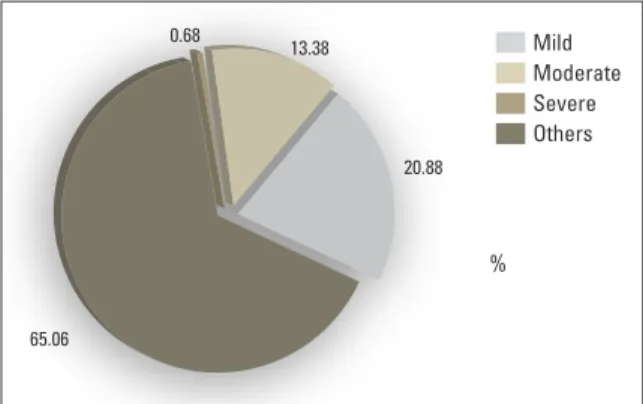
With regard to the prevalence of different severities on the vertical facial impairment, in-dividuals with mild subtype (20.88%) were predominant (Table 2 and Fig 5). Mild subtype individuals (Fig 1) may be different from each other. For whom it is likely to speculate that the primary etiologic factors are not genetic, but lo-cal or general. Identifi ed at an early age, the mild long face could be only postural that represents, morphologically, a mandatory but temporarily inadequacy between the internal and external functional components. This would be proven by the brevity of this vertical discrepancy present in these individuals.
Proffi t and Mason19 described the concept
of transitory lip incompetence, among other
functional irregularities that exist between the intra and perioral musculature, such as tongue thrust, resultant from expected asynchronism during the process of normal facial growth. The relationships that were described and recognized as normal could not necessarily be present during growth, which could be manifested only at the end of adolescence and, consequently, of the growth period. This hypothetical concept has been proven by researches and, since the early 90’s, has been in-troduced as the basic core of information recom-mended by the American Speech-Language-Hear-ing Association (ASHA)2 for the conception of
di-agnosis for intra and perioral musculature disorders.
FIGURE 4 - Frequency distribution of the total and sampled middle school students from the municipal, private and state schools at Ba-uru-SP/Brazil.
FIGURE 5 - Prevalence of individuals with vertically impaired facial rela-tionships by excess, according to levels of severity in the total sample.
Total
Mild
Severe Others Sampled
Moderate %
%
State 74.88 70.93
13.38
20.88 0.68
65.06
23.05 21.83
2.07 7.24
0 20 40 60 100
80
Also, these individuals may present postural chang-es related to true functional disturbancchang-es.
It is recognized that there are much more open-mouthed oral breather than genuine long face pattern individuals. Acquired or mandatory habits, and hypertrophic pharyngeal and palatal tonsils, allergic rhinitis, obstructive sleep apnea, and others,16 acting on a predisposed face5,26,
would create, at least, vertically impaired faces with mild level of severity. According to Linder-Aronson and Woodside,16 these would be the
environmental copies from genetic models. As it is known, the change in the breathing and all the possible postural and functional competen-cy that this change allows seem to be able to influence positively on the growth,16 specially in
patients who present the features described as mild subtype.
Individuals with vertically impaired facial relationships by excess with moderate and se-vere levels were classified as long face pattern individuals. A prevalence of 14.06% of individ-uals with long face pattern was found in this survey (Table 3), and resulted from the sum of the prevalence of moderate subtype individuals (13.38%) and severe subtype (0.68%) (Table 2). In the composition of the group of patients with long face pattern, individuals with vertically im-paired facial relationships by excess with mild subtype were not included, who were classified as having transitory long face, postural or even borderline for long face.
This prevalence for long face pattern (14.06%), in which patients with transient or postural long face were not considered, is lower but close to that found by Woodside and Linder-Aronson.30 In
their study, as discussed earlier, 18% of individu-als with vertical impairments were not subdivid-ed according to severity, but describsubdivid-ed as having discrepancies ranging from mild to severe. Prob-ably the inclusion of persons with mild severity contributed to create this difference between the obtained results.
The main reason for the differences observed in the values from this study—for patients with long face pattern—in comparison to other surveys15,20
probably is related to the study focus; since this study considered, in addition to severe subtype patients, individuals belonging to moderate subtype. In these individuals, a real disproportion between the middle and lower facial thirds can be observed, which can be classified certainly as long face pattern individuals, who were difficult to be identified in an epidemio-logical survey with focus on molar relationships.5
For individuals with long face pattern classi-fied as moderate subtype (Fig 2), a prevalence of 13.38% was evidenced (Table 2 and Fig 5). In op-position to mild subtype, moderate subtype indi-viduals cannot be considered as an environment’s product. The clinician should be conscious about the genetic determinants in the observed facial pattern. More than facial expression and malocclu-sion, it is imperative to recognize the irreversibility of the facial morphology destiny. The features of the face in individuals considered to have vertically impaired facial relationships, classified as moderate subtype, are more accentuated. In these individu-als, as already discussed, a true disproportion be-tween the middle and lower thirds can be observed and may facilitate their identification, in addition to features already described in the mild subtype.
In this context, although a conservative treat-ment may be indicated, it must follow the rules considered essential for the management of these individuals, always with the intention of not in-creasing or dein-creasing the intraoral dental volume and exercise the function of the intra and perioral musculature,5,18 or, in other words, to facilitate the
balance between the internal and external func-tional components.26 Additionally, the prognosis
For long face pattern individuals classified as severe subtype (Fig 3), a prevalence of 0.68% was found (Table 2 and Fig 5). This prevalence is close to the estimate of approximately 1.5% for the U.S. population. These data were col-lected by “U.S.A. Health Statistics”,15 in a young
American population aging from 12 to 17 years. In the sample, the authors reported that a surgi-cal procedure would be necessary, justified by the facial impairment, in approximately half of indi-viduals (0.75%). This percentage of indiindi-viduals who require surgery was close to the prevalence of 0.68% of long face pattern severe subtype in-dividuals evaluated in the present epidemiologic survey, which corroborates the estimate of 0.6% reported by Proffit and White.20
For severe subtype individuals, an intercep-tive orthopedic procedure is innocuous, in con-sequence to the unattractiveness of the patient’s facial relationships. This should superimpose on other exams, such as cephalometric and clinical dental examination.7 During the time from first
examination until confirmation of a severe sub-type, priority must be given to the management of tooth eruption and must be maintained, at each step, the patient and the family members aware about the evolution and possibilities for the com-plete correction of the face and teeth at the end of the growth period.
A slightly higher prevalence (4.1%) was re-ported in a retrospective study of 1,460 consecu-tive patients who sought for treatment in the orthognathic surgery service in North Carolina (USA).23 These results are difficult to be
com-pared with those found in this study, since the sample consisted of individuals that sought for surgical treatment and, furthermore, the focus of the investigation was facial asymmetry instead of the long face pattern itself.
The extensive material collected in this study in a population of different ethnicity compared to the literature,30 reported high frequencies of
indi-viduals with long face pattern. The difference in
prevalence may be explained by the classification criteria adopted by the examiner during the sam-pling. But one conclusion is certain: the relation-ship between the results found by Woodside and Linder-Aronson30 and those found in this study
express a high prevalence of this facial pattern in the population.
FInAL COnSIdERAtIOnS
The prevalence of individuals with vertical-ly impaired facial relationships by excess was significant (34.94%), and probably higher than expected. Considering that the prevalence was obtained from a sample of individuals with growth potential that properly represents Bra-zilian population, the reliability of the present study seems probable. The described argu-ments for the vertical impairargu-ments in the fa-cial relationships in growing individuals, even postural or transitory, support the concentra-tion of prevalence evidenced in mild subtype (20.88%).
For the prevalence of long face pattern (14.06%), the results appear to be logical and predictable specially when analyzed un-der proper perspective. The characteristics of the facial morphology of Brazilian population as a whole, and particularly black and pardo races, seem to predispose to the occurrence of vertical discrepancies, helping to increase the prevalence of long face pattern. From the prac-tical standpoint or the meaning of prevalence obtained in this epidemiologic study, it seems clear that the minimum percentage values such as described in about 1.5% should be dis-considered,15 for the occurrence of long face
pattern. Based on the literature review, this low percentage refers to the most severe cases, those with significant facial impairment.
literature, shows the similarity with the preva-lence obtained for long face pattern severe subtype patients (0.68%). In other words, this minimum percentage of prevalence is referred to long face individuals with the presence of facial features able to create unattractiveness and indicated for orthognathic surgery.
COnCLuSIOnS
This survey, which aimed to classify and de-termine the prevalence of individuals with ver-tically impaired facial relationships by excess,
1. Angelillo JC, Dolan EA. The surgical correction of vertical maxillary excess (long face syndrome). Ann Plast Surg. 1982 Jan;8(1):64-70.
2. The role of the speech language pathologist in assessment and management of oral myofunctional disorders. Asha. 1991 Mar; 33 supl. 5:7.
3. Bell WH, Creekmore TD, Alexander RG. Surgical correction of the long face syndrome. Am J Orthod. 1977 Jan;71(1):40-67.
4. IBGE (Brasil). Tabulação avançada do censo demográico 2000:
resultados preliminares da amostra. Rio de Janeiro: IBGE; 2002. 5. Capelozza Filho L. Diagnóstico en ortodoncia. Maringá:
Dental Press; 2004.
6. Capelozza Filho L, Cardoso MA, An TL, Bertoz FA. Características cefalométricas do Padrão Face Longa:
considerando o dimorismo sexual. Rev Dental Press Ortod
Ortop Facial. 2007 mar-abr;12(2):49-60.
7. Capelozza Filho L, Cardoso MA, An TL, Lauris JRP. Proposta
para classiicação, segundo a severidade, dos indivíduos
portadores de más oclusões do Padrão Face Longa. Rev Dental Press Ortod Ortop Facial. 2007 jul-ago;12(4):124-58. 8. Capelozza Filho L, Cardoso MA, Reis SAB, Mazzottini R.
Surgical-orthodontic correction of long face syndrome. J Clin Orthod. 2006 May;40(5):323-32.
9. Cardoso MA, Bertoz FA, Capelozza Filho L, Reis SAB. Características cefalométricas do Padrão Face Longa. Rev Dental Press Ortod Ortop Facial. 2005 mar-abr;10(2):29-43. REFEREnCES
according to the severity of the discrepancy, and specially of long face pattern individuals, in 5,020 students from middle schools in Bauru/ SP (Brazil), showed the following conclusions: » There was a total prevalence of 34.94% of
individuals with vertically impaired facial re-lationships by excess including all three lev-els of severity.
» The prevalence of long face pattern was 14.06%; 13.39% for moderate subtype and 0.68% for the severe subtype, and this value (14.06%) was higher than that presumed by literature.
10. Cardoso MA, Bertoz FA, Reis SAB, Capelozza Filho L. Estudo das características oclusais em portadores de Padrão Face Longa com indicação de tratamento ortodôntico-cirúrgico. Rev Dental Press Ortod Ortop Facial. 2002 nov-dez;7(4):63-70.
11. Epker BN, Fish L. Surgical-orthodontic correction of open-bite deformity. Am J Orthod. 1977 Mar;71(3):278-99.
12. Fields HW, Profit WR, Nixon WL, Phillips C, Stanek E. Facial
pattern differences in long-faced children and adults. Am J Orthod. 1984 Mar;85(3):217-23.
13. Fish LC, Wolford LM, Epker BN. Surgical-orthodontic correction of vertical maxillary excess. Am J Orthod. 1978 Mar;73(3):241-57.
14. Fitzpatrick BN. The long face and V.M.E. Aust Orthod J. 1984 Mar;8(3):82-9.
15. Kelly JE, Harvey C. An assessment of the occlusion of the teeth of youths 12-17 years. Washington, DC: National Center for Health Statistics; 1977. p. 1-18.
16. Linder-Aronson S, Woodside DG. Excess face height malocclusion: etiology, diagnosis and treatment. London: Quintessence; 2000.
17. Nanda SK. Growth patterns in subjects with long and short faces. Am J Orthod Dentofacial Orthop. 1990 Sep;98(3):247-58. 18. Nielsen IL. Vertical malocclusions: etiology, development,
Contact address
Mauricio de Almeida Cardoso
Rua Arnaldo de Jesus Carvalho Munhoz 6-100 CEP: 17.018-520 - Bauru / SP, Brazil
E-mail: [email protected]
25. Siriwat PP, Jarabak JR. Malocclusion and facial morphology: is there a relationship? An epidemiologic study. Angle Orthod. 1985 Apr;55(2):127-38.
26. Van der Linden PGM. O desenvolvimento das faces longas e curtas e as limitações do tratamento. Rev Dental Press Ortod Ortop Facial. 1999 nov-dez;4(6):6-11.
27. Vig KW, Turvey TA. Surgical correction of vertical maxillary excess during adolescence. Int J Adult Orthodon Orthognath Surg. 1989;4(2):119-28.
28. Willems G, De Bruyne I, Verdonck A, Fieuws S, Carels C. Prevalence of dentofacial characteristics in Belgian orthodontic population. Clin Oral Investig. 2001 Dec;5(4):220-6.
29. Wolford LM, Hilliard FW. The surgical-orthodontic correction of vertical dentofacial deformities. J Oral Surg. 1981 Nov;39(11):883-97.
30. Woodside DG, Linder-Aronson S. The channelization of upper and lower anterior face heights compared to population standard in males between ages 6 to 20 years. Eur J Orthod. 1979;1(1):25-40.
Submitted: December 2010 Revised and accepted: February 2011 19. Profit WR, Mason RM. Myofunctional therapy for
tongue-thrusting: background and recommendations. J Am Dent Assoc. 1975 Feb;90(2):403-11.
20. Profit WR, White RP. Long-face problems. In: Profit WR,
White RP. Surgical-orthodontic treatment. St. Louis: CV Mosby; 1990. p. 381.
21. Reis SAB, Abrão J, Capelozza Filho L, Claro CAA. Análise facial subjetiva. Rev Dental Press Ortod Ortop Facial. 2006 set-out;11(5):159-72.
22. Schendel SA, Eisenfeld J, Bell WH, Epker BN, Mishelevich DJ. The long face syndrome: vertical maxillary excess. Am J Orthod. 1976 Oct;70(4):398-408.
23. Severt TR, Profit WR. The prevalence of facial asymmetry
in the dentofacial deformities population at the University of North Carolina. Int J Adult Orthodon Orthognath Surg. 1997;12(3):171-6.