SUMMARY
Objective: To compare the volume, total calories, and protein received by critically ill pa-tients between open and closed enteral nutrition (EN) systems and identify the main rea-sons for EN discontinuation. Methods: A cohort study in which adult patients admitted to the intensive care unit (ICU) were followed-up in two periods: throughout November 2009 with all patients (n = 85) receiving EN using the open system (OS group); and from October 2010 to April 2011 with patients (n = 170) receiving EN using the closed system (CS group). Parametric and nonparametric tests were used to compare the variables, taking into account their distribution. Results: Demographic and clinical characteristics were similar in both groups. here were minor diferences with no statistical signiicance between groups: more calories/kg were prescribed to the OS group (p < 0.001), and a higher volume (mL/kg, p = 0.002) and protein (g/kg, p = 0.001) were prescribed to the CS group. Fasting, enteral feeding or gastrointestinal problems, and performance of pro-cedures and ICU routines in diferent frequencies between groups (p = 0.001) led to the discontinuation of EN. Conclusion: here was no clinically relevant diference between the volume, energy, and protein intake of EN prescribed and administered in OS and CS groups. Clinical instability, procedures, and ICU routines led to EN discontinuation in both groups.
Keywords: Enteral nutrition; nursing care; intensive care unity; nutritional therapy.
©2012 Elsevier Editora Ltda. All rights reserved.
Study conducted at Hospital de Clínicas de Porto Alegre, Porto Alegre, RS, Brazil
Submitted on: 08/19/2011 Approved on: 11/26/2011
Financial Support: Fundo de Incentivo à Pesquisa e Eventos (FIFE), Hospital de Clínicas de Porto Alegre and Pró-Reitoria de Pesquisa, Universidade Federal do
Rio Grande do Sul
Correspondence to: Stella Marys Rigatti Silva Rua: Ramiro Barcelos, 2350 Serviço de Nutrologia - Sala 635
CEP: 90035-003 Porto Alegre – RS, Brazil Phone: +55 (51) 3359-8199
Fax: +55 (51) 3359-8001 [email protected]
Conlicts of interest: None.
Open versus closed enteral nutrition systems for critically ill adults:
is there a difference?
STELLA MARYS RIGATTI SILVA1, MICHELLI CRISTINA SILVADE ASSIS2, CARLA ROSANEDE MORAES SILVEIRA3,MARIUR GOMES BEGHETTO4,
ELZA DANIELDE MELLO5
1Nurse, Universidade Federal do Rio Grande do Sul (UFRGS), Porto Alegre, RS, Brazil
2MSc in Health Sciences (Cardiology and Cardiovascular Sciences), UFRGS; Nurse at Hospital de Clínicas de Porto Alegre, Nutrology Service, and Nutritional Support Committee, Porto
Alegre, RS, Brazil
INTRODUCTION
Although enteral nutrition therapy (ENT) is a widely adopted treatment option for patients with intact gastro-intestinal tracts and partially or fully compromised oral intake1,2, the appropriate prescription and administration still represent a challenge3. Hospitalized patients receive less enteral nutrition (EN) than the prescribed volume4, increasing the risk of malnutrition, thus contributing to negative in-hospital outcomes5,6.
In Brazil, all stages of ENT are regulated by speciic legislation2, which establishes minimum requirements for the prescription, formulation, and administration of the diet, and speciies assignments to healthcare institu-tions and each member of the multidisciplinary team (physician, nurse, nutritionist, and pharmacist). Cur-rently, there are two types of ENT administration systems available: 1) open system (OS) and 2) closed system (CS). OS is characterized by being produced in a restricted and speciic area in which powder or liquid industrialized nu-trients are mixed, in accordance with Good Handling Practices2, in order to obtain the desired composition. OS appears to have less direct costs, although costs related to implementation, maintenance, physical space and equip-ment depreciation, human resources, and manipulation process validation should be considered7. However, OS allows the speciication of EN in terms of diet compo-sition (volume, calories, macronutrients, and micronu-trients). CS, also called ready-to-use, consists of indus-trialized, sterile, liquid diets packed in bags ready to be administered8,9. It is industrially manipulated, eliminat-ing critical stages of the preparation process in health facilities, which reduces the risk of contamination and, therefore, infection—if properly used10-12. However, the CS diets have standardized composition and volume, making it diicult to meet the speciic dietary require-ments of each patient. Countries like the USA, UK, and Australia, based on studies evaluating safety and cost, ad-opted the CS formulations as routine13,14, but stressed the need for additional studies assessing the environmental impact of ENT presentation15. It is worth noting that the CS diet presentations in these countries are not as costly as in Brazil because, within the Brazilian Uniied Health System (SUS), purchases are conducted by bidding in or-der to purchase products at the lowest price, regardless of indirect costs (e.g., handling process, physical area, and professionals).
Due to the lack of additional studies comparing these systems and evaluating the nutritional needs adjusted to the patient’s condition, particularly those critically ill, this study compared volume, total calories, and proteins of the EN received by critically ill adults using OS and CS. It also identiied the reasons leading to EN discon-tinuation in both systems.
METHODS
his was a cohort study in which groups were formed in two diferent periods. he study was approved by the Re-search Ethics Committee and the ReRe-search Council of the institution.
On the occasion of the annual audit of institutional rou-tines, adult patients in the intensive care unit (ICU) receiv-ing EN usreceiv-ing OS (November 2009) or CS (October 2010 to April 2011) were followed-up daily from the irst day of EN prescription to the end of the audit period, diet suspen-sion, or transfer. Two of the authors, using a standardized form, prospectively evaluated the clinical characteristics of patients and characteristics related to EN (volume, compo-sition, mode of diet administration). he patient’s medical records (electronic and paper) were also reviewed by the authors in search of additional information, when neces-sary. Patients with prescription of a sucrose- and lactose-free polymeric diet were monitored in both groups.
SAMPLECALCULATION
he need for inclusion of 90 patients in the OS group and 270 patients in the CS group was estimated using PEPI sotware, based on audit indings of 2009 (OS) when pa-tients received 692 ± 314 mL of diet, and considering a conidence interval (CI) of 95%, with 80% power, a ratio of three patients in the CS group to each patient in the OS group, and an expected increase of 104 mL (15%) in the volume administered within CS period. In the present study there was no increase in the estimated volume of the administered diet, and 170 patients were included in the CS group, which changed the ratio from 3:1 to 2:1. he same CI was maintained and, with the results obtained, sample power was calculated for the values of EN admin-istered: 98% for the volume, 21% for the calories, and 90% for the proteins.
DATAANALYSIS
OS group (n = 85)
CS group
(n = 170) p
Age 63 (45.5-71) 57.5 (40-68) 0.18*
Male 34 (40) 82 (48.2) 0.2§
Apache II score 23 (16-30) 21 (15-28) 0.13*
Glasgow score 11(7-14) 11.5 (7-15) 0.2*
Use of vasoactive drugs 66 (77.6) 132 (77.6) 1§
Use of mechanical ventilation 81 (95.3) 144 (84.7) 0.1§
Abdominal surgery 7 (8.2) 14 (8.2) 1§
Charlson comorbidity index 2 (1-4) 1.9 (0-3) 0.001*
Duration of ICU stay (days) 12 (6.5-22.5) 11 (6-18) 0.6*
Time on enteral nutrition (days) 6 (4-11) 7 (4-13) 0.5*
Hospital infection 35 (41.2) 50 (29.4) 0.7§
Death 39 (45.9) 52 (30.6) 0.2§
APACHE: Acute Physiology and Chronic Health Evaluation. Numbers are expressed as mean ± SD, n (%), or median (IQ: 25th and 75th percentiles). EN, enteral nutrition; ICU, intensive care unit; *Mann-Whitney U-test; §Pearson’s chi-squared test.
Table 1 –Comparison of clinical and demographic characteristics of patients enrolled in both periods
RESULTS
OS and CS groups had similar demographic and clinical characteristics for age, sex, APACHE II score, Glasgow scale, use of vasoactive drugs, abdominal surgery per-formed, mechanical ventilation, length of ICU stay, days of EN use, presence of infection, and hospital mortality (p > 0.05 for all comparisons). here was little difer-ence in the Charlson Comorbidity Index (OS: 2; IQ: 1-4
versus CS: 1.9; IQ: 0-3, p = 0.001), although this inding
has no clinical relevance (Table 1).
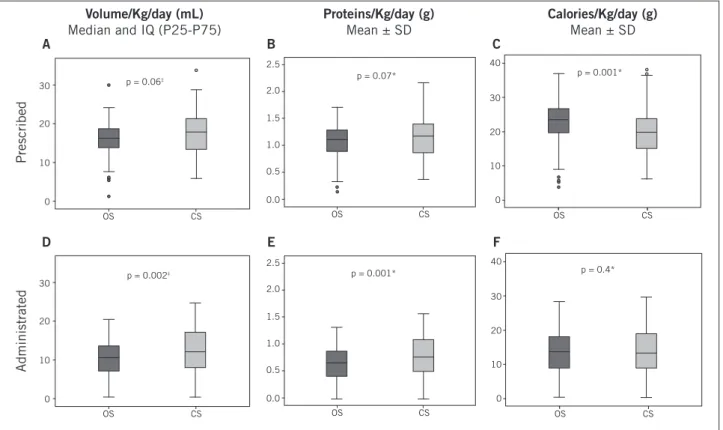
Figure 1A shows the analysis of prescribed vol-ume, calories, and proteins, with a trend towards low-er volume/kg/day of diet prescribed for patients in the OS group (16.3; IQ: 13.7-19) than for patients in the CS group (17.9; IQ: 13.4-21.5) (p = 0.06). Figure 1B shows the same trend towards proteins (OS = 1.05 ± 0.3 versus CS = 1.13 ± 0.3, p = 0.07). In contrast, Figure 1C shows that the values of prescribed calories/kg/day were high-er in the OS group (22.6 ± 6.5) than in the CS group (19.6 ± 6.1, p < 0.001).
Comparison of the administered volumes, calo-ries, and proteins showed statistical diference between groups: higher volume (mL/kg/day) in the CS group (11.8, IQ: 7.6-17) than in the OS group (10.2, IQ: 7-13.5, p = 0.002), and more protein/kg/day in the CS group (0.63 g ± 0.3 g versus 0.8 ± 0.3 g, p = 0.001) (Figure 1D and 1E). here was no signiicant diference between both systems regarding calorie administration (13 ± 6.6 versus 14 ± 6.4, p = 0.4) (Figure 1F). Despite any observed sta-tistical diference, it is noteworthy that, in clinical terms, the magnitude appears to be statistically irrelevant.
here were diferent reasons for EN discontinua-tion. 219 days of discontinuation for 699 days of EN use (31.3%) in the OS group were identiied, and 522 days of discontinuation for 1539 days of EN use (33.9%) in the CS group. Discontinuation of EN to perform tests and procedures, including preparation for surgery and/or by medical advice, was the most prevalent justi-ication in both groups (OS = 57%, CS = 65.1%). Other reasons for EN discontinuation were: opening the feeding container tube due to nausea/vomiting, transition to oral diet, transfer to inpatient unit, accidental removal and/or tube repositioning, and death. Diferences in reasons for diet discontinuation are shown in Table 2 for both groups (p = 0.001).
DISCUSSION
Reasons of EN discontinuation during follow-up OS = 219 d CS = 522 d p*
0.001
EN discontinuation 125 (57%) 340 (65.1%)
NET in open container 24 (10.9%) 82 (15.7%)
Start VO/ICU transfer 28 (12.8%) 49 (9.4%)
NET removed and/or re-passed 31 (14.1%) 30 (5.7%)
Death 11 (5%) 16 (3%)
NDS did not distribute diet – 1(0.2%)
Prescription for drip reduction – 4 (0.7%)
*p-value equal for all reasons by chi-square test and compared with Fisher’s exact test. Proportion of discontinuation days of the total days of EN use: OS group = 219/699 (31.3%) and CS group = 522/1539 (33.9%). OS, open system; CS, close system; EN, enteral nutrition; NET, nasoenteric tube; ICU, intensive care unit; PO, per mouth; NDS, nutrition and dietetics service.
Table 2 –Proportion of reasons of EN discontinuation during follow-up
Figure 1 – Table of comparison between open system (OS) and closed system (CS) groups for volume, protein, and calories
of enteral nutrition (EN), adjusted for kg/day, prescribed and administered to patients#.
IQ, interquartle range; #, p-values between groups (OS vs. CS), *Student’s t-test; ‡Mann-Whitney U test.
30
20
10
0
OS CS
p = 0.06‡
p = 0.002‡
p = 0.07*
p = 0.001*
Administrated
Prescribed
p = 0.001*
p = 0.4*
OS CS
2.5 2.0
1.5
1.0
0.5
0.0
40
30
20
10
0
OS CS
40
30
20
10
0
OS CS
OS CS
2.5
2.0
1.5
1.0
0.5
0.0 30
20
10
0
OS CS
Volume/Kg/day (mL)
Median and IQ (P25-P75)
A
D
B
E
C
F Proteins/Kg/day (g)
Mean ± SD
Calories/Kg/day (g)
Mean ± SD
groups, found that patients who had complications relat-ed to the OS receivrelat-ed more calories/day than those in CS group (p < 0.001). However, ater adjusting these calories to meet patient’s needs by body weight (using the Harris-Benedict equation), these diferences were not signiicant (p = 0.18).
Regardless of the system used, critically ill patients do not receive the recommended energy and protein in-takes, which is associated with worse clinical outcomes4,5.
protein intake (p = 0.002) in the irst 7 days of EN use, compared to those not using this protocol19.
In a study conducted in Spain20, regardless of EN system, critically ill patients had shorter period of dis-continuation (24.4%) than patients in our study (about 30%). he reasons for discontinuation were also similar to those reported by this study: diagnostic procedures or treatment inside/outside the ICU (53%), gastrointes-tinal manifestations (35%), and problems with feeding tubes (12%)20. In contrast, in a study by O’Meara et al.21, problems with gastrointestinal or nasogastric tubes oc-curred in 25.6% of total discontinuations, a percentage nearly twice that of the present study. However, 32.3% of those patients had their diet discontinued to under-go procedures, with 2.3% underunder-going nursing proce-dures21, almost half the percentage found in this study. he percentage of discontinuation for nursing care and physiotherapy was not assessed in the present study, as prescription diet is calculated for 22 hours, providing a 2 hour break for such procedures. However, in a research conducted in an ICU by O’Leary-Kelley et al.4, the per-centage of EN discontinuation was associated with spe-ciic intensive care routines (70%)4, surpassing the data presented in this study.
It is worth noting that the reasons for EN discontinu-ation do not follow a single pattern in all studies, making comparisons between the frequencies of the reasons dii-cult4,20,21. Most of these discontinuations occur due to the intensive care routines, norms, and standards of patient’s safety and protection established by each institution4,20,21. he multidisciplinary team should evaluate each case to avoid unnecessary and prolonged discontinuations that compromise the adequate daily intake.
In this study, the impact of changing the type of EN systems on the work process at the Department of Nutri-tion and the nursing staf was not evaluated. his point should be studied in order to investigate diferences in cost-efectiveness and work process management.
CONCLUSION
Changing the type of EN system did not afect the ENT of critically ill adults, as there was no clinically relevant diference in protein and energy intake using OS or CS. EN discontinuations in critically ill patients are moti-vated by clinical instability; performance of diagnostic, terapeutic, and nursing procedures; besides routines of intensive care.
ACKNOWLEDGMENTS
We thank the Fundo de Incentivo à Pesquisa e Eventos (FIPE), Hospital de Clínicas de Porto Alegre for inanc-ing the project, and the Pro-Rectory of Research, Univer-sidade Federal do Rio Grande do Sul.
REFERENCES
1. Campanella LCA, Silveira BM, Rosario Neto O, Silva AA. Terapia nutricio-nal enteral: a dieta prescrita e realmente infundida? Rev Bras de Nutr Clin. 2008;23(1):21-7.
2, Brasil. Ministério da Saúde. Agencia Nacional de Vigilância Sanitária. Res-olução RDC nº 63, de 06 de julho de 2000. Diário Oicial da União. Poder Ex-ecutivo, de 29 de junho de 2000. [cited 15 May 2011]. Available from:<http://e-legis.anvisa.gov.br/leisref/public/showAct.php?id=17610&word>
3. Nozaki VT, Peralta RM. Adequação do suporte nutricional na terapia nu-tricional enteral: Comparação entre dois hospitais. Rev Nutr Campinas. 2009;22(3):341-350.
4. O’Leary-Kelley CM, Puntillo KA, Barr J, Stotts N, Douglas MK. Nutritional adequacy in patients receiving mechanical ventilation who are feed enterally. Am J Crit Care. 2005;14(3):222-30.
5. Beghetto MG, Koglin G, Mello ED. Inluence of the assessment method on the prevalence of hospital malnutrition: a comparison between two periods. Nutr Hosp. 2010;25(5):774-780.
6. Beghetto MG, Lut VC, Mello ED, Polanczyk CA. Accuracy of nutritional assessment tools for predicting adverse hospital outcomes. Nutr Hosp. 2009;24(1):56-62.
7. Inman K, Davison B, Sibbald W, Rutledge F. Closed enteral system in the inten-sive care: evaluating their economic impact. Nutr Clin Pract. 1998;13(Supl):42. 8. Weenk G, Unen E, Meeuwisse J, Ess I, Hulst’ J. Assessment of the microbio-logical safety of enteral feeds when used with a prolonged feeding time. Burns. 1995;21(2):98-101.
9. Moitt SK, Gohman SM, Sass KM, Faucher KJ. Clinical and laboratory evalu-ation of a closed enteral feeding system under cyclic feeding conditions: a mi-crobial and cost evaluation. Nutrition. 1997;13(7):622-28.
10. Oliveira MR, Bonelli R, Aidoo KE, Batista CRV. Microbiological quality of re-constituted enteral formulations used in hospital. Nutrition. 2000;16(9):729-33. 11. Oliveira MR, Batista CRV, Aidoo KE. Application of hazard analysis critical
control points system to enteral tube feeding in hospital. J Hum Nutr Diet. 2001;14(5):397-403.
12. Watanabe S, Cukier C, Civelli S, Catalani LA, Muroya C. Impacto do sistema de infusão de dieta enteral sobre infecção respiratória e diarréia. Rev Bras Nutr Clin. 2008;23(1):46-50.
13. Crocker KS, Krey SH, Markovic M, Stefee WP. Microbial growth in clinically used enteral delivery systems. Am J Infect Control. 1986;14(6):250-6. 14. Curtas S. Closed enteral nutrition delivery systems: ine tuning a safe therapy.
Nutrition. 2000;16:307-310.
15. Anderton A, Beattie TK. Microbiological evaluation of four enteral feeding systems which have been deliberately subjected to faulty handling procedures. J Hosp Infect. 1999;42(1):11-20.
16. Herlick SJ, Vogt C, Pangman V, Fallis W. Clinical research: comparison of open versus closed systems of intermittent enteral feeding in two long-term care facilities. Nutr Clin Pract. 2000;15:287-298.
17. Borges RM, Nonino-Borges CB, Campos AD, Basile-Filho A. Incidência de complicações em terapia nutricional enteral de pacientes em estado grave. Rev Bras Ter Intensiva. 2005;17(2):98-103.
18. Mello ED, Beghetto MG, Teixeira LB, Lut VC. Desnutrição hospitalar: cinco anos após o IBRANUTRI. Rev Bras Nutr Clin. 2003;18(2):65-69.