ISSN 1678-992X
ABSTRACT: Arbuscular mycorrhizal fungi (AMF) are very important to plant nutrition, mostly in terms of acquisition of P and micronutrients. While Acacia mangium is closely associated with AMF throughout the whole cycle, Eucalyptus grandis presents this symbiosis primarily at the seedling stage. The aim of this study was to evaluate the dynamics of AMF in these two tree species in both pure and mixed plantations during the first 20 months after planting. We evalu-ated the abundance, richness and diversity of AMF spores, the rate of AMF mycorrhizal root colonization, enzymatic activity and soil and litter C, N and P. There was an increase in AMF root colonization of E. grandis when intercropped with A. mangium as well as an increase in the activ-ity of acid and alkaline phosphatase in the presence of leguminous trees. AMF colonization and phosphatase activities were both involved in improvements in P cycling and P nutrition in soil. In addition, P cycling was favored in the intercropped plantation, which showed negative correla-tion with litter C/N and C/P ratios and positive correlacorrela-tion with soil acid phosphatase activity and soil N and P concentrations. Intercropping A. mangium and E. grandis maximized AMF root colonization of E. grandis and phosphatase activity in the soil, both of which accelerate P cycling and forest performance.
Keywords: AMF spores, mycorrhiza, mixed species, soil enzymes, phosphorus
Intercropping
Acacia mangium
stimulates AMF colonization and soil
Daniel Bini1*, Cristiane Alcantara dos Santos2, Mylenne Calcciolari Pinheiro da Silva3, Joice Andrade Bonfim3, Elke Jurandy Bran Nogueira Cardoso3
1State University of Central-West of Paraná – Dept. of Biological Science, R. Simeão Camargo Varela de Sá, 03 – 85040-080 – Guarapuava, PR – Brazil.
2Campo Real College – Dept. of Agronomic Engineering, R. Comendador Norberto, 1299 – 85015-240 – Guarapuava, PR – Brazil.
3University of São Paulo/ESALQ – Dept. of Crop Science, Av. Pádua Dias, 11 – 13418-900 – Piracicaba, SP – Brazil. *Corresponding author <[email protected]>
Edited by: Fernando Dini Andreote
Received August 27, 2016 Accepted February 02, 2017
Introduction
Many studies have been conducted in intercropped plantations of Eucalyptus and leguminous trees to verify and validate the sustainability of these systems. Positive results of Eucalyptus intercropped with leguminous trees (e.g. Acacia mangium and A. mearnsii) have been reported to stimulate the biogeochemical cycles in soil, plant bio-mass productivity, soil fertility, and more (Bachega et al., 2016; Binkley et al., 1992; Bini et al., 2013a; Bouillet et al., 2013; Forrester et al., 2005; Khanna, 1997; Paula et al., 2015; Voigtlaender et al., 2012). It is known that legumes require more P than non-leguminous plants because main-taining the biological N2 fixation process in root nodules is highly dependent on P (Binkley, 1992). In this case, as-sociations with arbuscular mycorrhizal fungi (AMF) may positively influence plant P nutrition and, indirectly, the biological nitrogen fixation process (Cardoso et al., 2013).
Though both species, E. grandis and A. mangium, can associate either with AMF or with ectomycorrhizal fungi (Mendes-Filho et al., 2009; Pagano et al., 2008), our studies were restricted to the first group, since our observations refer to very young plants, beginning at the seedling stage, a period in which there is a predominance of AMF colonization in the roots of both plants (Adams et al., 2006; Pagano and Scotti, 2008). However, very little is known about the association between AMF and
Euca-lyptus, especially when intercropped with A. mangium,
which is characterized by forming symbioses with N-fixing bacteria and AMF (Mendes-Filho et al., 2009). In-tercropped systems generally show greater diversity and abundance of AMF than pure stands (Pagano et al., 2009).
phosphatase activity in
Eucalyptus grandis
High diversity and high inoculum potential of AMF in soils, even under low P availability, generally lead to a more efficient use of P and other nutrients (Cardoso et al., 2013; Ma and Rengel, 2008), owing to an increase in the root absorptive surface and to the external fungal hyphae mining the surrounding soil (Hinsinger, 2001). A decrease in available P in soil cultivated with intercropped trees was attributed to higher P uptake by mycorrhizal plants (Koutika et al., 2014). In addition, decreases in the litter C/P and C/N ratios in mixed plantations is a factor that favors litter decomposition by soil microorganisms and stimulates nutrient cycling (Bini et al., 2013a), mainly because of enzyme activities. Soil enzymes such as cel-lulase and phosphatases are good indicators of soil qual-ity and mineralization rates of organic matter (Cardoso et al., 2013). Phosphatases are enzymes produced by plants and/or microorganisms, which are able to hydrolyze or-ganic P into mineral phosphates and, thus, represent the mineralizing of organic P (Krämer and Green, 2000). The general aim of this manuscript was to evaluate the dy-namics of AMF and soil enzyme activity in A. mangium
and E. grandis plantations, and in mixed plantations
dur-ing the first 20 months after plantdur-ing.
Materials and Methods
Experimental area
The experiment was conducted in the municipal-ity of Itatinga, SP (23º02’01” S and 48º37’30” W), with an average altitude of 830 m. The soil of the area is a Rhodic Ferralsol (FAO classification), with approximate-ly the following constituents: 23 g kg–1 of organic
mat-Agricultural Micr
obiology
|
Resear
ch Ar
ter, 11 mmolc kg–1 of Al3+ and 52 mmol c kg
–1 of cation
exchange capacity (CEC), 3.8 of pH (CaCl2) and 5.3 µg g–1
of available P (Bini et al., 2013a).
Prior to the experiment’s installation, the ex-perimental area had been occupied by a very old plantation of E. saligna (1940 to 1998) that had nev-er been fnev-ertilized. Aftnev-er clear cutting, a plantation of
E. grandis with low fertilization (300 kg ha–1 10:20:10
Nitrogen:Phosphorus:Potassium - NPK) was estab-lished, and the trees were harvested in Dec 2002. Later, in 2003, a first rotation of pure or intercropped E. gran-dis and A. mangium were planted and maintained until May 2009.
Experimental design and treatments
The experiment was installed in Nov 2009 by means of the implantation of a second rotation or a sec-ond cropping cycle of pure and intercropped E. grandis
and A. mangium plantations, consisting of an array of
three randomized blocks with tree treatments: (E) E.
grandis monoculture (100E:0A); (A) A. mangium
mono-culture (0E:100A); and intercropped plantation (50A: 50E) of E. grandis (EMS) and A. mangium (AMS), all trees installed within lines, with the same experimental de-sign and minimum tillage as had been used in the first rotation. Each plot measured 30 m × 30 m, in which only an inner plot of 18 m × 18 m (36 trees) was consid-ered for sampling, leaving two buffer rows. Trees were spaced 3 m × 3 m in every treatment.
Soil, roots and litter sampling
Soil and roots (0-10 cm depth) as well as litter (0.25 m2 on the surface) were sampled at three intervals:
7 months after planting (a.p.) (winter – June 2010), 14 months a.p. (summer – Jan 2011) and 20 months a.p. (winter – July 2011). In Brazil’s tropical climate we can differentiate only between winter (colder temperature and less rainfall, an average of 16 °C and 45 mm, re-spectively, from June to Aug) and summer (higher tem-perature and rainfall, average of 24 °C and 360 mm, respectively, from Dec to Feb). Spring and autumn are intermediary in their characteristics. The first AMF spore counting was performed 2 months after trans-planting (Jan 2010), followed by the other three as previ-ously described.
For sampling, nine representative trees were ran-domly selected in each of the three blocks with mono-cultures for each species. In intercropped areas, 18 trees were chosen, nine A. mangium and nine E. grandis
seedlings, as explained above. Three soil, root and litter samples were taken from around each tree (at a distance of 1.5 m from the stem, between lines) and pooled to get three composite samples per block in monocultures and six composite samples in the intercropped plantation, three around A. mangium and three around E. grandis
trees. Although considering that there might have been a certain degree of intermingled root growth from both tree species between lines, we made this separation
dur-ing sampldur-ing just to learn about the most expressive in-fluences of each particular root system on the surround-ing AMF community.
The soil samples were sieved (2 mm) and stored at 4 °C up to 5 days for microbiological analysis. Air-dried soil was used for chemical analysis. Litter was sampled and consisted of twigs, branches and leaves, that were dried to constant weight at 45 °C.
The available soil P was extracted using ion-ex-change resin (Van Raij et al., 2001) and soil pH was de-termined in a suspension with 0.01 mol L−1 CaCl
2 in a
1:2.5 soil: water ratio. The total P in litter was quantified following Murphy and Riley (1962), whereas C and N in litter and in soil were measured in an elemental analyzer. Further information on the chemical analyses (C, N and P in soil and litter) can be found in Bini et al. (2013a).
Activity of soil enzymes in soil samples
Acid and alkaline phosphatases were assessed by spectrophotometry (420 nm). One gram of fresh soil was incubated at 37 °C for 1 h, with 0.2 mL of toluene, 4 mL buffer (pH 6 for acid phosphatase and pH 11 for alkaline phosphatase) and 1 mL of p-nitrophenyl phosphate (0.05 mol L–1). After incubation, the filtered extract was
treat-ed with 1 mL of CaCl2 (0.5 mol L–1) and 5 mL of NaOH
(0.5 mol L–1) and used for determining enzymatic
ac-tivities, based on the hydrolysis of p-nitrophenyl and the determination of the p-nitrophenol generated (Tabatabai and Bremner, 1969). Cellulase activity was evaluated as described by Schinner and von Mersi (1990), using 10 g of fresh soil incubated at 50 °C for 24 h in phosphate buffer (pH 5.5). Carboxy-methylcellulose was used as substrate and the reducing sugars formed were quanti-fied with a spectrophotometer (690 nm) according to the Prussian blue method.
Mycorrhizal root colonization
To obtain the percentage of AMF root coloniza-tion, roots were first cleared with 10 % KOH overnight followed by 10 min in 10 % H2O2. The use of H2O2 was necessary because these tree roots presented a pigmen-tation that was quite dark and needed bleaching for greater transparency of the roots and their visualization under microscope.
Subsequently, roots were stained with blue ink and submerged in glycerol (Vierheilig et al., 1998). Stained roots were analyzed under a dissecting micro-scope at 40x magnification. Mycorrhizal colonization was estimated accounting for the presence or absence of fungal structures such as hyphae, arbuscules and vesicles inside the roots, using the grid-line intersection method (Giovannetti and Mosse, 1980).
Quantification and identification of AMF spores
centrifuga-tions were performed with up to 70 % sucrose solucentrifuga-tions to separate the spores from the soil particles. The ex-tracted spores were counted, separated into groups of similar morphology, transferred and mounted on semi-permanent slides with glycerol and polyvinyl alcohol resin and Melzer’s reagent. Spores were identified at species level under a light microscope, using Schenck and Pérez’s Manual (1990) and descriptions provided by the International Culture Collection of (Vesicular) Ar-buscular Mycorrhizal Fungi (INVAM http:// invam.wvu. edu). After identifying the AMF species, we determined the number of spores in each species together with the total number of species (richness), Simpson’s dominance index (Is), and Shannon’s diversity index (H).
Statistical analyses
Data were subjected to analysis of variance (ANO-VA) and Duncan’s test for comparison of means (p ≤
0.05), and Pearson’s correlation analysis using SAS 9.2 software. The environmental and biological variables were tested by multivariate principal components analy-sis (PCA) to identify correlations between biological data (AMF, acid phosphatase, alkaline phosphatase and cel-lulase) and environmental data (N, P and C/N and C/P ratios of the soil and litter), for each sampling. The PCA was conducted using the Canoco 4.5 software program.
Results
There was a great fluctuation in spore numbers from one period to the next, sometimes increasing in one treatment and decreasing in another. Generalizing from all treatments, it would be possible to say that there was a quite low spore number at 2 months, with a tendency to decrease even more at 7 and 14 months after planting in a number of cases, followed by a more pronounced tendency to increase at 20 months or, at least, to recu-perate equivalent values to those presented at 2 months (Table 1). The total number of AMF species found was 17, five species belonging to the genus Acaulospora, one
to Ambispora, three to Gigaspora, three to Glomus,two
to Racocetra,two to Scutellospora,and one unidentified
specimen. Gigaspora decipiens and Racocetra intraorna-ta stood out for being present in all samplings and all treatments. Acaulospora mellea showed higher numbers of spores at 2 and 20 months after planting. Shannon’s index was higher at 2 months for pure Eucalyptus and at 20 months for three treatments (AMS, EMS and A). Simpson’s index was always lowest at 20 months, and highest for three treatments at 7 months and, for pure
Acacia, highest at 14 months (Table 1).
Overall, there was a high degree of AMF root colonization in all treatments and samplings, with roots showing up to 40 % colonization or even more, espe-cially at 14 months (Figure 1). Pure Acacia presented the highest mycorrhizal colonization in all samplings. In contrast, there was overall, lower root colonization in the pure Eucalyptus. However, the E. grandis root coloni- Table 1
– Number of spor
es (in 50 g soil) and ecological indices of AMF (Arbuscular mycorrhizal fungi) at 2, 7, 14 and 20 months after planting. A (pur
e
Acacia
); E (pur
e
Eucalyptus
); AMS (
Acacia
mixed
stand); EMS (
Eucalyptus
mixed stand). V
alues followed by dif
fer
ent lower
case letters dif
fer within each evaluation period. V
alues followed by dif
fer
ent upper
case letters show dif
fer
ences between the
evaluation periods within each tr
eatment (Duncan p < 0.05). 2 months 7 months 14 months 20 months A E AMS EMS A E AMS EMS A E AMS EMS A E AMS EMS Acaulospora mellea (Spain; Schenck) 3 -24 -5 -4 -4 5 Ac . foveata (T rappe; Janos)
a
-1 -Ac . scr obiculata (T rappe) -2 -Ac . sp1 -2 12 -1 1 -Ambispora leptoticha (Spain, Siever
d and N.C. Schenck)
-3 -1 -1 -2 3 Gigaspora decipiens (Hall; Abbott) 3 3 -3 5 -4 4 2 -1 1 11 9 5 7 Gigaspora sp1 -1 -3 -Gigaspora sp2 -1 Glomus clarum (Nicol.; Schenck) -1 -Glomus sp1 -2 1 1 -1 -Glomus sp2 -3 2 -Racocetra intraornata
(Goto, Maia and Oehl)
-1 -1 1 1 2 2 2 2 3 1 -R . verrucosa (Koske; W alker) -2 -2 -2 -4 Scutellospora biornata (Spain, Siever
ding and T
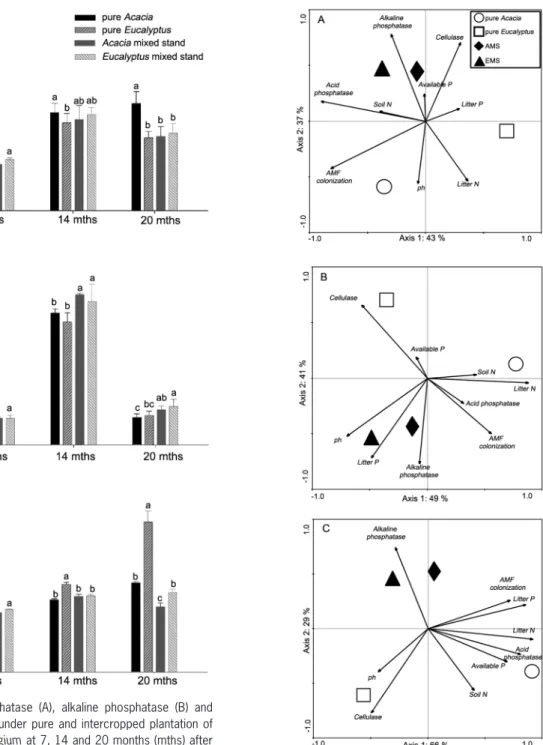
C). Acid phosphatase activity was closer to pure Acacia
at 20 months, while AMF colonization was equidistant from pure Acacia and the mixed plantation at 14 and 20 months. However, pure Eucalyptus was associated only with cellulase and pH, while pure Acacia was associated with AMF colonization, litter P, litter N, acid phospha-tase, available P, and soil N. At 20 months (Figure 3C) there was closer association between alkaline phospha-tase and the mixed plantation. At this sampling there was greater separation between the three treatments: axis 1 separated pure Acacia from pure Eucalyptus, while axis 2 separated the mixed plantation (represented by both plant species) from both monocultures.
Discussion
AMF sporulation dynamics at the initial stages after planting
High root colonization rates starting at 7 months after planting, when it was possible to get the first root samples, are probably due to an inoculum potential left by previous plantations of Eucalyptus grown for more than 50 years, and also by intercropped stands from the first rotation. However, this inoculum potential may have been due mostly to other AMF propagules, dif-ferent from spores, perhaps as fungal external hyphae or colonized root pieces. At early successional stages in pioneer or initial secondary species, tree development shows greater dependence on AMF than at the more advanced stages (climax). In fact, this evidence can be found in both, in initial secondary forests (Zangaro et al., 2003; Zangaro et al., 2007) and renewed Eucalyptus
plantations (Adams et al., 2006). Initial plant develop-ment depends mostly on soil nutrients, and early AMF root colonization can be an advantage for the plant. At zation in the intercropped plantation was similar to that
of pure Acacia and Acacia in mixed stands (AMS), at 14 and 20 months (Figure 1).
Mixed plantations stimulated the activity of acid and/or alkaline phosphatase (Figures 2A, B, C and 3A, B and C). Acid phosphatase was more active in pure Aca-cia at 14 and 20 months (Figure 2A), although the inter-cropped plantation showed similar values at 7 months. On the other hand, alkaline phosphatase had higher activity in the intercropped plantation at all samplings, in the following order: AMS and EMS > pure Eucalyp-tus and pure Acacia (Figure 2B). In general, cellulase showed the highest activity in treatment E, mainly at 14 and 20 months, since it had little variation in the other treatments over the 20 month period (Figure 2C).
At 7 months, mycorrhizal root colonization corre-lated positively with soil total C and acid phosphatase activity. For the same 7 months, there was negative cor-relation between root colonization and cellulase activity, litter C content and litter C/N ratio, the latter persisting at all samplings (Table 2). There was positive correlation between AMF root colonization and litter N at 14 and 20 months, negative correlation between AMF root coloniza-tion and litter C/P ratio, and positive correlacoloniza-tion between root colonization and litter P concentration and acid phos-phatase activity was also recorded at 20 months (Table 2).
For the PCA (Figure 3A, B and C) there was great similarity between samples originated from around
Acacia or Eucalyptus trees in the mixed plantation, and
this pattern was repeated at all samplings. In addition, pure Eucalyptus always appeared opposite pure Acacia
in the figure. Furthermore, during the whole study pe-riod, we found a very close association between alkaline phosphatase and the intercropped plantation, in both
the Eucalyptus or Acacia root systems (Figure 3A, B and
Table 2 – Pearson’s correlation between litter or soil chemical data
and AMF (Arbuscular mycorrhizal fungi) root colonization at 7, 14 and 20 months after planting.
7 months 14 months 20 months % AMF colonization
Soil moisture ns ns ns
Litter C -0.62*** ns ns
Litter N ns 0.42* 0.52**
Litter P ns ns 0.52**
Litter C/N -0.68*** -0.45* -0.63***
Litter C/P ns ns -0.40*
Soil C 0.42* ns ns
Soil N ns ns ns
Soil C/N ns ns ns
pH ns ns -0.33*
Available P ns ns 0.46*
Alkaline phosphatase ns ns ns
Acid phosphatase 0.65*** ns 0.40*
Cellulase -0.46** -0.58** -0.53**
***p < 0.0001; **p < 0.001; *p < 0.05; ns = not significant.
Figure 1 – Arbuscular mycorrhizal fungi (AMF) root colonization at
advanced growth stages, the plants become more effi-cient in recycling nutrients (biochemical cycling) which can decrease their demand for soil nutrients and fungal associations (Dighton and Mason, 1985). This has been verified generally in forest environments. Sometimes for certain plants this can also be said for ectomycorrhizae (Adams et al., 2006; Cheng et al., 2000). No ectomycor-rhizal structures were found on the roots during our
Figure 2 – Acid phosphatase (A), alkaline phosphatase (B) and
cellulase (C) activities under pure and intercropped plantation of
E. grandis and A. mangium at 7, 14 and 20 months (mths) after planting; RS = reducing sugars; PNF = p-nitrophenol phosphate. Values (with standard deviation) followed by different lowercase letters differ within each treatment (Duncan p < 0.05).
Figure 3 – Principal Components Analysis (PCA) of the environmental
and biological variables at 7 months (A), 14 months (B), 20 months (C). Geometrical forms (triangles, squares, diamonds and circles) represent the centroid of each treatment, from nine subsamples. AMS = Acacia mixed stand; EMS = Eucalyptus mixed stand; AMF = Arbuscular mycorrhizal fungi.
Another interesting form of behavior of early plantings refers to the dynamics of mycorrhizal fungi in terms of spore density, which was similar for all treat-ments. Although the ecological indices showed high variation, we found low diversity, abundance and rich-ness of spores at 7 and 14 months, which may be related to the spore germination process in response to the pres-ence of tree roots and the release of chemical precursors that stimulate germination and root infection (Smith and Read, 1997). Mycelial growth and root colonization can be prioritized at a number of developmental stages of AMF instead of spore multiplication (Moreira-Souza et al., 2003; Stürmer and Siqueira, 2011), as probably oc-curred at 7 and 14 months, corroborated by high rates of root colonization. After 20 months of planting, there might have been a change in strategy, leading to empha-sis on reproduction, triggered by several factors, such as seasonal weather changes or even the developmen-tal phase of the host plant (Moreira-Souza et al., 2003; Pereira et al., 2014). According to Pereira et al. (2014), instable areas, different host species, soil preparation, and crop rotation among others, may induce AMF spor-ulation to ensure their survival. The increase in diver-sity, abundance and richness of AMF spores in all areas at 20 months may be due to the reproduction of AMF associated with the host roots. Pagano et al. (2009) stud-ied AMF in plantations of E. camaldulensis and Tabebuia
heptaphylla and found greater spore diversity in
inter-cropped plantations. In our experiment, this probably also occured, since by two months after planting the intercropped plantation had already presented greater diversity and richness of AMF spores (Table 1).
AMF colonization
In addition to the successional stage of forests, other factors can affect the degree of mycorrhizal root colonization, such as host specificity, seasonality, soil pH and texture, and other physical or chemical attributes, as well as available P (Zangaro et al., 2007). Higher root colonization observed during summer, at 14 months, regardless of the treatment, contrasted with lower root colonization in winter, displaying a seasonal effect. Re-gardless of the treatment, the low P availability (5.4 µg g–1) (see Bini et al., 2013a) in the soil may have
stimu-lated the colonization rate even more than other factors (Smith and Read, 1997).
Ignoring seasonal effects, AMF colonization was always higher in A. mangium monoculture and inter-cropped plantations (AMS and EMS), since this is a highly mycotrophic species (Mendes-Filho et al., 2009). According to Ghosh and Verma (2006), Acacia seedlings inoculated with AMF (Glomus mosseae, G. occultum and
G. aggregatum) show an increase in shoot dry matter,
root diameter, leaf area, chlorophyll content and bio-mass of A. mangium, when compared with the non-in-oculated control plants. The greater mycorrhizal depen-dency of A. mangium and, consequently, maintenance of a higher inoculum potential in the surrounding soil,
may have been the main reason for the higher rate of mycorrhizal colonization in the intercropped E. grandis
at 20 months of transplanting, as reported by Pagano et al. (2009). Our results are corroborated by Adams et al. (2006), for whom the presence of understory may increase AMF colonization in monocultures of E. gran-dis. Thus, the presence of AMF colonized Acacia roots seems to stimulate AMF colonization in E. grandis.Many authors have reported an increase in AMF diversity and density in soils under mixed vegetation, in contrast to monocultures (Bainard et al., 2011; Dobo et al., 2016).
It is generally assumed that Eucalyptus trees form arbuscular mycorrhiza only at the seedling or plantlet stages (Adams et al., 2006; Chen et al., 2000), while there is increased association with ectomycorrhizal fungi in older plants (Adams et al., 2006; Santos et al., 2001), although it is not yet clear if this phenomenon always prevails. We showed an average of 37 % and 43 % AMF colonization at 20 months after planting in E and EMS, respectively, which is almost quadruple the colonization reported by Adams et al. (2005). Knowledge of the asso-ciation between AMF and Eucalyptus and the dynamics of the mycorrhizal symbiosis in different management systems and soil types is precarious. According to Bain-ard et al. (2016), soil management can play an important role in maintaining the association between E. grandis
and AMF. Therefore, a management system that enables the non-disruption of the network of underground hy-phae, and a greater abundance of AMF spores in pre-dominantly low-P soils, would have two highly desirable features that may result in higher AMF colonization.
Intercropping, AMF and nutrient cycling
Ac-cording to Treseder (2013), high AMF colonization lev-els correlate with increased P concentration and plant growth. In our study, the increase in plant P concen-tration and P cycling in soil seem to be consequences of mycorrhizal colonization and phosphatase activities. This also explains the negative correlations between root colonization and litter C/N (in all samplings) as well as litter C/P (at 20 months) (Table 1), which indicate that systems with higher root colonization may generate lit-ter of betlit-ter quality, with narrower C/N and C/P ratios. We also found negative correlation between AMF and litter C/N ratios at all samplings, suggesting that AMF may be involved in the transference of soil N to plants, mainly for EMS, or that AMF are responsible for great-er P acquisition which is fundamental to biological N fixation in legumes (Binkley, 1992; Hodge and Fitter, 2010). However, we observed only negative correlation between AMF colonization and litter C/P at 20 months, since the cycling of P is slower than that of N (Forrester et al., 2005). Furthermore, P cycling and phosphatase activity were maximized by N cycling in our study and AMF are possibly involved, especially with regard to EMS. According to Koutika et al. (2014), high transloca-tion of P from soil to tree may explain the lower soil P availability in intercropped plantations of A. mangium
and a first generation of the cross between E. urophylla
× E. grandis. In fact, Tang et al. (2013) have shown the
growth stimulation of E. camaldulensis intercropped with legumes caused by the return of nutrients to the soil via litter. Therefore, mycorrhizal transfer of nutrients such as P to plants promotes the enrichment of the depos-ited litter, decreasing the C/P ratio. Furthermore, certain mycorrhizal plants acquire nutrients through an exten-sive hyphal network connecting one plant to another of the same or different species (Simard et al., 2003). Thus plantations of E. grandis and A. mangium would help in the N nutrition of Eucalyptus via N transported from
Acacia by AMF.
The increased AMF colonization may have addi-tional positive effects, such as promoting the activity of acid phosphatase and alkaline phosphatase in inter-cropped plantations and pure plantations of A. mangi-um. In our study, conducted in soils with low available P, the dependency of plants on phosphatase activity (acid and alkaline) for mineralization of organic P may have been crucial for improving soil health and plant growth (Cardoso et al., 2013; Hinsinger, 2001; Vance et al., 2003). In intercropped or pure A. mangium we found maximum P cycling, also inferred by positive correlation between AMF colonization and acid phos-phatase at 7 and 20 months. In general, the production of acid phosphatase is assigned mainly to plant roots and fungi (Dakora and Phillips, 2002) and there might have been additional stimulation for acquisition of or-ganic P through the release of phosphatases by AMF. In addition, alkaline phosphatase activity was stimu-lated by intercropped plantations. This enzyme is pro-duced mostly by bacterial groups (Dakora and Phillips,
2002). In this case, AMF may affect the diversity and structure of bacterial communities in the rhizosphere and hyphosphere (Toljander et al., 2006; Andrade et al., 1997). Hyphosphere refers only to the soil zone surrounding individual fungal hyphae (Andrade et al., 1997), which may stimulate phosphatase activity (Tak-tek et al., 2015; Zhang et al., 2014). Thus, we suggest that in either pure or intercropped A. mangium a double strategy for P acquisition occurs, i.e., via mycorrhizal hyphae and stimulation of phosphatase activity. This result is a clear demonstration that, during the first 20 months of growth in the mixed plantation there were no relevant differences between the root regions of the intercropped species, at least for the parameters that were evaluated in our study.
Acknowledgements
We would like to extend thanks to the São Paulo Research Foundation - FAPESP (Project n°. 2009/17525-6 and n°. 2010/12009/17525-62009/17525-623-9), the National Agency for Re-search (ANR - 2010- STRA-004), the Programmed The-matic Action (ATP Neucapalm)/Centre for International Cooperation in Agricultural Research for Development (CIRAD) and the University of São Paulo (USP)/ French Committee for the Evaluation of Academic and Scien-tific Cooperation with Brazil (COFECUB) for funding this project (n°. 22193PA). Thanks are also due to the staff of the Itatinga Forest Sciences Experimental Station and of the Laboratory of Soil Microbiology at the Luiz de Queiroz College of Agriculture for their assistance in conducting the experiments. D. Bini was supported by a doctoral grant (n°. 140893/ 2011-3) and E.J.B.N. Cardoso by a productivity grant (n°. 307563/2009-0) of the Bra-zilian National Council for Scientific and Technological Development (CNPq).
References
Adams, F.; Reddell, P.; Webb, M.; Shipton, W. 2006. Arbuscular mycorrhizas and ectomycorrhizas on Eucalyptus grandis
(Myrtaceae) trees and seedlings in native forests of tropical north-eastern Australia. Australian Journal of Botany 54: 271-281.
Andrade, G.; Mihara, K.L.; Linderman, R.G.; Bethlenfalvay, G.J. 1997. Bacteria from rhizosphere and hyphosphere soils of different arbuscular-mycorrhizal fungi.Plant and Soil 192: 71-79.
Bachega, L.R.; Bouillet, J.P.; Piccolo, M.C.; Saint-André, L.; Bouvet, J.M.; Nouvellon, Y.; Gonçalves, J.L.M.; Robin, A.; Laclau, J.P. 2016. Decomposition of Eucalyptus grandis and
Acacia mangium leaves and fine roots in tropical conditions did
not meet the Home Field Advantage hypothesis. Forest Ecology and Management 359: 33-43.
Binkley, D.; Dunkin, K.A.; Debell, D.; Ryan, M.G. 1992. Production and nutrient cycling in mixed plantations of
Eucalyptus and Albizia in Hawaii. Forest Science 38:
393-408.
Binkley, D. 1992. Mixtures of N2-fixing and non-N2-fixing tree species. p. 99-123. In: Cannell, M.G.R.; Malcom, D.C.; Robertson, P.A., eds. The ecology of mixed-species stands of trees. Blackwell Scientific, London, UK.
Bini, D.; Santos, C.A.; Bouillet, J.; Gonçalves, J.L.D.M.; Cardoso, E.J.B.N. 2013a. Eucalyptus grandis and Acacia mangium in monoculture and intercropped plantations: Evolution of soil and litter microbial and chemical attributes during early stages of plant development. Applied Soil Ecology 63: 57-66.
Bini, D.; Alcantara, C.; Banhos, K.; Kishino, N.; Andrade, G.; Zangaro, W.; Nogueira, M.A. 2013b. Effects of land use on soil organic carbon and microbial processes associated with soil health in southern Brazil. European Journal of Soil Biology 55: 117-123.
Bouillet, J.P.; Laclau, J.P.; Gonçalves, J.L.M.; Voigtlaender, M.; Gava, J.L.; Leite, F.P.; Hakamada, R.; Mareschal, L.; Mabiala, A.; Tardy, F.; Levillain, J.; Deleporte, P.; Epron, D.; Nouvellon, Y. 2013. Eucalyptus and Acacia tree growth over entire rotation in single- and mixed-species plantations across five sites in Brazil and Congo. Forest Ecology and Management 301: 89-101.
Cardoso, E.J.B.N.; Vasconcellos, R.L.F.; Bini, D.; Miyauchi, M.Y.H.; Santos, C.A.; Alves, P.R.L.; Paula, A.M.; Nakatani, A.S.; Pereira, J.M.; Nogueira, M.A. 2013. Soil health: looking for suitable indicators. What should be considered to assess the effects of use and management on soil health? Scientia Agricola 70: 280-295.
Chen, Y.L.; Brundrett, M.C.; Dell, B. 2000. Effects of ectomycorrhizas and vesicular-arbuscular mycorrhizas, alone or in competition, on root colonization and growth of Eucalyptus
globulus and E. urophylla. New Phytologist 146: 545-556.
Dakora, F.D.; Phillips, D.A. 2002. Root as mediators of mineral acquisition in low-nutrient environments. Plant and Soil 245: 35-47.
Dighton, J.; Mason, P.A. 1985. Mycorrhizal dynamics during forest tree development. p. 117-139. In: Moore, D.; Casselton, L.A.; Wood, D.A.; Frankland, J.C., eds. Developmental Biology of Higher Fungi. Cambridge University Press, Cambrigde. Dobo, B.; Asefa, F.; Asfaw, Z. 2016. Diversity of arbuscular
mycorrhizal fungi of different plant species grown in three land use types in Wensho and Shebidino Districts of Sidama in Southern Ethiopia. Advances in Bioscience and Bioengineering 4: 25-34.
Forrester, D.I.; Bauhus, J.; Cowie, A.L. 2005. On the success and failure of mixed-species tree plantations: lessons learned from a model system of Eucalyptus globulus and Acacia mearnsii. Forest Ecology and Management 209: 147-155.
Gerdemann, J.W.; Nicolson, T.H. 1963. Spores of mycorrhizal Endogone species extracted from soil by wet sieving and decanting. Transactions of the British Mycological Society 46: 235-244.
Giovannetti, M.; Mosse, B. 1980. An evaluation of techniques for measuring vesicular-arbuscular mycorrhizal infection in roots. New Phytologist 84: 489-500.
Ghosh, S.; Verma, N.K. 2006. Growth and mycorrhizal dependency of Acacia mangium Willd. inoculated with three vesicular arbuscular mycorrhizal fungi in Lateritic Soil. New Forest 31: 75-81.
Hinsinger, P. 2001. Bioavailability of soil inorganic P in the rhizosphere as affected by root-induced chemical changes: a review. Plant and Soil 237: 173-195.
Hodge, A.; Fitter, A.H. 2010. Substantial nitrogen acquisition by arbuscular mycorrhizal fungi from organic material has implications for N cycling. Proceedings of the National Academy of Sciences of the United States of America 107: 13754-13759.
Khanna, P.K. 1997. Comparison of growth and nutrition of young monocultures and mixed stand of Eucalyptus globulus
and Acacia mearnsii. Forest Ecology and Management 94:
105-113.
Koutika, L.S.; Epron, D.; Bouillet, J.P.; Mareschal, L. 2014. Changes in N and C concentrations, soil acidity and P availability in tropical mixed Acacia and eucalypt plantations on a nutrient-poor sandy soil. Plant and Soil 379: 205-216. Kramer, S.; Green, D.M. 2000. Acid and alkaline phosphatase
dynamics and their relationship to soil microclimate in a semiarid woodland. Soil Biology and Biochemistry 32: 179-188. Laclau, J.P.; Bouillet, J.P.; Gonçalves, J.L.M.; Silva, E.V.; Jourdan, C.; Cunha, M.C.S.; Moreira, M.R.; Saint-André, L.; Maquère, V.; Nouvellon, Y.; Ranger, J. 2008. Mixed-species plantations
of Acacia mangium and Eucalyptus grandis in Brazil: Biomass
allocation and net primary production. Forest Ecology and Management 255: 3905-3917.
Ma, Q.; Rengel, Z. 2008. Phosphorus acquisition and wheat growth are influenced by shoot phosphorus status and soil phosphorus distribution in a split-root system. Journal of Plant
Nutrition and Soil Science 171: 266-271.
Mendes-Filho, P.F.; Vasconcellos, R.L.F.; Paula, A.M.; Cardoso, E.J.B.N. 2009. Evaluating the potential of forest species under “microbial management” for the restoration of degraded mining areas. Water, Air and Soil Pollution 208: 79-89. Moreira-Souza, M.; Trufem, S.F.B.; Gomes-da-Costa, S.M.;
Cardoso, E.J.B.N. 2003. Arbuscular mycorrhizal fungi associated with Araucaria angustifolia (Bert.) O. Ktze. Mycorrhiza 13: 211-215.
Pagano, M.C.; Scotti, M.R. 2008. Arbuscular and ectomycorrhizal colonization of two Eucalyptus species in semiarid Brazil. Mycoscience 49: 379-384.
Pagano, M.C.; Scotti, M.R.; Cabello, M.N. 2009. Effect of the inoculation and distribution of mycorrhizae in Plathymenia
reticulata Benth under monoculture and mixed plantation in
Brazil. New Forest 38: 197-214.
Paula, R.R.; Bouillet, J.P.; Trivelin, P.C.O.; Zeller, B.; Gonçalves, J.L.M.; Nouvellon, Y.; Bouvet, J.M.; Plassard, C.; Laclau, J.P. 2015. Evidence of short-term belowground transfer of nitrogen from Acacia mangium to Eucalyptus grandis trees in a tropical planted forest. Soil Biology and Biochemistry 91: 99-108.
Santos, V.L.; Muchovej, R.M.; Borges, A.C.; Neves, J.C.L.; Kasuya, M.C.M. 2001. Vesicular-arbuscular-ectomycorrhiza succession in seedlings of Eucalyptus spp. Brazilian Journal of Microbiology 32: 81-86.
Schenck, N.C.; Pérez, Y. 1990. Manual for the identification of VA mycorrhizal fungi. Synergistic, Gainesville.
Schinner, F.; Von Mersi, W. 1990. Xylanase-, CM-cellulase and invertase activity in soil: an improved method. Soil Biology and Biochemistry 22: 511-515.
Simard, W.S.; Jones, M.D.; Durall, D.M. 2003. Carbon and nutrient fluxes within and between mycorrhizal plants. p. 34-74. In: Van der Heijden, M.G.A.; Sanders, I.R., eds. Mycorrhizal ecology. Springer, Berlin.
Smith, S.E.; Read, D.J. 1997. Mycorrhizal symbiosis. Academic Press, New York, NY, USA.
Stürmer, S.L.; Siqueira, J.O. 2011. Species richness and spore abundance of arbuscular mycorrhizal fungi across distinct land uses in Western Brazilian Amazon. Mycorrhiza 21: 255-267. Tabatabai, M.A.; Bremner, J.M. 1969. Use of p-nitrofenol
phosphate for assay of soil phosphatase activity. Soil Biology and Biochemistry 1: 301-307.
Taktek, S.; Trepanier, M.; Servin, P.M.; St-Arnaud, M.; Piche, Y.; Fortin, J.A.; Antoun, H. 2015. Trapping of phosphate solubilizing bacteria on hyphae of the arbuscular mycorrhizal fungus Rhizophagus irregularis DAOM 197198. Soil Biology and Biochemistry 90: 1-9.
Tang, G.L.I.K.; Zhang, C.; Gao, C.; Li, B. 2013. Accelerated nutrient cycling via leaf litter, and not root interaction, increases growth of Eucalyptus in mixed-species plantations with Leucaena. Forest Ecology and Management 310: 45-53. Toljander, J.F.; Artursson, V.; Paul, L.R.; Jansson, J.K.; Finlay,
R.D. 2006. Attachment of different soil bacteria to arbuscular mycorrhizal fungal extraradical hyphae is determined by hyphal vitality and fungal species. FEMS Microbiology Letters 254: 34-40.
Treseder, K.K. 2013. The extent of mycorrhizal colonization of roots and its influence on plant growth and phosphorus content. Plant and Soil 371: 1-13.
Vance, C.P.; Uhde-Stone, C.; Allan, D.L. 2003. Phosphorus acquisition and use: critical adaptations by plants for securing a nonrenewable resource. New Phytologist 157: 423-447. Vierheilig, H.; Goughlan, A.P.; Wyss, U.; Piché, Y. 1998. Ink
and Vinegar, a simple staining technique for arbuscular mycorrhizal fungi. Applied and Environmental Microbiology 64: 5004-5007.
Voigtlaender, M.; Laclau, J.P.; Gonçalves, J.L.M.; Piccolo, M.D.C.; Moreira, M.Z.; Nouvellon, Y.; Ranger, J.; Bouillet, J.P. 2012. Introducing Acacia mangium trees in Eucalyptus grandis
plantations: consequences for soil organic matter stocks and nitrogen mineralization. Plant and Soil 352: 99-111.
Zangaro, W.; Nisizaki, S.M.A.; Domingos, J.C.B.; Nakano, E.M. 2003. Mycorrhizal response and successional status in 80 woody species from south Brazil. Journal of Tropical Ecology 19: 315-324.
Zangaro, W.; Nishidate, F.; Vandresen, J.; Andrade, A.; Nogueira, M.A. 2007. Root mycorrhizal colonization and plant responsiveness are related to root plasticity, soil fertility and successional status of native woody species in southern Brazil.
Journal ofTropical Ecology 23: 53-62.