High bacterial carbon demand and low growth efficiency at a tropical
hypereutrophic estuary: importance of dissolved organic matter
remineralization
Medidas simultâneas de produção (PB) e respiração
bacterianas (RB) são indispensáveis para o
entendimento da magnitude do ciclo do carbono nos
níveis tróicos mais basais dos sistemas aquáticos,
mas são ainda escassas nos trópicos. O presente
estudo foi realizado em um estuário extremamente
produtivo (Porto do Recife, 08°03'S; 34°52'W, NE
do Brasil), onde a demanda bacteriana por carbono
(DBC=PB+RB) e a eiciência de crescimento
bacteriano (ECB=PB/DBC) foram determinadas para
estimar o principal papel do bacterioplâncton: fonte
ou captador de carbono orgânico. Apesar das altas
taxas de PB (0.03-0.4 µMC h
-1), as taxas extremas
de RB (0.5-4.1 µMC h
-1) levaram a baixa ECB
(0.02-0.29), provavelmente devido às altas temperaturas
(>25
oC) e forte limitação por nitrogênio inorgânico
(razão N:P) A alta DBC e a baixa ECB indicam que
o bacterioplâncton esteja atuando principalmente
como remineralizador da matéria orgânica dissolvida,
alimentando a produção primaria do sistema. Esses
resultados contradizem o que seria esperado baseado
em estudos conduzidos em estuários eutróicos
temperados (onde geralmente ECB > 0.30) e apontam
para a importância de se aumentar estimativas in situ
de PB e RB em sistemas estuarinos tropicais a im
de se promover um melhor entendimento do papel
desses sistemas na ciclagem de carbono global.
R
esumo
Mariana Guenther
1*, Eliane Gonzalez-Rodriguez
2, Manuel Flores-Montes
3, Moacyr Araújo
3, Sigrid
Neumann-Leitão
3Descriptors:
Bacterioplankton, Bacterial production,
Bacterial respiration, Microbial loop, BCD, BGE.
Simultaneous measurements of bacterioplankton
production (BP) and respiration (BR) are
imperative to understand the magnitude of
carbon cycle in the lower trophic levels of the
aquatic systems, but are still scarce in the tropics.
The present study was performed in a highly
productive estuary (Recife harbor, 08°03'S;
34°52'W, NE Brazil) where bacterial carbon
demand (BCD=BP+BR) and growth efficiency
(BGE=BP/BCD) were evaluated in order to
estimate the major role of bacterioplankton:
source or sink of organic carbon. In spite of the
high BP rates (0.03-0.4 µMC h
-1), the extremely
high BR rates (0.5-4.1 µMC h
-1) led to low BGE
(0.02-0.29), possibly due to the high temperatures
(>25
oC) and strong inorganic nitrogen limitation
(N:P ratios) The high BCD and low BGE
indicate the major role of bacterioplankton as
dissolved organic matter remineralizers, fueling
the primary productivity of the system. These
findings contradict what could be expected from
studies in highly productive temperate estuaries
(where BGE is usually > 0.30) and highlight
the importance of increasing in situ BP and BR
estimates in tropical estuarine systems in order
to better understand the role of these systems in
global carbon cycling.
A
bstRAct
Descritores:
Bacterioplâncton, Produção bacteriana,
Respiração bacteriana, Alça microbiana, DBC, ECB.
1 Instituto de Ciências Biológicas, Universidade de Pernambuco
(Rua Arnóbio Marques, 310 - Santo Amaro - Recife - Pernambuco, 50100-130 - Brazil)
2 Instituto de Estudos do Mar Almirante Paulo Moreira
(Rua Kioto, 253 - Praia dos Anjos, Arraial do Cabo - RJ, 28930-000 - Brazil)
3 Departamento de Oceanograia, Universidade Federal de Pernambuco
(Av. Prof. Moraes Rego, 1235 - Cidade Universitária, Recife - PE - 50670-901 - Brazil)
*Corresponding author: [email protected]
INTRODUCTION
Bacterioplankton play multiple roles in aquatic systems, converting high amounts of allochthonous and autochthonous organic material into nutrients (organic
remineralization) and biomass (organic production).
Understanding the extent and the regulating factors of each of these bacterial metabolic pathways is thus imperative to comprehend the carbon cycle in those systems. The amount
of carbon incorporated by bacterioplankton is partitioned
into growth (anabolism) and maintenance processes (catabolism). The bacterial carbon demand (BCD) is thus the sum of biomass produced (=bacterial production: BP) and the energetic loss (=bacterial respiration: BR). The eiciency to which the carbon incorporated is converted into biomass, i.e., the bacterial growth eiciency (BGE) is thus estimated as BP/BCD (DEL GIORGIO; COLE, 1998).
Bacterial carbon consumption has been usually derived from bacterial production rates assuming constant growth eiciencies (GASOLet al., 2008). Nevertheless, several
studies showed a great spatial and temporal variability in BGE within and among systems, due to several abiotic and biotic factors like temperature, inorganic nutrients availability, dissolved organic matter (DOM) quality, light incidence and grazing pressure (APPLE; DEL GIORGIO, 2007; APPLEet al., 2006; ASMALAet al.,
2014; BERGGREN et al., 2010; CORY et al., 2010; RAM et al., 2003). The need for simultaneous in situ estimates
of bacterial production and respiration rates became thus imperative to accurately evaluate the bacterial carbon metabolism in the aquatic systems and understand its
regulation.
Estuarine systems are increasingly subject to eutrophication processes due to the rapid population growth and consequent density increase along the coast (DAY et al., 2013). The high and continuous input of allochthonous
nutrients and organic material from the surrounding lands and the domestic sewage leads to high phytoplankton and bacterial growth (BARRERA-ALBA et al., 2008;
GAULKE et al., 2010; GUENTHER; VALENTIN, 2008b;
MORTAZAVI et al.; 2012; SCHUMANN et al., 2003;
YUAN et al., 2010). However, most of estuarine BGE in situ estimates were performed in temperate zones, with
few exceptions on the tropics (GUENTHER et al., 2008a;
LEE et al., 2009; RAM et al., 2003; RAM et al., 2007).
In the most comprehensive review on BGE to date, DEL GIORGIO and COLE (1998) verified a direct correlation between BGE and the trophic status of the system, ranging from 1% at the most oligotrophic open ocean sites to near 50% at eutrophic coastal-estuarine systems. Since then, the vast majority of studies still corroborate this pattern: BGE >30% on average in more productive areas, such as upwelling and estuarine systems (ASMALA et al., 2014; DEL GIORGIO;
NEWELL, 2012; FUENTES et al., 2012; GUENTHER et al., 2008), and BGE < 20% on average at oceanic
sites (ALONSO-SÁEZ et al., 2007; DEL GIORGIO et al., 2011; LØNBORG et al., 2013; REINTHALER et al., 2008). This means that in most eutrophic systems, bacterioplankton act more as a source of organic carbon
for the higher consumers.
In the present study, we aimed to evaluate the main role of bacterioplankton (i.e., source or sink of organic carbon) in a hypereutrophic tropical estuarine system (Recife harbor, NE Brazil) through simultaneous BP and
BR in situ measurements and BCD and BGE calculation.
Despite the high bacterial production, bacterial growth eiciency was low due to high bacterial respiration rates. The role of temperature and nitrogen limitation in the regulation of bacterial carbon metabolism in this system is then discussed.
MATERIAL AND METHODS
Study site
The Recife harbor (08°03’S; 34°52’W, Recife - PE, Brazil) is a hypereutrophic well-mixed estuary with high primary production rates (GUENTHER et al., 2015).
Situated in a densely populated area of the city, it is supplied by three urban and intensely polluted rivers: the Pina, Capibaribe and Beberibe. It is a long, narrow and shallow system (7 km long, 250-1000 m wide and 1-12 m deep) connected to the ocean by a 300 m wide mouth, and also inluenced by the marine spray crossing the long (4 km) and thin (30 m) beach rock reef that separates it from the ocean (Fig. 1). Tides are semidiurnal with maximum ranges of 2.3 m. Tidal currents are strong (30 cm s-1 on
average), leading to residence times of 5-9 h, shorter than a complete tidal cycle (GUENTHERet al., 2015). The
Experimental design and sample analyses
The samplings were performed at three stations located at distinct sections of the estuary: #1 - outer (12 m deep), #2 - middle (9 m deep) and #3 - inner (3 m deep) (Fig. 1), during both ebb and lood tides, every 3 months during a year (January, April, July and October, 2008). The months sampled represent the wet (April and July) and dry (October and January) seasons (see GUENTHER
et al., 2015). The stations were sampled opposed to the
water low, i.e., from the outer to the inner estuary during the ebb tide and conversely during the lood tide. The water samples were collected with 10L Niskin bottles at the subsurface layer for dissolved inorganic nutrients,
dissolved organic carbon (DOC) and dissolved oxygen
(DO) contents, pH and bacterial production (BP) and
respiration (BR) incubation experiments. Temperature
and salinity were obtained in situ through a portable
thermometer and refractometer.
Nutrients, DOC and DO contents of each sample were determined in triplicates (or more when needed) in the laboratory within 1 h collection following the methods proposed by GRASSHOFF et al. (1983) for ammonium (N-NH4), nitrite (N-NO2), nitrate (N-NO3) and phosphate (P-PO4), STRICKLAND and PARSONS (1972) for DOC, and AMINOT and CHAUSSEPIED (1983) for DO. The pH was measured with a pH meter Gehaka PG2000.
Bacterial production rates were determined through
3H-leucine incorporation (SMITH; AZAM, 1992).
Samples and controls (1.3 mL) were incubated in triplicates in 2.0 mL sterile polypropylene tubes with L-[4,5-3H]
leucine at a 10 nM inal concentration, based on previous saturation curves. Controls were immediately ixed in 90
Figure 1. Map of the Recife harbor, located at the city of Recife - PE, northeastern coast of
μL 100% ice-cold trichloroacetic acid (TCA) and samples were incubated for 1h at room temperature in the dark. Incubation was halted with 90 μL 100% ice-cold TCA and the isotopic activity of the samples was determined in a Beckman LS6000SC scintillation counter. Bacterial carbon production was calculated using a protein/carbon conversion factor of 0.86 (SIMON; AZAM, 1989).
Bacterial respiration rates were measured through dissolved oxygen consumption in the picoplankton (<2.0 mm) fraction. Samples were previously iltered through 2.0
mm polycarbonate membranes and incubated in situ in 150
mL borosilicate bottles (triplicates) for 24h. The initial DO concentrations were also determined in triplicate samples immediately ixed with Winkler reagents (manganese sulide and alkaline iodine). Dissolved oxygen contents of each sample were determined in triplicates following the Winkler’s titration method (AMINOT; CHAUSSEPIED, 1983). Bacterial respiration rates were estimated using a respiration quotient (RQ) of 1.0 (BIDDANDA et al.,
1994). It is important to note that BR rates include also autotrophic picoplankton respiration.
Bacterial carbon demand (BCD) was calculated as BP+BR, and bacterial growth eiciency (BGE) as BP/BCD (DEL GIORGIO; COLE, 1998). The DOC turnover time through bacterioplankton (day -1) was estimated as the ratio
between the DOC content and the BCD at each sample. The meteorological conditions and the circulation dynamics of this system during this period have been presented and discussed elsewhere (GUENTHER et al., 2015).
Data analyses
For each variable, diferences between tidal periods (ebb and lood) and among stations (outer, middle and inner) and months (January, April, July, October) were veriied using a Mann-Whitney U test (for two groups: tidal periods) or a Kruskal-Wallis test (for multiple groups: stations and months), as data were not normally distributed (based on Kolmogorov-Smirnov test). The measured variables were compared through Pearson’s correlations.
RESULTS
Abiotic variables
Some abiotic variables sampled presented signiicant seasonal variations (Table 1). Spatial or tidal statistical
at the inner (#3) than the outer (#1) station, although not statistically diferent (H=4.01; p=0.13).
Ammonium contents ranged from 0.4 to 5.2 µM, while the oxidized nitrogen (N) forms (N-NO2+N-NO3)
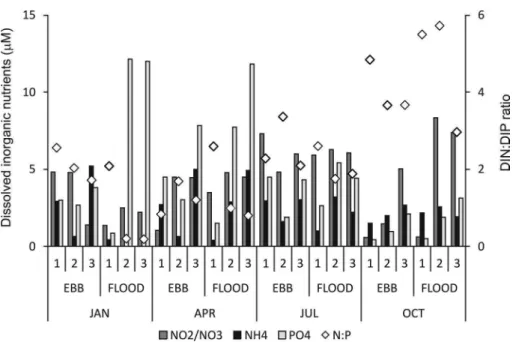
ranged from 0.6 to 8.3 µM. These N forms constituted the major fraction of total dissolved inorganic nitrogen (DIN): N-NO2/NO3=62% of DIN, on average, and N-NH4=38%. Phosphate contents ranged from 0.4 to 12 µM and the DIN:DIP ratios varied from 0.8 to 5.7 (Fig. 2). Dissolved organic carbon contents ranged from 475 to 942 µM. Dissolved oxygen contents ranged from 179 - 402 µM) and the pH ranged from 8.0 to 8.5.
The N-NO2/NO3 contents increased from January and April (3.3 µM on average) to July: 6.1 µM (H=8.23;
p=0.04). The DO contents decreased from April, beginning
of the wet season: 262 µM (on average), to October, beginning of the dry season: 234 µM, on average (H=11.1;
p=0.01). The pH also decreased from January (pH=8.4) to
July: pH=8.1 (H=12.5; p=0.005).
Bacterial metabolic rates
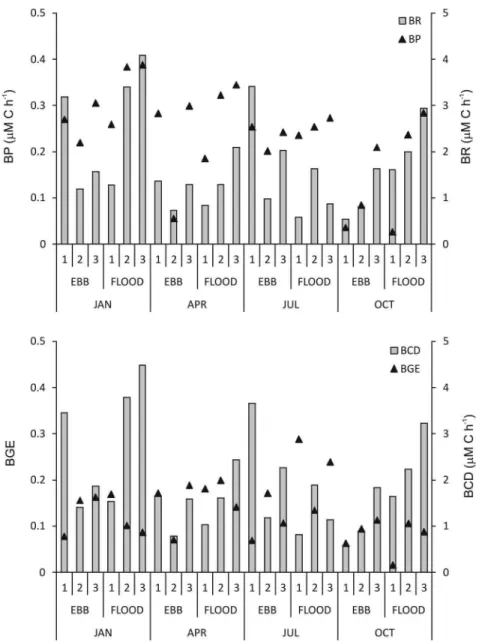
Bacterial metabolic rates were highly variable throughout the year studied with no significant differences between tidal phases or among stations or months (Fig. 3). Bacterial production (BP) ranged from 0.03 to 0.4 µM C h-1 (0.24 µM C h-1 on average,
CV=42%), bacterial respiration (BR) ranged from 0.5 to 4.1 µM C h-1 (1.72 µM C h-1 on average, CV=58%),
bacterial carbon demand (BCD=BP+BR) ranged
from 0.6 to 4.5 µM C h-1 (1.96 µM C h-1 on average,
CV=54%) and bacterial growth efficiency (BGE=BCD/ BR) varied from 2 to 29% (13% on average, CV=47%). The DOC turnover time through bacterioplankton consumption (DOC/BCD) ranged from 5 to 44 days (20 days on average, CV=54%).
The correlation matrix of all variables sampled showed that BP and BR rates were directly correlated to each other (r=0.58; p=0.003). The BP rates were also
directly correlated to N-NH4 contents (r=0.53; p=0.01)
and P-PO4 contents (r=0.76; p<0.001). The BR rates were
directly correlated to P-PO4 contents (r=0.56; p=0.004)
and inversely correlated to BGE (r= -0.46; p=0.022)
(Table 2).
Table 1. Range and average values (in parentheses) of the abiotic variables at each month sampled. Variables marked with asterisks showed signiicant variations among months at p<0.05 (*), p<0.01 (**) and p<0.001 levels (***). In these, treatments with the same symbol are not signiicant diferent from each other, based on the Kruskal-Wallis test.
JAN APR JUL OCT
Water temperature (oC)** 29-30 (29)a 29-30 (29)a 25-25 (25)b 27-28 (27)a,b
Salinity 28-36 (33) 26-35 (31) 29-33 (31) m.d.
DO (μM)* 179-402 (256)a,b 259-265 (262)a 229-262 (243)a,b 229-239 (234)b
pH** 8.3-8.5 (8.4)a 8.2-8.4 (8.3)a,b 8.0-8.4 (8.1)b 8.0-8.3 (8.1)a,b
NH3 (μM) 0.4-5.2 (2.3) 0.4-5.0 (2.8) 1.0-3.2 (2.3) 1.5-2.7 (2.1) NO2 + NO3 (μM) 1.4-4.8 (2.8)b 1.0-4.8 (3.8)b 4.8-7.3 (6.1)a 0.6-8.3 (3.9)a,b
PO4 (μM) 0.9-12 (5.8) 1.5-12 (6.1) 1.9-5.4 (3.9) 0.4-3.1 (1.5)
DOC (μM) 650-917 (769) 675-942 (814) 475-892 (594) 525-892 (713)
m.d.=missing data.
Figure 2. Dissolved inorganic nitrogen (N-NO3/NO2 and N-NH4) and phosphorous (P-PO4) contents and the
DIN:DIP ratio (N:P) at the three sampled stations: #1 (outer), #2 (middle), #3 (inner) during ebb and lood tides and the four months sampled: January, April, July and October.
respiration rates led to low bacterial growth eiciencies, indicating that bacterioplankton are acting more as organic material remineralizers than biomass source for the higher trophic levels.
The high variability in BP, BR, BCD and BGE, also observed in other tropical estuaries (GUENTHER et al., 2008; RAMet al., 2007), was already expected due
to the high hydrodynamic complexity of this system (GUENTHER et al., 2015). Although the BP rates
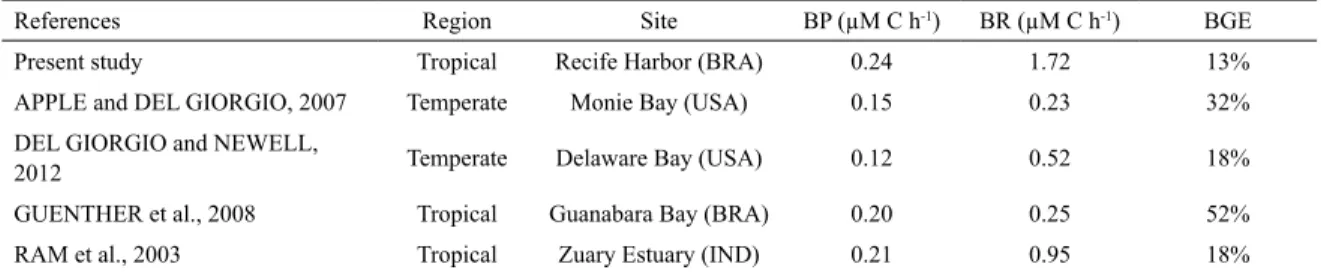
measured in Recife harbor were similar, on average, to other tropical and temperate estuaries (APPLE; DEL GIORGIO, 2007; DEL GIORGIO; NEWELL, 2012;
were higher, leading tolower BGE (see Table 3). Bacterial respiration rates were more variable than BP rates and inversely correlated to BGE (see Table 2) which suggest that BGE variations are better explained by BR.
Temperature strongly inluences bacterial carbon metabolism (MADIGAN et al., 2010). Warmer conditions
enhance metabolic rates (BROWN et al., 2004), which
also leads to higher energetic loss (MACLEAN, 2008; PFEIFFERet al., 2001). Therefore, water temperatures are often directly correlated to bacterial production
and respiration (JIMENEZ-MERCADO et al., 2007;
Figure 3. Bacterial production (BP) and respiration (RB) (top panel) and bacterial carbon demand (BCD) and
growth eiciency (BGE) (bottom panel) at the three sampled stations: #1 (outer), #2 (middle), #3 (inner) during ebb and lood tides and the four months sampled: January, April, July and October.
1994; SHIAH; DUCKLOW, 1994). When the efects of temperature on BR are higher than on BP due to this increase in energy expenditure, higher temperatures may result in lower BGE (AMADO et al., 2013; APPLE et al.,
2006; BERGGREN et al., 2010; GUENTHER et al., 2008;
HALL; COTNER, 2007; RIVKIN; LEGENDRE, 2001). Temperatures at Recife harbor are high throughout the year (25-30oC), which led to high bacterial production but even
higher bacterial respiration rates. Indeed, previous studies
were around 25oC (GUENTHERet al., 2008) and higher
BR rates (0.7 - 3.3 µM C h-1) at higher temperature ranges:
27-32oC (LEE et al., 2009; RAM et al., 2003).
Nutrient availability also plays a major role in regulating bacterial carbon metabolism (ASMALA
et al., 2014; BERGGREN et al., 2010; GASOL et al., 2009; SMITH; KEMP, 2003). Bacterial uptake of
Table 2. Pearson correlation coeicients between the variables sampled and estimated at Recife harbor. Temp=temperature; Sal=salinity; DO=dissolved oxygen; DOC=dissolved organic carbon; BP=bacterial production; BR=bacterial respiration; BGE=bacterial growth eiciency. Asterisks mean signiicant correlations at p<0.05 (*), p<0.01 (**) and p<0.001 levels (***). Not signiicant correlations (p>0.05) are not shown (-).
Sal DO pH NH4 NO2/NO3 PO4 DOC BP BR BGE
Temp _ _ 0.73*** _ -0.45* 0.44* 0.67** _ _ _
Sal _ _ _ -0.48* _ _ _ _ _
DO _ _ _ _ _ _ _ _
pH _ -0.58** _ _ _ _ _
NH4 _ 0.69*** _ 0.53* _ _
NO2/NO3 _ _ _ _ _
PO4 _ 0.76*** 0.56** _
DOC _ _ _
BP 0.58** _
BR -0.46*
Table 3. Mean bacterial production rates (BP), bacterial respiration rates (BR) and bacterial growth eiciency (BGE) from the present study and other tropical and temperate estuarine systems.
References Region Site BP (µM C h-1) BR (µM C h-1) BGE
Present study Tropical Recife Harbor (BRA) 0.24 1.72 13%
APPLE and DEL GIORGIO, 2007 Temperate Monie Bay (USA) 0.15 0.23 32% DEL GIORGIO and NEWELL,
2012 Temperate Delaware Bay (USA) 0.12 0.52 18%
GUENTHER et al., 2008 Tropical Guanabara Bay (BRA) 0.20 0.25 52%
RAM et al., 2003 Tropical Zuary Estuary (IND) 0.21 0.95 18%
P uptake (CHURCH, 2008; KIRCHMAN, 1994), which is achieved via the activation of metabolic pathways, raising respiration rates and lowering growth yield and BGE (HESSEN; ANDERSON, 2008; JANSSON et al., 2006).
At Recife harbor, although we did not measure DON or DOP contents, and thus cannot estimate DOM C:N:P ratios, the low DIN:DIP ratios (0.8 - 5.7) due to the large P-PO4 inputs from domestic sewage and agriculture runof, indicate inorganic nitrogen limitation. Moreover, the N-NH4 contents, the most readily available inorganic N form for bacterioplankton (CHURCH, 2008; VALLINO
et al., 1996), represented, on average, a minor fraction of
total DIN (38%). Inorganic nitrogen limitation of bacterial production and growth eiciency has been widely reported in both batch cultures and natural systems experiments (CARLSSON et al., 2012; CHURCH et al., 2000; KROER,
1993; ORTEGA-RETUERTA et al., 2012), some of them
showing a higher dependency of BGE on inorganic nitrogen than on DOM quality (ASMALA et al., 2014;
LØNBORGet al., 2011). The direct correlation between
BP and N-NH (r=0.53; =0.01) and the absence of
p=0.23) suggests a higher reliability of bacterioplankton
on ammonium contents in this system.
The higher BGE observed in the more productive estuarine systems is usually correlated to the nutrient availability and/or DOM quality (APPLE; DEL GIORGIO, 2007; ASMALA et al., 2014; DEL GIORGIO; NEWELL,
2012; GUENTHER et al., 2008) which support bacterial
growth (BP) with less maintenance energy costs (BR). The DOM quality (or lability) is deined by its nutritional value (stoichiometric balanced C:N:P ratio), diagenetic state (freshly leached vs. microbial processed), as well as
molecular size (low vs. high molecular weight) and shape
(degree of aromaticity), irrespective of its allochthonous or autochthonous origin (AMON; BENNER, 1996; ATTERMEYERet al., 2014; GOLDMAN et al., 1987).
The relatively rapid estimated DOC turnover through bacterioplankton consumption at Recife harbor, from a few days to a little more than a month (5 to 44 days), suggests that the DOM content range from labile to semi labile (CARLSON, 2002).
growth in both batch-cultures and mesocosms experiments (BELL; SAKSHAUG, 1980; CHERRIER et al., 1996;
CHRZANOWSKI; HUBBARD, 1989). At Recife harbor a considerable amount of phytoplankton exudates is expected due to the high primary production rates (GUENTHER et al., 2015). Moreover, the high domestic sewage input at
this system can be even more labile for bacterial growth than autochthonous phytoplankton-derived DOM (XU et al., 2013; XU et al., 2014). Thus, it is possible that despite
the high nutrient input and supposed labile to semi labile DOM contents, the low DIN:DIP ratios are hindering BGE through increasing BR at Recife harbor. Future research should thus focus on DOM stoichiometry and chemical composition along with bacterial uptake experiments to quantify the major available DOM sources in this system and verify the hypothesis of inorganic nitrogen limitation of bacterial growth raised in the present study.
CONCLUSIONS
The high temperatures and the inorganic nitrogen limitation due to large allochthonous P-PO4 loadings are the main factors driving the high BR rates and, hence, the low BGE observed at Recife harbor, in spite of the high primary productivity. These results highlight the importance of
increasing in situ BP and BR estimates in eutrophic tropical
estuaries, in order to reevaluate the established direct correlation between BGE and productivity based mostly on
temperate systems.
The high bacterial carbon demand and the relatively rapid DOC turnover indicate that huge amounts of DOM are channeled through bacterioplankton, showing the importance of this compartment in organic material recycling at this hypereutrophic system. The low BGE, however, means that most of this up taken DOM is released
as inorganic nutrients and CO2 to the water column. The
high bacterial production, similar to other tropical and temperate estuarine systems, suggests that this compartment also plays an important role as biomass sources for the next trophic levels (BONG; LEE, 2011; TROUSSELLIER et al.,
2005; VAN DEN MEERSCHE et al., 2011), but its major
role in this system is as DOM remineralizer. The large allochthonous nutrient inputs along with the rapid DOM remineralization, supports the high primary productivity and biomass of the system (GUENTHER et al., 2015),
which is the main source for the plankton consumers.
ACKNOWLEDGEMENTS
This work was supported by the National Research Council (CNPq - 470481/2005-4); and the Pernambuco State Research Foundation (FACEPE - APQ-0199-1.08/06, APQ-0120-1.08/07, APQ-0285-1.08/06, BFP-0023-1.08/06 to M.G). We are grateful to several undergraduate and graduate students and technicians from Laboratório de Zooplâncton, Laboratório de Oceanografia Química, Laboratório de Oceanografia Física Estuarina e Costeira (Departamento de Oceanografia - Universidade Federal de Pernambuco - DOCEAN/UFPE) and Instituto de Estudos do Mar Almirante Paulo Moreira (IEAPM) for laboratory and field support, and to the reviewers for important suggestions that improved the quality of our manuscript.
REFERENCES
ALONSO-SÁEZ, L.; GASOL, J. M.; ARÍSTEGUI, J.; VILAS, J. C.; VAQUÉ, D.; DUARTE, C. M.; AGUSTÍ, S. Large-scale variability in surface bacterial carbon demand and growth eiciency in the subtropical northeast Atlantic Ocean. Limnol. Oceanogr., v. 52, n. 2, p. 533-546, 2007.
AMADO, A. M.; MEIRELLES-PEREIRA, F.; VIDAL, L. O.; SARMENTO, H.; SUHETT, A. L.; FARJALLA, V. F.; COT-NER, J. B.; ROLAND, F. Tropical freshwater ecosystems have lower bacterial growth eiciency than temperate ones. Front. Microbiol., v. 4, p. 167, 2013.
AMINOT, A.; CHAUSSEPIED, M. Manuel des analyses chimiques en milieu marin. Brest: Centre National pour l’Exploitation des
Océans, 1983. 395 p.
AMON, R. M. W.; BENNER, R. Bacterial utilization of diferent size classes of dissolved organic matter. Limnol Oceanogr., v.
41, n. 1, p. 41-51, 1996.
APPLE, J. K.; DEL GIORGIO, P. A. Organic substrate quality as the link between bacterioplankton carbon demand and growth eiciency in a temperate salt-marsh estuary. Isme J., v. 1, n. 8,
p. 729-742, 2007.
APPLE, J. K.; DEL GIORGIO, P. A.; KEMP, W. M. Temperature regulation of bacterial production, respiration, and growth ei-ciency in a temperate salt-marsh estuary. Aquat. Microb. Ecol.,
v. 43, n. 3, p. 243-254, 2006.
ASMALA, E.; AUTIO, R.; KAARTOKALLIO, H.; PITKÄNEN, L.; STEDMON, C. A.; THOMAS, D. N. Bioavailability of ri-verine dissolved organic matter in three Baltic Sea estuaries and the efect of catchment land use. Biogeosciences, v. 10, n.
11, p. 6969-6986, 2014.
ATTERMEYER, K.; HORNICK, T.; KAYLER, Z. E.; BAHR, A.; ZWIRNMANN, E.; GROSSART, H. P.; PREMKE, K. Enhanced bacterial decomposition with increasing addition of autochthonous to allochthonous carbon without any efect on bacterial community composition. Biogeosciences, v. 11, n. 6,
BARRERA-ALBA, J. J.; GIANESELLA, S. M. F.; MOSER, G. A. O.; SALDANHA-CORREA, F. M. P. Bacterial and phyto-plankton dynamics in a sub-tropical estuary. Hydrobiologia, v.
598, n. 1, p. 229-246, 2008.
BELL, W. H.; SAKSHAUG, E. Bacterial utilization of algal ex-tracellular products. 2. A kinetic-study of natural-populations.
Limnol. Oceanogr., v. 25, n. 6, p. 1021-1033, 1980.
BERGGREN, M.; LAUDON, H.; JONSSON, A.; JANSSON, M. Nutrient constraints on metabolism afect the temperature re-gulation of aquatic bacterial growth eiciency. Microb. Ecol.,
v. 60, n. 4, p. 894-902, 2010.
BIDDANDA, B.; OPSAHL, S.; BENNER, R. Plankton respira-tion and carbon lux through bacterioplankton on the Louisiana Shelf. Limnol. Oceanogr., v. 39, n. 6, p. 1259-1275, 1994.
BONG, C. W.; LEE, C. W. The contribution of heterotrophic na-nolagellate grazing towards bacterial mortality in tropical wa-ters: comparing estuaries and coastal ecosystems. Mar. Freshw. Res., v. 62, n. 4, p. 414-420, 2011.
BROWN, J. H.; GILLOOLY, J. F.; ALLEN, A. P.; SAVAGE, V. M.; WEST, G. B. Toward a metabolic theory of ecology. Ecology,
v. 85, n. 7, p. 1771-1789, 2004.
CARLSON, C. A. Production and removal processes. In: HANSE-LL, D. A.; CARLSON, C. A. (Eds.). Biogeochemistry of Ma-rine Dissolved Organic Matter. San Diego: Academic Press,
2002. p. 91-150.
CARLSSON, P.; GRANÉLI, E.; GRANÉLI, W.; RODRIGUEZ, E. G.; CARVALHO, W. F.; BRUTEMARK, A.; LINDEHOFF, E. Bacterial and phytoplankton nutrient limitation in tropical marine waters, and a coastal lake in Brazil. J. Exp. Mar. Biol. Ecol., v. 418-419, p. 37-45, 2012.
CHERRIER, J.; BAUER, J. E.; DRUFFEL, E. R. M. Utilization and turnover of labile dissolved organic matter by bacterial he-terotrophs in eastern north Paciic surface waters. Mar. Ecol. Prog. Ser., v. 139, p. 267-279, 1996.
CHRZANOWSKI, T. H.; HUBBARD, J. G. Bacterial utilization of algal extracellular products in a southwestern reservoir. Hydro-biologia, v. 179, n. 1, p. 61-71, 1989.
CHURCH, M. J. Resource control of bacterial dynamics in the sea. In: KIRCHMAN, D. L. Microbial Ecology of the Oceans. 2nd
ed. New Jersey: John Wiley & Sons, 2008. p. 335-382. CHURCH, M. J.; HUTCHINS, D. A.; DUCKLOW, H. W.
Limita-tion of bacterial growth by dissolved organic matter and iron in the Southern Ocean. Appl. Environ. Microbiol., v. 66, n. 2,
p. 455-466, 2000.
CORY, R. M.; MCNEILL, K.; COTNER, J. P.; AMADO, A.; PURCELL, J. M.; MARSHALL, A. G. Singlet oxygen in the coupled photochemical and biochemical oxidation of dissolved organic matter. Environ. Sci. Technol., v. 44, n. 10, p.
3683-3689, 2010.
DAY JR, J. W.; CRUMP, B. C.; KEMP, W. M.; YÁÑEZ-ARAN-CIBIA, A. Estuarine Ecology. 2nd ed. New York:
Wiley-Bla-ckwell, 2013.
DEL GIORGIO, P. A.; COLE, J. J. Bacterial growth eiciency in natural aquatic systems. Annu. Rev. Ecol. Syst., v. 29, p.
503-541, 1998.
DEL GIORGIO, P. A.; CONDON, R.; BOUVIER, T.; LONGNE-CKER, K.; BOUVIER, C.; SHERR, E.; GASOL, J. M. Cohe-rent patterns in bacterial growth, growth eiciency, and leucine metabolism along a northeastern Paciic inshore-ofshore
tran-DEL GIORGIO, P. A.; NEWELL, R. E. I. Phosphorus and DOC availability inluence the partitioning between bacterio-plankton production and respiration in tidal marsh ecosystems.
Environ. Microbiol., v. 14, n. 5, p. 1296-1307, 2012.
FAGERBAKKE, K. M.; HELDAL, M.; NORLAND, S. Content of carbon, nitrogen, oxygen, sulfur and phosphorus in native aquatic and cultured bacteria. Aquat. Microb. Ecol., v. 10, n.
1, p. 15-27, 1996.
FUENTES, M.; ESCRIBANO, R.; CUEVAS, L. A. Bacterial res-ponse to a weak 2006 El Niño condition in an upwelling area of the Humboldt Current System. J. Mar. Biol. Assoc. U.K., v.
92, n. 1, 1-12, 2012.
GASOL, J. M.; PINHASSI, J.; ALONSO-SÁEZ, L.; DUCKLOW, H.; HERNDL, G. J.; KOBLIZEK, M.; LABRENZ, M.; LUO, Y.; MORÁN, X. A. G.; REINTHALER, T.; SIMON, M. To-wards a better understanding of microbial carbon lux in the sea. Aquat. Microb. Ecol., v. 53, n. 1, p. 21-38, 2008.
GASOL, J. M.; VÁZQUEZ-DOMÍNGUEZ, E.; VAQUÉ, D.; AGUSTÍ, S.; DUARTE, C. M. Bacterial activity and difusi-ve nutrient supply in the oligotrophic Central Atlantic Ocean.
Aquat. Microb. Ecol., v. 56, n. 1, p. 1-12, 2009.
GAULKE, A. K.; WETZ, M. S.; PAERL, H. W. Picophytoplankton: A major contributor to planktonic biomass and primary pro-duction in a eutrophic, river-dominated estuary. Estuar. Coast. Shelf Sci., v. 90, n. 1, p. 45-54, 2010.
GOLDMAN, J. C.; CARON, D. A.; DENNETT, M. R. Regulation of gross growth eiciency and ammonium regeneration in bac-teria by substrate C: N ratio. Limnol. Oceanogr., v. 32, n. 6, p.
1239-1252, 1987.
GRASSHOFF, K. A.; EHRHARDT, M.; KREMLING, K. Methods for seawater analysis. Weinheim: Verlag Chemie, 1983.
GUENTHER, M.; ARAÚJO, M.; FLORES-MONTES, M.; GON-ZALEZ-RODRIGUEZ, E.; NEUMANN-LEITÃO, S. Eutro-phication efects on phytoplankton size-fractioned biomass and production at a tropical estuary. Mar. Pollut. Bull., v. 91, n. 2,
p. 537-547, 2015.
GUENTHER, M.; PARANHOS, R.; REZENDE, C. E.; GONZA-LEZ-RODRIGUEZ, E.; VALENTIN, J. L. Dynamics of bacte-rial carbon metabolism at the entrance of a tropical eutrophic bay inluenced by tidal oscillation. Aquat. Microb. Ecol., v. 50,
n. 2, p. 123-133, 2008a.
GUENTHER, M.; VALENTIN, J. L. Bacterial and phytoplankton production in two coastal systems inluenced by distinct eu-trophication processes. Oecol Bras., v. 12, n. 1, p. 172-178,
2008b.
HALL, E. K.; COTNER, J. B. Interactive efect of temperature and resources on carbon cycling by freshwater bacterioplankton communities. Aquat. Microb. Ecol., v. 49, n. 1, p. 35-45, 2007.
HESSEN, D. O.; ANDERSON, T. R. Excess carbon in aquatic organisms and ecosystems: Physiological, ecological, and evolutionary implications. Limnol. Oceanogr., v. 53, n. 4, p.
1685-1696, 2008.
JANSSON, M.; BERGSTRÖM, A. K.; LYMER, D.; VREDE, K.; KARLSSON, J. Bacterioplankton growth and nutrient use ei-ciencies under variable organic carbon and inorganic phospho-rus ratios. Microb. Ecol., v. 52, n. 2, p. 358-364, 2006.
ex-KIRCHMAN, D. L. The uptake of inorganic nutrients by hetero-trophic bacteria. Microb. Ecol., v. 28, n. 2, p. 255-271, 1994.
KIRCHMAN, D. L.; MALMSTROM, R. R.; COTTRELL, M. T. Control of bacterial growth by temperature and organic mat-ter in the Wesmat-tern Arctic. Deep Sea Res. Part II: Top. Stud. Oceanogr., v. 52, n. 24-26, p. 3386-3395, 2005.
KÖPPEN, W. Versuch einer Klassiikation der Klimate, vorzu-gsweise nach ihren Beziehungen zur Planzenwelt. Geogr. Zeits., v. 6, n. 11, p. 593-611, 1900.
KROER, N. Bacterial-growth eiciency on natural dissolved organic-matter. Limnol. Oceanogr., v. 38, n. 6, p. 1282-1290,
1993.
LEE, C. W.; BONG, C. W.; HII, Y. S. Temporal variation of bac-terial respiration and growth eiciency in tropical coastal wa-ters. Appl. Environ. Microbiol., v. 75, n. 24, p. 7594-7601,
2009.
LØNBORG, C.; MARTÍNEZ-GARCÍA, S.; TEIRA, E.; ÁLVA-REZ-SALGADO, X. A. Bacterial carbon demand and growth eiciency in a coastal upwelling system. Aquat. Microb. Ecol., v. 63, n. 2, p. 183-191, 2011.
LØNBORG, C.; MARTÍNEZ-GARCÍA, S.; TEIRA, E.; ÁLVA-REZ-SALGADO, X. A. Efects of the photochemical trans-formation of dissolved organic matter on bacterial physiology and diversity in a coastal system. Estuar. Coast. Shelf Sci., v.
129, p. 11-18, 2013.
MACLEAN, R. C. The tragedy of the commons in microbial po-pulations: insights from theoretical, comparative and expe-rimental studies. Heredity (Edinb), v. 100, n. 5, p. 471-477,
2008.
MADIGAN, M. T.; MARTINKO, J. M.; STAHL, D.; CLARK, D. P. Brock Biology of Microorganisms. 13th ed. San Francisco:
Benjamin Cummings, 2010.
MORTAZAVI, B.; RIGGS, A. A.; CAFFREY, J. M.; GENET, H.; PHIPPS, S. W. The Contribution of Benthic Nutrient Regene-ration to Primary Production in a Shallow Eutrophic Estuary, Weeks Bay, Alabama. Estuar. Coast., v. 35, n. 3, p. 862-877,
2012.
ORTEGA-RETUERTA, E.; JEFFREY, W. H.; GHIGLIONE, J. F.; JOUX, F. Evidence of heterotrophic prokaryotic activity limitation by nitrogen in the Western Arctic Ocean during summer. Polar Biol., v. 35, n. 5, p. 785-794, 2012.
PFEIFFER, T.; SCHUSTER, S.; BONHOEFFER, S. Cooperation and competition in the evolution of ATP-producing pathways.
Science, v. 292, n. 5516, p. 504-507, 2001.
POMEROY, L. R.; SHELDON, J. E.; SHELDON, W. M.; PE-TERS, F. Limits to growth and respiration of bacterioplankton in the Gulf of Mexico. Mar. Ecol. Prog. Ser., v. 117, n. 1-3,
p. 259-268, 1995.
RAM, A. S. P.; NAIR, S.; CHANDRAMOHAN, D. Bacterial Growth Eiciency in the Tropical Estuarine and Coastal Wa-ters of Goa, Southwest Coast of India. Microb. Ecol., v. 45,
n. 1, p. 88-96. 2003.
RAM, A. S. P.; NAIR, S.; CHANDRAMOHAN, D. Bacterial growth eiciency in a tropical estuary: Seasonal variability subsidized by allochthonous carbon. Microb. Ecol., v. 53, n.
4, p. 591-599, 2007.
RAYMOND, P. A.; BAUER, J. E. Bacterial consumption of DOC
REINTHALER, T.; SINTES, E.; HERNDL, G. J. Dissolved or-ganic matter and bacterial production and respiration in the sea-surface microlayer of the open Atlantic and the western Mediterranean Sea. Limnol. Oceanogr., v. 53, n. 1, p.
122-136, 2008.
RIVKIN, R. B.; LEGENDRE, L. Biogenic carbon cycling in the upper ocean: efects of microbial respiration. Science, v. 291,
n. 5512, p. 2398-2400, 2001.
SAMPOU, P.; KEMP, W. M. Factors regulating plankton commu-nity respiration in Chesapeake bay. Mar. Ecol. Prog. Ser., v.
110, p. 249-258, 1994.
SCHUMANN, R.; RIELING, T.; GÖRS, S.; HAMMER, A.; SE-LIG, U.; SCHIEWER, U. Viability of bacteria from diferent aquatic habitats. I. Environmental conditions and productivi-ty. Aquat. Microb. Ecol., v. 32, n. 2, p. 121-135, 2003.
SHIAH, F. K.; DUCKLOW, H. W. Temperature and substrate regulation of bacterial abundance, production and speciic growth rate in Chesapeake Bay, USA. Mar. Ecol. Prog. Ser.,
v. 103, p. 297-308, 1994.
SIMON, M.; AZAM, F. Protein-content and protein-synthesis ra-tes of planktonic marine-bacteria. Mar. Ecol. Prog. Ser., v. 51,
p. 201-213, 1989.
SMITH, D. C.; AZAM, F. A simple, economical method for mea-suring bacterial protein synthesis rates in seawater using 3
H--leucine. Mar. Microb. food webs, v. 6, n. 2, p. 107-114, 1992.
SMITH, E. M.; KEMP, W. M. Planktonic and bacterial respiration along an estuarine gradient: responses to carbon and nutrient enrichment. Aquat. Microb. Ecol., v. 30, n. 3, p. 251-261,
2003.
STRICKLAND, J. D. H.; PARSONS, T. A Practical Handbook of Seawater Analysis. Ottawa: Fisheries Research Board of
Canada. v. 167, 1972. 311 p.
TROUSSELLIER, M.; GOT, P.; MBOUP, M.; CORBIN, D.; GIULIANO, L.; CAPPELLO, S.; BOUVY, M. Daily bacte-rioplankton dynamics in a sub-Saharan estuary (Senegal Ri-ver, West Africa): a mesocosm study. Aquat. Microb. Ecol., v.
40, n. 1, p. 13-24, 2005.
VALLINO, J. J.; HOPKINSON, C. S.; HOBBIE, J. E. Modeling bacterial utilization of dissolved organic matter: Optimization replaces Monod growth kinetics. Limnol. Oceanogr., v. 41, n.
8, p. 1591-1609, 1990.
VAN DEN MEERSCHE, K.; SOETAERT, K.; MIDDELBURG, J. J. Plankton dynamics in an estuarine plume: a mesocosm
13C and 15N tracer study. Mar. Ecol. Progr. Ser., v. 429, p. 29-43, 2011.
XU, J.; JING, H.; KONG, L.; SUN, M.; HARRISON, P. J.; LIU, H. Efect of seawater-sewage cross-transplants on bacterial metabolism and diversity. Microb. Ecol., v. 66, n. 1, p. 60-72,
2013.
XU, J.; SUN, M. M.; SHI, Z.; HARRISON, P. J.; LIU, H. B. Res-ponse of bacterial metabolic activity to riverine dissolved or-ganic carbon and exogenous viruses in estuarine and coastal waters: implications for CO2 emission. Plos ONE, v. 9, n. 7,
p. e102490, 2014.