Influence of artificial tides in
Ucides cordatus
innate immune system
http://dx.doi.org/10.1590/S1679-87592017131606503
Gisele de Aquino Prado da Costa
1, Ariane Teixeira Bertoldi
1, Douglas de Sousa Costa
1, Vívian
Ribeiro Pimentel
1, Juliano de Oliveira Barbirato
1, Leonardo Barros Dobbss
1, Cláudio Romero
Farias Marinho
1, Carlos Eduardo Tadokoro
1*
1 Universidade Vila Velha - Laboratório de Imunobiologia
(R. José Mauro de Vasconcelos, s/n - 29107-530 - Vila Velha - ES, Brazil)
*Corresponding author: [email protected]
Mangroves protect coastal lines, act as a biogeochemical barrier against pollutants, and function as husbandries for life cycles of many species, including the mangrove crab Ucides cordatus. The population distribution of these crabs extends from Florida, USA, to the southern coast of Brazil, where this species inhabits the intertidal zone and each animal digs its own hole in the sediment (CONTI; NALESSO, 2010; GOES et al., 2010; SANT’ANNA et al., 2014). This crab species is one of the main processors of leaf litters in mangroves, optimizing energy transfer and nutrient cycling (NORDHAUS; WOLFF, 2007), and making U. cordatus a keystone species within the ecosystem (SCHORIES et al., 2003).
U. cordatus in estuarine regions of Brazil, including the northern most part of Southeast Brazil and the Northeast regions, has a relevant economic importance as a ishery resource for the local population (GLASER; DIELE, 2004; LEITE et al., 2013). To minimize the impact of crab over-exploitation, this ishery is selective, where females and/or individuals with a cephalothorax width less than six centimeters are rejected (PASSOS; BENEDITTO, 2005). However, despite the implementation of these conservation measures, U. cordatus populations have been decreasing in many Brazilian coastal zones (DIELE et al., 2005).
Studies of U. cordatus have been carried out by harvesting crabs in diferent areas and seasons, mostly to evaluate the environmental impacts on crab populations (MIGUEL et al., 2007), or to measure the presence of crab contamination with pathogenic agents that could
represent a risk for human consumption (VIEIRA et al., 2004). Some of these studies are also used to evaluate the impact of environmental contamination by searching for the presence of chemical compounds or microorganisms within the U. cordatus population (CORRÊA JUNIOR et al., 2000; ORÉLIS-RIBEIRO et al., 2011; PIE et al., 2011; PINHEIRO et al., 2012; VICENTE et al., 2012; VILHENA et al., 2013). Some studies have attempted to mimic the environmental conditions in natural isheries by adding a gravel ramp to allow animals to move in-or-out the water (SANTOS, 2002; LEITE; ZANOTTO, 2013). Among these studies with captive crabs, the inluence of tidal cycles in animal physiology was not considered. However, such exogenous factors are important considering that U. cordatus lives in variable salinity environments that afect the calcium transport in gill cells (LEITE; ZANOTTO, 2013), and reproduction behavior (SANT’ANNA et al., 2014). Crab and prawns have an innate immune system formed by proteins and cells present in their hemolymph (MILLAR; RATCLIFFE, 1994). Three cell types are found in the hemolymph of these animals: granular (G), semigranular (SG), and hyaline (H) cells (SMITH; SÖDERÄLL, 1983). After injury or disease, the prophenoloxidase activating system (proPO) enters in action. The proPO system is localized inside circulating hemocytes and is exocytosed after cellular stimulation with microorganism compounds (SÖDERHÄLL; CERENIUS, 1992). Semigranular and granular cells are responsible for storage of the proPO system and can exert cytotoxic efects in target cells, while hyaline and semigranular cells are capable of phagocitosis
(JOHANSSON et al., 2000). Therefore, counting of each cell type in crab hemolymph can be used to characterize the innate immune response inside U. cordatus. To our knowledge, no published results exist that elucidate the amount of variations of hemocyte types according to diferent U. cordatus husbandry systems.
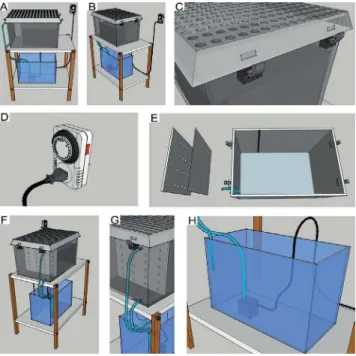
To mimic natural environmental mangrove conditions inside our lab, we developed a new tank system consisting of mangrove sediment together with a water pump. The pump was used to recreate mangrove tide diferences throughout the period of a day. Details of this tank system (experimental tank) are shown in Figures 1 and 3. We also constructed and installed conventional tanks published by others in order for comparison of water salinity between these systems and our new tank system (Figures 2 and 3).
Our experimental tank system was capable of mimicking two high and low tides per day. To achieve this we controlled two parameters: illing and pouring rates. The illing rate was deined as the amount of water pumped from a reservoir into the tank where all animals were conined; the pouring rate was deined as the amount of water leaking from our tank towards the reservoir. The illing rates were controlled by connecting our water pump to a timer and allowing it to turn on and of every 6 hours. Pouring rates were controlled by the size of our tubes since water exited from our tank to the reservoir by gravity. The two rate parameters needed to be synchronized for proper functioning: irst, the illing rates had to be twice the pouring rates, otherwise there would be no tank illing (high tide); second, the pouring rates could not stop before
Figure 1. Design of new experimental tank to mangrove crabs. This crab tank was
designed and developed to simulate natural mangrove tides within the lab. (A), front view of our experimental tank, showing a plastic cage on top (where U. cordatus are
Figure 2. A conventional crab cage. Traditionally, U. cordatus are kept within the lab in a
glass cage (A) with a gravel ramp, salt water, and an air pump. (B), if animals need to be outside water they climb this gravel ramp; (C) detail of an air pump connected to an aerator stone to oxygenate water inside the tank. Water salinity was changed and equalized together with gravel; each salinity was measured by an EcoSense EC300 conductivity meter (YSI Life Sciences, USA). Water temperature was maintained at 23oC and monitored by a thermometer.
Figure 3. Experimental (A, B, C) and conventional (D, E) tanks for U. cordatus husbandry. The
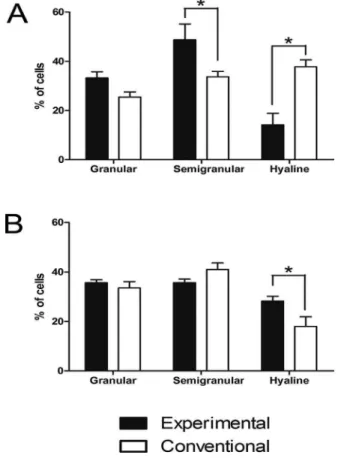
Figure 4. Counting of hemocytes from crabs kept in experimental and
conventional tanks. (A) Results from animals kept at 10 ppt; (B) Results from animals kept at 24 ppt. All animals were cold anesthetized before hemolymph harvesting. After ixation and staining, each sample was counted and these results represent average and standard deviation from 4 to 6 animals. These results are representative of 2 independent experiments. A total of 72 crabs were used in our experiments. Two-way ANOVA with Bonferroni post test were performed to determine signiicant diferences between the groups in our experimental study. These tests yielded p values < 0.05, which conirmed the
statistical signiicance of our results.
6 h of leaking, otherwise periods of low and high tides will be diferent. Since pump characteristics are diferent depending upon the manufacturer, we conducted a series of tests of the water pump during the time dedicated to mount the whole system.
Another important factor that was considered was the amount of water used to cover the sediment during the high tide. This water column needed to be between 10 to 15 centimeters. In our system, we used a 100 L plastic box and at least 24 L of water in order to ill the entire box during high tides.
Finally, despite the use of meshes and sponges to avoid obstruction of tubes, mangrove sediment is rich in organic matter and causes the tubes of the system to clog over the time. Therefore, constant checking of tubing was necessary to avoid any disruption of tide times and volumes. When necessary, the tubes and meshes were changed to avoid future tide problems.
We found that it is also recommendable to perform a full pump washing in tap water every two days.
Since our experimental system simulates an important environmental condition (diferent “tides” during the day), we checked whether this would interfere with a physiological parameter, in our case the amount of cell types in hemolymph.
At 24 ppt, animals kept in the experimental tanks showed higher levels of only hyaline cells (Figure 4B). Taken together with previous diferences in semigranular and hyaline cells at 10 ppt (Figure 4A), this could indicate that diferent seasons could also render animals less or more susceptible to infections, since 24 ppt water salinity is found during summers and 10 ppt during winters (Table I).
Table 1. Water salinity and pH at “Vitória” city mangrove
area.
Parameter Season Mangrovea
Salinity (ppt) Summer 10.00±0.60b Winter 24.53±5.27c
pH Summer 7.2±0.2b
Winter 6.8±0,6c a Parameters were measured during 2010-2011 in 4 diferent areas of
a mangrove at “Vitória” city. Each value represents the average and standard deviation of 4 independent measurements.
b Average values of salinity or pH during summers. c Average values of salinity or pH during winters.
In conclusion, we observed that tide diferences could interfere with hemocyte cell types inside U. cordatus hemolymph. Therefore, these animals would have diferent responses to pathogens according to such variations in their innate immune system. Taken together with other studies, our results show that improvement of husbandry conditions for animals under the inluence of high environmental variations during the day should be used to observe physiological diferences that occur in nature.
ACKNOWLEDGMENTS
We would like to thank Dr. Levy de Carvalho Gomes (Lab Peixe, Universidade Vila Velha, ES, Brazil) for landing ish tanks and equipments and Dr. David N. Olivieri for critical review of this manuscript. This work was partially supported by a FAPES grant (0461/2015).
REFERENCES
CONTI, R. C.; NALESSO, R. C. Status of the population struc-ture of the mangrove crab Ucides cordatus (Decapoda:
Ocy-podidae) on the Piraquê-açu River estuary, Espírito Santo, Brazil. Braz. J. Oceanogr., v. 58, n. 2, p. 81-92, 2010.
CORRÊA JUNIOR, J. D.; ALLODI, S.; AMADO-FILHO, G. M.; FARINA, M. Zinc accumulation in phosphate granules of
Ucides cordatus hepatopancreas. Braz. J. Med. Biol. Res., v.
33, n. 2, p. 217-221, 2000.
DIELE, K.; KOCH, V.; SAINT-PAUL, U. Population structure, catch composition and CPUE of the artisanally harvested mangrove crab Ucides cordatus (Ocypodidae) in the Caeté
estuary, North Brazil: Indications for overishing? Aquat. Li-ving Resour., v. 18, n. 2, p. 169-178, 2005.
GLASER, M.; DIELE, K. Asymmetric outcomes: assessing central aspects of the biological, economic and social sustainability of a mangrove crab ishery, Ucides cordatus (Ocypodidae), in North
Brazil. Ecol. Econ., v. 49, n. 3, p. 361-373, 2004.
GOES, P.; BRANCO, J. O.; PINHEIRO, M. A. A.; BARBIERI, E.; COSTA, D.; FERNANDES, L. L. Bioecology of the uçá--crab, Ucides cordatus (Linnaeus, 1763), in Vitória Bay,
Es-pírito Santo State, Brazil. Braz. J. Oceanogr., v. 58, n. 2, p.
153-163, 2010.
JOHANSSON, M. W.; KEYSER, P.; SRITUNYALUCKSANA, K.; SÖDERHÄLL, K. Crustacean haemocytes and haemato-poiesis. Aquaculture, v. 191, n. 1-3, p. 45-52, 2000.
LEITE, M. M. L.; REZENDE, C. F.; SILVA, J. R. F. Population biology of the mangrove crab Ucides cordatus (Decapoda:
Ucididae) in an estuary from semiarid Northeastern Brazil.
Rev. Biol. Trop., v. 61, n. 4, p. 1721-1735, 2013.
LEITE, V. P.; ZANOTTO, F. P. Calcium transport in gill cells of
Ucides cordatus, a mangrove crab living in variable
salini-ty environments. Comp. Biochem. Physiol. P: A Mol. Integr. Physiol., v. 166, n. 2, p. 370-374, 2013.
MIGUEL, N. C. O.; WAJSENZON, I. J. R.; ANDRADE, L. R.; TORTELOTE, G. G.; EINICKER-LAMAS, M.; ALLODI, S. Catalase, Bax and p53 expression in the visual system of the crab Ucides cordatus following exposure to ultraviolet
radia-tion. Cell Tissue Res., v. 329, n. 1, p. 159-168, 2007.
MILLAR, D. A.; RATCLIFFE, N. A. Invertebrates. In: TUR-NER, R. J. (Ed.). Immunology: A Comparative Approach.
New York: Wiley, 1994. p. 29-68.
NORDHAUS, I.; WOLFF, M. Feeding ecology of the mangrove crab Ucides cordatus (Ocypodidae): food choice, food quality
and assimilation eiciency. Mar. Biol., v. 151, n. 5, p.
1665-1681, 2007.
ORÉLIS-RIBEIRO, R.; BOEGER, W. A.; VICENTE, V. A.; CHAMMAS, M.; OSTRENSKY, A. Fulilling Koch's postu-lates conirms the mycotic origin of Lethargic Crab Disease.
Antonie Van Leeuwenhoek, v. 99, n. 3, p. 601-608, 2011.
PASSOS, C. A.; DI BENEDITTO, A. P. M. Captura comercial do caranguejo-uçá, Ucides cordatus (L., 1763), no Manguezal de
Gargaú, RJ. Biotemas, v. 18, n. 1, p. 223-231, 2005.
PIE, M. R.; BOEGER, W. A.; PATELLA, L.; VICENTE, V. A.; RI-BEIRO, R. O.; OSTRENSKY, A. Speciic primers for the de-tection of the black-yeast fungus associated with lethargic crab disease (LCD). Dis. Aquat. Organ., v. 94, n. 1, p. 73-75, 2011.
PINHEIRO, M. A.; SILVA, P. P.; DUARTE, L. F.; ALMEIDA, A. A.; ZANOTTO, F. P. Accumulation of six metals in the mangrove crab Ucides cordatus (Crustacea: Ucididae) and its
food source, the red mangrove Rhizophora mangle
(Angios-perma: Rhizophoraceae). Ecotoxicol. Environ. Saf., v. 81, p.
114-121, 2012.
SANT’ANNA, B. S.; BORGES, R. P.; HATTORI, G. Y., PI-NHEIRO, M. A. A. Reproduction and management of the mangrove crab Ucides cordatus (Crustacea, Brachyura,
Uci-didae) at Iguape, São Paulo, Brazil. An. Acad. Bras. Ciênc., v.
SANTOS, M. D. C. F. Drinking and osmoregulation in the man-grove crab Ucides cordatus following exposure to benzene.
Comp. Biochem. Physiol. P: A Mol. Integr. Physiol., v. 133,
n. 1, p. 29-42, 2002.
SCHORIES, D.; BERGAN, A. B.; BARLETTA, M.; KRUMME, U.; MEHLIG, U.; RADEMAKER, V. The keystone role of leaf-removing crabs in mangrove forests of North Brazil.
Wetl. Ecol. Manag., v. 11, n. 4, p. 243-255, 2003.
SMITH, V.; SÖDERÄLL, K. Induction of degranulation and lysis of haemocytes in the freshwater crayish, Astacus astacus by
components of the prophenoloxidase activating system in vi-tro. Cell Tissue Res., v. 233, n. 2, p. 295-303, 1983.
SÖDERHÄLL, K.; CERENIUS, L. Crustacean immunity. Annu. Rev. Fish Dis., v. 2, p. 3-23, 1992.
VICENTE, V. A.; ORÉLIS-RIBEIRO, R.; NAJAFZADEH, M. J.; SUN, J.; GUERRA, R. S.; MIESCH, S.; OSTRENSKY, A.; MEIS, J. F.; KLAASSEN, C. H.; DE HOOG, G. S; BOE-GER, W. A. Black yeast-like fungi associated with Lethargic Crab Disease (LCD) in the mangrove-land crab, Ucides
cor-datus (Ocypodidae). Vet. Microbiol., v. 158, n. 1-2, p.
109-122, 2012.
VIEIRA, R. H. F.; LIMA, E. A.; SOUSA, D. B. R. S.; REIS, E. F.; COSTA, R. G.; RODRIGUES, D. P. Vibrio spp. and Salmone-lla spp., presence and susceptibility in crabs Ucides cordatus. Rev. Inst. Med. Trop. Sao Paulo, v. 46, n. 4, p. 179-182, 2004.
VILHENA, M. S. P.; COSTA, M. L.; BERREDO, J. F. Accumu-lation and transfer of Hg, As, Se, and other metals in the se-diment-vegetation-crab-human food chain in the coastal zone of the northern Brazilian state of Pará (Amazonia). Environ.